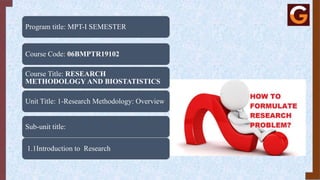
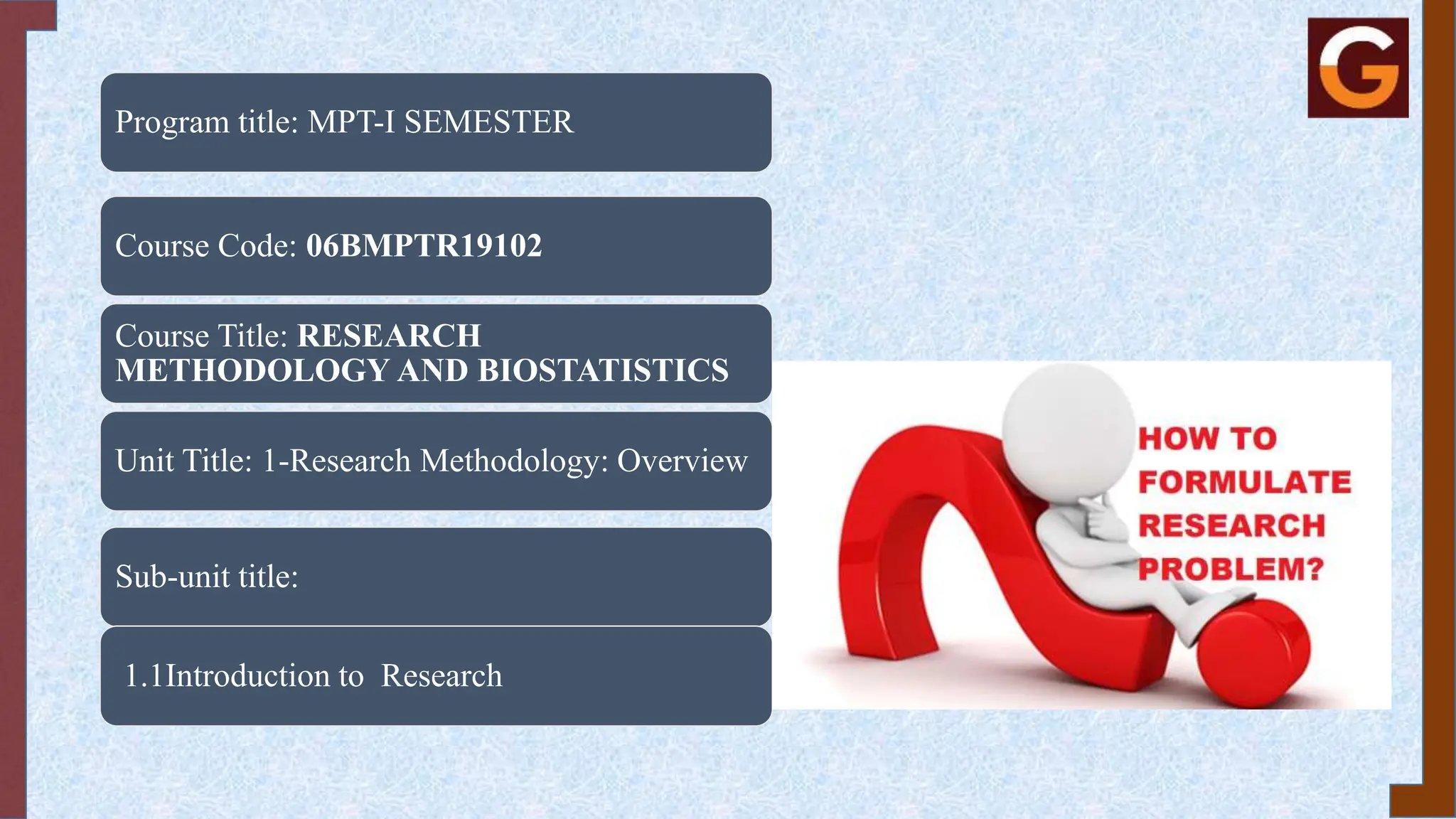
Program title: MPT-I SEMESTER
Course Code: 06BMPTR19102
Course Title: RESEARCH
METHODOLOGY AND BIOSTATISTICS
Unit Title: 1-Research Methodology: Overview
Sub-unit title:
1.1Introduction to Research
Research- fun and exciting?
• “The essence of all
research originates in
curiosity - a desire to find
out how and why things
happen”
• How can…?
• Why is…?
• What is the best way
to…?
• What causes…?
• What are the effects of…?
I wonder... 2
Scientific Inquiry
• Observable, verifiable data is collected in
order to:
• Describe
• Explain
• Predict events
3
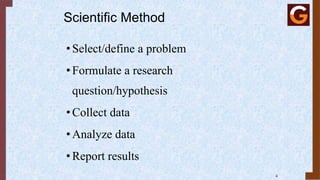
Scientific Method
•Select/define a problem
•Formulate a research
question/hypothesis
•Collect data
•Analyze data
•Report results
4
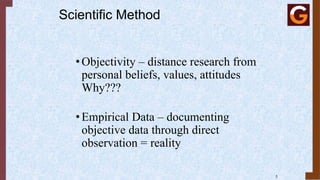
Scientific Method
•Objectivity – distance research from
personal beliefs, values, attitudes
Why???
•Empirical Data – documenting
objective data through direct
observation = reality
5
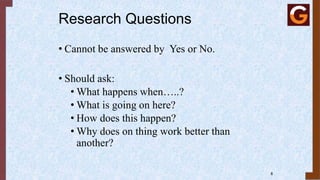
Research Questions
• Cannot be answered by Yes or No.
• Should ask:
• What happens when…..?
• What is going on here?
• How does this happen?
• Why does on thing work better than
another?
6
7
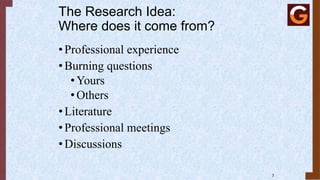
The Research Idea:
Where does it come from?
•Professional experience
•Burning questions
•Yours
•Others
•Literature
•Professional meetings
•Discussions
8
Research Topics
•Observations
•Behaviors
•Concepts
•Theories
•Testing of assessment and intervention
strategies
9
A Research Question Must Identify
1. The variables under study
2. The population being studied
3. The testability of the question
10
Criteria for developing a good research
question: FINER
• Feasibility
• Interesting
• Novel
• Ethical
• Relevant
• Cummings et al. 2001
FINER
Feasible
• Subjects
• Resources
• Manageable
• Data Available
Interesting
Novel
New idea, untested idea
Ethical
Social or Scientific Value
Safe
Relevant
Advance scientific knowledge
Influence clinical practice
11
• Qualitative
• Quantitative
• Descriptive
• Correlational
• Quasi-Experimental
• True Experimental – Randomized Controlled Trial
(RCT)
• Meta-Analyses and Systematic Reviews
Research Design: the basics
12
The Research Language - Some
Terminology
• Variable
• Data
• Rigor
• Control
• Sampling
• Setting
juliobahar, OCAL
13
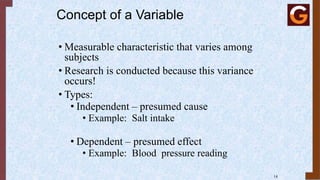
Concept of a Variable
• Measurable characteristic that varies among
subjects
• Research is conducted because this variance
occurs!
• Types:
• Independent – presumed cause
• Example: Salt intake
• Dependent – presumed effect
• Example: Blood pressure reading
14
Variables
 Have 2 or more properties or qualities
 Age, sex, weight, height
 Is one variable related to another?
 “ Is X related to Y? What is the effect of X on Y?” etc.
15
Data
• Pieces of information obtained in a study
• Are the actual “values” of the study variables
• Quantitative - numeric values
• Qualitative - narrative descriptions
16
Concept of RIGOR
• Striving for excellence in research.
Involves:
• Discipline
• Adherence to detail
• Strict accuracy!
• Uses precise measurement tools
sarxos, OCAL
17
Concept of CONTROL
• Using “rules” to decrease error and increase probability
that study findings are an accurate reflection of reality
• Ensure results that reflect true relationship among
variables
• Reduction of the influence of unwanted “extraneous”
variables
• Example: A control group of test subjects left untreated or
unexposed to some procedure in order to provide a
standard of comparison to the experimental group.
18
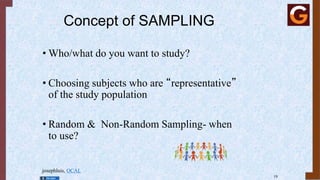
Concept of SAMPLING
• Who/what do you want to study?
• Choosing subjects who are “representative”
of the study population
• Random & Non-Random Sampling- when
to use?
josephluis, OCAL
19
Concept of SETTING
• Location of the study - can affect results
• Natural Setting: Uncontrolled, real life situation
• Partially Controlled: Manipulated or modified in
some way
• Highly Controlled: Artificial environment for sole
purpose of doing research. Decreases effects of
outside influences.
20
Some Myths About Research
• The purpose of research is to “prove” or “confirm”
a theory.
• Research findings are presented as complete and
conclusive answers.
• There is a hierarchy of research methodology that
places true “experimental” research at the top.
21
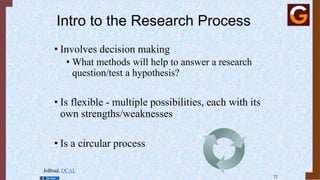
Intro to the Research Process
• Involves decision making
• What methods will help to answer a research
question/test a hypothesis?
• Is flexible - multiple possibilities, each with its
own strengths/weaknesses
• Is a circular process
JoBrad, OCAL
22
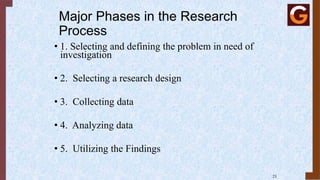
Major Phases in the Research
Process
• 1. Selecting and defining the problem in need of
investigation
• 2. Selecting a research design
• 3. Collecting data
• 4. Analyzing data
• 5. Utilizing the Findings
23
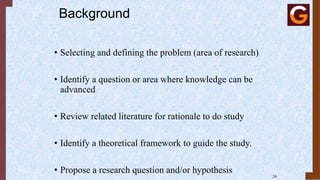
Background
• Selecting and defining the problem (area of research)
• Identify a question or area where knowledge can be
advanced
• Review related literature for rationale to do study
• Identify a theoretical framework to guide the study.
• Propose a research question and/or hypothesis
24
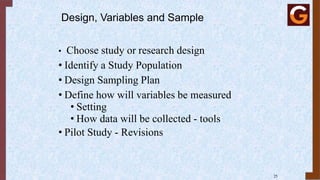
Design, Variables and Sample
• Choose study or research design
• Identify a Study Population
• Design Sampling Plan
• Define how will variables be measured
• Setting
• How data will be collected - tools
• Pilot Study - Revisions
25
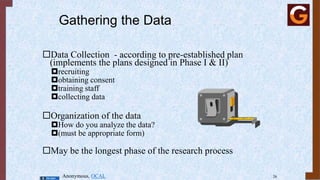
Gathering the Data
Data Collection - according to pre-established plan
(implements the plans designed in Phase I & II)
recruiting
obtaining consent
training staff
collecting data
Organization of the data
How do you analyze the data?
(must be appropriate form)
May be the longest phase of the research process
Anonymous, OCAL 26
Analyze and Interpret
• Data Analysis
• Interpret findings
• Draw conclusions
• Hypothesis is supported or rejected
• How best to utilize findings?
• New question formulated? (can lead to new questions
that can stimulate further study)
27
Dissemination
• Disseminate findings - Share findings with
colleagues
• May report findings in journal articles, oral
presentations, poster presentations
• Utilize findings - use in practice
28
Sway Link
• https://sway.office.com/JEuE8OflfdG1SyWi?ref=Link&loc=play
• We have come to the end of this session.
• Kindly watch all the videos embedded in the MS Sway.
• Complete the self-assessment MCQ(s) by 23:30 hours same day to get
your attendance recorded and the marks awarded for the same will be
a part of your CIA.
• Kindly post any questions for clarifications in the discussion form link
available in student portal. The answers to your questions will be
available in the Programme FAQs repository link.
• Happy Learning, have a great day, and stay safe.

Research Methodology: Overview -1.1Introduction to Research

  • 1.
    Program title: MPT-ISEMESTER Course Code: 06BMPTR19102 Course Title: RESEARCH METHODOLOGY AND BIOSTATISTICS Unit Title: 1-Research Methodology: Overview Sub-unit title: 1.1Introduction to Research
  • 2.
    Research- fun andexciting? • “The essence of all research originates in curiosity - a desire to find out how and why things happen” • How can…? • Why is…? • What is the best way to…? • What causes…? • What are the effects of…? I wonder... 2
  • 3.
    Scientific Inquiry • Observable,verifiable data is collected in order to: • Describe • Explain • Predict events 3
  • 4.
    Scientific Method •Select/define aproblem •Formulate a research question/hypothesis •Collect data •Analyze data •Report results 4
  • 5.
    Scientific Method •Objectivity –distance research from personal beliefs, values, attitudes Why??? •Empirical Data – documenting objective data through direct observation = reality 5
  • 6.
    Research Questions • Cannotbe answered by Yes or No. • Should ask: • What happens when…..? • What is going on here? • How does this happen? • Why does on thing work better than another? 6
  • 7.
    7 The Research Idea: Wheredoes it come from? •Professional experience •Burning questions •Yours •Others •Literature •Professional meetings •Discussions
  • 8.
  • 9.
    9 A Research QuestionMust Identify 1. The variables under study 2. The population being studied 3. The testability of the question
  • 10.
    10 Criteria for developinga good research question: FINER • Feasibility • Interesting • Novel • Ethical • Relevant • Cummings et al. 2001
  • 11.
    FINER Feasible • Subjects • Resources •Manageable • Data Available Interesting Novel New idea, untested idea Ethical Social or Scientific Value Safe Relevant Advance scientific knowledge Influence clinical practice 11
  • 12.
    • Qualitative • Quantitative •Descriptive • Correlational • Quasi-Experimental • True Experimental – Randomized Controlled Trial (RCT) • Meta-Analyses and Systematic Reviews Research Design: the basics 12
  • 13.
    The Research Language- Some Terminology • Variable • Data • Rigor • Control • Sampling • Setting juliobahar, OCAL 13
  • 14.
    Concept of aVariable • Measurable characteristic that varies among subjects • Research is conducted because this variance occurs! • Types: • Independent – presumed cause • Example: Salt intake • Dependent – presumed effect • Example: Blood pressure reading 14
  • 15.
    Variables  Have 2or more properties or qualities  Age, sex, weight, height  Is one variable related to another?  “ Is X related to Y? What is the effect of X on Y?” etc. 15
  • 16.
    Data • Pieces ofinformation obtained in a study • Are the actual “values” of the study variables • Quantitative - numeric values • Qualitative - narrative descriptions 16
  • 17.
    Concept of RIGOR •Striving for excellence in research. Involves: • Discipline • Adherence to detail • Strict accuracy! • Uses precise measurement tools sarxos, OCAL 17
  • 18.
    Concept of CONTROL •Using “rules” to decrease error and increase probability that study findings are an accurate reflection of reality • Ensure results that reflect true relationship among variables • Reduction of the influence of unwanted “extraneous” variables • Example: A control group of test subjects left untreated or unexposed to some procedure in order to provide a standard of comparison to the experimental group. 18
  • 19.
    Concept of SAMPLING •Who/what do you want to study? • Choosing subjects who are “representative” of the study population • Random & Non-Random Sampling- when to use? josephluis, OCAL 19
  • 20.
    Concept of SETTING •Location of the study - can affect results • Natural Setting: Uncontrolled, real life situation • Partially Controlled: Manipulated or modified in some way • Highly Controlled: Artificial environment for sole purpose of doing research. Decreases effects of outside influences. 20
  • 21.
    Some Myths AboutResearch • The purpose of research is to “prove” or “confirm” a theory. • Research findings are presented as complete and conclusive answers. • There is a hierarchy of research methodology that places true “experimental” research at the top. 21
  • 22.
    Intro to theResearch Process • Involves decision making • What methods will help to answer a research question/test a hypothesis? • Is flexible - multiple possibilities, each with its own strengths/weaknesses • Is a circular process JoBrad, OCAL 22
  • 23.
    Major Phases inthe Research Process • 1. Selecting and defining the problem in need of investigation • 2. Selecting a research design • 3. Collecting data • 4. Analyzing data • 5. Utilizing the Findings 23
  • 24.
    Background • Selecting anddefining the problem (area of research) • Identify a question or area where knowledge can be advanced • Review related literature for rationale to do study • Identify a theoretical framework to guide the study. • Propose a research question and/or hypothesis 24
  • 25.
    Design, Variables andSample • Choose study or research design • Identify a Study Population • Design Sampling Plan • Define how will variables be measured • Setting • How data will be collected - tools • Pilot Study - Revisions 25
  • 26.
    Gathering the Data DataCollection - according to pre-established plan (implements the plans designed in Phase I & II) recruiting obtaining consent training staff collecting data Organization of the data How do you analyze the data? (must be appropriate form) May be the longest phase of the research process Anonymous, OCAL 26
  • 27.
    Analyze and Interpret •Data Analysis • Interpret findings • Draw conclusions • Hypothesis is supported or rejected • How best to utilize findings? • New question formulated? (can lead to new questions that can stimulate further study) 27
  • 28.
    Dissemination • Disseminate findings- Share findings with colleagues • May report findings in journal articles, oral presentations, poster presentations • Utilize findings - use in practice 28
  • 29.
  • 30.
    • We havecome to the end of this session. • Kindly watch all the videos embedded in the MS Sway. • Complete the self-assessment MCQ(s) by 23:30 hours same day to get your attendance recorded and the marks awarded for the same will be a part of your CIA. • Kindly post any questions for clarifications in the discussion form link available in student portal. The answers to your questions will be available in the Programme FAQs repository link. • Happy Learning, have a great day, and stay safe.