Scenario: Mumps OutbreakPublic Health Practice and IssuesAbrea Johnson
Public Health Practice and IssuesRequired course in MPH programLectures onlineConcepts applied to real agencyAddresses cross-cutting issues:-public health biology-ethics-diversity and cultural considerations-informatics-communications
Public Health Practice and IssuesScenario: An outbreak of mumps has occurred in northeast Ohio. Akron Community Health Resources has seen several patients with suspected (later confirmed) cases of mumps over the past week. It is revealed that there is a larger outbreak at hand and hundreds of people in the immediate community are ill with mumps.
Biology of MumpsMumps is a contagious viral disease1It is spread through direct contact or through respiratory droplet1People are contagious 7 days before disease onset to 9 days after the disease onset1The incubation period can range from 14-21 days, with an average of 18 days1The disease usually resolves within 10 days1
Biology of MumpsEarly symptoms include: fever, headache, malaise, myalgias, anorexia, and fatigue followed by parotitis in up to 70% of patients1
Biology of MumpsThe submandibular or sublingual glands may occur alone or in combination with the parotitis1Complications may include5:-cerebrospinal fluid (CSF) pleocytosis 	-orchitis may occur in adolescent and adult males-oophoritis or mastitis in post pubertal females	- and rarely pancreatitis, myocarditis, arthritis,                thyroiditis,  or deafness.
Biology of MumpsMumps occurs worldwide1Prior to vaccination in the U.S., mumps was most commonly seen in children ages 5-9 years1After the vaccine mumps shifted to 10-14 year olds1In a 2006 outbreak students aged 18-24 were mostly affected6
Biology of MumpsVaccination for mumps is administered in the MMR combination1Recommended vaccination occurs between 12-15 months and again between 4-6 years1Two doses is recommended for school children, healthcare workers born in 1957 or after, and international travelersIncidence remains very low1
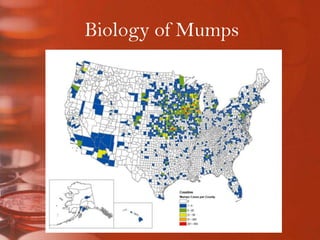
Biology of MumpsHowever, in 2006 and  in 2009-2010 there were two large outbreaks7In 2006 there were 6,584 cases reported to the CDC mostly centered in Iowa and college student population7The outbreak in 2009 and 2010 has reported almost 2,000 cases and is centered in New York and New Jersey in the Hasidic Jew population8
Biology of Mumps
Biology of MumpsACHR has seen several patients with suspected mumps that report they are students at the University of Akron or are a sibling of an U of A studentMost of these patients are 18-22 years oldResponse should be coordinated with the local departments of health, the ODH and the CDC
Mumps SurveillanceInformatics will track cases and contactsMumps is a notifiable disease9ODH classifies mumps as a B1 disease9Healthcare agencies, like ACHR, must report by end of next business day9Use the Ohio Confidential Reportable Disease Form, ODRS, or call the local health department the person resides in9
Mumps SurveillanceThe local health department will report to the ODH using ODRSThe ODH is responsible for maintaining the database, privacy, and confidentiality issuesThe ODH will report mumps cases to the CDC through NNDSSElectronic medical records can assist ACHR in reporting
Mumps SurveillanceACHR should report the following information:-name of case		-diagnosis	-date of birth		-sex of case	-address 			-telephone number-health care provider contact information	-mumps surveillance worksheetLocal health departments could use class lists track contacts in schools
Mumps SurveillanceGIS maps can provide a visual information on location of casesMap may show city, county, regional, state, or national casesWhen put all together data will reveal age, gender, race of those affected, incubation period, and place of concentrationHelps epidemiologists plan disease control
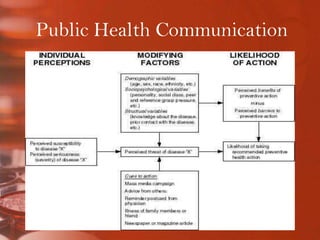
Public Health CommunicationRisk communication has evolved10Previously, risk communication was facts to inform public and transform behavior7Now risk communication is10:-an exchange of information and opinion-interactive process-expression of concerns-opinions or reactions to risk messages or risk management
Public Health CommunicationBoth sides should express their perspectives, listen, and respondMost importantly: RISK means something different to the public than it is to officials or physiciansI feel the Health Belief Model is very important in explaining risk perception in people
Public Health Communication
Public Health DiversityDiversity of patients must be consideredWhat is diversity?The condition of being diverse: variety; especially: the inclusion of diverse people (as people of different races or cultures) in a group or organization.12What diversity do you have within ACHR?What about the diversity of patients?
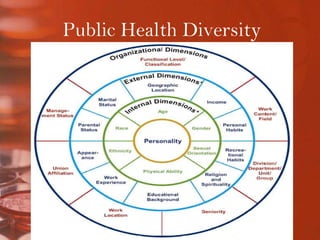
Public Health DiversityDiversity of people include13:-race	-sexual orientation	-religion	-age	-geographic region	-education level	-economic background	-communication styles
Public Health Diversity
Public Health DiversityWhy is this important?Organizations need to tailor services, programs, and planning with diversity in mindVulnerable populations often are at the most risk and the most need for services14Organizations should understand what makes populations vulnerableLets think of some things together.
Public Health Diversity
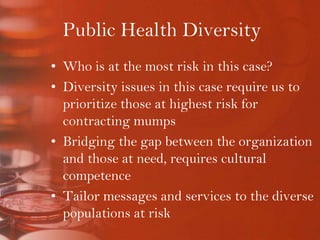
Public Health DiversityWho is at the most risk in this case? Diversity issues in this case require us to prioritize those at highest risk for contracting mumpsBridging the gap between the organization and those at need, requires cultural competenceTailor messages and services to the diverse populations at risk
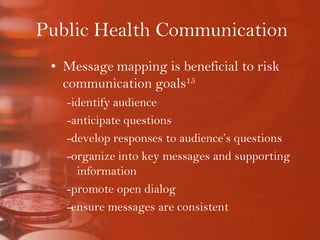
Public Health CommunicationMessage mapping is beneficial to risk communication goals15-identify audience-anticipate questions-develop responses to audience’s questions-organize into key messages and supporting information-promote open dialog-ensure messages are consistent
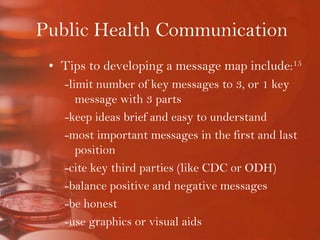
Public Health CommunicationTips to developing a message map include:15-limit number of key messages to 3, or 1 key message with 3 parts-keep ideas brief and easy to understand-most important messages in the first and last position-cite key third parties (like CDC or ODH)-balance positive and negative messages-be honest-use graphics or visual aids-
Public Health Communication
Public Health CommunicationACHR will also communicate with the health departments, partnering agencies, and its own employeesDeciding who will communicate with the partnering agencies and health departments is keyTraining employees to recognize mumps and how to respond will assist in outbreak containment
Public Health EthicsPublic health focuses on the health of the entire population, rather than individuals16Public health measures may infringe on individual rights16Ethics of infectious disease are not clear cutOne person can affect many when comes to infectious disease17
Public Health EthicsBasic Public Health ethical principles18:Autonomy- respect for individuals decisions, individuals rightsBeneficence- pursue good, benefits outweigh risksNonmaleficence- do no harmJustice- be fair, equal, impartial
Public Health EthicsPublic health asks us to16-19:-reduce harm			-maximize benefit	-balance power			-protect privacy	-build/maintain trust		-maintain 		-respect autonomous 		confidentiality		decisions	-make an obligation 	to communities
Public Health EthicsEthical issues in public health include, but are not limited to16-19:	-mandatory testing			-notification of authorities	-mandatory treatment	-surveillance	-travel restrictions 	-quarantine	-informed consent
Public Health Ethics
Public Health EthicsConditions to help resolve public health vs. individual rights dilemmas16-effectiveness: program has been shown to be effective-proportionality: probable public health benefit outweighs individual risks-necessity: public health program is necessary-least infringement: program is the least infringing option-justification: program can be publically justified
Public Health EthicsEthical considerations for ACHR involves both patients and employeesDiversity of patients and employees may lead to different autonomous decisionsACHR must balance its employee policy with the need for workers and their desire for autonomyEthical dilemmas should be weighed using the basic principles
ReferencesAverhoff, F., Wharton, M. Mumps. In: Wallace RB, Kohatsu N, Last JM, eds. Maxcy-Rosenau-Last Public Health and Preventive Medicine. 15th ed. New York, NY; McGraw-Hill; 2008:105-107.Campos-Outcalt, D. Mumps epidemic in 2006: Are you prepared to detect and prevent it? The Journal of Family Practice. 2006;55(6):500-502. Centers for Disease Control. Power Point. Epidemiology of Mumps and Multistate Outbreak United State 2006. Available online at: http://www.bt.cdc.gov/coca/ppt/Mumps_July2006.pptPicture from: http://www.symptomlog.com/Mumps/What+is+Mumps.htmOnline: http://www.cdc.gov/mumps/clinical/qa-physical-complic.htmlPower Point: Available online: www.cdc.gov/vaccines/Pubs/pinkbook/downloads/Slides/Mumps11.pptCDC-Mumps. Online: http://www.cdc.gov/mumps/outbreaks.htmlUpdate: Mumps Outbreak.-New York and New Jersey. MMWR. 2010;55(5) Available at: http://www.cdc.gov/mmwr/preview/mmwrhtml/mm5905a1.htm
ReferencesOhio Department of Health. Infectious Disease Control Manual. Available at: http://www.odh.ohio.gov/healthResources/infectiousDiseaseManual.aspxRopeik DP. Risk Communication—an Overlooked Tool for Improving Public Health. In: Wallace RB, Kohatsu N, Last JM, eds. Maxcy-Rosenau-Last Public Health and Preventive Medicine. 15th ed. New York, NY; McGraw-Hill; 2008:1029-1034.Hayden, J, Patterson, W. Introduction to Health Behavior Theory. Chapter 4: Health Belief Model. Boston: Jones and Bartlett; 2009.Definition of diversity. Available at: http://www.merriam-webster.com/dictionary/diversityVirginia Department of Behavioral Health and Developmental Services. Cultural on Linguistic Services. What is Cultural Competence. Available at: http://www.dbhds.virginia.gov/2008CLC/documents/clc-pres-What-is-CCC.pdf
ReferencesCalifornia’s Governer’s Office of Emergency Services. Meeting the Needs of Vulnerable Populations in a Disaster: A Guide for Emergency Managers. May 2000. Available at: http://www.oes.ca.gov/Operational/OESHome.nsf/PDF/Vulnerable%20Populations/$file/Vulnerable%20Populations.pdfYale Center for Public Health Preparedness. Message mapping. Available at: http://publichealth.yale.edu/ycphp/messagemapping.pdf. Accessed March 1, 2010. Childress, J., Faden, R., Gaare, R., Gostin, L., Kahn, J., Bonnie, R., Kass, N., Mastrioianni, A., Moreno, J. & Nieburg, P. (2002). Public Health Ethics: Mapping the Terrain, Law, Medicine and Ethics, 30, 170-178.Selgelid, M. (2005). Ethics and Infectious Disease, Bioethics 2005; 19(3): 272-289.Author Unknown. Public Health Principles and Methods.Ethics and public Policy. In: Wallace RB, Kohatsu N, Last JM, eds. Maxcy-Rosenau-Last Public Health and Preventive Medicine. 15th ed. New York, NY; McGraw-Hill; 2008:28-31.Cite ethics of quarantine.
ReferencesCoughin, S. Ethical issues in epidemiological research and public health practice. Emerging Themes in Epidemiology. 2006;3(16). Available at: http://www.ete-online.com/content/3/1/16..

Mumps Scenario

  • 1.
    Scenario: Mumps OutbreakPublicHealth Practice and IssuesAbrea Johnson
  • 2.
    Public Health Practiceand IssuesRequired course in MPH programLectures onlineConcepts applied to real agencyAddresses cross-cutting issues:-public health biology-ethics-diversity and cultural considerations-informatics-communications
  • 3.
    Public Health Practiceand IssuesScenario: An outbreak of mumps has occurred in northeast Ohio. Akron Community Health Resources has seen several patients with suspected (later confirmed) cases of mumps over the past week. It is revealed that there is a larger outbreak at hand and hundreds of people in the immediate community are ill with mumps.
  • 4.
    Biology of MumpsMumpsis a contagious viral disease1It is spread through direct contact or through respiratory droplet1People are contagious 7 days before disease onset to 9 days after the disease onset1The incubation period can range from 14-21 days, with an average of 18 days1The disease usually resolves within 10 days1
  • 5.
    Biology of MumpsEarlysymptoms include: fever, headache, malaise, myalgias, anorexia, and fatigue followed by parotitis in up to 70% of patients1
  • 6.
    Biology of MumpsThesubmandibular or sublingual glands may occur alone or in combination with the parotitis1Complications may include5:-cerebrospinal fluid (CSF) pleocytosis -orchitis may occur in adolescent and adult males-oophoritis or mastitis in post pubertal females - and rarely pancreatitis, myocarditis, arthritis, thyroiditis, or deafness.
  • 7.
    Biology of MumpsMumpsoccurs worldwide1Prior to vaccination in the U.S., mumps was most commonly seen in children ages 5-9 years1After the vaccine mumps shifted to 10-14 year olds1In a 2006 outbreak students aged 18-24 were mostly affected6
  • 8.
    Biology of MumpsVaccinationfor mumps is administered in the MMR combination1Recommended vaccination occurs between 12-15 months and again between 4-6 years1Two doses is recommended for school children, healthcare workers born in 1957 or after, and international travelersIncidence remains very low1
  • 9.
    Biology of MumpsHowever,in 2006 and in 2009-2010 there were two large outbreaks7In 2006 there were 6,584 cases reported to the CDC mostly centered in Iowa and college student population7The outbreak in 2009 and 2010 has reported almost 2,000 cases and is centered in New York and New Jersey in the Hasidic Jew population8
  • 10.
  • 11.
    Biology of MumpsACHRhas seen several patients with suspected mumps that report they are students at the University of Akron or are a sibling of an U of A studentMost of these patients are 18-22 years oldResponse should be coordinated with the local departments of health, the ODH and the CDC
  • 12.
    Mumps SurveillanceInformatics willtrack cases and contactsMumps is a notifiable disease9ODH classifies mumps as a B1 disease9Healthcare agencies, like ACHR, must report by end of next business day9Use the Ohio Confidential Reportable Disease Form, ODRS, or call the local health department the person resides in9
  • 13.
    Mumps SurveillanceThe localhealth department will report to the ODH using ODRSThe ODH is responsible for maintaining the database, privacy, and confidentiality issuesThe ODH will report mumps cases to the CDC through NNDSSElectronic medical records can assist ACHR in reporting
  • 14.
    Mumps SurveillanceACHR shouldreport the following information:-name of case -diagnosis -date of birth -sex of case -address -telephone number-health care provider contact information -mumps surveillance worksheetLocal health departments could use class lists track contacts in schools
  • 15.
    Mumps SurveillanceGIS mapscan provide a visual information on location of casesMap may show city, county, regional, state, or national casesWhen put all together data will reveal age, gender, race of those affected, incubation period, and place of concentrationHelps epidemiologists plan disease control
  • 16.
    Public Health CommunicationRiskcommunication has evolved10Previously, risk communication was facts to inform public and transform behavior7Now risk communication is10:-an exchange of information and opinion-interactive process-expression of concerns-opinions or reactions to risk messages or risk management
  • 17.
    Public Health CommunicationBothsides should express their perspectives, listen, and respondMost importantly: RISK means something different to the public than it is to officials or physiciansI feel the Health Belief Model is very important in explaining risk perception in people
  • 18.
  • 19.
    Public Health DiversityDiversityof patients must be consideredWhat is diversity?The condition of being diverse: variety; especially: the inclusion of diverse people (as people of different races or cultures) in a group or organization.12What diversity do you have within ACHR?What about the diversity of patients?
  • 20.
    Public Health DiversityDiversityof people include13:-race -sexual orientation -religion -age -geographic region -education level -economic background -communication styles
  • 21.
  • 22.
    Public Health DiversityWhyis this important?Organizations need to tailor services, programs, and planning with diversity in mindVulnerable populations often are at the most risk and the most need for services14Organizations should understand what makes populations vulnerableLets think of some things together.
  • 24.
  • 25.
  • 26.
    Public Health DiversityWhois at the most risk in this case? Diversity issues in this case require us to prioritize those at highest risk for contracting mumpsBridging the gap between the organization and those at need, requires cultural competenceTailor messages and services to the diverse populations at risk
  • 27.
    Public Health CommunicationMessagemapping is beneficial to risk communication goals15-identify audience-anticipate questions-develop responses to audience’s questions-organize into key messages and supporting information-promote open dialog-ensure messages are consistent
  • 28.
    Public Health CommunicationTipsto developing a message map include:15-limit number of key messages to 3, or 1 key message with 3 parts-keep ideas brief and easy to understand-most important messages in the first and last position-cite key third parties (like CDC or ODH)-balance positive and negative messages-be honest-use graphics or visual aids-
  • 29.
  • 30.
    Public Health CommunicationACHRwill also communicate with the health departments, partnering agencies, and its own employeesDeciding who will communicate with the partnering agencies and health departments is keyTraining employees to recognize mumps and how to respond will assist in outbreak containment
  • 31.
    Public Health EthicsPublichealth focuses on the health of the entire population, rather than individuals16Public health measures may infringe on individual rights16Ethics of infectious disease are not clear cutOne person can affect many when comes to infectious disease17
  • 32.
    Public Health EthicsBasicPublic Health ethical principles18:Autonomy- respect for individuals decisions, individuals rightsBeneficence- pursue good, benefits outweigh risksNonmaleficence- do no harmJustice- be fair, equal, impartial
  • 33.
    Public Health EthicsPublichealth asks us to16-19:-reduce harm -maximize benefit -balance power -protect privacy -build/maintain trust -maintain -respect autonomous confidentiality decisions -make an obligation to communities
  • 34.
    Public Health EthicsEthicalissues in public health include, but are not limited to16-19: -mandatory testing -notification of authorities -mandatory treatment -surveillance -travel restrictions -quarantine -informed consent
  • 35.
  • 36.
    Public Health EthicsConditionsto help resolve public health vs. individual rights dilemmas16-effectiveness: program has been shown to be effective-proportionality: probable public health benefit outweighs individual risks-necessity: public health program is necessary-least infringement: program is the least infringing option-justification: program can be publically justified
  • 37.
    Public Health EthicsEthicalconsiderations for ACHR involves both patients and employeesDiversity of patients and employees may lead to different autonomous decisionsACHR must balance its employee policy with the need for workers and their desire for autonomyEthical dilemmas should be weighed using the basic principles
  • 39.
    ReferencesAverhoff, F., Wharton,M. Mumps. In: Wallace RB, Kohatsu N, Last JM, eds. Maxcy-Rosenau-Last Public Health and Preventive Medicine. 15th ed. New York, NY; McGraw-Hill; 2008:105-107.Campos-Outcalt, D. Mumps epidemic in 2006: Are you prepared to detect and prevent it? The Journal of Family Practice. 2006;55(6):500-502. Centers for Disease Control. Power Point. Epidemiology of Mumps and Multistate Outbreak United State 2006. Available online at: http://www.bt.cdc.gov/coca/ppt/Mumps_July2006.pptPicture from: http://www.symptomlog.com/Mumps/What+is+Mumps.htmOnline: http://www.cdc.gov/mumps/clinical/qa-physical-complic.htmlPower Point: Available online: www.cdc.gov/vaccines/Pubs/pinkbook/downloads/Slides/Mumps11.pptCDC-Mumps. Online: http://www.cdc.gov/mumps/outbreaks.htmlUpdate: Mumps Outbreak.-New York and New Jersey. MMWR. 2010;55(5) Available at: http://www.cdc.gov/mmwr/preview/mmwrhtml/mm5905a1.htm
  • 40.
    ReferencesOhio Department ofHealth. Infectious Disease Control Manual. Available at: http://www.odh.ohio.gov/healthResources/infectiousDiseaseManual.aspxRopeik DP. Risk Communication—an Overlooked Tool for Improving Public Health. In: Wallace RB, Kohatsu N, Last JM, eds. Maxcy-Rosenau-Last Public Health and Preventive Medicine. 15th ed. New York, NY; McGraw-Hill; 2008:1029-1034.Hayden, J, Patterson, W. Introduction to Health Behavior Theory. Chapter 4: Health Belief Model. Boston: Jones and Bartlett; 2009.Definition of diversity. Available at: http://www.merriam-webster.com/dictionary/diversityVirginia Department of Behavioral Health and Developmental Services. Cultural on Linguistic Services. What is Cultural Competence. Available at: http://www.dbhds.virginia.gov/2008CLC/documents/clc-pres-What-is-CCC.pdf
  • 41.
    ReferencesCalifornia’s Governer’s Officeof Emergency Services. Meeting the Needs of Vulnerable Populations in a Disaster: A Guide for Emergency Managers. May 2000. Available at: http://www.oes.ca.gov/Operational/OESHome.nsf/PDF/Vulnerable%20Populations/$file/Vulnerable%20Populations.pdfYale Center for Public Health Preparedness. Message mapping. Available at: http://publichealth.yale.edu/ycphp/messagemapping.pdf. Accessed March 1, 2010. Childress, J., Faden, R., Gaare, R., Gostin, L., Kahn, J., Bonnie, R., Kass, N., Mastrioianni, A., Moreno, J. & Nieburg, P. (2002). Public Health Ethics: Mapping the Terrain, Law, Medicine and Ethics, 30, 170-178.Selgelid, M. (2005). Ethics and Infectious Disease, Bioethics 2005; 19(3): 272-289.Author Unknown. Public Health Principles and Methods.Ethics and public Policy. In: Wallace RB, Kohatsu N, Last JM, eds. Maxcy-Rosenau-Last Public Health and Preventive Medicine. 15th ed. New York, NY; McGraw-Hill; 2008:28-31.Cite ethics of quarantine.
  • 42.
    ReferencesCoughin, S. Ethicalissues in epidemiological research and public health practice. Emerging Themes in Epidemiology. 2006;3(16). Available at: http://www.ete-online.com/content/3/1/16..

Editor's Notes

  • #3 Before I start, I wanted to explain the context for my presentation. I am a student in the Consortium of Eastern Ohio Master of Public Health program in a course called “Public Health Practice and Issues.” This is a required course where we receive lectures online and apply the course concepts to an agency. The “cross-cutting” competencies that the course addresses are public health biology, ethics, diversity and cultural considerations, informatics and communications. This presentation is my final project, where I will be discussing these issues within a topic that my preceptor, Angela DeJulius and I agreed upon a few weeks ago.As part of my project, I hope that you will fill out my presentation log and let my instructors know what you thought of my presentation
  • #4 This presentation involves a hypothetical scenario. Keep this in mind as I go through the presentation. I have provided a copy for all of you. I will be asking questions and hope I will have some eager responders. Please feel free to shout out your answers. There are no right or wrong answers.Scenario: An outbreak of mumps has occurred in northeast Ohio. Akron Community Health Resources has seen several patients with suspected (later confirmed) cases of mumps over the past week. It is revealed that there is a larger outbreak at hand and hundreds of people in the immediate community are ill with mumps.
  • #5 First, I will start with an introduction to mumps. Mumps is a contagious viral disease that is spread from direct contact or respiratory droplet.1 People are considered contagious 7 days prior to 9 days after the disease onset.1 After exposure, it may take anywhere from 14-21 days before symptoms begin to appear.1 People usually recover without intervention in about 10 days.1
  • #6 Patients could complain of fever, headache, muscle aches, poor appetite, or fatigue early on.1 The most prominent symptom is parotitis, which occurs in up to 70% of patients.1Mumps is the only infectious disease known to cause epidemic parotitis.1 There is a question about atypical symptoms in immunized patients.2 Has the vaccine modified the disease?3
  • #7 Swelling of the submandibular and sublingual glands may also occur with or without the presence of parotitis.1 Possible complications of mumps include cerebrospinal fluid pleocytosis, orchitis, oophoritis and/ or mastitis.5 Infertility rarely occurs in either sex.5
  • #8 Mumps occurs worldwide and prior to vaccination in the United States it was most frequently seen in children ages 5-9 years old.1 Then, it was seen most commonly in 10-14 year olds.1 In a 2006 multistate outbreak mumps was seen mostly in college students aged 18-24.6
  • #9 Mumps is included in the measles, mumps, rubella vaccine.1 Vaccination is recommended between 12-15 months and a second dose between 4-6 years of age.1 Two doses are recommended for school children, healthcare workers born in 1957 or after, and international travelers.1 Incidence of mumps is very low .1 per 100,000 persons annually.1
  • #10 This is where it gets interesting.In 2006 a large outbreak was seen involving 6,584 cases mostly concentrated in Iowa.7 Most of the cases in Iowa were seen in college students.7 The second largest outbreak of mumps began in June 2009 and has continued.8 It is concentrated in New Jersey and New York in the Hasidic Jew population.8 I have not been able to locate any updates from the CDC since January regarding the exact number of cases. The CDC did put out a travel notice in March letting travelers know about the outbreak.7 Most recently there were 3 mumps cases in a Playattsburg, NY college campus.
  • #11 This is a county map of the 2006 outbreak.
  • #12 In this case, most of the patients with mumps are University of Akron students or have a sibling that attends U of A. Most of the patients are 18-22 years old. ACHR reports these cases to the local health departments when it is revealed that a larger outbreak is occurring. Working with the Ohio Department of Health and the Centers for Disease Control, the local health departments coordinate a response.
  • #13 The role informatics plays in this scenario is strictly to track cases and contacts. Mumps is a notifiable disease and must be reported to the local health department, the Ohio Department of Health and the CDC.9 The ODH requires that healthcare agencies report a suspected or confirmed case of mumps by the end of the next business day to the local health department where the resident resides, since it is classified as a B1 disease.9 Agencies may use the Ohio Confidential Reportable Disease Form found on the ODH website, the Ohio Disease Reporting System, or call the local health department.9
  • #14 The local health department will use the Ohio Disease Reporting system to report the mumps cases to the ODH. The ODRS is flexible and allows users to generate lists of cases and contacts. The ODH will report it to the CDC using the National Notifiable Disease Surveillance System. Electronic medical records may be beneficial to ACHR because it can assist in reporting.

  • #15 ACHR should report the following information to the local health department. Local health departments could use class lists to track cases and contacts at the University of Akron and local schools.
  • #16 Like the previous map shown, GIS maps can provide a visual product of the location of cases. Depending on the scope of the outbreak, maps can be local, county, regional, state, or national. Informatics is important to epidemiologists because the data will reveal who is affected, where they are affected, and the incubation period. This will influence how health departments develop a plan to control the disease.
  • #17 Risk communication has been redefined and evolved from what it once was, a one-way process where experts gave facts to reduce opposition.10 Facts were intended to bring about behavior change but people don’t change behavior based on facts alone.10 Risk communication has evolved to an interactive process that involves an exchange of information and opinion.10 This involves both healthcare workers and the patients.
  • #18 Sharing perspectives and listening can help both the healthcare worker and patient understand each others’ view. Everyone has a different view of that risk is. What is risk to you? An example of what I think is a risk is riding a motorcycle in heavy traffic on the highway with no helmet going 85mph. But that is not risky to the person on the motorcycle. Why not? Why don’t they see that as a risk? The health belief model has been used to understand why some people view a behavior as a risk and why others do not.11
  • #19 All of these components come into play when someone is faced with a decision to take action. Physicians and public health figures have to take every part into consideration when dealing with people of different backgrounds and cultures. A person’s perception of a disease or situation is going to depend on many factors. Age, sex, race, perceived threat, perceived susceptibility, barriers, benefits etc. I like the health belief model because I feel that “perception” is important to a person. Changing perception is a challenge.
  • #20 I’m going to talk a little about diversity here, and then transition back into communication. Understanding patient diversity is important for organizations and healthcare workers. When working with the public, there are as many different people as there are stars in the universe. Diversity is the variety of people and the inclusion of people of different races, backgrounds, and cultures. Let discuss for a minute about the diversity within ACHR. What makes your organization diverse? Lets consider the diversity of the patients ACHR serves. Can you describe the diversity of patients?
  • #21 There is no limitation on what make people diverse. We can find many things that are different about our own family members. Everyone is unique.
  • #22 This chart shows how diversity spans from an individual to an organization.13 Things we cannot always control include our personality and internal factors. We can’t change things like our race, age, or physical ability. Most of the external factors are changeable within reason.
  • #23 Why do organizations care about diversity? Because programs and services wont work if you aren’t looking at the people you are serving. Many times, the diverse populations choose YOU! What may start out as a program intended for a certain group attracts a totally different group and then they demand it be changed for them. That’s okay! That’s progress! Often, vulnerable populations are in the most need of services and programs. What makes people vulnerable? Let see if you can think of anything.
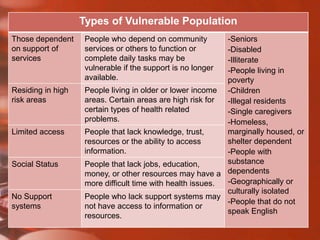
  • #24 This chart outlines the types of vulnerable populations.14 Do these look familiar? ACHR sees many patients like this everyday. Right now, due to poor economic conditions more people are vulnerable. Certain life events can have a huge impact on someone’s vulnerability. Job loss, death in the family, loss of insurance coverage, etc. Is there any population that ACHR sees more than others?
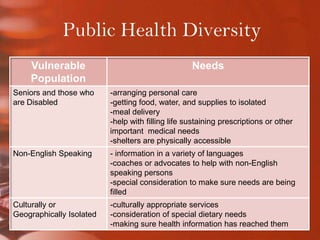
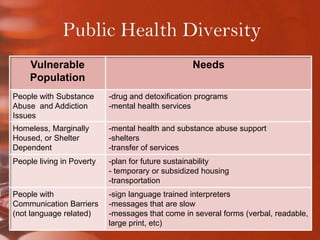
  • #25 This chart focuses on the specific types of vulnerable populations and what their needs may be.14 As you can see each population has very different needs.
  • #26 It’s hard to provide it all so it’s important to know the population your serve.
  • #27 What diversity issues can you see in this case?By knowing the agency’s population, ACHR can identify those most vulnerable to mumps? We know that 18-22yr old college students are most at risk. What are the demographics of the 18-22 yr old college students ACHR sees? Where do they live? Do they speak English?How can ACHR bridge the gap between its clients and the CDC, ODH, and the local health department. ACHR knows its clients best! What will work? What’s NOT going to work? These are all questions ACHR should ask themselves and plan accordingly.
  • #28 Now that we understand diversity and ACHR’s population’s needs we can develop messages for them. A message map is intended to deliver messages that are understandable, informative, and open communication channels.15
  • #29 When developing a message map there are some things to keep in mind. Develop messages that are brief and understandable by the target audience that may be at a 6th to 8th grade readability level.15Organization should limit the number of messages to 3, or 1 key message with 3 ideas.15Put the most important messages first and/or last.15 Citing credible sources like the ODH or CDC gives the messages integrity, according to the AAP (kidding). Avoid messages that are heavily negative or optimistic. Balance messages but be truthful. Using graphs and visual aids is always a great way to catch a person’s eye.15
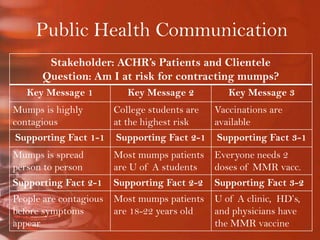
  • #30 This is what a message map looks like. There are 3 key messages and for space sake there are 2 supporting facts for each message. What other messages would ACHR be sending to its patients?
  • #31 Communicating with patients is a big part of ACHR’s response, but you will also have to communicate with partnering agencies and the local health departments in order to get up to date outbreak response information. The emergency operations plan is a good place to begin planning who will be responsible for communication. A training session may also prove beneficial for employees so they too have information on mumps and how ACHR plans to respond and also to receive feedback.
  • #32 In public health, the goal is to provide the most amount of good to the most amount of people. The focus is on population health. This does not come without risks however. The ethics of an infectious disease outbreak are not clear cut and individual rights are questioned. Infectious disease is a common part of public health and special ethical considerations must be made when dealing with it. Since infectious diseases are contagious, the health of one person may jeopardize many.
  • #33 This slide touches on some of the basic ethical principals in public health. This are not moral reasoning like utilitarianism and Marxism. Autonomy is the right for individuals to make decisions and act as they see appropriate. Beneficence requires a balance between both the promotion of common welfare and the protection of individual benefit and always to pursue good. Nonmaleficence requires that act of harm be avoided. Justice may be the most complicated because it seeks fairness and equal treatment. When resources are limited equality may not always be upheld. There is always some tension between the four principals and it may be impossible to balance them all.The principals help guide our decisions in public health. If there were an MMR vaccine shortage who should be vaccinated first? Why? Is that fair? Could people be potentially harmed? If someone refuses to be vaccinated do we respect that decision?
  • #34 At the same time public health morals tell us to prevent and reduce harm, maximize benefit, balance power, build and maintain trust, protect privacy, respect autonomous decisions, maintain confidentiality, and make an obligation to community health. Ethical principals help guide our decisions.
  • #35 Some public health measuresin this case may include mandatory testing, notification of authorities, mandatory treatment, surveillance, travel restrictions, quarantine and informed consent. As a healthcare worker, you often understand the reasoning behind these measures, but not everyone can. The father of a University of Akron student is feeling ill and goes to his doctor. Since there is an outbreak going on the physician suspects that it is in fact, a case of mumps. The father, who just happens to be a lawyer has a big case to present tomorrow, in Columbus. The trial could last several days. There is no way he could possibly postpone it anymore. He doesn’t think this is a big deal and although he agrees with the doctor to not go, he does anyway.This scenario exemplifies how communicable diseases are more complicated than they seem.
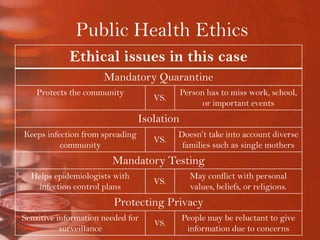
  • #36 In this case, mandating quarantines is an ethical dilemma. A quarantine is the restriction of an individual that is presumed to been exposed to a contagious disease but are not ill. Although it is most beneficial to the community as a whole, a person that depends on an income may not be willing to take time off work for a mild illness that they do not view as serious. Mandating that a person stay in isolation is also a public health ethical dilemma. Isolation is the separation of an ill person with a contagious disease. This helps the community from being exposed it doesn’t take into account diverse family and work situations. Most people probably wouldn’t have an issue with testing for mumps but HIV has a serious stigma. A diagnosis of HIV or AIDS and can carry a huge burden of not only financial costs but personal costs as well. In the digital age where personal information is stored on computers we have grown more concerned about the protection of our private information. Although great measures are taken to protect personal information in public health many people don’t feel comfortable knowing they have no control over who may see it. Healthcare workers have an obligation to respect and protect the information they have access to. I once saw on a discussion board, a woman asking for advice for a friend. Her friend was a nurse at a health department and a young man came in for an HIV/AIDS test. This young man happened to be her daughter’s friend’s boyfriend. Her daughter had revealed prior to this, that her friend was sexually active with him. His test came back positive and he refused to release any information about his sexual partners. The woman’s friend was burdened with knowing the young man’s HIV/AIDS status and knowing he could potentially infect her daughter’s friend.
  • #37 In order to resolve issues surrounding a public health program that may infringe on personal rights, there are certain conditions that should be taken into consideration. The effectiveness of a program should be shown in order to justify infringement of person rights. The proportionality of a program should balance the positive and negative outcomes. If more harm is done, then the program should not be implemented. Often, that is not seen immediately. Necessity ask us if there is any other alternative to the public health measure? Is there another measure that could be just as effective and not infringe on personal rights?Least infringement asks us to verify that the public health measure is one in which infringes on right the least of all other options.In the case that a public health measure infringes of the right of individuals, public health officials should publically explain and justify these measures. This offers transparency to the public.
  • #38 This case may not only involve the public but ACHR’s own employees. ACHR should take ethical consideration when developing or implementing policy. The diversity of patients and employees should be taken into consideration when considering ethics. Balancing public health needs and individual concerns is hard, but there are ways to guide decision making. Ethical principals should be used when confronted with conflicts.
  • #39 That concludes my presentation. Thank you for your time and I hope you enjoyed the presentation. Does anyone have any questions?Please remember to fill out the presentation log and return them to me so I can forward them to my instructors.