Multithreading
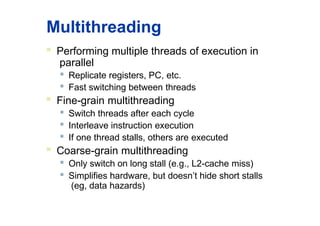
Performing multiplethreads of execution in
parallel
Replicate registers, PC, etc.
Fast switching between threads
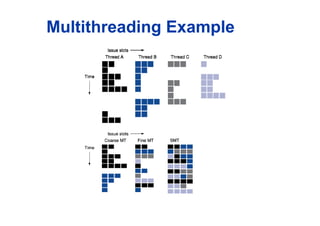
Fine-grain multithreading
Switch threads after each cycle
Interleave instruction execution
If one thread stalls, others are executed
Coarse-grain multithreading
Only switch on long stall (e.g., L2-cache miss)
Simplifies hardware, but doesn’t hide short stalls
(eg, data hazards)
3.
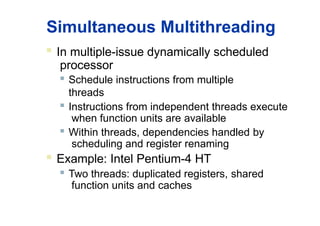
Simultaneous Multithreading
Inmultiple-issue dynamically scheduled
processor
Schedule instructions from multiple
threads
Instructions from independent threads execute
when function units are available
Within threads, dependencies handled by
scheduling and register renaming
Example: Intel Pentium-4 HT
Two threads: duplicated registers, shared
function units and caches
Future of Multithreading
Will it survive? In what form?
Power considerations simplified
microarchitectures
Simpler forms of multithreading
Tolerating cache-miss latency
Thread switch may be most
effective
Multiple simple cores might share
resources more effectively
6.
Shared Memory
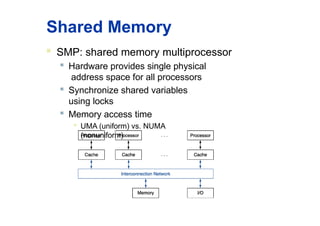
SMP:shared memory multiprocessor
Hardware provides single physical
address space for all processors
Synchronize shared variables
using locks
Memory access time
UMA (uniform) vs. NUMA
(nonuniform)
7.
Example: Sum Reduction
Sum 100,000 numbers on 100 processor UMA
Each processor has ID: 0 ≤ Pn ≤ 99
Partition 1000 numbers per processor
Initial summation on each processor
sum [ Pn ] = 0 ;
f o r ( i = 1000 * Pn ;
i < 1000 * ( Pn+1 ) ; i = i
+ 1 )
sum [ Pn ] = sum [ Pn ] + A [ i ];
Now need to add these partial sums
Reduction: divide and conquer
Half the processors add pairs, then quarter, …
Need to synchronize between reduction steps
8.
Example: Sum Reduction
!= 0 && Pn ==
0 )
ha l f =
100 ;
r epea t
synch () ;
i f
( ha l f %2
sum [ 0 ]
=
sum [ 0 ] + sum [ ha l f - 1 ];
needed when ha l
f
/ * Cond i t i
ona l sum
P r ocesso r 0 ge t
s
i s
odd ;
* /
mi ss i
ng
e l emen
t
ha l f = ha l f/ 2 ; /
*
d i v i d i
ng
l i ne on who sums
* /
i f ( Pn < ha l f ) sum [ Pn
]
= sum [ Pn ] + sum [ Pn+ha l f];
un t il ( ha l f == 1 ) ;
9.
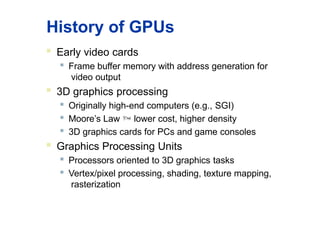
History of GPUs
Early video cards
Frame buffer memory with address generation for
video output
3D graphics processing
Originally high-end computers (e.g., SGI)
Moore’s Law lower cost, higher density
3D graphics cards for PCs and game consoles
Graphics Processing Units
Processors oriented to 3D graphics tasks
Vertex/pixel processing, shading, texture mapping,
rasterization
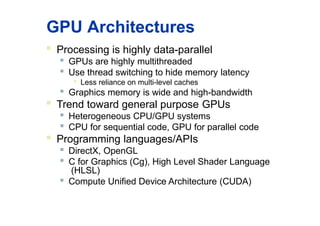
GPU Architectures
Processingis highly data-parallel
GPUs are highly multithreaded
Use thread switching to hide memory latency
Less reliance on multi-level caches
Graphics memory is wide and high-bandwidth
Trend toward general purpose GPUs
Heterogeneous CPU/GPU systems
CPU for sequential code, GPU for parallel code
Programming languages/APIs
DirectX, OpenGL
C for Graphics (Cg), High Level Shader Language
(HLSL)
Compute Unified Device Architecture (CUDA)
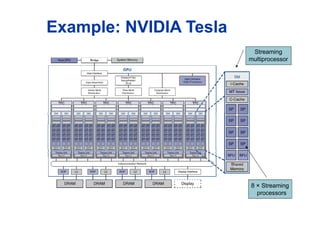
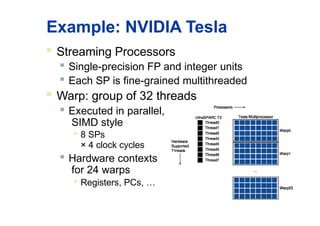
Example: NVIDIA Tesla
Streaming Processors
Single-precision FP and integer units
Each SP is fine-grained multithreaded
Warp: group of 32 threads
Executed in parallel,
SIMD style
8 SPs
× 4 clock cycles
Hardware contexts
for 24 warps
Registers, PCs, …
14.
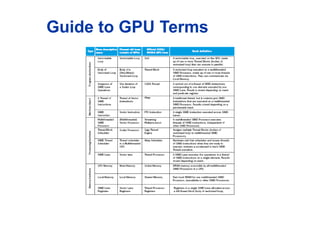
Classifying GPUs
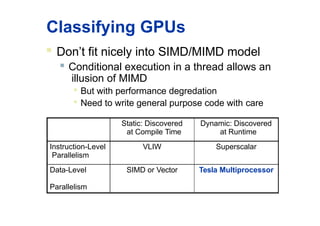
Don’tfit nicely into SIMD/MIMD model
Conditional execution in a thread allows an
illusion of MIMD
But with performance degredation
Need to write general purpose code with care
Static: Discovered
at Compile Time
Dynamic: Discovered
at Runtime
Instruction-Level
Parallelism
VLIW Superscalar
Data-Level
Parallelism
SIMD or Vector Tesla Multiprocessor
Putting GPUs intoPerspective
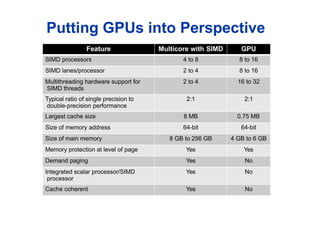
Feature Multicore with SIMD GPU
SIMD processors 4 to 8 8 to 16
SIMD lanes/processor 2 to 4 8 to 16
Multithreading hardware support for
SIMD threads
2 to 4 16 to 32
Typical ratio of single precision to
double-precision performance
2:1 2:1
Largest cache size 8 MB 0.75 MB
Size of memory address 64-bit 64-bit
Size of main memory 8 GB to 256 GB 4 GB to 6 GB
Memory protection at level of page Yes Yes
Demand paging Yes No
Integrated scalar processor/SIMD
processor
Yes No
Cache coherent Yes No


![Example: Sum Reduction
Sum 100,000 numbers on 100 processor UMA
Each processor has ID: 0 ≤ Pn ≤ 99
Partition 1000 numbers per processor
Initial summation on each processor
sum [ Pn ] = 0 ;
f o r ( i = 1000 * Pn ;
i < 1000 * ( Pn+1 ) ; i = i
+ 1 )
sum [ Pn ] = sum [ Pn ] + A [ i ];
Now need to add these partial sums
Reduction: divide and conquer
Half the processors add pairs, then quarter, …
Need to synchronize between reduction steps](https://image.slidesharecdn.com/multithreadingandgpu-250915032809-3cdfa847/85/Multithreading-and-GPU-for-computer-Architecture-pptx-7-320.jpg)
![Example: Sum Reduction
! = 0 && Pn ==
0 )
ha l f =
100 ;
r epea t
synch () ;
i f
( ha l f %2
sum [ 0 ]
=
sum [ 0 ] + sum [ ha l f - 1 ];
needed when ha l
f
/ * Cond i t i
ona l sum
P r ocesso r 0 ge t
s
i s
odd ;
* /
mi ss i
ng
e l emen
t
ha l f = ha l f/ 2 ; /
*
d i v i d i
ng
l i ne on who sums
* /
i f ( Pn < ha l f ) sum [ Pn
]
= sum [ Pn ] + sum [ Pn+ha l f];
un t il ( ha l f == 1 ) ;](https://image.slidesharecdn.com/multithreadingandgpu-250915032809-3cdfa847/85/Multithreading-and-GPU-for-computer-Architecture-pptx-8-320.jpg)