Multi-system machine translation
using online APIs for English-Latvian
Matīss Rikters
University of Latvia
ACL 2015 Fourth Workshop on
Hybrid Approaches to Translation
Beijing, 31.07.2015
Introduction
 Motivation:
 Doctoral studies at the University of Latvia
 A hybrid machine translation method, combining results of various machine translation systems
 Literature review
 Recent trends in Multi-System Machine Translation
 Nothing similar publically available was found
Introduction
 Goals:
 Combine output from multiple online MT APIs
 Keep it simple
 Make it work fast
Related work
 "Coupling Statistical Machine Translation with Rule-based Transfer and Generation",
A. Ahsan, and P. Kolachina.
 "Using language and translation models to select the best among outputs from
multiple MT systems", Y. Akiba, T. Watanabe, and E. Sumita.
 "MANY: Open source machine translation system combination", L. Barrault.
 "A program for automatically selecting the best output from multiple machine
translation engines", C. Callison-Burch and R. S. Flournoy.
Initial plan
 Use systems that support English – Latvian translation
 Found five such systems:
What worked
 Couldn`t get APIs of two of them to work
 Used the remaining three:
System description
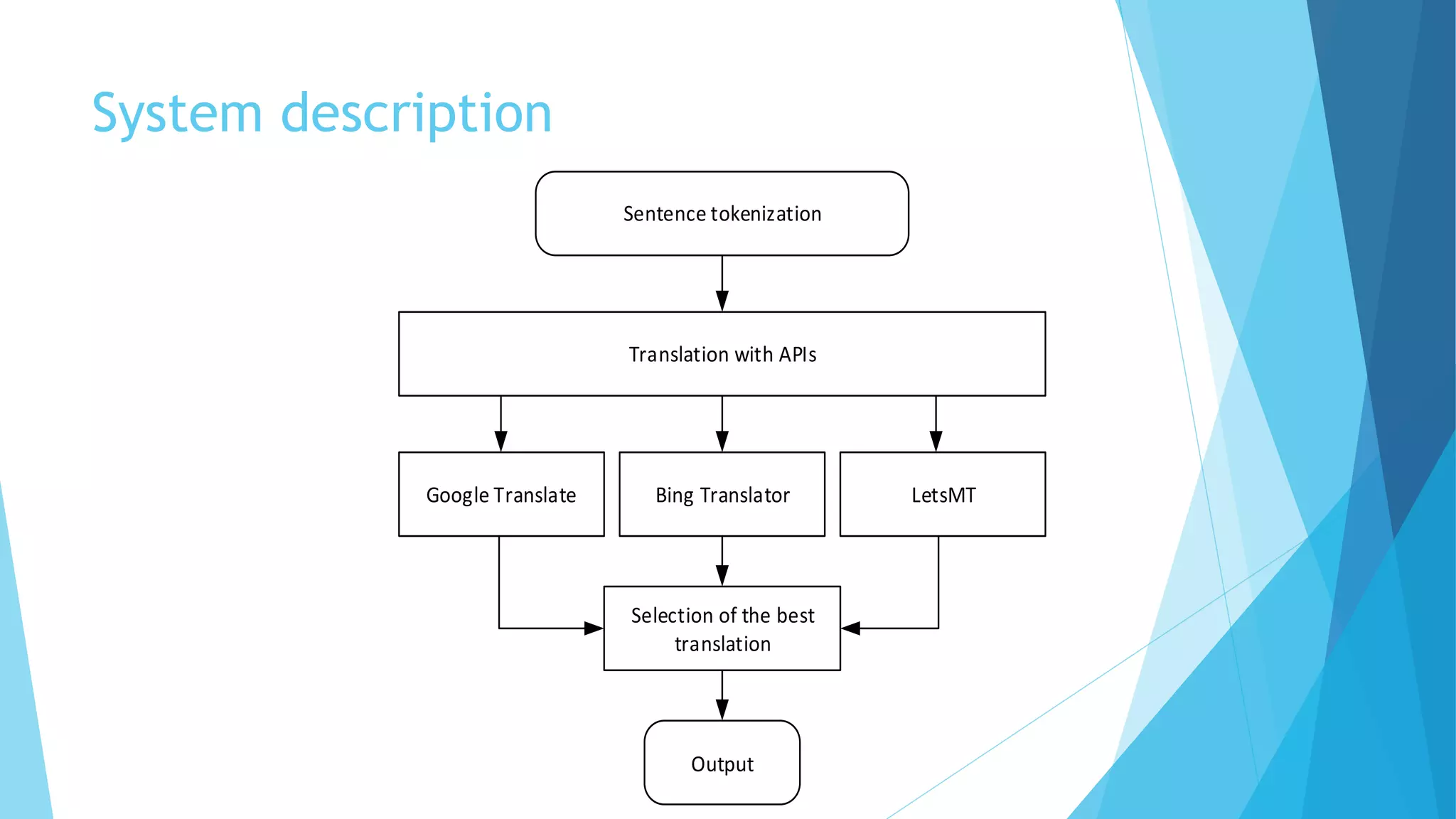
Sentence tokenization
Translation with APIs
Google Translate Bing Translator LetsMT
Selection of the best
translation
Output
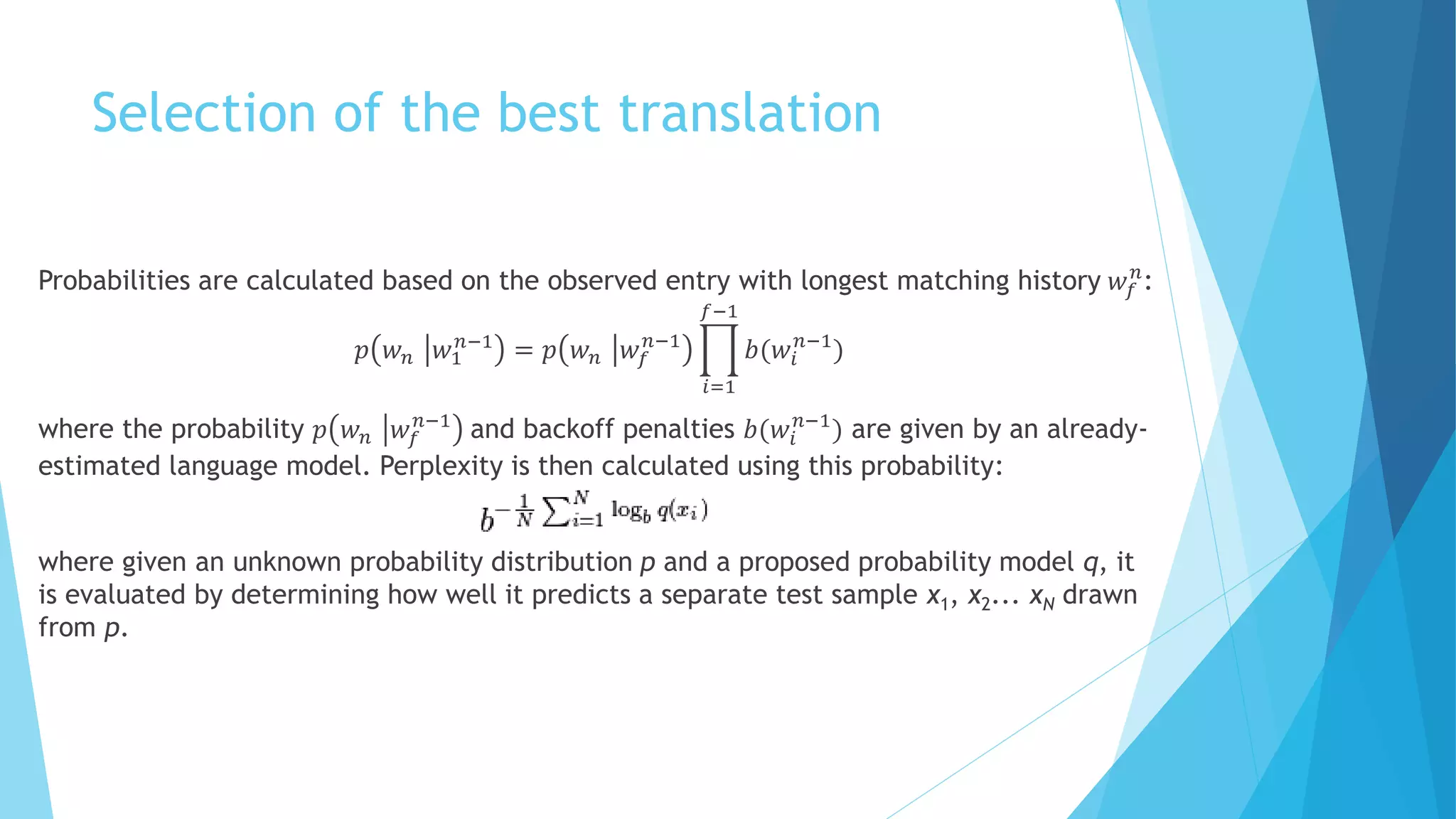
Selection of the best translation
Probabilities are calculated based on the observed entry with longest matching history 𝑤𝑓
𝑛
:
𝑝 𝑤 𝑛 𝑤1
𝑛−1
= 𝑝 𝑤 𝑛 𝑤𝑓
𝑛−1
𝑖=1
𝑓−1
𝑏(𝑤𝑖
𝑛−1
)
where the probability 𝑝 𝑤 𝑛 𝑤𝑓
𝑛−1
and backoff penalties 𝑏(𝑤𝑖
𝑛−1
) are given by an already-
estimated language model. Perplexity is then calculated using this probability:
where given an unknown probability distribution p and a proposed probability model q, it
is evaluated by determining how well it predicts a separate test sample x1, x2... xN drawn
from p.
System usage
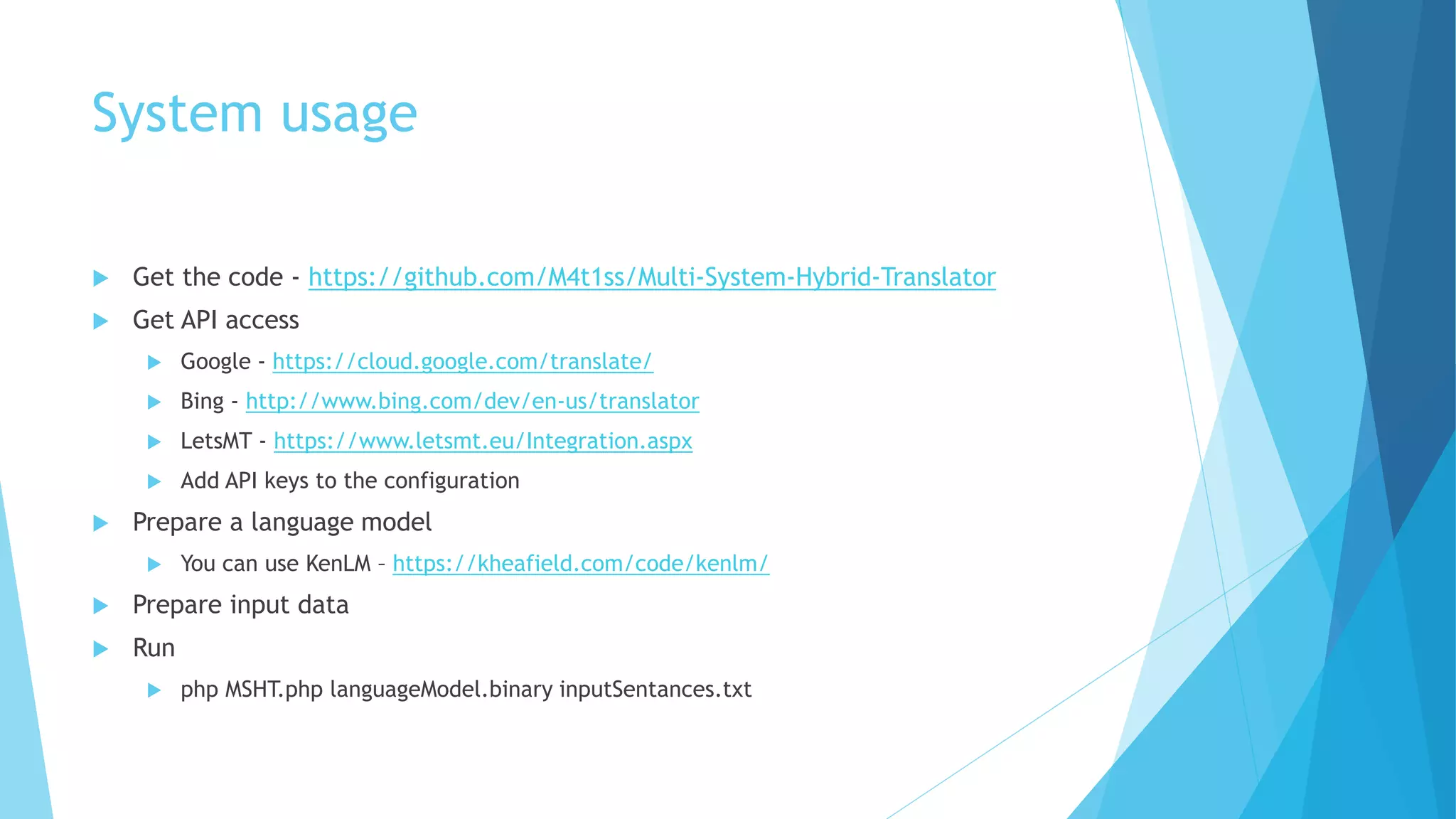
 Get the code - https://github.com/M4t1ss/Multi-System-Hybrid-Translator
 Get API access
 Google - https://cloud.google.com/translate/
 Bing - http://www.bing.com/dev/en-us/translator
 LetsMT - https://www.letsmt.eu/Integration.aspx
 Add API keys to the configuration
 Prepare a language model
 You can use KenLM – https://kheafield.com/code/kenlm/
 Prepare input data
 Run
 php MSHT.php languageModel.binary inputSentances.txt
Experiments
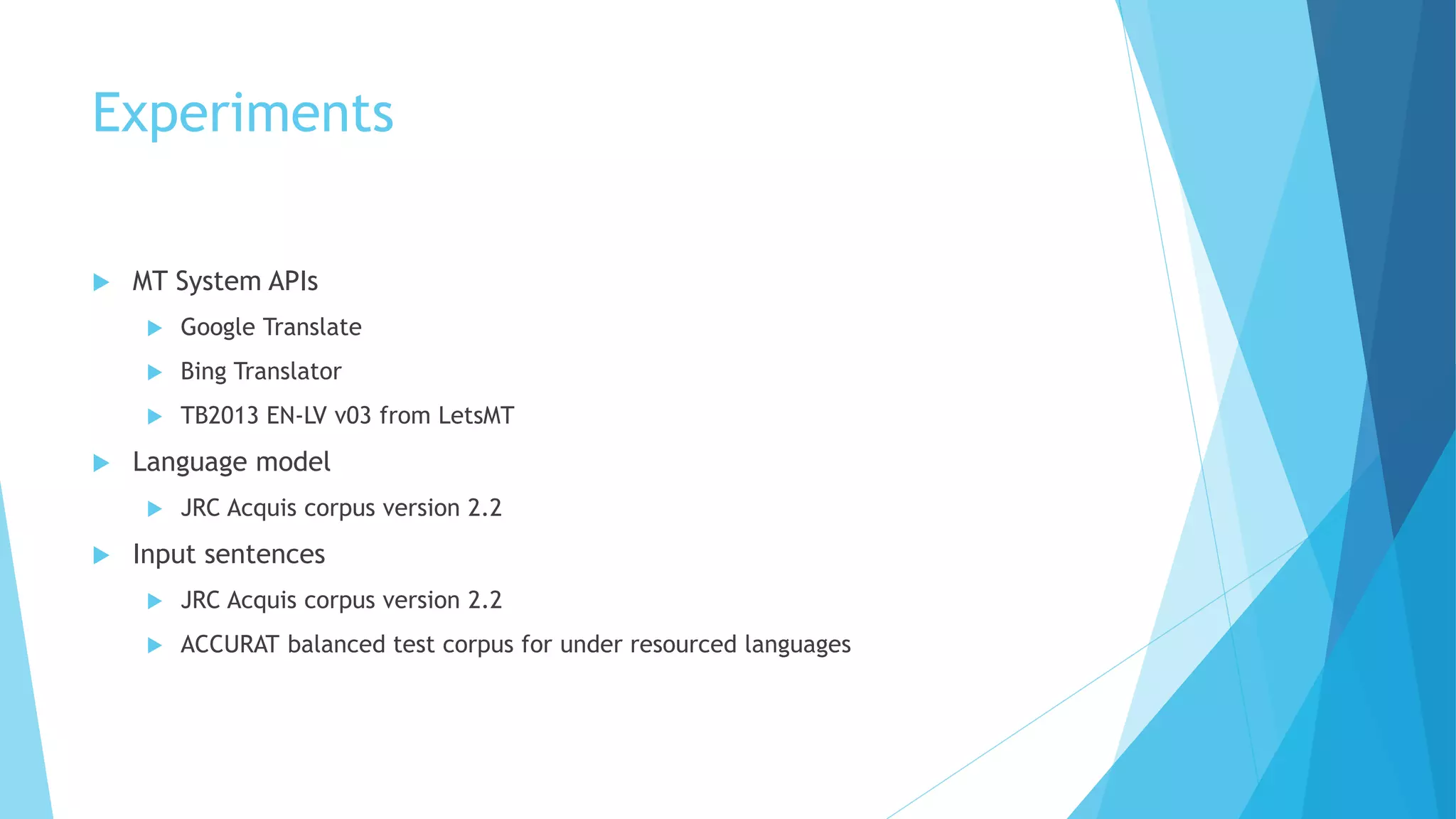
 MT System APIs
 Google Translate
 Bing Translator
 TB2013 EN-LV v03 from LetsMT
 Language model
 JRC Acquis corpus version 2.2
 Input sentences
 JRC Acquis corpus version 2.2
 ACCURAT balanced test corpus for under resourced languages
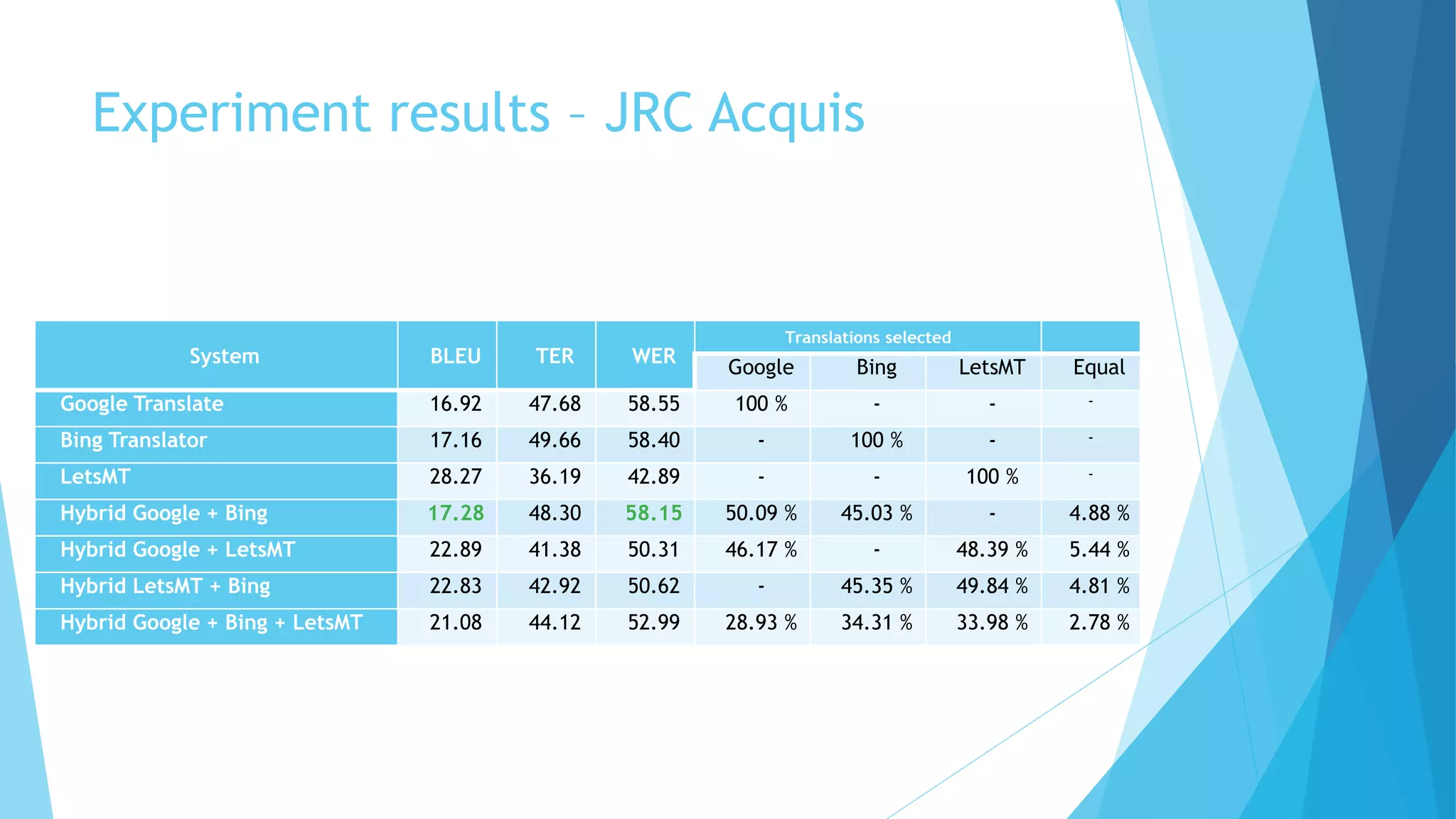
Experiment results – JRC Acquis
System BLEU TER WER
Translations selected
Google Bing LetsMT Equal
Google Translate 16.92 47.68 58.55 100 % - - -
Bing Translator 17.16 49.66 58.40 - 100 % - -
LetsMT 28.27 36.19 42.89 - - 100 % -
Hybrid Google + Bing 17.28 48.30 58.15 50.09 % 45.03 % - 4.88 %
Hybrid Google + LetsMT 22.89 41.38 50.31 46.17 % - 48.39 % 5.44 %
Hybrid LetsMT + Bing 22.83 42.92 50.62 - 45.35 % 49.84 % 4.81 %
Hybrid Google + Bing + LetsMT 21.08 44.12 52.99 28.93 % 34.31 % 33.98 % 2.78 %
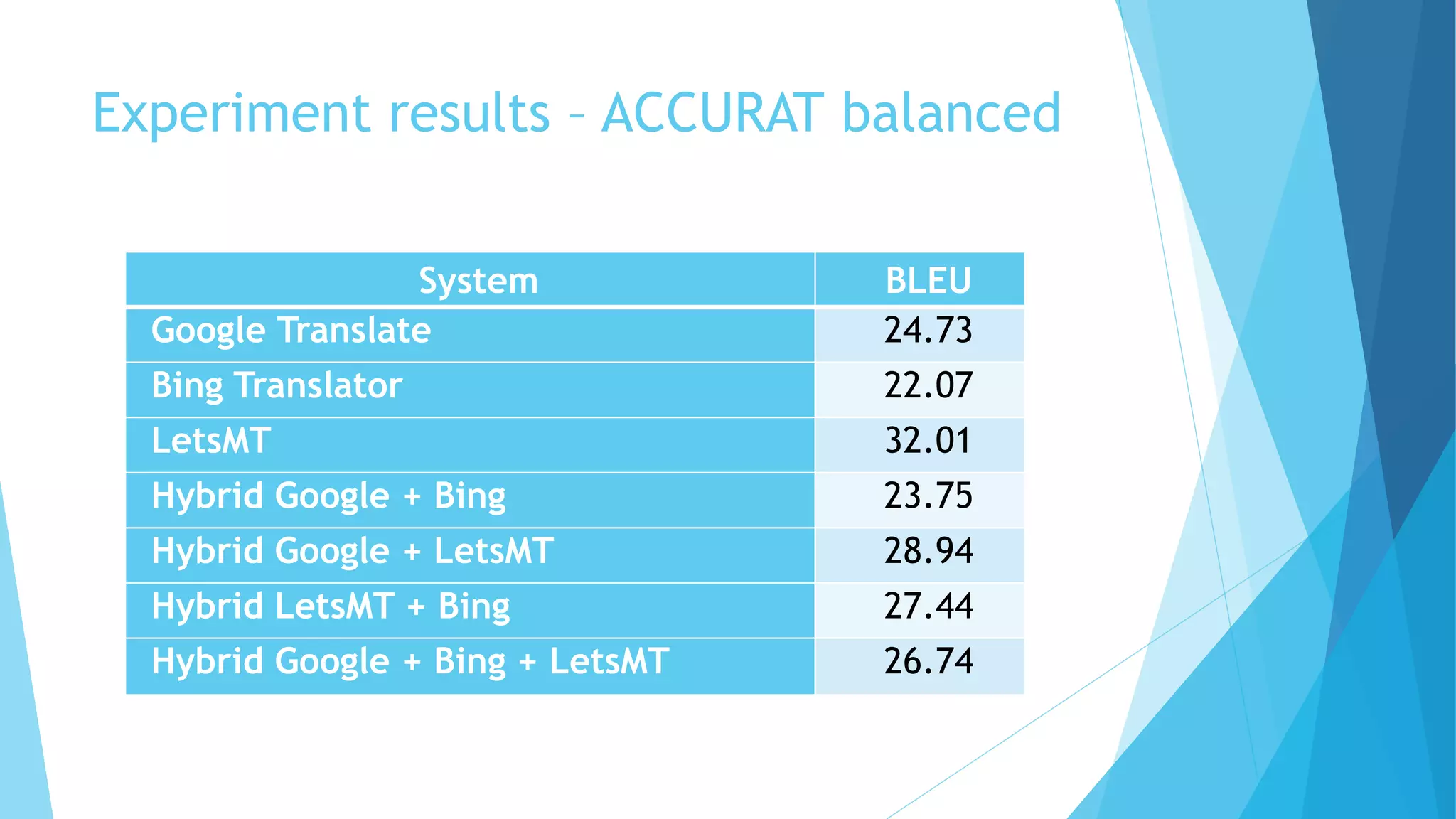
Experiment results – ACCURAT balanced
System BLEU
Google Translate 24.73
Bing Translator 22.07
LetsMT 32.01
Hybrid Google + Bing 23.75
Hybrid Google + LetsMT 28.94
Hybrid LetsMT + Bing 27.44
Hybrid Google + Bing + LetsMT 26.74
Human evaluation
 5 native Latvian speakers were given a random 2% - 32 sentences
 They were told to mark which of the three MT outputs is the best, worst and OK
 Having the option to select multiple answers for best, worst or OK
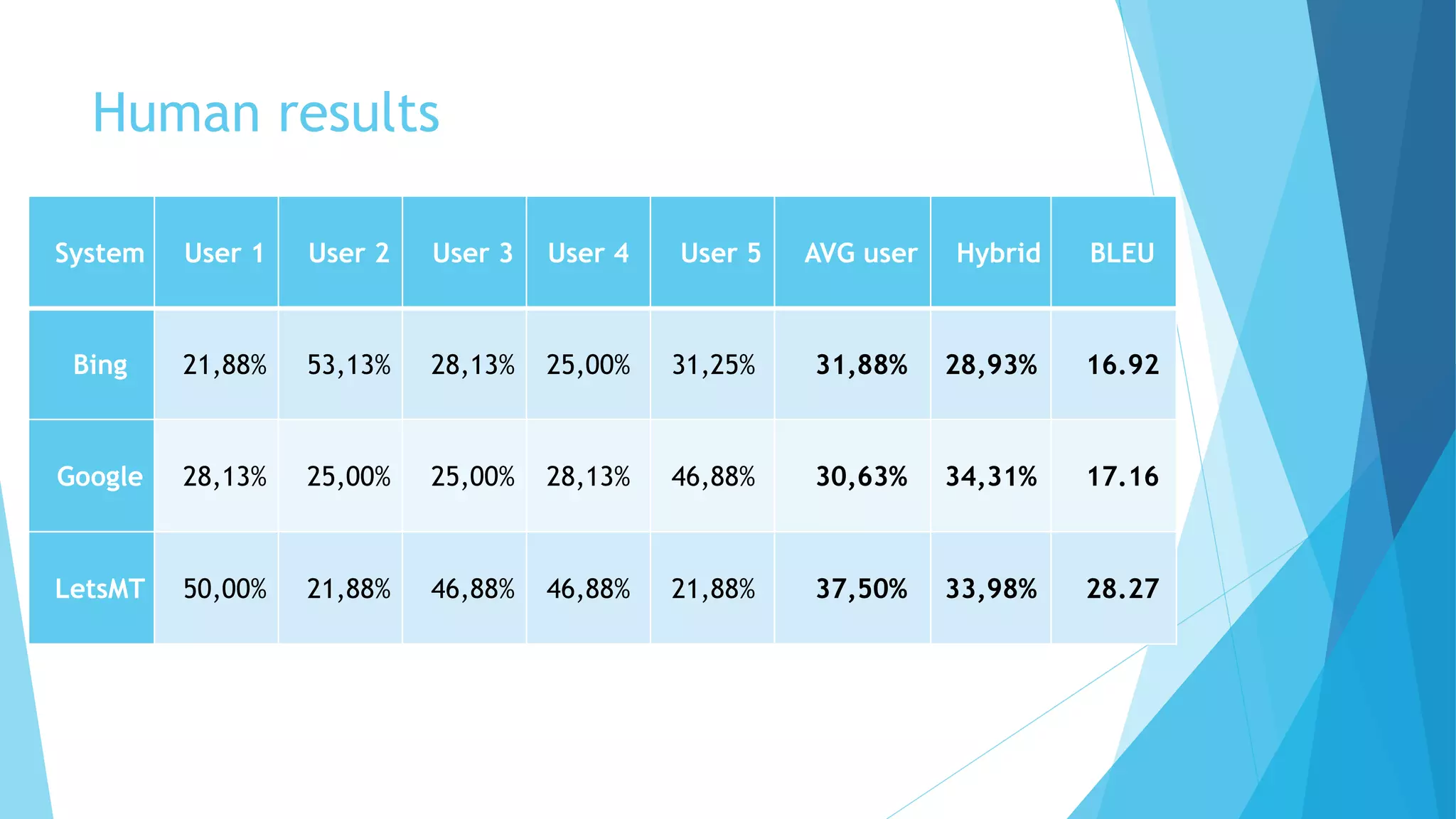
Human results
System User 1 User 2 User 3 User 4 User 5 AVG user Hybrid BLEU
Bing 21,88% 53,13% 28,13% 25,00% 31,25% 31,88% 28,93% 16.92
Google 28,13% 25,00% 25,00% 28,13% 46,88% 30,63% 34,31% 17.16
LetsMT 50,00% 21,88% 46,88% 46,88% 21,88% 37,50% 33,98% 28.27
Conclusion
 Simple to
 Build
 Use
 Add new MT APIs
 Works
 When used on similar systems
 Poor with one much superior system
 Needs
 Improvements for translation selection
 More configuration options
Future work
 Use a bigger & better language model?
 Tried it… about the same results
 Confusion networks?
 Too confusing for now
 Use MT quality estimation for selecting the best candidates
 QuEst or QuEst++
 Other quality estimation
 Chunk sentences in smaller parts, translate & recombine
Thank you!
http://ej.uz/MSHT-GITHUB
http://ej.uz/MSMT-EN-LV

Multi-system machine translation using online APIs for English-Latvian

  • 1.
    Multi-system machine translation usingonline APIs for English-Latvian Matīss Rikters University of Latvia ACL 2015 Fourth Workshop on Hybrid Approaches to Translation Beijing, 31.07.2015
  • 2.
    Introduction  Motivation:  Doctoralstudies at the University of Latvia  A hybrid machine translation method, combining results of various machine translation systems  Literature review  Recent trends in Multi-System Machine Translation  Nothing similar publically available was found
  • 3.
    Introduction  Goals:  Combineoutput from multiple online MT APIs  Keep it simple  Make it work fast
  • 4.
    Related work  "CouplingStatistical Machine Translation with Rule-based Transfer and Generation", A. Ahsan, and P. Kolachina.  "Using language and translation models to select the best among outputs from multiple MT systems", Y. Akiba, T. Watanabe, and E. Sumita.  "MANY: Open source machine translation system combination", L. Barrault.  "A program for automatically selecting the best output from multiple machine translation engines", C. Callison-Burch and R. S. Flournoy.
  • 5.
    Initial plan  Usesystems that support English – Latvian translation  Found five such systems:
  • 6.
    What worked  Couldn`tget APIs of two of them to work  Used the remaining three:
  • 7.
    System description Sentence tokenization Translationwith APIs Google Translate Bing Translator LetsMT Selection of the best translation Output
  • 8.
    Selection of thebest translation Probabilities are calculated based on the observed entry with longest matching history 𝑤𝑓 𝑛 : 𝑝 𝑤 𝑛 𝑤1 𝑛−1 = 𝑝 𝑤 𝑛 𝑤𝑓 𝑛−1 𝑖=1 𝑓−1 𝑏(𝑤𝑖 𝑛−1 ) where the probability 𝑝 𝑤 𝑛 𝑤𝑓 𝑛−1 and backoff penalties 𝑏(𝑤𝑖 𝑛−1 ) are given by an already- estimated language model. Perplexity is then calculated using this probability: where given an unknown probability distribution p and a proposed probability model q, it is evaluated by determining how well it predicts a separate test sample x1, x2... xN drawn from p.
  • 9.
    System usage  Getthe code - https://github.com/M4t1ss/Multi-System-Hybrid-Translator  Get API access  Google - https://cloud.google.com/translate/  Bing - http://www.bing.com/dev/en-us/translator  LetsMT - https://www.letsmt.eu/Integration.aspx  Add API keys to the configuration  Prepare a language model  You can use KenLM – https://kheafield.com/code/kenlm/  Prepare input data  Run  php MSHT.php languageModel.binary inputSentances.txt
  • 10.
    Experiments  MT SystemAPIs  Google Translate  Bing Translator  TB2013 EN-LV v03 from LetsMT  Language model  JRC Acquis corpus version 2.2  Input sentences  JRC Acquis corpus version 2.2  ACCURAT balanced test corpus for under resourced languages
  • 11.
    Experiment results –JRC Acquis System BLEU TER WER Translations selected Google Bing LetsMT Equal Google Translate 16.92 47.68 58.55 100 % - - - Bing Translator 17.16 49.66 58.40 - 100 % - - LetsMT 28.27 36.19 42.89 - - 100 % - Hybrid Google + Bing 17.28 48.30 58.15 50.09 % 45.03 % - 4.88 % Hybrid Google + LetsMT 22.89 41.38 50.31 46.17 % - 48.39 % 5.44 % Hybrid LetsMT + Bing 22.83 42.92 50.62 - 45.35 % 49.84 % 4.81 % Hybrid Google + Bing + LetsMT 21.08 44.12 52.99 28.93 % 34.31 % 33.98 % 2.78 %
  • 12.
    Experiment results –ACCURAT balanced System BLEU Google Translate 24.73 Bing Translator 22.07 LetsMT 32.01 Hybrid Google + Bing 23.75 Hybrid Google + LetsMT 28.94 Hybrid LetsMT + Bing 27.44 Hybrid Google + Bing + LetsMT 26.74
  • 13.
    Human evaluation  5native Latvian speakers were given a random 2% - 32 sentences  They were told to mark which of the three MT outputs is the best, worst and OK  Having the option to select multiple answers for best, worst or OK
  • 14.
    Human results System User1 User 2 User 3 User 4 User 5 AVG user Hybrid BLEU Bing 21,88% 53,13% 28,13% 25,00% 31,25% 31,88% 28,93% 16.92 Google 28,13% 25,00% 25,00% 28,13% 46,88% 30,63% 34,31% 17.16 LetsMT 50,00% 21,88% 46,88% 46,88% 21,88% 37,50% 33,98% 28.27
  • 15.
    Conclusion  Simple to Build  Use  Add new MT APIs  Works  When used on similar systems  Poor with one much superior system  Needs  Improvements for translation selection  More configuration options
  • 16.
    Future work  Usea bigger & better language model?  Tried it… about the same results  Confusion networks?  Too confusing for now  Use MT quality estimation for selecting the best candidates  QuEst or QuEst++  Other quality estimation  Chunk sentences in smaller parts, translate & recombine
  • 17.