Designing the hardware
 Improving communication between distributed processors and managing shared data
 are two of the central challenges in creating tomorrow’s chips.
 Larry Hardesty, MIT News Office
 February 23, 2011


 Computer chips’ clocks have stopped getting faster. To maintain the regular doubling of computer power
 that we now take for granted, chip makers have been giving chips more “cores,” or processing units. But
 how to distribute computations across multiple cores is a hard problem, and this five-part series of articles
 examines the different levels at which MIT researchers are tackling it, from hardware design up to the
 development of new programming languages.


 W
               ith the multicore chips in today’s personal computers, which might have four or six or even
               eight cores, splitting computational tasks hasn’t proved a huge problem. If the chip is running
               four programs — say, a word processor, an e-mail program, a Web browser and a media
               player — the operating system can assign each its own core. But in future chips, with
               hundreds or even thousands of cores, a single program will be split among multiple cores,
 which drastically complicates things. The cores will have to exchange data much more often; but in today’s
 chips, the connections between cores are much slower than the connections within cores. Cores executing
 a single program may also have to modify the same chunk of data, but the performance of the program
 could be radically different depending on which of them gets to it first. At MIT, a host of researchers are
 exploring how to reinvent chip architecture from the ground up, to ensure that adding more cores makes
 chips perform better, not worse.

 In August 2010, the U.S. Department of Defense’s Defense Advanced Research Projects Agency
 announced that it was dividing almost $80 million among four research teams as part of a “ubiquitous high-
 performance computing” initiative. Three of those teams are led by commercial chip manufacturers. The
 fourth, which includes researchers from Mercury Computer, Freescale, the University of Maryland and
 Lockheed Martin, is led by MIT’s Computer Science and Artificial Intelligence Lab and will concentrate on
 the development of multicore systems.

 The MIT project, called Angstrom, involves 19 MIT researchers (so far) and is headed by Anant Agarwal, a
 professor in the Department of Electrical Engineering and Computer Science. In 2004, Agarwal cofounded
 the chip company Tilera to commercialize research he’d done at MIT, and today, Tilera’s 64-core processor
 is the state of the art for multicore technology.

 One way to improve communication between cores, which the Angstrom project is investigating, is optical
 communication — using light instead of electricity to move data. Though prototype chips with optical-
 communications systems have been built in the lab, they rely on exotic materials that are difficult to integrate
 into existing chip-manufacturing processes. Two of the Angstrom researchers are investigating optical-
 communications schemes that use more practical materials.

 In early 2010, an MIT research group led by Lionel Kimerling, the Thomas Lord Professor of Materials
 Science and Engineering, demonstrated the first germanium laser. Germanium is already used in many
 commercial chips simply to improve the speed of electrical circuits, but it has much better optical properties
 than silicon. Another Angstrom member, Vladimir Stojanović of the Microsystems Technology Laboratory, is
 collaborating with several chip manufacturers to build prototype chips with polysilicon waveguides.
 Waveguides are ridges on the surface of a chip that can direct optical signals; polysilicon is a type of silicon
 that consists of tiny, distinct crystals of silicon clumped together. Typically used in the transistor element
 called the gate, polysilicon has been part of the standard chip-manufacturing process for decades.

 Other Angstrom researchers, however, are working on improving electrical connections between cores. In
 today’s multicore chips, adjacent cores typically have two high-capacity connections between them, which
 carry data in opposite directions, like the lanes of a two-lane highway. But in future chips, cores’ bandwidth


http://web.mit.edu/newsoffice/2011/multicore-series-1-0223.html?tmpl=component&print=1                Page 1 of 3
requirements could fluctuate wildly. A core
 performing a calculation that requires
 information updates from dozens of other
 cores would need much more receiving
 capacity than sending. But once it completes
 its calculation, it might have to broadcast the
 results, so its requirements would invert. Srini
 Devadas, a professor in the Computer
 Science and Artificial Intelligence Lab, is
 researching chip designs in which cores are
 connected by eight or maybe 16 lower-
 capacity connections, each of which can carry
 data in either direction. As the bandwidth
 requirements of the chip change, so can the
 number of connections carrying data in each
 direction. Devadas has demonstrated that
 small circuits connected to the cores can
 calculate the allotment of bandwidth and
 switch the direction of the connections in a
 single clock cycle.

 In theory, a computer chip has two main
 components: a processor and a memory
 circuit. The processor retrieves data from the
 memory, performs an operation on it, then
                                                  Graphic: Christine Daniloff
 returns it to memory. But in practice, chips
 have for decades featured an additional,
 smaller memory circuit called a cache, which is closer to the processor, can be accessed much more rapidly
 than main memory, and stores frequently used data. The processor might perform dozens or hundreds of
 operations on a chunk of data in the cache before relinquishing it to memory.

                                                                In multicore chips, however, multiple cores
                                                                may have cached copies of the same data. If
                                                                one of the cores modifies its copy, all the
                                                                other copies have to be updated. There are
                                                                two general approaches to maintaining “cache
                                                                coherence”: one is to keep a table of all the
                                                                cached copies of the data, which has a cost in
                                                                the computation time required to look up or
                                                                modify entries in the table; the other is to
                                                                simply broadcast any data updates to all the
                                                                cores, which has a cost in bandwidth and,
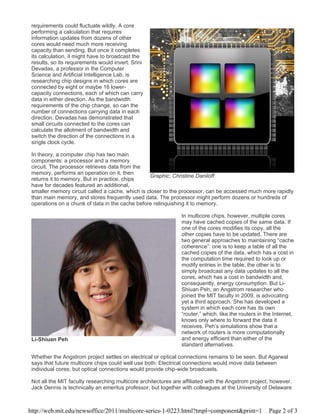
                                                                consequently, energy consumption. But Li-
                                                                Shiuan Peh, an Angstrom researcher who
                                                                joined the MIT faculty in 2009, is advocating
                                                                yet a third approach. She has developed a
                                                                system in which each core has its own
                                                                “router,” which, like the routers in the Internet,
                                                                knows only where to forward the data it
                                                                receives. Peh’s simulations show that a
                                                                network of routers is more computationally
 Li-Shiuan Peh                                                  and energy efficient than either of the
                                                                standard alternatives.

 Whether the Angstrom project settles on electrical or optical connections remains to be seen. But Agarwal
 says that future multicore chips could well use both: Electrical connections would move data between
 individual cores; but optical connections would provide chip-wide broadcasts.

 Not all the MIT faculty researching multicore architectures are affiliated with the Angstrom project, however.
 Jack Dennis is technically an emeritus professor, but together with colleagues at the University of Delaware


http://web.mit.edu/newsoffice/2011/multicore-series-1-0223.html?tmpl=component&print=1                Page 2 of 3
and Rice University, he’s received National Science Foundation funding to research a radically different
 multicore architecture. In Dennis’ system, a computer’s memory is divided into chunks of uniform size, each
 of which can store data but can also point to as many as 16 other chunks. If a data structure — say, a frame
 of video — is too large to fit in a single chunk, the system creates additional chunks to share the burden and
 links them to existing chunks.

 Dennis’ data chunks have three unusual properties. First, they are abstractions: Several chunks storing a
 single data structure might be found in a core’s cache, but if the cache fills up, other chunks might be
 recruited from main memory or even from a flash drive. The system doesn’t care how the chunks are
 instantiated. Second, and perhaps most counterintuitively, once a chunk has been created, it may never be
 altered. If a core performs an operation on data stored in a chunk, it must create a new chunk to store the
 results. This solves the problems of multiple cores trying to modify the same location in memory and of
 cache coherence. Once a chunk is no longer in use by any core, it’s simply released for general use.
 Another chunk, storing the result of a computation, could take its place in the network of links. Finally,
 because any operation of any core could result in the creation or deletion of chunks, the allocation of the
 chunks is performed by circuits hard-wired into the chip, not by the computer’s operating system. “As far as I
 know, nothing like this is going on anywhere else,” Dennis says.

 Whatever the architectural challenges posed by multicore computing, however, they’re only the tip of the
 iceberg. The next installment in this series will begin to look at MIT research on software.


http://web.mit.edu/newsoffice/2011/multicore-series-1-0223.html?tmpl=component&print=1              Page 3 of 3

Multicore series-1-0223

  • 1.
    Designing the hardware Improving communication between distributed processors and managing shared data are two of the central challenges in creating tomorrow’s chips. Larry Hardesty, MIT News Office February 23, 2011 Computer chips’ clocks have stopped getting faster. To maintain the regular doubling of computer power that we now take for granted, chip makers have been giving chips more “cores,” or processing units. But how to distribute computations across multiple cores is a hard problem, and this five-part series of articles examines the different levels at which MIT researchers are tackling it, from hardware design up to the development of new programming languages. W ith the multicore chips in today’s personal computers, which might have four or six or even eight cores, splitting computational tasks hasn’t proved a huge problem. If the chip is running four programs — say, a word processor, an e-mail program, a Web browser and a media player — the operating system can assign each its own core. But in future chips, with hundreds or even thousands of cores, a single program will be split among multiple cores, which drastically complicates things. The cores will have to exchange data much more often; but in today’s chips, the connections between cores are much slower than the connections within cores. Cores executing a single program may also have to modify the same chunk of data, but the performance of the program could be radically different depending on which of them gets to it first. At MIT, a host of researchers are exploring how to reinvent chip architecture from the ground up, to ensure that adding more cores makes chips perform better, not worse. In August 2010, the U.S. Department of Defense’s Defense Advanced Research Projects Agency announced that it was dividing almost $80 million among four research teams as part of a “ubiquitous high- performance computing” initiative. Three of those teams are led by commercial chip manufacturers. The fourth, which includes researchers from Mercury Computer, Freescale, the University of Maryland and Lockheed Martin, is led by MIT’s Computer Science and Artificial Intelligence Lab and will concentrate on the development of multicore systems. The MIT project, called Angstrom, involves 19 MIT researchers (so far) and is headed by Anant Agarwal, a professor in the Department of Electrical Engineering and Computer Science. In 2004, Agarwal cofounded the chip company Tilera to commercialize research he’d done at MIT, and today, Tilera’s 64-core processor is the state of the art for multicore technology. One way to improve communication between cores, which the Angstrom project is investigating, is optical communication — using light instead of electricity to move data. Though prototype chips with optical- communications systems have been built in the lab, they rely on exotic materials that are difficult to integrate into existing chip-manufacturing processes. Two of the Angstrom researchers are investigating optical- communications schemes that use more practical materials. In early 2010, an MIT research group led by Lionel Kimerling, the Thomas Lord Professor of Materials Science and Engineering, demonstrated the first germanium laser. Germanium is already used in many commercial chips simply to improve the speed of electrical circuits, but it has much better optical properties than silicon. Another Angstrom member, Vladimir Stojanović of the Microsystems Technology Laboratory, is collaborating with several chip manufacturers to build prototype chips with polysilicon waveguides. Waveguides are ridges on the surface of a chip that can direct optical signals; polysilicon is a type of silicon that consists of tiny, distinct crystals of silicon clumped together. Typically used in the transistor element called the gate, polysilicon has been part of the standard chip-manufacturing process for decades. Other Angstrom researchers, however, are working on improving electrical connections between cores. In today’s multicore chips, adjacent cores typically have two high-capacity connections between them, which carry data in opposite directions, like the lanes of a two-lane highway. But in future chips, cores’ bandwidth http://web.mit.edu/newsoffice/2011/multicore-series-1-0223.html?tmpl=component&print=1 Page 1 of 3
  • 2.
    requirements could fluctuatewildly. A core performing a calculation that requires information updates from dozens of other cores would need much more receiving capacity than sending. But once it completes its calculation, it might have to broadcast the results, so its requirements would invert. Srini Devadas, a professor in the Computer Science and Artificial Intelligence Lab, is researching chip designs in which cores are connected by eight or maybe 16 lower- capacity connections, each of which can carry data in either direction. As the bandwidth requirements of the chip change, so can the number of connections carrying data in each direction. Devadas has demonstrated that small circuits connected to the cores can calculate the allotment of bandwidth and switch the direction of the connections in a single clock cycle. In theory, a computer chip has two main components: a processor and a memory circuit. The processor retrieves data from the memory, performs an operation on it, then Graphic: Christine Daniloff returns it to memory. But in practice, chips have for decades featured an additional, smaller memory circuit called a cache, which is closer to the processor, can be accessed much more rapidly than main memory, and stores frequently used data. The processor might perform dozens or hundreds of operations on a chunk of data in the cache before relinquishing it to memory. In multicore chips, however, multiple cores may have cached copies of the same data. If one of the cores modifies its copy, all the other copies have to be updated. There are two general approaches to maintaining “cache coherence”: one is to keep a table of all the cached copies of the data, which has a cost in the computation time required to look up or modify entries in the table; the other is to simply broadcast any data updates to all the cores, which has a cost in bandwidth and, consequently, energy consumption. But Li- Shiuan Peh, an Angstrom researcher who joined the MIT faculty in 2009, is advocating yet a third approach. She has developed a system in which each core has its own “router,” which, like the routers in the Internet, knows only where to forward the data it receives. Peh’s simulations show that a network of routers is more computationally Li-Shiuan Peh and energy efficient than either of the standard alternatives. Whether the Angstrom project settles on electrical or optical connections remains to be seen. But Agarwal says that future multicore chips could well use both: Electrical connections would move data between individual cores; but optical connections would provide chip-wide broadcasts. Not all the MIT faculty researching multicore architectures are affiliated with the Angstrom project, however. Jack Dennis is technically an emeritus professor, but together with colleagues at the University of Delaware http://web.mit.edu/newsoffice/2011/multicore-series-1-0223.html?tmpl=component&print=1 Page 2 of 3
  • 3.
    and Rice University,he’s received National Science Foundation funding to research a radically different multicore architecture. In Dennis’ system, a computer’s memory is divided into chunks of uniform size, each of which can store data but can also point to as many as 16 other chunks. If a data structure — say, a frame of video — is too large to fit in a single chunk, the system creates additional chunks to share the burden and links them to existing chunks. Dennis’ data chunks have three unusual properties. First, they are abstractions: Several chunks storing a single data structure might be found in a core’s cache, but if the cache fills up, other chunks might be recruited from main memory or even from a flash drive. The system doesn’t care how the chunks are instantiated. Second, and perhaps most counterintuitively, once a chunk has been created, it may never be altered. If a core performs an operation on data stored in a chunk, it must create a new chunk to store the results. This solves the problems of multiple cores trying to modify the same location in memory and of cache coherence. Once a chunk is no longer in use by any core, it’s simply released for general use. Another chunk, storing the result of a computation, could take its place in the network of links. Finally, because any operation of any core could result in the creation or deletion of chunks, the allocation of the chunks is performed by circuits hard-wired into the chip, not by the computer’s operating system. “As far as I know, nothing like this is going on anywhere else,” Dennis says. Whatever the architectural challenges posed by multicore computing, however, they’re only the tip of the iceberg. The next installment in this series will begin to look at MIT research on software. http://web.mit.edu/newsoffice/2011/multicore-series-1-0223.html?tmpl=component&print=1 Page 3 of 3