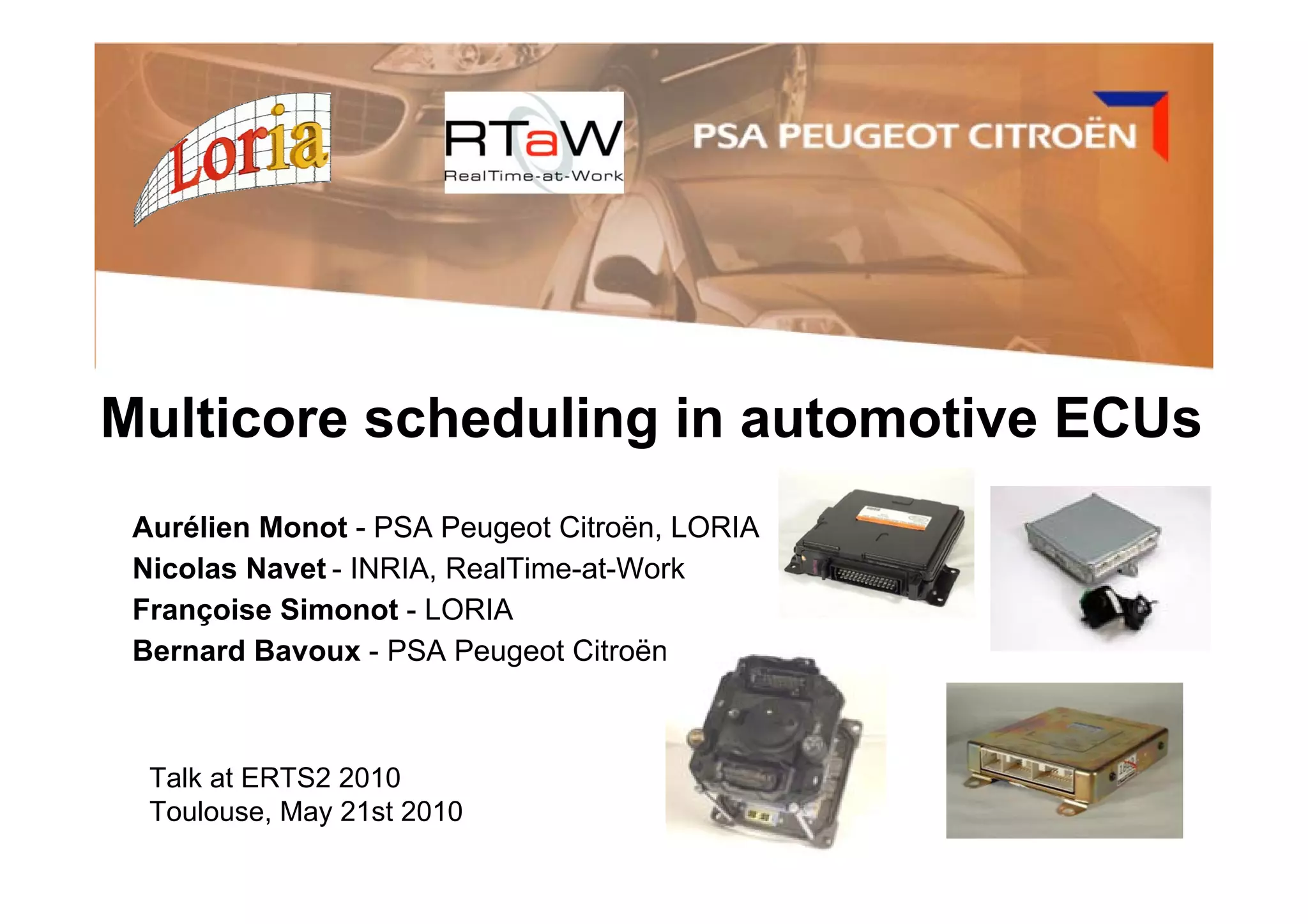
Multicore scheduling in automotive ECUs
 Aurélien Monot - PSA Peugeot Citroën, LORIA
 Nicolas Navet - INRIA, RealTime-at-Work
 Françoise Simonot - LORIA
 Bernard Bavoux - PSA Peugeot Citroën


  Talk at ERTS2 2010
  Toulouse, May 21st 2010
2


                         Outlook

Context:
New tools and methodologies are needed as multicore ECUs
are being introduced in the automotive EE architecture.


Problem:
How to address the scheduling of numerous runnables on a
multicore ECUs in the context of the automotive domain?


Method:
Deployment of load balancing algorithms in ECU configuration
tools.
3


   The case of a generic car manufacturer


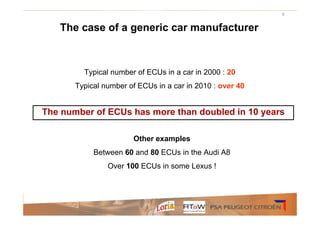
         Typical number of ECUs in a car in 2000 : 20
       Typical number of ECUs in a car in 2010 : over 40


The number of ECUs has more than doubled in 10 years

                       Other examples
            Between 60 and 80 ECUs in the Audi A8
                Over 100 ECUs in some Lexus !
4


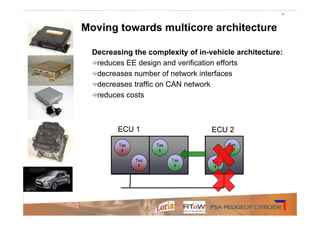
Moving towards multicore architecture

  Decreasing the complexity of in-vehicle architecture:
   reduces EE design and verification efforts
   decreases number of network interfaces
   decreases traffic on CAN network
   reduces costs


         ECU 1                     ECU 2
         Tas         Tas                 Tas
          k           k                   k

               Tas         Tas     Tas
                k           k       k
5


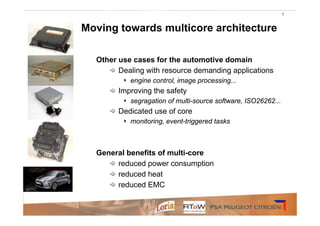
Moving towards multicore architecture

  Other use cases for the automotive domain
        Dealing with resource demanding applications
         ‣   engine control, image processing...
        Improving the safety
         ‣   segragation of multi-source software, ISO26262...
        Dedicated use of core
         ‣   monitoring, event-triggered tasks


  General benefits of multi-core
       reduced power consumption
       reduced heat
       reduced EMC
6


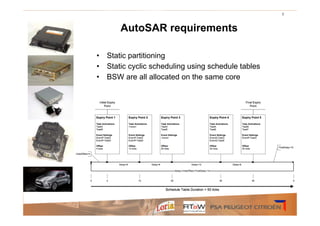
        AutoSAR requirements

•   Static partitioning
•   Static cyclic scheduling using schedule tables
•   BSW are all allocated on the same core
7


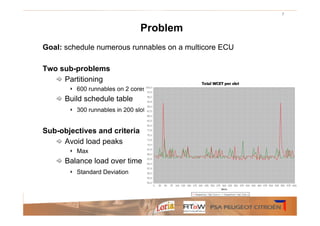
                                  Problem
Goal: schedule numerous runnables on a multicore ECU

Two sub-problems
     Partitioning
      ‣ 600 runnables on 2 cores : 2600 possible allocations
     Build schedule table
      ‣ 300 runnables in 200 slots (expiry points) : 200300 schedules

Sub-objectives and criteria
     Avoid load peaks
       ‣ Max
     Balance load over time
       ‣ Standard Deviation
8


                                          Model

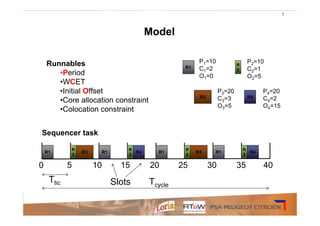
    Runnables                                             P1=10             R
                                                                                 P2=10
                                                    R1    C1=2                   C2=1
                                                                            2
       •Period                                            O1=0                   O2=5
       •WCET
       •Initial Offset                                              P3=20              P4=20
                                                          R3        C3=3         R4    C4=2
       •Core allocation constraint
                                                                    O3=5               O4=15
       •Colocation constraint


Sequencer task

                R                  R                R                           R
    R1              R3    R1         R4     R1           R3     R1                R4
                2                  2                2                           2

0           5            10      15       20       25          30           35         40
     Ttic                      Slots      Tcycle
9


                         Solution


Partitioning is dealt with as a bin packing problem
        Worst fit decreasing algorithm with fixed number of bins


Load Balancing is done with the Least Loaded algorithm (LL)
  inspired from CAN domain [Grenier and Navet ERTSS2008]
        Extended to handle non harmonic runnable sets (G-LL)
        Improved so as to reduce further load peaks (G-LLσ)

Implemented in a tool
      Freely available soon at http://www.realtimeatwork.com
10


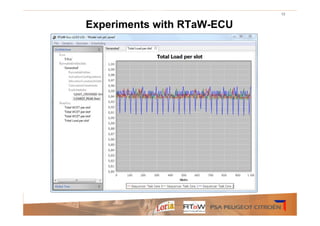
Experiments with RTaW-ECU
11


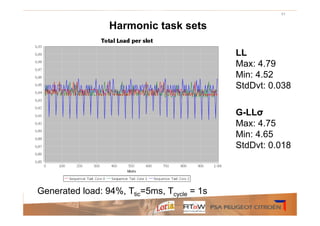
                 Harmonic task sets

                                             LL
                                             Max: 4.79
                                             Min: 4.52
                                             StdDvt: 0.038

                                             G-LLσ
                                             Max: 4.75
                                             Min: 4.65
                                             StdDvt: 0.018


Generated load: 94%, Ttic=5ms, Tcycle = 1s
12


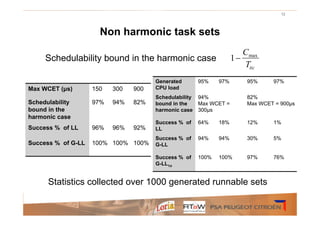
                      Non harmonic task sets
                                                                         Cmax
     Schedulability bound in the harmonic case                      1−
                                                                         Ttic
                                      Generated        95%    97%         95%     97%
Max WCET (μs)       150   300   900   CPU load
                                      Schedulability   94%                82%
Schedulability      97%   94%   82%   bound in the     Max WCET =         Max WCET = 900μs
bound in the                          harmonic case    300μs
harmonic case
                                      Success % of     64%    18%         12%     1%
Success % of LL     96%   96%   92%   LL
                                      Success % of     94%    94%         30%     5%
Success % of G-LL   100% 100% 100%    G-LL

                                      Success % of     100%   100%        97%     76%
                                      G-LL1σ


      Statistics collected over 1000 generated runnable sets
13

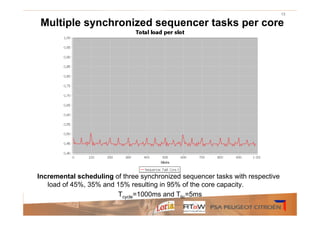
 Multiple synchronized sequencer tasks per core


Incremental scheduling of three synchronized sequencer tasks with respective
   load of 45%, 35% and 15% resulting in 95% of the core capacity.
                        Tcycle=1000ms and Ttic=5ms
14


   Multiple non synchronized sequencer
              tasks per core

Case arises for sequencer tasks using different tic counters
      Engine control applications (standard time vs RPM)


Any offset between the sequencer tasks and all clock rates are
  possible during runtime
      each sequencer task needs to be balanced
      independantly

Verification is possible considering maximum clock rates
       Multi-frame scheduling results can be used
15


                  Conclusion
Adoption of multicore ECU raises new challenges
     Evolution of software architecture design
     Scheduling of software components

We propose runnable scheduling heuristics for ECUs
     Fast and performant
     Easily adaptable for more advanced applications
     Compatible with AutoSAR R4.0 and its multicore
     extensions

Future work
      Precedence constraints
      Lockstep synchronization
      Distributed timing chains
16


Thank you for your attention

Multicore scheduling in automotive ECUs

  • 1.
    Multicore scheduling inautomotive ECUs Aurélien Monot - PSA Peugeot Citroën, LORIA Nicolas Navet - INRIA, RealTime-at-Work Françoise Simonot - LORIA Bernard Bavoux - PSA Peugeot Citroën Talk at ERTS2 2010 Toulouse, May 21st 2010
  • 2.
    2 Outlook Context: New tools and methodologies are needed as multicore ECUs are being introduced in the automotive EE architecture. Problem: How to address the scheduling of numerous runnables on a multicore ECUs in the context of the automotive domain? Method: Deployment of load balancing algorithms in ECU configuration tools.
  • 3.
    3 The case of a generic car manufacturer Typical number of ECUs in a car in 2000 : 20 Typical number of ECUs in a car in 2010 : over 40 The number of ECUs has more than doubled in 10 years Other examples Between 60 and 80 ECUs in the Audi A8 Over 100 ECUs in some Lexus !
  • 4.
    4 Moving towards multicorearchitecture Decreasing the complexity of in-vehicle architecture: reduces EE design and verification efforts decreases number of network interfaces decreases traffic on CAN network reduces costs ECU 1 ECU 2 Tas Tas Tas k k k Tas Tas Tas k k k
  • 5.
    5 Moving towards multicorearchitecture Other use cases for the automotive domain Dealing with resource demanding applications ‣ engine control, image processing... Improving the safety ‣ segragation of multi-source software, ISO26262... Dedicated use of core ‣ monitoring, event-triggered tasks General benefits of multi-core reduced power consumption reduced heat reduced EMC
  • 6.
    6 AutoSAR requirements • Static partitioning • Static cyclic scheduling using schedule tables • BSW are all allocated on the same core
  • 7.
    7 Problem Goal: schedule numerous runnables on a multicore ECU Two sub-problems Partitioning ‣ 600 runnables on 2 cores : 2600 possible allocations Build schedule table ‣ 300 runnables in 200 slots (expiry points) : 200300 schedules Sub-objectives and criteria Avoid load peaks ‣ Max Balance load over time ‣ Standard Deviation
  • 8.
    8 Model Runnables P1=10 R P2=10 R1 C1=2 C2=1 2 •Period O1=0 O2=5 •WCET •Initial Offset P3=20 P4=20 R3 C3=3 R4 C4=2 •Core allocation constraint O3=5 O4=15 •Colocation constraint Sequencer task R R R R R1 R3 R1 R4 R1 R3 R1 R4 2 2 2 2 0 5 10 15 20 25 30 35 40 Ttic Slots Tcycle
  • 9.
    9 Solution Partitioning is dealt with as a bin packing problem Worst fit decreasing algorithm with fixed number of bins Load Balancing is done with the Least Loaded algorithm (LL) inspired from CAN domain [Grenier and Navet ERTSS2008] Extended to handle non harmonic runnable sets (G-LL) Improved so as to reduce further load peaks (G-LLσ) Implemented in a tool Freely available soon at http://www.realtimeatwork.com
  • 10.
  • 11.
    11 Harmonic task sets LL Max: 4.79 Min: 4.52 StdDvt: 0.038 G-LLσ Max: 4.75 Min: 4.65 StdDvt: 0.018 Generated load: 94%, Ttic=5ms, Tcycle = 1s
  • 12.
    12 Non harmonic task sets Cmax Schedulability bound in the harmonic case 1− Ttic Generated 95% 97% 95% 97% Max WCET (μs) 150 300 900 CPU load Schedulability 94% 82% Schedulability 97% 94% 82% bound in the Max WCET = Max WCET = 900μs bound in the harmonic case 300μs harmonic case Success % of 64% 18% 12% 1% Success % of LL 96% 96% 92% LL Success % of 94% 94% 30% 5% Success % of G-LL 100% 100% 100% G-LL Success % of 100% 100% 97% 76% G-LL1σ Statistics collected over 1000 generated runnable sets
  • 13.
    13 Multiple synchronizedsequencer tasks per core Incremental scheduling of three synchronized sequencer tasks with respective load of 45%, 35% and 15% resulting in 95% of the core capacity. Tcycle=1000ms and Ttic=5ms
  • 14.
    14 Multiple non synchronized sequencer tasks per core Case arises for sequencer tasks using different tic counters Engine control applications (standard time vs RPM) Any offset between the sequencer tasks and all clock rates are possible during runtime each sequencer task needs to be balanced independantly Verification is possible considering maximum clock rates Multi-frame scheduling results can be used
  • 15.
    15 Conclusion Adoption of multicore ECU raises new challenges Evolution of software architecture design Scheduling of software components We propose runnable scheduling heuristics for ECUs Fast and performant Easily adaptable for more advanced applications Compatible with AutoSAR R4.0 and its multicore extensions Future work Precedence constraints Lockstep synchronization Distributed timing chains
  • 16.
    16 Thank you foryour attention