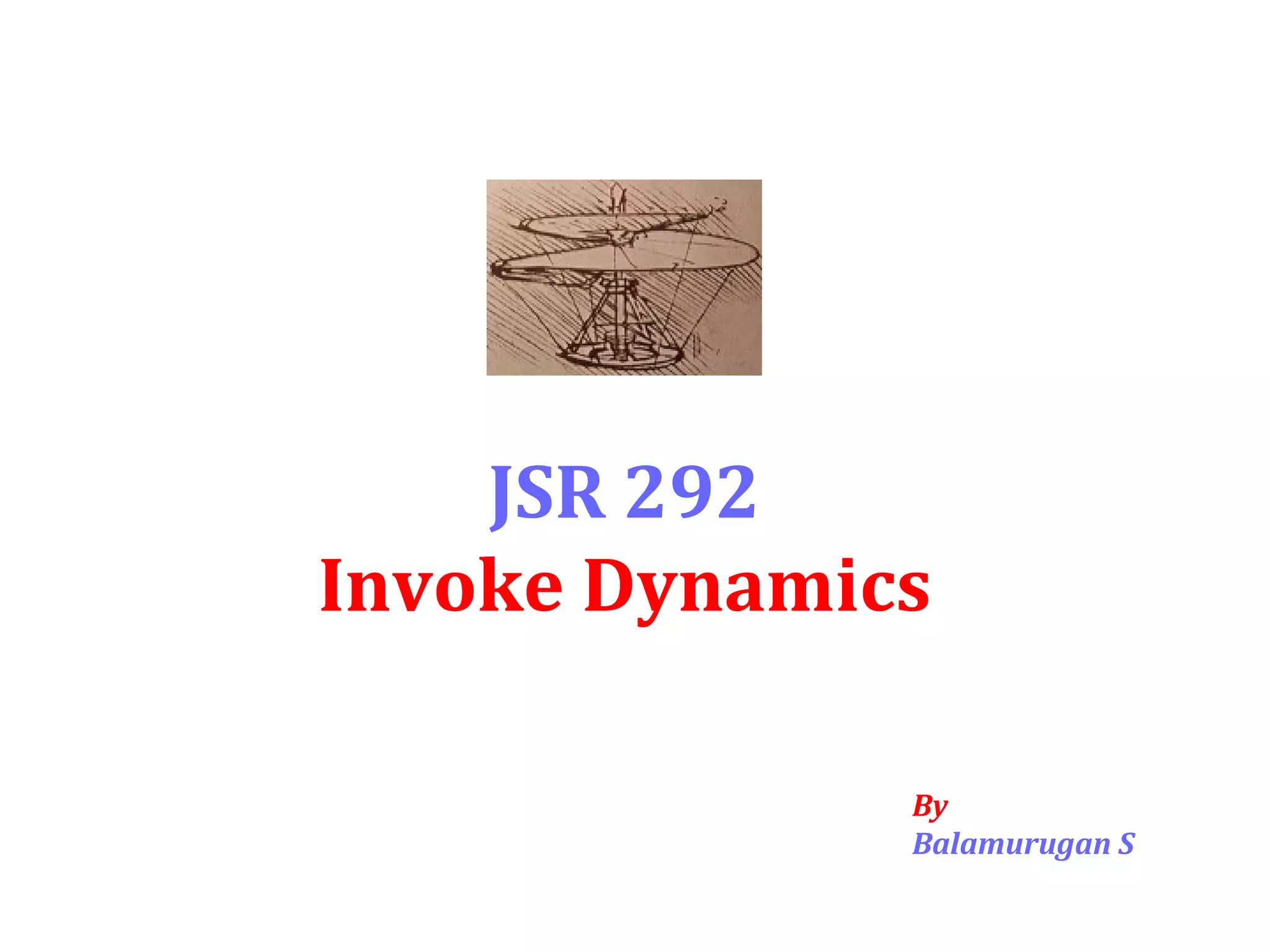
JSR 292 Invoke Dynamics By Balamurugan S
My Info 4+ years of experience in Java  Currently working in logica Worked as a trainer for two years Completed SCJP, SCWCD and SCBCD certifications Passion in learning new technologies and training people Joined JUG Chennai few months back
Why JSR 292 ? Dynamically Typed  Languages Performance Invokedynamic instruction Hotswappable classes – Interface Injection
Dynamically Typed Languages and the JVM What is the JVM? Statically Typed Languages vs. Dynamically Typed  Languages JSR 223 — A First Step in Dynamic Language Support
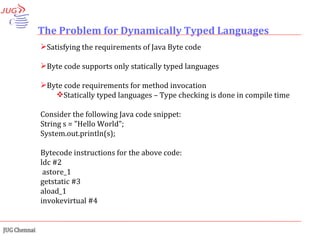
The Problem for Dynamically Typed Languages Satisfying the requirements of Java Byte code Byte code supports only statically typed languages Byte code requirements for method invocation Statically typed languages – Type checking is done in compile time Consider the following Java code snippet:  String s = "Hello World";  System.out.println(s);  Bytecode instructions for the above code: ldc #2 astore_1  getstatic #3  aload_1  invokevirtual #4
JSR 292 — The Next Step in Dynamic Language Support Introduction of new java byte code instruction “invokedynamic” and new method linkage mechanism Bytecode Instructions for Method Invocation: Since its inception, the Java Virtual Machine Specification has specified four bytecodes for method invocation invokevirtual invokeinterface invokestatic Invokespecial Let's examine invokevirtual and invokeinterface instruction, because it's similar in format to the new “invokedynamic” instruction.
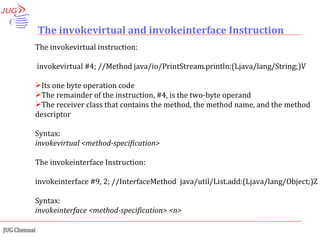
The invokevirtual and invokeinterface Instruction The invokevirtual instruction: invokevirtual #4; //Method java/io/PrintStream.println:(Ljava/lang/String;)V  Its one byte operation code The remainder of the instruction, #4, is the two-byte operand The receiver class that contains the method, the method name, and the method descriptor Syntax: invokevirtual <method-specification>  The invokeinterface Instruction: invokeinterface #9, 2; //InterfaceMethod  java/util/List.add:(Ljava/lang/Object;)Z Syntax: invokeinterface <method-specification> <n>
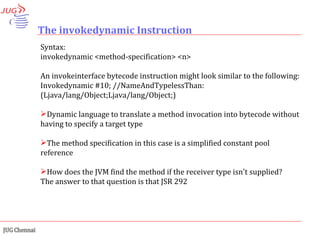
The invokedynamic Instruction Syntax: invokedynamic <method-specification> <n>  An invokeinterface bytecode instruction might look similar to the following:  Invokedynamic #10; //NameAndTypelessThan:(Ljava/lang/Object;Ljava/lang/Object;)  Dynamic language to translate a method invocation into bytecode without having to specify a target type  The method specification in this case is a simplified constant pool reference How does the JVM find the method if the receiver type isn't supplied? The answer to that question is that JSR 292
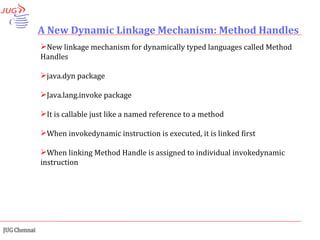
A New Dynamic Linkage Mechanism: Method Handles New linkage mechanism for dynamically typed languages called Method Handles java.dyn package Java.lang.invoke package It is callable just like a named reference to a method When invokedynamic instruction is executed, it is linked first When linking Method Handle is assigned to individual invokedynamic instruction
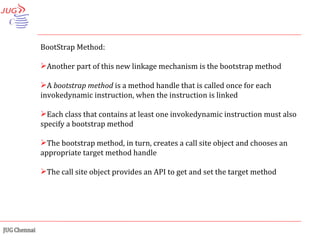
BootStrap Method: Another part of this new linkage mechanism is the bootstrap method A  bootstrap method  is a method handle that is called once for each invokedynamic instruction, when the instruction is linked Each class that contains at least one invokedynamic instruction must also specify a bootstrap method The bootstrap method, in turn, creates a call site object and chooses an appropriate target method handle The call site object provides an API to get and set the target method
Here, for example, is a snippet of bytecode that calls a method handle:  getfield myMH  ldc #999  invokevirtual #44 //Method java/dyn/MethodHandle:invoke(I)I  istore 5  When a bootstrap method is called for an unlinked dynamic call site, it is passed the following information:  The java.lang.Class object for the class containing the instruction.  The method name represented as a String.  The resolved descriptor for the instruction, represented as a java.dyn.MethodType token.   
Sample code snippet import java.lang.invoke.*; import java.sql.*; public class Query { static {  //Bootstrap method Linkage.registerBootstrapMethod(&quot;doBootstrap&quot;); } public static ResultSet query(String queryString, Object... params) { //Performs query, return ResultSet } public static CallSite doBootstrap(Class caller, String methodName, MethodType type) { MethodHandles.Lookup lookup = MethodHandles.lookup(); //Lookup the class that has the method that we will be linking to //In this case, query is in the same class Class me = lookup.lookupClass(); //Lookup query method by matching the parameter type and return type MethodHandle rawQuery = lookup.findStatic(me, &quot;query&quot; , MethodType.methodType(ResultSet.class, String.class, Object[].class)); //Set the method name as the first parameter to query() MethodHandle cookedQuery = MethodHandles.insertArguments(rawQuery, 0, methodName); //Return a CallSite object back to the JVM to continue with the call return (new ConstantCallSite(MethodHandles.collectArguments(cookedQuery, type))); }
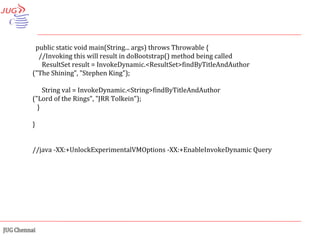
public static void main(String... args) throws Throwable { //Invoking this will result in doBootstrap() method being called ResultSet result = InvokeDynamic.<ResultSet>findByTitleAndAuthor (&quot;The Shining&quot;, &quot;Stephen King&quot;); String val = InvokeDynamic.<String>findByTitleAndAuthor (&quot;Lord of the Rings&quot;, &quot;JRR Tolkein&quot;); } } //java -XX:+UnlockExperimentalVMOptions -XX:+EnableInvokeDynamic Query
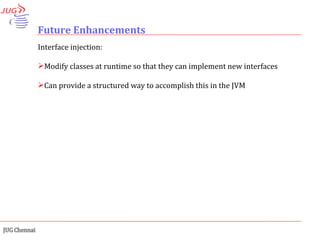
Future Enhancements Interface injection: Modify classes at runtime so that they can implement new interfaces Can provide a structured way to accomplish this in the JVM
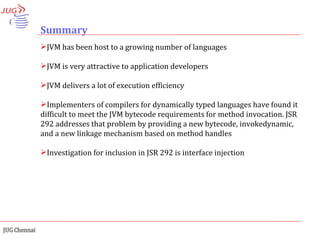
Summary JVM has been host to a growing number of languages JVM is very attractive to application developers  JVM delivers a lot of execution efficiency Implementers of compilers for dynamically typed languages have found it difficult to meet the JVM bytecode requirements for method invocation. JSR 292 addresses that problem by providing a new bytecode, invokedynamic, and a new linkage mechanism based on method handles Investigation for inclusion in JSR 292 is interface injection
Thank ‘U’ email: ssrbala@gmail.com
Queries?

Invoke dynamics

  • 1.
    JSR 292 InvokeDynamics By Balamurugan S
  • 2.
    My Info 4+years of experience in Java Currently working in logica Worked as a trainer for two years Completed SCJP, SCWCD and SCBCD certifications Passion in learning new technologies and training people Joined JUG Chennai few months back
  • 3.
    Why JSR 292? Dynamically Typed Languages Performance Invokedynamic instruction Hotswappable classes – Interface Injection
  • 4.
    Dynamically Typed Languagesand the JVM What is the JVM? Statically Typed Languages vs. Dynamically Typed Languages JSR 223 — A First Step in Dynamic Language Support
  • 5.
    The Problem forDynamically Typed Languages Satisfying the requirements of Java Byte code Byte code supports only statically typed languages Byte code requirements for method invocation Statically typed languages – Type checking is done in compile time Consider the following Java code snippet: String s = &quot;Hello World&quot;; System.out.println(s); Bytecode instructions for the above code: ldc #2 astore_1 getstatic #3 aload_1 invokevirtual #4
  • 6.
    JSR 292 —The Next Step in Dynamic Language Support Introduction of new java byte code instruction “invokedynamic” and new method linkage mechanism Bytecode Instructions for Method Invocation: Since its inception, the Java Virtual Machine Specification has specified four bytecodes for method invocation invokevirtual invokeinterface invokestatic Invokespecial Let's examine invokevirtual and invokeinterface instruction, because it's similar in format to the new “invokedynamic” instruction.
  • 7.
    The invokevirtual andinvokeinterface Instruction The invokevirtual instruction: invokevirtual #4; //Method java/io/PrintStream.println:(Ljava/lang/String;)V Its one byte operation code The remainder of the instruction, #4, is the two-byte operand The receiver class that contains the method, the method name, and the method descriptor Syntax: invokevirtual <method-specification> The invokeinterface Instruction: invokeinterface #9, 2; //InterfaceMethod java/util/List.add:(Ljava/lang/Object;)Z Syntax: invokeinterface <method-specification> <n>
  • 8.
    The invokedynamic InstructionSyntax: invokedynamic <method-specification> <n> An invokeinterface bytecode instruction might look similar to the following: Invokedynamic #10; //NameAndTypelessThan:(Ljava/lang/Object;Ljava/lang/Object;) Dynamic language to translate a method invocation into bytecode without having to specify a target type The method specification in this case is a simplified constant pool reference How does the JVM find the method if the receiver type isn't supplied? The answer to that question is that JSR 292
  • 9.
    A New DynamicLinkage Mechanism: Method Handles New linkage mechanism for dynamically typed languages called Method Handles java.dyn package Java.lang.invoke package It is callable just like a named reference to a method When invokedynamic instruction is executed, it is linked first When linking Method Handle is assigned to individual invokedynamic instruction
  • 10.
    BootStrap Method: Anotherpart of this new linkage mechanism is the bootstrap method A bootstrap method is a method handle that is called once for each invokedynamic instruction, when the instruction is linked Each class that contains at least one invokedynamic instruction must also specify a bootstrap method The bootstrap method, in turn, creates a call site object and chooses an appropriate target method handle The call site object provides an API to get and set the target method
  • 11.
    Here, for example,is a snippet of bytecode that calls a method handle: getfield myMH ldc #999 invokevirtual #44 //Method java/dyn/MethodHandle:invoke(I)I istore 5 When a bootstrap method is called for an unlinked dynamic call site, it is passed the following information: The java.lang.Class object for the class containing the instruction. The method name represented as a String. The resolved descriptor for the instruction, represented as a java.dyn.MethodType token.  
  • 12.
    Sample code snippetimport java.lang.invoke.*; import java.sql.*; public class Query { static { //Bootstrap method Linkage.registerBootstrapMethod(&quot;doBootstrap&quot;); } public static ResultSet query(String queryString, Object... params) { //Performs query, return ResultSet } public static CallSite doBootstrap(Class caller, String methodName, MethodType type) { MethodHandles.Lookup lookup = MethodHandles.lookup(); //Lookup the class that has the method that we will be linking to //In this case, query is in the same class Class me = lookup.lookupClass(); //Lookup query method by matching the parameter type and return type MethodHandle rawQuery = lookup.findStatic(me, &quot;query&quot; , MethodType.methodType(ResultSet.class, String.class, Object[].class)); //Set the method name as the first parameter to query() MethodHandle cookedQuery = MethodHandles.insertArguments(rawQuery, 0, methodName); //Return a CallSite object back to the JVM to continue with the call return (new ConstantCallSite(MethodHandles.collectArguments(cookedQuery, type))); }
  • 13.
    public static voidmain(String... args) throws Throwable { //Invoking this will result in doBootstrap() method being called ResultSet result = InvokeDynamic.<ResultSet>findByTitleAndAuthor (&quot;The Shining&quot;, &quot;Stephen King&quot;); String val = InvokeDynamic.<String>findByTitleAndAuthor (&quot;Lord of the Rings&quot;, &quot;JRR Tolkein&quot;); } } //java -XX:+UnlockExperimentalVMOptions -XX:+EnableInvokeDynamic Query
  • 14.
    Future Enhancements Interfaceinjection: Modify classes at runtime so that they can implement new interfaces Can provide a structured way to accomplish this in the JVM
  • 15.
    Summary JVM hasbeen host to a growing number of languages JVM is very attractive to application developers JVM delivers a lot of execution efficiency Implementers of compilers for dynamically typed languages have found it difficult to meet the JVM bytecode requirements for method invocation. JSR 292 addresses that problem by providing a new bytecode, invokedynamic, and a new linkage mechanism based on method handles Investigation for inclusion in JSR 292 is interface injection
  • 16.
    Thank ‘U’ email:ssrbala@gmail.com
  • 17.