MUJI
Strategic Review
Made by Junxian Qu
Edited BY Dong Wang, Wan Zhang
Wei-Yu Hsieh
PART ONE PART TWO PART THREE PART FOUR
01
02
03
04
Company Purpose
External Environment
Internal Environment
International Strategy
Agenda
1
About MUJI
• Background
• Vision
• Mission
• Value
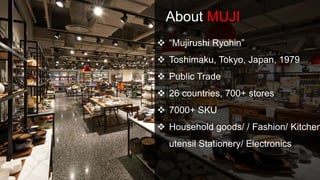
About MUJI
 “Mujirushi Ryohin”
 Toshimaku, Tokyo, Japan, 1979
 Public Trade
 26 countries, 700+ stores
 7000+ SKU
 Household goods/ / Fashion/ Kitchen
utensil Stationery/ Electronics
What is MUJI
MUJI Mission
MUJI Vision
 “There is no set answer to what
Ryohin is. But ask yourself the
question and you will see infinite
possibilities.”
2
External
Environment
• PEST
• 5 Forces
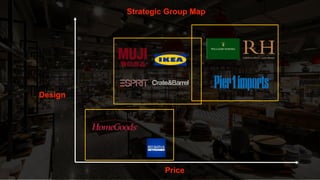
• Strategic Group Map
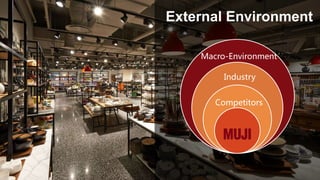
External Environment
Competitors
Industry
Macro-Environment
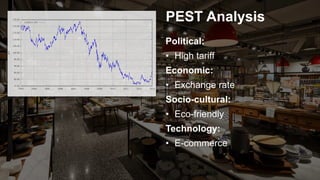
PEST Analysis
Political:
• High tariff
Economic:
• Exchange rate
Socio-cultural:
• Eco-friendly
Technology:
• E-commerce
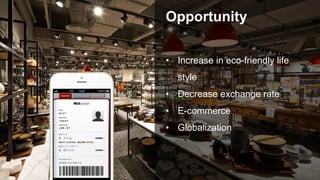
Opportunity
• Increase in eco-friendly life
style
• Decrease exchange rate
• E-commerce
• Globalization
Threat
• Cultural difference
• High tariff
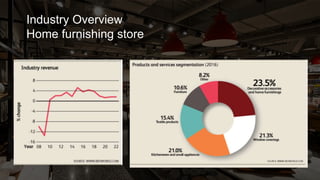
Industry Overview
Home furnishing store
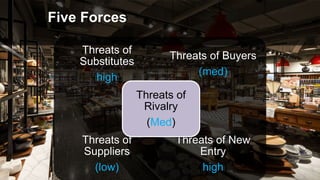
Five Forces
Threats of
Substitutes
(high)
Threats of Buyers
(med)
Threats of
Suppliers
(low)
Threats of New
Entry
(high)
Threats of
Rivalry
(Med)
High threat of entry
It is easy to enter the industry
It is easy to imitate (MiniSo)
High threat of
substitution
Clothing-Uniqlo
Furniture/life style-ikea
Stationary-piolet, Bic
Fabric-JC Penney’s
Design
Price
Strategic Group Map
3
Internal
Environment
• Strengths
• Weakness
S
W
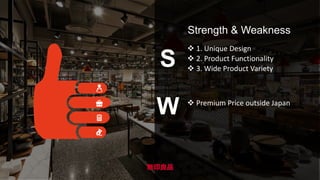
Strength & Weakness
 1. Unique Design
 2. Product Functionality
 3. Wide Product Variety
 Premium Price outside Japan
4
Strategy
• Corporate Strategy
• International Strategy
Diversification
 The variety of products
 Compete in many markets
Diversification
 Related diversification
 Related Linked
 Designers
 Distribution channel
 Procurement
 Technology
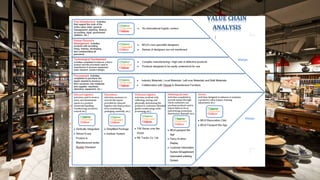
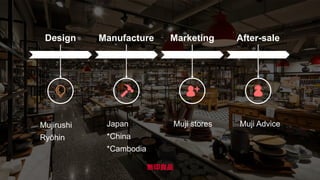
Vertical Integration
 1980s --- Design
 1983 --- First Store
 1985 --- Independent
procurement
 1989 --- Ryohin Keikaku Ltd
Now --- After sale service
After-saleDesign Manufacture Marketing
Japan
*China
*Cambodia
Muji stores Muji AdviceMujirushi
Ryōhin
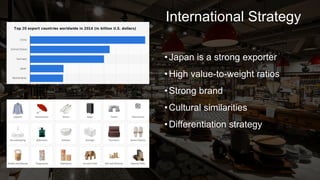
International Strategy
•Japan is a strong exporter
•High value-to-weight ratios
•Strong brand
•Cultural similarities
•Differentiation strategy
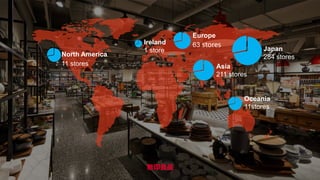
North America
11 stores Asia
211 stores
Ireland
1 store
Oceania
11stores
Europe
63 stores
Japan
284 stores
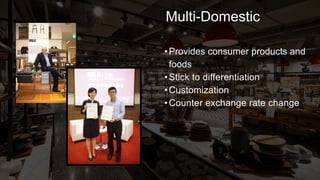
Multi-Domestic
•Provides consumer products and
foods
•Stick to differentiation
•Customization
•Counter exchange rate change
THANK YOU
Citation
• What is MUJI? http://www.muji.com/us/feature/whatismuji/
• Behind The Label: MUJI, on July 25, 2012, by Jessica Marati, ecosalon.com/behind-the-label-muji/
• Useful and agreeable, http://web.archive.org/web/20090527173256/
• http://www.usefulandagreeable.com/muji.html
• Corporate Information ryohin-keikaku.jp/eng/corporate/
• Muji Economics Project,
http://webcache.googleusercontent.com/search?q=cache:http://www.plkclscmc.edu.hk/resource/subjects/econ/M
UJI.pdf
• http://www.liutan88.com/ltfzd/mujijfycxd_1.html

Muji Strategy Review

Editor's Notes

  • #5   MUJI, originally founded in Japan in 1980 It is derived from its Japanese name, which means “no-brand quality goods.” It is a public trade company, they have over 700 stores across over 26 countries, and offers over 7000 products. Muji positions itself in terms of three basic ideas: “Simple, Functional and Affordable” For people who is unfamiliar with Muji, I am going to show you a video which briefly explained what is Muji.
  • #6 As mentioned in the video, Muji offers a wide variety of high quality products including: household goods, apparel and food. Many American consumers viewed MUJI as the quiet version of IKEA
  • #7 It is unclear on what the organization does, and it could be easily get mixed up with another similar brand. Ex: IKEA also have the simple design and familiar products
  • #8 Same for their vision, it is unclear for the most audience on what their goal is. However, in my personal opinion, MUJI did follow their vision by continuing to expand their market by offering new creative and high quality product Ex: Muji selling office supplies, household goods, travelling tools and apparels, then Meal Muji- restaurant, muji car 1000, 2001 product collaboration with Nissan Yes, Muji does have the organizational value because it does follow its mission and vision to expand their market to offers simple, nature good quality of products to consumers
  • #9 Pest industry Five forces
  • #11 Increase in Tariffs (political-legal)—give example/numbers/laws to support it Eco-friendly life style(social-cultral) Globalizationon In crease in E-commerce (technological, social cultral)
  • #12 Popularity of customized products Environmental protection High inflation rate
  • #13 Competition Rise of cost of raw material Labor cost 名创优品
  • #14 It is actually not eco friendly Behind The Label: MUJI, on July 25, 2012, by Jessica Marati, ecosalon.com/behind-the-label-muji/ Embrace internet How Muji succeed from O2O, 2015/12/02 www.woshipm.com/it/244490.html
  • #15 Competition Rise of cost of raw material Labor cost 名创优品
  • #16 Popularity of customized products Environmental protection High inflation rate
  • #17 Popularity of customized products Environmental protection High inflation rate
  • #18 Competition Rise of cost of raw material Labor cost 名创优品
  • #19 Pest industry Five forces
  • #22 In what stages of the industry value chain should we participate? Related to the topic of vertical integration What range of products and services should the we offer? Related to the topic of diversification Where should we compete geographically? Related to the topic of geographic scope
  • #23 Corporate Diversification: Expanding Beyond a Single Market Vertical Integration along the Industry Value Chain Diversification Increase in: The variety of products / services a firm offers, or The markets / geographic regions in which it competes Can be targeted towards: Products Geography Product-Market Provide economies of scale: reduces costs Exploit economies of scope: increases value Reduce costs and increase value
  • #25 Related Linked: some businesses share competencies
  • #26 1980. The Mujirushi Ryōhin was a private owned brand of Seiyu Corporation, its only responsibility is to design Within 3 years, Muji received a lot of attention, became a very successful brand, and started its own store In 1983, the first directly operated Mujirushi Ryōhin store opened In 1985, Mujirushi Ryōhin gains more autonomy, It started overseas production and procurement, it is allowed to place direct factory orders In 1989, Ryohin Keikaku Ltd became the manufacturer and retailer for all Mujirushi Ryōhin products and operations, including planning, development, production, distribution and sale. In 1991, Mujirushi Ryōhin opened its first international store in London.
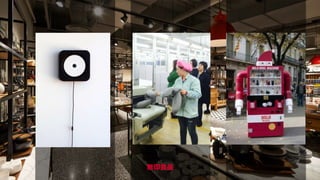
  • #27 Design: Muji products are not attributed to individual designers. There are, however, some designers who made their involvement public. The notable are Naoto Fukasawa Jasper Morrison, James Irvine, Sam Hecht, Muji participates in design collaborations with other companies. In 2001, Muji and Nissan Motors produced the Muji Car 1000. Following Muji's no-brand strategy the car had no logos Production As well as its designers, ordinarily Muji keeps its manufacturers private. collaboration with Thonet, the oldest German furniture maker
  • #28 Design: Muji products are not attributed to individual designers. There are, however, some designers who made their involvement public. The notable are Naoto Fukasawa Jasper Morrison, James Irvine, Sam Hecht, Muji participates in design collaborations with other companies. In 2001, Muji and Nissan Motors produced the Muji Car 1000. Following Muji's no-brand strategy the car had no logos Production As well as its designers, ordinarily Muji keeps its manufacturers private. collaboration with Thonet, the oldest German furniture maker http://www.liutan88.com/ltfzd/mujijfycxd_1. https://www.pinterest.com/pin/158540849354088003/ (Spain)
  • #29 Often the first step in internationalizing. Used by MNEs with relatively large domestic markets or strong exporters (e.g., MNEs from the United States, Germany, Japan, South Korea). Well-suited for high-end products with high value-to-weight ratios such as machine tools and luxury goods that can be shipped across the globe. Products and services tend to have strong brands. Main business-level strategy tends to be differentiation because exporting, licensing, and franchising add additional costs. Leveraging core competencies. Economies of scale. Low-cost implementation through: Exporting or licensing (for products) Franchising (for services) Licensing (for trademarks) No or limited local responsiveness. Highly affected by exchange-rate fluctuations. IP embedded in product or service could be expropriated.
  • #30 In Japan, Ryohin Keikaku has directly operated 284 stores and supplies 117 outlets, as of January 2016.[10] There are 303 International retail outlets as of January 2016 which include UK (12), France (12), Italy (9), Germany (8), Ireland(1), Sweden (7), Norway (4), Spain (6), Turkey (2), Poland (1), Portugal (1), United States (10), Canada (2), Hong Kong (14),Singapore (10), Malaysia (5), South Korea (14), Mainland China (128), Taiwan (33), Thailand (12), Australia (2), Indonesia (2),Philippines (7), Kuwait (1), UAE (3).[10][11][12] In New York Muji supplies products to a design store at the Museum of Modern Art and maintains a flagship store.[9] Ryohin Keikaku has 284 directly operated stores in Japan, and has 5,271 (including 3,886 part-timers) employees.[13]
  • #31 Used by MNEs to compete in host countries with large and/or lucrative but idiosyncratic domestic markets (e.g., Germany, Japan, Saudi Arabia). Often used in consumer products and food industries. Main business-level strategy is differentiation. MNE wants to be perceived as local company Moved Muji Award from Japan to China for the first time in 2014 Partnered with Alibaba in China. Partner with Thonet in Europe.
  • #33 What is MUJI? http://www.muji.com/us/feature/whatismuji/ Behind The Label: MUJI, on July 25, 2012, by Jessica Marati, ecosalon.com/behind-the-label-muji/ Useful and agreeable, http://web.archive.org/web/20090527173256/ http://www.usefulandagreeable.com/muji.html Corporate Information ryohin-keikaku.jp/eng/corporate/ http://ryohin-keikaku.jp/eng/corporate/company.html http://www.liutan88.com/ltfzd/mujijfycxd_1.html