Citation: Molecular Therapy — Methods & Clinical Development (2015) 2, 15013; doi:10.1038/mtm.2015.13
© 2015 The American Society of Gene & Cell Therapy  All rights reserved 2329-0501/15
www.nature.com/mtm
INTRODUCTION
The retina, a typical neurovascular unit is composed of vascular
cells (endothelial and pericyte) that interact with neurons and glia
to maintain retinal homeostasis under variant conditions.1
Retinal
ischemia gauged as an inadequacy, but not essentially a complete
block of blood flow can result in failure to meet the high energy
demand of retina cells. Central and branched retinal vein occlusion
and diabetic retinopathy are the most well-defined retinal micro-
angiopathy diseases in adults.2
Due to lack of effective treatments,
retinal ischemia remains a common cause of visual impairment
and blindness in the working age. Therefore, understanding of the
molecular events that govern microvascular degeneration is critical
for devising new treatments for such blinding diseases.
Neurons and glia are the main source of neurotrophins, essential
factors for differentiation, development, and maturation of neuro-
nal cells.3–6
Although typically studied in relation to their actions
on neurons, the role of neurotrophins in maintaining the proper
function of the vasculature has gained recent attention. The first
discovered neurotrophin, nerve growth factor (NGF), is secreted as
a proform NGF (proNGF) that is traditionally cleaved intracellular by
furin and extracellular by the matrix metalloproteineases including
MMP-7 and -9 into the mature ligand.7
NGF promotes cell survival
by preferentially binding the prosurvival receptor tyrosine kinase A
(TrkA), while proNGF has high affinity to bind and activate p75NTR
,
resulting in cell death.3,8
Accumulation of proNGF has been associ-
ated with neurodegenerative diseases such as Alzheimer’s,9
Down’s
syndrome,10
and retinal neurodegenerative diseases.11,12
Our group
was the first to demonstrate that diabetes-induced oxidative milieu
impairs MMP-7 activity and maturation of NGF, resulting in accumu-
lation of its precursor, proNGF, in clinical and experimental diabe-
tes.13–15
Next, we attempted to mimic accumulation of proNGF via
an artificial model of overexpressing cleavage-resistant proNGF in
rat retina to examine molecular events triggered by proNGF apart
from diabetic milieu.16–18
These studies elucidated that proNGF
overexpression causes glial activation, retinal inflammation, and
neurodegeneration.
Deleterious effects of the proNGF/p75NTR
pathway on retinal
neurodegeneration have been shown to occur via direct action
on neurons16
or indirectly via paracrine stimulation of proinflam-
matory mediators in Müller cells.12,16,17
While the role of proNGF/
p75NTR
in mediating neuronal cell death is well-documented, the
extent and mechanism by which proNGF/p75NTR
contributes to reti-
nal endothelial cell (EC) death in vitro and development of acellular
capillaries in vivo remains unexplored. P75NTR
lacks intrinsic kinase
activity; instead, p75NTR
undergoes two-step proteolytic cleavage by
α- and γ-secretase to release the intracellular domain (p75ICD
) that
can recruit different protein adaptors to dictate specific signaling
pathways.19,20
In neurons, a number of interacting proteins have
Received 16 September 2014; accepted 13 February 2015
Accumulation of the nerve growth factor precursor (proNGF) and its receptor p75NTR
have been associated with several neuro-
degenerative diseases in both brain and retina. However, whether proNGF contributes to microvascular degeneration remain
unexplored. This study seeks to investigate the mechanism by which proNGF/p75NTR
induce endothelial cell (EC) death and devel-
opment of acellular capillaries, a surrogate marker of retinal ischemia. Stable overexpression of the cleavage-resistant proNGF and
molecular silencing of p75NTR
were utilized in human retinal EC and rat retinas in vivo. Stable overexpression of proNGF decreased
NGF levels and induced retinal vascular cell death evident by 1.9-fold increase in acellular capillaries and activation of JNK and
­cleaved-PARP that were mitigated by p75NTR
shRNA. In vitro, overexpression of proNGF did not alter TNF-α level, reduced NGF,
however induced EC apoptosis evident by activation of JNK and p38 MAPK, cleaved-PARP. Silencing p75NTR
using siRNA restored
expression of NGF and TrkA activation and prevented EC apoptosis. Treatment of EC with human-mutant proNGF induced apopto-
sis that coincided with marked protein interaction and nuclear translocation of p75NTR
and the neurotrophin receptor interacting
factor. These effects were abolished by a selective p75NTR
antagonist. Therefore, targeting p75NTR
represents a potential therapeutic
strategy for diseases associated with aberrant expression of proNGF.
Molecular Therapy — Methods & Clinical Development (2015) 2, 15013; doi:10.1038/mtm.2015.13; published online 6 May 2015
1
Program in Clinical and ExperimentalTherapeutics, College of Pharmacy, University of Georgia, Georgia, USA; 2
CulverVision Discovery Institute, Georgia Regents University,
Georgia, USA; 3
Charlie NorwoodVeterans Affairs Medical Center, Augusta, Georgia, USA.. Correspondence: AB El-Remessy (aelremessy@gru.edu or azza@uga.edu)
Silencing p75NTR
prevents proNGF-induced endothelial cell death
and development of acellular capillaries in rat retina
AhmedY Shanab1,2,3
, Barbara A Mysona1,2,3
, Suraporn Matragoon1,2,3
and Azza B El-Remessy1,2,3
Article
2
Modulating p75NTR
is vascular protective
AY Shanab et al.
Molecular Therapy — Methods & Clinical Development (2015) 15013 © 2015 The American Society of Gene & Cell Therapy
been identified that can bind the p75ICD
in the cytosol and activate
proapoptotic signaling including neurotrophin receptor interact-
ing factor (NRIF)21
and tumor necrosis factor receptor associated
­factor-6 (TRAF6).22
The significance of NRIF has been established
based on phenotypic similarities between NRIF–/–
and p75NTR–/–
mice23
and on its essential role in p75NTR
-mediated apoptosis in the
developing mouse retina.24
Nevertheless, the impact of modulating
expression p75NTR
on EC death and the crosstalk between p75NTR
and
TrkA in EC remain largely unexplored.
The aim of this study was to elucidate the molecular mecha-
nisms by which p75NTR
contributes to proNGF-induced acellular
capillary formation, a hallmark of retinal ischemia. A comprehensive
approach using stable overexpression of cleavage-resistant proNGF,
and pharmacological and molecular modulators of p75NTR
expres-
sion and activity were used to probe the mechanisms in vivo and
in vitro. The results demonstrate protective effect of modulating
p75NTR
expression at two levels: by inhibiting proapoptotic action
of proNGF/p75NTR
and by restoring endogenous survival pathways
of NGF/TrkA.
RESULTS
Silencing p75NTR
prevents proNGF accumulation and restores NGF
levels in rat retina
To examine the contribution of proNGF to retinal microvascular
degeneration, we used our established protocol of overexpressing
cleavage-resistant proNGF in rat retina.18
Before ­electroporation,
rats received single intraocular injection of one of the follow-
ing: pGFP plus scrambled shRNA (GFP+Scr), pGFP plus short hair-
pin RNA (shRNA) against p75NTR
(GFP+shRNA); pGFP-proNGF123,
a ­cleavage-resistant form of proNGF plus scrambled shRNA
(proNGF+Scr); pGFP-proNGF123 plus shRNA against p75NTR
(proNGF+shRNA). After 6-weeks, retinas were collected and
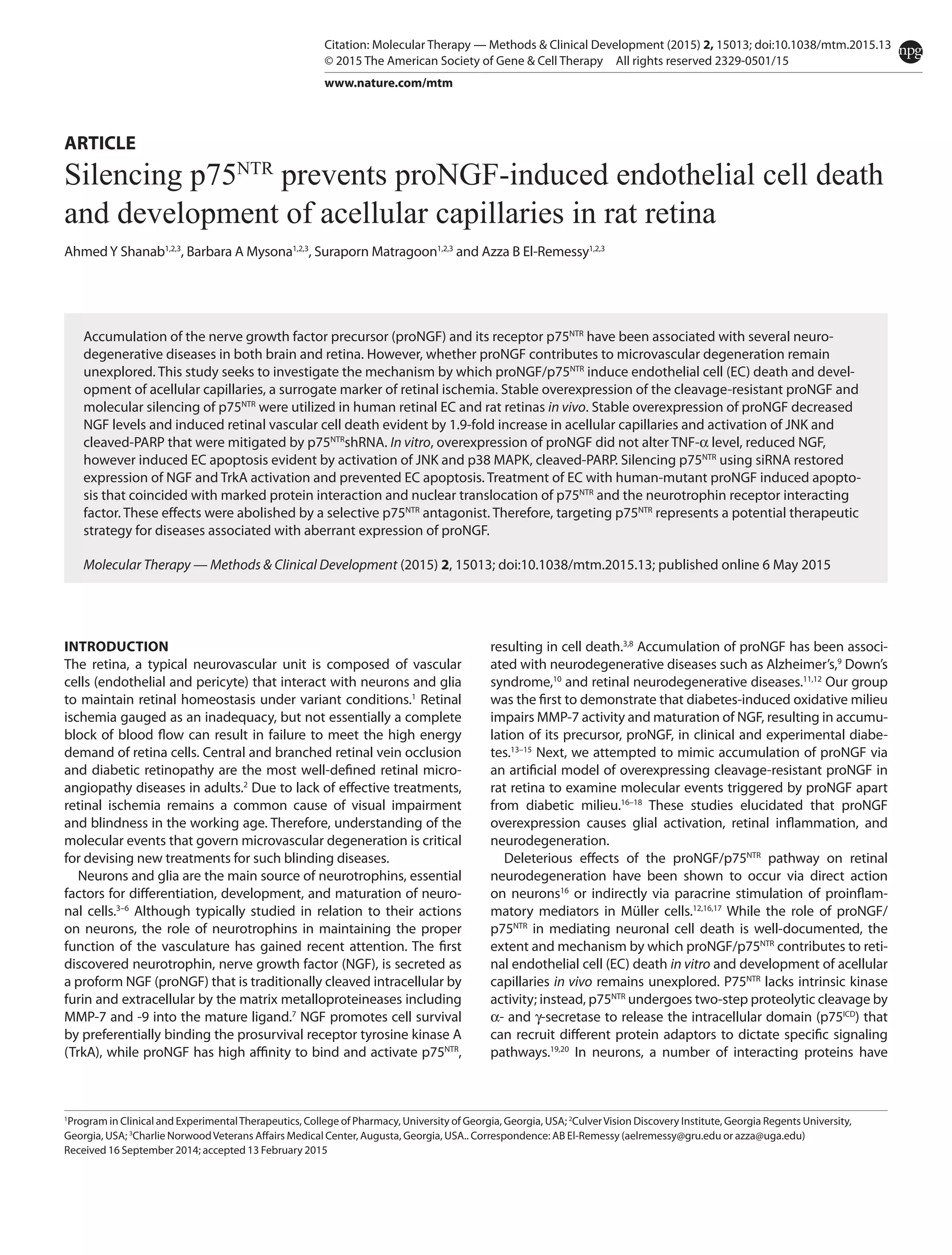
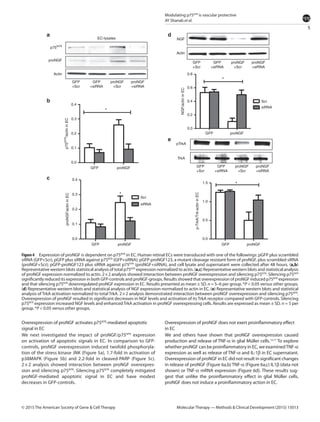
Figure1  Silencing p75NTR
prevents proNGF accumulation and restores NGF levels in rat retina. Rats received single intraocular injection of one of the
following: pGFP plus scrambled shRNA (GFP+Scr), pGFP plus shRNA against p75NTR
(GFP+shRNA); pGFP-proNGF123, a cleavage-resistant form of proNGF
plus scrambled shRNA (proNGF+Scr); pGFP-proNGF123 plus shRNA against p75NTR
(proNGF+shRNA). Retinas were lysed after 6 weeks. (a) Representative
western blot image and (b,c) statistical analysis of total p75NTR
(75 kDa) and its intracellular domain (ICD, 25 kDa) normalized to actin. A 2 × 2 analysis
showed a significant interaction between proNGF overexpression and silencing p75NTR
. Overexpression of proNGF induced expression of both total
p75NTR
and p75ICD
compared with GFP. Silencing p75NTR
with shRNA prevented the increase in p75NTR
and p75ICD
expression in proNGF group but not
in GFP group. n = 4–5 per group, *P < 0.05 versus other groups. (d) Representative western blot image and statistical analysis of proNGF expression
normalized to actin showing significant increases in proNGF in proNGF overexpressing group that were mitigated by silencing p75NTR
compared with
GFP controls. (e) Representative western blot images and statistical analysis of NGF expression normalized to actin. A 2 × 2 analysis showed a significant
interaction between proNGF overexpression and silencing p75NTR
. ProNGF overexpression resulted in significant decreases in NGF levels compared with
GFP. Silencing p75NTR
with shRNA significantly reduced NGF levels in GFP-controls and restored NGF levels in proNGF overexpressing retina. Results
presented as mean ± SD. n = 4–5 per group. *P < 0.05 versus other groups.
GFP
+Scr
p75NTR
p75ICD
Actin
proNGF
Actin
NGF
2.5
2.0
1.5
1.0
0.5
0.0
Actin
1.5
1.0
RetinalproNGF/actin
0.5
0.0
GFP proNGF
GFP proNGF
2.0
1.5
1.0
Retinalp75NTR
/actin
0.5
0.0
GFP proNGF
1.5
1.0
RetinalICD/actin
RetinalNGF/actin
0.5
0.0
GFP proNGF
Scrambled
*
*
*
*
p75shRNA
Scrambled
p75shRNA
Scrambled
p75shRNA
Scrambled
p75shRNA
proNGF
+Scr
GFP
+shRNA
proNGF
+shRNA
GFP
+Scr
proNGF
+Scr
GFP
+shRNA
proNGF
+shRNA
GFP
+Scr
proNGF
+Scr
GFP
+shRNA
proNGF
+shRNA
a
b
c
d
e
3
Modulating p75NTR
is vascular protective
AY Shanab et al.
Molecular Therapy — Methods & Clinical Development (2015) 15013© 2015 The American Society of Gene & Cell Therapy
examined to verify proNGF and p75NTR
expression. As shown in
Figure 1a, overexpression of proNGF induced expression of both
total p75NTR
and its intracellular domain (p75ICD
) compared with GFP-
control. A 2 × 2 analysis showed a significant interaction between
proNGF overexpression and silencing p75NTR
. Silencing p75NTR
with
shRNA prevented the increase in p75NTR
and p75ICD
expression
in proNGF group but not in GFP controls (Figure  1b,c). Silencing
p75NTR
mitigated the increase in proNGF level in the proNGF-over-
expressing group (proNGF+shRNA) comparable to GFP-controls
(Figure 1d).We next examined impact of proNGF overexpression on
NGF levels in rat retina. A 2 × 2 analysis showed a significant inter-
action between proNGF overexpression and silencing p75NTR
. As
shown in Figure 1e, proNGF overexpression resulted in significant
decreases in NGF levels compared with GFP-control similar to our
prior report.18
Silencing p75NTR
with shRNA significantly increased
NGF levels in proNGF overexpressing retina (Figure 1e). However,
silencing p75NTR
with shRNA significantly reduced NGF levels in
GFP+p75shRNA compared with GFP+Scrambled controls.
Silencing p75NTR
mitigates proNGF-induced retinal acellular
capillaries formation
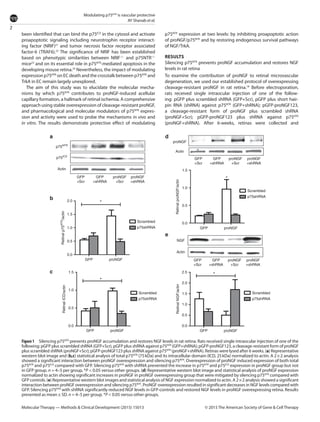
Prior work showed that proNGF overexpression can induce
formation of acellular capillaries,18
a surrogate marker for reti-
nal microangiopathy.25
To dissect the contribution of p75NTR
in
­proNGF-mediated acellular capillary formation, p75NTR
expression
was silenced using single intravitreal delivery of lentiviral par-
ticles containing shRNA against p75NTR
. Representative images of
periodic acid–Schiff and hematoxylin stained, trypsin-digested,
and flat-mounted retinas show acellular capillaries (arrows) identi-
fied as capillary-sized vessel tubes having no nuclei anywhere along
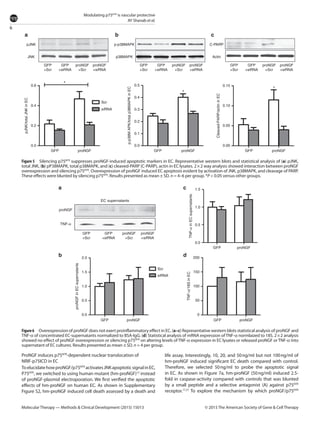
their length (see typical example in Figure 2f). 2 × 2 way analysis
showed interaction between proNGF overexpression and silenc-
ing p75NTR
. Overexpression of GFP-proNGF induced significant
(1.9-fold) increase in acellular capillaries compared with the control
­GFP-plasmid (Figure 2e). Silencing expression of p75NTR
using shRNA
mitigated proNGF-induced acellular-capillary formation but did not
alter the number in GFP-plasmid control group.
Silencing p75NTR
mitigates proNGF-induced apoptotic markers in
vivo
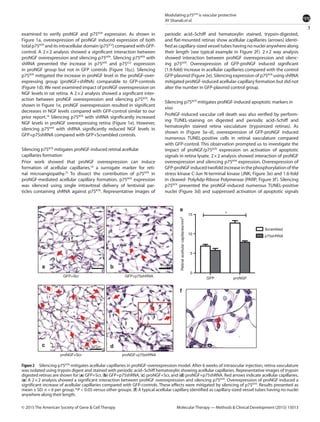
ProNGF-induced vascular cell death was also verified by perform-
ing TUNEL-staining on digested and periodic acid–Schiff and
hematoxylin stained retina vasculature (trypsinized retinas). As
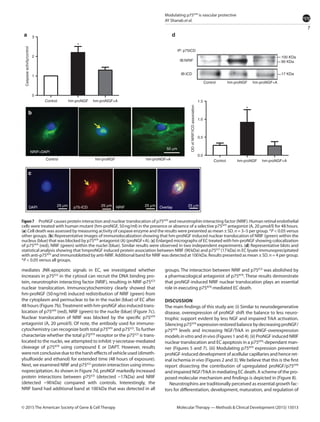
shown in (Figure  3a–d), overexpression of GFP-proNGF induced
numerous TUNEL-positive cells in retinal vasculature compared
with ­GFP-control. This observation prompted us to investigate the
impact of proNGF/p75NTR
expression on activation of apoptotic
signals in retina lysate. 2 × 2 analysis showed interaction of proNGF
overexpression and silencing p75NTR
expression. Overexpression of
GFP-proNGFinducedtwofoldincreaseinthephosphorylationofthe
stress kinase C-Jun N-terminal kinase (JNK; Figure 3e) and 1.6-fold
in cleaved- PolyAdp-Ribose Polymerase (PARP; Figure 3f). Silencing
p75NTR
prevented the proNGF-induced numerous ­TUNEL-positive
nuclei (Figure 3d) and suppressed activation of apoptotic signals
Figure 2  Silencing p75NTR
mitigates acellular capillaries in proNGF-overexpression model. After 6 weeks of intraocular injection, retina vasculature
was isolated using trypsin digest and stained with periodic acid–Schiff hematoxylin showing acellular capillaries. Representative images of trypsin
digested retinas are shown for (a) GFP+Scr, (b) GFP+p75shRNA, (c) proNGF+Scr, and (d) proNGF+p75shRNA. Red arrows indicate acellular capillaries.
(e) A 2 × 2 analysis showed a significant interaction between proNGF overexpression and silencing p75NTR
. Overexpression of proNGF induced a
significant increase of acellular capillaries compared with GFP-controls. These effects were mitigated by silencing of p75NTR
. Results presented as
mean ± SD. n = 6 per group. *P < 0.05 versus other groups. (f) A typical acellular capillary identified as capillary-sized vessel tubes having no nuclei
anywhere along their length.
GFP+Scr
50 µm 50 µm
50 µm 50 µm
GFP+p75shRNA
GFP proNGF
Scrambled
*
p75shRNA
15
10
Retinalacellularcapillaries/mm2
5
0
proNGF+Scr proNGF+p75shRNA
a b
f
e
c d
4
Modulating p75NTR
is vascular protective
AY Shanab et al.
Molecular Therapy — Methods & Clinical Development (2015) 15013 © 2015 The American Society of Gene & Cell Therapy
suggesting that p75NTR
is a critical mediator of proNGF-induced cap-
illary degeneration.
Expression of proNGF is dependent on p75NTR
in retinal endothelial
cells
Overexpression of proNGF has been shown to induce triad of events
in the retina including glial inflammation and neurodegeneration
that can contribute to microvascular degeneration. To dissect the
detrimental effects of proNGF in vasculature, we used proNGF
overexpression model in human retinal EC. ECs were transduced
with one of the followings: pGFP plus scrambled siRNA (GFP+Scr),
pGFP plus siRNA against p75NTR
(GFP+siRNA); pGFP-proNGF123,
plus scrambled siRNA (proNGF+Scr); pGFP-proNGF123 plus siRNA
against p75NTR
(proNGF+siRNA) and cell lysate and supernatant were
collected after 48 hours. 2 × 2 analysis showed interaction between
proNGF overexpression and silencing p75NTR
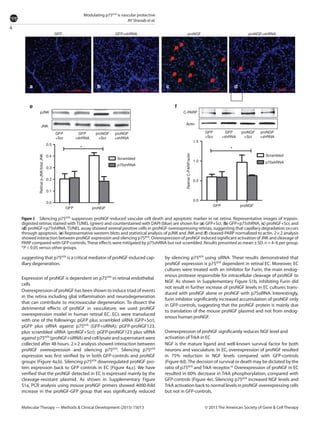
. Silencing p75NTR
expression was first verified by in both GFP-controls and proNGF
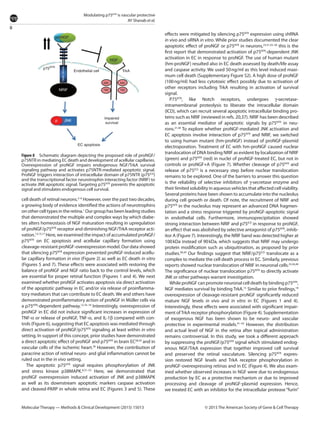
groups (Figure 4a,b). Silencing p75NTR
downregulated proNGF pro-
tein expression back to GFP controls in EC (Figure 4a,c). We have
verified that the proNGF detected in EC is expressed mainly by the
cleavage-resistant plasmid. As shown in Supplementary Figure
S1a, PCR analysis using mouse proNGF primers showed 4000-fold
increase in the proNGF-GFP group that was significantly reduced
by silencing p75NTR
using siRNA. These results demonstrated that
proNGF expression is p75NTR
dependent in retinal EC. Moreover, EC
cultures were treated with an inhibitor for Furin, the main endog-
enous protease responsible for intracellular cleavage of proNGF to
NGF. As shown in Supplementary Figure S1b, inhibiting Furin did
not result in further increase of proNGF levels in EC cultures trans-
duced with proNGF alone or proNGF with p75siRNA. Interestingly,
furin inhibitor significantly increased accumulation of proNGF only
in GFP-controls, suggesting that the proNGF protein is mainly due
to translation of the mouse proNGF plasmid and not from endog-
enous human proNGF.
Overexpression of proNGF significantly reduces NGF level and
activation of TrkA in EC
NGF is the mature ligand and well-known survival factor for both
neurons and vasculature. In EC, overexpression of proNGF resulted
in 75% reduction in NGF levels compared with GFP-controls
(Figure 4d).The decision of survival or death may be dictated by the
ratio of p75NTR
and TrkA receptor.26
Overexpression of proNGF in EC
resulted in 60% decrease in TrkA phosphorylation, compared with
GFP-controls (Figure 4e). Silencing p75NTR
increased NGF levels and
TrkA activation back to normal levels in proNGF overexpressing cells
but not in GFP-controls.
Figure 3  Silencing p75NTR
suppresses proNGF-induced vascular cell death and apoptotic marker in rat retina. Representative images of ­trypsin-
digested retinas stained withTUNEL (green) and counterstained with DAPI (blue) are shown for (a) GFP+Scr, (b) GFP+p75shRNA, (c) proNGF+Scr, and
(d) proNGF+p75shRNA. TUNEL assay showed several positive cells in proNGF-overexpressing retinas, suggesting that capillary degradation occurs
through apoptosis. (e) Representative western blots and statistical analysis of pJNK and JNK and (f) cleaved-PARP normalized to actin. 2 × 2 analysis
showed interaction between proNGF expression and silencing p75NTR
. Overexpression of proNGF induced significant activation of JNK and cleavage of
PARP compared with GFP-controls.These effects were mitigated by p75shRNA but not scrambled. Results presented as mean ± SD. n = 4–6 per group.
*P < 0.05 versus other groups.
GFP
a
e f
b c d
pJNK
JNK
GFP
+Scr
0.5
0.4
0.3
0.2
Retinalp-JNK/totalJNK
0.1
0.0
GFP proNGF
* *
GFP
+shRNA
proNGF
+shRNA
proNGF
+Scr
C-PARP
Actin
GFP
+Scr
GFP
+shRNA
p75shRNA
Scrambled
p75shRNA
Scrambled
1.5
1.0
RetinalC-PARP/actin
0.5
0.0
proNGF
+shRNA
proNGF
+Scr
GFP proNGF
proNGF+shRNAGFP+shRNA proNGF
5
Modulating p75NTR
is vascular protective
AY Shanab et al.
Molecular Therapy — Methods & Clinical Development (2015) 15013© 2015 The American Society of Gene & Cell Therapy
Overexpression of proNGF activates p75NTR
-mediated apoptotic
signal in EC
We next investigated the impact of proNGF/p75NTR
expression
on activation of apoptotic signals in EC. In comparison to GFP-
controls, proNGF overexpression induced twofold phosphoryla-
tion of the stress kinase JNK (Figure 5a), 1.7-fold in activation of
p38MAPK (Figure  5b) and 2.2-fold in cleaved-PARP (Figure  5c).
2 × 2 analysis showed interaction between proNGF overexpres-
sion and silencing p75NTR
. Silencing p75NTR
completely mitigated
proNGF-mediated apoptotic signal in EC and have modest
decreases in GFP-controls.
Overexpression of proNGF does not exert proinflammatory effect
in EC
We and others have shown that proNGF overexpression caused
production and release of TNF-α in glial Müller cells.12,17
To explore
whether proNGF can be proinflammatory in EC, we examined­TNF-α
expression as well as release of TNF-α and IL-1β in EC supernatant.
Overexpression of proNGF in EC did not result in significant changes
in release of proNGF (Figure 6a,b) TNF-α (Figure 6a,c) IL1β (data not
shown) or TNF-α mRNA expression (Figure 6d). These results sug-
gest that unlike the proinflammatory effect in glial Müller cells,
proNGF does not induce a proinflammatory action in EC.
Figure4  Expression of proNGF is dependent on p75NTR
in EC. Human retinal ECs were transduced with one of the followings: pGFP plus scrambled
siRNA (GFP+Scr), pGFP plus siRNA against p75NTR
(GFP+siRNA); pGFP-proNGF123, a mutant cleavage resistant form of proNGF, plus scrambled siRNA
(proNGF+Scr); pGFP-proNGF123 plus siRNA against p75NTR
(proNGF+siRNA), and cell lysate and supernatant were collected after 48 hours. (a,b)
Representative western blots statistical analysis of total p75NTR
expression normalized to actin. (a,c) Representative western blots and statistical analysis
of proNGF expression normalized to actin. 2 × 2 analysis showed interaction between proNGF overexpression and silencing p75NTR
. Silencing p75NTR
significantly reduced its expression in both GFP-controls and proNGF-groups. Results showed that overexpression of proNGF induced p75NTR
expression
and that silencing p75NTR
downregulated proNGF expression in EC. Results presented as mean ± SD. n = 5–6 per group. *P < 0.05 versus other groups.
(d) Representative western blots and statistical analysis of NGF expression normalized to actin in EC. (e) Representative western blots and statistical
analysis of TrkA activation normalized to total TrkA. 2 × 2 analysis demonstrated interaction between proNGF overexpression and silencing p75NTR
.
Overexpression of proNGF resulted in significant decreases in NGF levels and activation of its TrkA receptor compared with GFP-controls. Silencing
p75NTR
expression increased NGF levels and enhanced TrkA activation in proNGF overexpressing cells. Results are expressed as mean ± SD. n = 5 per
group. *P < 0.05 versus other groups.
GFP
+Scr
p75NTR
proNGF
Actin
proNGF
+Scr
GFP
+siRNA
EC-lysates
proNGF
+siRNA
GFP
+Scr
0.8
0.6
NGF/actininEC
0.4
0.2
0.4
0.3
0.2
p75NTR
/actininEC
0.1
0.0
0.0
GFP proNGF
GFP proNGF
0.4
1.5 *
*
*
*
1.0
p-TrkA/Trk-actininEC
0.5
0.0
0.3
0.2
proNGF/actininEC
0.1
0.0
GFP proNGF GFP proNGF
Scr
siRNA
Scr
siRNA
proNGF
+Scr
GFP
+siRNA
proNGF
+siRNA
GFP
+Scr
pTrkA
NGF
Actin
TrkA
proNGF
+Scr
GFP
+siRNA
proNGF
+siRNA
a d
e
b
c
6
Modulating p75NTR
is vascular protective
AY Shanab et al.
Molecular Therapy — Methods & Clinical Development (2015) 15013 © 2015 The American Society of Gene & Cell Therapy
ProNGF induces p75NTR
-dependent nuclear translocation of ­
NRIF-p75ICD in EC
ToelucidatehowproNGF/p75NTR
activatesJNKapoptoticsignalinEC,
P75NTR
, we switched to using human mutant (hm-proNGF)12
instead
of proNGF-plasmid electroporation. We first verified the apoptotic
effects of hm-proNGF on human EC. As shown in Supplementary
Figure S2, hm-proNGF induced cell death assessed by a death and
life assay. Interestingly, 10, 20, and 50 ng/ml but not 100 ng/ml of
hm-proNGF induced significant EC death compared with control.
Therefore, we selected 50 ng/ml to probe the apoptotic signal
in EC. As shown in Figure 7a, hm-proNGF (50 ng/ml) induced 2.5-
fold in caspase-activity compared with controls that was blunted
by a small peptide and a selective antagonist (A) against p75NTR
receptor.17,27
To explore the mechanism by which proNGF/p75NTR
Figure 5  Silencing p75NTR
suppresses proNGF-induced apoptotic markers in EC. Representative western blots and statistical analysis of (a) pJNK,
total JNK, (b) pP38MAPK, total p38MAPK, and (c) cleaved-PARP (C-PARP), actin in EC lysates. 2 × 2 way analysis showed interaction between proNGF
overexpression and silencing p75NTR
. Overexpression of proNGF induced EC apoptosis evident by activation of JNK, p38MAPK, and cleavage of PARP.
These effects were blunted by silencing p75NTR
. Results presented as mean ± SD. n = 4–6 per group. *P < 0.05 versus other groups.
GFP
+Scr
0.6 0.5 0.15
0.10
0.05
0.00
0.4
0.3
p-p38MAPK/totalp38MAPKinEC
Cleaved-PARP/actininEC
0.2
0.1
0.0
0.4
pJNK/totalJNKinEC
0.2
0.0
pJNK
JNK
p-p38MAPK
p38MAPK
C-PARP
Actin
proNGF
+Scr
GFP
+siRNA
proNGF
+siRNA
*
*
*
siRNA
GFP proNGF GFP proNGF GFP proNGF
Scr
GFP
+Scr
proNGF
+Scr
GFP
+siRNA
proNGF
+siRNA
GFP
+Scr
proNGF
+Scr
GFP
+siRNA
proNGF
+siRNA
a b c
Figure6  Overexpression of proNGF does not exert proinflammatory effect in EC. (a–c) Representative western blots statistical analysis of proNGF and
TNF-α of concentrated EC-supernatants normalized to BSA-IgG. (d) Statistical analysis of mRNA expression of TNF-α normlaized to 18S. 2 × 2 analysis
showed no effect of proNGF overexpression or silencing p75NTR
on altering levels of TNF-α expression in EC lysates or released proNGF or TNF-α into
supernatant of EC cultures. Results presented as mean ± SD. n = 4 per group.
EC supernatants
proNGF
GFP
+Scr
proNGF
+Scr
GFP
+siRNA
proNGF
+siRNA
proNGFGFP
proNGFGFP proNGFGFP
Scr
siRNA
1.5
1.0
TNF-αinECsupernatants
0.5
2.0
1.5
200
150
100
50
0
1.0
proNGFinECsupernatants
TNF-α/18SinEC
0.5
0.0
0.0
TNF-α
a c
b d
7
Modulating p75NTR
is vascular protective
AY Shanab et al.
Molecular Therapy — Methods & Clinical Development (2015) 15013© 2015 The American Society of Gene & Cell Therapy
mediates ­JNK-apoptotic signals in EC, we investigated whether
increases in p75ICD
in the cytosol can recruit the DNA binding pro-
tein, neurotrophin interacting factor (NRIF), resulting in NRIF-p75ICD
nuclear translocation. Immunocytochemistry clearly showed that
­hm-proNGF (50 ng/ml) induced redistribution of NRIF (green) from
the cytoplasm and perinuclear to be in the nuclei (blue) of EC after
48 hours (Figure 7b).Treatment with hm-proNGF also induced trans-
location of p75NTR
(red), NRIF (green) to the nuclie (blue) (Figure 7c).
Nuclear translocation of NRIF was blocked by the specific p75NTR
antagonist (A, 20 μmol/l). Of note, the antibody used for immuno-
cytochemistry can recognize both total p75NTR
and p75ICD
.To further
characterize whether the total p75NTR
receptor or the p75ICD
is trans-
located to the nuclei, we attempted to inhibit γ-secretase-mediated
cleavage of p75NTR
using compound E or DAPT. However, results
werenotconclusiveduetotheharsheffectsofvehicleused(dimeth-
ylsulfoxide and ethanol) for extended time (48 hours of exposure).
Next, we examined NRIF and p75ICD
protein interaction using immu-
noprecipitation. As shown in Figure 7d, proNGF markedly increased
protein interactions between p75ICD
(detected ~17kDa) and NRIF
(detected ~90 kDa) compared with controls. Interestingly, the
NRIF band had additional band at 100 kDa that was detected in all
groups. The interaction between NRIF and p75ICD
was abolished by
a pharmacological antagonist of p75NTR
. These results demonstrate
that proNGF-induced NRIF nuclear translocation plays an essential
role in executing p75NTR
-mediated EC death.
DISCUSSION
The main findings of this study are: (i) Similar to neurodegenerative
disease, overexpression of proNGF shift the balance to less neuro-
trophic support evident by less NGF and impaired TrkA activation.
Silencingp75NTR
expressionrestoredbalancebydecreasingproNGF/
p75NTR
levels and increasing NGF/TrkA in proNGF-overexpression
models invitro and invivo (Figures 1 and 4). (ii) ProNGF induced NRIF
nuclear translocation and EC apoptosis in a p75NTR
-dependant man-
ner (Figures 5 and 7). (iii) Modulating p75NTR
expression prevented
proNGF-induced development of acellular capillaries and hence ret-
inal ischemia in vivo (Figures 2 and 3). We believe that this is the first
report dissecting the contribution of upregulated proNGF/p75NTR
and impaired NGF/TrkA in mediating EC death. A scheme of the pro-
posed molecular mechanism and findings is depicted in (Figure 8).
Neurotrophins are traditionally perceived as essential growth fac-
tors for differentiation, development, maturation, and regulation of
Figure7  ProNGF causes protein interaction and nuclear translocation of p75NTR
and neurotrophin interacting factor (NRIF). Human retinal endothelial
cells were treated with human mutant (hm-proNGF, 50 ng/ml) in the presence or absence of a selective p75NTR
antagonist (A, 20 μmol/l) for 48 hours.
(a) Cell death was assessed by measuring activity of caspase enzyme and the results were presented as mean ± SD. n = 3–5 per group. *P < 0.05 versus
other groups. (b) Representative images of immunolocalization showing that hm-proNGF induced nuclear translocation of NRIF (green) within the
nucleus (blue) that was blocked by p75NTR
antagonist (A) (proNGF+A). (c) Enlarged micrographs of EC treated with hm-proNGF showing colocalization
of p75NTR
(red), NRIF (green) within the nuclei (blue). Similar results were observed in two independent experiments. (d) Representative blots and
statistical analysis showing that hmproNGF induced protein association between NRIF (90 kDa) and p75ICD
(17 kDa) in EC lysate immunoprecipitated
with anti-p75NTR
and immunoblotted by anti-NRIF. Additional band for NRIF was detected at 100 kDa. Results presented as mean ± SD. n = 4 per group.
*P < 0.05 versus all groups.
3
2
Caspaseactivity/control
1
0
Control hm-proNGF
*
hm-proNGF+A
Control
IP: p75ICD
IB:NRIF
100 KDa
90 KDa
17 KDaIB:ICD
1.5
1.0
ODofNRIF/ICDassociation
0.5
0.0
hm-proNGF hm-proNGF+A
Control hm-proNGF
*
hm-proNGF+AControl hm-proNGF hm-proNGF+A
NRIF+DAPI
DAPI NRIF Overlayp75-ICD
50 µm
25 µm 25 µm 25 µm 25 µm
a
b
c
d
8
Modulating p75NTR
is vascular protective
AY Shanab et al.
Molecular Therapy — Methods & Clinical Development (2015) 15013 © 2015 The American Society of Gene & Cell Therapy
cell death of retinal neurons.3–6
However, over the past two decades,
a growing body of evidence identified the actions of neurotrophins
on other cell types in the retina.1
Our group has been leading studies
that demonstrated the multiple and complex ways by which diabe-
tes alters homeostasis of NGF maturation resulting in upregulation
of proNGF/p75NTR
receptor and diminishing NGF/TrkA receptor acti-
vation.13,15,17
Here, we examined the impact of accumulated proNGF/
p75NTR
on EC apoptosis and acellular capillary formation using
cleavage-resistant proNGF-overexpression model. Our data showed
that silencing p75NTR
expression prevented proNGF-induced acellu-
lar capillary formation in vivo (Figure 2) as well as EC death in vitro
(Figures 5 and 7). These effects were associated with restoring the
balance of proNGF and NGF ratio back to the control levels, which
are essential for proper retinal function (Figures 1 and 4). We next
examined whether proNGF activates apoptosis via direct activation
of the apoptotic pathway in EC and/or via release of proinflamma-
tory mediators that can contribute to EC death. We and others have
demonstrated proinflammatory action of proNGF in Müller cells via
a p75NTR
-dependent pathway.12,16–18
Interestingly, overexpression of
proNGF in EC did not induce significant increases in expression of
TNF-α or release of proNGF, TNF-α, and IL-1β compared with con-
trols (Figure 6), suggesting that EC apoptosis was mediated through
direct activation of proNGF/p75NTR
signaling at least within in vitro
setting. In support of this concept, prior studies have demonstrated
a direct apoptotic effect of proNGF and p75NTR
in brain EC28,29
and in
vascular cells of the ischemic heart.30
However, the contribution of
paracrine action of retinal neuro- and glial inflammation cannot be
ruled out in the in vivo setting.
The apoptotic p75NTR
signal requires phosphorylation of JNK
and stress kinase p38MAPK.8,31–33
Here, we demonstrated that
proNGF overexpression induced activation of JNK and p38MAPK
as well as its downstream apoptotic markers caspase activation
and ­cleaved-PARP in whole retina and EC (Figures 3 and 5). These
effects were mitigated by silencing p75NTR
expression using shRNA
in vivo and siRNA in vitro. While prior studies documented the clear
apoptotic effect of proNGF or p75NTR
in neurons,23,31,33–36
this is the
first report that demonstrated activation of p75NTR
-dependent JNK
activation in EC in response to proNGF. The use of human mutant
­(hm-proNGF) resulted also in EC death assessed by death/life assay
and caspase activity. We used 50 ng/ml as this level induced maxi-
mum cell death (Supplementary Figure S2). A high dose of proNGF
(100 ng/ml) had less cytotoxic effect possibly due to activation of
other receptors including TrkA resulting in activation of survival
signal.
P75NTR
, like Notch receptors, undergoes ­γ-secretase-
intramembranal proteolysis to liberate the intracellular domain
(ICD), which can recruit several apoptotic intracellular binding pro-
teins such as NRIF (reviewed in refs. 20,37). NRIF has been described
as an essential mediator of apoptotic signals by p75NTR
in neu-
rons.21,38
To explore whether proNGF-mediated JNK activation and
EC apoptosis involve interaction of p75NTR
and NRIF, we switched
to using human mutant (hm-proNGF) instead of proNGF-plasmid
electroporation. Treatment of EC with hm-proNGF caused nuclear
translocation of DNA binding NRIF as evident by localization of NRIF
(green) and p75NTR
(red) in nuclei of proNGF-treated EC, but not in
controls or proNGF+A (Figure 7). Whether cleavage of p75NTR
and
release of p75ICD
is a necessary step before nuclear translocation
remains to be explored. One of the barriers to answer this question
is the reliability of selective inhibitors of γ-secretase enzyme and
their limited solubility in aqueous vehicles that affected cell viability.
Several proteins have been shown to accumulate into the nucleolus
during cell growth or death. Of note, the recruitment of NRIF and
p75NTR
in the nucleolus may represent an advanced DNA fragmen-
tation and a stress response triggered by proNGF-apoptotic signal
in endothelial cells. Furthermore, immunoprecipitation showed
strong interaction between NRIF and p75ICD
in response to proNGF,
an effect that was abolished by selective antagonist of p75NTR
, inhib-
itor A (Figure 7). Interestingly, the NRIF band was detected higher at
100 kDa instead of 90 kDa, which suggests that NRIF may undergo
protein modification such as ubiquitination, as proposed by prior
studies.38,39
Our findings suggest that NRIF/p75ICD
translocate as a
complex to mediate the cell death process in EC. Similarly, previous
reports showed nuclear translocation of NRIF in neuronal cells.23,26,40
The significance of nuclear translocation p75NTR
to directly activate
JNK or other pathways warrant investigation.
While proNGF can promote neuronal cell death by binding p75NTR
,
NGF mediates survival by binding TrkA.15
Similar to prior findings,18
overexpression of cleavage-resistant proNGF significantly reduced
mature NGF levels in vivo and in vitro in EC (Figures  1 and 4).
Interestingly, these effects were associated with significant impair-
ment ofTrkA receptor phosphorylation (Figure 4). Supplementation
of exogenous NGF has been shown to be neuro- and vascular
protective in experimental models.41–43
However, the distribution
and actual level of NGF in the retina after topical administration
remains controversial. In this study, we took a different approach
by suppressing the proNGF/p75NTR
signal which stimulated endog-
enous NGF/TrkA expression that together improved cell survival
and preserved the retinal vasculature. Silencing p75NTR
expres-
sion restored NGF levels and TrkA receptor phosphorylation in
­proNGF-overexpressing retinas and in EC (Figure 4). We also exam-
ined whether observed increases in NGF were due to endogenous
production by EC as a protective mechanism or due to improved
processing and cleavage of proNGF-plasmid expression. Hence,
we treated EC with an inhibitor for the intracellular protease “furin”
Figure 8  Schematic diagram depicting the proposed role of proNGF/
p75NTR in mediating EC death and development of acellular capillaries.
Overexpression of proNGF impairs endogenous NGF/TrkA survival
signaling pathway and activates p75NTR-mediated apoptotic signal.
ProNGF triggers interaction of intracellular domain of p75NTR (p75ICD
)
and the transcriptional factor neurotrophin interacting factor (NRIF) to
activate JNK apoptotic signal. Targeting p75NTR
prevents the apoptotic
signal and stimulates endogenous cell survival.
p75NTR
NRIF
Endothelial cell
Deathdomain
NGF
TrkA
490
785
490
785
proNGF
Impaired
survival
EC apoptosis
p JNK
9
Modulating p75NTR
is vascular protective
AY Shanab et al.
Molecular Therapy — Methods & Clinical Development (2015) 15013© 2015 The American Society of Gene & Cell Therapy
and results showed that inhibiting furin resulted in accumulation of
proNGF levels only in GFP-controls but not in GFP-proNGF express-
ing cells (Supplementary Figure S1b). These results confirmed that
the detected proNGF protein is primarily coming from the exog-
enous non-cleavable proNGF-plasmid. Overexpression of proNGF
reduced NGF levels in vivo and in EC probably due to feedback
inhibition at the transcription level (see Supplementary Figure S1a).
These results came similar to our prior findings using proNGF over-
expression model.18
In support, our previous studies using diabetic
model showed that deletion of p75NTR
resulted in restoring the ratio
between proNGF and NGF that was associated with preserving reti-
nal barrier function.17
Studies are warranted to further elucidate the
molecular events involved in how silencing p75NTR
restored NGF
levels.
AccumulationofproNGFhasbeendocumentedinneurodegener-
ative diseases in the brain and retina including Alzheimer’s,9
Down’s
syndrome,10
as well as models of optic neuropathy, light damage
and diabetic retinopathy.11,12,15,16
In this study, we demonstrated
unexplored role of p75NTR
in proNGF-mediated EC cell apoptosis
and subsequent acellular capillary formation, beyond its known
role in neurodegeneration. These findings support the notion that
targeting p75NTR
expression represents a viable therapeutic option
in diseases of the neurovascular unit. Modulating expression of
p75NTR
can protect against proNGF mediated-EC death at two lev-
els by inhibiting apoptotic effect of proNGF and by stimulating NGF
expression and activating theTrkA survival pathway to mitigate reti-
nal cell death and acellular capillary formation.
MATERIALS AND METHODS
Animals
All animal procedures were performed in accordance with Association for
Research in Vision and Ophthalmology statement for use of animals in oph-
thalmic and vision research, and Charlie NorwoodVA Medical Center Animal
Care and Use Committee (ACORP#13–01–055).
Overexpression of the cleavage-resistant proNGF in rat retinas
Four sets of, a total of 48 animals, Male Sprague-Dawley rats (~250 g body
weight) were purchased from Harlan Laboratories (Indianapolis, IN) and
randomly assigned to four groups. Stable overexpression of proNGF was
achieved via intravitreal injection of proNGF123 plasmid and electropora-
tion as described previously by our group.18
Animals received either lentivi-
ral particles containing scrambled or shRNA against p75NTR
(5,000 ­infectious
units/eye) were obtained from Santa Cruz BioTechnology (Dallas,TX). Animal
groups included intravitreal injection of pGFP plasmid (5 μg/eye) plus lentivi-
ral particles containing scrambled shRNA (5,000 infectious units/eye); pGFP
plasmid plus shRNA against p75NTR
; pGFP-proNGF123, a cleavage resistant
proNGF construct, plus scrambled shRNA; or pGFP-proNGF123 plus shRNA
against p75NTR
. Rats were sacrificed after 6 weeks, and eyes were enucleated
for further investigations.
Isolation of retinal vasculature and determination of acellular
capillaries
The retinal vasculature was isolated as described previously.44
Freshly enucle-
ated eyes were fixed with 2% paraformaldehyde overnight. Retinal cups were
dissected, washed in phosphate-buffered saline, then incubated with 3%
Difco-trypsin 250 (BD Biosciences, San Jose, CA) in 25 mmol/lTris buffer, pH 8,
at 37 °C for 2 hours.Vitreous and nonvascular cells were gently removed from
the vasculature, which was soaked in several washes of 0.5% Triton X-100 to
remove the neuronal retina. Trypsin-digested retinas were stained with peri-
odic acid–Schiff and hematoxylin. Numbers of acellular capillaries were quan-
tified in six different areas of the mid-retina under the microscope (×20) in a
masked manner by two different researchers. Acellular capillaries were iden-
tified as capillary-sized blood vessel tubes with no nuclei along their length.
TUNEL assay was performed using ApopTaG in whole flat-mounted retinas
that went through tryptic digest as described previously by our group.44
Cell culture
All human retinal endothelial cell (EC) studies were in accordance with
Association for Research inVision and Ophthalmology and Charlie Norwood
Veterans Affairs Medical Center, research and ethics committee. EC and sup-
plies were purchased from Cell Systems Corporations (Kirkland,WA) andVEC
Technology (Rensselaer, NY) as described previously.45
Overexpression of proNGF and manipulation of p75NTR
in EC culture
Plasmids used to overexpress cleavage-resistant proNGF (0.5 μg/ml) and
silencing of p75NTR
expression using small interfering RNA siRNA (0.6 μmol/l)
were performed as described by our group.31,45
Both the SMARTpool of
siRNA specific for p75NTR
gene (also known as Ngfr) and its scrambled form
were obtained commercially from Dharmacon (Lafayette, CO). The groups
included: Control, pGFP alone plus scrambled siRNA (GFP); control-treated,
pGFP plus siRNA against p75NTR
(GFP-siRNA); proNGF, pGFP-proNGF123 plus
scrambled siRNA (proNGF); and proNGF-treated, pGFP-proNGF123 plus
siRNA against p75NTR
(pro-siRNA). EC transduction was performed using
Amaxa nucleofector primary endothelial cells kit (Lonza, Germany). EC cul-
tures were transduced for 6 hours, then left to recover in complete medium
for 24 hours before performing experiments. Transfection efficiency was
60–70% for both methods as indicated by number of cells expressing green
fluorescent protein (GFP) or FITC-labeled siRNA. Silencing of p75NTR
expres-
sion was verified by western blot analysis.
Pharmacological treatments
For cell viability experiments, human mutant proNGF (Alomone Labs,
Jerusalem, Israel) was used to induce apoptosis in EC. A specific phar-
macological antagonist of p75NTR
(A) was provided by Dr Uri Saragovi
(McGill University, Montreal, QC, Canada) and was used at 20 μmol/l as
previously described17
for 48 hours. To examine whether inhibition of pro-
teolytic activity would modify proNGF levels, a furin enzyme inhibitor
­Decanoyl-Arginyl-Valyl-Lysyl-Arginyl-Chloromethyl Ketone (Millipore, MA)
was used at concentration 25 μmol/l, which did not affect cell viability up
to 12 hours.46
Western blot assay and immunoprecipitation
Retinas and EC samples (30 μg protein) were homogenized in RIPA buffer
and separated by sodium dodecyl sulfate polyacrylamide gel electropho-
resis (SDS-PAGE).13
Antibodies were purchased as follows: anti-proNGF and
anti-NGF (Alomone Labs, Jerusalem, Israel), JNK, p-JNK, p-p38, p38MAPK
(Santa Cruz Biotechnology), and cleaved-PARP (Cell Signaling, Danvers, MA).
Antibodies for p75NTR
, p75ICD
, and NRIF were kindly provided by Dr Bruce
Carter (Department of Biochemistry,Vanderbilt University). Membranes were
reprobed with β-actin (Sigma-Aldrich, St Louis, MO) to confirm equal loading.
Theprimaryantibodywasdetectedusinghorseradish­peroxidase-conjugated
sheep antirabbit antibody (GE Healthcare, Piscataway, NJ) and enhanced
chemiluminescence (Pierce, Thermo Fischer Scientific, Waltham, MA). For
immunoprecipitation, EC lysates (150 g) were immunoprecipitated with
anti-p75 antibody kindly provided by Dr Moses Chao (Skirball Institute of
Biomolecular Medicine, New York University). The proteins were separated
by SDS-PAGE, transferred to nitrocellulose membrane, and probed with anti-
body directed against NRIF. Band intensity was quantified using densitom-
etry software (alphEaseFC) and normalized to p75ICD
.
Caspase activity assay
This assay was performed as described previously.47
Briefly, 40 μl of 2× reac-
tion buffer followed by 4 μl of 1 mol/l zDEVD-AFC (Enzo Life, Farmingdale,
NY) were added to an equal volume of each sample. Cell lysates (10 μg)
were incubated at 37 °C for 30 minutes, and caspase activity determined by
measuring relative fluorescence units (RFU) at 505 nm following excitation at
400 nm using a Microplate reader BioTek (BioTek Instrument, Winooski, VT).
Death and life cell viability assay
This assay was performed following manufacturer’s protocol (Thermo
Fischer Scientific) as described previously by our group.45
ECs were viewed
under fluorescent microscope (Axiovert-200; Zeiss, Jena, Germany) with fil-
ter 488 nm, green for viable cells, and 568 nm, red nonviable. Death/ life ratio
was counted in a masked manner.
10
Modulating p75NTR
is vascular protective
AY Shanab et al.
Molecular Therapy — Methods & Clinical Development (2015) 15013 © 2015 The American Society of Gene & Cell Therapy
Quantitative real-time PCR
The One-Step qRT-PCR kit (Thermo Fischer Scientific) was used to amplify
10 ng retinal mRNA and quantification was performed as described previ-
ously.31,45
PCR primers designed to amplify human TNF-α were purchased
from Integrated DNA Technologies (Coralville, IA). Quantitative PCR was
performed using a Realplex Master cycler (Eppendorf, Germany) using prim-
ers (F: 5′CCAGGGACCTCTCTCTAATCA3′; R 5′TCAGCTTGAGGGTTTGCTAC3′).
Primers for mouse proNGF are F: 5′TTTGATCGGCGTACAGGCAG3′ and R: 5′
AGTGGAGTCTCGCTGCCTTAAACA3′. Expression of human TNF-α or mouse
proNGF was normalized to the 18S level and expressed as relative expres-
sion to control.
Immunofluorescence
Immunofluorescence was performed as described previously.48
EC were
fixed with 2% PFA and incubated with blocking buffer (phosphate-buffered
saline containing 5% goat serum, 0.02% Tween 20) followed by primary
antibody (1:200) against antirabbit NRIF (provided by Dr Bruce Carter,
Vanderbilt University) and antimouse p75NTR
(Abcam, Cambridge, MA) fol-
lowed by Alexa 488-conjugated goat antirabbit or goat antimouse IgG
(1:200, Thermo Fischer Scientific) in blocking buffer. Specimens were cov-
ered with Vectashield mounting medium with DAPI (Vector Laboratories,
Burlingame, CA). Micrographs of EC were taken using a fluorescent micro-
scope (Axiovert-200) at ×20 and ×40.
Data analysis
Results are expressed as mean ± SD, and the data were evaluated for nor-
mality and appropriate transformations were used when necessary. Data
was processed for statistical analysis with one-way ANOVA to examine the
effect of human-proNGF and p75NTR
antagonist in endothelial cells.Two-way
ANOVA was used to examine the effect of proNGF gene overexpression (GFP
versus proNGF) and silencing p75NTR
(scrambled versus shRNA) and their
interaction on cell death, mRNA, and protein expression. Two-way ANOVA
followed by Bonferroni posttests were used to adjust for the multiple com-
parisons used to assess significant effects using Prism (Graphpad version 6).
Significance, GraphPad software, La Jolla, CA was defined as P < 0.05.
CONFLICT OF INTEREST
The authors declared no conflict of interest.
ACKNOWLEDGMENTS
This work was supported by grant from EY-0022408, JDRF (2-2008-149), and Vision
Discovery Institute to A.B.E.-R. AHA-postdoctoral fellowship to B.A.M. Authors are grate-
ful for Moses Chao and Bruce Carter for providing p75NTR
, NRIF antibodies.
A.Y.S. and A.B.E.-R. conceived the hypothesis. A.Y.S., B.A.M., S.M., and A.B.E.-R. performed
experiments and data analysis. A.Y.S. and A.B.E.-R. wrote the manuscript. B.A.M. and
A.B.E.-R. edited the manuscript. A.Y.S., B.A.M., S.M., and A.B.E.-R. approved final version.
References
	 1	 Mysona, BA, Shanab, AY, Elshaer, SL and El-Remessy, AB (2014). Nerve growth factor in
diabetic retinopathy: beyond neurons. ExpertRevOphthalmol 9: 99–107.
	 2	 Osborne, NN, Casson, RJ,Wood, JP, Chidlow, G, Graham, M and Melena, J (2004). Retinal
ischemia: mechanisms of damage and potential therapeutic strategies. Prog Retin Eye
Res 23: 91–147.
	 3	 von Bartheld, CS (1998). Neurotrophins in the developing and regenerating visual
system. HistolHistopathol 13: 437–459.
	 4	 Huang, EJ and Reichardt, LF (2001). Neurotrophins: roles in neuronal development and
function. AnnuRevNeurosci 24: 677–736.
	 5	 Steinle, JJ and Granger, HJ (2003). Nerve growth factor regulates human choroidal,
but not retinal, endothelial cell migration and proliferation. Auton Neurosci 108:
57–62.
	 6	 Jadhao, CS, Bhatwadekar, AD, Jiang, Y, Boulton, ME, Steinle, JJ and Grant, MB (2012).
Nerve growth factor promotes endothelial progenitor cell-mediated angiogenic
responses. InvestOphthalmolVisSci 53: 2030–2037.
	 7	 Hempstead, BL (2009). Commentary: regulating proNGF action: multiple targets for
therapeutic intervention. NeurotoxRes 16: 255–260.
	 8	 Casaccia-Bonnefil, P, Carter, BD, Dobrowsky, RT and Chao, MV (1996). Death of
oligodendrocytes mediated by the interaction of nerve growth factor with its receptor
p75. Nature 383: 716–719.
	 9	 Allard, S, Leon, WC, Pakavathkumar, P, Bruno, MA, Ribeiro-da-Silva, A and Cuello, AC
(2012). Impact of the NGF maturation and degradation pathway on the cortical
cholinergic system phenotype. J Neurosci 32: 2002–2012.
	10	 Iulita, MF, Do Carmo, S, Ower, AK, Fortress, AM, Aguilar, LF, Hanna, M et al. (2014). Nerve
growth factor metabolic dysfunction in Down’s syndrome brains. Brain 137(Pt 3):
860–872.
	11	 Santos, AM, López-Sánchez, N, Martín-Oliva, D, de la Villa, P, Cuadros, MA and Frade, JM
(2012). Sortilin participates in light-dependent photoreceptor degeneration in vivo.
PLoSOne 7: e36243.
	12	 Lebrun-Julien, F, Bertrand, MJ, De Backer, O, Stellwagen, D, Morales, CR, Di Polo, A et al.
(2010). ProNGF induces TNFalpha-dependent death of retinal ganglion cells through
a p75NTR non-cell-autonomous signaling pathway. Proc Natl Acad Sci USA 107:
3817–3822.
	13	 Ali, TK,Matragoon, S,Pillai, BA,Liou, GIandEl-Remessy, AB(2008).Peroxynitritemediates
retinal neurodegeneration by inhibiting nerve growth factor survival signaling in
experimental and human diabetes. Diabetes 57: 889–898.
	14	 Al-Gayyar, MM, Abdelsaid, MA, Matragoon, S, Pillai, BA and El-Remessy, AB (2011).
Thioredoxin interacting protein is a novel mediator of retinal inflammation and
neurotoxicity. Br JPharmacol 164: 170–180.
	15	 Ali, TK, Al-Gayyar, MM, Matragoon, S, Pillai, BA, Abdelsaid, MA, Nussbaum, JJ et al. (2011).
Diabetes-induced peroxynitrite impairs the balance of pro-nerve growth factor and
nerve growth factor, and causes neurovascular injury. Diabetologia 54: 657–668.
	16	 Al-Gayyar, MM, Mysona, BA, Matragoon, S, Abdelsaid, MA, El-Azab, MF, Shanab, AY et al.
(2013). Diabetes and overexpression of proNGF cause retinal neurodegeneration via
activation of RhoA pathway. PLoSOne 8: e54692.
	17	 Mysona, BA, Al-Gayyar, MM, Matragoon, S, Abdelsaid, MA, El-Azab, MF, Saragovi, HU
et al. (2013). Modulation of p75(NTR) prevents diabetes- and proNGF-induced retinal
inflammation and blood-retina barrier breakdown in mice and rats. Diabetologia 56:
2329–2339.
	18	 Matragoon, S,Al-Gayyar, MM,Mysona, BA,Abdelsaid, MA,Pillai, BA,Neet, KEet al.(2012).
Electroporation-mediated gene delivery of cleavage-resistant pro-nerve growth factor
causes retinal neuro- and vascular degeneration. Mol Vis 18: 2993–3003.
	19	 Zampieri, N, Xu, CF, Neubert, TA and Chao, MV (2005). Cleavage of p75 neurotrophin
receptor by alpha-secretase and gamma-secretase requires specific receptor domains.
J BiolChem 280: 14563–14571.
	20	 Fortini, ME (2002). Gamma-secretase-mediated proteolysis in cell-surface-receptor
signalling. Nat RevMolCellBiol 3: 673–684.
	21	 Linggi, MS,Burke, TL,Williams, BB,Harrington, A,Kraemer, R,Hempstead, BLet al.(2005).
Neurotrophin receptor interacting factor (NRIF) is an essential mediator of apoptotic
signaling by the p75 neurotrophin receptor. J BiolChem 280: 13801–13808.
	22	 Salehi, AH, Roux, PP, Kubu, CJ, Zeindler, C, Bhakar, A, Tannis, LL et al. (2000). NRAGE, a
novel MAGE protein, interacts with the p75 neurotrophin receptor and facilitates nerve
growth factor-dependent apoptosis. Neuron 27: 279–288.
	23	 Kenchappa, RS, Zampieri, N, Chao, MV, Barker, PA,Teng, HK, Hempstead, BL et al. (2006).
Ligand-dependent cleavage of the P75 neurotrophin receptor is necessary for NRIF
nuclear translocation and apoptosis in sympathetic neurons. Neuron 50: 219–232.
	24	 Casademunt, E, Carter, BD, Benzel, I, Frade, JM, Dechant, G and Barde, YA (1999).The zinc
finger protein NRIF interacts with the neurotrophin receptor p75(NTR) and participates
in programmed cell death. EMBOJ 18: 6050–6061.
	25	 Zheng, L, Gong, B, Hatala, DA and Kern, TS (2007). Retinal ischemia and reperfusion
causes capillary degeneration: similarities to diabetes. Invest Ophthalmol Vis Sci 48:
361–367.
	26	 Skeldal, S, Matusica, D, Nykjaer, A and Coulson, EJ (2011). Proteolytic processing of the
p75 neurotrophin receptor: a prerequisite for signalling?: neuronal life, growth and
death signalling are crucially regulated by intra-membrane proteolysis and trafficking
of p75(NTR). Bioessays 33: 614–625.
	27	 LeSauteur, L, Wei, L, Gibbs, BF and Saragovi, HU (1995). Small peptide mimics of nerve
growth factor bind TrkA receptors and affect biological responses. J Biol Chem 270:
6564–6569.
	28	 Kim, H, Li, Q, Hempstead, BL and Madri, JA (2004). Paracrine and autocrine functions
of brain-derived neurotrophic factor (BDNF) and nerve growth factor (NGF) in ­brain-
derived endothelial cells. J BiolChem 279: 33538–33546.
	29	 Caporali, A, Pani, E, Horrevoets, AJ, Kraenkel, N, Oikawa, A, Sala-Newby, GB et al. (2008).
Neurotrophin p75 receptor (p75NTR) promotes endothelial cell apoptosis and inhibits
angiogenesis: implications for diabetes-induced impaired neovascularization in
ischemic limb muscles. CircRes 103: e15–e26.
	30	 Siao, CJ, Lorentz, CU, Kermani, P, Marinic, T, Carter, J, McGrath, K et al. (2012). ProNGF, a
cytokine induced after myocardial infarction in humans, targets pericytes to promote
microvascular damage and activation. J ExpMed 209: 2291–2305.
	31	 Al-Gayyar, MM, Matragoon, S, Pillai, BA, Ali, TK, Abdelsaid, MA and El-Remessy, AB
(2011). Epicatechin blocks pro-nerve growth factor (proNGF)-mediated retinal
11
Modulating p75NTR
is vascular protective
AY Shanab et al.
Molecular Therapy — Methods & Clinical Development (2015) 15013© 2015 The American Society of Gene & Cell Therapy
neurodegeneration via inhibition of p75 neurotrophin receptor expression in a rat
model of diabetes [corrected]. Diabetologia 54: 669–680.
	32	 Ichijo, H, Nishida, E, Irie, K, ten Dijke, P, Saitoh, M, Moriguchi, T et al. (1997). Induction of
apoptosis by ASK1, a mammalian MAPKKK that activates SAPK/JNK and p38 signaling
pathways. Science 275: 90–94.
	33	 Bamji, SX, Majdan, M, Pozniak, CD, Belliveau, DJ, Aloyz, R, Kohn, J et al. (1998). The p75
neurotrophin receptor mediates neuronal apoptosis and is essential for naturally
occurring sympathetic neuron death. J CellBiol 140: 911–923.
	34	 Beattie, MS, Harrington, AW, Lee, R, Kim, JY, Boyce, SL, Longo, FM et al. (2002). ProNGF
induces p75-mediated death of oligodendrocytes following spinal cord injury. Neuron
36: 375–386.
	35	 Bhakar, AL, Howell, JL, Paul, CE, Salehi, AH, Becker, EB, Said, F et al. (2003). Apoptosis
induced by p75NTR overexpression requires Jun kinase-dependent phosphorylation of
Bad. J Neurosci 23: 11373–11381.
	36	 Barde, YA (2004). Death of injured neurons caused by the precursor of nerve growth
factor. ProcNatlAcadSciUSA 101: 5703–5704.
	37	 Teng, KK, Felice, S, Kim, T and Hempstead, BL (2010). Understanding proneurotrophin
actions: recent advances and challenges. Dev Neurobiol 70: 350–359.
	38	 Geetha, T, Kenchappa, RS, Wooten, MW and Carter, BD (2005). TRAF6-mediated
ubiquitinationregulatesnucleartranslocationofNRIF,thep75receptorinteractor.EMBO
J 24: 3859–3868.
	39	 Jadhav, TS,Wooten, MW andWooten, MC (2011). Mining theTRAF6/p62 interactome for
a selective ubiquitination motif. BMC Proc 5 (suppl. 2): S4.
	40	 Volosin, M, Trotter, C, Cragnolini, A, Kenchappa, RS, Light, M, Hempstead, BL et al.
(2008). Induction of proneurotrophins and activation of p75NTR-mediated apoptosis
via neurotrophin receptor-interacting factor in hippocampal neurons after seizures.
J Neurosci 28: 9870–9879.
	41	 Hammes, HP, Federoff, HJ and Brownlee, M (1995). Nerve growth factor prevents both
neuroretinal programmed cell death and capillary pathology in experimental diabetes.
Mol Med 1: 527–534.
	42	 Colafrancesco, V, Coassin, M, Rossi, S and Aloe, L (2011). Effect of eye NGF administration
on two animal models of retinal ganglion cells degeneration. Ann Ist Super Sanita 47:
284–289.
	43	 Mantelli, F, Lambiase, A, Colafrancesco, V, Rocco, ML, Macchi, I and Aloe, L (2014). NGF
and VEGF effects on retinal ganglion cell fate: new evidence from an animal model of
diabetes. Eur JOphthalmol 24: 247–253.
	44	 Al-Gayyar, MM, Abdelsaid, MA, Matragoon, S, Pillai, BA and El-Remessy, AB (2010).
NeurovascularprotectiveeffectofFeTPPsinN-methyl-D-aspartatemodel:similaritiesto
diabetes. Am JPathol 177: 1187–1197.
	45	 Mohamed, IN, Hafez, SS, Fairaq, A, Ergul, A, Imig, JD and El-Remessy, AB (2014).
Thioredoxin-interacting protein is required for endothelial NLRP3 inflammasome
activation and cell death in a rat model of high-fat diet. Diabetologia 57: 413–423.
	46	 Negishi, M, Lu, D, Zhang, YQ, Sawada, Y, Sasaki, T, Kayo, T et al. (2001). Upregulatory
expression of furin and transforming growth factor-beta by fluid shear stress in vascular
endothelial cells. ArteriosclerThrombVascBiol 21: 785–790.
	47	 el-Remessy, AB, Bartoli, M, Platt, DH, Fulton, D and Caldwell, RB (2005). Oxidative stress
inactivates VEGF survival signaling in retinal endothelial cells via PI 3-kinase tyrosine
nitration. J CellSci 118 (Pt 1): 243–252.
	48	 Shanab, AY, Nakazawa, T, Ryu, M,Tanaka, Y, Himori, N,Taguchi, K et al. (2012). Metabolic
stress response implicated in diabetic retinopathy: the role of calpain, and the
therapeutic impact of calpain inhibitor. NeurobiolDis 48: 556–567.
This work is licensed under a Creative Commons ­Attribution-
NonCommercial-NoDerivs 4.0 International License. The images or other
third party material in this article are included in the article’s Creative Commons license,
unless indicated otherwise in the credit line; if the material is not included under the
Creative Commons license, users will need to obtain permission from the license holder to
reproduce the material. To view a copy of this license, visit ­­http://creativecommons.org/
licenses/by-nc-nd/4.0/
Supplementary Information accompanies this paper on the MolecularTherapy—Methods&ClinicalDevelopment website (http://www.nature.com/mtm)

mtm201513

  • 1.
    Citation: Molecular Therapy— Methods & Clinical Development (2015) 2, 15013; doi:10.1038/mtm.2015.13 © 2015 The American Society of Gene & Cell Therapy  All rights reserved 2329-0501/15 www.nature.com/mtm INTRODUCTION The retina, a typical neurovascular unit is composed of vascular cells (endothelial and pericyte) that interact with neurons and glia to maintain retinal homeostasis under variant conditions.1 Retinal ischemia gauged as an inadequacy, but not essentially a complete block of blood flow can result in failure to meet the high energy demand of retina cells. Central and branched retinal vein occlusion and diabetic retinopathy are the most well-defined retinal micro- angiopathy diseases in adults.2 Due to lack of effective treatments, retinal ischemia remains a common cause of visual impairment and blindness in the working age. Therefore, understanding of the molecular events that govern microvascular degeneration is critical for devising new treatments for such blinding diseases. Neurons and glia are the main source of neurotrophins, essential factors for differentiation, development, and maturation of neuro- nal cells.3–6 Although typically studied in relation to their actions on neurons, the role of neurotrophins in maintaining the proper function of the vasculature has gained recent attention. The first discovered neurotrophin, nerve growth factor (NGF), is secreted as a proform NGF (proNGF) that is traditionally cleaved intracellular by furin and extracellular by the matrix metalloproteineases including MMP-7 and -9 into the mature ligand.7 NGF promotes cell survival by preferentially binding the prosurvival receptor tyrosine kinase A (TrkA), while proNGF has high affinity to bind and activate p75NTR , resulting in cell death.3,8 Accumulation of proNGF has been associ- ated with neurodegenerative diseases such as Alzheimer’s,9 Down’s syndrome,10 and retinal neurodegenerative diseases.11,12 Our group was the first to demonstrate that diabetes-induced oxidative milieu impairs MMP-7 activity and maturation of NGF, resulting in accumu- lation of its precursor, proNGF, in clinical and experimental diabe- tes.13–15 Next, we attempted to mimic accumulation of proNGF via an artificial model of overexpressing cleavage-resistant proNGF in rat retina to examine molecular events triggered by proNGF apart from diabetic milieu.16–18 These studies elucidated that proNGF overexpression causes glial activation, retinal inflammation, and neurodegeneration. Deleterious effects of the proNGF/p75NTR pathway on retinal neurodegeneration have been shown to occur via direct action on neurons16 or indirectly via paracrine stimulation of proinflam- matory mediators in Müller cells.12,16,17 While the role of proNGF/ p75NTR in mediating neuronal cell death is well-documented, the extent and mechanism by which proNGF/p75NTR contributes to reti- nal endothelial cell (EC) death in vitro and development of acellular capillaries in vivo remains unexplored. P75NTR lacks intrinsic kinase activity; instead, p75NTR undergoes two-step proteolytic cleavage by α- and γ-secretase to release the intracellular domain (p75ICD ) that can recruit different protein adaptors to dictate specific signaling pathways.19,20 In neurons, a number of interacting proteins have Received 16 September 2014; accepted 13 February 2015 Accumulation of the nerve growth factor precursor (proNGF) and its receptor p75NTR have been associated with several neuro- degenerative diseases in both brain and retina. However, whether proNGF contributes to microvascular degeneration remain unexplored. This study seeks to investigate the mechanism by which proNGF/p75NTR induce endothelial cell (EC) death and devel- opment of acellular capillaries, a surrogate marker of retinal ischemia. Stable overexpression of the cleavage-resistant proNGF and molecular silencing of p75NTR were utilized in human retinal EC and rat retinas in vivo. Stable overexpression of proNGF decreased NGF levels and induced retinal vascular cell death evident by 1.9-fold increase in acellular capillaries and activation of JNK and ­cleaved-PARP that were mitigated by p75NTR shRNA. In vitro, overexpression of proNGF did not alter TNF-α level, reduced NGF, however induced EC apoptosis evident by activation of JNK and p38 MAPK, cleaved-PARP. Silencing p75NTR using siRNA restored expression of NGF and TrkA activation and prevented EC apoptosis. Treatment of EC with human-mutant proNGF induced apopto- sis that coincided with marked protein interaction and nuclear translocation of p75NTR and the neurotrophin receptor interacting factor. These effects were abolished by a selective p75NTR antagonist. Therefore, targeting p75NTR represents a potential therapeutic strategy for diseases associated with aberrant expression of proNGF. Molecular Therapy — Methods & Clinical Development (2015) 2, 15013; doi:10.1038/mtm.2015.13; published online 6 May 2015 1 Program in Clinical and ExperimentalTherapeutics, College of Pharmacy, University of Georgia, Georgia, USA; 2 CulverVision Discovery Institute, Georgia Regents University, Georgia, USA; 3 Charlie NorwoodVeterans Affairs Medical Center, Augusta, Georgia, USA.. Correspondence: AB El-Remessy (aelremessy@gru.edu or azza@uga.edu) Silencing p75NTR prevents proNGF-induced endothelial cell death and development of acellular capillaries in rat retina AhmedY Shanab1,2,3 , Barbara A Mysona1,2,3 , Suraporn Matragoon1,2,3 and Azza B El-Remessy1,2,3 Article
  • 2.
    2 Modulating p75NTR is vascularprotective AY Shanab et al. Molecular Therapy — Methods & Clinical Development (2015) 15013 © 2015 The American Society of Gene & Cell Therapy been identified that can bind the p75ICD in the cytosol and activate proapoptotic signaling including neurotrophin receptor interact- ing factor (NRIF)21 and tumor necrosis factor receptor associated ­factor-6 (TRAF6).22 The significance of NRIF has been established based on phenotypic similarities between NRIF–/– and p75NTR–/– mice23 and on its essential role in p75NTR -mediated apoptosis in the developing mouse retina.24 Nevertheless, the impact of modulating expression p75NTR on EC death and the crosstalk between p75NTR and TrkA in EC remain largely unexplored. The aim of this study was to elucidate the molecular mecha- nisms by which p75NTR contributes to proNGF-induced acellular capillary formation, a hallmark of retinal ischemia. A comprehensive approach using stable overexpression of cleavage-resistant proNGF, and pharmacological and molecular modulators of p75NTR expres- sion and activity were used to probe the mechanisms in vivo and in vitro. The results demonstrate protective effect of modulating p75NTR expression at two levels: by inhibiting proapoptotic action of proNGF/p75NTR and by restoring endogenous survival pathways of NGF/TrkA. RESULTS Silencing p75NTR prevents proNGF accumulation and restores NGF levels in rat retina To examine the contribution of proNGF to retinal microvascular degeneration, we used our established protocol of overexpressing cleavage-resistant proNGF in rat retina.18 Before ­electroporation, rats received single intraocular injection of one of the follow- ing: pGFP plus scrambled shRNA (GFP+Scr), pGFP plus short hair- pin RNA (shRNA) against p75NTR (GFP+shRNA); pGFP-proNGF123, a ­cleavage-resistant form of proNGF plus scrambled shRNA (proNGF+Scr); pGFP-proNGF123 plus shRNA against p75NTR (proNGF+shRNA). After 6-weeks, retinas were collected and Figure1  Silencing p75NTR prevents proNGF accumulation and restores NGF levels in rat retina. Rats received single intraocular injection of one of the following: pGFP plus scrambled shRNA (GFP+Scr), pGFP plus shRNA against p75NTR (GFP+shRNA); pGFP-proNGF123, a cleavage-resistant form of proNGF plus scrambled shRNA (proNGF+Scr); pGFP-proNGF123 plus shRNA against p75NTR (proNGF+shRNA). Retinas were lysed after 6 weeks. (a) Representative western blot image and (b,c) statistical analysis of total p75NTR (75 kDa) and its intracellular domain (ICD, 25 kDa) normalized to actin. A 2 × 2 analysis showed a significant interaction between proNGF overexpression and silencing p75NTR . Overexpression of proNGF induced expression of both total p75NTR and p75ICD compared with GFP. Silencing p75NTR with shRNA prevented the increase in p75NTR and p75ICD expression in proNGF group but not in GFP group. n = 4–5 per group, *P < 0.05 versus other groups. (d) Representative western blot image and statistical analysis of proNGF expression normalized to actin showing significant increases in proNGF in proNGF overexpressing group that were mitigated by silencing p75NTR compared with GFP controls. (e) Representative western blot images and statistical analysis of NGF expression normalized to actin. A 2 × 2 analysis showed a significant interaction between proNGF overexpression and silencing p75NTR . ProNGF overexpression resulted in significant decreases in NGF levels compared with GFP. Silencing p75NTR with shRNA significantly reduced NGF levels in GFP-controls and restored NGF levels in proNGF overexpressing retina. Results presented as mean ± SD. n = 4–5 per group. *P < 0.05 versus other groups. GFP +Scr p75NTR p75ICD Actin proNGF Actin NGF 2.5 2.0 1.5 1.0 0.5 0.0 Actin 1.5 1.0 RetinalproNGF/actin 0.5 0.0 GFP proNGF GFP proNGF 2.0 1.5 1.0 Retinalp75NTR /actin 0.5 0.0 GFP proNGF 1.5 1.0 RetinalICD/actin RetinalNGF/actin 0.5 0.0 GFP proNGF Scrambled * * * * p75shRNA Scrambled p75shRNA Scrambled p75shRNA Scrambled p75shRNA proNGF +Scr GFP +shRNA proNGF +shRNA GFP +Scr proNGF +Scr GFP +shRNA proNGF +shRNA GFP +Scr proNGF +Scr GFP +shRNA proNGF +shRNA a b c d e
  • 3.
    3 Modulating p75NTR is vascularprotective AY Shanab et al. Molecular Therapy — Methods & Clinical Development (2015) 15013© 2015 The American Society of Gene & Cell Therapy examined to verify proNGF and p75NTR expression. As shown in Figure 1a, overexpression of proNGF induced expression of both total p75NTR and its intracellular domain (p75ICD ) compared with GFP- control. A 2 × 2 analysis showed a significant interaction between proNGF overexpression and silencing p75NTR . Silencing p75NTR with shRNA prevented the increase in p75NTR and p75ICD expression in proNGF group but not in GFP controls (Figure  1b,c). Silencing p75NTR mitigated the increase in proNGF level in the proNGF-over- expressing group (proNGF+shRNA) comparable to GFP-controls (Figure 1d).We next examined impact of proNGF overexpression on NGF levels in rat retina. A 2 × 2 analysis showed a significant inter- action between proNGF overexpression and silencing p75NTR . As shown in Figure 1e, proNGF overexpression resulted in significant decreases in NGF levels compared with GFP-control similar to our prior report.18 Silencing p75NTR with shRNA significantly increased NGF levels in proNGF overexpressing retina (Figure 1e). However, silencing p75NTR with shRNA significantly reduced NGF levels in GFP+p75shRNA compared with GFP+Scrambled controls. Silencing p75NTR mitigates proNGF-induced retinal acellular capillaries formation Prior work showed that proNGF overexpression can induce formation of acellular capillaries,18 a surrogate marker for reti- nal microangiopathy.25 To dissect the contribution of p75NTR in ­proNGF-mediated acellular capillary formation, p75NTR expression was silenced using single intravitreal delivery of lentiviral par- ticles containing shRNA against p75NTR . Representative images of periodic acid–Schiff and hematoxylin stained, trypsin-digested, and flat-mounted retinas show acellular capillaries (arrows) identi- fied as capillary-sized vessel tubes having no nuclei anywhere along their length (see typical example in Figure 2f). 2 × 2 way analysis showed interaction between proNGF overexpression and silenc- ing p75NTR . Overexpression of GFP-proNGF induced significant (1.9-fold) increase in acellular capillaries compared with the control ­GFP-plasmid (Figure 2e). Silencing expression of p75NTR using shRNA mitigated proNGF-induced acellular-capillary formation but did not alter the number in GFP-plasmid control group. Silencing p75NTR mitigates proNGF-induced apoptotic markers in vivo ProNGF-induced vascular cell death was also verified by perform- ing TUNEL-staining on digested and periodic acid–Schiff and hematoxylin stained retina vasculature (trypsinized retinas). As shown in (Figure  3a–d), overexpression of GFP-proNGF induced numerous TUNEL-positive cells in retinal vasculature compared with ­GFP-control. This observation prompted us to investigate the impact of proNGF/p75NTR expression on activation of apoptotic signals in retina lysate. 2 × 2 analysis showed interaction of proNGF overexpression and silencing p75NTR expression. Overexpression of GFP-proNGFinducedtwofoldincreaseinthephosphorylationofthe stress kinase C-Jun N-terminal kinase (JNK; Figure 3e) and 1.6-fold in cleaved- PolyAdp-Ribose Polymerase (PARP; Figure 3f). Silencing p75NTR prevented the proNGF-induced numerous ­TUNEL-positive nuclei (Figure 3d) and suppressed activation of apoptotic signals Figure 2  Silencing p75NTR mitigates acellular capillaries in proNGF-overexpression model. After 6 weeks of intraocular injection, retina vasculature was isolated using trypsin digest and stained with periodic acid–Schiff hematoxylin showing acellular capillaries. Representative images of trypsin digested retinas are shown for (a) GFP+Scr, (b) GFP+p75shRNA, (c) proNGF+Scr, and (d) proNGF+p75shRNA. Red arrows indicate acellular capillaries. (e) A 2 × 2 analysis showed a significant interaction between proNGF overexpression and silencing p75NTR . Overexpression of proNGF induced a significant increase of acellular capillaries compared with GFP-controls. These effects were mitigated by silencing of p75NTR . Results presented as mean ± SD. n = 6 per group. *P < 0.05 versus other groups. (f) A typical acellular capillary identified as capillary-sized vessel tubes having no nuclei anywhere along their length. GFP+Scr 50 µm 50 µm 50 µm 50 µm GFP+p75shRNA GFP proNGF Scrambled * p75shRNA 15 10 Retinalacellularcapillaries/mm2 5 0 proNGF+Scr proNGF+p75shRNA a b f e c d
  • 4.
    4 Modulating p75NTR is vascularprotective AY Shanab et al. Molecular Therapy — Methods & Clinical Development (2015) 15013 © 2015 The American Society of Gene & Cell Therapy suggesting that p75NTR is a critical mediator of proNGF-induced cap- illary degeneration. Expression of proNGF is dependent on p75NTR in retinal endothelial cells Overexpression of proNGF has been shown to induce triad of events in the retina including glial inflammation and neurodegeneration that can contribute to microvascular degeneration. To dissect the detrimental effects of proNGF in vasculature, we used proNGF overexpression model in human retinal EC. ECs were transduced with one of the followings: pGFP plus scrambled siRNA (GFP+Scr), pGFP plus siRNA against p75NTR (GFP+siRNA); pGFP-proNGF123, plus scrambled siRNA (proNGF+Scr); pGFP-proNGF123 plus siRNA against p75NTR (proNGF+siRNA) and cell lysate and supernatant were collected after 48 hours. 2 × 2 analysis showed interaction between proNGF overexpression and silencing p75NTR . Silencing p75NTR expression was first verified by in both GFP-controls and proNGF groups (Figure 4a,b). Silencing p75NTR downregulated proNGF pro- tein expression back to GFP controls in EC (Figure 4a,c). We have verified that the proNGF detected in EC is expressed mainly by the cleavage-resistant plasmid. As shown in Supplementary Figure S1a, PCR analysis using mouse proNGF primers showed 4000-fold increase in the proNGF-GFP group that was significantly reduced by silencing p75NTR using siRNA. These results demonstrated that proNGF expression is p75NTR dependent in retinal EC. Moreover, EC cultures were treated with an inhibitor for Furin, the main endog- enous protease responsible for intracellular cleavage of proNGF to NGF. As shown in Supplementary Figure S1b, inhibiting Furin did not result in further increase of proNGF levels in EC cultures trans- duced with proNGF alone or proNGF with p75siRNA. Interestingly, furin inhibitor significantly increased accumulation of proNGF only in GFP-controls, suggesting that the proNGF protein is mainly due to translation of the mouse proNGF plasmid and not from endog- enous human proNGF. Overexpression of proNGF significantly reduces NGF level and activation of TrkA in EC NGF is the mature ligand and well-known survival factor for both neurons and vasculature. In EC, overexpression of proNGF resulted in 75% reduction in NGF levels compared with GFP-controls (Figure 4d).The decision of survival or death may be dictated by the ratio of p75NTR and TrkA receptor.26 Overexpression of proNGF in EC resulted in 60% decrease in TrkA phosphorylation, compared with GFP-controls (Figure 4e). Silencing p75NTR increased NGF levels and TrkA activation back to normal levels in proNGF overexpressing cells but not in GFP-controls. Figure 3  Silencing p75NTR suppresses proNGF-induced vascular cell death and apoptotic marker in rat retina. Representative images of ­trypsin- digested retinas stained withTUNEL (green) and counterstained with DAPI (blue) are shown for (a) GFP+Scr, (b) GFP+p75shRNA, (c) proNGF+Scr, and (d) proNGF+p75shRNA. TUNEL assay showed several positive cells in proNGF-overexpressing retinas, suggesting that capillary degradation occurs through apoptosis. (e) Representative western blots and statistical analysis of pJNK and JNK and (f) cleaved-PARP normalized to actin. 2 × 2 analysis showed interaction between proNGF expression and silencing p75NTR . Overexpression of proNGF induced significant activation of JNK and cleavage of PARP compared with GFP-controls.These effects were mitigated by p75shRNA but not scrambled. Results presented as mean ± SD. n = 4–6 per group. *P < 0.05 versus other groups. GFP a e f b c d pJNK JNK GFP +Scr 0.5 0.4 0.3 0.2 Retinalp-JNK/totalJNK 0.1 0.0 GFP proNGF * * GFP +shRNA proNGF +shRNA proNGF +Scr C-PARP Actin GFP +Scr GFP +shRNA p75shRNA Scrambled p75shRNA Scrambled 1.5 1.0 RetinalC-PARP/actin 0.5 0.0 proNGF +shRNA proNGF +Scr GFP proNGF proNGF+shRNAGFP+shRNA proNGF
  • 5.
    5 Modulating p75NTR is vascularprotective AY Shanab et al. Molecular Therapy — Methods & Clinical Development (2015) 15013© 2015 The American Society of Gene & Cell Therapy Overexpression of proNGF activates p75NTR -mediated apoptotic signal in EC We next investigated the impact of proNGF/p75NTR expression on activation of apoptotic signals in EC. In comparison to GFP- controls, proNGF overexpression induced twofold phosphoryla- tion of the stress kinase JNK (Figure 5a), 1.7-fold in activation of p38MAPK (Figure  5b) and 2.2-fold in cleaved-PARP (Figure  5c). 2 × 2 analysis showed interaction between proNGF overexpres- sion and silencing p75NTR . Silencing p75NTR completely mitigated proNGF-mediated apoptotic signal in EC and have modest decreases in GFP-controls. Overexpression of proNGF does not exert proinflammatory effect in EC We and others have shown that proNGF overexpression caused production and release of TNF-α in glial Müller cells.12,17 To explore whether proNGF can be proinflammatory in EC, we examined­TNF-α expression as well as release of TNF-α and IL-1β in EC supernatant. Overexpression of proNGF in EC did not result in significant changes in release of proNGF (Figure 6a,b) TNF-α (Figure 6a,c) IL1β (data not shown) or TNF-α mRNA expression (Figure 6d). These results sug- gest that unlike the proinflammatory effect in glial Müller cells, proNGF does not induce a proinflammatory action in EC. Figure4  Expression of proNGF is dependent on p75NTR in EC. Human retinal ECs were transduced with one of the followings: pGFP plus scrambled siRNA (GFP+Scr), pGFP plus siRNA against p75NTR (GFP+siRNA); pGFP-proNGF123, a mutant cleavage resistant form of proNGF, plus scrambled siRNA (proNGF+Scr); pGFP-proNGF123 plus siRNA against p75NTR (proNGF+siRNA), and cell lysate and supernatant were collected after 48 hours. (a,b) Representative western blots statistical analysis of total p75NTR expression normalized to actin. (a,c) Representative western blots and statistical analysis of proNGF expression normalized to actin. 2 × 2 analysis showed interaction between proNGF overexpression and silencing p75NTR . Silencing p75NTR significantly reduced its expression in both GFP-controls and proNGF-groups. Results showed that overexpression of proNGF induced p75NTR expression and that silencing p75NTR downregulated proNGF expression in EC. Results presented as mean ± SD. n = 5–6 per group. *P < 0.05 versus other groups. (d) Representative western blots and statistical analysis of NGF expression normalized to actin in EC. (e) Representative western blots and statistical analysis of TrkA activation normalized to total TrkA. 2 × 2 analysis demonstrated interaction between proNGF overexpression and silencing p75NTR . Overexpression of proNGF resulted in significant decreases in NGF levels and activation of its TrkA receptor compared with GFP-controls. Silencing p75NTR expression increased NGF levels and enhanced TrkA activation in proNGF overexpressing cells. Results are expressed as mean ± SD. n = 5 per group. *P < 0.05 versus other groups. GFP +Scr p75NTR proNGF Actin proNGF +Scr GFP +siRNA EC-lysates proNGF +siRNA GFP +Scr 0.8 0.6 NGF/actininEC 0.4 0.2 0.4 0.3 0.2 p75NTR /actininEC 0.1 0.0 0.0 GFP proNGF GFP proNGF 0.4 1.5 * * * * 1.0 p-TrkA/Trk-actininEC 0.5 0.0 0.3 0.2 proNGF/actininEC 0.1 0.0 GFP proNGF GFP proNGF Scr siRNA Scr siRNA proNGF +Scr GFP +siRNA proNGF +siRNA GFP +Scr pTrkA NGF Actin TrkA proNGF +Scr GFP +siRNA proNGF +siRNA a d e b c
  • 6.
    6 Modulating p75NTR is vascularprotective AY Shanab et al. Molecular Therapy — Methods & Clinical Development (2015) 15013 © 2015 The American Society of Gene & Cell Therapy ProNGF induces p75NTR -dependent nuclear translocation of ­ NRIF-p75ICD in EC ToelucidatehowproNGF/p75NTR activatesJNKapoptoticsignalinEC, P75NTR , we switched to using human mutant (hm-proNGF)12 instead of proNGF-plasmid electroporation. We first verified the apoptotic effects of hm-proNGF on human EC. As shown in Supplementary Figure S2, hm-proNGF induced cell death assessed by a death and life assay. Interestingly, 10, 20, and 50 ng/ml but not 100 ng/ml of hm-proNGF induced significant EC death compared with control. Therefore, we selected 50 ng/ml to probe the apoptotic signal in EC. As shown in Figure 7a, hm-proNGF (50 ng/ml) induced 2.5- fold in caspase-activity compared with controls that was blunted by a small peptide and a selective antagonist (A) against p75NTR receptor.17,27 To explore the mechanism by which proNGF/p75NTR Figure 5  Silencing p75NTR suppresses proNGF-induced apoptotic markers in EC. Representative western blots and statistical analysis of (a) pJNK, total JNK, (b) pP38MAPK, total p38MAPK, and (c) cleaved-PARP (C-PARP), actin in EC lysates. 2 × 2 way analysis showed interaction between proNGF overexpression and silencing p75NTR . Overexpression of proNGF induced EC apoptosis evident by activation of JNK, p38MAPK, and cleavage of PARP. These effects were blunted by silencing p75NTR . Results presented as mean ± SD. n = 4–6 per group. *P < 0.05 versus other groups. GFP +Scr 0.6 0.5 0.15 0.10 0.05 0.00 0.4 0.3 p-p38MAPK/totalp38MAPKinEC Cleaved-PARP/actininEC 0.2 0.1 0.0 0.4 pJNK/totalJNKinEC 0.2 0.0 pJNK JNK p-p38MAPK p38MAPK C-PARP Actin proNGF +Scr GFP +siRNA proNGF +siRNA * * * siRNA GFP proNGF GFP proNGF GFP proNGF Scr GFP +Scr proNGF +Scr GFP +siRNA proNGF +siRNA GFP +Scr proNGF +Scr GFP +siRNA proNGF +siRNA a b c Figure6  Overexpression of proNGF does not exert proinflammatory effect in EC. (a–c) Representative western blots statistical analysis of proNGF and TNF-α of concentrated EC-supernatants normalized to BSA-IgG. (d) Statistical analysis of mRNA expression of TNF-α normlaized to 18S. 2 × 2 analysis showed no effect of proNGF overexpression or silencing p75NTR on altering levels of TNF-α expression in EC lysates or released proNGF or TNF-α into supernatant of EC cultures. Results presented as mean ± SD. n = 4 per group. EC supernatants proNGF GFP +Scr proNGF +Scr GFP +siRNA proNGF +siRNA proNGFGFP proNGFGFP proNGFGFP Scr siRNA 1.5 1.0 TNF-αinECsupernatants 0.5 2.0 1.5 200 150 100 50 0 1.0 proNGFinECsupernatants TNF-α/18SinEC 0.5 0.0 0.0 TNF-α a c b d
  • 7.
    7 Modulating p75NTR is vascularprotective AY Shanab et al. Molecular Therapy — Methods & Clinical Development (2015) 15013© 2015 The American Society of Gene & Cell Therapy mediates ­JNK-apoptotic signals in EC, we investigated whether increases in p75ICD in the cytosol can recruit the DNA binding pro- tein, neurotrophin interacting factor (NRIF), resulting in NRIF-p75ICD nuclear translocation. Immunocytochemistry clearly showed that ­hm-proNGF (50 ng/ml) induced redistribution of NRIF (green) from the cytoplasm and perinuclear to be in the nuclei (blue) of EC after 48 hours (Figure 7b).Treatment with hm-proNGF also induced trans- location of p75NTR (red), NRIF (green) to the nuclie (blue) (Figure 7c). Nuclear translocation of NRIF was blocked by the specific p75NTR antagonist (A, 20 μmol/l). Of note, the antibody used for immuno- cytochemistry can recognize both total p75NTR and p75ICD .To further characterize whether the total p75NTR receptor or the p75ICD is trans- located to the nuclei, we attempted to inhibit γ-secretase-mediated cleavage of p75NTR using compound E or DAPT. However, results werenotconclusiveduetotheharsheffectsofvehicleused(dimeth- ylsulfoxide and ethanol) for extended time (48 hours of exposure). Next, we examined NRIF and p75ICD protein interaction using immu- noprecipitation. As shown in Figure 7d, proNGF markedly increased protein interactions between p75ICD (detected ~17kDa) and NRIF (detected ~90 kDa) compared with controls. Interestingly, the NRIF band had additional band at 100 kDa that was detected in all groups. The interaction between NRIF and p75ICD was abolished by a pharmacological antagonist of p75NTR . These results demonstrate that proNGF-induced NRIF nuclear translocation plays an essential role in executing p75NTR -mediated EC death. DISCUSSION The main findings of this study are: (i) Similar to neurodegenerative disease, overexpression of proNGF shift the balance to less neuro- trophic support evident by less NGF and impaired TrkA activation. Silencingp75NTR expressionrestoredbalancebydecreasingproNGF/ p75NTR levels and increasing NGF/TrkA in proNGF-overexpression models invitro and invivo (Figures 1 and 4). (ii) ProNGF induced NRIF nuclear translocation and EC apoptosis in a p75NTR -dependant man- ner (Figures 5 and 7). (iii) Modulating p75NTR expression prevented proNGF-induced development of acellular capillaries and hence ret- inal ischemia in vivo (Figures 2 and 3). We believe that this is the first report dissecting the contribution of upregulated proNGF/p75NTR and impaired NGF/TrkA in mediating EC death. A scheme of the pro- posed molecular mechanism and findings is depicted in (Figure 8). Neurotrophins are traditionally perceived as essential growth fac- tors for differentiation, development, maturation, and regulation of Figure7  ProNGF causes protein interaction and nuclear translocation of p75NTR and neurotrophin interacting factor (NRIF). Human retinal endothelial cells were treated with human mutant (hm-proNGF, 50 ng/ml) in the presence or absence of a selective p75NTR antagonist (A, 20 μmol/l) for 48 hours. (a) Cell death was assessed by measuring activity of caspase enzyme and the results were presented as mean ± SD. n = 3–5 per group. *P < 0.05 versus other groups. (b) Representative images of immunolocalization showing that hm-proNGF induced nuclear translocation of NRIF (green) within the nucleus (blue) that was blocked by p75NTR antagonist (A) (proNGF+A). (c) Enlarged micrographs of EC treated with hm-proNGF showing colocalization of p75NTR (red), NRIF (green) within the nuclei (blue). Similar results were observed in two independent experiments. (d) Representative blots and statistical analysis showing that hmproNGF induced protein association between NRIF (90 kDa) and p75ICD (17 kDa) in EC lysate immunoprecipitated with anti-p75NTR and immunoblotted by anti-NRIF. Additional band for NRIF was detected at 100 kDa. Results presented as mean ± SD. n = 4 per group. *P < 0.05 versus all groups. 3 2 Caspaseactivity/control 1 0 Control hm-proNGF * hm-proNGF+A Control IP: p75ICD IB:NRIF 100 KDa 90 KDa 17 KDaIB:ICD 1.5 1.0 ODofNRIF/ICDassociation 0.5 0.0 hm-proNGF hm-proNGF+A Control hm-proNGF * hm-proNGF+AControl hm-proNGF hm-proNGF+A NRIF+DAPI DAPI NRIF Overlayp75-ICD 50 µm 25 µm 25 µm 25 µm 25 µm a b c d
  • 8.
    8 Modulating p75NTR is vascularprotective AY Shanab et al. Molecular Therapy — Methods & Clinical Development (2015) 15013 © 2015 The American Society of Gene & Cell Therapy cell death of retinal neurons.3–6 However, over the past two decades, a growing body of evidence identified the actions of neurotrophins on other cell types in the retina.1 Our group has been leading studies that demonstrated the multiple and complex ways by which diabe- tes alters homeostasis of NGF maturation resulting in upregulation of proNGF/p75NTR receptor and diminishing NGF/TrkA receptor acti- vation.13,15,17 Here, we examined the impact of accumulated proNGF/ p75NTR on EC apoptosis and acellular capillary formation using cleavage-resistant proNGF-overexpression model. Our data showed that silencing p75NTR expression prevented proNGF-induced acellu- lar capillary formation in vivo (Figure 2) as well as EC death in vitro (Figures 5 and 7). These effects were associated with restoring the balance of proNGF and NGF ratio back to the control levels, which are essential for proper retinal function (Figures 1 and 4). We next examined whether proNGF activates apoptosis via direct activation of the apoptotic pathway in EC and/or via release of proinflamma- tory mediators that can contribute to EC death. We and others have demonstrated proinflammatory action of proNGF in Müller cells via a p75NTR -dependent pathway.12,16–18 Interestingly, overexpression of proNGF in EC did not induce significant increases in expression of TNF-α or release of proNGF, TNF-α, and IL-1β compared with con- trols (Figure 6), suggesting that EC apoptosis was mediated through direct activation of proNGF/p75NTR signaling at least within in vitro setting. In support of this concept, prior studies have demonstrated a direct apoptotic effect of proNGF and p75NTR in brain EC28,29 and in vascular cells of the ischemic heart.30 However, the contribution of paracrine action of retinal neuro- and glial inflammation cannot be ruled out in the in vivo setting. The apoptotic p75NTR signal requires phosphorylation of JNK and stress kinase p38MAPK.8,31–33 Here, we demonstrated that proNGF overexpression induced activation of JNK and p38MAPK as well as its downstream apoptotic markers caspase activation and ­cleaved-PARP in whole retina and EC (Figures 3 and 5). These effects were mitigated by silencing p75NTR expression using shRNA in vivo and siRNA in vitro. While prior studies documented the clear apoptotic effect of proNGF or p75NTR in neurons,23,31,33–36 this is the first report that demonstrated activation of p75NTR -dependent JNK activation in EC in response to proNGF. The use of human mutant ­(hm-proNGF) resulted also in EC death assessed by death/life assay and caspase activity. We used 50 ng/ml as this level induced maxi- mum cell death (Supplementary Figure S2). A high dose of proNGF (100 ng/ml) had less cytotoxic effect possibly due to activation of other receptors including TrkA resulting in activation of survival signal. P75NTR , like Notch receptors, undergoes ­γ-secretase- intramembranal proteolysis to liberate the intracellular domain (ICD), which can recruit several apoptotic intracellular binding pro- teins such as NRIF (reviewed in refs. 20,37). NRIF has been described as an essential mediator of apoptotic signals by p75NTR in neu- rons.21,38 To explore whether proNGF-mediated JNK activation and EC apoptosis involve interaction of p75NTR and NRIF, we switched to using human mutant (hm-proNGF) instead of proNGF-plasmid electroporation. Treatment of EC with hm-proNGF caused nuclear translocation of DNA binding NRIF as evident by localization of NRIF (green) and p75NTR (red) in nuclei of proNGF-treated EC, but not in controls or proNGF+A (Figure 7). Whether cleavage of p75NTR and release of p75ICD is a necessary step before nuclear translocation remains to be explored. One of the barriers to answer this question is the reliability of selective inhibitors of γ-secretase enzyme and their limited solubility in aqueous vehicles that affected cell viability. Several proteins have been shown to accumulate into the nucleolus during cell growth or death. Of note, the recruitment of NRIF and p75NTR in the nucleolus may represent an advanced DNA fragmen- tation and a stress response triggered by proNGF-apoptotic signal in endothelial cells. Furthermore, immunoprecipitation showed strong interaction between NRIF and p75ICD in response to proNGF, an effect that was abolished by selective antagonist of p75NTR , inhib- itor A (Figure 7). Interestingly, the NRIF band was detected higher at 100 kDa instead of 90 kDa, which suggests that NRIF may undergo protein modification such as ubiquitination, as proposed by prior studies.38,39 Our findings suggest that NRIF/p75ICD translocate as a complex to mediate the cell death process in EC. Similarly, previous reports showed nuclear translocation of NRIF in neuronal cells.23,26,40 The significance of nuclear translocation p75NTR to directly activate JNK or other pathways warrant investigation. While proNGF can promote neuronal cell death by binding p75NTR , NGF mediates survival by binding TrkA.15 Similar to prior findings,18 overexpression of cleavage-resistant proNGF significantly reduced mature NGF levels in vivo and in vitro in EC (Figures  1 and 4). Interestingly, these effects were associated with significant impair- ment ofTrkA receptor phosphorylation (Figure 4). Supplementation of exogenous NGF has been shown to be neuro- and vascular protective in experimental models.41–43 However, the distribution and actual level of NGF in the retina after topical administration remains controversial. In this study, we took a different approach by suppressing the proNGF/p75NTR signal which stimulated endog- enous NGF/TrkA expression that together improved cell survival and preserved the retinal vasculature. Silencing p75NTR expres- sion restored NGF levels and TrkA receptor phosphorylation in ­proNGF-overexpressing retinas and in EC (Figure 4). We also exam- ined whether observed increases in NGF were due to endogenous production by EC as a protective mechanism or due to improved processing and cleavage of proNGF-plasmid expression. Hence, we treated EC with an inhibitor for the intracellular protease “furin” Figure 8  Schematic diagram depicting the proposed role of proNGF/ p75NTR in mediating EC death and development of acellular capillaries. Overexpression of proNGF impairs endogenous NGF/TrkA survival signaling pathway and activates p75NTR-mediated apoptotic signal. ProNGF triggers interaction of intracellular domain of p75NTR (p75ICD ) and the transcriptional factor neurotrophin interacting factor (NRIF) to activate JNK apoptotic signal. Targeting p75NTR prevents the apoptotic signal and stimulates endogenous cell survival. p75NTR NRIF Endothelial cell Deathdomain NGF TrkA 490 785 490 785 proNGF Impaired survival EC apoptosis p JNK
  • 9.
    9 Modulating p75NTR is vascularprotective AY Shanab et al. Molecular Therapy — Methods & Clinical Development (2015) 15013© 2015 The American Society of Gene & Cell Therapy and results showed that inhibiting furin resulted in accumulation of proNGF levels only in GFP-controls but not in GFP-proNGF express- ing cells (Supplementary Figure S1b). These results confirmed that the detected proNGF protein is primarily coming from the exog- enous non-cleavable proNGF-plasmid. Overexpression of proNGF reduced NGF levels in vivo and in EC probably due to feedback inhibition at the transcription level (see Supplementary Figure S1a). These results came similar to our prior findings using proNGF over- expression model.18 In support, our previous studies using diabetic model showed that deletion of p75NTR resulted in restoring the ratio between proNGF and NGF that was associated with preserving reti- nal barrier function.17 Studies are warranted to further elucidate the molecular events involved in how silencing p75NTR restored NGF levels. AccumulationofproNGFhasbeendocumentedinneurodegener- ative diseases in the brain and retina including Alzheimer’s,9 Down’s syndrome,10 as well as models of optic neuropathy, light damage and diabetic retinopathy.11,12,15,16 In this study, we demonstrated unexplored role of p75NTR in proNGF-mediated EC cell apoptosis and subsequent acellular capillary formation, beyond its known role in neurodegeneration. These findings support the notion that targeting p75NTR expression represents a viable therapeutic option in diseases of the neurovascular unit. Modulating expression of p75NTR can protect against proNGF mediated-EC death at two lev- els by inhibiting apoptotic effect of proNGF and by stimulating NGF expression and activating theTrkA survival pathway to mitigate reti- nal cell death and acellular capillary formation. MATERIALS AND METHODS Animals All animal procedures were performed in accordance with Association for Research in Vision and Ophthalmology statement for use of animals in oph- thalmic and vision research, and Charlie NorwoodVA Medical Center Animal Care and Use Committee (ACORP#13–01–055). Overexpression of the cleavage-resistant proNGF in rat retinas Four sets of, a total of 48 animals, Male Sprague-Dawley rats (~250 g body weight) were purchased from Harlan Laboratories (Indianapolis, IN) and randomly assigned to four groups. Stable overexpression of proNGF was achieved via intravitreal injection of proNGF123 plasmid and electropora- tion as described previously by our group.18 Animals received either lentivi- ral particles containing scrambled or shRNA against p75NTR (5,000 ­infectious units/eye) were obtained from Santa Cruz BioTechnology (Dallas,TX). Animal groups included intravitreal injection of pGFP plasmid (5 μg/eye) plus lentivi- ral particles containing scrambled shRNA (5,000 infectious units/eye); pGFP plasmid plus shRNA against p75NTR ; pGFP-proNGF123, a cleavage resistant proNGF construct, plus scrambled shRNA; or pGFP-proNGF123 plus shRNA against p75NTR . Rats were sacrificed after 6 weeks, and eyes were enucleated for further investigations. Isolation of retinal vasculature and determination of acellular capillaries The retinal vasculature was isolated as described previously.44 Freshly enucle- ated eyes were fixed with 2% paraformaldehyde overnight. Retinal cups were dissected, washed in phosphate-buffered saline, then incubated with 3% Difco-trypsin 250 (BD Biosciences, San Jose, CA) in 25 mmol/lTris buffer, pH 8, at 37 °C for 2 hours.Vitreous and nonvascular cells were gently removed from the vasculature, which was soaked in several washes of 0.5% Triton X-100 to remove the neuronal retina. Trypsin-digested retinas were stained with peri- odic acid–Schiff and hematoxylin. Numbers of acellular capillaries were quan- tified in six different areas of the mid-retina under the microscope (×20) in a masked manner by two different researchers. Acellular capillaries were iden- tified as capillary-sized blood vessel tubes with no nuclei along their length. TUNEL assay was performed using ApopTaG in whole flat-mounted retinas that went through tryptic digest as described previously by our group.44 Cell culture All human retinal endothelial cell (EC) studies were in accordance with Association for Research inVision and Ophthalmology and Charlie Norwood Veterans Affairs Medical Center, research and ethics committee. EC and sup- plies were purchased from Cell Systems Corporations (Kirkland,WA) andVEC Technology (Rensselaer, NY) as described previously.45 Overexpression of proNGF and manipulation of p75NTR in EC culture Plasmids used to overexpress cleavage-resistant proNGF (0.5 μg/ml) and silencing of p75NTR expression using small interfering RNA siRNA (0.6 μmol/l) were performed as described by our group.31,45 Both the SMARTpool of siRNA specific for p75NTR gene (also known as Ngfr) and its scrambled form were obtained commercially from Dharmacon (Lafayette, CO). The groups included: Control, pGFP alone plus scrambled siRNA (GFP); control-treated, pGFP plus siRNA against p75NTR (GFP-siRNA); proNGF, pGFP-proNGF123 plus scrambled siRNA (proNGF); and proNGF-treated, pGFP-proNGF123 plus siRNA against p75NTR (pro-siRNA). EC transduction was performed using Amaxa nucleofector primary endothelial cells kit (Lonza, Germany). EC cul- tures were transduced for 6 hours, then left to recover in complete medium for 24 hours before performing experiments. Transfection efficiency was 60–70% for both methods as indicated by number of cells expressing green fluorescent protein (GFP) or FITC-labeled siRNA. Silencing of p75NTR expres- sion was verified by western blot analysis. Pharmacological treatments For cell viability experiments, human mutant proNGF (Alomone Labs, Jerusalem, Israel) was used to induce apoptosis in EC. A specific phar- macological antagonist of p75NTR (A) was provided by Dr Uri Saragovi (McGill University, Montreal, QC, Canada) and was used at 20 μmol/l as previously described17 for 48 hours. To examine whether inhibition of pro- teolytic activity would modify proNGF levels, a furin enzyme inhibitor ­Decanoyl-Arginyl-Valyl-Lysyl-Arginyl-Chloromethyl Ketone (Millipore, MA) was used at concentration 25 μmol/l, which did not affect cell viability up to 12 hours.46 Western blot assay and immunoprecipitation Retinas and EC samples (30 μg protein) were homogenized in RIPA buffer and separated by sodium dodecyl sulfate polyacrylamide gel electropho- resis (SDS-PAGE).13 Antibodies were purchased as follows: anti-proNGF and anti-NGF (Alomone Labs, Jerusalem, Israel), JNK, p-JNK, p-p38, p38MAPK (Santa Cruz Biotechnology), and cleaved-PARP (Cell Signaling, Danvers, MA). Antibodies for p75NTR , p75ICD , and NRIF were kindly provided by Dr Bruce Carter (Department of Biochemistry,Vanderbilt University). Membranes were reprobed with β-actin (Sigma-Aldrich, St Louis, MO) to confirm equal loading. Theprimaryantibodywasdetectedusinghorseradish­peroxidase-conjugated sheep antirabbit antibody (GE Healthcare, Piscataway, NJ) and enhanced chemiluminescence (Pierce, Thermo Fischer Scientific, Waltham, MA). For immunoprecipitation, EC lysates (150 g) were immunoprecipitated with anti-p75 antibody kindly provided by Dr Moses Chao (Skirball Institute of Biomolecular Medicine, New York University). The proteins were separated by SDS-PAGE, transferred to nitrocellulose membrane, and probed with anti- body directed against NRIF. Band intensity was quantified using densitom- etry software (alphEaseFC) and normalized to p75ICD . Caspase activity assay This assay was performed as described previously.47 Briefly, 40 μl of 2× reac- tion buffer followed by 4 μl of 1 mol/l zDEVD-AFC (Enzo Life, Farmingdale, NY) were added to an equal volume of each sample. Cell lysates (10 μg) were incubated at 37 °C for 30 minutes, and caspase activity determined by measuring relative fluorescence units (RFU) at 505 nm following excitation at 400 nm using a Microplate reader BioTek (BioTek Instrument, Winooski, VT). Death and life cell viability assay This assay was performed following manufacturer’s protocol (Thermo Fischer Scientific) as described previously by our group.45 ECs were viewed under fluorescent microscope (Axiovert-200; Zeiss, Jena, Germany) with fil- ter 488 nm, green for viable cells, and 568 nm, red nonviable. Death/ life ratio was counted in a masked manner.
  • 10.
    10 Modulating p75NTR is vascularprotective AY Shanab et al. Molecular Therapy — Methods & Clinical Development (2015) 15013 © 2015 The American Society of Gene & Cell Therapy Quantitative real-time PCR The One-Step qRT-PCR kit (Thermo Fischer Scientific) was used to amplify 10 ng retinal mRNA and quantification was performed as described previ- ously.31,45 PCR primers designed to amplify human TNF-α were purchased from Integrated DNA Technologies (Coralville, IA). Quantitative PCR was performed using a Realplex Master cycler (Eppendorf, Germany) using prim- ers (F: 5′CCAGGGACCTCTCTCTAATCA3′; R 5′TCAGCTTGAGGGTTTGCTAC3′). Primers for mouse proNGF are F: 5′TTTGATCGGCGTACAGGCAG3′ and R: 5′ AGTGGAGTCTCGCTGCCTTAAACA3′. Expression of human TNF-α or mouse proNGF was normalized to the 18S level and expressed as relative expres- sion to control. Immunofluorescence Immunofluorescence was performed as described previously.48 EC were fixed with 2% PFA and incubated with blocking buffer (phosphate-buffered saline containing 5% goat serum, 0.02% Tween 20) followed by primary antibody (1:200) against antirabbit NRIF (provided by Dr Bruce Carter, Vanderbilt University) and antimouse p75NTR (Abcam, Cambridge, MA) fol- lowed by Alexa 488-conjugated goat antirabbit or goat antimouse IgG (1:200, Thermo Fischer Scientific) in blocking buffer. Specimens were cov- ered with Vectashield mounting medium with DAPI (Vector Laboratories, Burlingame, CA). Micrographs of EC were taken using a fluorescent micro- scope (Axiovert-200) at ×20 and ×40. Data analysis Results are expressed as mean ± SD, and the data were evaluated for nor- mality and appropriate transformations were used when necessary. Data was processed for statistical analysis with one-way ANOVA to examine the effect of human-proNGF and p75NTR antagonist in endothelial cells.Two-way ANOVA was used to examine the effect of proNGF gene overexpression (GFP versus proNGF) and silencing p75NTR (scrambled versus shRNA) and their interaction on cell death, mRNA, and protein expression. Two-way ANOVA followed by Bonferroni posttests were used to adjust for the multiple com- parisons used to assess significant effects using Prism (Graphpad version 6). Significance, GraphPad software, La Jolla, CA was defined as P < 0.05. CONFLICT OF INTEREST The authors declared no conflict of interest. ACKNOWLEDGMENTS This work was supported by grant from EY-0022408, JDRF (2-2008-149), and Vision Discovery Institute to A.B.E.-R. AHA-postdoctoral fellowship to B.A.M. Authors are grate- ful for Moses Chao and Bruce Carter for providing p75NTR , NRIF antibodies. A.Y.S. and A.B.E.-R. conceived the hypothesis. A.Y.S., B.A.M., S.M., and A.B.E.-R. performed experiments and data analysis. A.Y.S. and A.B.E.-R. wrote the manuscript. B.A.M. and A.B.E.-R. edited the manuscript. A.Y.S., B.A.M., S.M., and A.B.E.-R. approved final version. References 1 Mysona, BA, Shanab, AY, Elshaer, SL and El-Remessy, AB (2014). Nerve growth factor in diabetic retinopathy: beyond neurons. ExpertRevOphthalmol 9: 99–107. 2 Osborne, NN, Casson, RJ,Wood, JP, Chidlow, G, Graham, M and Melena, J (2004). Retinal ischemia: mechanisms of damage and potential therapeutic strategies. Prog Retin Eye Res 23: 91–147. 3 von Bartheld, CS (1998). Neurotrophins in the developing and regenerating visual system. HistolHistopathol 13: 437–459. 4 Huang, EJ and Reichardt, LF (2001). Neurotrophins: roles in neuronal development and function. AnnuRevNeurosci 24: 677–736. 5 Steinle, JJ and Granger, HJ (2003). Nerve growth factor regulates human choroidal, but not retinal, endothelial cell migration and proliferation. Auton Neurosci 108: 57–62. 6 Jadhao, CS, Bhatwadekar, AD, Jiang, Y, Boulton, ME, Steinle, JJ and Grant, MB (2012). Nerve growth factor promotes endothelial progenitor cell-mediated angiogenic responses. InvestOphthalmolVisSci 53: 2030–2037. 7 Hempstead, BL (2009). Commentary: regulating proNGF action: multiple targets for therapeutic intervention. NeurotoxRes 16: 255–260. 8 Casaccia-Bonnefil, P, Carter, BD, Dobrowsky, RT and Chao, MV (1996). Death of oligodendrocytes mediated by the interaction of nerve growth factor with its receptor p75. Nature 383: 716–719. 9 Allard, S, Leon, WC, Pakavathkumar, P, Bruno, MA, Ribeiro-da-Silva, A and Cuello, AC (2012). Impact of the NGF maturation and degradation pathway on the cortical cholinergic system phenotype. J Neurosci 32: 2002–2012. 10 Iulita, MF, Do Carmo, S, Ower, AK, Fortress, AM, Aguilar, LF, Hanna, M et al. (2014). Nerve growth factor metabolic dysfunction in Down’s syndrome brains. Brain 137(Pt 3): 860–872. 11 Santos, AM, López-Sánchez, N, Martín-Oliva, D, de la Villa, P, Cuadros, MA and Frade, JM (2012). Sortilin participates in light-dependent photoreceptor degeneration in vivo. PLoSOne 7: e36243. 12 Lebrun-Julien, F, Bertrand, MJ, De Backer, O, Stellwagen, D, Morales, CR, Di Polo, A et al. (2010). ProNGF induces TNFalpha-dependent death of retinal ganglion cells through a p75NTR non-cell-autonomous signaling pathway. Proc Natl Acad Sci USA 107: 3817–3822. 13 Ali, TK,Matragoon, S,Pillai, BA,Liou, GIandEl-Remessy, AB(2008).Peroxynitritemediates retinal neurodegeneration by inhibiting nerve growth factor survival signaling in experimental and human diabetes. Diabetes 57: 889–898. 14 Al-Gayyar, MM, Abdelsaid, MA, Matragoon, S, Pillai, BA and El-Remessy, AB (2011). Thioredoxin interacting protein is a novel mediator of retinal inflammation and neurotoxicity. Br JPharmacol 164: 170–180. 15 Ali, TK, Al-Gayyar, MM, Matragoon, S, Pillai, BA, Abdelsaid, MA, Nussbaum, JJ et al. (2011). Diabetes-induced peroxynitrite impairs the balance of pro-nerve growth factor and nerve growth factor, and causes neurovascular injury. Diabetologia 54: 657–668. 16 Al-Gayyar, MM, Mysona, BA, Matragoon, S, Abdelsaid, MA, El-Azab, MF, Shanab, AY et al. (2013). Diabetes and overexpression of proNGF cause retinal neurodegeneration via activation of RhoA pathway. PLoSOne 8: e54692. 17 Mysona, BA, Al-Gayyar, MM, Matragoon, S, Abdelsaid, MA, El-Azab, MF, Saragovi, HU et al. (2013). Modulation of p75(NTR) prevents diabetes- and proNGF-induced retinal inflammation and blood-retina barrier breakdown in mice and rats. Diabetologia 56: 2329–2339. 18 Matragoon, S,Al-Gayyar, MM,Mysona, BA,Abdelsaid, MA,Pillai, BA,Neet, KEet al.(2012). Electroporation-mediated gene delivery of cleavage-resistant pro-nerve growth factor causes retinal neuro- and vascular degeneration. Mol Vis 18: 2993–3003. 19 Zampieri, N, Xu, CF, Neubert, TA and Chao, MV (2005). Cleavage of p75 neurotrophin receptor by alpha-secretase and gamma-secretase requires specific receptor domains. J BiolChem 280: 14563–14571. 20 Fortini, ME (2002). Gamma-secretase-mediated proteolysis in cell-surface-receptor signalling. Nat RevMolCellBiol 3: 673–684. 21 Linggi, MS,Burke, TL,Williams, BB,Harrington, A,Kraemer, R,Hempstead, BLet al.(2005). Neurotrophin receptor interacting factor (NRIF) is an essential mediator of apoptotic signaling by the p75 neurotrophin receptor. J BiolChem 280: 13801–13808. 22 Salehi, AH, Roux, PP, Kubu, CJ, Zeindler, C, Bhakar, A, Tannis, LL et al. (2000). NRAGE, a novel MAGE protein, interacts with the p75 neurotrophin receptor and facilitates nerve growth factor-dependent apoptosis. Neuron 27: 279–288. 23 Kenchappa, RS, Zampieri, N, Chao, MV, Barker, PA,Teng, HK, Hempstead, BL et al. (2006). Ligand-dependent cleavage of the P75 neurotrophin receptor is necessary for NRIF nuclear translocation and apoptosis in sympathetic neurons. Neuron 50: 219–232. 24 Casademunt, E, Carter, BD, Benzel, I, Frade, JM, Dechant, G and Barde, YA (1999).The zinc finger protein NRIF interacts with the neurotrophin receptor p75(NTR) and participates in programmed cell death. EMBOJ 18: 6050–6061. 25 Zheng, L, Gong, B, Hatala, DA and Kern, TS (2007). Retinal ischemia and reperfusion causes capillary degeneration: similarities to diabetes. Invest Ophthalmol Vis Sci 48: 361–367. 26 Skeldal, S, Matusica, D, Nykjaer, A and Coulson, EJ (2011). Proteolytic processing of the p75 neurotrophin receptor: a prerequisite for signalling?: neuronal life, growth and death signalling are crucially regulated by intra-membrane proteolysis and trafficking of p75(NTR). Bioessays 33: 614–625. 27 LeSauteur, L, Wei, L, Gibbs, BF and Saragovi, HU (1995). Small peptide mimics of nerve growth factor bind TrkA receptors and affect biological responses. J Biol Chem 270: 6564–6569. 28 Kim, H, Li, Q, Hempstead, BL and Madri, JA (2004). Paracrine and autocrine functions of brain-derived neurotrophic factor (BDNF) and nerve growth factor (NGF) in ­brain- derived endothelial cells. J BiolChem 279: 33538–33546. 29 Caporali, A, Pani, E, Horrevoets, AJ, Kraenkel, N, Oikawa, A, Sala-Newby, GB et al. (2008). Neurotrophin p75 receptor (p75NTR) promotes endothelial cell apoptosis and inhibits angiogenesis: implications for diabetes-induced impaired neovascularization in ischemic limb muscles. CircRes 103: e15–e26. 30 Siao, CJ, Lorentz, CU, Kermani, P, Marinic, T, Carter, J, McGrath, K et al. (2012). ProNGF, a cytokine induced after myocardial infarction in humans, targets pericytes to promote microvascular damage and activation. J ExpMed 209: 2291–2305. 31 Al-Gayyar, MM, Matragoon, S, Pillai, BA, Ali, TK, Abdelsaid, MA and El-Remessy, AB (2011). Epicatechin blocks pro-nerve growth factor (proNGF)-mediated retinal
  • 11.
    11 Modulating p75NTR is vascularprotective AY Shanab et al. Molecular Therapy — Methods & Clinical Development (2015) 15013© 2015 The American Society of Gene & Cell Therapy neurodegeneration via inhibition of p75 neurotrophin receptor expression in a rat model of diabetes [corrected]. Diabetologia 54: 669–680. 32 Ichijo, H, Nishida, E, Irie, K, ten Dijke, P, Saitoh, M, Moriguchi, T et al. (1997). Induction of apoptosis by ASK1, a mammalian MAPKKK that activates SAPK/JNK and p38 signaling pathways. Science 275: 90–94. 33 Bamji, SX, Majdan, M, Pozniak, CD, Belliveau, DJ, Aloyz, R, Kohn, J et al. (1998). The p75 neurotrophin receptor mediates neuronal apoptosis and is essential for naturally occurring sympathetic neuron death. J CellBiol 140: 911–923. 34 Beattie, MS, Harrington, AW, Lee, R, Kim, JY, Boyce, SL, Longo, FM et al. (2002). ProNGF induces p75-mediated death of oligodendrocytes following spinal cord injury. Neuron 36: 375–386. 35 Bhakar, AL, Howell, JL, Paul, CE, Salehi, AH, Becker, EB, Said, F et al. (2003). Apoptosis induced by p75NTR overexpression requires Jun kinase-dependent phosphorylation of Bad. J Neurosci 23: 11373–11381. 36 Barde, YA (2004). Death of injured neurons caused by the precursor of nerve growth factor. ProcNatlAcadSciUSA 101: 5703–5704. 37 Teng, KK, Felice, S, Kim, T and Hempstead, BL (2010). Understanding proneurotrophin actions: recent advances and challenges. Dev Neurobiol 70: 350–359. 38 Geetha, T, Kenchappa, RS, Wooten, MW and Carter, BD (2005). TRAF6-mediated ubiquitinationregulatesnucleartranslocationofNRIF,thep75receptorinteractor.EMBO J 24: 3859–3868. 39 Jadhav, TS,Wooten, MW andWooten, MC (2011). Mining theTRAF6/p62 interactome for a selective ubiquitination motif. BMC Proc 5 (suppl. 2): S4. 40 Volosin, M, Trotter, C, Cragnolini, A, Kenchappa, RS, Light, M, Hempstead, BL et al. (2008). Induction of proneurotrophins and activation of p75NTR-mediated apoptosis via neurotrophin receptor-interacting factor in hippocampal neurons after seizures. J Neurosci 28: 9870–9879. 41 Hammes, HP, Federoff, HJ and Brownlee, M (1995). Nerve growth factor prevents both neuroretinal programmed cell death and capillary pathology in experimental diabetes. Mol Med 1: 527–534. 42 Colafrancesco, V, Coassin, M, Rossi, S and Aloe, L (2011). Effect of eye NGF administration on two animal models of retinal ganglion cells degeneration. Ann Ist Super Sanita 47: 284–289. 43 Mantelli, F, Lambiase, A, Colafrancesco, V, Rocco, ML, Macchi, I and Aloe, L (2014). NGF and VEGF effects on retinal ganglion cell fate: new evidence from an animal model of diabetes. Eur JOphthalmol 24: 247–253. 44 Al-Gayyar, MM, Abdelsaid, MA, Matragoon, S, Pillai, BA and El-Remessy, AB (2010). NeurovascularprotectiveeffectofFeTPPsinN-methyl-D-aspartatemodel:similaritiesto diabetes. Am JPathol 177: 1187–1197. 45 Mohamed, IN, Hafez, SS, Fairaq, A, Ergul, A, Imig, JD and El-Remessy, AB (2014). Thioredoxin-interacting protein is required for endothelial NLRP3 inflammasome activation and cell death in a rat model of high-fat diet. Diabetologia 57: 413–423. 46 Negishi, M, Lu, D, Zhang, YQ, Sawada, Y, Sasaki, T, Kayo, T et al. (2001). Upregulatory expression of furin and transforming growth factor-beta by fluid shear stress in vascular endothelial cells. ArteriosclerThrombVascBiol 21: 785–790. 47 el-Remessy, AB, Bartoli, M, Platt, DH, Fulton, D and Caldwell, RB (2005). Oxidative stress inactivates VEGF survival signaling in retinal endothelial cells via PI 3-kinase tyrosine nitration. J CellSci 118 (Pt 1): 243–252. 48 Shanab, AY, Nakazawa, T, Ryu, M,Tanaka, Y, Himori, N,Taguchi, K et al. (2012). Metabolic stress response implicated in diabetic retinopathy: the role of calpain, and the therapeutic impact of calpain inhibitor. NeurobiolDis 48: 556–567. This work is licensed under a Creative Commons ­Attribution- NonCommercial-NoDerivs 4.0 International License. The images or other third party material in this article are included in the article’s Creative Commons license, unless indicated otherwise in the credit line; if the material is not included under the Creative Commons license, users will need to obtain permission from the license holder to reproduce the material. To view a copy of this license, visit ­­http://creativecommons.org/ licenses/by-nc-nd/4.0/ Supplementary Information accompanies this paper on the MolecularTherapy—Methods&ClinicalDevelopment website (http://www.nature.com/mtm)