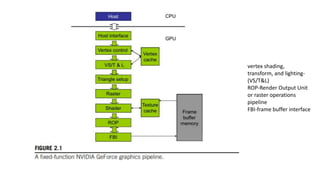
vertex shading,
transform, and lighting-
(VS/T&L)
ROP-Render Output Unit
or raster operations
pipeline
FBI-frame buffer interface
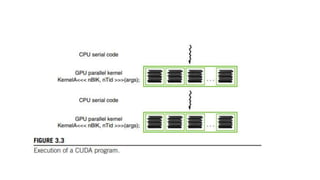
CUDA STRUCTURE
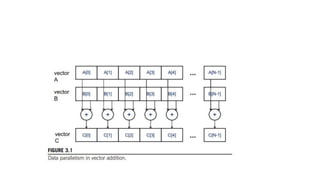
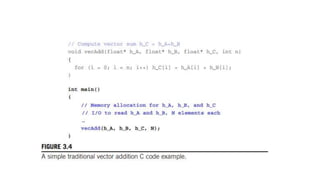
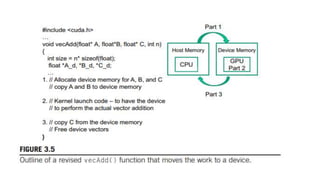
VECTORE ADDITION PROGRAM
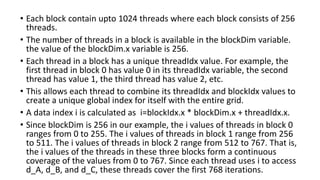
• Each block contain upto 1024 threads where each block consists of 256
threads.
• The number of threads in a block is available in the blockDim variable.
the value of the blockDim.x variable is 256.
• Each thread in a block has a unique threadIdx value. For example, the
first thread in block 0 has value 0 in its threadIdx variable, the second
thread has value 1, the third thread has value 2, etc.
• This allows each thread to combine its threadIdx and blockIdx values to
create a unique global index for itself with the entire grid.
• A data index i is calculated as i=blockIdx.x * blockDim.x + threadIdx.x.
• Since blockDim is 256 in our example, the i values of threads in block 0
ranges from 0 to 255. The i values of threads in block 1 range from 256
to 511. The i values of threads in block 2 range from 512 to 767. That is,
the i values of the threads in these three blocks form a continuous
coverage of the values from 0 to 767. Since each thread uses i to access
d_A, d_B, and d_C, these threads cover the first 768 iterations.
MTECH control charts in operation management.pptx

MTECH control charts in operation management.pptx

  • 4.
    vertex shading, transform, andlighting- (VS/T&L) ROP-Render Output Unit or raster operations pipeline FBI-frame buffer interface
  • 5.
  • 10.
  • 12.
    • Each blockcontain upto 1024 threads where each block consists of 256 threads. • The number of threads in a block is available in the blockDim variable. the value of the blockDim.x variable is 256. • Each thread in a block has a unique threadIdx value. For example, the first thread in block 0 has value 0 in its threadIdx variable, the second thread has value 1, the third thread has value 2, etc. • This allows each thread to combine its threadIdx and blockIdx values to create a unique global index for itself with the entire grid. • A data index i is calculated as i=blockIdx.x * blockDim.x + threadIdx.x. • Since blockDim is 256 in our example, the i values of threads in block 0 ranges from 0 to 255. The i values of threads in block 1 range from 256 to 511. The i values of threads in block 2 range from 512 to 767. That is, the i values of the threads in these three blocks form a continuous coverage of the values from 0 to 767. Since each thread uses i to access d_A, d_B, and d_C, these threads cover the first 768 iterations.