© Copyrights 2018 HITAM. All rights reserved. 1
Hyderabad Institute of Technology
and Management
Faculty Presentation
By CHINTAMREDDY MEGHANA
Name of the faculty
Designation & Department
Assistant Professor(ET) Date: 27/01/2024
Topic: Introduction to
Block Chain Technology
Photograph
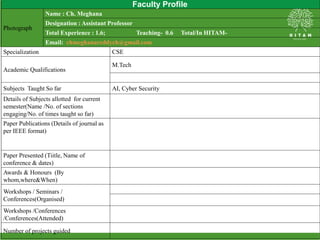
Name : Ch. Meghana
Designation : Assistant Professor
Total Experience : 1.6; Teaching- 0.6 Total/In HITAM-
Email: chmeghanareddych@gmail.com
Specialization CSE
Academic Qualifications
M.Tech
Subjects Taught So far AI, Cyber Security
Details of Subjects allotted for current
semester(Name /No. of sections
engaging/No. of times taught so far)
Paper Publications (Details of journal as
per IEEE format)
Paper Presented (Tiitle, Name of
conference & dates)
Awards & Honours (By
whom,where&When)
Workshops / Seminars /
Conferences(Organised)
Workshops /Conferences
/Conferences(Attended)
Number of projects guided
Faculty Profile
Course Introduction
 Ability to translate end-user requirements into system and software
requirements, using UML, and structure the requirements in a
software Requirements Documentation(SRD).
 Identify and apply appropriate software architecture and patterns to
carry out high level design of a system and to be able to critically
SOFTWARE ENGINEERING AND TESTING METHODOLOGIES
• Prerequisites: Software Design Engineering
COURSE OUTCOMES
compare alternative choices.
 Will have a experience and/or a awareness of testing problems
and will be able to develop a simple testing report.
 Design and develop the best test strategies in accordance to the
development model.
COURSE OUTCOMES
Text Books
1. Software Testing Techniques – Baris Beizer, Dreamtech , Second Edition.
2. Software Testing Tools – Dr.K.V.K.K. Prasad, Dreamtech.
REFERENCE BOOKS:
1. The Craft of Software Testing – Brain Marick,Pearson Education
2. Software Testing Techniques- SPD(Orelle)
3. Software Testing in the Real World – Edward Kit, Pearson
4.Effective methods of software testing, Perry, John Wiley.
5. Art of Software Testing –Meyers, John Wiley.
MODEL OF TESTING
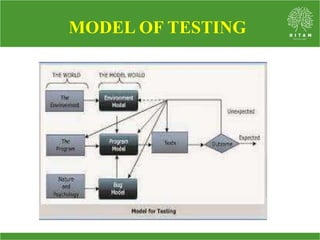
Above figure is a model of testing process.
It includes three Models.
 A Model Of the environment .
 A Model of the program ad
 A Model of the Excepted Bugs.
MODEL OF TESTING
• Environment
• A Programs Environment is the hardware and
software required to make it run.
• For Online System, the environment may
include communication lines, other Systems,
terminals and operators.
MODEL OF TESTING
• Program
• Most Programs are too complicated to
understand in detail.
• The concept of the program is to be simplified
in order to test it.
• Program and behaviour.
• Modification of Program.
MODEL OF TESTING
• Bugs
• Bugs are more Dangerous
• An Unexpected test result may lead us to
change our notion of what a bug is and our
model of bugs.
• Optimistic notions leads to less bug recovery.
MODEL OF TESTING
• Tests
• Unit Testing
• Integration Testing
• System Testing
MODEL OF TESTING
© Copyrights 2018 HITAM. All rights reserved. 12

Faculty Presentation Sample ppt.pptx presentation

  • 1.
    © Copyrights 2018HITAM. All rights reserved. 1 Hyderabad Institute of Technology and Management Faculty Presentation By CHINTAMREDDY MEGHANA Name of the faculty Designation & Department Assistant Professor(ET) Date: 27/01/2024 Topic: Introduction to Block Chain Technology
  • 2.
    Photograph Name : Ch.Meghana Designation : Assistant Professor Total Experience : 1.6; Teaching- 0.6 Total/In HITAM- Email: chmeghanareddych@gmail.com Specialization CSE Academic Qualifications M.Tech Subjects Taught So far AI, Cyber Security Details of Subjects allotted for current semester(Name /No. of sections engaging/No. of times taught so far) Paper Publications (Details of journal as per IEEE format) Paper Presented (Tiitle, Name of conference & dates) Awards & Honours (By whom,where&When) Workshops / Seminars / Conferences(Organised) Workshops /Conferences /Conferences(Attended) Number of projects guided Faculty Profile
  • 3.
    Course Introduction  Abilityto translate end-user requirements into system and software requirements, using UML, and structure the requirements in a software Requirements Documentation(SRD).  Identify and apply appropriate software architecture and patterns to carry out high level design of a system and to be able to critically SOFTWARE ENGINEERING AND TESTING METHODOLOGIES • Prerequisites: Software Design Engineering COURSE OUTCOMES
  • 4.
    compare alternative choices. Will have a experience and/or a awareness of testing problems and will be able to develop a simple testing report.  Design and develop the best test strategies in accordance to the development model. COURSE OUTCOMES
  • 5.
    Text Books 1. SoftwareTesting Techniques – Baris Beizer, Dreamtech , Second Edition. 2. Software Testing Tools – Dr.K.V.K.K. Prasad, Dreamtech. REFERENCE BOOKS: 1. The Craft of Software Testing – Brain Marick,Pearson Education 2. Software Testing Techniques- SPD(Orelle) 3. Software Testing in the Real World – Edward Kit, Pearson 4.Effective methods of software testing, Perry, John Wiley. 5. Art of Software Testing –Meyers, John Wiley.
  • 6.
  • 7.
    Above figure isa model of testing process. It includes three Models.  A Model Of the environment .  A Model of the program ad  A Model of the Excepted Bugs. MODEL OF TESTING
  • 8.
    • Environment • APrograms Environment is the hardware and software required to make it run. • For Online System, the environment may include communication lines, other Systems, terminals and operators. MODEL OF TESTING
  • 9.
    • Program • MostPrograms are too complicated to understand in detail. • The concept of the program is to be simplified in order to test it. • Program and behaviour. • Modification of Program. MODEL OF TESTING
  • 10.
    • Bugs • Bugsare more Dangerous • An Unexpected test result may lead us to change our notion of what a bug is and our model of bugs. • Optimistic notions leads to less bug recovery. MODEL OF TESTING
  • 11.
    • Tests • UnitTesting • Integration Testing • System Testing MODEL OF TESTING
  • 12.
    © Copyrights 2018HITAM. All rights reserved. 12