Microsoft Project Presentation
By Corey Johnson
10/11/00
What is a Gantt Chart?
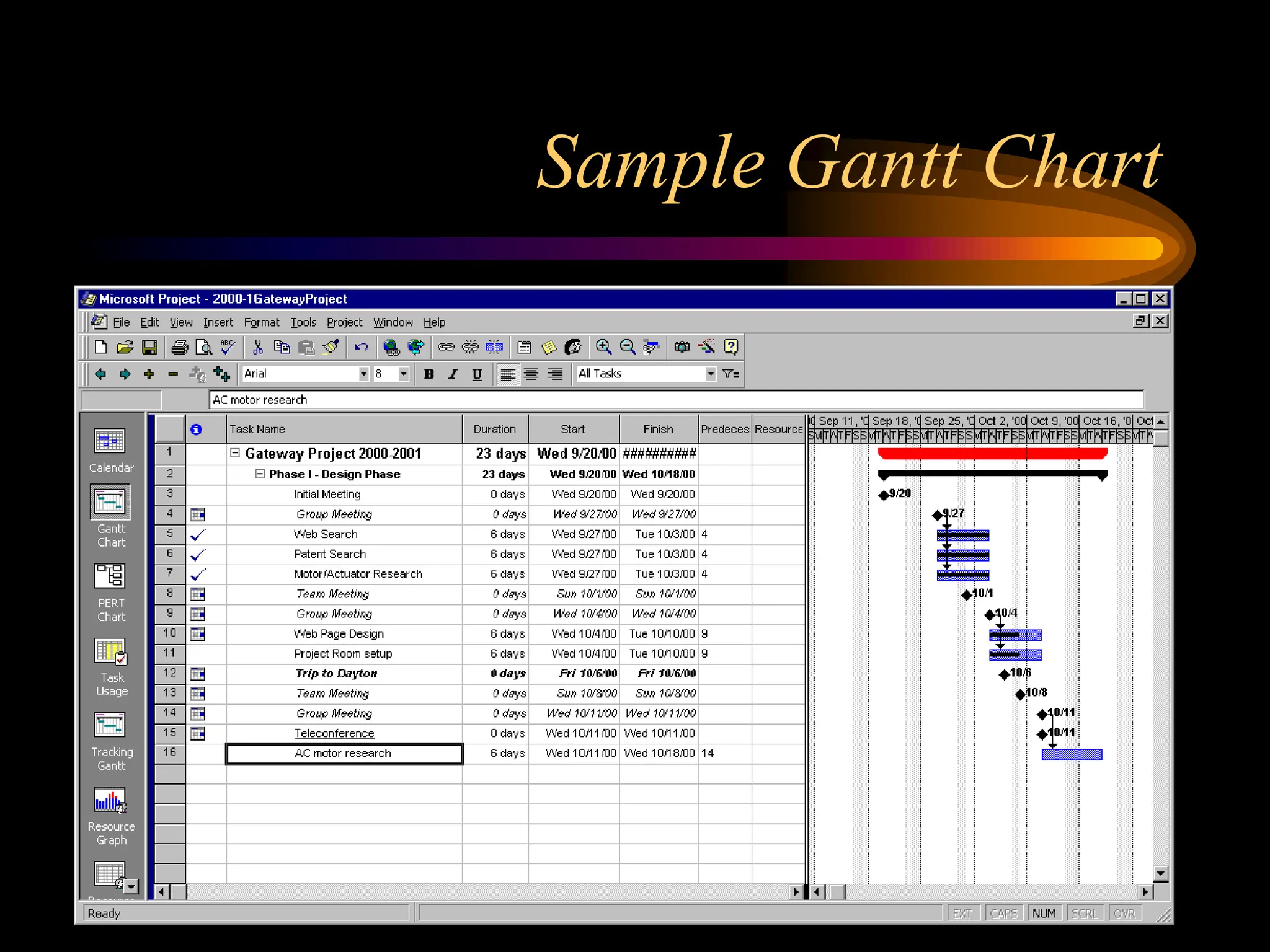
• A Gantt Chart is a visual tool to help Plan,
Manage, and Track a project or projects.
Sample Gantt Chart
Planning a Project
• Define Goals
• Develop Tasks
• Establish Timeframes
• Resource Availability?
• Organize
Managing and Tracking a Project
• Track Progress
– Are the tasks being completed on time?
– Is one task holding up the whole project?
• Manage Finances
– Is the project going to stay within the budget?
Using MS Project
• Define the Project
• Build the Plan
– Set a start date
– Enter tasks/durations
– Assign resources
– Link tasks
– Fine tune the plan
Using MS Project (cont’d)
• Track and Manage
– Set a baseline
– Enter actuals
– Adjust plan
• Close Project
Defining the Project
• The objective of the project should be
defined by the person/group that is going to
manage the project.
• Tasks, start times, and deadlines should be
clearly established.
Setting a Start Date
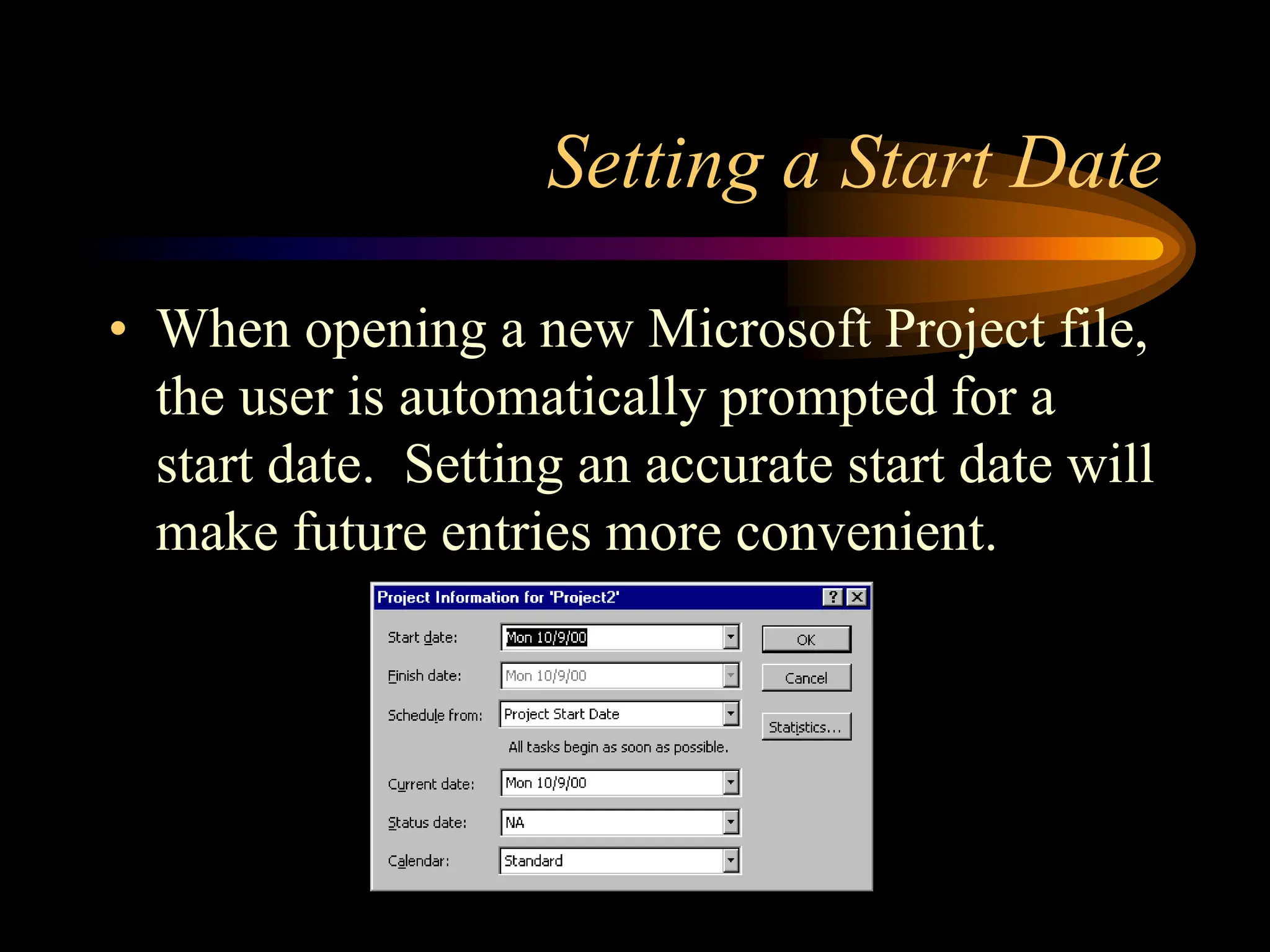
• When opening a new Microsoft Project file,
the user is automatically prompted for a
start date. Setting an accurate start date will
make future entries more convenient.
Entering Tasks and Durations
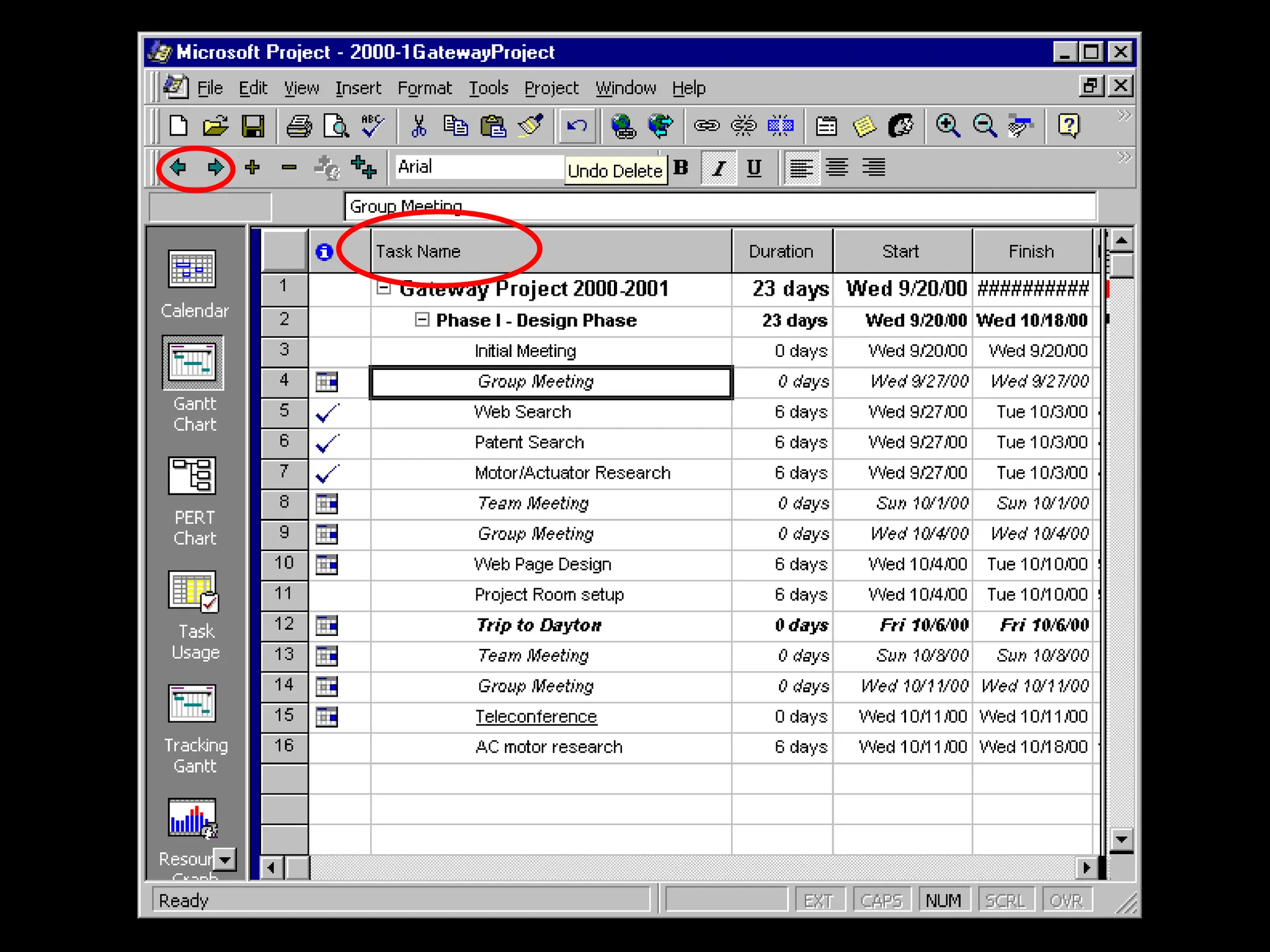
• Tasks are entered in the “Task Name”
column
• Subtasks are created by indenting a task.
• Durations may be entered in number of
working days or start and finish dates may
be used
Standard Markers
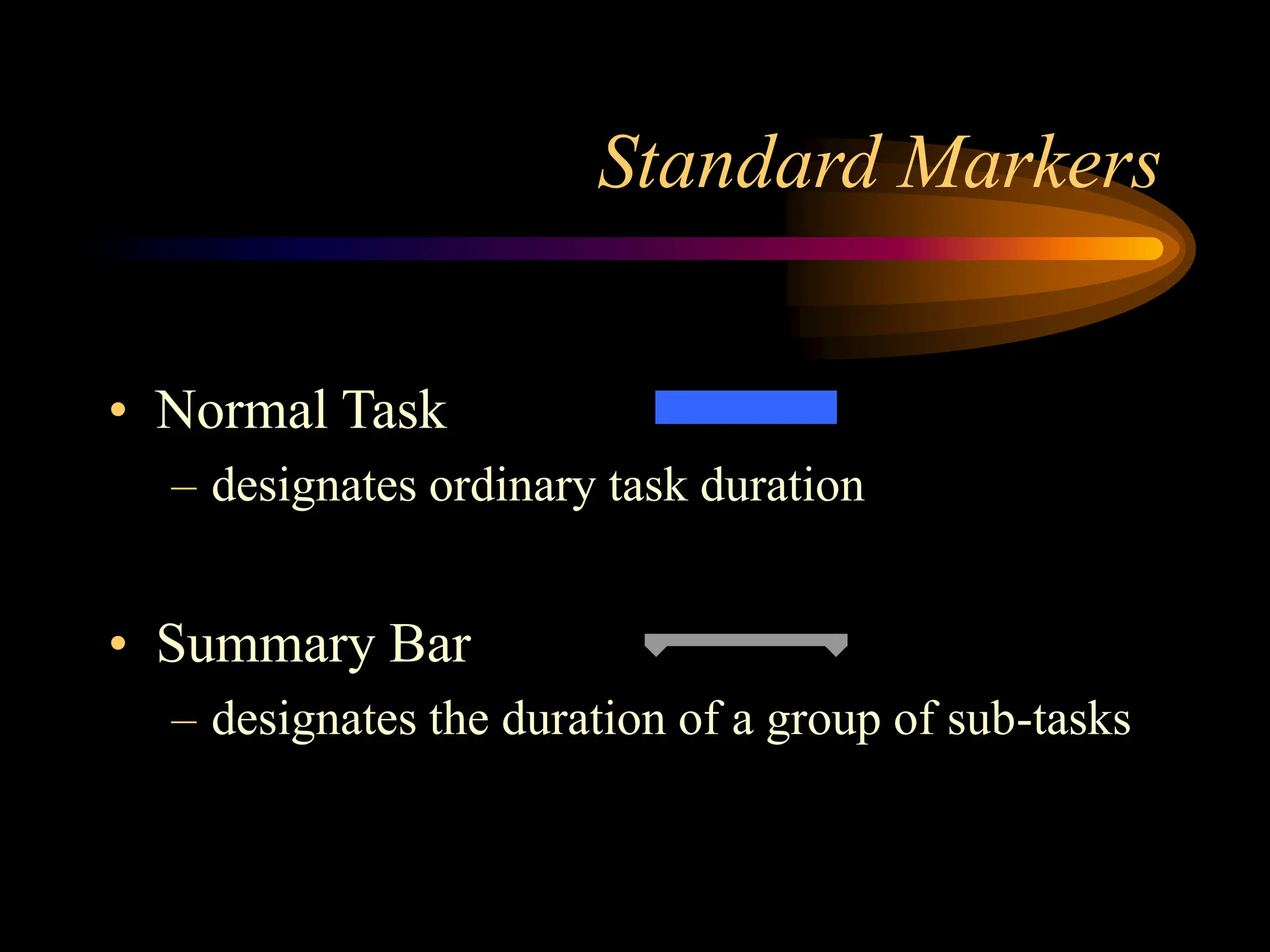
• Normal Task
– designates ordinary task duration
• Summary Bar
– designates the duration of a group of sub-tasks
Special Markers
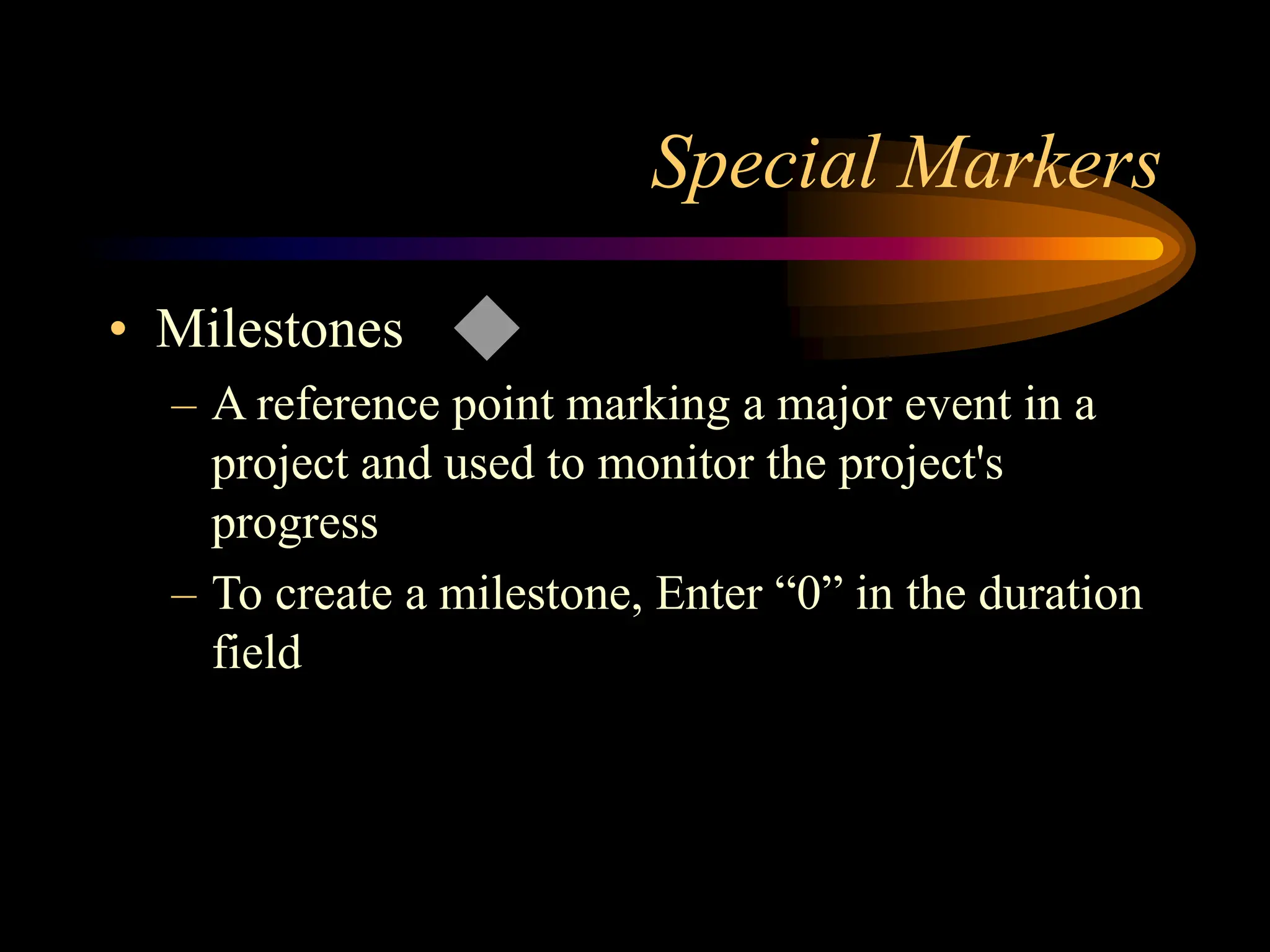
• Milestones
– A reference point marking a major event in a
project and used to monitor the project's
progress
– To create a milestone, Enter “0” in the duration
field
Changing Marker Styles
• Double-click on the Marker you want to change
and format accordingly
Assigning Resources
• A resource can be a single person, a piece of
equipment, or it can represent a group, such
as Plumbers
• Information on resources include
Availability, Costs, and Working Time
• Resources are very important in accurate
scheduling
Assigning Resources
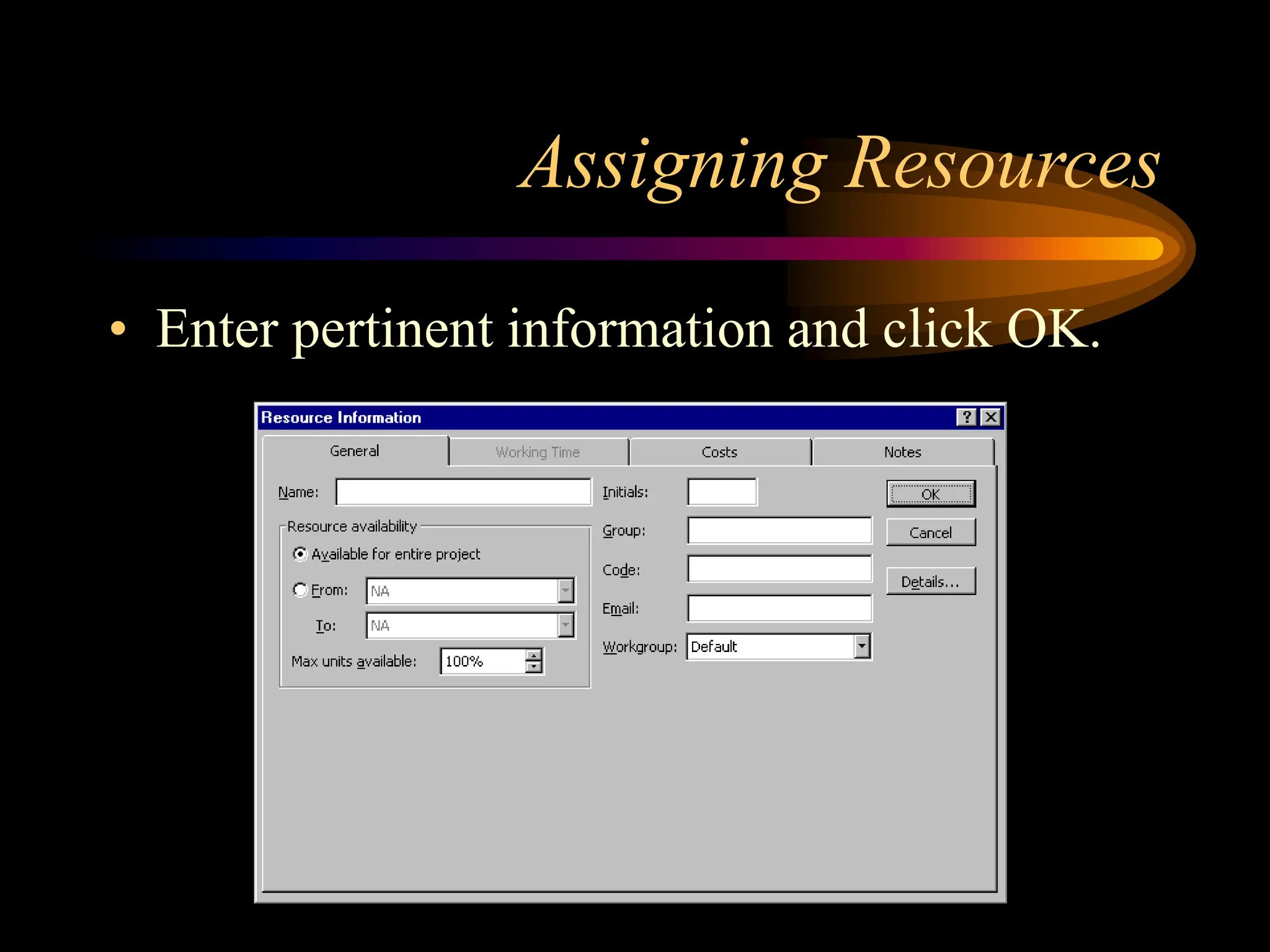
• To Assign a Resource:
– Select the task to which you want to assign the
resource
– Click the Assign Resources button on the
toolbar
Assigning Resources
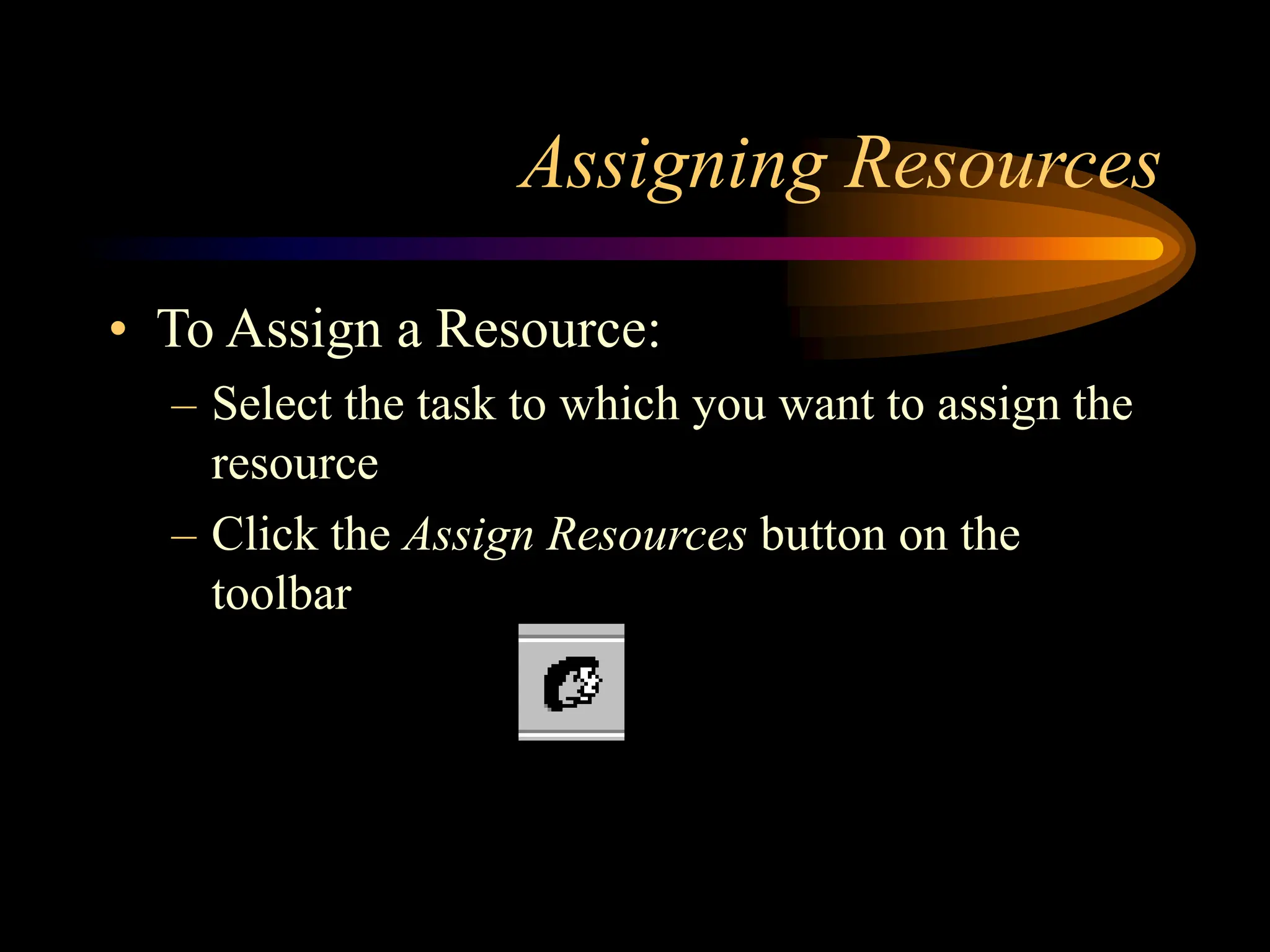
• If resources are not already set up, double
click on the name box
Assigning Resources
• Enter pertinent information and click OK.
Assigning Resources
• When a resource has been selected, click
Assign
Linking Tasks
• Some tasks require that another task be
completed before it can begin. These tasks
must be linked.
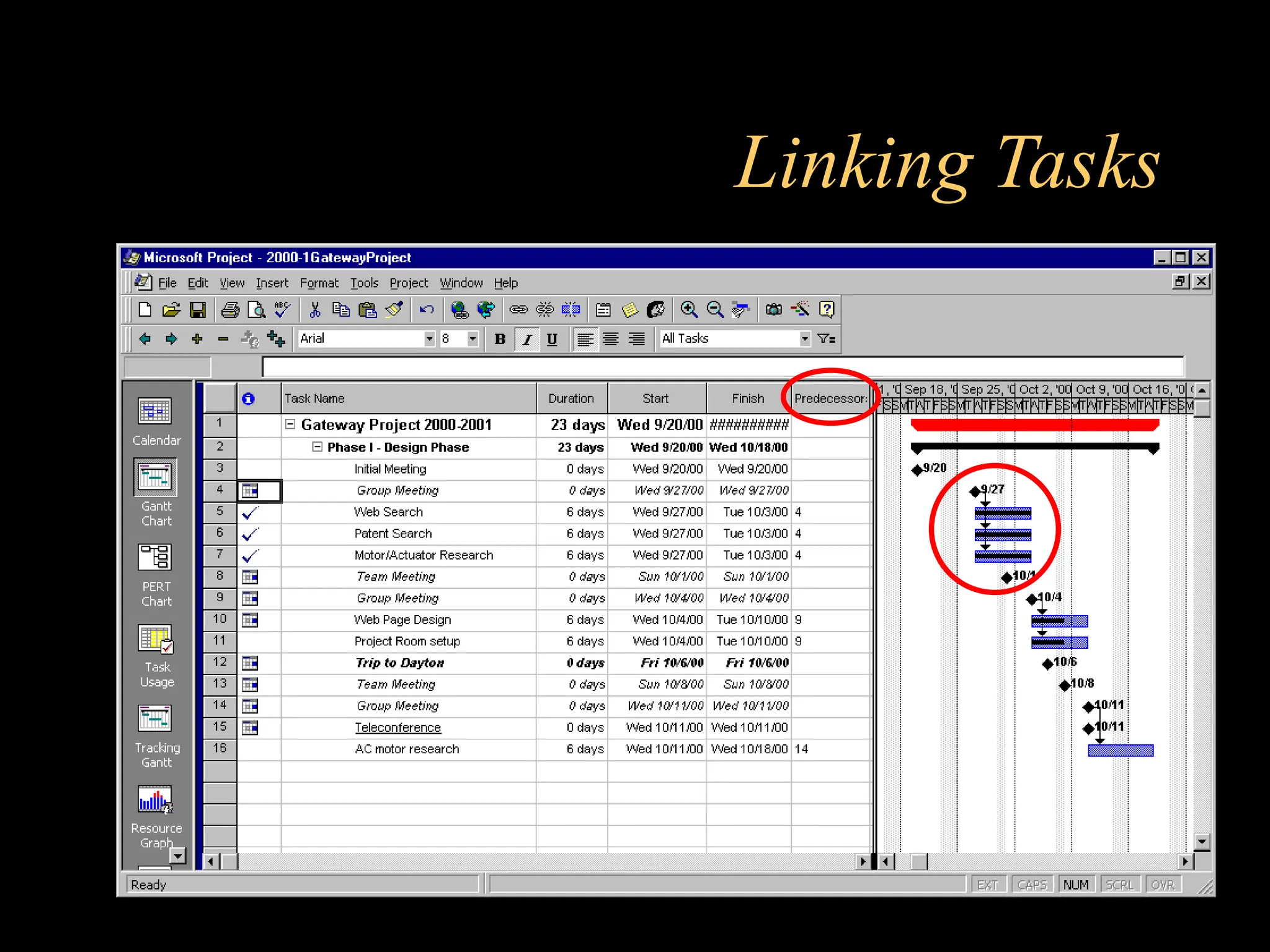
• Tasks and subtasks are linked by assigning
Predecessors.
Linking Tasks
• Predecessor
– A task that must start or finish before another
task can start or finish
• Successor
– A task that cannot start or finish until another
task starts or finishes
– A task becomes a successor when a row
number is entered in the predecessor column
Linking Tasks
Fine Tune the Plan
• When all resources have been assigned and
appropriate tasks are linked, the original
Gantt chart will be complete
• Check to make sure tasks have been linked
correctly and task durations are correct
• The project is now ready to begin
Set a Baseline
• A baseline compares your original plan for
the project with the actual course of the
project.
• You can see which tasks started earlier or
later than planned, exceeded their original
budget, took longer than planned, and so on.
Set a Baseline
• Create a baseline after you've polished it
and just before you actually start work on
the project
• To track costs, be sure to enter cost
information before you create the baseline
• Updates can easily be made to the baseline
if information is missing
Set a Baseline
• The Baseline plan includes:
– Tasks (start and finish dates, duration, work,
cost, splits, timephased work, and timephased
cost)
– Resources (work, cost, timephased work, and
timephased cost)
– Assignments (start and finish dates, work, cost,
timephased work, and timephased cost)
Set a Baseline
• To set a baseline:
– Point to Tracking on the Tools menu
– Click Save Baseline
Entering Progress
• Update actual start and finish dates for a task.
– On the Tools menu, point to Tracking and then click
Update Task
– Under Actual, type Start and Finish dates
Entering Progress
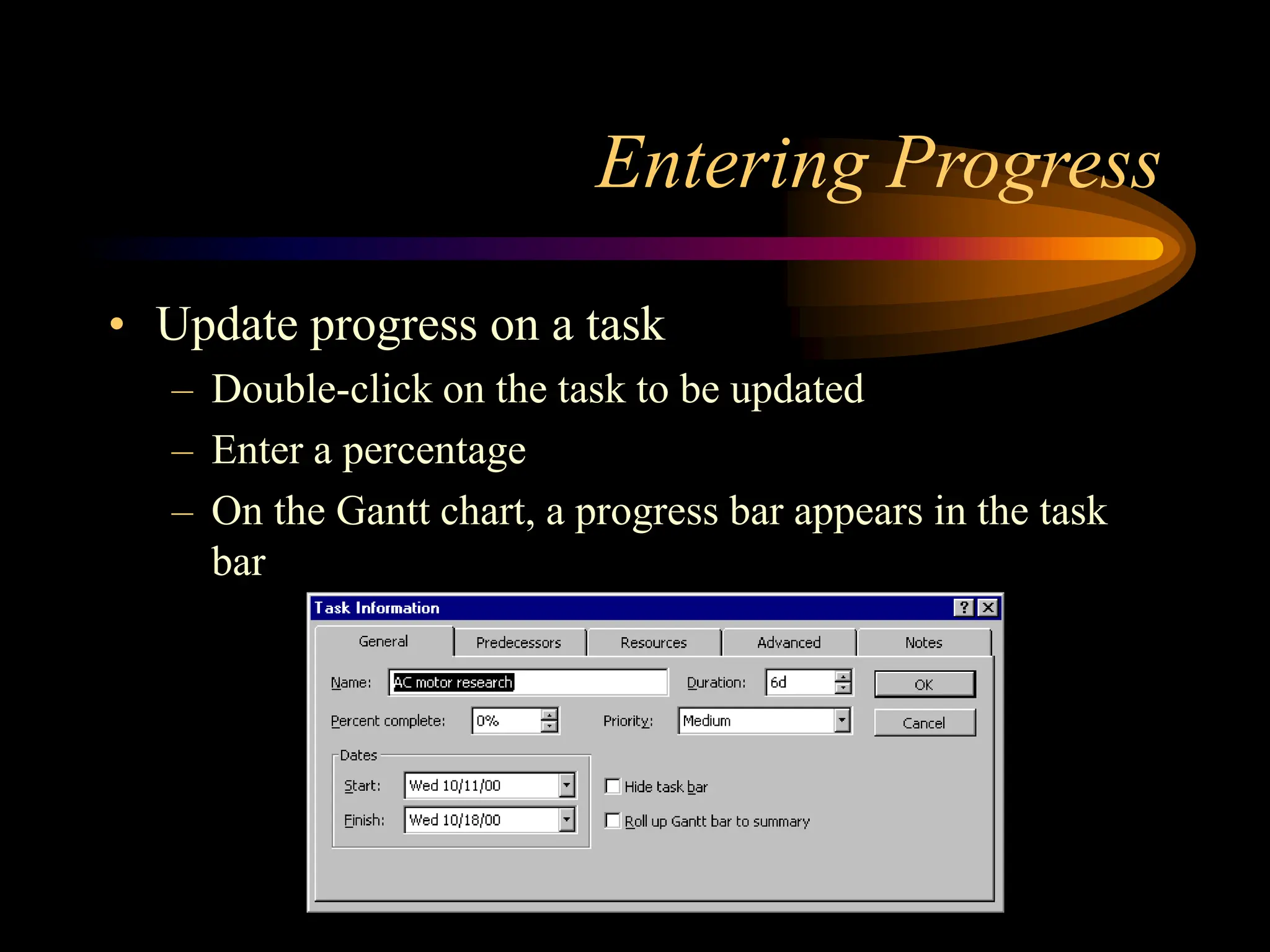
• Update progress on a task
– Double-click on the task to be updated
– Enter a percentage
– On the Gantt chart, a progress bar appears in the task
bar
Tracking Gantt Chart
• Tracks the progress of the project
• Shows what tasks are overdue and what has
been completed on time
• Click on the Tracking Gantt icon to view
Tracking Gantt Chart
Tracking Progress
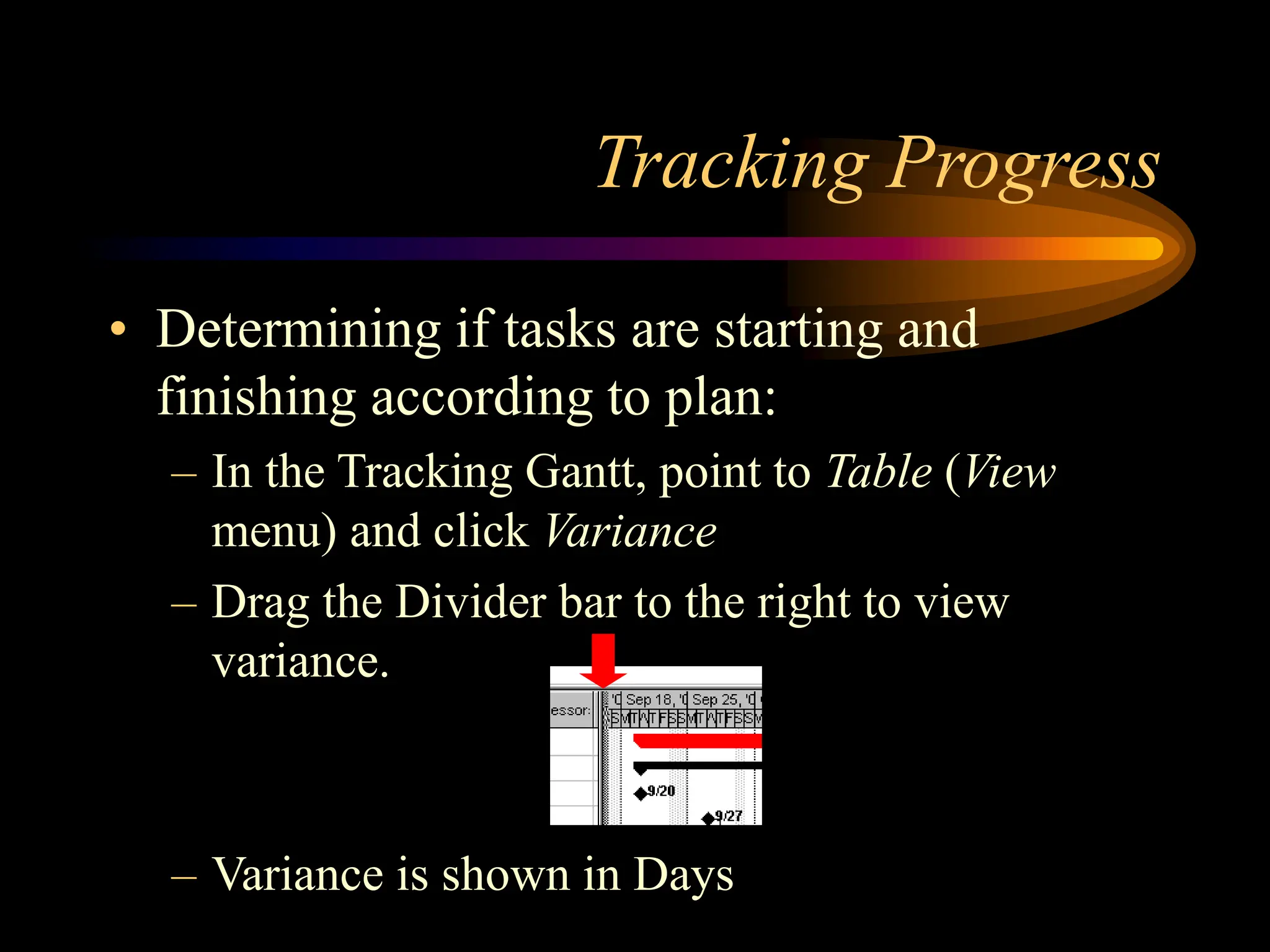
• Determining if tasks are starting and
finishing according to plan:
– In the Tracking Gantt, point to Table (View
menu) and click Variance
– Drag the Divider bar to the right to view
variance.
– Variance is shown in Days
Tracking Progress
• Determine if tasks cost more or less than
budgeted
– In the Tracking Gantt, point to Table (View
menu) and click Cost
– Drag the Divider bar to the right to view Total
Cost and Baseline fields
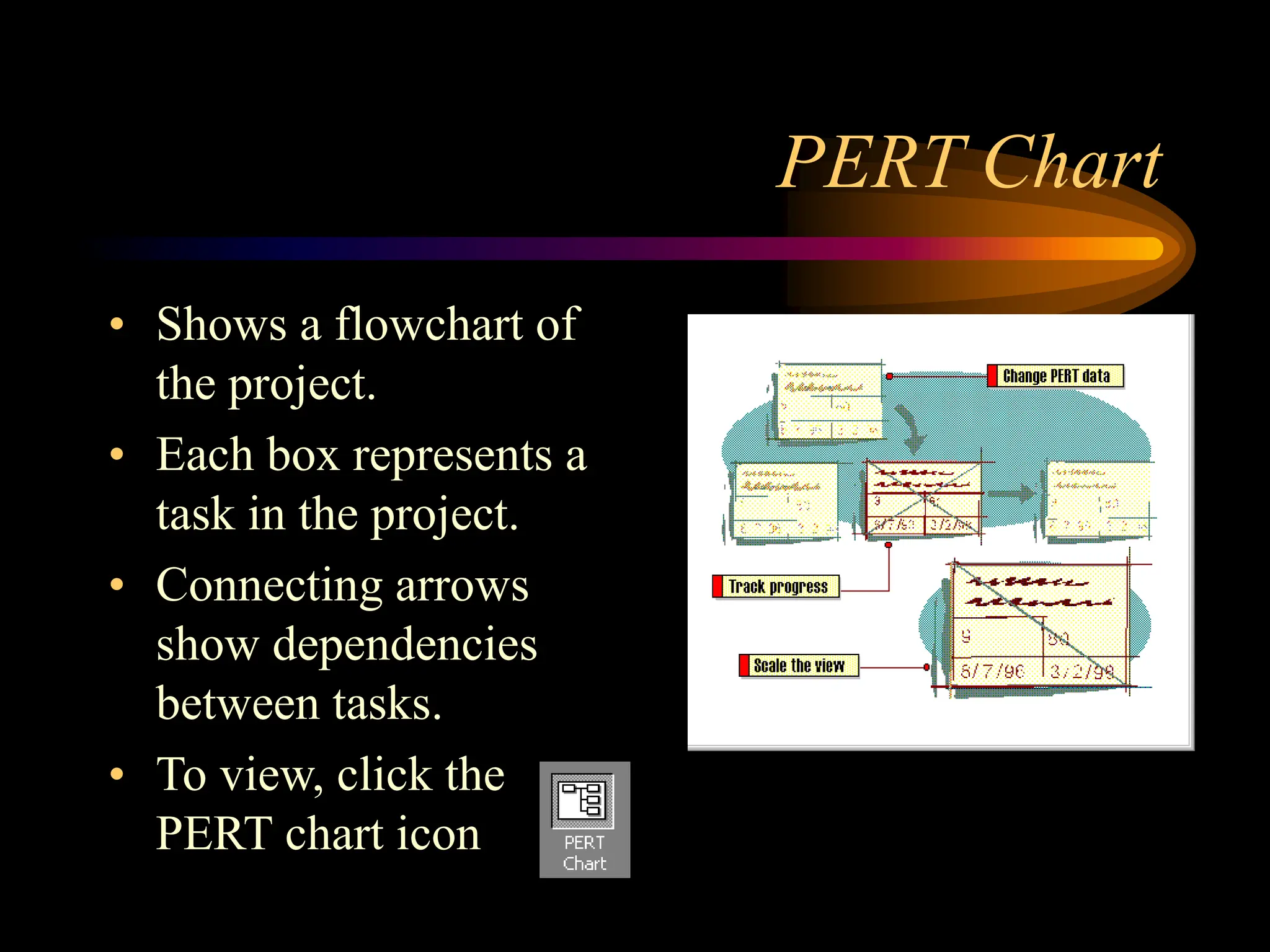
PERT Chart
• Shows a flowchart of
the project.
• Each box represents a
task in the project.
• Connecting arrows
show dependencies
between tasks.
• To view, click the
PERT chart icon
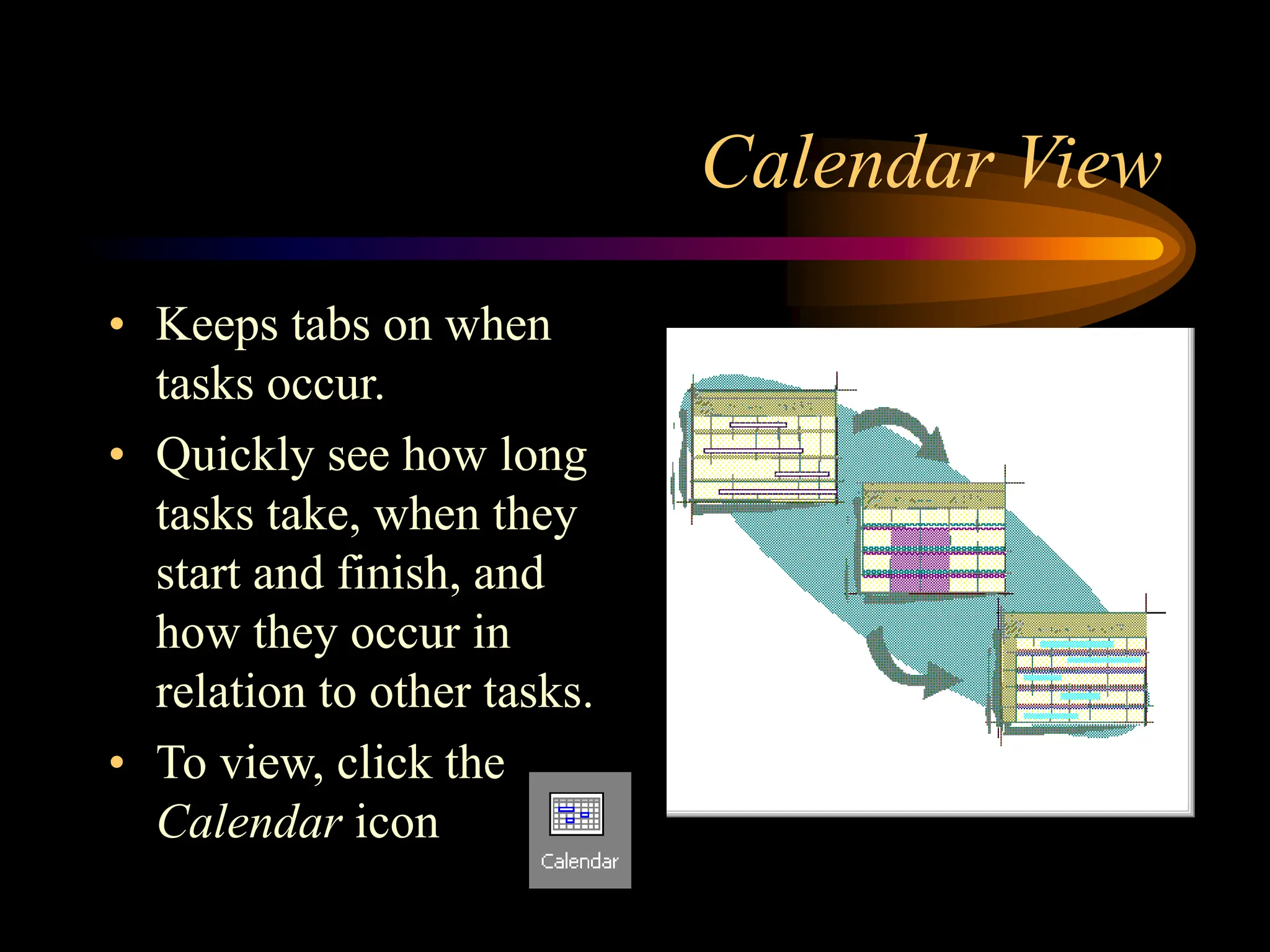
Calendar View
• Keeps tabs on when
tasks occur.
• Quickly see how long
tasks take, when they
start and finish, and
how they occur in
relation to other tasks.
• To view, click the
Calendar icon
Task Usage View
• Work with task and
resource information
side by side.
• Easily create useful
reports about when a
resource is scheduled
to work on a task.
• To view, click the Task
Usage icon
Resource Graph View
• See whether resources
are overallocated,
what capacity they're
working at, and how
much they cost in a
timescale graph
• To view, click the
Resource Graph icon
More Views
• Resource Sheet View
– Easy way to review, add, edit data about
resources
• Resource Usage View
– Work with resource and task information side
by side
The Project is Now Complete !!
• MS Project is a very powerful tool if it is
used correctly
• This program can save a lot of time for
engineers who are interested in time, cost,
etc.
• Automatically keeps your project organized.
Thank you !!
Please feel free to ask any questions

msproject.ppt MARTIN DE BORAS PRAGASH M PPT

  • 1.
    Microsoft Project Presentation ByCorey Johnson 10/11/00
  • 2.
    What is aGantt Chart? • A Gantt Chart is a visual tool to help Plan, Manage, and Track a project or projects.
  • 3.
  • 4.
    Planning a Project •Define Goals • Develop Tasks • Establish Timeframes • Resource Availability? • Organize
  • 5.
    Managing and Trackinga Project • Track Progress – Are the tasks being completed on time? – Is one task holding up the whole project? • Manage Finances – Is the project going to stay within the budget?
  • 6.
    Using MS Project •Define the Project • Build the Plan – Set a start date – Enter tasks/durations – Assign resources – Link tasks – Fine tune the plan
  • 7.
    Using MS Project(cont’d) • Track and Manage – Set a baseline – Enter actuals – Adjust plan • Close Project
  • 8.
    Defining the Project •The objective of the project should be defined by the person/group that is going to manage the project. • Tasks, start times, and deadlines should be clearly established.
  • 9.
    Setting a StartDate • When opening a new Microsoft Project file, the user is automatically prompted for a start date. Setting an accurate start date will make future entries more convenient.
  • 10.
    Entering Tasks andDurations • Tasks are entered in the “Task Name” column • Subtasks are created by indenting a task. • Durations may be entered in number of working days or start and finish dates may be used
  • 12.
    Standard Markers • NormalTask – designates ordinary task duration • Summary Bar – designates the duration of a group of sub-tasks
  • 13.
    Special Markers • Milestones –A reference point marking a major event in a project and used to monitor the project's progress – To create a milestone, Enter “0” in the duration field
  • 14.
    Changing Marker Styles •Double-click on the Marker you want to change and format accordingly
  • 15.
    Assigning Resources • Aresource can be a single person, a piece of equipment, or it can represent a group, such as Plumbers • Information on resources include Availability, Costs, and Working Time • Resources are very important in accurate scheduling
  • 16.
    Assigning Resources • ToAssign a Resource: – Select the task to which you want to assign the resource – Click the Assign Resources button on the toolbar
  • 17.
    Assigning Resources • Ifresources are not already set up, double click on the name box
  • 18.
    Assigning Resources • Enterpertinent information and click OK.
  • 19.
    Assigning Resources • Whena resource has been selected, click Assign
  • 20.
    Linking Tasks • Sometasks require that another task be completed before it can begin. These tasks must be linked. • Tasks and subtasks are linked by assigning Predecessors.
  • 21.
    Linking Tasks • Predecessor –A task that must start or finish before another task can start or finish • Successor – A task that cannot start or finish until another task starts or finishes – A task becomes a successor when a row number is entered in the predecessor column
  • 22.
  • 23.
    Fine Tune thePlan • When all resources have been assigned and appropriate tasks are linked, the original Gantt chart will be complete • Check to make sure tasks have been linked correctly and task durations are correct • The project is now ready to begin
  • 24.
    Set a Baseline •A baseline compares your original plan for the project with the actual course of the project. • You can see which tasks started earlier or later than planned, exceeded their original budget, took longer than planned, and so on.
  • 25.
    Set a Baseline •Create a baseline after you've polished it and just before you actually start work on the project • To track costs, be sure to enter cost information before you create the baseline • Updates can easily be made to the baseline if information is missing
  • 26.
    Set a Baseline •The Baseline plan includes: – Tasks (start and finish dates, duration, work, cost, splits, timephased work, and timephased cost) – Resources (work, cost, timephased work, and timephased cost) – Assignments (start and finish dates, work, cost, timephased work, and timephased cost)
  • 27.
    Set a Baseline •To set a baseline: – Point to Tracking on the Tools menu – Click Save Baseline
  • 28.
    Entering Progress • Updateactual start and finish dates for a task. – On the Tools menu, point to Tracking and then click Update Task – Under Actual, type Start and Finish dates
  • 29.
    Entering Progress • Updateprogress on a task – Double-click on the task to be updated – Enter a percentage – On the Gantt chart, a progress bar appears in the task bar
  • 30.
    Tracking Gantt Chart •Tracks the progress of the project • Shows what tasks are overdue and what has been completed on time • Click on the Tracking Gantt icon to view
  • 31.
  • 32.
    Tracking Progress • Determiningif tasks are starting and finishing according to plan: – In the Tracking Gantt, point to Table (View menu) and click Variance – Drag the Divider bar to the right to view variance. – Variance is shown in Days
  • 33.
    Tracking Progress • Determineif tasks cost more or less than budgeted – In the Tracking Gantt, point to Table (View menu) and click Cost – Drag the Divider bar to the right to view Total Cost and Baseline fields
  • 34.
    PERT Chart • Showsa flowchart of the project. • Each box represents a task in the project. • Connecting arrows show dependencies between tasks. • To view, click the PERT chart icon
  • 35.
    Calendar View • Keepstabs on when tasks occur. • Quickly see how long tasks take, when they start and finish, and how they occur in relation to other tasks. • To view, click the Calendar icon
  • 36.
    Task Usage View •Work with task and resource information side by side. • Easily create useful reports about when a resource is scheduled to work on a task. • To view, click the Task Usage icon
  • 37.
    Resource Graph View •See whether resources are overallocated, what capacity they're working at, and how much they cost in a timescale graph • To view, click the Resource Graph icon
  • 38.
    More Views • ResourceSheet View – Easy way to review, add, edit data about resources • Resource Usage View – Work with resource and task information side by side
  • 39.
    The Project isNow Complete !! • MS Project is a very powerful tool if it is used correctly • This program can save a lot of time for engineers who are interested in time, cost, etc. • Automatically keeps your project organized.
  • 40.
    Thank you !! Pleasefeel free to ask any questions