psychometricspsychometrics
M SANTHOSH KUMAR
Psychometrics: An intro
An introductionAn introduction
Psychometrics: An intro
OverviewOverview
A brief history of psychometrics
The main types of tests
The 10 most common tests
Why psychometrics?: Clinical versus
actuarial judgment
Psychometrics: An intro
A brief historyA brief history
Testing for proficiency dates back to 2200
B.C., when the Chinese emperor used grueling
tests to assess fitness for office
Psychometrics: An intro
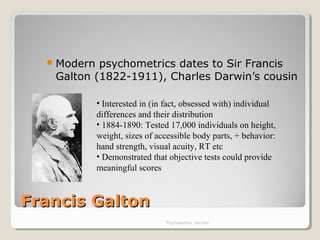
Francis GaltonFrancis Galton
Modern psychometrics dates to Sir Francis
Galton (1822-1911), Charles Darwin’s cousin
Psychometrics: An intro
• Interested in (in fact, obsessed with) individual
differences and their distribution
• 1884-1890: Tested 17,000 individuals on height,
weight, sizes of accessible body parts, + behavior:
hand strength, visual acuity, RT etc
• Demonstrated that objective tests could provide
meaningful scores
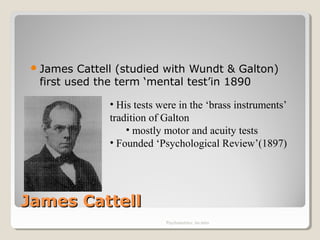
James CattellJames Cattell
James Cattell (studied with Wundt & Galton)
first used the term ‘mental test’in 1890
Psychometrics: An intro
• His tests were in the ‘brass instruments’
tradition of Galton
• mostly motor and acuity tests
• Founded ‘Psychological Review’(1897)
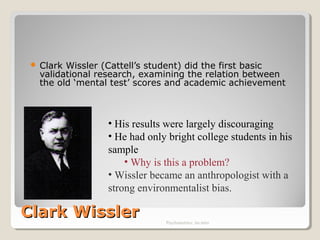
Clark WisslerClark Wissler
 Clark Wissler (Cattell’s student) did the first basic
validational research, examining the relation between
the old ‘mental test’ scores and academic achievement
Psychometrics: An intro
• His results were largely discouraging
• He had only bright college students in his
sample
• Why is this a problem?
• Wissler became an anthropologist with a
strong environmentalist bias.
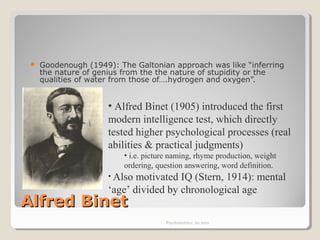
Alfred BinetAlfred Binet
 Goodenough (1949): The Galtonian approach was like “inferring
the nature of genius from the the nature of stupidity or the
qualities of water from those of….hydrogen and oxygen”.
Psychometrics: An intro
• Alfred Binet (1905) introduced the first
modern intelligence test, which directly
tested higher psychological processes (real
abilities & practical judgments)
• i.e. picture naming, rhyme production, weight
ordering, question answering, word definition.
• Also motivated IQ (Stern, 1914): mental
‘age’ divided by chronological age
The rise of psychometricsThe rise of psychometrics
 Lewis Terman (1916) produced a major revision of Binet’s scale
 Robert Yerkes (1919) convinced the US government to test 1.75 million army recruits
 Post WWI: Factor analysis emerged, making other aptitude and personality tests possible
Psychometrics: An intro
What is a psychometric test?What is a psychometric test?
 A test is a standardized procedure for sampling behavior and describing it using scores or categories
◦ Most tests are predictive of of some non-test behavior of interest
◦ Most tests are norm-referenced = they describe the behavior in terms of norms, test results gathered from a large group of
subjects (the standardization sample)
◦ Some tests are criterion-referenced = the objective is to see if the subject can attain some pre-specified criterion.
Psychometrics: An intro
The main types of testsThe main types of tests
 Intelligence tests: Assess intelligence
 Aptitude tests: Assess capability
 Achievement tests: Assess degree of
accomplishment
 Creativity tests: Assess capacity for novelty
 Personality tests: Assess traits
 Interest inventories: Assess preferences for
activities
 Behavioral tests: Measure behaviors and their
antecedents/consequences
 Neuropsychological tests: Measure cognitive,
sensory, perceptual, or motor functions
Psychometrics: An intro
The 10 most commonly used testsThe 10 most commonly used tests
1.) Wechsler Intelligence Scale for Children (WISC)
2.) Bender Visual-Motor Gestalt Test
3.) Wechsler Adult Intelligence Scale (WAIS)
4.) Minnesota Multiphasic Personality Inventory
(MMPI)
5.) Rorschach Ink Blot Test
6.) Thematic Apperception Test (TAT)
7.) Sentence Completion
8.) Goodenough Draw-A-Person Test
9.) House-Tree-Person Test
10.) Stanford-Binet Intelligence Scale
From Brown & McGuire, 1976
Psychometrics: An intro
Clinical versus actuarial judgmentClinical versus actuarial judgment
Clinical judgment = reaching a decision by
processing information in ones head
Actuarial judgment = reaching a decision
without employing human judgment, using
empirically-established relations between data
and the event of interest
◦ ‘Actuarial’: ad. L. actu [{amac}] ri-us, a
keeper of accounts
◦ Note that some of the data in an actuarial
judgment may be qualitative clinical
observations, allowing a mixture of methods
Psychometrics: An intro
Clinical versus actuarial judgmentClinical versus actuarial judgment
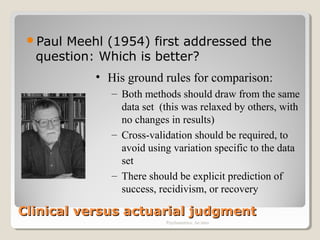
Paul Meehl (1954) first addressed the
question: Which is better?
Psychometrics: An intro
• His ground rules for comparison:
– Both methods should draw from the same
data set (this was relaxed by others, with
no changes in results)
– Cross-validation should be required, to
avoid using variation specific to the data
set
– There should be explicit prediction of
success, recidivism, or recovery
Meehl (1954): ResultsMeehl (1954): Results
 He looked at between 16 and 20 studies (depending on inclusion criteria)
“…it is clear that the dogmatic, complacent assertion sometimes heard from clinicians that ‘naturally’ clinical
prediction, being based on ‘real understanding’ is superior, is simply not justified by the facts to date”.
 In all but one case, predictions made by actuarial means were equal to or better than clinical methods
◦ In a later paper, he changed his mind about the one.
Psychometrics: An intro
Thirty years later...Thirty years later...
“There is no controversy in social science
that shows such a large body of
qualitatively diverse studies coming out
so uniformly as this one.”
Paul Meehl, 1986
Psychometrics: An intro
Where are clinician’s strengths? IWhere are clinician’s strengths? I
i.) Theory-mediated judgments
◦ If the predictor knows the relevant causal
influences, can measure them, and has a
model specific enough to take him/her from
theory to fact
◦ However, are there any reasons to doubt this
potential advantage?
Psychometrics: An intro
Where are clinician’s strengths? IIWhere are clinician’s strengths? II
ii.) Ability to use rare events
◦ If the predictor knows that the current case
is an exception to the statistical trend, s/he
can use that information to over-ride the
trend
◦ it is in theory possible to build these into
actuarial methods
 Why is it very difficult in practice?
 Why might we worry about clinicians ability to
incorporate rare events into prediction?
Psychometrics: An intro
Where are clinician’s strengths?Where are clinician’s strengths?
IIIIII
iii.) Able to detect complex predictive
cures
- Humans beings still (for now) are
masters at recognizing some complex
configurations, such as facial
expressions etc.
Psychometrics: An intro
Where are clinician’s strengths?Where are clinician’s strengths?
IVIV
iv.) Able to re-weight utilities in real-time
- For ethical, legal, or humanitarian
reasons, we might decide to do things
differently than usual in particular
cases.
Psychometrics: An intro
Where are actuarial strengths? IWhere are actuarial strengths? I
i.) Immunity from fatigue, forgetfulness,
hang-overs, hostility, prejudice,
ignorance, false association, over-
confidence, bias, and random
fluctuations in judgment.
Psychometrics: An intro
Where are actuarial strengths? IIWhere are actuarial strengths? II
ii.) Consistency & proper weighting
- variables are weighted the same way
every time, according to their actual
demonstrable contributions to the
criterion of interest
- irrelevant variables are properly
weighted to zero
Psychometrics: An intro
Where are actuarial strengths? IIIWhere are actuarial strengths? III
iii.) Feedback & base-rates ‘built-in’ to the
system
- Clinicians rarely know how they are doing
because they don’t get immediate
feedback and because they have imperfect
memory
- actuarial records constitute perfect
memories of how things came out in
similar cases and can include a larger and
wider sample than a human can ever hope
to see
Psychometrics: An intro
Where are actuarial strengths? IVWhere are actuarial strengths? IV
iv.) Not overly sensitive to optimal
weightings
- Even simplistic actuarial judgments
often beat human judgments
Psychometrics: An intro

Msk1

  • 1.
  • 2.
  • 3.
    OverviewOverview A brief historyof psychometrics The main types of tests The 10 most common tests Why psychometrics?: Clinical versus actuarial judgment Psychometrics: An intro
  • 4.
    A brief historyAbrief history Testing for proficiency dates back to 2200 B.C., when the Chinese emperor used grueling tests to assess fitness for office Psychometrics: An intro
  • 5.
    Francis GaltonFrancis Galton Modernpsychometrics dates to Sir Francis Galton (1822-1911), Charles Darwin’s cousin Psychometrics: An intro • Interested in (in fact, obsessed with) individual differences and their distribution • 1884-1890: Tested 17,000 individuals on height, weight, sizes of accessible body parts, + behavior: hand strength, visual acuity, RT etc • Demonstrated that objective tests could provide meaningful scores
  • 6.
    James CattellJames Cattell JamesCattell (studied with Wundt & Galton) first used the term ‘mental test’in 1890 Psychometrics: An intro • His tests were in the ‘brass instruments’ tradition of Galton • mostly motor and acuity tests • Founded ‘Psychological Review’(1897)
  • 7.
    Clark WisslerClark Wissler Clark Wissler (Cattell’s student) did the first basic validational research, examining the relation between the old ‘mental test’ scores and academic achievement Psychometrics: An intro • His results were largely discouraging • He had only bright college students in his sample • Why is this a problem? • Wissler became an anthropologist with a strong environmentalist bias.
  • 8.
    Alfred BinetAlfred Binet Goodenough (1949): The Galtonian approach was like “inferring the nature of genius from the the nature of stupidity or the qualities of water from those of….hydrogen and oxygen”. Psychometrics: An intro • Alfred Binet (1905) introduced the first modern intelligence test, which directly tested higher psychological processes (real abilities & practical judgments) • i.e. picture naming, rhyme production, weight ordering, question answering, word definition. • Also motivated IQ (Stern, 1914): mental ‘age’ divided by chronological age
  • 9.
    The rise ofpsychometricsThe rise of psychometrics  Lewis Terman (1916) produced a major revision of Binet’s scale  Robert Yerkes (1919) convinced the US government to test 1.75 million army recruits  Post WWI: Factor analysis emerged, making other aptitude and personality tests possible Psychometrics: An intro
  • 10.
    What is apsychometric test?What is a psychometric test?  A test is a standardized procedure for sampling behavior and describing it using scores or categories ◦ Most tests are predictive of of some non-test behavior of interest ◦ Most tests are norm-referenced = they describe the behavior in terms of norms, test results gathered from a large group of subjects (the standardization sample) ◦ Some tests are criterion-referenced = the objective is to see if the subject can attain some pre-specified criterion. Psychometrics: An intro
  • 11.
    The main typesof testsThe main types of tests  Intelligence tests: Assess intelligence  Aptitude tests: Assess capability  Achievement tests: Assess degree of accomplishment  Creativity tests: Assess capacity for novelty  Personality tests: Assess traits  Interest inventories: Assess preferences for activities  Behavioral tests: Measure behaviors and their antecedents/consequences  Neuropsychological tests: Measure cognitive, sensory, perceptual, or motor functions Psychometrics: An intro
  • 12.
    The 10 mostcommonly used testsThe 10 most commonly used tests 1.) Wechsler Intelligence Scale for Children (WISC) 2.) Bender Visual-Motor Gestalt Test 3.) Wechsler Adult Intelligence Scale (WAIS) 4.) Minnesota Multiphasic Personality Inventory (MMPI) 5.) Rorschach Ink Blot Test 6.) Thematic Apperception Test (TAT) 7.) Sentence Completion 8.) Goodenough Draw-A-Person Test 9.) House-Tree-Person Test 10.) Stanford-Binet Intelligence Scale From Brown & McGuire, 1976 Psychometrics: An intro
  • 13.
    Clinical versus actuarialjudgmentClinical versus actuarial judgment Clinical judgment = reaching a decision by processing information in ones head Actuarial judgment = reaching a decision without employing human judgment, using empirically-established relations between data and the event of interest ◦ ‘Actuarial’: ad. L. actu [{amac}] ri-us, a keeper of accounts ◦ Note that some of the data in an actuarial judgment may be qualitative clinical observations, allowing a mixture of methods Psychometrics: An intro
  • 14.
    Clinical versus actuarialjudgmentClinical versus actuarial judgment Paul Meehl (1954) first addressed the question: Which is better? Psychometrics: An intro • His ground rules for comparison: – Both methods should draw from the same data set (this was relaxed by others, with no changes in results) – Cross-validation should be required, to avoid using variation specific to the data set – There should be explicit prediction of success, recidivism, or recovery
  • 15.
    Meehl (1954): ResultsMeehl(1954): Results  He looked at between 16 and 20 studies (depending on inclusion criteria) “…it is clear that the dogmatic, complacent assertion sometimes heard from clinicians that ‘naturally’ clinical prediction, being based on ‘real understanding’ is superior, is simply not justified by the facts to date”.  In all but one case, predictions made by actuarial means were equal to or better than clinical methods ◦ In a later paper, he changed his mind about the one. Psychometrics: An intro
  • 16.
    Thirty years later...Thirtyyears later... “There is no controversy in social science that shows such a large body of qualitatively diverse studies coming out so uniformly as this one.” Paul Meehl, 1986 Psychometrics: An intro
  • 17.
    Where are clinician’sstrengths? IWhere are clinician’s strengths? I i.) Theory-mediated judgments ◦ If the predictor knows the relevant causal influences, can measure them, and has a model specific enough to take him/her from theory to fact ◦ However, are there any reasons to doubt this potential advantage? Psychometrics: An intro
  • 18.
    Where are clinician’sstrengths? IIWhere are clinician’s strengths? II ii.) Ability to use rare events ◦ If the predictor knows that the current case is an exception to the statistical trend, s/he can use that information to over-ride the trend ◦ it is in theory possible to build these into actuarial methods  Why is it very difficult in practice?  Why might we worry about clinicians ability to incorporate rare events into prediction? Psychometrics: An intro
  • 19.
    Where are clinician’sstrengths?Where are clinician’s strengths? IIIIII iii.) Able to detect complex predictive cures - Humans beings still (for now) are masters at recognizing some complex configurations, such as facial expressions etc. Psychometrics: An intro
  • 20.
    Where are clinician’sstrengths?Where are clinician’s strengths? IVIV iv.) Able to re-weight utilities in real-time - For ethical, legal, or humanitarian reasons, we might decide to do things differently than usual in particular cases. Psychometrics: An intro
  • 21.
    Where are actuarialstrengths? IWhere are actuarial strengths? I i.) Immunity from fatigue, forgetfulness, hang-overs, hostility, prejudice, ignorance, false association, over- confidence, bias, and random fluctuations in judgment. Psychometrics: An intro
  • 22.
    Where are actuarialstrengths? IIWhere are actuarial strengths? II ii.) Consistency & proper weighting - variables are weighted the same way every time, according to their actual demonstrable contributions to the criterion of interest - irrelevant variables are properly weighted to zero Psychometrics: An intro
  • 23.
    Where are actuarialstrengths? IIIWhere are actuarial strengths? III iii.) Feedback & base-rates ‘built-in’ to the system - Clinicians rarely know how they are doing because they don’t get immediate feedback and because they have imperfect memory - actuarial records constitute perfect memories of how things came out in similar cases and can include a larger and wider sample than a human can ever hope to see Psychometrics: An intro
  • 24.
    Where are actuarialstrengths? IVWhere are actuarial strengths? IV iv.) Not overly sensitive to optimal weightings - Even simplistic actuarial judgments often beat human judgments Psychometrics: An intro