IMPORTANT FEATURES OF MS-WORD
Ms-Word not only supports word processing features but also DTP features. Some of the
important features of Ms-Word are listed below:
 Using word you can create the document and edit them later, as and when required,
by adding more text, modifying the existing text, deleting/moving some part of it.
 Changing the size of the margins can reformat complete document or part of text.
 Font size and type of fonts can also be changed. Page numbers and Header and Footer
can be included.
 Spelling can be checked and correction can be made automatically in the entire
document. Word count and other statistics can be generated.
 Text can be formatted in columnar style as we see in the newspaper. Text boxes can be
made.
Tables can be made and included in the text.
 Word also allows the user to mix the graphical pictures with the text. Graphical pictures
can either be created in word itself or can be imported from outside like from Clip Art
Gallery.
Word also provides the mail-merge facility.
 Word also has the facility of macros. Macros can be either attached to some
function/special keys or to a tool bar or to a menu.
 It also provides online help of any option.
Attempts at cross-version compatibility
Opening a Word Document file in a version of Word other than the one with which
it was created can cause incorrect display of the document. The document formats
of the various versions change in subtle and not so subtle ways (such as changing
the font, or the handling the footnotes), creating a "lock in" phenomenon to the
base.Formatting created in newer versions does not always survive when viewed in
older versions of the program, nearly always because that capability does not exist
in the previous version. Rich Text Format (RTF), to create a format for interchanging
formatted text between applications, is an optional format for Word that retains
most formatting and all content of the original document.
As HTML appeared, Word supported an HTML derivative as an additional full-
fidelity roundtrip format similar to RTF, with the additional capability that the file
could be viewed in a web browser.
The ability of one device or program to work with another device or program. The
term compatible implies different degrees of partnership. For example, a printer and a
computer are said to be compatible if they can be connected to each other.
Software products are compatible if they use the same data formats. For example,
many programs are compatible with dBASE. This means that the files they produce can
easily be transformed into a dBASE database or that they can import dBASE files.
Compatibility
File Formats
File extension
Microsoft Word's native file formats are denoted either by a .doc or .docx file extension.
Although the ".doc" extension has been used in many different versions of Word, it actually
encompasses four distinct file formats:
o Word for DOS
o Word for Windows 1 and 2; Word 4 and 5 for Mac
o Word 6 and Word 95 for Windows; Word 6 for Mac
o Word 97, 2000, 2002 and 2003 for Windows; Word 98, 2001, X, and 2004 for Mac
The newer ".docx" extension signifies the Office Open XML international standard for Office
documents and is used by Word 2007 and 2010 for Windows, Word 2008 and 2011 for the
Macintosh, as well as by a growing number of applications from other vendors, including
OpenOffice.org Writer, an open source word processing program.
Microsoft does not guarantee the correct display of the document on different workstations,
even if the two workstations use the same version of Microsoft Word, primarily due to page
layout depending on the current printer. This means it is possible the document the recipient
sees might not be exactly the same as the document the sender sees.
Binary formats (Word 97–2003)
Word document files by using the Word 97-2003 Binary File Format implement OLE (Object
Linking and Embedding) structured storage to manage the structure of their file format. OLE
behaves like a conventional hard drive file system and is made up of several key components.
Each Word document is composed of so-called "big blocks" which are almost always 512-byte
chunks;
Word automatically creates a hyperlink when you type the address of an existing Web
page, such as www.microsoft.com, into a document. You can also create customized
hyperlinks to documents on a computer or on a network share. These hyperlinks can be
absolute or relative to the Word document.
•Absolute hyperlink
An absolute hyperlink is a hyperlink that contains the full address of the
destination file or of the Web site. The following address is an example of a full
address in an absolute hyperlink:
http://www.microsoft.com/support
•Hyperlink base
A hyperlink base is the path that is shared by the file that contains the hyperlink
and the destination file. The address of the destination file is also known as the
hyperlink base.
•Relative hyperlink
A relative hyperlink is a hyperlink that contains an address that is relative to the
address of the destination file.
For example, a document has the following hyperlink base:
C:Documents and SettingsUsernameMy Documents.
A document that is named "Sales.doc" is located at the following file path:
C:Documents and SettingsUsernameMy DocumentsAprilSales.doc
The relative hyperlink to this document contains only the relative address to Sales.doc.
Therefore, the relative hyperlink contains the following address: AprilSales.doc
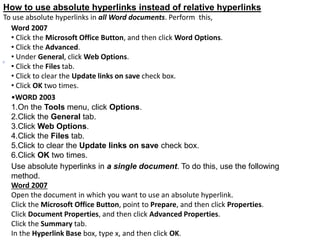
How to use absolute hyperlinks instead of relative hyperlinks
To use absolute hyperlinks in all Word documents. Perform this,
Word 2007
• Click the Microsoft Office Button, and then click Word Options.
• Click the Advanced.
• Under General, click Web Options.
• Click the Files tab.
• Click to clear the Update links on save check box.
• Click OK two times.
•WORD 2003
1.On the Tools menu, click Options.
2.Click the General tab.
3.Click Web Options.
4.Click the Files tab.
5.Click to clear the Update links on save check box.
6.Click OK two times.
Use absolute hyperlinks in a single document. To do this, use the following
method.
Word 2007
Open the document in which you want to use an absolute hyperlink.
Click the Microsoft Office Button, point to Prepare, and then click Properties.
Click Document Properties, and then click Advanced Properties.
Click the Summary tab.
In the Hyperlink Base box, type x, and then click OK.
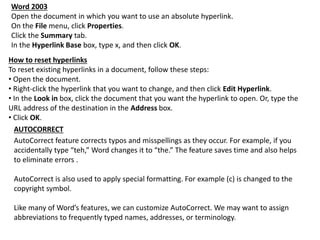
Word 2003
Open the document in which you want to use an absolute hyperlink.
On the File menu, click Properties.
Click the Summary tab.
In the Hyperlink Base box, type x, and then click OK.
How to reset hyperlinks
To reset existing hyperlinks in a document, follow these steps:
• Open the document.
• Right-click the hyperlink that you want to change, and then click Edit Hyperlink.
• In the Look in box, click the document that you want the hyperlink to open. Or, type the
URL address of the destination in the Address box.
• Click OK.
AUTOCORRECT
AutoCorrect feature corrects typos and misspellings as they occur. For example, if you
accidentally type “teh,” Word changes it to “the.” The feature saves time and also helps
to eliminate errors .
AutoCorrect is also used to apply special formatting. For example (c) is changed to the
copyright symbol.
Like many of Word’s features, we can customize AutoCorrect. We may want to assign
abbreviations to frequently typed names, addresses, or terminology.
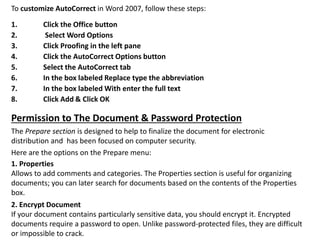
To customize AutoCorrect in Word 2007, follow these steps:
1. Click the Office button
2. Select Word Options
3. Click Proofing in the left pane
4. Click the AutoCorrect Options button
5. Select the AutoCorrect tab
6. In the box labeled Replace type the abbreviation
7. In the box labeled With enter the full text
8. Click Add & Click OK
Permission to The Document & Password Protection
The Prepare section is designed to help to finalize the document for electronic
distribution and has been focused on computer security.6
Here are the options on the Prepare menu:7
1. Properties
Allows to add comments and categories. The Properties section is useful for organizing
documents; you can later search for documents based on the contents of the Properties
box.7
2. Encrypt Document
If your document contains particularly sensitive data, you should encrypt it. Encrypted
documents require a password to open. Unlike password-protected files, they are difficult
or impossible to crack.
3. Restrict Permissions
You can restrict permissions on your Word 2007 document. This prevents unauthorized users
from accessing and/or editing your document and this is good for sensitive documents.
4. Add a Digital Signature
A digital signature verifies the source of the document. Digital Signatures can be used to
determine whether a document contains malicious elements.
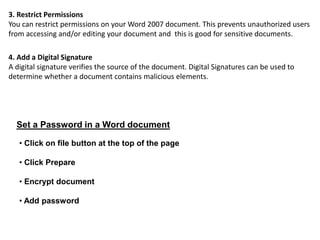
Set a Password in a Word document
• Click on file button at the top of the page
• Click Prepare
• Encrypt document
• Add password
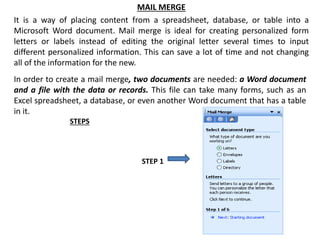
MAIL MERGE
It is a way of placing content from a spreadsheet, database, or table into a
Microsoft Word document. Mail merge is ideal for creating personalized form
letters or labels instead of editing the original letter several times to input
different personalized information. This can save a lot of time and not changing
all of the information for the new.
In order to create a mail merge, two documents are needed: a Word document
and a file with the data or records. This file can take many forms, such as an
Excel spreadsheet, a database, or even another Word document that has a table
in it.
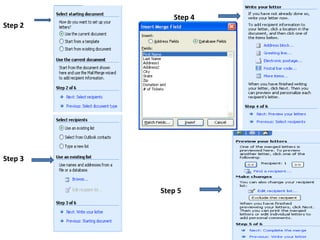
STEPS
STEP 1
Step 2
Step 4
Step 3
Step 5
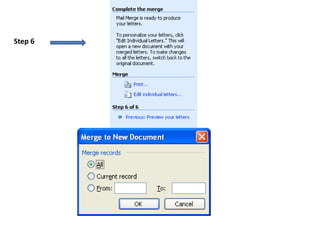
Step 6

Ms Word

  • 1.
    IMPORTANT FEATURES OFMS-WORD Ms-Word not only supports word processing features but also DTP features. Some of the important features of Ms-Word are listed below:  Using word you can create the document and edit them later, as and when required, by adding more text, modifying the existing text, deleting/moving some part of it.  Changing the size of the margins can reformat complete document or part of text.  Font size and type of fonts can also be changed. Page numbers and Header and Footer can be included.  Spelling can be checked and correction can be made automatically in the entire document. Word count and other statistics can be generated.  Text can be formatted in columnar style as we see in the newspaper. Text boxes can be made. Tables can be made and included in the text.  Word also allows the user to mix the graphical pictures with the text. Graphical pictures can either be created in word itself or can be imported from outside like from Clip Art Gallery. Word also provides the mail-merge facility.  Word also has the facility of macros. Macros can be either attached to some function/special keys or to a tool bar or to a menu.  It also provides online help of any option.
  • 2.
    Attempts at cross-versioncompatibility Opening a Word Document file in a version of Word other than the one with which it was created can cause incorrect display of the document. The document formats of the various versions change in subtle and not so subtle ways (such as changing the font, or the handling the footnotes), creating a "lock in" phenomenon to the base.Formatting created in newer versions does not always survive when viewed in older versions of the program, nearly always because that capability does not exist in the previous version. Rich Text Format (RTF), to create a format for interchanging formatted text between applications, is an optional format for Word that retains most formatting and all content of the original document. As HTML appeared, Word supported an HTML derivative as an additional full- fidelity roundtrip format similar to RTF, with the additional capability that the file could be viewed in a web browser. The ability of one device or program to work with another device or program. The term compatible implies different degrees of partnership. For example, a printer and a computer are said to be compatible if they can be connected to each other. Software products are compatible if they use the same data formats. For example, many programs are compatible with dBASE. This means that the files they produce can easily be transformed into a dBASE database or that they can import dBASE files. Compatibility
  • 3.
    File Formats File extension MicrosoftWord's native file formats are denoted either by a .doc or .docx file extension. Although the ".doc" extension has been used in many different versions of Word, it actually encompasses four distinct file formats: o Word for DOS o Word for Windows 1 and 2; Word 4 and 5 for Mac o Word 6 and Word 95 for Windows; Word 6 for Mac o Word 97, 2000, 2002 and 2003 for Windows; Word 98, 2001, X, and 2004 for Mac The newer ".docx" extension signifies the Office Open XML international standard for Office documents and is used by Word 2007 and 2010 for Windows, Word 2008 and 2011 for the Macintosh, as well as by a growing number of applications from other vendors, including OpenOffice.org Writer, an open source word processing program. Microsoft does not guarantee the correct display of the document on different workstations, even if the two workstations use the same version of Microsoft Word, primarily due to page layout depending on the current printer. This means it is possible the document the recipient sees might not be exactly the same as the document the sender sees. Binary formats (Word 97–2003) Word document files by using the Word 97-2003 Binary File Format implement OLE (Object Linking and Embedding) structured storage to manage the structure of their file format. OLE behaves like a conventional hard drive file system and is made up of several key components. Each Word document is composed of so-called "big blocks" which are almost always 512-byte chunks;
  • 4.
    Word automatically createsa hyperlink when you type the address of an existing Web page, such as www.microsoft.com, into a document. You can also create customized hyperlinks to documents on a computer or on a network share. These hyperlinks can be absolute or relative to the Word document. •Absolute hyperlink An absolute hyperlink is a hyperlink that contains the full address of the destination file or of the Web site. The following address is an example of a full address in an absolute hyperlink: http://www.microsoft.com/support •Hyperlink base A hyperlink base is the path that is shared by the file that contains the hyperlink and the destination file. The address of the destination file is also known as the hyperlink base. •Relative hyperlink A relative hyperlink is a hyperlink that contains an address that is relative to the address of the destination file. For example, a document has the following hyperlink base: C:Documents and SettingsUsernameMy Documents. A document that is named "Sales.doc" is located at the following file path: C:Documents and SettingsUsernameMy DocumentsAprilSales.doc The relative hyperlink to this document contains only the relative address to Sales.doc. Therefore, the relative hyperlink contains the following address: AprilSales.doc
  • 5.
    How to useabsolute hyperlinks instead of relative hyperlinks To use absolute hyperlinks in all Word documents. Perform this, Word 2007 • Click the Microsoft Office Button, and then click Word Options. • Click the Advanced. • Under General, click Web Options. • Click the Files tab. • Click to clear the Update links on save check box. • Click OK two times. •WORD 2003 1.On the Tools menu, click Options. 2.Click the General tab. 3.Click Web Options. 4.Click the Files tab. 5.Click to clear the Update links on save check box. 6.Click OK two times. Use absolute hyperlinks in a single document. To do this, use the following method. Word 2007 Open the document in which you want to use an absolute hyperlink. Click the Microsoft Office Button, point to Prepare, and then click Properties. Click Document Properties, and then click Advanced Properties. Click the Summary tab. In the Hyperlink Base box, type x, and then click OK.
  • 6.
    Word 2003 Open thedocument in which you want to use an absolute hyperlink. On the File menu, click Properties. Click the Summary tab. In the Hyperlink Base box, type x, and then click OK. How to reset hyperlinks To reset existing hyperlinks in a document, follow these steps: • Open the document. • Right-click the hyperlink that you want to change, and then click Edit Hyperlink. • In the Look in box, click the document that you want the hyperlink to open. Or, type the URL address of the destination in the Address box. • Click OK. AUTOCORRECT AutoCorrect feature corrects typos and misspellings as they occur. For example, if you accidentally type “teh,” Word changes it to “the.” The feature saves time and also helps to eliminate errors . AutoCorrect is also used to apply special formatting. For example (c) is changed to the copyright symbol. Like many of Word’s features, we can customize AutoCorrect. We may want to assign abbreviations to frequently typed names, addresses, or terminology.
  • 7.
    To customize AutoCorrectin Word 2007, follow these steps: 1. Click the Office button 2. Select Word Options 3. Click Proofing in the left pane 4. Click the AutoCorrect Options button 5. Select the AutoCorrect tab 6. In the box labeled Replace type the abbreviation 7. In the box labeled With enter the full text 8. Click Add & Click OK Permission to The Document & Password Protection The Prepare section is designed to help to finalize the document for electronic distribution and has been focused on computer security.6 Here are the options on the Prepare menu:7 1. Properties Allows to add comments and categories. The Properties section is useful for organizing documents; you can later search for documents based on the contents of the Properties box.7 2. Encrypt Document If your document contains particularly sensitive data, you should encrypt it. Encrypted documents require a password to open. Unlike password-protected files, they are difficult or impossible to crack.
  • 8.
    3. Restrict Permissions Youcan restrict permissions on your Word 2007 document. This prevents unauthorized users from accessing and/or editing your document and this is good for sensitive documents. 4. Add a Digital Signature A digital signature verifies the source of the document. Digital Signatures can be used to determine whether a document contains malicious elements. Set a Password in a Word document • Click on file button at the top of the page • Click Prepare • Encrypt document • Add password
  • 9.
    MAIL MERGE It isa way of placing content from a spreadsheet, database, or table into a Microsoft Word document. Mail merge is ideal for creating personalized form letters or labels instead of editing the original letter several times to input different personalized information. This can save a lot of time and not changing all of the information for the new. In order to create a mail merge, two documents are needed: a Word document and a file with the data or records. This file can take many forms, such as an Excel spreadsheet, a database, or even another Word document that has a table in it. STEPS STEP 1
  • 10.
  • 11.