The Post Disaster Needs Assessment in Asia-
Pacific: A Regional Overview
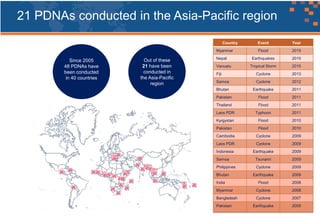
Since 2005
48 PDNAs have
been conducted
in 40 countries
Out of these
21 have been
conducted in
the Asia-Pacific
region
21 PDNAs conducted in the Asia-Pacific region
Country Event Year
Myanmar Flood 2015
Nepal Earthquakes 2015
Vanuatu Tropical Storm 2015
Fiji Cyclone 2013
Samoa Cyclone 2012
Bhutan Earthquake 2011
Pakistan Flood 2011
Thailand Flood 2011
Laos PDR Typhoon 2011
Kyrgystan Flood 2010
Pakistan Flood 2010
Cambodia Cyclone 2009
Laos PDR Cyclone 2009
Indonesia Earthquake 2009
Samoa Tsunami 2009
Philippines Cyclone 2009
Bhutan Earthquake 2009
India Flood 2008
Myanmar Cyclone 2008
Bangladesh Cyclone 2007
Pakistan Earthquake 2005
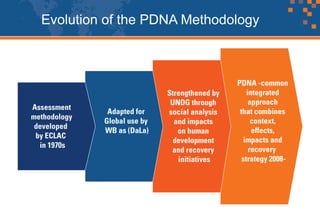
Evolution of the PDNA Methodology
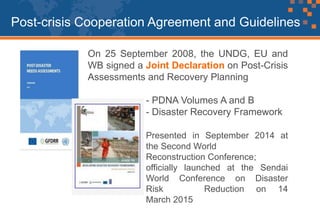
Post-crisis Cooperation Agreement and Guidelines
On 25 September 2008, the UNDG, EU and
WB signed a Joint Declaration on Post-Crisis
Assessments and Recovery Planning
- PDNA Volumes A and B
- Disaster Recovery Framework
Presented in September 2014 at
the Second World
Reconstruction Conference;
officially launched at the Sendai
World Conference on Disaster
Risk Reduction on 14
March 2015
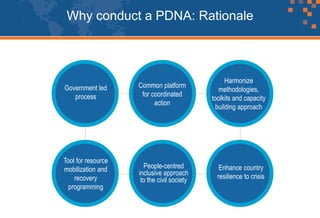
Why conduct a PDNA: Rationale
Common platform
for coordinated
action
Enhance country
resilience to crisis
People-centred
inclusive approach
to the civil society
Government led
process
Tool for resource
mobilization and
recovery
programming
Harmonize
methodologies,
toolkits and capacity
building approach
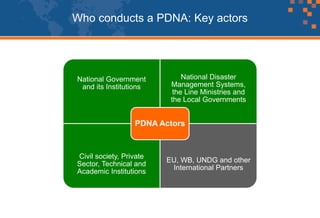
PDNA Actors
National Government
and its Institutions
National Disaster
Management Systems,
the Line Ministries and
the Local Governments
Civil society, Private
Sector, Technical and
Academic Institutions
EU, WB, UNDG and other
International Partners
PDNA Actors
Who conducts a PDNA: Key actors
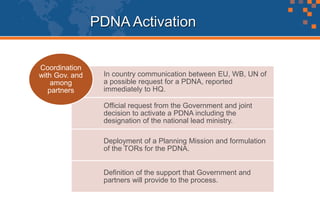
PDNA Activation
In country communication between EU, WB, UN of
a possible request for a PDNA, reported
immediately to HQ.
Official request from the Government and joint
decision to activate a PDNA including the
designation of the national lead ministry.
Deployment of a Planning Mission and formulation
of the TORs for the PDNA.
Definition of the support that Government and
partners will provide to the process.
Coordination
with Gov. and
among
partners
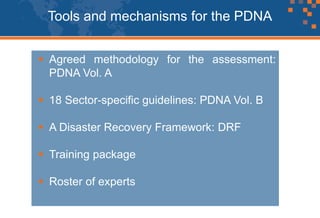
Tools and mechanisms for the PDNA
 Agreed methodology for the assessment:
PDNA Vol. A
 18 Sector-specific guidelines: PDNA Vol. B
 A Disaster Recovery Framework: DRF
 Training package
 Roster of experts
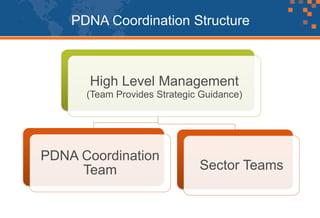
High Level Management
(Team Provides Strategic Guidance)
PDNA Coordination
Team Sector Teams
PDNA Coordination Structure
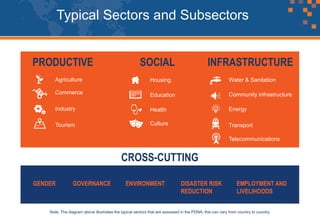
Note: The diagram above illustrates the typical sectors that are assessed in the PDNA, this can vary from country to country.
Typical Sectors and Subsectors
CROSS-CUTTING
Agriculture
Commerce
Industry
Tourism
Housing
Education
Health
Culture
Water & Sanitation
Community infrastructure
Energy
Transport
Telecommunications
GENDER GOVERNANCE ENVIRONMENT DISASTER RISK
REDUCTION
EMPLOYMENT AND
LIVELIHOODS
PRODUCTIVE SOCIAL INFRASTRUCTURE
Sectors
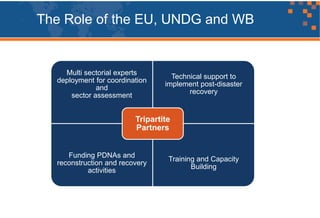
The Role of the EU, UNDG and WB
Multi sectorial experts
deployment for coordination
and
sector assessment
Technical support to
implement post-disaster
recovery
Funding PDNAs and
reconstruction and recovery
activities
Training and Capacity
Building
Tripartite
Partners
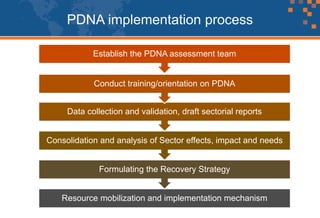
PDNA implementation process
Resource mobilization and implementation mechanism
Formulating the Recovery Strategy
Consolidation and analysis of Sector effects, impact and needs
Data collection and validation, draft sectorial reports
Conduct training/orientation on PDNA
Establish the PDNA assessment team
What is a PDNA?
Key Considerations
• Types of disasters impact sectors differently eg. earthquakes impact the housing (social) and
roads (infrastructure) the most; floods and cyclones tend to impact agriculture (productive),
livelihoods and environment (cross-cutting) more
• The country context is critical in calculating recovery needs eg. in Bhutan and Nepal
earthquakes, restoration of cultural heritage is important for physical as well as psycho-social
needs
• To analyse pre-and-post-disaster effects, baseline data must be available and collected
beforehand, usually by the Government
• In addition to desk review, the assessment must include field visits to validate data and
ensure the human dimension
• The PDNA highlights underlying risks and vulnerabilities that pose a threat to future
disasters, therefore, recovery needs include components of disaster risk reduction or build
back better
• Disaggregated data from enough disasters show that women are disproportionately affected
by disasters, gender has emerged as an important cross cutting issue to address in recovery
• PDNAs led to national assessment instruments adapted and developed in: Indonesia, Laos,
Philippines, Nepal, Kyrgyzstan, Central America, Caribbean, Jamaica
• Used for small and large disasters to form recovery and reconstruction plans: Fiji, Samoa,
Caribbean islands
• Institutionalized process by law: Indonesia, Nepal
• Recovery and Reconstruction done with a focus on reducing risks, “building back better”:
Indonesia
• Led to complete review of strategy and investment in Disaster Risk Reduction: Indonesia,
Bangladesh, Nigeria
• Post-disaster recovery led to conflict reduction: Indonesia (Aceh)
• Concept of recovery moving from focus on physical reconstruction to focus on recovery
from impacts on human development, welfare, livelihoods and capacities: Fiji, Samoa,
Malawi
• Capacity building on conducting the PDNA: Trainings for representatives from ASEAN
member states (July 2015) and SAARC disaster management authorities (September 2015)
held
Strategic results of cooperation
• ASEAN-UN Strategic Plan of Action on Disaster
Management: MOU signed on 27 November
2007
• Joint Declaration on ASEAN-UN Collaboration
on Disaster Management to support the
implementation of the AADMER Work Plan,
2010-15
• UNDP leading Recovery component: ASEAN
Disaster Recovery Reference Guide, first draft
by end 2015
• The pre-disaster recovery arrangements and
post-disaster recovery plans include the conduct
of PDNAs and building capacities in the region
to undertake PDNAs
What is a PDNA?
ASEAN Disaster Recovery Reference Guide
• Finalization of ASEAN Disaster Recovery
Reference Guide and roll-out of PDNA trainings
at the country level
• Hands on training for SAARC country
representatives on conducting PDNA and RARR
• Creation of roster of sector experts in the Asia-
Pacific region
• Greater use of innovative tools such as space
technology, crowdsourcing applications and
others developed by ESCAP into the PDNA
methodology
What is a PDNA?
Looking Ahead

Ms. Matur - PDNA presentation.pdf

  • 1.
    The Post DisasterNeeds Assessment in Asia- Pacific: A Regional Overview
  • 2.
    Since 2005 48 PDNAshave been conducted in 40 countries Out of these 21 have been conducted in the Asia-Pacific region 21 PDNAs conducted in the Asia-Pacific region Country Event Year Myanmar Flood 2015 Nepal Earthquakes 2015 Vanuatu Tropical Storm 2015 Fiji Cyclone 2013 Samoa Cyclone 2012 Bhutan Earthquake 2011 Pakistan Flood 2011 Thailand Flood 2011 Laos PDR Typhoon 2011 Kyrgystan Flood 2010 Pakistan Flood 2010 Cambodia Cyclone 2009 Laos PDR Cyclone 2009 Indonesia Earthquake 2009 Samoa Tsunami 2009 Philippines Cyclone 2009 Bhutan Earthquake 2009 India Flood 2008 Myanmar Cyclone 2008 Bangladesh Cyclone 2007 Pakistan Earthquake 2005
  • 3.
    Evolution of thePDNA Methodology
  • 4.
    Post-crisis Cooperation Agreementand Guidelines On 25 September 2008, the UNDG, EU and WB signed a Joint Declaration on Post-Crisis Assessments and Recovery Planning - PDNA Volumes A and B - Disaster Recovery Framework Presented in September 2014 at the Second World Reconstruction Conference; officially launched at the Sendai World Conference on Disaster Risk Reduction on 14 March 2015
  • 5.
    Why conduct aPDNA: Rationale Common platform for coordinated action Enhance country resilience to crisis People-centred inclusive approach to the civil society Government led process Tool for resource mobilization and recovery programming Harmonize methodologies, toolkits and capacity building approach
  • 6.
    PDNA Actors National Government andits Institutions National Disaster Management Systems, the Line Ministries and the Local Governments Civil society, Private Sector, Technical and Academic Institutions EU, WB, UNDG and other International Partners PDNA Actors Who conducts a PDNA: Key actors
  • 7.
    PDNA Activation In countrycommunication between EU, WB, UN of a possible request for a PDNA, reported immediately to HQ. Official request from the Government and joint decision to activate a PDNA including the designation of the national lead ministry. Deployment of a Planning Mission and formulation of the TORs for the PDNA. Definition of the support that Government and partners will provide to the process. Coordination with Gov. and among partners
  • 8.
    Tools and mechanismsfor the PDNA  Agreed methodology for the assessment: PDNA Vol. A  18 Sector-specific guidelines: PDNA Vol. B  A Disaster Recovery Framework: DRF  Training package  Roster of experts
  • 9.
    High Level Management (TeamProvides Strategic Guidance) PDNA Coordination Team Sector Teams PDNA Coordination Structure
  • 10.
    Note: The diagramabove illustrates the typical sectors that are assessed in the PDNA, this can vary from country to country. Typical Sectors and Subsectors CROSS-CUTTING Agriculture Commerce Industry Tourism Housing Education Health Culture Water & Sanitation Community infrastructure Energy Transport Telecommunications GENDER GOVERNANCE ENVIRONMENT DISASTER RISK REDUCTION EMPLOYMENT AND LIVELIHOODS PRODUCTIVE SOCIAL INFRASTRUCTURE
  • 11.
    Sectors The Role ofthe EU, UNDG and WB Multi sectorial experts deployment for coordination and sector assessment Technical support to implement post-disaster recovery Funding PDNAs and reconstruction and recovery activities Training and Capacity Building Tripartite Partners
  • 12.
    PDNA implementation process Resourcemobilization and implementation mechanism Formulating the Recovery Strategy Consolidation and analysis of Sector effects, impact and needs Data collection and validation, draft sectorial reports Conduct training/orientation on PDNA Establish the PDNA assessment team
  • 13.
    What is aPDNA? Key Considerations • Types of disasters impact sectors differently eg. earthquakes impact the housing (social) and roads (infrastructure) the most; floods and cyclones tend to impact agriculture (productive), livelihoods and environment (cross-cutting) more • The country context is critical in calculating recovery needs eg. in Bhutan and Nepal earthquakes, restoration of cultural heritage is important for physical as well as psycho-social needs • To analyse pre-and-post-disaster effects, baseline data must be available and collected beforehand, usually by the Government • In addition to desk review, the assessment must include field visits to validate data and ensure the human dimension • The PDNA highlights underlying risks and vulnerabilities that pose a threat to future disasters, therefore, recovery needs include components of disaster risk reduction or build back better • Disaggregated data from enough disasters show that women are disproportionately affected by disasters, gender has emerged as an important cross cutting issue to address in recovery
  • 14.
    • PDNAs ledto national assessment instruments adapted and developed in: Indonesia, Laos, Philippines, Nepal, Kyrgyzstan, Central America, Caribbean, Jamaica • Used for small and large disasters to form recovery and reconstruction plans: Fiji, Samoa, Caribbean islands • Institutionalized process by law: Indonesia, Nepal • Recovery and Reconstruction done with a focus on reducing risks, “building back better”: Indonesia • Led to complete review of strategy and investment in Disaster Risk Reduction: Indonesia, Bangladesh, Nigeria • Post-disaster recovery led to conflict reduction: Indonesia (Aceh) • Concept of recovery moving from focus on physical reconstruction to focus on recovery from impacts on human development, welfare, livelihoods and capacities: Fiji, Samoa, Malawi • Capacity building on conducting the PDNA: Trainings for representatives from ASEAN member states (July 2015) and SAARC disaster management authorities (September 2015) held Strategic results of cooperation Strategic results of cooperation
  • 15.
    • ASEAN-UN StrategicPlan of Action on Disaster Management: MOU signed on 27 November 2007 • Joint Declaration on ASEAN-UN Collaboration on Disaster Management to support the implementation of the AADMER Work Plan, 2010-15 • UNDP leading Recovery component: ASEAN Disaster Recovery Reference Guide, first draft by end 2015 • The pre-disaster recovery arrangements and post-disaster recovery plans include the conduct of PDNAs and building capacities in the region to undertake PDNAs What is a PDNA? ASEAN Disaster Recovery Reference Guide
  • 16.
    • Finalization ofASEAN Disaster Recovery Reference Guide and roll-out of PDNA trainings at the country level • Hands on training for SAARC country representatives on conducting PDNA and RARR • Creation of roster of sector experts in the Asia- Pacific region • Greater use of innovative tools such as space technology, crowdsourcing applications and others developed by ESCAP into the PDNA methodology What is a PDNA? Looking Ahead