Module 1
Workforce Planning &
Recruitment Analytics
Concept of Works & Organisation Work & Jobs
▪ Work : a relevant & strategic collectin of tasks & responsibilities
that are perfromed for a secific purpose & outcome
▪ Task : An activity requring a specific combination of cognitive &
physical perfromace & results in a targeted output. Ex : writing
Programming code
▪ Other task like handling monetary transactions, speaking to
customers
2
Concept of Works & Organisation Work & Jobs
▪ In conducting an organizational needs assesment that will result
in the identification of tasks & structuring of work & jobs, the
following questions will be valuable to examine:
 what is organisation strategic plan, including its short & long term
goals ?
 What task & activities will need to be perfromed to meet stated goals
& objectives ?
 How should these tasks & activities be organised into logical
functional areas ?
 How should work relationships be structured among departments &
functions ?
3
Concept of Works & Organisation Work & Jobs
▪ Once information has gathered that address these big-picture
questions, Job design can proceed as the next level logical step in
the workforce planning process, Jod design requires answers to
below questions ;
 How should taks & activities to be organized, scheduled, & dristibuted
to specific job roles
 What are the qualifications necessary for individuals to sucessfully
perfrom the essential task & activities for each job ?
 what are perfromance expectations that an indvidual in a specific job
in order to contribute to the acheivement of departmental / functional
or organizational outcomes ?
4
Millennials
Children born in the 80s and
90s, the Millennials are today’s
20 to early-30-
somethings,poised to make up
the majority of the workforce
by 2025, and already an
important part of the working
population. 5
Millennials at WorkPlace
▪ Millennials (also known as ‘Generation Y’) are the first
generation of ‘digital natives’ – tech savvy and connected,
rarely without a mobile phone or tablet
▪ Aside from Millennials (born 1980-1999) the current
workforce also includes Generation X (born 1960-1979)
6
Millennials at WorkPlace
▪ India boasts of being home to nearly 19percent (385 million)
of global Millennial population & is one of the eight
countries presently termed as the “Millennial Majors”
▪ To manage the Millennial workforce effectively, managers
first need to understand top 3 aspirations of Indian
Millennials were wealth, health & fame
▪ Another survey which seconds these findings revealed that
money was the key motivator for millennials & that 83 percent
of Gen Y Employee would consider switching their jobs for a
salary hike
7
Millennials at WorkPlace
▪ Understanding what motivates Millennials, as well as how
they perceive their employers and their colleagues, is
essential to attracting them to your organisation and
ensuring that you can maximise their effectiveness as
employees and potential leaders
▪ Several organisation have already started implementing
innovative practices to attract & retain millennials
▪ For instance Infosys have scrapped the formal dress code &
encourages its employees to wear smart business casual
8
Millennials at WorkPlace
▪ It has also come up with up with a new crowd-sourcing
initiative known as “Murmuring” which invites innovative
business ideas that could contribute to the company's
strategy
▪ Microsoft attempts to drive the culture of innovation at the
internship phase itself by allowing interns to learn from
experts directly
▪ IBM integrative tool “IBM Verse” which integrates email,
calendar, meetings, video chats & a lot of other capabilities
in a single platform
9
Key Characteristics of Millennials
▪ Millennials not only make up a significant proportion of the
workforce, but also form an essential segment of the
customer base
▪ Millennials are very likely to switch their service providers if
they do not feel satisfied with the quality of goods and
services.
▪ They ought to continually innovate, provide personalized
services and take up the responsibility of managing the best
interests of their customers
10
Key Characteristics of Millennials
▪ Millennials make compromise : Many Millennials tend to
make compromise while finding the first jobs
▪ PwC revealed 72 % of the respondents had made
compromises to get into job market
▪ The compromises could take many forms, ranging from
accepting a lower salary to working outside preferred
locations or job roles or industries
▪ Turnover rates are also higher amongst millennials than
those amongst other generations.
11
Key Characteristics of Millennials
▪ Millennials value personal development and work life
balance over financial rewards :
▪ This group is not driven primarily by financial rewards and
monetary incentives
▪ A recent global survey reported that young professionals
chose work-life balance over wealth and leadership
opportunities
▪ Millennials think about the expected levels of work-life
balance even while considering which organization to work
for
12
Key Characteristics of Millennials
▪ Millennials form a techno-generation that avoids face
time:
▪ The tech-savvy nature of millennials also influences the way
they communicate
▪ It was observed that 41 per cent of the respondents
preferred
▪ electronic communication methods such as texts, instant
messages and company intranet over outdated traditional
methods like face-to-face meetings and phone calls
▪ Another study reported that millennials were more
susceptible to the risk of developing chronic loneliness
▪ The youth today spend a major chunk of their time
communicating over social media
13
Key Characteristics of Millennials
▪ Loyalty of Millennials :
▪ In the job market, millennials are predominantly seen as
job-hoppers (someone who changes their job very often)
▪ The reason behind such behaviour is possibly the incentive,
that is, the pay rise associated with each switch
▪ Millennials are ambitious, entitled and self-absorbed.
Hence, if they do not see good salary hikes within a couple
of years, they prefer to switch
14
Key Characteristics of Millennials
▪ Millennials like to move up the ladder faster:
▪ Career progression is a principal motivator for millennial
professionals
▪ 91 per cent of millennials consider career progression to be
important while choosing a new job
▪ Millennials look for instant gratifications and, therefore, do
not believe in toiling (struggling) for years to earn a
promotion or pay hike.
▪ They are impatient, ambitious and entitled, which fuels their
pursuit of reaching the top faster than other generations.
15
Key Characteristics of Millennials
▪ Socially responsible brands influence millennials:
▪ Millennials have a sense of purpose, and they are, therefore,
more drawn towards philanthropic brands that practice
socially & ethically responsible behaviour.
▪ Corporate social responsibility (CSR) initiatives go a long
way in not only attracting the right talent but also
contributing to the bottom line by boosting sales
▪ Organizations today not only spend money on social
causes, but also allow their employees to take ownership of
the process by giving them opportunities to volunteer
16
Key Characteristics of Millennials
▪ Socially responsible brands influence millennials:
▪ Millennials have a sense of purpose, and they are, therefore,
more drawn towards philanthropic brands that practice
socially & ethically responsible behaviour.
▪ Corporate social responsibility (CSR) initiatives go a long
way in not only attracting the right talent but also
contributing to the bottom line by boosting sales
▪ Organizations today not only spend money on social
causes, but also allow their employees to take ownership of
the process by giving them opportunities to volunteer
17
Key Characteristics of Millennials
▪ Wanderlust :
▪ Millennials are characterized by a sense of wanderlust, that
is, a strong desire to travel.
▪ The results of an official travel report revealed that
millennials travel much more compared with other group
▪ Millennials believe in splurging on authentic experiences
rather than saving up and investing in big purchases such
as buying a new home
▪ Moreover, their openness towards new cultures and the
passion for exploring the unknown takes them places
18
Key Characteristics of Millennials
▪ Wanderlust :
▪ A new term known as ‘bleisure’, combing business as well as
leisure has been recently coined in the millennial context
▪ Millennials have changed the face of traditional business
trips and now view them as personal leisure time while
simultaneously travelling for business-related purposes
▪ Accustomed to rapid feedbacks :
▪ Millennials might get frustrated by the delayed responses
from older employees
▪ Older generations, on the other hand, may even be
displeased by a lack of face-to-face or voice-to-voice
communication
19
Key Characteristics of Millennials
▪ Millennial stereotypes :
▪ An essential element that contributes heavily to
intergenerational conflicts is the accumulation of negative
stereotypes in the minds of individuals of different
generations
▪ Baby boomers (1946-1964) perceive millennials as lazy,
impatient and unprofessional
▪ while millennials view baby boomers as old school or
unapproachable
▪ Stereotyping gives rise to misunderstandings and
miscommunication amongst co-workers
20
Key Characteristics of Millennials
▪ Differences amongst Millennial :
▪ Every Individual is a part of the broad demographic group
but is also a unique bundle comprising of different
experiences, skills, aspirations, talents and perspectives
▪ Therefore, it is recommended that the best way to lead
millennial employees is to ignore sweeping generalizations
▪ Focus on the individual under consideration, and find out
what
▪ works for him (her) the most irrespective of demographic
▪ group memberships
21
Key Characteristics of Millennials
▪ Millennials are excellent employees :
▪ Millennials carry some traits that are very unique to their
generation
▪ Therefore, if handled correctly, millennials can serve as
excellent employees for business organizations.
▪ They are fascinated to learn new skills and are proactive in
making efforts to improve themselves
▪ This inclination to grow also helps the organization to grow
in the long run
22
Key Characteristics of Millennials
▪ Millennials are excellent employees :
▪ millennials love collaborations. They are equipped to survive
in teams and are comfortable working with others, learning
from them and also competing with them.
▪ They like open-spaced offices instead of sitting in a cubicle
eight hours a day, six days a week
▪ Giving such work environments to millennials will satisfy
their needs and will help foster loyalty.
23
The Evolution of Work Structure
▪ Perhaps the earliest of the systematic organisation of work
& job design in industrialized environments can be
examined through the work of Fredrick Taylor who
developed the concept of scientific management,
▪ Emphasizing production, streamlined processes, & the
elimination of waste
▪ Taylors mission was to facilitate worker efficiency &
productivity through job design
▪ Another prominent researcher of this time was Max Weber
he focus was on hierarchical command & control,
▪
24
The Evolution of Work Structure
▪ which featured prominently in the delegation of authority &
decision making power among different types & levels of
jobs
▪ Work was organized into simple, routine tasks – job design
focused on a few basic tasks
▪ Labour supply was largely unskilled / semiskilled workers &
work was organized accordingly
▪ As a result of organizational hierarchy with greater
supervisory span of control was necessary because workers
had no authority or decision-making capability
25
The Evolution of Work Structure
▪ Frederick Taylor & Max Weber are considered to be pioneers
in the area of job & organisation design contributing to the
maximum efficiency & effectiveness
▪ Though their work was more focused on work production
than the needs of the workers themselves
▪ McGregor & Maslow to expand into new different directions
that considered the needs of the employees as well as the
organisations
26
The Evolution of Work Structure
▪ In the latter half of 20th
century Peter Drucker emerged as
one of the most influential expert in organisational structure,
management strategy, & understanding the nature of work as
technology & knowledge became increasingly all over the
place
▪ Drucker developed the concept of MBO to facilitate the
alignment of organisation objectives with the manager &
employee , work goals, also clear connection to
organisational goals & specific performance standards &
expectations
27
The Evolution of Work Structure
▪ The idea behind this approach is that employees will be
more engaged & motivated to perform a high level when
they are involved a setting their own goals
▪ Each employee would not only have a clear understanding
of their job duties & responsibilities, but also the
performance level their manager expects
▪ At the department & functional level, MBO approach foster
more open line of communication between managers &
their staffs
28
The Evolution of Work Structure
▪ Open communication which helps the employees to ask
questions, seek clarifications, & better understand the
purpose of work they perform
▪ The latter half 20th
century rise of technology, major
societal, economic & demographic shifts & globalization
have resulted in all of us living & working in a more complex
world
▪ Work cannot be organized & distributed in a such simplistic
ways anymore
▪ Even work that used to be performed by a worker with a
limited or specific skill set may now require some level of
technical proficiency 29
The Evolution of Work Structure
▪ In general, work is more complex & requires individual
workers to make more autonomous decisions rapidly
▪ complex jobs requires more decision making &
responsibility on the part of the incumbents, which is an
important consideration for the organisation in the job
design process
▪ Complex jobs also requires higher qualifications & more
specialized knowledge & skills
▪ Organisations need to stay competitive & able to shift gears
& make quick decisions often in complicated &
unpredictable circumstances
30
The Evolution of Work Structure
▪ To meet these needs the work performed must be
categorized arranged & distributed strategically & logically
▪ Jobs & job families are the support system of the
organization- how & where the work is performed that
keeps the organization moving & progressing
31
Organising the work
▪ A job is a type of role within an organization comprised of a
set of specific tasks & responsibilities that facilitate the
achievement of targeted performance outcomes
▪ These performance outcomes should be directly or
indirectly aligned with organizational objectives & short &
long term goals
▪ Depending on the size of organizations & its needs there
may be more than one individual working in a specific job
▪ Each job will be comprised of a unique set of qualifications
that will be necessary to effectively perform the work
involved
32
Organising the work
▪ They are referred as KSAOs Knowledge skills abilities other
characteristics
▪ Having a clear understanding of a job current KSAO
requirement is critically important for all HR processes
including compensation planning, recruitment, selection,
performance management, & training & development.
▪ Lets look at these each elements in detail
33
Organising the work
▪ Knowledge :
▪ It may be comprised of any declarative, procedural & factual
information required to be perform the job
▪ For ex school bus drivers, knowledge about the road rules,
the operation of the bus & emergency evacuation
procedures is absolutely critical to their safe driving
performance
▪ For pharmacists, knowledge about prescription & over the
counter drugs, their chemical composition, potential side
effects & interaction effects with food & other drugs is
equally critical to their job performance
34
Organising the work
▪ Skills :
▪ Its comprised of tasks that can be successfully
demonstrated & have been learned & practiced over time
▪ With essentially all of today’s jobs there is a diverse array of
skill set required for any type of job
▪ Such as communication skills, technical skills, organisational
skills, interpersonal skills
▪ Technical skills – Excel spreadsheets, programming,
Communication skills – explaining the concepts as teacher,
organisational skills – travel plan , coordinating,
interpersonal skills – building rapport, flexibility, team
player, showing respect, being patient, building trust &
positive relations
35
Organising the work
▪ Abilities :
▪ Includes the capacity for demonstrating certain behaviours &
performing a wide range of relevant tasks
▪ while some abilities may be applicable to many jobs like
multitasking
▪ The job of an physicians assistant may require to draw blood
sample & give injection
▪ Ability also differs across diverse jobs but show up in a
different ways
▪ Firefighters &B police officers, emergency room workers &
flight attendants, the ability to remain calm be approachable &
maintain order, but it tends to be different on job where
pressure is high 36
Organising the work
▪ Other characteristics :
▪ Includes any other critical personal job requirements not
covered within the knowledge, skills & abilities
▪ They may be broad & relevant to a wide variety of different jobs
▪ Some jobs requires passions & enthusiasm would be critical
othe r characteristics element
▪ A research scientist can be too curious nature would be other
characteristics
37
Organising the work
▪ Job families :
▪ A group of jobs that is similar in function & scope & share
common knowledge, skills, & abilities
▪ A job family may also include jobs of different levels. For
example a job family in an accounting department may consist
of a Billing clerk, accounts receivable specialist, an account
payable specialist, a bookkeeper, & an accounting manager
▪ Having organised job families is beneficial to an organization in
a variety of ways
▪ They can ensure greater alignment & uniformity among similar
jobs, which provides clear understanding of nature of each job
as well as how they operate together as a cohesive function
38
Organising the work
▪ Position :
▪ A position is a job that is held by one individual employee
▪ Think of a position like headcount each incumbent working in an
organisation is filling one specific position
▪ You can have multiple incumbent working in one type of job
▪ Occupation :
▪ A type of job that may exist in different types of organizations or
industries
▪ There will be similarities & differences in the same occupation from one
organization to another
▪ A nurse is a board type of occupation & even though there will be
overlap of the same qualifications & required tasks & responsibilities in
different settings
39
Strategic Job Redesign & its benefits
▪ Jobs will need to be evaluated & often redesigned to continue
to support the organization
▪ Job redesign may be needed due to unpredictable / immediate
needs, & it may also be strategically implemented to enhance
existing jobs to contribute to the organization in more far
reaching innovative ways
▪ Job Enlargement :
▪ The augmenting of a job by adding an array of tasks similar in
complexity & responsibility as the existing tasks, enabling variety
▪ Job enlargement is not about giving an employee more work to
do for the same pay, but rather
40
Strategic Job Redesign & its benefits
▪ Its an opportunity to expand into different types of related
tasks for stimulation & the ability to experience the job in a
integrated way as it contributes to the bigger picture for the
organization
▪ An example of JE for a Barista at a coffee shop may be to
expand an incumbent tasks from simply making the drink orders
as a stand alone tasks to taking the orders from the customers,
making the beverages, & delivering them to customers
▪ But while expanding the job make sure work is not overloaded
▪ JE when carefully designed & implemented with fairness &
equity can be integrated into many different jobs, particularly
jobs that have traditionally consisted of a few specialized
routine tasks without much variety 41
Strategic Job Redesign & its benefits
▪ Job Enrichment :
▪ The enhancing of a job by adding tasks that are grater in
complexity & responsibility
▪ This is a strategy designed to facilitate greater motivation & job
satisfaction, leading to increased performance
▪ Hackman & Oldham developed a set of characteristics that can
be used as a tool to asses the extent to which a job can be
enriched
▪ Skill variety : The breadth & type of skills that a job incumbent
must posses to successfully perform a job
▪ Task Identity : the extent to which a task is clear to understand
and has a defined beginning, midpoint & end
42
Strategic Job Redesign & its benefits
▪ Job Enrichment :
▪ Task significance : the value or the importance of the task in
the context of the job in which it is performed and the outcome
it yields for the organization
▪ Autonomy : the extent to which a job incumbent has a control
of how tasks are performed, such as the procedures &
timelines
▪ Task feedback : the level of knowledge that a job incumbent
has about his or her task performance that is received as a
result of performing the task rather than receiving the
feedback from the supervisor
43
Strategic Job Redesign & its benefits
▪ Job Enrichment :
▪ A relevant example of JE can be seen in various retail
environments
▪ A common job today is that of a manager on duty (MOD) also
referred to as a Key Holder
▪ this job is essentially a cross functional combination of
salesperson & supervisor
▪ The worker in this type of job is able perform the same
activities as any sales associate, handling customer
transactions, responding to customer inquiries for assistance,
keeping products organized & well stocked & so on
44
Strategic Job Redesign & its benefits
▪ Job Enrichment :
▪ However MOD is given added responsibility & authority to
serve as the acting manager on his work shift, performing
activities such as opening or closing store, accepting deliveries,
resolving customer problems, monitoring sales progress in
accordance with daily goals, & handling on shift employee
issues such as staff motivation, conflict resolution & immediate
disciplinary action needs
45
Strategic Issues in Recruitment
▪ Making it hard to grab candidates’ attention
▪ Great candidates are often fielding multiple offers at once
▪ There’s a shortage of talent with the skills your company needs
▪ Testing candidates’ skills accurately and fairly can be tricky
▪ Recruiters sometimes lack the technical knowledge needed to
answer candidates’ questions
▪ There aren’t enough hours in the day
▪ Candidate screening challenges
▪ Longer time to hire
46
What make Bad recruitment
▪ Not Creating an Accurate Job Description
▪ Failing to Consider Recruiting From Within
▪ Using Unconscious Bias
▪ Hiring People Less Qualified Than You
▪ Refilling the same role
▪ Lack of diversity
▪ Lack of rigour in interviewing and reference checking
▪ Too few people involved in the hiring decision
▪ Aptitude and Attitude are not measured
▪ Poor on boarding
▪ Your interview practices are outdated
▪ Never getting back to candidates after interviews
47
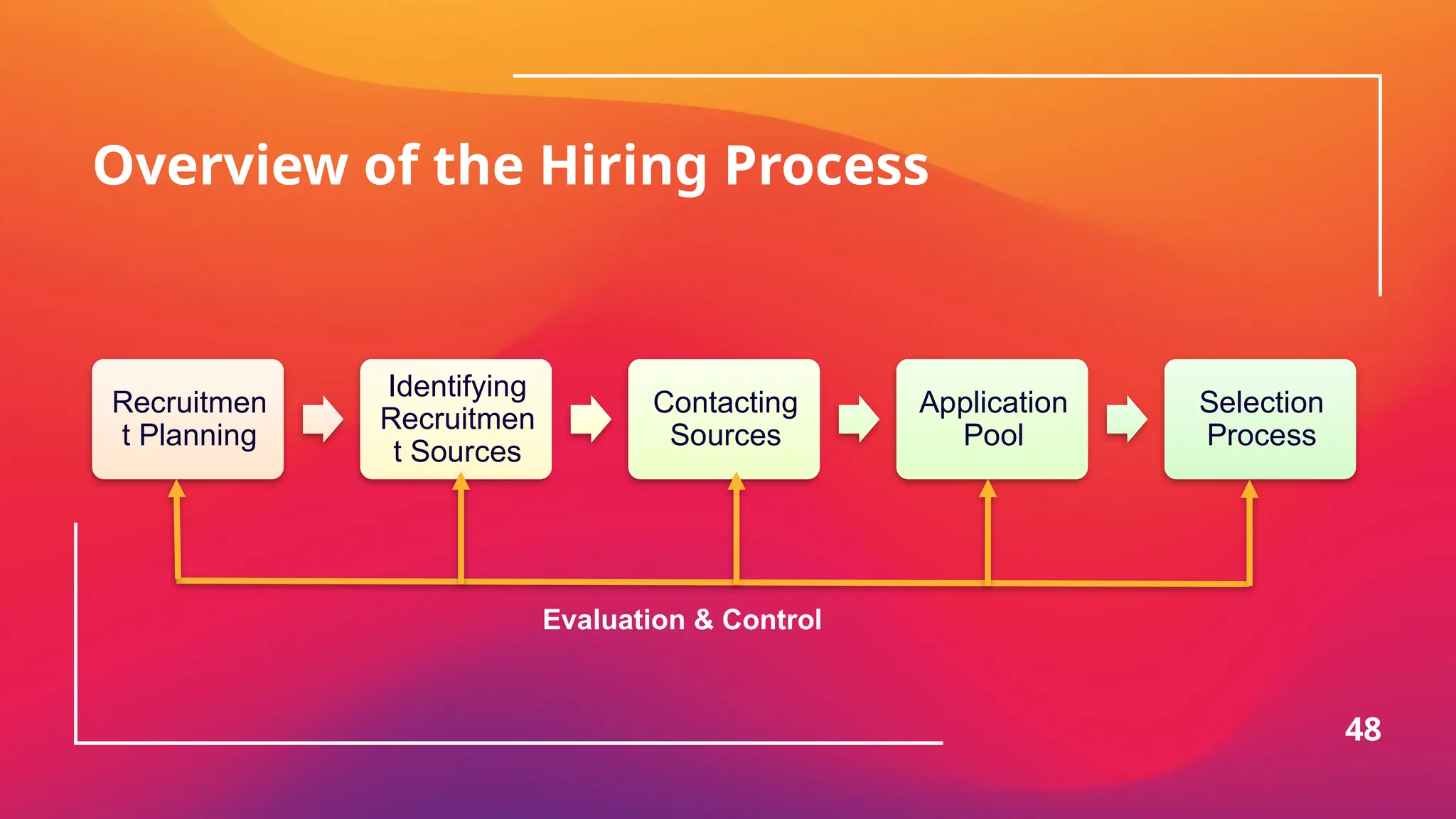
Overview of the Hiring Process
48
Recruitmen
t Planning
Identifying
Recruitmen
t Sources
Contacting
Sources
Application
Pool
Selection
Process
Evaluation & Control
Recruitment Metrics
▪ Recruiting metrics are measurements used to track hiring success &
optimise the process of hiring candidates for an organisation
▪ When used correctly these metrics help to evaluate the recruiting
process & whether the company is hiring the right people
▪ Recruiting metrics refers to measurements used to gather, analyse &
track hiring success & optimise the hiring process in order to make
more informed decisions & receive the best return on investment
49
Recruitment Metrics
▪ Evaluating Quantity & Quality of recruitment
▫ Quality of applicants
▫ Quantity of applicants
▪ Evaluating the average time required for filling job openings
▪ Evaluating the cost of Recruiting
▫ Recruitment expenses / Number of Recruits Hired
▪ Evaluating Recruiting Satisfaction
▪ General Recruiting Process Metrics : Yield Ratios, Selection Rate,
Acceptance Rate, Success Base Rate
50
Recruitment Metrics
▪ Yield Ratios : Yield ratio compares how many applicants took part in
one phase of recruitment process with how many took part in the
other phase, it gives a figure that number of applicants who initially
applied
▪ Selection Rate : Selection Rate is another important statistic. It is the
percentage for applicants hired from the whole applicant pool
▪ Acceptance Rate : Acceptance rate informs about the success of the
organisation at hiring desired employees. This is calculated by
dividing the “number of applicants hired “ by the “number of applicants
offered jobs”
51
Recruitment Metrics
▪ Success Base Rate : An important way of finding recruiting
effectiveness is the success rate of applicants
▪ This can be calculated by comparing the number of previous
applicants who are now successful employees with the number of
applicants they had competed with.
52
Factors Affecting Recruitment
▪ Recruitment is mainly affected by following two types of factors :
▪ External Factors :
▪ Supply & Demand
▪ Unemployment Rate
▪ Labour Market
▪ Image / Goodwill
▪ Political Social Legal environment
▪ Competitors
53
Factors Affecting Recruitment
▪ Recruitment is mainly affected by following two types of factors :
▪ Internal Factors :
▪ Human Resource Planning
▪ Recruitment Policy
▪ Size of Firm
▪ Cost
54
Recruitment Strategy
▪ Internal Approach :
▪ Transfer & Promotion
▪ Job Posting
▪ Employee Referrals
▪ Former Employee
▪ Previous Applicants
▪ Merits : Familiarity, Utilisation of Internal Talent, Economy,
Motivation
▪ De-Merits : Restricted choice, Inbreeding, Conflict
55
Recruitment Strategy
▪ External Approach :
▪ Campus Recruitment
▪ Scouting
▪ Factory Gate
▪ Advertisements
▪ Employee Trade Association
▪ Professional Associations
▪ Private Employment Agencies
▪ State Employment Agencies
▪ Unconsolidated Applications
56
Recruitment Strategy
▪ External Approach :
▪ Merits : Wide choice, Fresh Talent, Long Term Benefit
▪ Demerits : Expensive Time Consuming, Demotivating, Uncertainty
57
Recruitment Strategy
▪ Legal & Ethical Considerations in Recruitment :
▪ Discriminations
▪ Nepotism
▪ Posting Fake benefits
▪ Hijacking Emp. from Competitors
▪ Recruiting Non Skilled employee
▪ Requesting an Application fee
▪ Offering least pay structure
▪ Unethical Employee Referral Practices
58
Recruitment Strategy
Organisational Best Practices :
▪ Use Recruitment Marketing Strategies -Brand Awareness & Benefits
▪ Make use of Social Media – Instagram , Facebook
▪ Focus on Employers Branding
▪ Enhance Candidate Experience
▪ Utilise Applicant Management System – the applicant manager
(TAM)
59
Thanks !

R-S-MODULE-1.pptx project mba students Recruitment and Selection

  • 1.
    Module 1 Workforce Planning& Recruitment Analytics
  • 2.
    Concept of Works& Organisation Work & Jobs ▪ Work : a relevant & strategic collectin of tasks & responsibilities that are perfromed for a secific purpose & outcome ▪ Task : An activity requring a specific combination of cognitive & physical perfromace & results in a targeted output. Ex : writing Programming code ▪ Other task like handling monetary transactions, speaking to customers 2
  • 3.
    Concept of Works& Organisation Work & Jobs ▪ In conducting an organizational needs assesment that will result in the identification of tasks & structuring of work & jobs, the following questions will be valuable to examine:  what is organisation strategic plan, including its short & long term goals ?  What task & activities will need to be perfromed to meet stated goals & objectives ?  How should these tasks & activities be organised into logical functional areas ?  How should work relationships be structured among departments & functions ? 3
  • 4.
    Concept of Works& Organisation Work & Jobs ▪ Once information has gathered that address these big-picture questions, Job design can proceed as the next level logical step in the workforce planning process, Jod design requires answers to below questions ;  How should taks & activities to be organized, scheduled, & dristibuted to specific job roles  What are the qualifications necessary for individuals to sucessfully perfrom the essential task & activities for each job ?  what are perfromance expectations that an indvidual in a specific job in order to contribute to the acheivement of departmental / functional or organizational outcomes ? 4
  • 5.
    Millennials Children born inthe 80s and 90s, the Millennials are today’s 20 to early-30- somethings,poised to make up the majority of the workforce by 2025, and already an important part of the working population. 5
  • 6.
    Millennials at WorkPlace ▪Millennials (also known as ‘Generation Y’) are the first generation of ‘digital natives’ – tech savvy and connected, rarely without a mobile phone or tablet ▪ Aside from Millennials (born 1980-1999) the current workforce also includes Generation X (born 1960-1979) 6
  • 7.
    Millennials at WorkPlace ▪India boasts of being home to nearly 19percent (385 million) of global Millennial population & is one of the eight countries presently termed as the “Millennial Majors” ▪ To manage the Millennial workforce effectively, managers first need to understand top 3 aspirations of Indian Millennials were wealth, health & fame ▪ Another survey which seconds these findings revealed that money was the key motivator for millennials & that 83 percent of Gen Y Employee would consider switching their jobs for a salary hike 7
  • 8.
    Millennials at WorkPlace ▪Understanding what motivates Millennials, as well as how they perceive their employers and their colleagues, is essential to attracting them to your organisation and ensuring that you can maximise their effectiveness as employees and potential leaders ▪ Several organisation have already started implementing innovative practices to attract & retain millennials ▪ For instance Infosys have scrapped the formal dress code & encourages its employees to wear smart business casual 8
  • 9.
    Millennials at WorkPlace ▪It has also come up with up with a new crowd-sourcing initiative known as “Murmuring” which invites innovative business ideas that could contribute to the company's strategy ▪ Microsoft attempts to drive the culture of innovation at the internship phase itself by allowing interns to learn from experts directly ▪ IBM integrative tool “IBM Verse” which integrates email, calendar, meetings, video chats & a lot of other capabilities in a single platform 9
  • 10.
    Key Characteristics ofMillennials ▪ Millennials not only make up a significant proportion of the workforce, but also form an essential segment of the customer base ▪ Millennials are very likely to switch their service providers if they do not feel satisfied with the quality of goods and services. ▪ They ought to continually innovate, provide personalized services and take up the responsibility of managing the best interests of their customers 10
  • 11.
    Key Characteristics ofMillennials ▪ Millennials make compromise : Many Millennials tend to make compromise while finding the first jobs ▪ PwC revealed 72 % of the respondents had made compromises to get into job market ▪ The compromises could take many forms, ranging from accepting a lower salary to working outside preferred locations or job roles or industries ▪ Turnover rates are also higher amongst millennials than those amongst other generations. 11
  • 12.
    Key Characteristics ofMillennials ▪ Millennials value personal development and work life balance over financial rewards : ▪ This group is not driven primarily by financial rewards and monetary incentives ▪ A recent global survey reported that young professionals chose work-life balance over wealth and leadership opportunities ▪ Millennials think about the expected levels of work-life balance even while considering which organization to work for 12
  • 13.
    Key Characteristics ofMillennials ▪ Millennials form a techno-generation that avoids face time: ▪ The tech-savvy nature of millennials also influences the way they communicate ▪ It was observed that 41 per cent of the respondents preferred ▪ electronic communication methods such as texts, instant messages and company intranet over outdated traditional methods like face-to-face meetings and phone calls ▪ Another study reported that millennials were more susceptible to the risk of developing chronic loneliness ▪ The youth today spend a major chunk of their time communicating over social media 13
  • 14.
    Key Characteristics ofMillennials ▪ Loyalty of Millennials : ▪ In the job market, millennials are predominantly seen as job-hoppers (someone who changes their job very often) ▪ The reason behind such behaviour is possibly the incentive, that is, the pay rise associated with each switch ▪ Millennials are ambitious, entitled and self-absorbed. Hence, if they do not see good salary hikes within a couple of years, they prefer to switch 14
  • 15.
    Key Characteristics ofMillennials ▪ Millennials like to move up the ladder faster: ▪ Career progression is a principal motivator for millennial professionals ▪ 91 per cent of millennials consider career progression to be important while choosing a new job ▪ Millennials look for instant gratifications and, therefore, do not believe in toiling (struggling) for years to earn a promotion or pay hike. ▪ They are impatient, ambitious and entitled, which fuels their pursuit of reaching the top faster than other generations. 15
  • 16.
    Key Characteristics ofMillennials ▪ Socially responsible brands influence millennials: ▪ Millennials have a sense of purpose, and they are, therefore, more drawn towards philanthropic brands that practice socially & ethically responsible behaviour. ▪ Corporate social responsibility (CSR) initiatives go a long way in not only attracting the right talent but also contributing to the bottom line by boosting sales ▪ Organizations today not only spend money on social causes, but also allow their employees to take ownership of the process by giving them opportunities to volunteer 16
  • 17.
    Key Characteristics ofMillennials ▪ Socially responsible brands influence millennials: ▪ Millennials have a sense of purpose, and they are, therefore, more drawn towards philanthropic brands that practice socially & ethically responsible behaviour. ▪ Corporate social responsibility (CSR) initiatives go a long way in not only attracting the right talent but also contributing to the bottom line by boosting sales ▪ Organizations today not only spend money on social causes, but also allow their employees to take ownership of the process by giving them opportunities to volunteer 17
  • 18.
    Key Characteristics ofMillennials ▪ Wanderlust : ▪ Millennials are characterized by a sense of wanderlust, that is, a strong desire to travel. ▪ The results of an official travel report revealed that millennials travel much more compared with other group ▪ Millennials believe in splurging on authentic experiences rather than saving up and investing in big purchases such as buying a new home ▪ Moreover, their openness towards new cultures and the passion for exploring the unknown takes them places 18
  • 19.
    Key Characteristics ofMillennials ▪ Wanderlust : ▪ A new term known as ‘bleisure’, combing business as well as leisure has been recently coined in the millennial context ▪ Millennials have changed the face of traditional business trips and now view them as personal leisure time while simultaneously travelling for business-related purposes ▪ Accustomed to rapid feedbacks : ▪ Millennials might get frustrated by the delayed responses from older employees ▪ Older generations, on the other hand, may even be displeased by a lack of face-to-face or voice-to-voice communication 19
  • 20.
    Key Characteristics ofMillennials ▪ Millennial stereotypes : ▪ An essential element that contributes heavily to intergenerational conflicts is the accumulation of negative stereotypes in the minds of individuals of different generations ▪ Baby boomers (1946-1964) perceive millennials as lazy, impatient and unprofessional ▪ while millennials view baby boomers as old school or unapproachable ▪ Stereotyping gives rise to misunderstandings and miscommunication amongst co-workers 20
  • 21.
    Key Characteristics ofMillennials ▪ Differences amongst Millennial : ▪ Every Individual is a part of the broad demographic group but is also a unique bundle comprising of different experiences, skills, aspirations, talents and perspectives ▪ Therefore, it is recommended that the best way to lead millennial employees is to ignore sweeping generalizations ▪ Focus on the individual under consideration, and find out what ▪ works for him (her) the most irrespective of demographic ▪ group memberships 21
  • 22.
    Key Characteristics ofMillennials ▪ Millennials are excellent employees : ▪ Millennials carry some traits that are very unique to their generation ▪ Therefore, if handled correctly, millennials can serve as excellent employees for business organizations. ▪ They are fascinated to learn new skills and are proactive in making efforts to improve themselves ▪ This inclination to grow also helps the organization to grow in the long run 22
  • 23.
    Key Characteristics ofMillennials ▪ Millennials are excellent employees : ▪ millennials love collaborations. They are equipped to survive in teams and are comfortable working with others, learning from them and also competing with them. ▪ They like open-spaced offices instead of sitting in a cubicle eight hours a day, six days a week ▪ Giving such work environments to millennials will satisfy their needs and will help foster loyalty. 23
  • 24.
    The Evolution ofWork Structure ▪ Perhaps the earliest of the systematic organisation of work & job design in industrialized environments can be examined through the work of Fredrick Taylor who developed the concept of scientific management, ▪ Emphasizing production, streamlined processes, & the elimination of waste ▪ Taylors mission was to facilitate worker efficiency & productivity through job design ▪ Another prominent researcher of this time was Max Weber he focus was on hierarchical command & control, ▪ 24
  • 25.
    The Evolution ofWork Structure ▪ which featured prominently in the delegation of authority & decision making power among different types & levels of jobs ▪ Work was organized into simple, routine tasks – job design focused on a few basic tasks ▪ Labour supply was largely unskilled / semiskilled workers & work was organized accordingly ▪ As a result of organizational hierarchy with greater supervisory span of control was necessary because workers had no authority or decision-making capability 25
  • 26.
    The Evolution ofWork Structure ▪ Frederick Taylor & Max Weber are considered to be pioneers in the area of job & organisation design contributing to the maximum efficiency & effectiveness ▪ Though their work was more focused on work production than the needs of the workers themselves ▪ McGregor & Maslow to expand into new different directions that considered the needs of the employees as well as the organisations 26
  • 27.
    The Evolution ofWork Structure ▪ In the latter half of 20th century Peter Drucker emerged as one of the most influential expert in organisational structure, management strategy, & understanding the nature of work as technology & knowledge became increasingly all over the place ▪ Drucker developed the concept of MBO to facilitate the alignment of organisation objectives with the manager & employee , work goals, also clear connection to organisational goals & specific performance standards & expectations 27
  • 28.
    The Evolution ofWork Structure ▪ The idea behind this approach is that employees will be more engaged & motivated to perform a high level when they are involved a setting their own goals ▪ Each employee would not only have a clear understanding of their job duties & responsibilities, but also the performance level their manager expects ▪ At the department & functional level, MBO approach foster more open line of communication between managers & their staffs 28
  • 29.
    The Evolution ofWork Structure ▪ Open communication which helps the employees to ask questions, seek clarifications, & better understand the purpose of work they perform ▪ The latter half 20th century rise of technology, major societal, economic & demographic shifts & globalization have resulted in all of us living & working in a more complex world ▪ Work cannot be organized & distributed in a such simplistic ways anymore ▪ Even work that used to be performed by a worker with a limited or specific skill set may now require some level of technical proficiency 29
  • 30.
    The Evolution ofWork Structure ▪ In general, work is more complex & requires individual workers to make more autonomous decisions rapidly ▪ complex jobs requires more decision making & responsibility on the part of the incumbents, which is an important consideration for the organisation in the job design process ▪ Complex jobs also requires higher qualifications & more specialized knowledge & skills ▪ Organisations need to stay competitive & able to shift gears & make quick decisions often in complicated & unpredictable circumstances 30
  • 31.
    The Evolution ofWork Structure ▪ To meet these needs the work performed must be categorized arranged & distributed strategically & logically ▪ Jobs & job families are the support system of the organization- how & where the work is performed that keeps the organization moving & progressing 31
  • 32.
    Organising the work ▪A job is a type of role within an organization comprised of a set of specific tasks & responsibilities that facilitate the achievement of targeted performance outcomes ▪ These performance outcomes should be directly or indirectly aligned with organizational objectives & short & long term goals ▪ Depending on the size of organizations & its needs there may be more than one individual working in a specific job ▪ Each job will be comprised of a unique set of qualifications that will be necessary to effectively perform the work involved 32
  • 33.
    Organising the work ▪They are referred as KSAOs Knowledge skills abilities other characteristics ▪ Having a clear understanding of a job current KSAO requirement is critically important for all HR processes including compensation planning, recruitment, selection, performance management, & training & development. ▪ Lets look at these each elements in detail 33
  • 34.
    Organising the work ▪Knowledge : ▪ It may be comprised of any declarative, procedural & factual information required to be perform the job ▪ For ex school bus drivers, knowledge about the road rules, the operation of the bus & emergency evacuation procedures is absolutely critical to their safe driving performance ▪ For pharmacists, knowledge about prescription & over the counter drugs, their chemical composition, potential side effects & interaction effects with food & other drugs is equally critical to their job performance 34
  • 35.
    Organising the work ▪Skills : ▪ Its comprised of tasks that can be successfully demonstrated & have been learned & practiced over time ▪ With essentially all of today’s jobs there is a diverse array of skill set required for any type of job ▪ Such as communication skills, technical skills, organisational skills, interpersonal skills ▪ Technical skills – Excel spreadsheets, programming, Communication skills – explaining the concepts as teacher, organisational skills – travel plan , coordinating, interpersonal skills – building rapport, flexibility, team player, showing respect, being patient, building trust & positive relations 35
  • 36.
    Organising the work ▪Abilities : ▪ Includes the capacity for demonstrating certain behaviours & performing a wide range of relevant tasks ▪ while some abilities may be applicable to many jobs like multitasking ▪ The job of an physicians assistant may require to draw blood sample & give injection ▪ Ability also differs across diverse jobs but show up in a different ways ▪ Firefighters &B police officers, emergency room workers & flight attendants, the ability to remain calm be approachable & maintain order, but it tends to be different on job where pressure is high 36
  • 37.
    Organising the work ▪Other characteristics : ▪ Includes any other critical personal job requirements not covered within the knowledge, skills & abilities ▪ They may be broad & relevant to a wide variety of different jobs ▪ Some jobs requires passions & enthusiasm would be critical othe r characteristics element ▪ A research scientist can be too curious nature would be other characteristics 37
  • 38.
    Organising the work ▪Job families : ▪ A group of jobs that is similar in function & scope & share common knowledge, skills, & abilities ▪ A job family may also include jobs of different levels. For example a job family in an accounting department may consist of a Billing clerk, accounts receivable specialist, an account payable specialist, a bookkeeper, & an accounting manager ▪ Having organised job families is beneficial to an organization in a variety of ways ▪ They can ensure greater alignment & uniformity among similar jobs, which provides clear understanding of nature of each job as well as how they operate together as a cohesive function 38
  • 39.
    Organising the work ▪Position : ▪ A position is a job that is held by one individual employee ▪ Think of a position like headcount each incumbent working in an organisation is filling one specific position ▪ You can have multiple incumbent working in one type of job ▪ Occupation : ▪ A type of job that may exist in different types of organizations or industries ▪ There will be similarities & differences in the same occupation from one organization to another ▪ A nurse is a board type of occupation & even though there will be overlap of the same qualifications & required tasks & responsibilities in different settings 39
  • 40.
    Strategic Job Redesign& its benefits ▪ Jobs will need to be evaluated & often redesigned to continue to support the organization ▪ Job redesign may be needed due to unpredictable / immediate needs, & it may also be strategically implemented to enhance existing jobs to contribute to the organization in more far reaching innovative ways ▪ Job Enlargement : ▪ The augmenting of a job by adding an array of tasks similar in complexity & responsibility as the existing tasks, enabling variety ▪ Job enlargement is not about giving an employee more work to do for the same pay, but rather 40
  • 41.
    Strategic Job Redesign& its benefits ▪ Its an opportunity to expand into different types of related tasks for stimulation & the ability to experience the job in a integrated way as it contributes to the bigger picture for the organization ▪ An example of JE for a Barista at a coffee shop may be to expand an incumbent tasks from simply making the drink orders as a stand alone tasks to taking the orders from the customers, making the beverages, & delivering them to customers ▪ But while expanding the job make sure work is not overloaded ▪ JE when carefully designed & implemented with fairness & equity can be integrated into many different jobs, particularly jobs that have traditionally consisted of a few specialized routine tasks without much variety 41
  • 42.
    Strategic Job Redesign& its benefits ▪ Job Enrichment : ▪ The enhancing of a job by adding tasks that are grater in complexity & responsibility ▪ This is a strategy designed to facilitate greater motivation & job satisfaction, leading to increased performance ▪ Hackman & Oldham developed a set of characteristics that can be used as a tool to asses the extent to which a job can be enriched ▪ Skill variety : The breadth & type of skills that a job incumbent must posses to successfully perform a job ▪ Task Identity : the extent to which a task is clear to understand and has a defined beginning, midpoint & end 42
  • 43.
    Strategic Job Redesign& its benefits ▪ Job Enrichment : ▪ Task significance : the value or the importance of the task in the context of the job in which it is performed and the outcome it yields for the organization ▪ Autonomy : the extent to which a job incumbent has a control of how tasks are performed, such as the procedures & timelines ▪ Task feedback : the level of knowledge that a job incumbent has about his or her task performance that is received as a result of performing the task rather than receiving the feedback from the supervisor 43
  • 44.
    Strategic Job Redesign& its benefits ▪ Job Enrichment : ▪ A relevant example of JE can be seen in various retail environments ▪ A common job today is that of a manager on duty (MOD) also referred to as a Key Holder ▪ this job is essentially a cross functional combination of salesperson & supervisor ▪ The worker in this type of job is able perform the same activities as any sales associate, handling customer transactions, responding to customer inquiries for assistance, keeping products organized & well stocked & so on 44
  • 45.
    Strategic Job Redesign& its benefits ▪ Job Enrichment : ▪ However MOD is given added responsibility & authority to serve as the acting manager on his work shift, performing activities such as opening or closing store, accepting deliveries, resolving customer problems, monitoring sales progress in accordance with daily goals, & handling on shift employee issues such as staff motivation, conflict resolution & immediate disciplinary action needs 45
  • 46.
    Strategic Issues inRecruitment ▪ Making it hard to grab candidates’ attention ▪ Great candidates are often fielding multiple offers at once ▪ There’s a shortage of talent with the skills your company needs ▪ Testing candidates’ skills accurately and fairly can be tricky ▪ Recruiters sometimes lack the technical knowledge needed to answer candidates’ questions ▪ There aren’t enough hours in the day ▪ Candidate screening challenges ▪ Longer time to hire 46
  • 47.
    What make Badrecruitment ▪ Not Creating an Accurate Job Description ▪ Failing to Consider Recruiting From Within ▪ Using Unconscious Bias ▪ Hiring People Less Qualified Than You ▪ Refilling the same role ▪ Lack of diversity ▪ Lack of rigour in interviewing and reference checking ▪ Too few people involved in the hiring decision ▪ Aptitude and Attitude are not measured ▪ Poor on boarding ▪ Your interview practices are outdated ▪ Never getting back to candidates after interviews 47
  • 48.
    Overview of theHiring Process 48 Recruitmen t Planning Identifying Recruitmen t Sources Contacting Sources Application Pool Selection Process Evaluation & Control
  • 49.
    Recruitment Metrics ▪ Recruitingmetrics are measurements used to track hiring success & optimise the process of hiring candidates for an organisation ▪ When used correctly these metrics help to evaluate the recruiting process & whether the company is hiring the right people ▪ Recruiting metrics refers to measurements used to gather, analyse & track hiring success & optimise the hiring process in order to make more informed decisions & receive the best return on investment 49
  • 50.
    Recruitment Metrics ▪ EvaluatingQuantity & Quality of recruitment ▫ Quality of applicants ▫ Quantity of applicants ▪ Evaluating the average time required for filling job openings ▪ Evaluating the cost of Recruiting ▫ Recruitment expenses / Number of Recruits Hired ▪ Evaluating Recruiting Satisfaction ▪ General Recruiting Process Metrics : Yield Ratios, Selection Rate, Acceptance Rate, Success Base Rate 50
  • 51.
    Recruitment Metrics ▪ YieldRatios : Yield ratio compares how many applicants took part in one phase of recruitment process with how many took part in the other phase, it gives a figure that number of applicants who initially applied ▪ Selection Rate : Selection Rate is another important statistic. It is the percentage for applicants hired from the whole applicant pool ▪ Acceptance Rate : Acceptance rate informs about the success of the organisation at hiring desired employees. This is calculated by dividing the “number of applicants hired “ by the “number of applicants offered jobs” 51
  • 52.
    Recruitment Metrics ▪ SuccessBase Rate : An important way of finding recruiting effectiveness is the success rate of applicants ▪ This can be calculated by comparing the number of previous applicants who are now successful employees with the number of applicants they had competed with. 52
  • 53.
    Factors Affecting Recruitment ▪Recruitment is mainly affected by following two types of factors : ▪ External Factors : ▪ Supply & Demand ▪ Unemployment Rate ▪ Labour Market ▪ Image / Goodwill ▪ Political Social Legal environment ▪ Competitors 53
  • 54.
    Factors Affecting Recruitment ▪Recruitment is mainly affected by following two types of factors : ▪ Internal Factors : ▪ Human Resource Planning ▪ Recruitment Policy ▪ Size of Firm ▪ Cost 54
  • 55.
    Recruitment Strategy ▪ InternalApproach : ▪ Transfer & Promotion ▪ Job Posting ▪ Employee Referrals ▪ Former Employee ▪ Previous Applicants ▪ Merits : Familiarity, Utilisation of Internal Talent, Economy, Motivation ▪ De-Merits : Restricted choice, Inbreeding, Conflict 55
  • 56.
    Recruitment Strategy ▪ ExternalApproach : ▪ Campus Recruitment ▪ Scouting ▪ Factory Gate ▪ Advertisements ▪ Employee Trade Association ▪ Professional Associations ▪ Private Employment Agencies ▪ State Employment Agencies ▪ Unconsolidated Applications 56
  • 57.
    Recruitment Strategy ▪ ExternalApproach : ▪ Merits : Wide choice, Fresh Talent, Long Term Benefit ▪ Demerits : Expensive Time Consuming, Demotivating, Uncertainty 57
  • 58.
    Recruitment Strategy ▪ Legal& Ethical Considerations in Recruitment : ▪ Discriminations ▪ Nepotism ▪ Posting Fake benefits ▪ Hijacking Emp. from Competitors ▪ Recruiting Non Skilled employee ▪ Requesting an Application fee ▪ Offering least pay structure ▪ Unethical Employee Referral Practices 58
  • 59.
    Recruitment Strategy Organisational BestPractices : ▪ Use Recruitment Marketing Strategies -Brand Awareness & Benefits ▪ Make use of Social Media – Instagram , Facebook ▪ Focus on Employers Branding ▪ Enhance Candidate Experience ▪ Utilise Applicant Management System – the applicant manager (TAM) 59
  • 60.