



IT SECURIT Y FOR LIBRARIES
PART 3: DISASTER RECOVERY
B R I A N P I C H M A N | E V O LV E P R O J E C T
@ B P I C H M A N O N T W I T T E R !
IDENTIFYING THREATS
• “Act of God”
– Tornado, Flood, Fire
• ”Act of Evil”
– Break-ins, Hacking, Physical Damage, Viruses
• “Act of Error”
– Accidental Deletions, Hardware Failure, Software Glitches
• Loss of Services (could be caused by above)
– Internet, Power, Heating/Cooling, Phone, Building Issues
RECOVERABLE RISKS
• Risks with Provided Services:
– Internet
– Phone
– Power
• Risks with Created Data
– Corruption
– Loss
• Risk with Owned Systems
– Errors or Corruption
– Failure or Loss
A GOOD RECOVERY PLAN INCLUDES
• Monitoring
– Systems need to be actively monitored
• Recoverable Backups and Systems
– Systems need to have data backed up
• Redundancy
– Systems need to be redundant to mitigate risk of device or service failure, having failover
devices and services is important to ensure uptime.
• TESTING
– I’m going to say this a few times.
COST OF DOWNTIME
• RESEARCH HIGHLIGHTS:
• Data loss and downtime costs enterprises $1.7 trillion1
• Companies on average lost 400%2 more data over the last two years (equivalent to 24
million emails3 each)
• 71% of IT professionals are not fully confident in their ability to recover information
following an incident
• 51% of organizations lack a disaster recovery plan for emerging workloads4; just 6% have
plans for big data, hybrid cloud and mobile
• Only 2% of organizations are data protection “Leaders”; 11% “Adopters”; 87% are behind
the curve
• China, Hong Kong, The Netherlands, Singapore and the US lead protection maturity;
Switzerland, Turkey and the UAE lag behind
• Companies with three or more vendors lost three times as much data as those with a
single-vendor strategy
https://www.emc.com/about/news/press/2014/20141202-
A DISASTER PLAN IS ABOUT
• Ensuring Redundancy and Recovery
• Planning and Preparation:
– Risk Management
– Risk Assessment
– Risk Mitigation
– Business Continuity
• If a Disaster Occurs:
– Response
– Relief
– Recovery
– Restoration
SERVICES: INTERNET AND PHONE
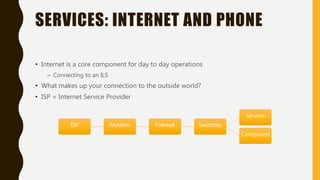
• Internet is a core component for day to day operations
– Connecting to an ILS
• What makes up your connection to the outside world?
• ISP = Internet Service Provider
ISP Modem Firewall Switches
Servers
Computers
ISPs
Modem Firewall Switches
Servers
Computers
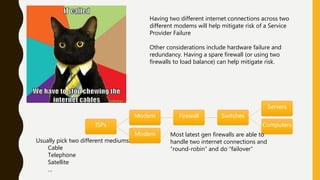
Modem Most latest gen firewalls are able to
handle two internet connections and
“round-robin” and do “failover”
Usually pick two different mediums:
Cable
Telephone
Satellite
…
Having two different internet connections across two
different modems will help mitigate risk of a Service
Provider Failure
Other considerations include hardware failure and
redundancy. Having a spare firewall (or using two
firewalls to load balance) can help mitigate risk.
SERVICES: POWER
• Having Battery Power Supplies / UPS
for your server and network
equipment can help ensure uptime
– Time for Generators to kick on
– Gives you enough time to power down
the machines versus an abrupt power
loss.
• Have generators if your business
requires you to have power in your
building consistently.
– If you are considered a shelter or a
heating place it should be a
requirement.
CHOOSING A BATTERY BACKUP-
CONSUMPTION
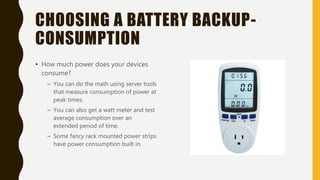
• How much power does your devices
consume?
– You can do the math using server tools
that measure consumption of power at
peak times.
– You can also get a watt meter and test
average consumption over an
extended period of time.
– Some fancy rack mounted power strips
have power consumption built in.
CHOOSING A BATTERY BACKUP-
LOAD TIME
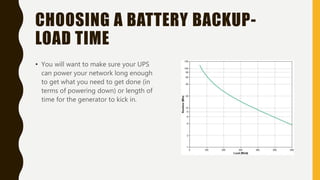
• You will want to make sure your UPS
can power your network long enough
to get what you need to get done (in
terms of powering down) or length of
time for the generator to kick in.
CHOOSING A BATTERY BACKUP-
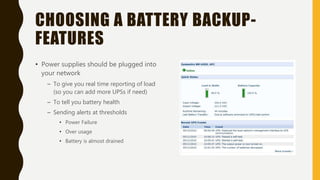
FEATURES
• Power supplies should be plugged into
your network
– To give you real time reporting of load
(so you can add more UPSs if need)
– To tell you battery health
– Sending alerts at thresholds
• Power Failure
• Over usage
• Battery is almost drained
DATA IS EXPENSIVE
• Financial Records for 7 years
– SOX ( Sarbanes–Oxley Act of 2002 )
• Cost of a “data record”
– On average, the cost of such a record containing healthcare information is $363 (and also
employee records are known to be this much if including social information
– At the end of May 2015, the Ponemon Institute released its annual “Cost of Data Breach
Study.” Researchers estimated that the average cost of each lost or stolen record containing
sensitive and confidential information was $154.
– Verizon has the concept from a per-record perspective, claiming an average cost of just 58
cents for each lost or stolen file.
WHAT CAN HAPPEN TO MY DATA?
• It can be corrupted!
– Someone makes changes to a file. Accidental deletion, purposeful manipulation, script goes
rouge.
– Can impact system performance
• It can be lost!
– Server goes down, disappears, etc.
– Spreadsheets, employee files, payroll, flyers, data about events
– Website Data, Catalog Data, Hosted Applications…gone!
– Email!
• Hardware failure
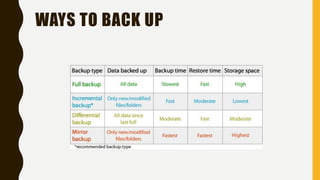
WAYS TO BACK UP
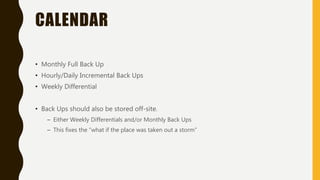
CALENDAR
• Monthly Full Back Up
• Hourly/Daily Incremental Back Ups
• Weekly Differential
• Back Ups should also be stored off-site.
– Either Weekly Differentials and/or Monthly Back Ups
– This fixes the “what if the place was taken out a storm”
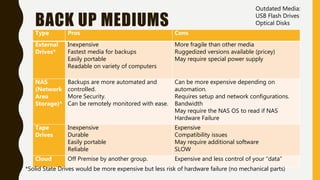
BACK UP MEDIUMS
Type Pros Cons
External
Drives*
Inexpensive
Fastest media for backups
Easily portable
Readable on variety of computers
More fragile than other media
Ruggedized versions available (pricey)
May require special power supply
NAS
(Network
Area
Storage)*
Backups are more automated and
controlled.
More Security.
Can be remotely monitored with ease.
Can be more expensive depending on
automation.
Requires setup and network configurations.
Bandwidth
May require the NAS OS to read if NAS
Hardware Failure
Tape
Drives
Inexpensive
Durable
Easily portable
Reliable
Expensive
Compatibility issues
May require additional software
SLOW
Cloud Off Premise by another group. Expensive and less control of your “data”
Outdated Media:
USB Flash Drives
Optical Disks
*Solid State Drives would be more expensive but less risk of hardware failure (no mechanical parts)
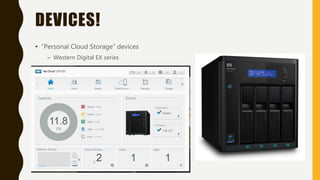
DEVICES!
• “Personal Cloud Storage” devices
– Western Digital EX series
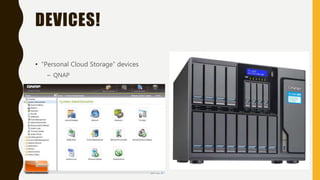
DEVICES!
• “Personal Cloud Storage” devices
– QNAP
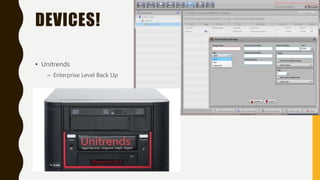
DEVICES!
• Unitrends
– Enterprise Level Back Up
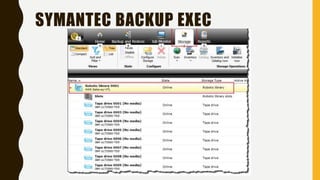
SYMANTEC BACKUP EXEC
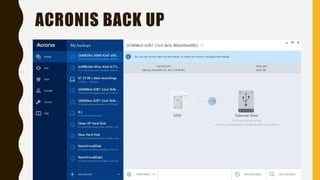
ACRONIS BACK UP
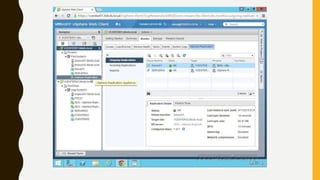
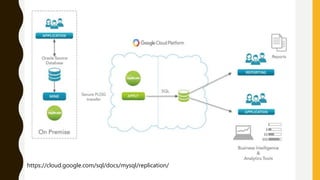
REPLICATION
• You can also replicate your servers (with all of its data) to multiple locations.
– This isn’t the best for protecting of “corrupted” data
• IE Crypto Locker
– However this offers redundancy!
• Replication is running the exact same server environment on different:
– Hardware (preferred)
– VM (less preferred)
https://cloud.google.com/sql/docs/mysql/replication/
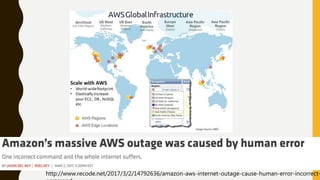
http://www.recode.net/2017/3/2/14792636/amazon-aws-internet-outage-cause-human-error-incorrect-
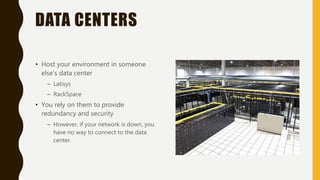
DATA CENTERS
• Host your environment in someone
else’s data center
– Latisys
– RackSpace
• You rely on them to provide
redundancy and security
– However, if your network is down, you
have no way to connect to the data
center.
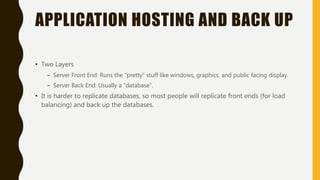
APPLICATION HOSTING AND BACK UP
• Two Layers
– Server Front End: Runs the “pretty” stuff like windows, graphics, and public facing display.
– Server Back End: Usually a “database”.
• It is harder to replicate databases, so most people will replicate front ends (for load
balancing) and back up the databases.
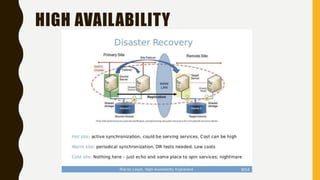
HIGH AVAILABILITY
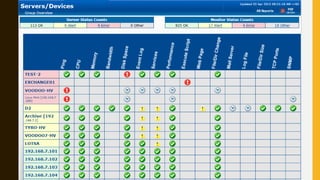
MONITORING IS IMPORTANT
• Monitor your servers to prevent issues before they happen. Things to monitor for:
– Network Drops (means it can be device failure or network issue)
– Temperature of Devices (prevent overheating)
– Server Processes (if a server is running to high for too long something could be wrong)
– Storage Space (running out of space can corrupt an entire system)
– Memory Usage
– Database Errors
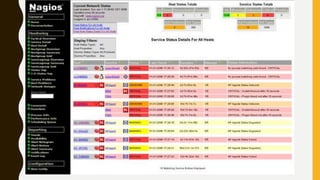
NIAGOS
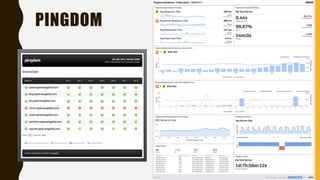
PINGDOM
TEST YOUR PLAN
• Test Your Back Ups
– Do a recovery on a different server to
ensure accuracy and time how long it
takes to recover
• Test Your Redundancy
– Remove a network, server, and
determine if fail over occurs.
– Time these!
• Test Test Test.
DIFFERENCES BETWEEN…
• An Emergency Response Plan
– What to do immediately if an incident occurs.
• Business Continuity Plan
– Address the immediate response AND short and long term continued performance of
essential business functions
• While you make your disaster plan, you should work to mitigate as many risks, and
then plan for the risks you couldn’t mitigate.
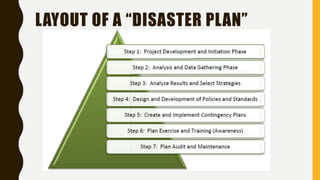
LAYOUT OF A “DISASTER PLAN”
TO RECAP
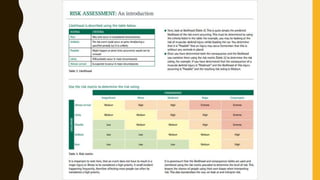
• Risk Assessments to determine what the risks are and how to handle them.
– Using the risk matrix; determine how much effort will be needed (and at what costs)
• Plans in place if there is some sort of failure.
– Using the options presented, what makes the most sense to you?
– Who are the contacts?
• Test.
– Most important part of the entire disaster recovery process.
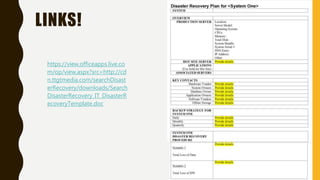
LINKS!
https://view.officeapps.live.co
m/op/view.aspx?src=http://cd
n.ttgtmedia.com/searchDisast
erRecovery/downloads/Search
DisasterRecovery_IT_DisasterR
ecoveryTemplate.doc
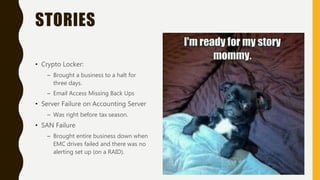
STORIES
• Crypto Locker:
– Brought a business to a halt for
three days.
– Email Access Missing Back Ups
• Server Failure on Accounting Server
– Was right before tax season.
• SAN Failure
– Brought entire business down when
EMC drives failed and there was no
alerting set up (on a RAID).
QUESTIONS
• Brian Pichman
• bpichman@evolveproject.or
g
• Twitter: @bpichman

It security for libraries part 3 - disaster recovery

  • 1.
    IT SECURIT YFOR LIBRARIES PART 3: DISASTER RECOVERY B R I A N P I C H M A N | E V O LV E P R O J E C T @ B P I C H M A N O N T W I T T E R !
  • 3.
    IDENTIFYING THREATS • “Actof God” – Tornado, Flood, Fire • ”Act of Evil” – Break-ins, Hacking, Physical Damage, Viruses • “Act of Error” – Accidental Deletions, Hardware Failure, Software Glitches • Loss of Services (could be caused by above) – Internet, Power, Heating/Cooling, Phone, Building Issues
  • 4.
    RECOVERABLE RISKS • Riskswith Provided Services: – Internet – Phone – Power • Risks with Created Data – Corruption – Loss • Risk with Owned Systems – Errors or Corruption – Failure or Loss
  • 6.
    A GOOD RECOVERYPLAN INCLUDES • Monitoring – Systems need to be actively monitored • Recoverable Backups and Systems – Systems need to have data backed up • Redundancy – Systems need to be redundant to mitigate risk of device or service failure, having failover devices and services is important to ensure uptime. • TESTING – I’m going to say this a few times.
  • 8.
    COST OF DOWNTIME •RESEARCH HIGHLIGHTS: • Data loss and downtime costs enterprises $1.7 trillion1 • Companies on average lost 400%2 more data over the last two years (equivalent to 24 million emails3 each) • 71% of IT professionals are not fully confident in their ability to recover information following an incident • 51% of organizations lack a disaster recovery plan for emerging workloads4; just 6% have plans for big data, hybrid cloud and mobile • Only 2% of organizations are data protection “Leaders”; 11% “Adopters”; 87% are behind the curve • China, Hong Kong, The Netherlands, Singapore and the US lead protection maturity; Switzerland, Turkey and the UAE lag behind • Companies with three or more vendors lost three times as much data as those with a single-vendor strategy https://www.emc.com/about/news/press/2014/20141202-
  • 9.
    A DISASTER PLANIS ABOUT • Ensuring Redundancy and Recovery • Planning and Preparation: – Risk Management – Risk Assessment – Risk Mitigation – Business Continuity • If a Disaster Occurs: – Response – Relief – Recovery – Restoration
  • 10.
    SERVICES: INTERNET ANDPHONE • Internet is a core component for day to day operations – Connecting to an ILS • What makes up your connection to the outside world? • ISP = Internet Service Provider ISP Modem Firewall Switches Servers Computers
  • 11.
    ISPs Modem Firewall Switches Servers Computers ModemMost latest gen firewalls are able to handle two internet connections and “round-robin” and do “failover” Usually pick two different mediums: Cable Telephone Satellite … Having two different internet connections across two different modems will help mitigate risk of a Service Provider Failure Other considerations include hardware failure and redundancy. Having a spare firewall (or using two firewalls to load balance) can help mitigate risk.
  • 12.
    SERVICES: POWER • HavingBattery Power Supplies / UPS for your server and network equipment can help ensure uptime – Time for Generators to kick on – Gives you enough time to power down the machines versus an abrupt power loss. • Have generators if your business requires you to have power in your building consistently. – If you are considered a shelter or a heating place it should be a requirement.
  • 13.
    CHOOSING A BATTERYBACKUP- CONSUMPTION • How much power does your devices consume? – You can do the math using server tools that measure consumption of power at peak times. – You can also get a watt meter and test average consumption over an extended period of time. – Some fancy rack mounted power strips have power consumption built in.
  • 14.
    CHOOSING A BATTERYBACKUP- LOAD TIME • You will want to make sure your UPS can power your network long enough to get what you need to get done (in terms of powering down) or length of time for the generator to kick in.
  • 15.
    CHOOSING A BATTERYBACKUP- FEATURES • Power supplies should be plugged into your network – To give you real time reporting of load (so you can add more UPSs if need) – To tell you battery health – Sending alerts at thresholds • Power Failure • Over usage • Battery is almost drained
  • 16.
    DATA IS EXPENSIVE •Financial Records for 7 years – SOX ( Sarbanes–Oxley Act of 2002 ) • Cost of a “data record” – On average, the cost of such a record containing healthcare information is $363 (and also employee records are known to be this much if including social information – At the end of May 2015, the Ponemon Institute released its annual “Cost of Data Breach Study.” Researchers estimated that the average cost of each lost or stolen record containing sensitive and confidential information was $154. – Verizon has the concept from a per-record perspective, claiming an average cost of just 58 cents for each lost or stolen file.
  • 18.
    WHAT CAN HAPPENTO MY DATA? • It can be corrupted! – Someone makes changes to a file. Accidental deletion, purposeful manipulation, script goes rouge. – Can impact system performance • It can be lost! – Server goes down, disappears, etc. – Spreadsheets, employee files, payroll, flyers, data about events – Website Data, Catalog Data, Hosted Applications…gone! – Email! • Hardware failure
  • 19.
  • 20.
    CALENDAR • Monthly FullBack Up • Hourly/Daily Incremental Back Ups • Weekly Differential • Back Ups should also be stored off-site. – Either Weekly Differentials and/or Monthly Back Ups – This fixes the “what if the place was taken out a storm”
  • 21.
    BACK UP MEDIUMS TypePros Cons External Drives* Inexpensive Fastest media for backups Easily portable Readable on variety of computers More fragile than other media Ruggedized versions available (pricey) May require special power supply NAS (Network Area Storage)* Backups are more automated and controlled. More Security. Can be remotely monitored with ease. Can be more expensive depending on automation. Requires setup and network configurations. Bandwidth May require the NAS OS to read if NAS Hardware Failure Tape Drives Inexpensive Durable Easily portable Reliable Expensive Compatibility issues May require additional software SLOW Cloud Off Premise by another group. Expensive and less control of your “data” Outdated Media: USB Flash Drives Optical Disks *Solid State Drives would be more expensive but less risk of hardware failure (no mechanical parts)
  • 23.
    DEVICES! • “Personal CloudStorage” devices – Western Digital EX series
  • 24.
    DEVICES! • “Personal CloudStorage” devices – QNAP
  • 25.
  • 26.
  • 27.
  • 28.
    REPLICATION • You canalso replicate your servers (with all of its data) to multiple locations. – This isn’t the best for protecting of “corrupted” data • IE Crypto Locker – However this offers redundancy! • Replication is running the exact same server environment on different: – Hardware (preferred) – VM (less preferred)
  • 30.
  • 31.
  • 32.
    DATA CENTERS • Hostyour environment in someone else’s data center – Latisys – RackSpace • You rely on them to provide redundancy and security – However, if your network is down, you have no way to connect to the data center.
  • 33.
    APPLICATION HOSTING ANDBACK UP • Two Layers – Server Front End: Runs the “pretty” stuff like windows, graphics, and public facing display. – Server Back End: Usually a “database”. • It is harder to replicate databases, so most people will replicate front ends (for load balancing) and back up the databases.
  • 34.
  • 35.
    MONITORING IS IMPORTANT •Monitor your servers to prevent issues before they happen. Things to monitor for: – Network Drops (means it can be device failure or network issue) – Temperature of Devices (prevent overheating) – Server Processes (if a server is running to high for too long something could be wrong) – Storage Space (running out of space can corrupt an entire system) – Memory Usage – Database Errors
  • 37.
  • 38.
  • 39.
    TEST YOUR PLAN •Test Your Back Ups – Do a recovery on a different server to ensure accuracy and time how long it takes to recover • Test Your Redundancy – Remove a network, server, and determine if fail over occurs. – Time these! • Test Test Test.
  • 40.
    DIFFERENCES BETWEEN… • AnEmergency Response Plan – What to do immediately if an incident occurs. • Business Continuity Plan – Address the immediate response AND short and long term continued performance of essential business functions • While you make your disaster plan, you should work to mitigate as many risks, and then plan for the risks you couldn’t mitigate.
  • 41.
    LAYOUT OF A“DISASTER PLAN”
  • 42.
    TO RECAP • RiskAssessments to determine what the risks are and how to handle them. – Using the risk matrix; determine how much effort will be needed (and at what costs) • Plans in place if there is some sort of failure. – Using the options presented, what makes the most sense to you? – Who are the contacts? • Test. – Most important part of the entire disaster recovery process.
  • 43.
  • 44.
    STORIES • Crypto Locker: –Brought a business to a halt for three days. – Email Access Missing Back Ups • Server Failure on Accounting Server – Was right before tax season. • SAN Failure – Brought entire business down when EMC drives failed and there was no alerting set up (on a RAID).
  • 45.
    QUESTIONS • Brian Pichman •bpichman@evolveproject.or g • Twitter: @bpichman