Mountain Climbing
By Lucia Empina Harry
(116650)
(930518-13-6254)
Mountain Climbing : Altitude
•

•
•

•

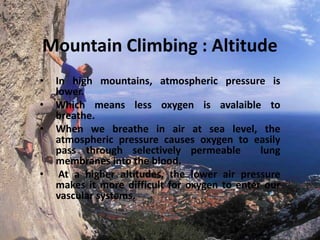
In high mountains, atmospheric pressure is
lower.
Which means less oxygen is avalaible to
breathe.
When we breathe in air at sea level, the
atmospheric pressure causes oxygen to easily
pass through selectively permeable
lung
membranes into the blood.
At a higher altitudes, the lower air pressure
makes it more difficult for oxygen to enter our
vascular systems.
Mountain Climbing : Changes in
circulatory and respiratory system
•
•
•
•
•
•
•

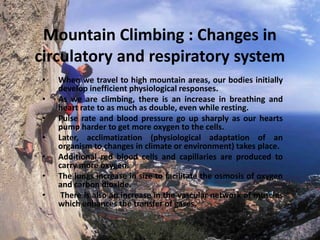
When we travel to high mountain areas, our bodies initially
develop inefficient physiological responses.
As we are climbing, there is an increase in breathing and
heart rate to as much as double, even while resting.
Pulse rate and blood pressure go up sharply as our hearts
pump harder to get more oxygen to the cells.
Later, acclimatization (physiological adaptation of an
organism to changes in climate or environment) takes place.
Additional red blood cells and capillaries are produced to
carry more oxygen.
The lungs increase in size to facilitate the osmosis of oxygen
and carbon dioxide.
There is also an increase in the vascular network of muscles
which enhances the transfer of gases.
Mountain Climbing : Hypoxia
•
•
•
•

•

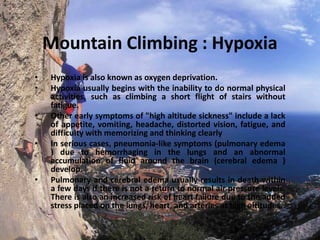
Hypoxia is also known as oxygen deprivation.
Hypoxia usually begins with the inability to do normal physical
activities, such as climbing a short flight of stairs without
fatigue.
Other early symptoms of "high altitude sickness" include a lack
of appetite, vomiting, headache, distorted vision, fatigue, and
difficulty with memorizing and thinking clearly
In serious cases, pneumonia-like symptoms (pulmonary edema
) due to hemorrhaging in the lungs and an abnormal
accumulation of fluid around the brain (cerebral edema )
develop.
Pulmonary and cerebral edema usually results in death within
a few days if there is not a return to normal air pressure levels.
There is also an increased risk of heart failure due to the added
stress placed on the lungs, heart, and arteries at high altitudes.
Mountain Climbing : Treatment
for Hypoxia
• In terms of medication , seizure-curbing
medicines or anesthetics may also be part of
your treatment.
• Brain hypoxia requires immediate treatment
to restore the flow of oxygen to the brain.
• The exact course of treatment depends on
the cause and severity of your condition.
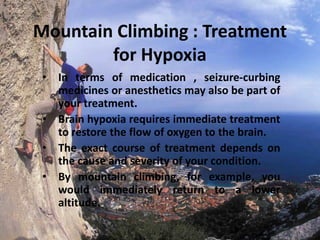
• By mountain climbing, for example, you
would immediately return to a lower
altitude.
Mountain Climbing : Treatment
for Hypoxia
•
•
•

•

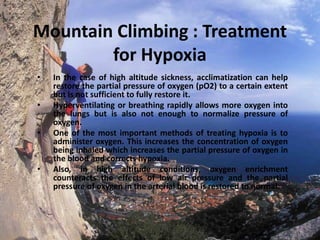
In the case of high altitude sickness, acclimatization can help
restore the partial pressure of oxygen (pO2) to a certain extent
but is not sufficient to fully restore it.
Hyperventilating or breathing rapidly allows more oxygen into
the lungs but is also not enough to normalize pressure of
oxygen.
One of the most important methods of treating hypoxia is to
administer oxygen. This increases the concentration of oxygen
being inhaled which increases the partial pressure of oxygen in
the blood and corrects hypoxia.
Also, in high altitude conditions, oxygen enrichment
counteracts the effects of low air pressure and the partial
pressure of oxygen in the arterial blood is restored to normal.
Mountain Climbing
Question : Would it make any difference if the climber is a female?
Answer :
It will be just a small difference if the climber is a
female. Men has more staminas than women. Men are of course,
stronger than women. Unless if the woman who is climbing the
mountain, is pregnant , then the risk of losing the baby is high.
Because in a higher altitude, the percentage of oxygen is lower
than at the sea level. Why? Because women who is pregnant, has
to provide more oxygen to her baby in the womb as oxygen is also
one of the most important needs for the baby to survive in her
mother’s womb.

Mountain climbing ( Assignment 4 & 5 )

  • 1.
    Mountain Climbing By LuciaEmpina Harry (116650) (930518-13-6254)
  • 2.
    Mountain Climbing :Altitude • • • • In high mountains, atmospheric pressure is lower. Which means less oxygen is avalaible to breathe. When we breathe in air at sea level, the atmospheric pressure causes oxygen to easily pass through selectively permeable lung membranes into the blood. At a higher altitudes, the lower air pressure makes it more difficult for oxygen to enter our vascular systems.
  • 3.
    Mountain Climbing :Changes in circulatory and respiratory system • • • • • • • When we travel to high mountain areas, our bodies initially develop inefficient physiological responses. As we are climbing, there is an increase in breathing and heart rate to as much as double, even while resting. Pulse rate and blood pressure go up sharply as our hearts pump harder to get more oxygen to the cells. Later, acclimatization (physiological adaptation of an organism to changes in climate or environment) takes place. Additional red blood cells and capillaries are produced to carry more oxygen. The lungs increase in size to facilitate the osmosis of oxygen and carbon dioxide. There is also an increase in the vascular network of muscles which enhances the transfer of gases.
  • 4.
    Mountain Climbing :Hypoxia • • • • • Hypoxia is also known as oxygen deprivation. Hypoxia usually begins with the inability to do normal physical activities, such as climbing a short flight of stairs without fatigue. Other early symptoms of "high altitude sickness" include a lack of appetite, vomiting, headache, distorted vision, fatigue, and difficulty with memorizing and thinking clearly In serious cases, pneumonia-like symptoms (pulmonary edema ) due to hemorrhaging in the lungs and an abnormal accumulation of fluid around the brain (cerebral edema ) develop. Pulmonary and cerebral edema usually results in death within a few days if there is not a return to normal air pressure levels. There is also an increased risk of heart failure due to the added stress placed on the lungs, heart, and arteries at high altitudes.
  • 5.
    Mountain Climbing :Treatment for Hypoxia • In terms of medication , seizure-curbing medicines or anesthetics may also be part of your treatment. • Brain hypoxia requires immediate treatment to restore the flow of oxygen to the brain. • The exact course of treatment depends on the cause and severity of your condition. • By mountain climbing, for example, you would immediately return to a lower altitude.
  • 6.
    Mountain Climbing :Treatment for Hypoxia • • • • In the case of high altitude sickness, acclimatization can help restore the partial pressure of oxygen (pO2) to a certain extent but is not sufficient to fully restore it. Hyperventilating or breathing rapidly allows more oxygen into the lungs but is also not enough to normalize pressure of oxygen. One of the most important methods of treating hypoxia is to administer oxygen. This increases the concentration of oxygen being inhaled which increases the partial pressure of oxygen in the blood and corrects hypoxia. Also, in high altitude conditions, oxygen enrichment counteracts the effects of low air pressure and the partial pressure of oxygen in the arterial blood is restored to normal.
  • 7.
    Mountain Climbing Question :Would it make any difference if the climber is a female? Answer : It will be just a small difference if the climber is a female. Men has more staminas than women. Men are of course, stronger than women. Unless if the woman who is climbing the mountain, is pregnant , then the risk of losing the baby is high. Because in a higher altitude, the percentage of oxygen is lower than at the sea level. Why? Because women who is pregnant, has to provide more oxygen to her baby in the womb as oxygen is also one of the most important needs for the baby to survive in her mother’s womb.