MOTIVATIONS FOR
ENTREPRENEURSHIP
Ute Stephan, Mark Hart, Tomasz Mickiewicz,
Cord-Christian Drews,
Aston Business School & Enterprise Research Centre
& IFF Research
Commissioned by The Department for Business,
Innovation And Skills
Observations
• Increases in rates of entrepreneurship and very small businesses
during recession and subsequent economic downturn
• Renewed focus on how motivations (e.g., necessity entrepreneurship)
influence business survival and performance
Aims
1) Unpack motivations for entrepreneurship
2) Understand whether and how entrepreneurial motivations change
3) Assess how start-up motivations link with business survival and
success
Starting point
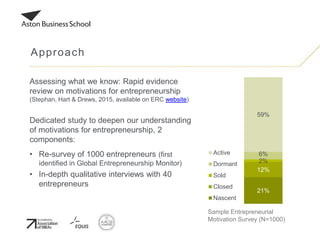
Assessing what we know: Rapid evidence
review on motivations for entrepreneurship
(Stephan, Hart & Drews, 2015, available on ERC website)
Dedicated study to deepen our understanding
of motivations for entrepreneurship, 2
components:
• Re-survey of 1000 entrepreneurs (first
identified in Global Entrepreneurship Monitor)
• In-depth qualitative interviews with 40
entrepreneurs
Approach
21%
12%
2%
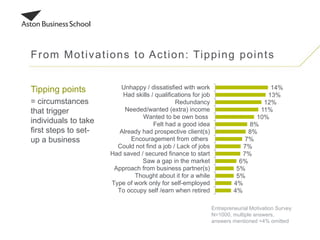
6%
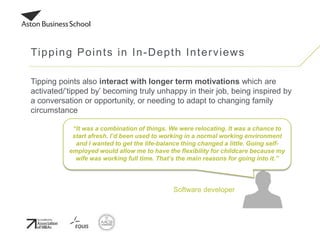
59%
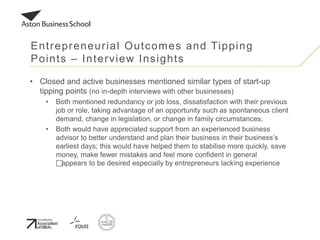
Active
Dormant
Sold
Closed
Nascent
Sample Entrepreneurial
Motivation Survey (N=1000)
1) UNPACKING MOTIVATIONS FOR
ENTREPRENEURSHIP
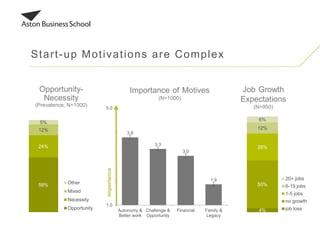
59%
24%
12%
5%
Other
Mixed
Necessity
Opportunity
3.8
3.3
3.0
1.9
1.0
2.0
3.0
4.0
5.0
Autonomy &
Better work
Challenge &
Opportunity
Financial Family &
Legacy
Start-up Motivations are Complex
Importance
4%
50%
28%
12%
6%
20+ jobs
6-19 jobs
1-5 jobs
no growth
job loss
Opportunity-
Necessity
(Prevalence, N=1000)
Importance of Motives
(N=1000)
Job Growth
Expectations
(N=950)
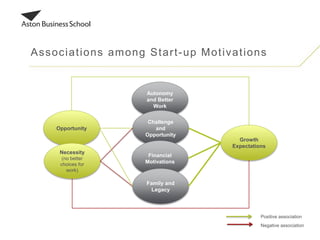
Autonomy
and Better
Work
Associations among Start-up Motivations
Challenge
and
Opportunity
Financial
Motivations
Family and
Legacy
Opportunity
Necessity
(no better
choices for
work)
Positive association
Negative association
Growth
Expectations
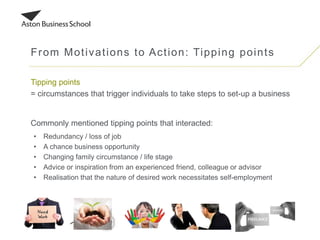
Tipping points
= circumstances that trigger individuals to take steps to set-up a business
Commonly mentioned tipping points that interacted:
• Redundancy / loss of job
• A chance business opportunity
• Changing family circumstance / life stage
• Advice or inspiration from an experienced friend, colleague or advisor
• Realisation that the nature of desired work necessitates self-employment
From Motivations to Action: Tipping points
2) CHANGING MOTIVATIONS FOR
ENTREPRENEURSHIP?
Comparison of start-up with current motivations for running a business
(active business-owners only)
Entrepreneurial motivations are remarkably stable
• Slight increase in the prevalence of opportunity motivation
• Increase in importance of autonomy motivation
• Slight decrease in growth expectations
A) Does running a business change
entrepreneurial motivations?
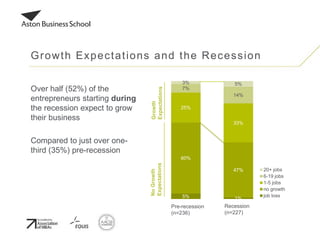
Comparison of entrepreneurs who started prior to (2002-08) and during
the economic downturn (2009-13)
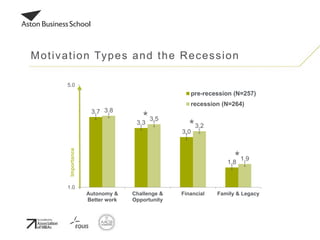
The recession triggered changes in motivation
• No significant change in opportunity-necessity motivation
• Increase in importance of challenge, financial and family start-
up motivations
• Increase in growth expectations
B) Did the recession change motivations?
Motivation Types and the Recession
3.7
3.3
3.0
1.8
3.8
3.5
3.2
1.9
1.0
2.0
3.0
4.0
5.0
Autonomy &
Better work
Challenge &
Opportunity
Financial Family & Legacy
pre-recession (N=257)
recession (N=264)
Importance
Growth Expectations and the Recession
5% 1%
60%
47%
25%
33%
7%
14%
3% 5%
20+ jobs
6-19 jobs
1-5 jobs
no growth
job loss
Pre-recession
(n=236)
Recession
(n=227)
Over half (52%) of the
entrepreneurs starting during
the recession expect to grow
their business
Compared to just over one-
third (35%) pre-recession Growth
Expectations
NoGrowth
Expectations
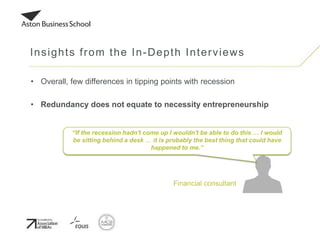
• Overall, few differences in tipping points with recession
• Redundancy does not equate to necessity entrepreneurship
Insights from the In-Depth Interviews
Financial consultant
“If the recession hadn't come up I wouldn't be able to do this … I would
be sitting behind a desk … it is probably the best thing that could have
happened to me.”
3) LINKING MOTIVATIONS,
BUSINESS SURVIVAL AND SUCCESS
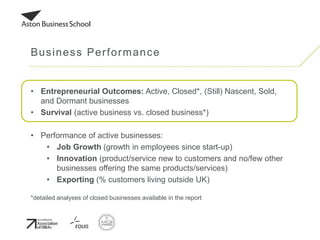
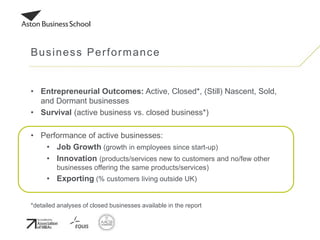
• Entrepreneurial Outcomes: Active, Closed*, (Still) Nascent, Sold,
and Dormant businesses
• Survival (active business vs. closed business*)
• Performance of active businesses:
• Job Growth (growth in employees since start-up)
• Innovation (product/service new to customers and no/few other
businesses offering the same products/services)
• Exporting (% customers living outside UK)
*detailed analyses of closed businesses available in the report
Business Performance
Entrepreneurial Outcomes
and Opportunity-Necessity Motivations
Active
(53%)
Sold (2%)
Closed
(15%)
Dormant (8%)
Nascent
(23%)
Active
(62%)
Sold (2%)
Closed
(11%)
Dormant (5%)
Nascent
(20%)
Necessity (N=240)Opportunity (N=594)
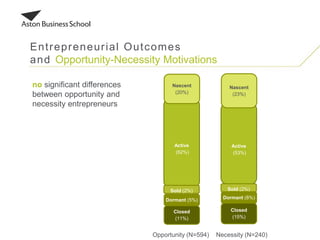
no significant differences
between opportunity and
necessity entrepreneurs
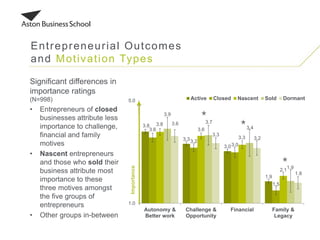
Significant differences in
importance ratings
(N=998)
• Entrepreneurs of closed
businesses attribute less
importance to challenge,
financial and family
motives
• Nascent entrepreneurs
and those who sold their
business attribute most
importance to these
three motives amongst
the five groups of
entrepreneurs
• Other groups in-between
Entrepreneurial Outcomes
and Motivation Types
3.8
3.3
3.0
1.9
3.6
3.2
3.0
1.5
3.8
3.6
3.3
2.1
3.9
3.7
3.4
1.9
3.6
3.3
3.2
1.8
1.0
2.0
3.0
4.0
5.0
Autonomy &
Better work
Challenge &
Opportunity
Financial Family &
Legacy
Active Closed Nascent Sold Dormant
Importance
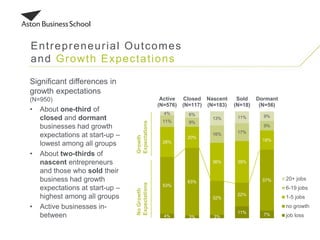
Significant differences in
growth expectations
(N=950)
• About one-third of
closed and dormant
businesses had growth
expectations at start-up –
lowest among all groups
• About two-thirds of
nascent entrepreneurs
and those who sold their
business had growth
expectations at start-up –
highest among all groups
• Active businesses in-
between
Entrepreneurial Outcomes
and Growth Expectations
4% 3% 3%
11% 7%
53%
63%
32%
22%
57%
28%
20%
36% 39%
18%
11% 9%
16% 17%
9%
4% 6%
13% 11% 9%
Active
(N=576)
Closed
(N=117)
Nascent
(N=183)
Sold
(N=18)
Dormant
(N=56)
20+ jobs
6-19 jobs
1-5 jobs
no growth
job loss
NoGrowth
Expectations
Growth
Expectations
• Entrepreneurial Outcomes: Active, Closed*, (Still) Nascent, Sold,
and Dormant businesses
• Survival (active business vs. closed business*)
• Performance of active businesses:
• Job Growth (growth in employees since start-up)
• Innovation (products/services new to customers and no/few other
businesses offering the same products/services)
• Exporting (% customers living outside UK)
*detailed analyses of closed businesses available in the report
Business Performance
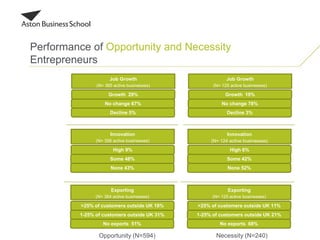
Growth 29%
No change 67%
Decline 5%
Job Growth
(N= 365 active businesses)
>25% of customers outside UK 18%
1-25% of customers outside UK 31%
No exports 51%
Exporting
(N= 364 active businesses)
High 9%
Some 48%
None 43%
Innovation
(N= 356 active businesses)
Growth 19%
No change 78%
Decline 3%
Job Growth
(N= 125 active businesses)
>25% of customers outside UK 11%
1-25% of customers outside UK 21%
No exports 68%
Exporting
(N= 125 active businesses)
High 6%
Some 42%
None 52%
Innovation
(N= 124 active businesses)
Necessity (N=240)Opportunity (N=594)
Performance of Opportunity and Necessity
Entrepreneurs
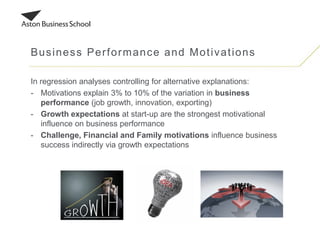
In regression analyses controlling for alternative explanations:
- Motivations explain 3% to 10% of the variation in business
performance (job growth, innovation, exporting)
- Growth expectations at start-up are the strongest motivational
influence on business performance
- Challenge, Financial and Family motivations influence business
success indirectly via growth expectations
Business Performance and Motivations
CONCLUSION
• Less focus on opportunity-necessity distinction: both opportunity and
necessity businesses perform well and have similar survival rates
• Other motivations are important:
• Across all business types, entrepreneurs say autonomy is their
most important motivator
• Businesses created by autonomy and family-motivated
entrepreneurs have a higher chance of survival
• Recession-era entrepreneurs often saw redundancy as an opportunity,
and were highly motivated and ambitious when starting their business
Entrepreneurial Motivations are Complex
• Ambition is the most important factor for business success (job
creation, innovation, exporting)
• Other motivations influence business success mainly via growth
expectations, they highlight different reasons for ambitions:
• Challenge and opportunity
• Financial motivations (security, wealth)
• Family enterprise and legacy building
Ambition is Important for Success
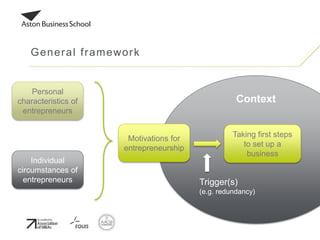
Context
General framework
Personal
characteristics of
entrepreneurs
Individual
circumstances of
entrepreneurs
Motivations for
entrepreneurship
Taking first steps
to set up a
business
Trigger(s)
(e.g. redundancy)
THANK YOU
Contact:
Prof. Ute Stephan and Prof. Mark Hart
U.Stephan@aston.ac.uk and Mark.Hart@aston.ac.uk
Aston Business School/Enterprise Research Centre
Economics &Strategy Group
Aston Triangle, Birmingham B4 7ET
ADDITIONAL INFORMATION
FOR Q&A
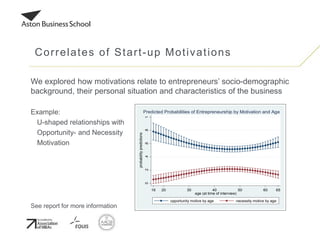
We explored how motivations relate to entrepreneurs’ socio-demographic
background, their personal situation and characteristics of the business
Example:
U-shaped relationships with
Opportunity- and Necessity
Motivation
See report for more information
Correlates of Start-up Motivations
0.2.4.6.81
probabilitypredictions
16 6520 30 40 50 60
age (at time of interview)
opportunity motive by age necessity motive by age
Predicted Probabilities of Entrepreneurship by Motivation and Age
• We explored how motivations relate to entrepreneurs’ socio-
demographic background, their personal situation and characteristics
of the business
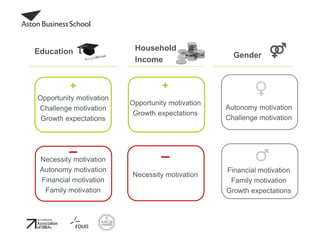
• Clearest associations for socio-demographic background
• Education
• Household income
• Age
• Gender
Correlates of Start-up Motivations
Household
Income
+
Opportunity motivation
Growth expectations
_
Necessity motivation
Education
+
Opportunity motivation
Challenge motivation
Growth expectations
_
Necessity motivation
Autonomy motivation
Financial motivation
Family motivation
Gender
Autonomy motivation
Challenge motivation
Financial motivation
Family motivation
Growth expectations
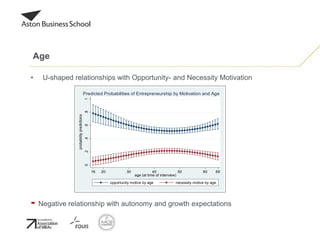
Age
• U-shaped relationships with Opportunity- and Necessity Motivation
- Negative relationship with autonomy and growth expectations
0.2.4.6.81
probabilitypredictions
16 6520 30 40 50 60
age (at time of interview)
opportunity motive by age necessity motive by age
Predicted Probabilities of Entrepreneurship by Motivation and Age
• Entrepreneurs’ personal situation
• Cross-over with previous job positively related to importance attributed
to autonomy, challenge, financial and family motivations
• Necessity entrepreneurs appear to lack role models (know no other
entrepreneurs), while role models are positively related to nearly all other
motivations
• No systematic relationships with employments status (beyond
opportunity-necessity motivations), and family commitments
• Characteristics of the entrepreneurs’ business
• Starting together with others – opportunity, challenge, and growth
expectation
• Starting together with other family members – financial and family motives
• Starting-alone – necessity and autonomy motivated
• Various weak associations with industry sectors
Correlates of Start-up Motivations
From Motivations to Action: Tipping points
Tipping points
= circumstances
that trigger
individuals to take
first steps to set-
up a business
14%
13%
12%
11%
10%
8%
8%
7%
7%
7%
6%
5%
5%
4%
4%
4%
3%
3%
2%
2%
2%
Unhappy / dissatisfied with work
Had skills / qualifications for job
Redundancy
Needed/wanted (extra) income
Wanted to be own boss
Felt had a good idea
Already had prospective client(s)
Encouragement from others
Could not find a job / Lack of jobs
Had saved / secured finance to start
Saw a gap in the market
Approach from business partner(s)
Thought about it for a while
Type of work only for self-employed
To occupy self /earn when retired
Other
Time was right for me personally
Support/advice from a public…
Needed flexibility for…
No reason / DK
Recession / Economic Downturn
Entrepreneurial Motivation Survey
N=1000, multiple answers,
answers mentioned <4% omitted
Tipping points also interact with longer term motivations which are
activated/’tipped by’ becoming truly unhappy in their job, being inspired by
a conversation or opportunity, or needing to adapt to changing family
circumstance
Tipping Points in In-Depth Interviews
Software developer
“It was a combination of things. We were relocating. It was a chance to
start afresh. I’d been used to working in a normal working environment
and I wanted to get the life-balance thing changed a little. Going self-
employed would allow me to have the flexibility for childcare because my
wife was working full time. That’s the main reasons for going into it.”
• Closed and active businesses mentioned similar types of start-up
tipping points (no in-depth interviews with other businesses)
• Both mentioned redundancy or job loss, dissatisfaction with their previous
job or role, taking advantage of an opportunity such as spontaneous client
demand, change in legislation, or change in family circumstances.
• Both would have appreciated support from an experienced business
advisor to better understand and plan their business in their business’s
earliest days; this would have helped them to stabilise more quickly, save
money, make fewer mistakes and feel more confident in general
appears to be desired especially by entrepreneurs lacking experience
Entrepreneurial Outcomes and Tipping
Points – Interview Insights
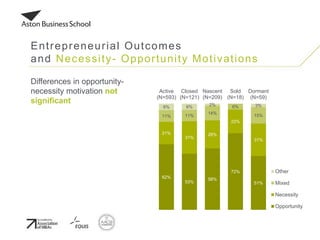
Differences in opportunity-
necessity motivation not
significant
Entrepreneurial Outcomes
and Necessity- Opportunity Motivations
62%
53%
58%
72%
51%
21%
31%
26%
22%
31%
11% 11%
14%
6%
15%
6% 6% 2% 3%
Active
(N=593)
Closed
(N=121)
Nascent
(N=209)
Sold
(N=18)
Dormant
(N=59)
Other
Mixed
Necessity
Opportunity
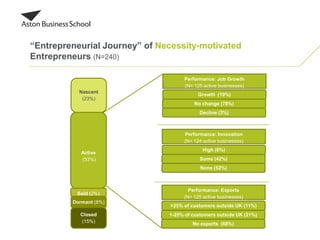
“Entrepreneurial Journey” of Necessity-motivated
Entrepreneurs (N=240)
Active
(53%)
Sold (2%)
Closed
(15%)
Dormant (8%)
Nascent
(23%)
Growth (19%)
No change (78%)
Decline (3%)
Performance: Job Growth
(N= 125 active businesses)
>25% of customers outside UK (11%)
1-25% of customers outside UK (21%)
No exports (68%)
Performance: Exports
(N= 125 active businesses)
High (6%)
Some (42%)
None (52%)
Performance: Innovation
(N= 124 active businesses)
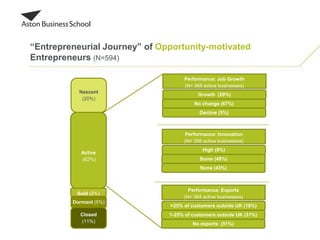
“Entrepreneurial Journey” of Opportunity-motivated
Entrepreneurs (N=594)
Active
(62%)
Sold (2%)
Closed
(11%)
Dormant (5%)
Nascent
(20%)
Growth (29%)
No change (67%)
Decline (5%)
Performance: Job Growth
(N= 365 active businesses)
>25% of customers outside UK (18%)
1-25% of customers outside UK (31%)
No exports (51%)
Performance: Exports
(N= 364 active businesses)
High (9%)
Some (48%)
None (43%)
Performance: Innovation
(N= 356 active businesses)
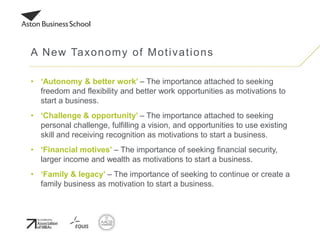
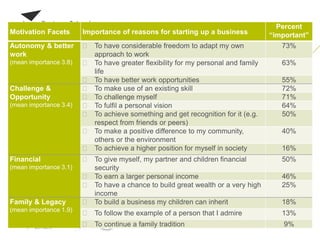
• ‘Autonomy & better work’ – The importance attached to seeking
freedom and flexibility and better work opportunities as motivations to
start a business.
• ‘Challenge & opportunity’ – The importance attached to seeking
personal challenge, fulfilling a vision, and opportunities to use existing
skill and receiving recognition as motivations to start a business.
• ‘Financial motives’ – The importance of seeking financial security,
larger income and wealth as motivations to start a business.
• ‘Family & legacy’ – The importance of seeking to continue or create a
family business as motivation to start a business.
A New Taxonomy of Motivations
Motivation Facets Importance of reasons for starting up a business
Percent
“important”
Autonomy & better
work
(mean importance 3.8)
 To have considerable freedom to adapt my own
approach to work
73%
 To have greater flexibility for my personal and family
life
63%
 To have better work opportunities 55%
Challenge &
Opportunity
(mean importance 3.4)
 To make use of an existing skill 72%
 To challenge myself 71%
 To fulfil a personal vision 64%
 To achieve something and get recognition for it (e.g.
respect from friends or peers)
50%
 To make a positive difference to my community,
others or the environment
40%
 To achieve a higher position for myself in society 16%
Financial
(mean importance 3.1)
 To give myself, my partner and children financial
security
50%
 To earn a larger personal income 46%
 To have a chance to build great wealth or a very high
income
25%
Family & Legacy
(mean importance 1.9)
 To build a business my children can inherit 18%
 To follow the example of a person that I admire 13%
 To continue a family tradition 9%

Motivations for Entrepreneurship presentation

  • 1.
    MOTIVATIONS FOR ENTREPRENEURSHIP Ute Stephan,Mark Hart, Tomasz Mickiewicz, Cord-Christian Drews, Aston Business School & Enterprise Research Centre & IFF Research Commissioned by The Department for Business, Innovation And Skills
  • 2.
    Observations • Increases inrates of entrepreneurship and very small businesses during recession and subsequent economic downturn • Renewed focus on how motivations (e.g., necessity entrepreneurship) influence business survival and performance Aims 1) Unpack motivations for entrepreneurship 2) Understand whether and how entrepreneurial motivations change 3) Assess how start-up motivations link with business survival and success Starting point
  • 3.
    Assessing what weknow: Rapid evidence review on motivations for entrepreneurship (Stephan, Hart & Drews, 2015, available on ERC website) Dedicated study to deepen our understanding of motivations for entrepreneurship, 2 components: • Re-survey of 1000 entrepreneurs (first identified in Global Entrepreneurship Monitor) • In-depth qualitative interviews with 40 entrepreneurs Approach 21% 12% 2% 6% 59% Active Dormant Sold Closed Nascent Sample Entrepreneurial Motivation Survey (N=1000)
  • 4.
    1) UNPACKING MOTIVATIONSFOR ENTREPRENEURSHIP
  • 5.
    59% 24% 12% 5% Other Mixed Necessity Opportunity 3.8 3.3 3.0 1.9 1.0 2.0 3.0 4.0 5.0 Autonomy & Better work Challenge& Opportunity Financial Family & Legacy Start-up Motivations are Complex Importance 4% 50% 28% 12% 6% 20+ jobs 6-19 jobs 1-5 jobs no growth job loss Opportunity- Necessity (Prevalence, N=1000) Importance of Motives (N=1000) Job Growth Expectations (N=950)
  • 6.
    Autonomy and Better Work Associations amongStart-up Motivations Challenge and Opportunity Financial Motivations Family and Legacy Opportunity Necessity (no better choices for work) Positive association Negative association Growth Expectations
  • 7.
    Tipping points = circumstancesthat trigger individuals to take steps to set-up a business Commonly mentioned tipping points that interacted: • Redundancy / loss of job • A chance business opportunity • Changing family circumstance / life stage • Advice or inspiration from an experienced friend, colleague or advisor • Realisation that the nature of desired work necessitates self-employment From Motivations to Action: Tipping points
  • 8.
    2) CHANGING MOTIVATIONSFOR ENTREPRENEURSHIP?
  • 9.
    Comparison of start-upwith current motivations for running a business (active business-owners only) Entrepreneurial motivations are remarkably stable • Slight increase in the prevalence of opportunity motivation • Increase in importance of autonomy motivation • Slight decrease in growth expectations A) Does running a business change entrepreneurial motivations?
  • 10.
    Comparison of entrepreneurswho started prior to (2002-08) and during the economic downturn (2009-13) The recession triggered changes in motivation • No significant change in opportunity-necessity motivation • Increase in importance of challenge, financial and family start- up motivations • Increase in growth expectations B) Did the recession change motivations?
  • 11.
    Motivation Types andthe Recession 3.7 3.3 3.0 1.8 3.8 3.5 3.2 1.9 1.0 2.0 3.0 4.0 5.0 Autonomy & Better work Challenge & Opportunity Financial Family & Legacy pre-recession (N=257) recession (N=264) Importance
  • 12.
    Growth Expectations andthe Recession 5% 1% 60% 47% 25% 33% 7% 14% 3% 5% 20+ jobs 6-19 jobs 1-5 jobs no growth job loss Pre-recession (n=236) Recession (n=227) Over half (52%) of the entrepreneurs starting during the recession expect to grow their business Compared to just over one- third (35%) pre-recession Growth Expectations NoGrowth Expectations
  • 13.
    • Overall, fewdifferences in tipping points with recession • Redundancy does not equate to necessity entrepreneurship Insights from the In-Depth Interviews Financial consultant “If the recession hadn't come up I wouldn't be able to do this … I would be sitting behind a desk … it is probably the best thing that could have happened to me.”
  • 14.
  • 15.
    • Entrepreneurial Outcomes:Active, Closed*, (Still) Nascent, Sold, and Dormant businesses • Survival (active business vs. closed business*) • Performance of active businesses: • Job Growth (growth in employees since start-up) • Innovation (product/service new to customers and no/few other businesses offering the same products/services) • Exporting (% customers living outside UK) *detailed analyses of closed businesses available in the report Business Performance
  • 16.
    Entrepreneurial Outcomes and Opportunity-NecessityMotivations Active (53%) Sold (2%) Closed (15%) Dormant (8%) Nascent (23%) Active (62%) Sold (2%) Closed (11%) Dormant (5%) Nascent (20%) Necessity (N=240)Opportunity (N=594) no significant differences between opportunity and necessity entrepreneurs
  • 17.
    Significant differences in importanceratings (N=998) • Entrepreneurs of closed businesses attribute less importance to challenge, financial and family motives • Nascent entrepreneurs and those who sold their business attribute most importance to these three motives amongst the five groups of entrepreneurs • Other groups in-between Entrepreneurial Outcomes and Motivation Types 3.8 3.3 3.0 1.9 3.6 3.2 3.0 1.5 3.8 3.6 3.3 2.1 3.9 3.7 3.4 1.9 3.6 3.3 3.2 1.8 1.0 2.0 3.0 4.0 5.0 Autonomy & Better work Challenge & Opportunity Financial Family & Legacy Active Closed Nascent Sold Dormant Importance
  • 18.
    Significant differences in growthexpectations (N=950) • About one-third of closed and dormant businesses had growth expectations at start-up – lowest among all groups • About two-thirds of nascent entrepreneurs and those who sold their business had growth expectations at start-up – highest among all groups • Active businesses in- between Entrepreneurial Outcomes and Growth Expectations 4% 3% 3% 11% 7% 53% 63% 32% 22% 57% 28% 20% 36% 39% 18% 11% 9% 16% 17% 9% 4% 6% 13% 11% 9% Active (N=576) Closed (N=117) Nascent (N=183) Sold (N=18) Dormant (N=56) 20+ jobs 6-19 jobs 1-5 jobs no growth job loss NoGrowth Expectations Growth Expectations
  • 19.
    • Entrepreneurial Outcomes:Active, Closed*, (Still) Nascent, Sold, and Dormant businesses • Survival (active business vs. closed business*) • Performance of active businesses: • Job Growth (growth in employees since start-up) • Innovation (products/services new to customers and no/few other businesses offering the same products/services) • Exporting (% customers living outside UK) *detailed analyses of closed businesses available in the report Business Performance
  • 20.
    Growth 29% No change67% Decline 5% Job Growth (N= 365 active businesses) >25% of customers outside UK 18% 1-25% of customers outside UK 31% No exports 51% Exporting (N= 364 active businesses) High 9% Some 48% None 43% Innovation (N= 356 active businesses) Growth 19% No change 78% Decline 3% Job Growth (N= 125 active businesses) >25% of customers outside UK 11% 1-25% of customers outside UK 21% No exports 68% Exporting (N= 125 active businesses) High 6% Some 42% None 52% Innovation (N= 124 active businesses) Necessity (N=240)Opportunity (N=594) Performance of Opportunity and Necessity Entrepreneurs
  • 21.
    In regression analysescontrolling for alternative explanations: - Motivations explain 3% to 10% of the variation in business performance (job growth, innovation, exporting) - Growth expectations at start-up are the strongest motivational influence on business performance - Challenge, Financial and Family motivations influence business success indirectly via growth expectations Business Performance and Motivations
  • 22.
  • 23.
    • Less focuson opportunity-necessity distinction: both opportunity and necessity businesses perform well and have similar survival rates • Other motivations are important: • Across all business types, entrepreneurs say autonomy is their most important motivator • Businesses created by autonomy and family-motivated entrepreneurs have a higher chance of survival • Recession-era entrepreneurs often saw redundancy as an opportunity, and were highly motivated and ambitious when starting their business Entrepreneurial Motivations are Complex
  • 24.
    • Ambition isthe most important factor for business success (job creation, innovation, exporting) • Other motivations influence business success mainly via growth expectations, they highlight different reasons for ambitions: • Challenge and opportunity • Financial motivations (security, wealth) • Family enterprise and legacy building Ambition is Important for Success
  • 25.
    Context General framework Personal characteristics of entrepreneurs Individual circumstancesof entrepreneurs Motivations for entrepreneurship Taking first steps to set up a business Trigger(s) (e.g. redundancy)
  • 26.
    THANK YOU Contact: Prof. UteStephan and Prof. Mark Hart U.Stephan@aston.ac.uk and Mark.Hart@aston.ac.uk Aston Business School/Enterprise Research Centre Economics &Strategy Group Aston Triangle, Birmingham B4 7ET
  • 27.
  • 28.
    We explored howmotivations relate to entrepreneurs’ socio-demographic background, their personal situation and characteristics of the business Example: U-shaped relationships with Opportunity- and Necessity Motivation See report for more information Correlates of Start-up Motivations 0.2.4.6.81 probabilitypredictions 16 6520 30 40 50 60 age (at time of interview) opportunity motive by age necessity motive by age Predicted Probabilities of Entrepreneurship by Motivation and Age
  • 29.
    • We exploredhow motivations relate to entrepreneurs’ socio- demographic background, their personal situation and characteristics of the business • Clearest associations for socio-demographic background • Education • Household income • Age • Gender Correlates of Start-up Motivations
  • 30.
    Household Income + Opportunity motivation Growth expectations _ Necessitymotivation Education + Opportunity motivation Challenge motivation Growth expectations _ Necessity motivation Autonomy motivation Financial motivation Family motivation Gender Autonomy motivation Challenge motivation Financial motivation Family motivation Growth expectations
  • 31.
    Age • U-shaped relationshipswith Opportunity- and Necessity Motivation - Negative relationship with autonomy and growth expectations 0.2.4.6.81 probabilitypredictions 16 6520 30 40 50 60 age (at time of interview) opportunity motive by age necessity motive by age Predicted Probabilities of Entrepreneurship by Motivation and Age
  • 32.
    • Entrepreneurs’ personalsituation • Cross-over with previous job positively related to importance attributed to autonomy, challenge, financial and family motivations • Necessity entrepreneurs appear to lack role models (know no other entrepreneurs), while role models are positively related to nearly all other motivations • No systematic relationships with employments status (beyond opportunity-necessity motivations), and family commitments • Characteristics of the entrepreneurs’ business • Starting together with others – opportunity, challenge, and growth expectation • Starting together with other family members – financial and family motives • Starting-alone – necessity and autonomy motivated • Various weak associations with industry sectors Correlates of Start-up Motivations
  • 33.
    From Motivations toAction: Tipping points Tipping points = circumstances that trigger individuals to take first steps to set- up a business 14% 13% 12% 11% 10% 8% 8% 7% 7% 7% 6% 5% 5% 4% 4% 4% 3% 3% 2% 2% 2% Unhappy / dissatisfied with work Had skills / qualifications for job Redundancy Needed/wanted (extra) income Wanted to be own boss Felt had a good idea Already had prospective client(s) Encouragement from others Could not find a job / Lack of jobs Had saved / secured finance to start Saw a gap in the market Approach from business partner(s) Thought about it for a while Type of work only for self-employed To occupy self /earn when retired Other Time was right for me personally Support/advice from a public… Needed flexibility for… No reason / DK Recession / Economic Downturn Entrepreneurial Motivation Survey N=1000, multiple answers, answers mentioned <4% omitted
  • 34.
    Tipping points alsointeract with longer term motivations which are activated/’tipped by’ becoming truly unhappy in their job, being inspired by a conversation or opportunity, or needing to adapt to changing family circumstance Tipping Points in In-Depth Interviews Software developer “It was a combination of things. We were relocating. It was a chance to start afresh. I’d been used to working in a normal working environment and I wanted to get the life-balance thing changed a little. Going self- employed would allow me to have the flexibility for childcare because my wife was working full time. That’s the main reasons for going into it.”
  • 35.
    • Closed andactive businesses mentioned similar types of start-up tipping points (no in-depth interviews with other businesses) • Both mentioned redundancy or job loss, dissatisfaction with their previous job or role, taking advantage of an opportunity such as spontaneous client demand, change in legislation, or change in family circumstances. • Both would have appreciated support from an experienced business advisor to better understand and plan their business in their business’s earliest days; this would have helped them to stabilise more quickly, save money, make fewer mistakes and feel more confident in general appears to be desired especially by entrepreneurs lacking experience Entrepreneurial Outcomes and Tipping Points – Interview Insights
  • 36.
    Differences in opportunity- necessitymotivation not significant Entrepreneurial Outcomes and Necessity- Opportunity Motivations 62% 53% 58% 72% 51% 21% 31% 26% 22% 31% 11% 11% 14% 6% 15% 6% 6% 2% 3% Active (N=593) Closed (N=121) Nascent (N=209) Sold (N=18) Dormant (N=59) Other Mixed Necessity Opportunity
  • 37.
    “Entrepreneurial Journey” ofNecessity-motivated Entrepreneurs (N=240) Active (53%) Sold (2%) Closed (15%) Dormant (8%) Nascent (23%) Growth (19%) No change (78%) Decline (3%) Performance: Job Growth (N= 125 active businesses) >25% of customers outside UK (11%) 1-25% of customers outside UK (21%) No exports (68%) Performance: Exports (N= 125 active businesses) High (6%) Some (42%) None (52%) Performance: Innovation (N= 124 active businesses)
  • 38.
    “Entrepreneurial Journey” ofOpportunity-motivated Entrepreneurs (N=594) Active (62%) Sold (2%) Closed (11%) Dormant (5%) Nascent (20%) Growth (29%) No change (67%) Decline (5%) Performance: Job Growth (N= 365 active businesses) >25% of customers outside UK (18%) 1-25% of customers outside UK (31%) No exports (51%) Performance: Exports (N= 364 active businesses) High (9%) Some (48%) None (43%) Performance: Innovation (N= 356 active businesses)
  • 39.
    • ‘Autonomy &better work’ – The importance attached to seeking freedom and flexibility and better work opportunities as motivations to start a business. • ‘Challenge & opportunity’ – The importance attached to seeking personal challenge, fulfilling a vision, and opportunities to use existing skill and receiving recognition as motivations to start a business. • ‘Financial motives’ – The importance of seeking financial security, larger income and wealth as motivations to start a business. • ‘Family & legacy’ – The importance of seeking to continue or create a family business as motivation to start a business. A New Taxonomy of Motivations
  • 40.
    Motivation Facets Importanceof reasons for starting up a business Percent “important” Autonomy & better work (mean importance 3.8)  To have considerable freedom to adapt my own approach to work 73%  To have greater flexibility for my personal and family life 63%  To have better work opportunities 55% Challenge & Opportunity (mean importance 3.4)  To make use of an existing skill 72%  To challenge myself 71%  To fulfil a personal vision 64%  To achieve something and get recognition for it (e.g. respect from friends or peers) 50%  To make a positive difference to my community, others or the environment 40%  To achieve a higher position for myself in society 16% Financial (mean importance 3.1)  To give myself, my partner and children financial security 50%  To earn a larger personal income 46%  To have a chance to build great wealth or a very high income 25% Family & Legacy (mean importance 1.9)  To build a business my children can inherit 18%  To follow the example of a person that I admire 13%  To continue a family tradition 9%