@ERC_UK
#smallbizbritain24
STATE OF SMALL BUSINESS
BRITAIN CONFERENCE
2024
Other Funders
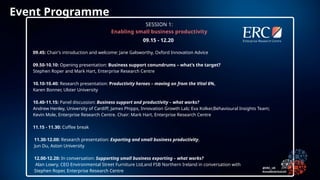
09.45: Chair’s introduction and welcome: Jane Galsworthy, Oxford Innovation Advice
09.50-10.10: Opening presentation: Business support conundrums – what’s the target?
Stephen Roper and Mark Hart, Enterprise Research Centre
10.10-10.40: Research presentation: Productivity heroes – moving on from the Vital 6%,
Karen Bonner, Ulster University
10.40-11.15: Panel discussion: Business support and productivity – what works?
Andrew Henley, University of Cardiff; James Phipps, Innovation Growth Lab; Eva Kolker,Behavioural Insights Team;
Kevin Mole, Enterprise Research Centre. Chair: Mark Hart, Enterprise Research Centre
11.15 - 11.30: Coffee break
11.30-12.00: Research presentation: Exporting and small business productivity,
Jun Du, Aston University
12.00-12.20: In conversation: Supporting small business exporting – what works?
Alan Lowry, CEO Environmental Street Furniture Ltd,and FSB Northern Ireland in conversation with
Stephen Roper, Enterprise Research Centre
09.15 - 12.20
SESSION 1:
Enabling small business productivity
Event Programme
Chair’s introduction and welcome
Jane Galsworthy
Oxford Innovation Advice
Opening presentation
Business support conundrums –
what’s the target?
Stephen Roper
Enterprise Research Centre
Mark Hart
Enterprise Research Centre
Stephen Roper and Mark Hart
Business Support
Conundrums
Other Funders
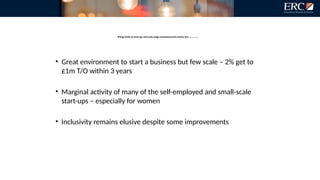
Rising levels of start-ups and early-stage entrepreneurial activity but……………..
• Great environment to start a business but few scale – 2% get to
£1m T/O within 3 years
• Marginal activity of many of the self-employed and small-scale
start-ups – especially for women
• Inclusivity remains elusive despite some improvements
Business dynamism in decline for over a decade – how can we reverse this?
• Business dynamism important for productivity growth –i.e.,
creates high level of productive churn
• Key reason is lack of growth in established firms – proportion
growing declined significantly in last decade
• Scaling remains the major policy challenge in the UK as it has
done for decades – how do we break the trend?
• Access to finance a loaded deck for women-led businesses?
Productivity a key policy focus yet.….enduring challenges
• Remains a large productivity and innovation gap between
frontier and non-frontier firms
• There is a lack of overall investment, especially in the adoption
of new digital technologies. Translation of investment into
innovation and productivity improvement is also an issue (?)
• Investment issues are exacerbated by skills shortages, which are
highly concentrated spatially
• There remain open questions over how we can shift the dial on
investment, innovation, productivity ….
Support for innovation is intensive yet……..remains a problem
• Public sector innovation support delivers positive outcomes –
UKRI-engaged firms grow faster
• But despite growing R&D tax credit spending, we see persistent
declines in innovation rates (particularly product innovation)
and SMEs moving out of innovating
• Why is this? How can we better measure and support and de-
risk SME innovation? Partnerships? Peer learning? Pilots?
Extensive suite of business support – yet not cutting through
• Lots of evidence on what works and in what settings (public and
private) but the needle not moving on overall growth and
productivity at firm level
• Why not?
– Poor design and implementation of programmes
– Too small scale
– Short-termism – no stability in delivery (organisations and personnel)
– Awareness of quality support
Karen Bonner
Ulster University
Research presentation
Productivity heroes – moving on from the vital 6%
Productivity Heroes –
moving on from the vital 6%
Dr Karen Bonner & Prof Mark Hart
3rd
October 2024
Context
Note:
This presentation contains statistical data from ONS which is Crown copyright and reproduced with the permission of the controller of
HMSO and Queen's Printer for Scotland. The use of the ONS statistical data in this work does not imply the endorsement of the ONS
in relation to the interpretation or analysis of the statistical data. The analysis upon which this presentation is based uses research
datasets which may not exactly reproduce National Statistics aggregates.
14
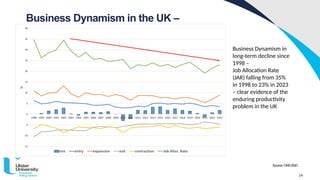
Business Dynamism in the UK –
a story of long-term decline
Source: ONS BSD
Business Dynamism in
long-term decline since
1998 –
Job Allocation Rate
(JAR) falling from 35%
in 1998 to 23% in 2023
– clear evidence of the
enduring productivity
problem in the UK
15
Scaling and HGFs…..
Hart, M; Prashar, N and Ri, A (2020) “From the Cabinet of Curiosities: The misdirection of research and policy debates on small firm growth”,
International small Business Journal, 2020 (with Neha Prashar and Anastasia Ri) https://journalsˌsagepubˌcom/doi/10ˌ1177/0266242620951718
Scaling’ is an important dynamic to nurture in the economy.
Current discussions about ‘scale-ups’ profoundly unhelpful from a policy perspective.
Having started the ball rolling a decade ago with our work for NESTA (i.e., the Vital 6% - HGFs
2005-08 – 40% had exited the market by 2016!!) we now state:
“There’s no such thing as a High-Growth Firm (or ‘scale-ups’) only firms that have high-growth
episodes”
To use, e.g., the OECD definition of a HGF renders invisible the actual growth that takes place in
a firm over its life cycle and indeed the wider firm population!
Importance of interplay between firm size and age cannot be understated in our
understanding of the scaling process
16
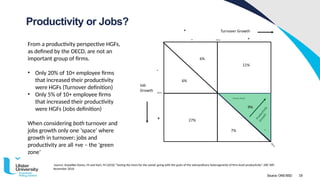
Productivity or Jobs?
Source: Anyadike-Danes, M and Hart, M (2016) “Seeing the trees for the wood: going with the grain of the extraordinary heterogeneity of firm-level productivity”, ERC WP,
November 2016
Source: ONS BSD
From a productivity perspective HGFs,
as defined by the OECD, are not an
important group of firms.
• Only 20% of 10+ employee firms
that increased their productivity
were HGFs (Turnover definition)
• Only 5% of 10+ employee firms
that increased their productivity
were HGFs (Jobs definition)
When considering both turnover and
jobs growth only one ‘space’ where
growth in turnover; jobs and
productivity are all +ve – the ‘green
zone’
Productivity Heroes
18
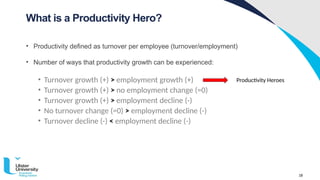
• Productivity defined as turnover per employee (turnover/employment)
• Number of ways that productivity growth can be experienced:
• Turnover growth (+) > employment growth (+)
• Turnover growth (+) > no employment change (=0)
• Turnover growth (+) > employment decline (-)
• No turnover change (=0) > employment decline (-)
• Turnover decline (-) < employment decline (-)
What is a Productivity Hero?
Productivity Heroes
19
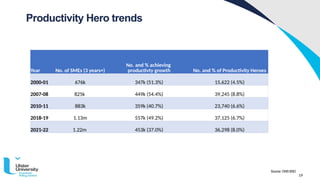
Productivity Hero trends
Year No. of SMEs (3 years+)
No. and % achieving
productivty growth No. and % of Productivity Heroes
2000-01 676k 347k (51.3%) 15,622 (4.5%)
2007-08 825k 449k (54.4%) 39,245 (8.8%)
2010-11 883k 359k (40.7%) 23,740 (6.6%)
2018-19 1.13m 557k (49.2%) 37,125 (6.7%)
2021-22 1.22m 453k (37.0%) 36,298 (8.0%)
Source: ONS BSD
20
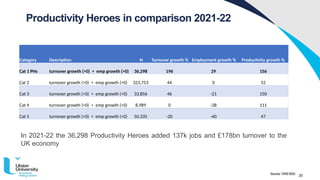
Productivity Heroes in comparison 2021-22
Category Description N Turnover growth % Employment growth % Productivity growth %
Cat 1 PHs turnover growth (>0) > emp growth (>0) 36,298 196 29 156
Cat 2 turnover growth (>0) > emp growth (=0) 323,753 44 0 52
Cat 3 turnover growth (>0) > emp growth (<0) 33,856 46 -21 150
Cat 4 turnover growth (=0) > emp growth (<0) 8,989 0 -28 111
Cat 5 turnover growth (<0) < emp growth (<0) 50,335 -20 -40 47
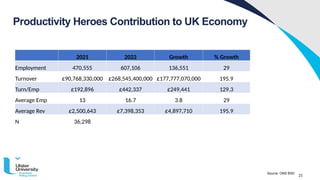
In 2021-22 the 36,298 Productivity Heroes added 137k jobs and £178bn turnover to the
UK economy
Source: ONS BSD
21
Productivity Heroes Contribution to UK Economy
2021 2022 Growth % Growth
Employment 470,555 607,106 136,551 29
Turnover £90,768,330,000 £268,545,400,000 £177,777,070,000 195.9
Turn/Emp £192,896 £442,337 £249,441 129.3
Average Emp 13 16.7 3.8 29
Average Rev £2,500,643 £7,398,353 £4,897,710 195.9
N 36,298
Source: ONS BSD
22
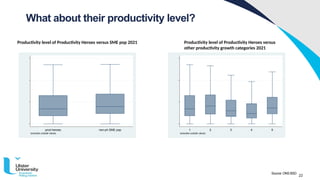
What about their productivity level?
Source: ONS BSD
0
100
200
300
prod21
prod heroes non-ph SME pop
excludes outside values
Productivity level of Productivity Heroes versus SME pop 2021
0
100
200
300
prod21
1 2 3 4 5
excludes outside values
Productivity level of Productivity Heroes versus
other productivity growth categories 2021
23
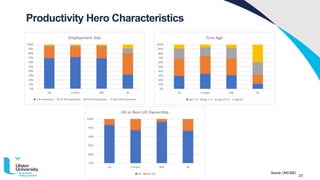
Productivity Hero Characteristics
Source: ONS BSD
24
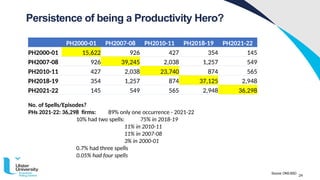
Persistence of being a Productivity Hero?
PH2000-01 PH2007-08 PH2010-11 PH2018-19 PH2021-22
PH2000-01 15,622 926 427 354 145
PH2007-08 926 39,245 2,038 1,257 549
PH2010-11 427 2,038 23,740 874 565
PH2018-19 354 1,257 874 37,125 2,948
PH2021-22 145 549 565 2,948 36,298
No. of Spells/Episodes?
PHs 2021-22: 36,298 firms: 89% only one occurrence - 2021-22
10% had two spells: 75% in 2018-19
11% in 2010-11
11% in 2007-08
3% in 2000-01
0.7% had three spells
0.05% had four spells
Source: ONS BSD
25
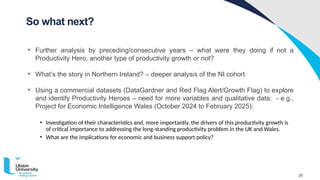
• Further analysis by preceding/consecutive years – what were they doing if not a
Productivity Hero, another type of productivity growth or not?
• What’s the story in Northern Ireland? – deeper analysis of the NI cohort
• Using a commercial datasets (DataGardner and Red Flag Alert/Growth Flag) to explore
and identify Productivity Heroes – need for more variables and qualitative data: - e.g.,
Project for Economic Intelligence Wales (October 2024 to February 2025):
• Investigation of their characteristics and, more importantly, the drivers of this productivity growth is
of critical importance to addressing the long-standing productivity problem in the UK and Wales.
• What are the implications for economic and business support policy?
So what next?
Contact Details:
Dr Karen Bonner
Principal Economist
Email: ka.bonner@ulster.ac.uk
Telephone: 02895 367625
Thank you
Kevin Mole
Enterprise Research Centre
Chair:
Mark Hart
Enterprise Research Centre
Eva Kolker
Behavioural Insights Team
Andrew Henley
University of Cardiff
James Phipps
Innovation Growth Lab
Panel discussion
Business support and productivity –
what works?
Coffee Break
Jun Du
Aston University
Research presentation
Exporting and small business productivity
Prof. Jun Du
Aston University
3 October 2024
ERC Annual Conference
Other Funders
Exporting and
Small Business Productivity
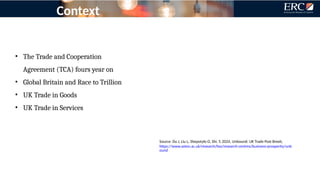
Context
• The Trade and Cooperation
Agreement (TCA) fours year on
• Global Britain and Race to Trillion
• UK Trade in Goods
• UK Trade in Services
Source: Du J, Liu L, Shepotylo O, Shi, Y, 2024, Unbound: UK Trade Post Brexit,
https://www.aston.ac.uk/research/bss/research-centres/business-prosperity/unb
ound
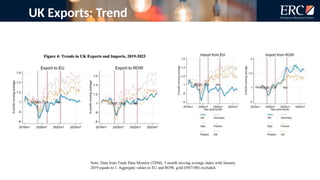
UK Exports: Trend
Note: Data from Trade Data Monitor (TDM). 3 month moving average index with January
2019 equals to 1. Aggregate values to EU and ROW, gold (HS7108) excluded.
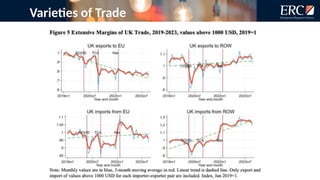
Varieties of Trade
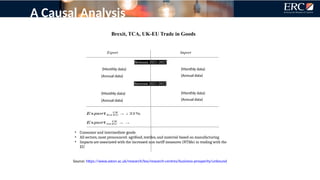
Brexit, TCA, UK-EU Trade in Goods
(Monthly data)
Export Import
𝐸𝑥𝑝𝑜𝑟𝑡 𝐸𝑥𝑡 𝐸𝑈
𝑈𝐾
→ ↓ 33 %
(Monthly data)
Between 2021-2023
(Annual data)
(Monthly data)
(Annual data)
(Annual data)
Between 2021-2022
(Monthly data)
(Annual data)
Source: https://www.aston.ac.uk/research/bss/research-centres/business-prosperity/unbound
𝐸𝑥𝑝𝑜𝑟𝑡 𝐼𝑛𝑡 𝐸𝑈
𝑈𝐾
→ →
• Consumer and intermediate goods
• All sectors, most pronounced: agrifood, textiles, and material-based on manufacturing
• Impacts are associated with the increased non-tariff measures (NTMs) in trading with the
EU
A Causal Analysis
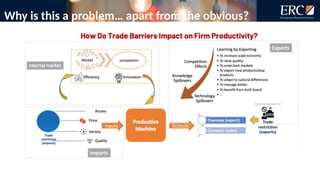
Why is this a problem… apart from the obvious?
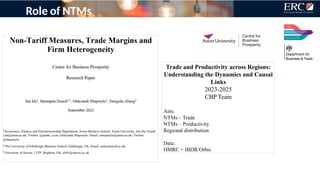
Role of NTMs
Trade and Productivity across Regions:
Understanding the Dynamics and Causal
Links
2023-2025
CBP Team
Aim:
NTMs – Trade
NTMs – Productivity
Regional distribution
Data:
HMRC + IBDR/Orbis
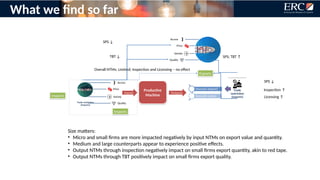
What we find so far
Inputs
Trade restriction
(imports)
Access
Price
Variety
Quality
Outputs
Overseas (export)
Domestic (sales)
Trade
restriction
(exports)
Productive
Machine
Imports
Exports
Access
Price
Variety
Quality
Imports
Overall NTMs: Limited; Inspection and Licensing – no effect
TBT ↓
SPS ↓
SPS ↓
Inspection ↑
Licensing ↑
SPS; TBT ↑
Size matters:
• Micro and small firms are more impacted negatively by input NTMs on export value and quantity.
• Medium and large counterparts appear to experience positive effects.
• Output NTMs through inspection negatively impact on small firms export quantity, akin to red tape.
• Output NTMs through TBT positively impact on small firms export quality.
Policy Recommendations
Mitigate the Negative Effects of the TCA
• More flexible and adaptive trade policies that aim to renegotiate to reduce non-tariff barriers and regulatory
barriers
• Targeted policy interventions, reconfiguring supply chains and supporting SMEs to adapt to new trade
requirements.
Reconfigure Supply Chains for Resilience
The UK’s disentanglement from EU value chains has resulted in a weakened and more fragmented supply chain.
In response, businesses and policymakers must reconfigure supply chains to build resilience by reshoring critical
production, diversifying global sourcing, and strengthening infrastructure.
Support SME Adaptation and Productivity
SMEs, the backbone of the UK economy, are struggling to cope with the increased costs and complexities of new
trade barriers. Providing targeted support, including access to finance, export training, and fostering innovation,
is essential to help these firms thrive in the post-Brexit landscape.
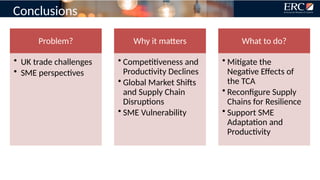
Conclusions
Problem?
• UK trade challenges
• SME perspectives
Why it matters
• Competitiveness and
Productivity Declines
• Global Market Shifts
and Supply Chain
Disruptions
• SME Vulnerability
What to do?
• Mitigate the
Negative Effects of
the TCA
• Reconfigure Supply
Chains for Resilience
• Support SME
Adaptation and
Productivity
centremanager@enterpriseresearch.ac.uk
Linkedin.com/company/enterprise-research-centre-uk-
Contact us
@ERC_UK
www.enterpriseresearch.ac.uk
Other Funders
Professor Jun Du
Enterprise Research Centre Lead for ERC4 WP4 Internationalisation and
Productivity
Centre Director for Centre for Business Prosperity (CBP)
Professor of Economics, Economics, Finance & Entrepreneurship Group
Aston Business School, Aston University Birmingham B4 7ET, UK
Email: j.du@aston.ac.uk
In conversation
Supporting small business exporting – what works?
Alan Lowry
CEO, Environmental Street Furniture
Ltd., and FSB Northern Ireland
Stephen Roper
Enterprise Research Centre
Lunch & networking
13.15-13.45: Policy case study: The challenges faced by SMEs in Austria and policy response,
Karin Bachinger, Austrian Institute for SME Research
13.45-14.20: Panel discussion: Using evidence to inform better business support at local level – What works?
Victoria Sutherland, What Works Centre for Local Growth; Robert Wapshott, University of Nottingham;
Cathy Keenan, Belfast City Council
Chair: Eugenie Golubova, Enterprise Research Centre
14.20-14.35: Refreshment break
14.35-15.00: Business case study: Gripsure UK’s growth and finance journey,
Mike Nicholson, Managing Director, Gripsure UK Ltd
15.00-15.35: Panel discussion: Strengthening financial resilience in small businesses - what works?
Liz Barclay, Small Business Commissioner ;Miriam Koreen, OECD; Richard Bearman, British Business Bank
Chair: Maria Wishart, Enterprise Research Centre
15.35-15.45 Closing remarks – Jane Galsworthy and Stephen Roper
Event Programme
13.15 - 15.45
SESSION 2:
Strengthening small business support systems
Karin Bachinger
Austrian Institute for SME Research
Policy case study:
The challenges faced by SMEs in Austria
and policy response
www.kmuforschung.ac.at
Karin Bachinger / Austrian Institute for SME Research
The challenges faced by SMEs
in Austria and policy response
Member of: www.kmuforschung.ac.at
Over
80
projects per
year
Since
1954
active in
economic
research
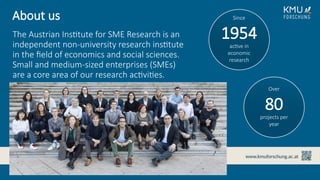
The Austrian Institute for SME Research is an
independent non-university research institute
in the field of economics and social sciences.
Small and medium-sized enterprises (SMEs)
are a core area of our research activities.
About us
 The Austrian institutional framework – What‘s special?
 Key challenges faced by Austrian SMEs
 Austria’s policy response
 Transitioning to a climate neutral economy- Austria's policy
response based on findings from ongoing research
 Recap & conclusion
Outline of the presentation
 The responsibility for SME policy lies with the Ministry of
Labour and Economy
 Corporatism / social partnership- important role of the
Chamber of Commerce
 Strong direct funding system
 Austrian Research Promotion Agency (FFG)
 Promotional bank of the Austrian federal government (aws)
 Important driver from the regulatory side: EU
What‘s special? (I)
The Austrian institutional framework
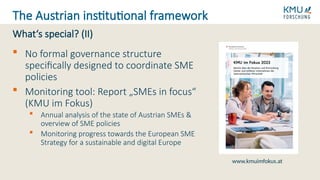
 No formal governance structure
specifically designed to coordinate SME
policies
 Monitoring tool: Report „SMEs in focus“
(KMU im Fokus)
 Annual analysis of the state of Austrian SMEs &
overview of SME policies
 Monitoring progress towards the European SME
Strategy for a sustainable and digital Europe
What‘s special? (II)
The Austrian institutional framework
www.kmuimfokus.at
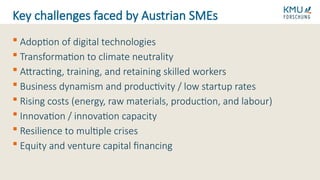
 Adoption of digital technologies
 Transformation to climate neutrality
 Attracting, training, and retaining skilled workers
 Business dynamism and productivity / low startup rates
 Rising costs (energy, raw materials, production, and labour)
 Innovation / innovation capacity
 Resilience to multiple crises
 Equity and venture capital financing
Key challenges faced by Austrian SMEs
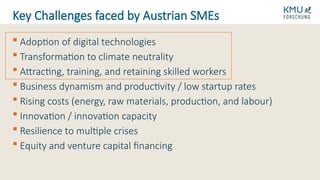
 Adoption of digital technologies
 Transformation to climate neutrality
 Attracting, training, and retaining skilled workers
 Business dynamism and productivity / low startup rates
 Rising costs (energy, raw materials, production, and labour)
 Innovation / innovation capacity
 Resilience to multiple crises
 Equity and venture capital financing
Key Challenges faced by Austrian SMEs
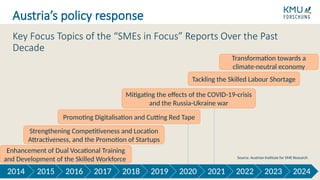
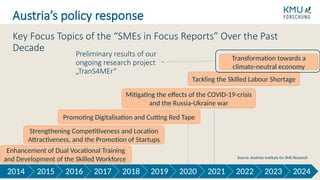
2014 2015 2016 2017 2018 2019 2020 2021 2022 2023 2024
Key Focus Topics of the “SMEs in Focus” Reports Over the Past
Decade
Austria’s policy response
Enhancement of Dual Vocational Training
and Development of the Skilled Workforce
Strengthening Competitiveness and Location
Attractiveness, and the Promotion of Startups
Promoting Digitalisation and Cutting Red Tape
Mitigating the effects of the COVID-19-crisis
and the Russia-Ukraine war
Tackling the Skilled Labour Shortage
Transformation towards a
climate-neutral economy
Source: Austrian Institute for SME Research
2014 2015 2016 2017 2018 2019 2020 2021 2022 2023 2024
Key Focus Topics of the “SMEs in Focus Reports” Over the Past
Decade
Austria’s policy response
Enhancement of Dual Vocational Training
and Development of the Skilled Workforce
Strengthening Competitiveness and Location
Attractiveness, and the Promotion of Startups
Promoting Digitalisation and Cutting Red Tape
Mitigating the effects of the COVID-19-crisis
and the Russia-Ukraine war
Tackling the Skilled Labour Shortage
Transformation towards a
climate-neutral economy
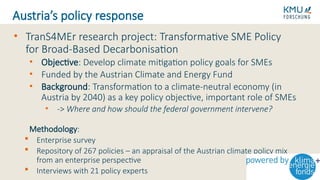
Preliminary results of our
ongoing research project
„TranS4MEr“
Source: Austrian Institute for SME Research
• TranS4MEr research project: Transformative SME Policy
for Broad-Based Decarbonisation
• Objective: Develop climate mitigation policy goals for SMEs
• Funded by the Austrian Climate and Energy Fund
• Background: Transformation to a climate-neutral economy (in
Austria by 2040) as a key policy objective, important role of SMEs
• -> Where and how should the federal government intervene?
Methodology:
 Enterprise survey
 Repository of 267 policies – an appraisal of the Austrian climate policy mix
from an enterprise perspective
 Interviews with 21 policy experts
Austria’s policy response
• TranS4MEr research project: Transformative SME Policy
for Broad-Based Decarbonisation
• Objective: Develop climate mitigation policy goals for SMEs
• Background: Transformation to a climate-neutral economy (in
Austria by 2040) as a key policy objective, important role of SMEs
• -> Where and how should the federal government intervene?
Methodology:
 Enterprise survey
 Repository of 267 policies – an appraisal of the Austrian climate policy mix
from an enterprise perspective
 Interviews with 21 policy experts
Austria’s policy response
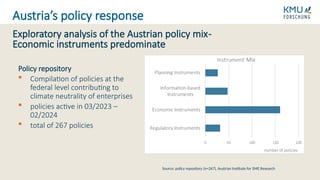
Exploratory analysis of the Austrian policy mix-
Economic instruments predominate
Austria’s policy response
Policy repository
 Compilation of policies at the
federal level contributing to
climate neutrality of enterprises
 policies active in 03/2023 –
02/2024
 total of 267 policies
Source: policy repository (n=267), Austrian Institute for SME Research
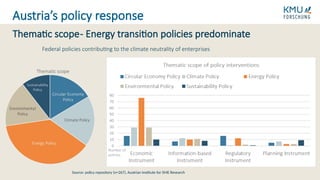
Thematic scope- Energy transition policies predominate
Austria’s policy response
Source: policy repository (n=267), Austrian Institute for SME Research
Number of
policies
Federal policies contributing to the climate neutrality of enterprises
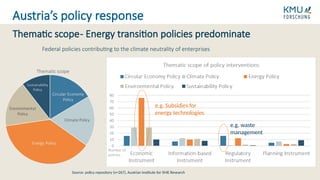
Thematic scope- Energy transition policies predominate
Austria’s policy response
Source: policy repository (n=267), Austrian Institute for SME Research
Number of
policies
Federal policies contributing to the climate neutrality of enterprises
e.g. Subsidies for
energy technologies
e.g. waste
management
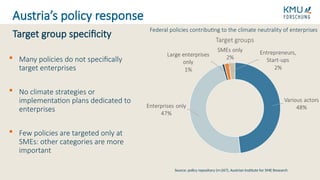
 Many policies do not specifically
target enterprises
 No climate strategies or
implementation plans dedicated to
enterprises
 Few policies are targeted only at
SMEs: other categories are more
important
Target group specificity
Austria’s policy response
Source: policy repository (n=267), Austrian Institute for SME Research
Federal policies contributing to the climate neutrality of enterprises
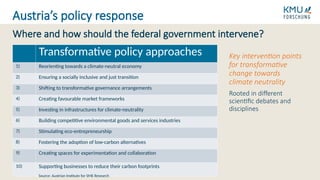
Key intervention points
for transformative
change towards
climate neutrality
Rooted in different
scientific debates and
disciplines
Where and how should the federal government intervene?
Austria’s policy response
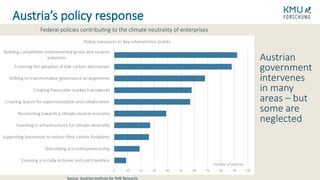
Transformative policy approaches
1) Reorienting towards a climate-neutral economy
2) Ensuring a socially inclusive and just transition
3) Shifting to transformative governance arrangements
4) Creating favourable market frameworks
5) Investing in infrastructures for climate-neutrality
6) Building competitive environmental goods and services industries
7) Stimulating eco-entrepreneurship
8) Fostering the adoption of low-carbon alternatives
9) Creating spaces for experimentation and collaboration
10) Supporting businesses to reduce their carbon footprints
Source: Austrian Institute for SME Research
Austrian
government
intervenes
in many
areas – but
some are
neglected
Austria’s policy response
Federal policies contributing to the climate neutrality of enterprises
Source: Austrian Institute for SME Research
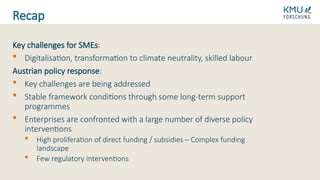
Key challenges for SMEs:
 Digitalisation, transformation to climate neutrality, skilled labour
Austrian policy response:
 Key challenges are being addressed
 Stable framework conditions through some long-term support
programmes
 Enterprises are confronted with a large number of diverse policy
interventions
 High proliferation of direct funding / subsidies – Complex funding
landscape
 Few regulatory interventions
Recap
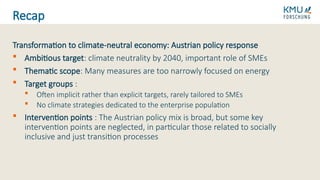
Transformation to climate-neutral economy: Austrian policy response
 Ambitious target: climate neutrality by 2040, important role of SMEs
 Thematic scope: Many measures are too narrowly focused on energy
 Target groups :
 Often implicit rather than explicit targets, rarely tailored to SMEs
 No climate strategies dedicated to the enterprise population
 Intervention points : The Austrian policy mix is broad, but some key
intervention points are neglected, in particular those related to socially
inclusive and just transition processes
Recap
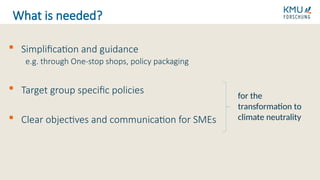
 Simplification and guidance
e.g. through One-stop shops, policy packaging
 Target group specific policies
 Clear objectives and communication for SMEs
What is needed?
for the
transformation to
climate neutrality
Senior Researcher
Austrian Institute for SME Research
k.bachinger@kmuforschung.ac.at
KARIN BACHINGER
Thank you for your attention!
Chair:
Eugenie Golubova
Enterprise Research Centre
Cathy Keenan
Belfast City Council
Victoria Sutherland
What Works Centre for Local Growth
Robert Wapshott
University of Nottingham
Panel discussion
Using evidence to inform better business
support at local level – what works?
Refreshment break
Mike Nicholson
Managing Director, Gripsure UK Ltd.
Business case study
Gripsure UK’s growth and finance journey
Chair:
Maria Wishart
Enterprise Research Centre
Richard Bearman
British Business Bank
Liz Barclay
Small Business Commissioner
Miriam Koreen
OECD
Panel discussion
Strengthening financial resilience in small
businesses – what works?
Closing remarks
Stephen Roper
Enterprise Research Centre
Jane Galsworthy
Oxford Innovation Advice
Networking &
drinks reception
www.enterpriseresearch.ac.u
k
centremanager@enterpriseresearch.ac.
uk
@ERC_UK
enterprise-research-centre-uk
Contact Us:
@ERC_UK
#smallbizbritain2
4
Other Funders

Conference 2024 presentation master - public final.pptx

  • 1.
    @ERC_UK #smallbizbritain24 STATE OF SMALLBUSINESS BRITAIN CONFERENCE 2024 Other Funders
  • 2.
    09.45: Chair’s introductionand welcome: Jane Galsworthy, Oxford Innovation Advice 09.50-10.10: Opening presentation: Business support conundrums – what’s the target? Stephen Roper and Mark Hart, Enterprise Research Centre 10.10-10.40: Research presentation: Productivity heroes – moving on from the Vital 6%, Karen Bonner, Ulster University 10.40-11.15: Panel discussion: Business support and productivity – what works? Andrew Henley, University of Cardiff; James Phipps, Innovation Growth Lab; Eva Kolker,Behavioural Insights Team; Kevin Mole, Enterprise Research Centre. Chair: Mark Hart, Enterprise Research Centre 11.15 - 11.30: Coffee break 11.30-12.00: Research presentation: Exporting and small business productivity, Jun Du, Aston University 12.00-12.20: In conversation: Supporting small business exporting – what works? Alan Lowry, CEO Environmental Street Furniture Ltd,and FSB Northern Ireland in conversation with Stephen Roper, Enterprise Research Centre 09.15 - 12.20 SESSION 1: Enabling small business productivity Event Programme
  • 3.
    Chair’s introduction andwelcome Jane Galsworthy Oxford Innovation Advice
  • 4.
    Opening presentation Business supportconundrums – what’s the target? Stephen Roper Enterprise Research Centre Mark Hart Enterprise Research Centre
  • 5.
    Stephen Roper andMark Hart Business Support Conundrums Other Funders
  • 6.
    Rising levels ofstart-ups and early-stage entrepreneurial activity but…………….. • Great environment to start a business but few scale – 2% get to £1m T/O within 3 years • Marginal activity of many of the self-employed and small-scale start-ups – especially for women • Inclusivity remains elusive despite some improvements
  • 7.
    Business dynamism indecline for over a decade – how can we reverse this? • Business dynamism important for productivity growth –i.e., creates high level of productive churn • Key reason is lack of growth in established firms – proportion growing declined significantly in last decade • Scaling remains the major policy challenge in the UK as it has done for decades – how do we break the trend? • Access to finance a loaded deck for women-led businesses?
  • 8.
    Productivity a keypolicy focus yet.….enduring challenges • Remains a large productivity and innovation gap between frontier and non-frontier firms • There is a lack of overall investment, especially in the adoption of new digital technologies. Translation of investment into innovation and productivity improvement is also an issue (?) • Investment issues are exacerbated by skills shortages, which are highly concentrated spatially • There remain open questions over how we can shift the dial on investment, innovation, productivity ….
  • 9.
    Support for innovationis intensive yet……..remains a problem • Public sector innovation support delivers positive outcomes – UKRI-engaged firms grow faster • But despite growing R&D tax credit spending, we see persistent declines in innovation rates (particularly product innovation) and SMEs moving out of innovating • Why is this? How can we better measure and support and de- risk SME innovation? Partnerships? Peer learning? Pilots?
  • 10.
    Extensive suite ofbusiness support – yet not cutting through • Lots of evidence on what works and in what settings (public and private) but the needle not moving on overall growth and productivity at firm level • Why not? – Poor design and implementation of programmes – Too small scale – Short-termism – no stability in delivery (organisations and personnel) – Awareness of quality support
  • 11.
    Karen Bonner Ulster University Researchpresentation Productivity heroes – moving on from the vital 6%
  • 12.
    Productivity Heroes – movingon from the vital 6% Dr Karen Bonner & Prof Mark Hart 3rd October 2024
  • 13.
    Context Note: This presentation containsstatistical data from ONS which is Crown copyright and reproduced with the permission of the controller of HMSO and Queen's Printer for Scotland. The use of the ONS statistical data in this work does not imply the endorsement of the ONS in relation to the interpretation or analysis of the statistical data. The analysis upon which this presentation is based uses research datasets which may not exactly reproduce National Statistics aggregates.
  • 14.
    14 Business Dynamism inthe UK – a story of long-term decline Source: ONS BSD Business Dynamism in long-term decline since 1998 – Job Allocation Rate (JAR) falling from 35% in 1998 to 23% in 2023 – clear evidence of the enduring productivity problem in the UK
  • 15.
    15 Scaling and HGFs….. Hart,M; Prashar, N and Ri, A (2020) “From the Cabinet of Curiosities: The misdirection of research and policy debates on small firm growth”, International small Business Journal, 2020 (with Neha Prashar and Anastasia Ri) https://journalsˌsagepubˌcom/doi/10ˌ1177/0266242620951718 Scaling’ is an important dynamic to nurture in the economy. Current discussions about ‘scale-ups’ profoundly unhelpful from a policy perspective. Having started the ball rolling a decade ago with our work for NESTA (i.e., the Vital 6% - HGFs 2005-08 – 40% had exited the market by 2016!!) we now state: “There’s no such thing as a High-Growth Firm (or ‘scale-ups’) only firms that have high-growth episodes” To use, e.g., the OECD definition of a HGF renders invisible the actual growth that takes place in a firm over its life cycle and indeed the wider firm population! Importance of interplay between firm size and age cannot be understated in our understanding of the scaling process
  • 16.
    16 Productivity or Jobs? Source:Anyadike-Danes, M and Hart, M (2016) “Seeing the trees for the wood: going with the grain of the extraordinary heterogeneity of firm-level productivity”, ERC WP, November 2016 Source: ONS BSD From a productivity perspective HGFs, as defined by the OECD, are not an important group of firms. • Only 20% of 10+ employee firms that increased their productivity were HGFs (Turnover definition) • Only 5% of 10+ employee firms that increased their productivity were HGFs (Jobs definition) When considering both turnover and jobs growth only one ‘space’ where growth in turnover; jobs and productivity are all +ve – the ‘green zone’
  • 17.
  • 18.
    18 • Productivity definedas turnover per employee (turnover/employment) • Number of ways that productivity growth can be experienced: • Turnover growth (+) > employment growth (+) • Turnover growth (+) > no employment change (=0) • Turnover growth (+) > employment decline (-) • No turnover change (=0) > employment decline (-) • Turnover decline (-) < employment decline (-) What is a Productivity Hero? Productivity Heroes
  • 19.
    19 Productivity Hero trends YearNo. of SMEs (3 years+) No. and % achieving productivty growth No. and % of Productivity Heroes 2000-01 676k 347k (51.3%) 15,622 (4.5%) 2007-08 825k 449k (54.4%) 39,245 (8.8%) 2010-11 883k 359k (40.7%) 23,740 (6.6%) 2018-19 1.13m 557k (49.2%) 37,125 (6.7%) 2021-22 1.22m 453k (37.0%) 36,298 (8.0%) Source: ONS BSD
  • 20.
    20 Productivity Heroes incomparison 2021-22 Category Description N Turnover growth % Employment growth % Productivity growth % Cat 1 PHs turnover growth (>0) > emp growth (>0) 36,298 196 29 156 Cat 2 turnover growth (>0) > emp growth (=0) 323,753 44 0 52 Cat 3 turnover growth (>0) > emp growth (<0) 33,856 46 -21 150 Cat 4 turnover growth (=0) > emp growth (<0) 8,989 0 -28 111 Cat 5 turnover growth (<0) < emp growth (<0) 50,335 -20 -40 47 In 2021-22 the 36,298 Productivity Heroes added 137k jobs and £178bn turnover to the UK economy Source: ONS BSD
  • 21.
    21 Productivity Heroes Contributionto UK Economy 2021 2022 Growth % Growth Employment 470,555 607,106 136,551 29 Turnover £90,768,330,000 £268,545,400,000 £177,777,070,000 195.9 Turn/Emp £192,896 £442,337 £249,441 129.3 Average Emp 13 16.7 3.8 29 Average Rev £2,500,643 £7,398,353 £4,897,710 195.9 N 36,298 Source: ONS BSD
  • 22.
    22 What about theirproductivity level? Source: ONS BSD 0 100 200 300 prod21 prod heroes non-ph SME pop excludes outside values Productivity level of Productivity Heroes versus SME pop 2021 0 100 200 300 prod21 1 2 3 4 5 excludes outside values Productivity level of Productivity Heroes versus other productivity growth categories 2021
  • 23.
  • 24.
    24 Persistence of beinga Productivity Hero? PH2000-01 PH2007-08 PH2010-11 PH2018-19 PH2021-22 PH2000-01 15,622 926 427 354 145 PH2007-08 926 39,245 2,038 1,257 549 PH2010-11 427 2,038 23,740 874 565 PH2018-19 354 1,257 874 37,125 2,948 PH2021-22 145 549 565 2,948 36,298 No. of Spells/Episodes? PHs 2021-22: 36,298 firms: 89% only one occurrence - 2021-22 10% had two spells: 75% in 2018-19 11% in 2010-11 11% in 2007-08 3% in 2000-01 0.7% had three spells 0.05% had four spells Source: ONS BSD
  • 25.
    25 • Further analysisby preceding/consecutive years – what were they doing if not a Productivity Hero, another type of productivity growth or not? • What’s the story in Northern Ireland? – deeper analysis of the NI cohort • Using a commercial datasets (DataGardner and Red Flag Alert/Growth Flag) to explore and identify Productivity Heroes – need for more variables and qualitative data: - e.g., Project for Economic Intelligence Wales (October 2024 to February 2025): • Investigation of their characteristics and, more importantly, the drivers of this productivity growth is of critical importance to addressing the long-standing productivity problem in the UK and Wales. • What are the implications for economic and business support policy? So what next?
  • 26.
    Contact Details: Dr KarenBonner Principal Economist Email: ka.bonner@ulster.ac.uk Telephone: 02895 367625 Thank you
  • 27.
    Kevin Mole Enterprise ResearchCentre Chair: Mark Hart Enterprise Research Centre Eva Kolker Behavioural Insights Team Andrew Henley University of Cardiff James Phipps Innovation Growth Lab Panel discussion Business support and productivity – what works?
  • 28.
  • 29.
    Jun Du Aston University Researchpresentation Exporting and small business productivity
  • 30.
    Prof. Jun Du AstonUniversity 3 October 2024 ERC Annual Conference Other Funders Exporting and Small Business Productivity
  • 31.
    Context • The Tradeand Cooperation Agreement (TCA) fours year on • Global Britain and Race to Trillion • UK Trade in Goods • UK Trade in Services Source: Du J, Liu L, Shepotylo O, Shi, Y, 2024, Unbound: UK Trade Post Brexit, https://www.aston.ac.uk/research/bss/research-centres/business-prosperity/unb ound
  • 32.
    UK Exports: Trend Note:Data from Trade Data Monitor (TDM). 3 month moving average index with January 2019 equals to 1. Aggregate values to EU and ROW, gold (HS7108) excluded.
  • 33.
  • 34.
    Brexit, TCA, UK-EUTrade in Goods (Monthly data) Export Import 𝐸𝑥𝑝𝑜𝑟𝑡 𝐸𝑥𝑡 𝐸𝑈 𝑈𝐾 → ↓ 33 % (Monthly data) Between 2021-2023 (Annual data) (Monthly data) (Annual data) (Annual data) Between 2021-2022 (Monthly data) (Annual data) Source: https://www.aston.ac.uk/research/bss/research-centres/business-prosperity/unbound 𝐸𝑥𝑝𝑜𝑟𝑡 𝐼𝑛𝑡 𝐸𝑈 𝑈𝐾 → → • Consumer and intermediate goods • All sectors, most pronounced: agrifood, textiles, and material-based on manufacturing • Impacts are associated with the increased non-tariff measures (NTMs) in trading with the EU A Causal Analysis
  • 35.
    Why is thisa problem… apart from the obvious?
  • 36.
    Role of NTMs Tradeand Productivity across Regions: Understanding the Dynamics and Causal Links 2023-2025 CBP Team Aim: NTMs – Trade NTMs – Productivity Regional distribution Data: HMRC + IBDR/Orbis
  • 37.
    What we findso far Inputs Trade restriction (imports) Access Price Variety Quality Outputs Overseas (export) Domestic (sales) Trade restriction (exports) Productive Machine Imports Exports Access Price Variety Quality Imports Overall NTMs: Limited; Inspection and Licensing – no effect TBT ↓ SPS ↓ SPS ↓ Inspection ↑ Licensing ↑ SPS; TBT ↑ Size matters: • Micro and small firms are more impacted negatively by input NTMs on export value and quantity. • Medium and large counterparts appear to experience positive effects. • Output NTMs through inspection negatively impact on small firms export quantity, akin to red tape. • Output NTMs through TBT positively impact on small firms export quality.
  • 38.
    Policy Recommendations Mitigate theNegative Effects of the TCA • More flexible and adaptive trade policies that aim to renegotiate to reduce non-tariff barriers and regulatory barriers • Targeted policy interventions, reconfiguring supply chains and supporting SMEs to adapt to new trade requirements. Reconfigure Supply Chains for Resilience The UK’s disentanglement from EU value chains has resulted in a weakened and more fragmented supply chain. In response, businesses and policymakers must reconfigure supply chains to build resilience by reshoring critical production, diversifying global sourcing, and strengthening infrastructure. Support SME Adaptation and Productivity SMEs, the backbone of the UK economy, are struggling to cope with the increased costs and complexities of new trade barriers. Providing targeted support, including access to finance, export training, and fostering innovation, is essential to help these firms thrive in the post-Brexit landscape.
  • 39.
    Conclusions Problem? • UK tradechallenges • SME perspectives Why it matters • Competitiveness and Productivity Declines • Global Market Shifts and Supply Chain Disruptions • SME Vulnerability What to do? • Mitigate the Negative Effects of the TCA • Reconfigure Supply Chains for Resilience • Support SME Adaptation and Productivity
  • 40.
    centremanager@enterpriseresearch.ac.uk Linkedin.com/company/enterprise-research-centre-uk- Contact us @ERC_UK www.enterpriseresearch.ac.uk Other Funders ProfessorJun Du Enterprise Research Centre Lead for ERC4 WP4 Internationalisation and Productivity Centre Director for Centre for Business Prosperity (CBP) Professor of Economics, Economics, Finance & Entrepreneurship Group Aston Business School, Aston University Birmingham B4 7ET, UK Email: j.du@aston.ac.uk
  • 41.
    In conversation Supporting smallbusiness exporting – what works? Alan Lowry CEO, Environmental Street Furniture Ltd., and FSB Northern Ireland Stephen Roper Enterprise Research Centre
  • 42.
  • 43.
    13.15-13.45: Policy casestudy: The challenges faced by SMEs in Austria and policy response, Karin Bachinger, Austrian Institute for SME Research 13.45-14.20: Panel discussion: Using evidence to inform better business support at local level – What works? Victoria Sutherland, What Works Centre for Local Growth; Robert Wapshott, University of Nottingham; Cathy Keenan, Belfast City Council Chair: Eugenie Golubova, Enterprise Research Centre 14.20-14.35: Refreshment break 14.35-15.00: Business case study: Gripsure UK’s growth and finance journey, Mike Nicholson, Managing Director, Gripsure UK Ltd 15.00-15.35: Panel discussion: Strengthening financial resilience in small businesses - what works? Liz Barclay, Small Business Commissioner ;Miriam Koreen, OECD; Richard Bearman, British Business Bank Chair: Maria Wishart, Enterprise Research Centre 15.35-15.45 Closing remarks – Jane Galsworthy and Stephen Roper Event Programme 13.15 - 15.45 SESSION 2: Strengthening small business support systems
  • 44.
    Karin Bachinger Austrian Institutefor SME Research Policy case study: The challenges faced by SMEs in Austria and policy response
  • 45.
    www.kmuforschung.ac.at Karin Bachinger /Austrian Institute for SME Research The challenges faced by SMEs in Austria and policy response
  • 46.
    Member of: www.kmuforschung.ac.at Over 80 projectsper year Since 1954 active in economic research The Austrian Institute for SME Research is an independent non-university research institute in the field of economics and social sciences. Small and medium-sized enterprises (SMEs) are a core area of our research activities. About us
  • 47.
     The Austrianinstitutional framework – What‘s special?  Key challenges faced by Austrian SMEs  Austria’s policy response  Transitioning to a climate neutral economy- Austria's policy response based on findings from ongoing research  Recap & conclusion Outline of the presentation
  • 48.
     The responsibilityfor SME policy lies with the Ministry of Labour and Economy  Corporatism / social partnership- important role of the Chamber of Commerce  Strong direct funding system  Austrian Research Promotion Agency (FFG)  Promotional bank of the Austrian federal government (aws)  Important driver from the regulatory side: EU What‘s special? (I) The Austrian institutional framework
  • 49.
     No formalgovernance structure specifically designed to coordinate SME policies  Monitoring tool: Report „SMEs in focus“ (KMU im Fokus)  Annual analysis of the state of Austrian SMEs & overview of SME policies  Monitoring progress towards the European SME Strategy for a sustainable and digital Europe What‘s special? (II) The Austrian institutional framework www.kmuimfokus.at
  • 50.
     Adoption ofdigital technologies  Transformation to climate neutrality  Attracting, training, and retaining skilled workers  Business dynamism and productivity / low startup rates  Rising costs (energy, raw materials, production, and labour)  Innovation / innovation capacity  Resilience to multiple crises  Equity and venture capital financing Key challenges faced by Austrian SMEs
  • 51.
     Adoption ofdigital technologies  Transformation to climate neutrality  Attracting, training, and retaining skilled workers  Business dynamism and productivity / low startup rates  Rising costs (energy, raw materials, production, and labour)  Innovation / innovation capacity  Resilience to multiple crises  Equity and venture capital financing Key Challenges faced by Austrian SMEs
  • 52.
    2014 2015 20162017 2018 2019 2020 2021 2022 2023 2024 Key Focus Topics of the “SMEs in Focus” Reports Over the Past Decade Austria’s policy response Enhancement of Dual Vocational Training and Development of the Skilled Workforce Strengthening Competitiveness and Location Attractiveness, and the Promotion of Startups Promoting Digitalisation and Cutting Red Tape Mitigating the effects of the COVID-19-crisis and the Russia-Ukraine war Tackling the Skilled Labour Shortage Transformation towards a climate-neutral economy Source: Austrian Institute for SME Research
  • 53.
    2014 2015 20162017 2018 2019 2020 2021 2022 2023 2024 Key Focus Topics of the “SMEs in Focus Reports” Over the Past Decade Austria’s policy response Enhancement of Dual Vocational Training and Development of the Skilled Workforce Strengthening Competitiveness and Location Attractiveness, and the Promotion of Startups Promoting Digitalisation and Cutting Red Tape Mitigating the effects of the COVID-19-crisis and the Russia-Ukraine war Tackling the Skilled Labour Shortage Transformation towards a climate-neutral economy Preliminary results of our ongoing research project „TranS4MEr“ Source: Austrian Institute for SME Research
  • 54.
    • TranS4MEr researchproject: Transformative SME Policy for Broad-Based Decarbonisation • Objective: Develop climate mitigation policy goals for SMEs • Funded by the Austrian Climate and Energy Fund • Background: Transformation to a climate-neutral economy (in Austria by 2040) as a key policy objective, important role of SMEs • -> Where and how should the federal government intervene? Methodology:  Enterprise survey  Repository of 267 policies – an appraisal of the Austrian climate policy mix from an enterprise perspective  Interviews with 21 policy experts Austria’s policy response
  • 55.
    • TranS4MEr researchproject: Transformative SME Policy for Broad-Based Decarbonisation • Objective: Develop climate mitigation policy goals for SMEs • Background: Transformation to a climate-neutral economy (in Austria by 2040) as a key policy objective, important role of SMEs • -> Where and how should the federal government intervene? Methodology:  Enterprise survey  Repository of 267 policies – an appraisal of the Austrian climate policy mix from an enterprise perspective  Interviews with 21 policy experts Austria’s policy response
  • 56.
    Exploratory analysis ofthe Austrian policy mix- Economic instruments predominate Austria’s policy response Policy repository  Compilation of policies at the federal level contributing to climate neutrality of enterprises  policies active in 03/2023 – 02/2024  total of 267 policies Source: policy repository (n=267), Austrian Institute for SME Research
  • 57.
    Thematic scope- Energytransition policies predominate Austria’s policy response Source: policy repository (n=267), Austrian Institute for SME Research Number of policies Federal policies contributing to the climate neutrality of enterprises
  • 58.
    Thematic scope- Energytransition policies predominate Austria’s policy response Source: policy repository (n=267), Austrian Institute for SME Research Number of policies Federal policies contributing to the climate neutrality of enterprises e.g. Subsidies for energy technologies e.g. waste management
  • 59.
     Many policiesdo not specifically target enterprises  No climate strategies or implementation plans dedicated to enterprises  Few policies are targeted only at SMEs: other categories are more important Target group specificity Austria’s policy response Source: policy repository (n=267), Austrian Institute for SME Research Federal policies contributing to the climate neutrality of enterprises
  • 60.
    Key intervention points fortransformative change towards climate neutrality Rooted in different scientific debates and disciplines Where and how should the federal government intervene? Austria’s policy response Transformative policy approaches 1) Reorienting towards a climate-neutral economy 2) Ensuring a socially inclusive and just transition 3) Shifting to transformative governance arrangements 4) Creating favourable market frameworks 5) Investing in infrastructures for climate-neutrality 6) Building competitive environmental goods and services industries 7) Stimulating eco-entrepreneurship 8) Fostering the adoption of low-carbon alternatives 9) Creating spaces for experimentation and collaboration 10) Supporting businesses to reduce their carbon footprints Source: Austrian Institute for SME Research
  • 61.
    Austrian government intervenes in many areas –but some are neglected Austria’s policy response Federal policies contributing to the climate neutrality of enterprises Source: Austrian Institute for SME Research
  • 62.
    Key challenges forSMEs:  Digitalisation, transformation to climate neutrality, skilled labour Austrian policy response:  Key challenges are being addressed  Stable framework conditions through some long-term support programmes  Enterprises are confronted with a large number of diverse policy interventions  High proliferation of direct funding / subsidies – Complex funding landscape  Few regulatory interventions Recap
  • 63.
    Transformation to climate-neutraleconomy: Austrian policy response  Ambitious target: climate neutrality by 2040, important role of SMEs  Thematic scope: Many measures are too narrowly focused on energy  Target groups :  Often implicit rather than explicit targets, rarely tailored to SMEs  No climate strategies dedicated to the enterprise population  Intervention points : The Austrian policy mix is broad, but some key intervention points are neglected, in particular those related to socially inclusive and just transition processes Recap
  • 64.
     Simplification andguidance e.g. through One-stop shops, policy packaging  Target group specific policies  Clear objectives and communication for SMEs What is needed? for the transformation to climate neutrality
  • 65.
    Senior Researcher Austrian Institutefor SME Research k.bachinger@kmuforschung.ac.at KARIN BACHINGER Thank you for your attention!
  • 66.
    Chair: Eugenie Golubova Enterprise ResearchCentre Cathy Keenan Belfast City Council Victoria Sutherland What Works Centre for Local Growth Robert Wapshott University of Nottingham Panel discussion Using evidence to inform better business support at local level – what works?
  • 67.
  • 68.
    Mike Nicholson Managing Director,Gripsure UK Ltd. Business case study Gripsure UK’s growth and finance journey
  • 69.
    Chair: Maria Wishart Enterprise ResearchCentre Richard Bearman British Business Bank Liz Barclay Small Business Commissioner Miriam Koreen OECD Panel discussion Strengthening financial resilience in small businesses – what works?
  • 70.
    Closing remarks Stephen Roper EnterpriseResearch Centre Jane Galsworthy Oxford Innovation Advice
  • 71.
  • 72.