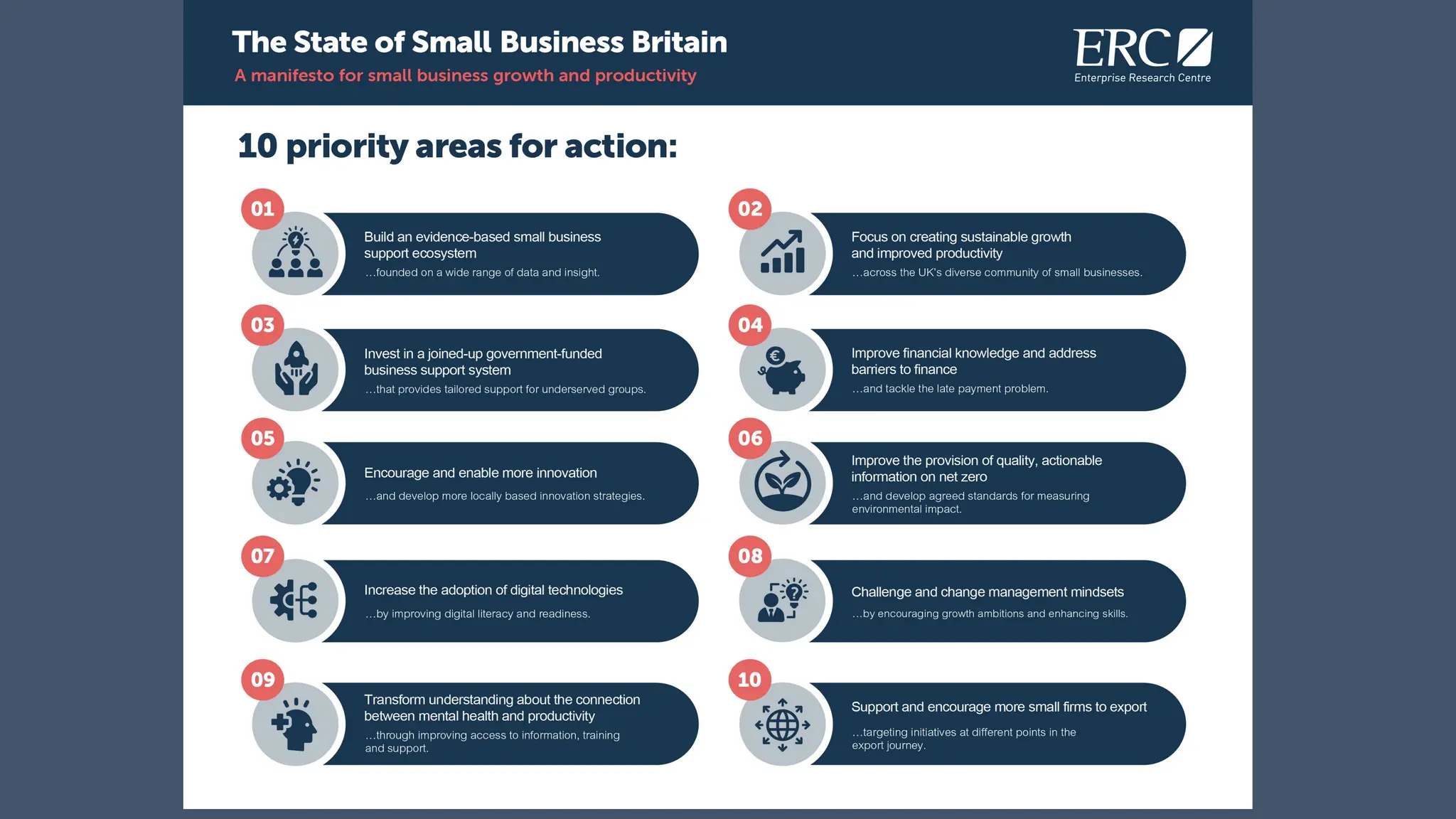
The State ofSmall Business Britain Report Series
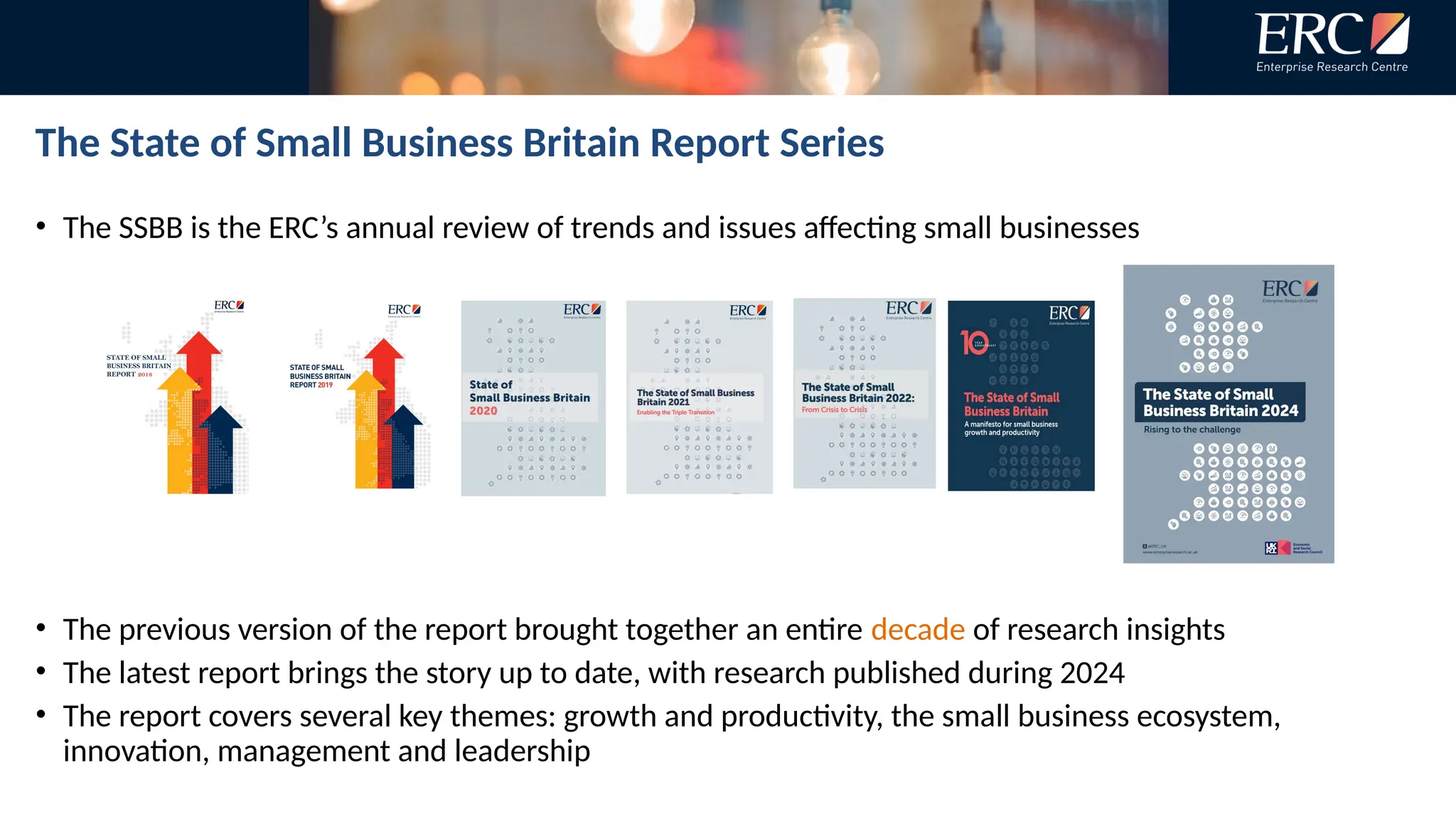
• The SSBB is the ERC’s annual review of trends and issues affecting small businesses
• The previous version of the report brought together an entire decade of research insights
• The latest report brings the story up to date, with research published during 2024
• The report covers several key themes: growth and productivity, the small business ecosystem,
innovation, management and leadership
3.
What’s the context?
•SMEs are often seen as the backbone of the economy: there were 5.5 million businesses in the UK in
2024
• 99.8 per cent of these were classified as SMEs
• 99.2 per cent were small firms (0 to 49 employees)
• The UK has traditionally had a strong entrepreneurial culture, with comparatively good start-up rates
• But, ERC analysis has shown that many start-ups do not survive over the longer term, and that only a
small proportion of firms reach significant business growth milestones
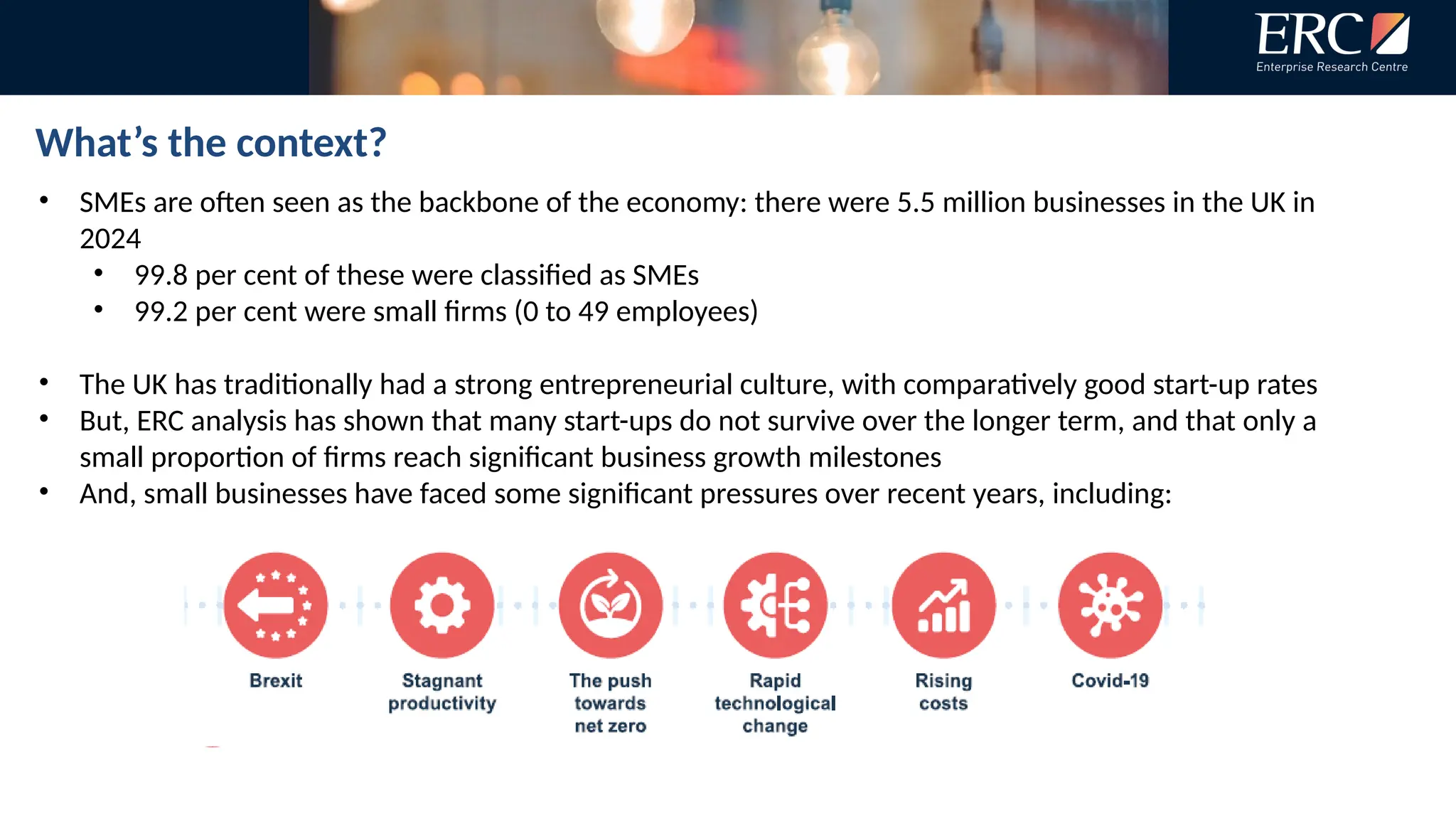
• And, small businesses have faced some significant pressures over recent years, including:
4.
What promotes sustainedgrowth in small businesses?
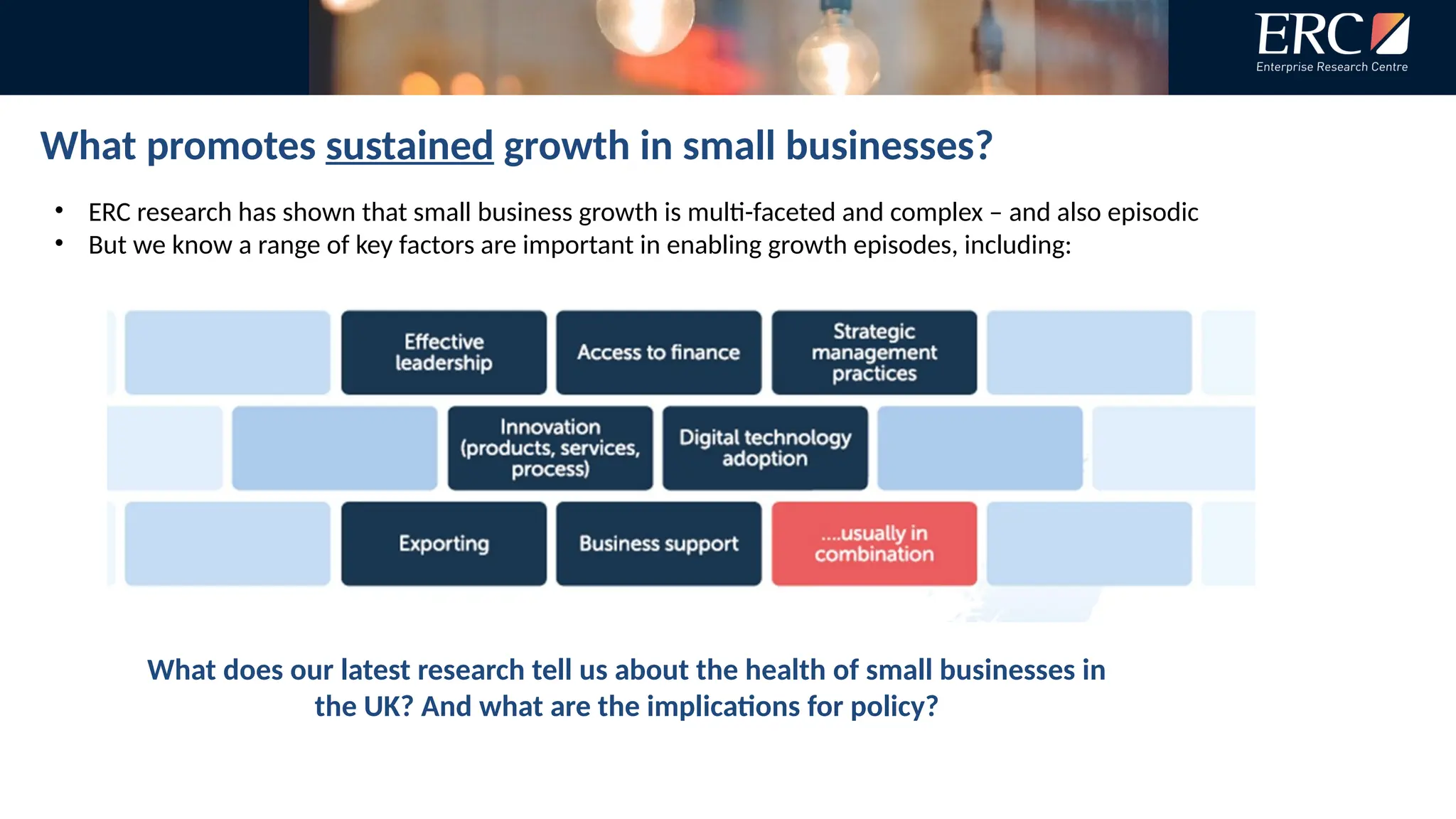
• ERC research has shown that small business growth is multi-faceted and complex – and also episodic
• But we know a range of key factors are important in enabling growth episodes, including:
What does our latest research tell us about the health of small businesses in
the UK? And what are the implications for policy?
5.
Business context
The pastfew years have
been extremely
challenging ones for
SMEs, and 2024 saw this
continue, with economic
uncertainty continuing to
impact firm behaviour
• Global Entrepreneurship Survey findings show the UK is significantly more
entrepreneurial now than 25 years ago:
• 30% of working-age individuals intend to start a business within the
next 3 years/ were trying to start/already running a business
• The pandemic prompted a rise in early-stage entrepreneurial activity
• But a substantial proportion of this is ‘necessity’ entrepreneurship
• Business Insights and Conditions Survey data shows marked changes in
business concerns in 2024:
• Falling demand for goods and services, increased competition and
taxation were all higher up the agenda
• Inflation, energy prices and interest rates became less important
concerns
• Focusing specifically on business turnover, SMEs most concerned
about the cost of labour and materials, wider economic uncertainty,
and increased competition
6.
SME growth
A lackof sustained
growth amongst SMEs
in the UK remains a key
problem for
policymakers
• Business growth has become more rare over time
• There are 400,000 more established SMEs (3 years +) since 2010, but
the proportion registering ANY employment growth fell from 20% to
13%
• Most small businesses do not survive, never mind grow
• Of the 325,811 start-ups registered in 2020, only 47% survived to 2023.
The 10-year survival rates for start-ups is 10%
• Only a small proportion of firms scale up
• Only 2% (3,049) of the surviving start-ups registered in 2020 managed
to achieve £1m turnover after three years
• A very small number of firms take a ‘step up’
• Only 7% of firms reaching over £1m turnover had over £3m by 2023
• Most firms struggle to significantly increase turnover, jobs and productivity
simultaneously
• Just under 10% of all firms that had increased their productivity did this
between 2020-23
• A range of factors affect business investment decisions
• Financial health, human capital, management practices and attitudes
7.
The SME
ecosystem
The UKhas some clear
and persistent
weaknesses in its
ecosystem that urgently
need to be addressed
• The UK has seen its overall entrepreneurial environment slip from being
rated a ‘sufficient’ to ‘less than sufficient’ (GEM Survey)
• The ratings for entrepreneurial finance (finance provision and ease of
access to finance) have fallen over the last three years
• Seeking external finance is positively associated with faster growth and
productivity in small firms, but most are permanent ‘non-borrowers’
• There has been a shift in the willingness of small firms to seek finance.
Reasons include inadequate information, fear of rejection, lack of focus on
growth
• Research on equity finance amongst UK early-stage ventures published in
2024 shows that the journey to accessing equity finance is often long and
difficult
• 1/3 of the firms surveyed had sought equity finance in 2022-23, but
only half of these were receiving any finance
• The average amount of their finance was only 2/5 of what they’d
applied for
• Firms had typically made multiple (five or more) applications
8.
The SME ecosystem
(continued)
•There has also been a weakening in other areas of the ecosystem, including
business support and physical infrastructure
• The UK’s current business support system is fragmented and unstable
• Nevertheless, business support plays an important role in business survival
and growth, and is important for diffusing good practice
• Uptake of support varies by range of factors, and there is a recognised lack of
tailored support for disadvantaged/under-represented groups
• Many firms first seek advice when they are already at the point of crisis – and
that’s too late
• The Longitudinal Small Business Survey panel report shows that there has
been an increase in the proportion of SMEs using business support in recent
years - 24% in 2020 to 27% in 2023
• New LSBS analysis also shows the positive impact of business support on
productivity. Firms that used external advice saw an average increase in their
labour productivity by 22%
9.
Innovation
Recent years haveseen a
worrying decline in
innovation, particularly
amongst smaller
businesses
• Innovation is closely linked to business survival, growth and productivity
• The UK Innovation Survey (UKIS) shows a sharp decrease in innovation in
recent years
• 36% of firms were innovating in 2020-2022 compared to 45% in
2018-2020
• Large businesses are much more likely to be innovation active than
smaller ones
• In 2020-2022, the UKIS found that 50% of large businesses were
innovation active, compared to just 36% of SMEs
• The ERC’s 2024 Innovation State of the Nation Survey (ISNS) also found
evidence of declining innovation
• 56% of businesses reported making product or service changes over
the last year, falling from 61 per cent in 2023
• The after-effects of the pandemic and the cost of doing business crisis
were the most commonly cited barriers to innovation
10.
Innovation
(continued)
• Digital adoptionis linked to performance benefits in SMEs
• ERC research shows that digitalised SMEs were also better equipped to deal
with pandemic challenges
• ERC research shows that the level of ‘digital readiness’ is key to adoption
• New analysis of the LSBS reveals disparities in the adoption of specific digital
technologies amongst SMEs
• Artificial Intelligence (AI), robotics, automation, and VR/AR technologies are
less frequently adopted than others like accountancy software
• There are also differences in technology adoption by gender and location
• Other new research highlights the tensions small business leaders face when
adopting net zero practices (e.g., between sustainability and business goals)
• These can lead to firms becoming stuck in a ‘cycle of inaction’
• Only a minority of small firms are currently receiving support with net zero
adoption
11.
Management
and leadership
There isroom for
improvement in the
adoption of
management practices
and strategic
approaches to mental
health and wellbeing
• ERC research shows the link between business growth and management and
leadership
• High growth firms are more likely to use bundles of High Performance Working
Practices and these practices are strongly associated with higher levels of
innovation activity
• Our longitudinal research on workplace mental health shows this is presenting
significant issues for businesses. There has been a growth in long-term mental
health related sickness absence and presenteeism
• There is an ‘attitude to action’ gap in workplace mental health
• 20% more firms say they believe that they should address mental health than
are actually taking action
• Smaller firms are less likely to take action
• Changing working practices (e.g. remote working) have brought new challenges
for businesses
• 72% of businesses believe that employees working from home are happier,
but 53% cent said that it made teamworking more difficult
14.
THANK YOU!
For furtherinformation about
the ERC please visit us at:
www.enterpriseresearch.ac.uk