Opening Remarks
• Highlight 4 key areas of current research:
– Trade
– Climate change and digital technologies
– Rural SMEs and environmental action
– Workplace mental health
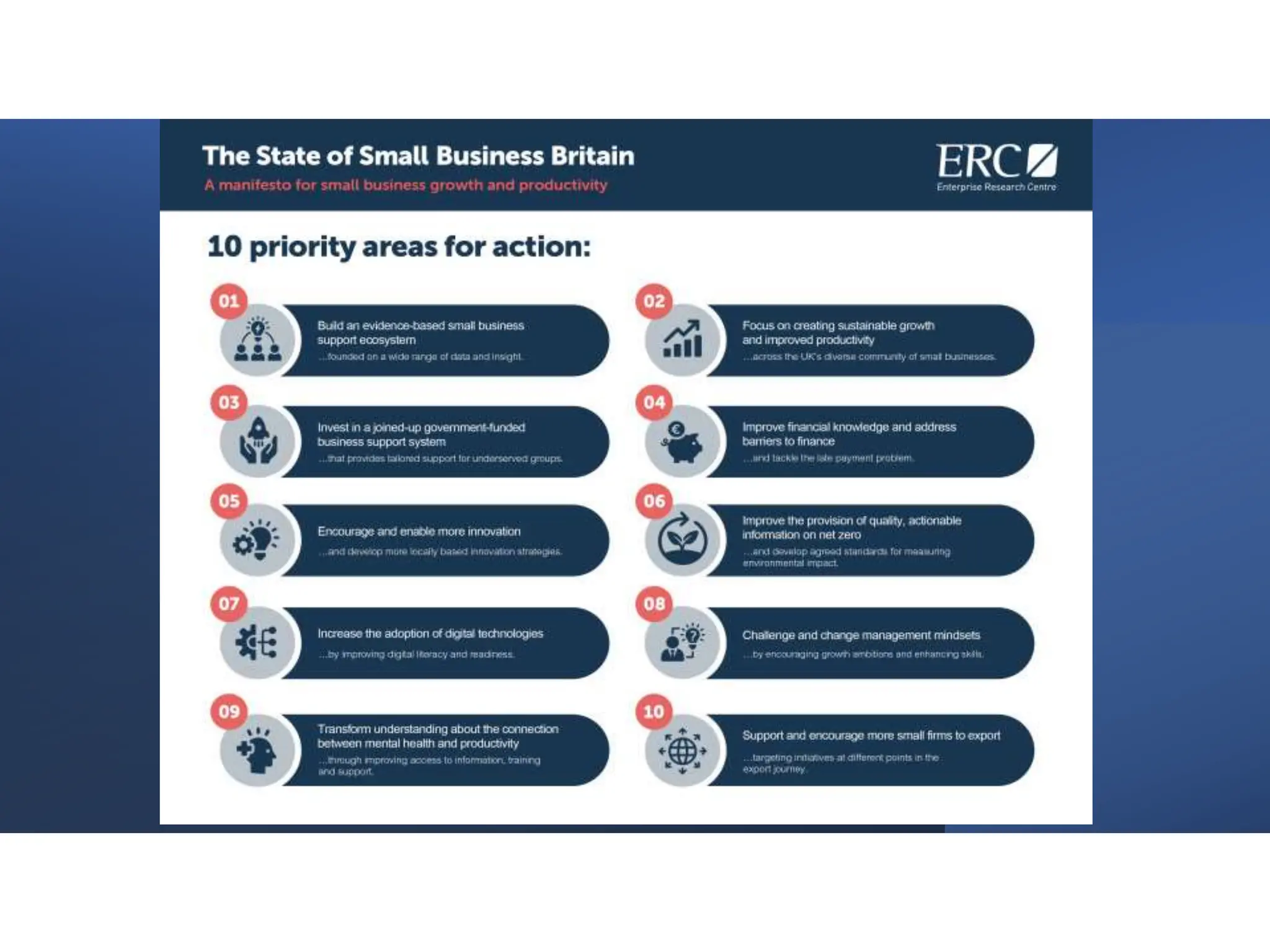
• ERC Manifesto for small business growth and productivity
• ERC Plans for 2024 and beyond
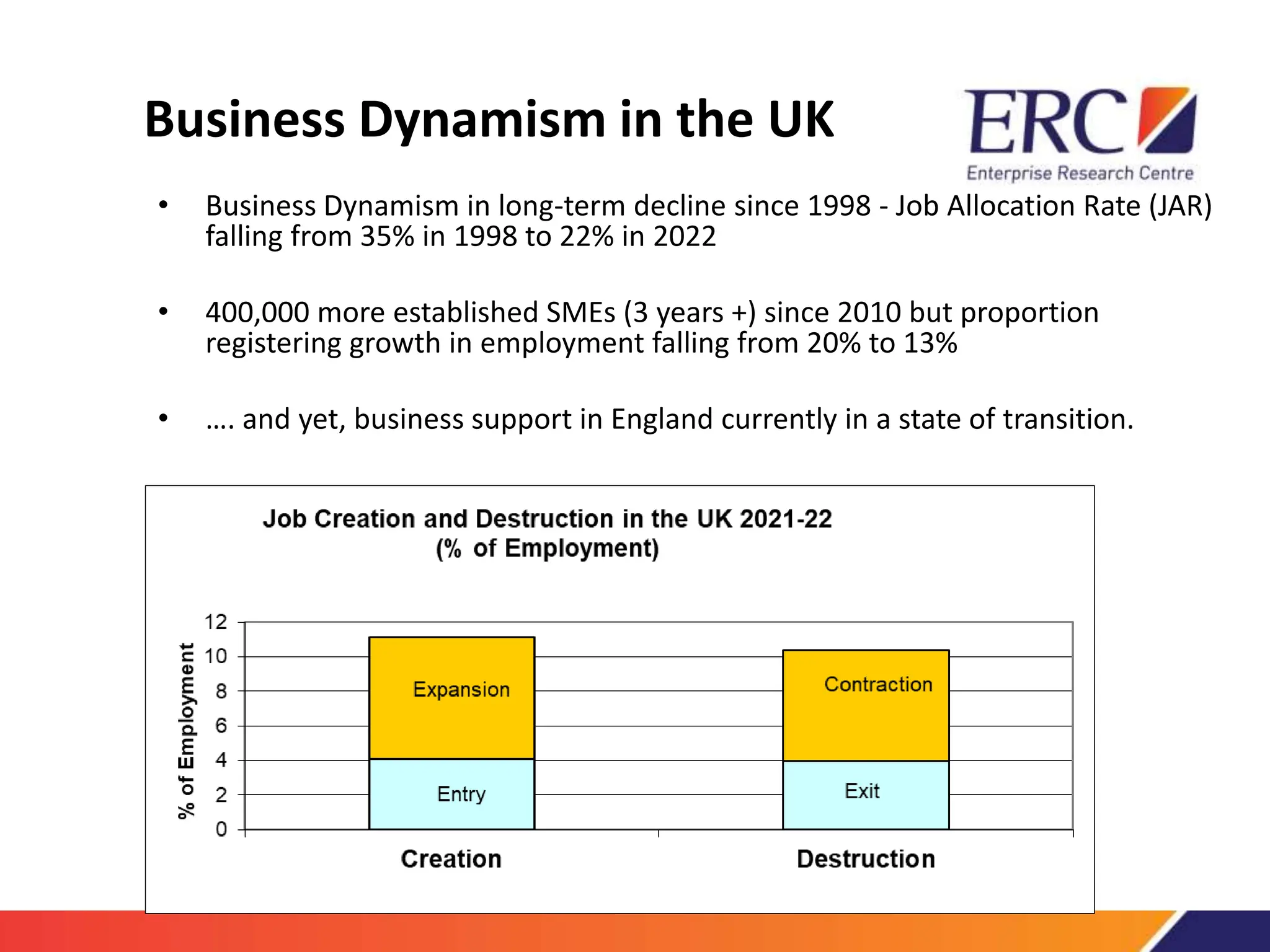
Business Dynamism in the UK
• Business Dynamism in long-term decline since 1998 - Job Allocation Rate (JAR)
falling from 35% in 1998 to 22% in 2022
• 400,000 more established SMEs (3 years +) since 2010 but proportion
registering growth in employment falling from 20% to 13%
• …. and yet, business support in England currently in a state of transition.
Jobs, Turnover and Productivity
• Developing a new focus for small business policy in the UK
• Previous research by the ERC showed that there was a very poor
correlation between jobs growth, increases in revenues and
productivity gains in the UK business population.
• Panel study of 250k employer enterprises (2008-15) - only 5% of
the firms studied managed to significantly increase turnover, jobs
and productivity at the same time – some 10,000 firms!
• The relationship between the growth of turnover and productivity
was strong and positive, with 3 out of 4 firms that grew turnover
also raising productivity.
Productivity Heroes
• We set out to investigate those firms that are registering productivity gains
(i.e., turnover per employee) and are doing so while still creating jobs.
• These small businesses we call ‘Productivity Heroes’ are defined as SMEs
aged 3 years and over that are growing both their revenues and
headcount but their revenues at a faster rate.
• The base population used to identify the number of Productivity Heroes is
all surviving private sector SME employer enterprises (1-249 emps) in the
UK in 2021-22 which are at least 3 years of age - i.e., not start-ups – 1.22m
enterprises.
Productivity Heroes - Trends
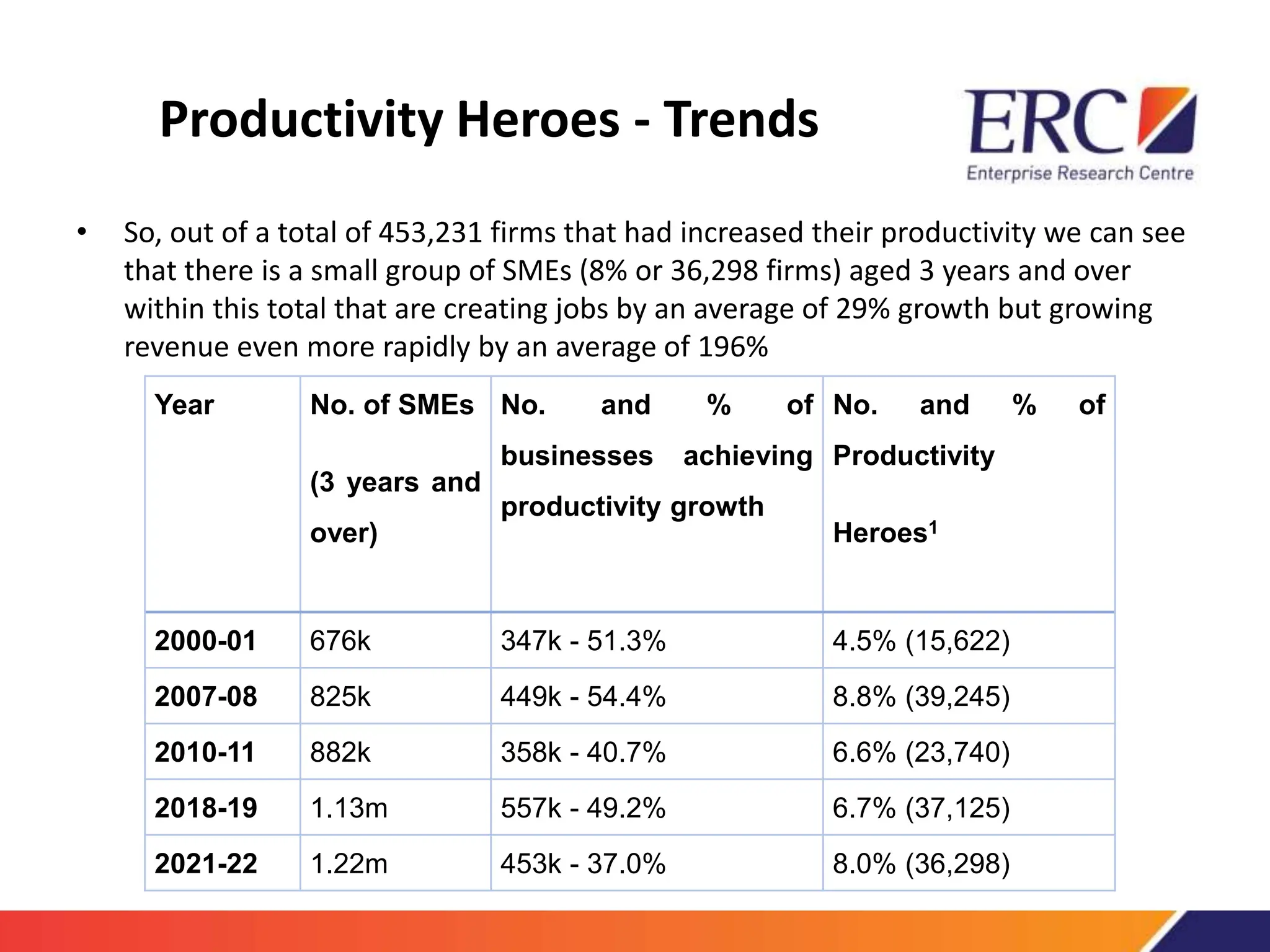
• So, out of a total of 453,231 firms that had increased their productivity we can see
that there is a small group of SMEs (8% or 36,298 firms) aged 3 years and over
within this total that are creating jobs by an average of 29% growth but growing
revenue even more rapidly by an average of 196%
Year No. of SMEs
(3 years and
over)
No. and % of
businesses achieving
productivity growth
No. and % of
Productivity
Heroes1
2000-01 676k 347k - 51.3% 4.5% (15,622)
2007-08 825k 449k - 54.4% 8.8% (39,245)
2010-11 882k 358k - 40.7% 6.6% (23,740)
2018-19 1.13m 557k - 49.2% 6.7% (37,125)
2021-22 1.22m 453k - 37.0% 8.0% (36,298)
Productivity Heroes – what next?
• Enterprise policy should place a central focus on this newly identified
small group of firms to provide some evidence on how to address the UK’s
long-standing productivity problem and with it the long tail of
unproductive mainly small firms.
• Next stage is to track their performance over time to investigate the
persistence of their productivity gains over time and indeed, looking back,
identify in what year the 2021-22 cohort of Productivity Heroes first met
the criteria.
• Engage in qualitative research to understand the drivers of these
productivity gains – especially leaders’ mindset and ambition
• Read more – Hart and Bonner (2024) “Productivity Puzzles, Long Tails and
Productivity Heroes: developing a new focus for small business policy in the
UK”, ERC Insight Paper, February 2024.
ERC Research Showcase Introduction Mark Hart

ERC Research Showcase Introduction Mark Hart

  • 1.
    Opening Remarks • Highlight4 key areas of current research: – Trade – Climate change and digital technologies – Rural SMEs and environmental action – Workplace mental health • ERC Manifesto for small business growth and productivity • ERC Plans for 2024 and beyond
  • 2.
    Business Dynamism inthe UK • Business Dynamism in long-term decline since 1998 - Job Allocation Rate (JAR) falling from 35% in 1998 to 22% in 2022 • 400,000 more established SMEs (3 years +) since 2010 but proportion registering growth in employment falling from 20% to 13% • …. and yet, business support in England currently in a state of transition.
  • 3.
    Jobs, Turnover andProductivity • Developing a new focus for small business policy in the UK • Previous research by the ERC showed that there was a very poor correlation between jobs growth, increases in revenues and productivity gains in the UK business population. • Panel study of 250k employer enterprises (2008-15) - only 5% of the firms studied managed to significantly increase turnover, jobs and productivity at the same time – some 10,000 firms! • The relationship between the growth of turnover and productivity was strong and positive, with 3 out of 4 firms that grew turnover also raising productivity.
  • 4.
    Productivity Heroes • Weset out to investigate those firms that are registering productivity gains (i.e., turnover per employee) and are doing so while still creating jobs. • These small businesses we call ‘Productivity Heroes’ are defined as SMEs aged 3 years and over that are growing both their revenues and headcount but their revenues at a faster rate. • The base population used to identify the number of Productivity Heroes is all surviving private sector SME employer enterprises (1-249 emps) in the UK in 2021-22 which are at least 3 years of age - i.e., not start-ups – 1.22m enterprises.
  • 5.
    Productivity Heroes -Trends • So, out of a total of 453,231 firms that had increased their productivity we can see that there is a small group of SMEs (8% or 36,298 firms) aged 3 years and over within this total that are creating jobs by an average of 29% growth but growing revenue even more rapidly by an average of 196% Year No. of SMEs (3 years and over) No. and % of businesses achieving productivity growth No. and % of Productivity Heroes1 2000-01 676k 347k - 51.3% 4.5% (15,622) 2007-08 825k 449k - 54.4% 8.8% (39,245) 2010-11 882k 358k - 40.7% 6.6% (23,740) 2018-19 1.13m 557k - 49.2% 6.7% (37,125) 2021-22 1.22m 453k - 37.0% 8.0% (36,298)
  • 6.
    Productivity Heroes –what next? • Enterprise policy should place a central focus on this newly identified small group of firms to provide some evidence on how to address the UK’s long-standing productivity problem and with it the long tail of unproductive mainly small firms. • Next stage is to track their performance over time to investigate the persistence of their productivity gains over time and indeed, looking back, identify in what year the 2021-22 cohort of Productivity Heroes first met the criteria. • Engage in qualitative research to understand the drivers of these productivity gains – especially leaders’ mindset and ambition • Read more – Hart and Bonner (2024) “Productivity Puzzles, Long Tails and Productivity Heroes: developing a new focus for small business policy in the UK”, ERC Insight Paper, February 2024.