Motivation TheoryMotivation Theory
ObjectiveObjective
ActionsActions::
Standards:
Discuss Motivation As It Relates
To Human Behavior
Conditions: Given Classroom Discussion
and Practical Exercise
Students Will Be Able To
Discuss:
- Types of Motivation Theory
- Maslow’s Hierarchy Of Needs
Model
OverviewOverview
 Define MotivationDefine Motivation
 Discuss The Motivation TheoryDiscuss The Motivation Theory
 Discuss Maslow’s Hierarchy OfDiscuss Maslow’s Hierarchy Of
Needs ModelNeeds Model
 Discuss McClelland’s Needs ModelDiscuss McClelland’s Needs Model
DefinitionDefinition
 Webster – An Act Or Process OfWebster – An Act Or Process Of
Motivating, The Condition Of TheMotivating, The Condition Of The
One Motivated, A Force, Stimulus,One Motivated, A Force, Stimulus,
Or Influence: Incentive Or Drive.Or Influence: Incentive Or Drive.
 Herbert Petri – The Concept UsedHerbert Petri – The Concept Used
To Describe The Forces Acting OnTo Describe The Forces Acting On
Or Within An Organism To InitiateOr Within An Organism To Initiate
And Direct Behavior.And Direct Behavior.
 Abraham Maslow – That Which IsAbraham Maslow – That Which Is
Derived From The Needs Of TheDerived From The Needs Of The
Person.Person.
Motivation TheoryMotivation Theory
 Accounts For Behavior By MakingAccounts For Behavior By Making
Logical Conclusions And AssumptionsLogical Conclusions And Assumptions
 Seeks To Explain How These AreSeeks To Explain How These Are
Affected By The Work PeopleAffected By The Work People
Accomplish And The Situation In WhichAccomplish And The Situation In Which
They Do ItThey Do It
 TypesTypes
 Content TheoryContent Theory
 Process TheoryProcess Theory
Content TheoryContent Theory
 Asks What Motivates PeopleAsks What Motivates People
 Explains Motivation In Terms OfExplains Motivation In Terms Of
NeedsNeeds
 Specify A Variety Of NeedsSpecify A Variety Of Needs
 In Some Cases Dynamic Shifts OfIn Some Cases Dynamic Shifts Of
NeedsNeeds
Content TheoryContent Theory
 Often Referred To As “NeedsOften Referred To As “Needs
Theories”Theories”
 Underlie The Strength And CharacterUnderlie The Strength And Character
Of Our Desires Or WantsOf Our Desires Or Wants
 Two TypesTwo Types
 Malsow’s Heirarchy Of NeedsMalsow’s Heirarchy Of Needs
Process TheoryProcess Theory
 Asks How Motivation OccursAsks How Motivation Occurs
 How And Why We Choose A ParticularHow And Why We Choose A Particular
Behavior To Meet NeedsBehavior To Meet Needs
 Expectancy TheoryExpectancy Theory
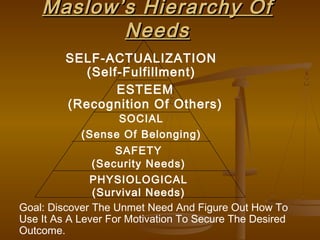
Maslow’s Hierarchy OfMaslow’s Hierarchy Of
NeedsNeeds
PHYSIOLOGICAL
(Survival Needs)
SAFETY
(Security Needs)
SOCIAL
(Sense Of Belonging)
ESTEEM
(Recognition Of Others)
SELF-ACTUALIZATION
(Self-Fulfillment)
Goal: Discover The Unmet Need And Figure Out How To
Use It As A Lever For Motivation To Secure The Desired
Outcome.
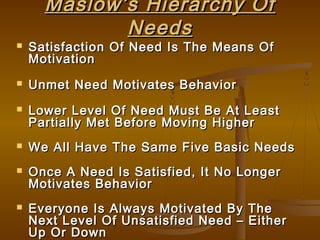
Maslow’s Hierarchy OfMaslow’s Hierarchy Of
NeedsNeeds
 Satisfaction Of Need Is The Means OfSatisfaction Of Need Is The Means Of
MotivationMotivation
 Unmet Need Motivates BehaviorUnmet Need Motivates Behavior
 Lower Level Of Need Must Be At LeastLower Level Of Need Must Be At Least
Partially Met Before Moving HigherPartially Met Before Moving Higher
 We All Have The Same Five Basic NeedsWe All Have The Same Five Basic Needs
 Once A Need Is Satisfied, It No LongerOnce A Need Is Satisfied, It No Longer
Motivates BehaviorMotivates Behavior
 Everyone Is Always Motivated By TheEveryone Is Always Motivated By The
Next Level Of Unsatisfied Need – EitherNext Level Of Unsatisfied Need – Either
Up Or DownUp Or Down
InfluencesInfluences
 Our Behavior Is Affected By OurOur Behavior Is Affected By Our
NeedsNeeds
 People Do Different Things For ThePeople Do Different Things For The
Same ReasonSame Reason
 People Do The Same Thing ForPeople Do The Same Thing For
Different ReasonsDifferent Reasons
 Most Actions Have More Than OneMost Actions Have More Than One
LimitationsLimitations
 Linear Approach Is Limited
 Varies In The Cross-CulturalVaries In The Cross-Cultural
Settings Of Collectivism AndSettings Of Collectivism And
IndividualismIndividualism
 Collectivism – Priority To In-Collectivism – Priority To In-
Group GoalsGroup Goals
 Individualism – Priority ToIndividualism – Priority To
Personal GoalsPersonal Goals
McClelland’s NeedsMcClelland’s Needs
ModelModel
 People Are Motivated By ThreePeople Are Motivated By Three
Basic NeedsBasic Needs
 AchievementAchievement
 AffiliationAffiliation
 PowerPower
 People Possess These Needs InPeople Possess These Needs In
Varying DegreesVarying Degrees
AchievementAchievement
““Finishers”Finishers”
 Enjoy ChallengeEnjoy Challenge
 Want Ensured SuccessWant Ensured Success
 Conservative GoalsConservative Goals
 Plan AheadPlan Ahead
 Personal ResponsibilityPersonal Responsibility
 Need Hard Data ReinforcementNeed Hard Data Reinforcement
AffiliationAffiliation
““Lovers”Lovers”
 Establish/Maintain RelationshipsEstablish/Maintain Relationships
 Approval Needs May Affect TheApproval Needs May Affect The
Decision Making/ImplementationDecision Making/Implementation
 Strive To Maintain HarmonyStrive To Maintain Harmony
PowerPower
““WinnersWinners
”” Usually Quite FluentUsually Quite Fluent
 Enjoy ConflictEnjoy Conflict
 Strong-Speaking SkillsStrong-Speaking Skills
 Autocratic Decision MakingAutocratic Decision Making
 Situations Are Win/LoseSituations Are Win/Lose
 Can Make People A Means ToCan Make People A Means To
An End; Relationships LostAn End; Relationships Lost
SummarySummary
 Defined MotivationDefined Motivation
 Discussed The Motivation TheoryDiscussed The Motivation Theory
 Discussed Maslow’s Hierarchy OfDiscussed Maslow’s Hierarchy Of
Needs ModelNeeds Model
 Discussed McClelland’s NeedsDiscussed McClelland’s Needs
ModelModel
QuestionsQuestions

Motivation theory

  • 1.
  • 2.
    ObjectiveObjective ActionsActions:: Standards: Discuss Motivation AsIt Relates To Human Behavior Conditions: Given Classroom Discussion and Practical Exercise Students Will Be Able To Discuss: - Types of Motivation Theory - Maslow’s Hierarchy Of Needs Model
  • 3.
    OverviewOverview  Define MotivationDefineMotivation  Discuss The Motivation TheoryDiscuss The Motivation Theory  Discuss Maslow’s Hierarchy OfDiscuss Maslow’s Hierarchy Of Needs ModelNeeds Model  Discuss McClelland’s Needs ModelDiscuss McClelland’s Needs Model
  • 4.
    DefinitionDefinition  Webster –An Act Or Process OfWebster – An Act Or Process Of Motivating, The Condition Of TheMotivating, The Condition Of The One Motivated, A Force, Stimulus,One Motivated, A Force, Stimulus, Or Influence: Incentive Or Drive.Or Influence: Incentive Or Drive.  Herbert Petri – The Concept UsedHerbert Petri – The Concept Used To Describe The Forces Acting OnTo Describe The Forces Acting On Or Within An Organism To InitiateOr Within An Organism To Initiate And Direct Behavior.And Direct Behavior.  Abraham Maslow – That Which IsAbraham Maslow – That Which Is Derived From The Needs Of TheDerived From The Needs Of The Person.Person.
  • 5.
    Motivation TheoryMotivation Theory Accounts For Behavior By MakingAccounts For Behavior By Making Logical Conclusions And AssumptionsLogical Conclusions And Assumptions  Seeks To Explain How These AreSeeks To Explain How These Are Affected By The Work PeopleAffected By The Work People Accomplish And The Situation In WhichAccomplish And The Situation In Which They Do ItThey Do It  TypesTypes  Content TheoryContent Theory  Process TheoryProcess Theory
  • 6.
    Content TheoryContent Theory Asks What Motivates PeopleAsks What Motivates People  Explains Motivation In Terms OfExplains Motivation In Terms Of NeedsNeeds  Specify A Variety Of NeedsSpecify A Variety Of Needs  In Some Cases Dynamic Shifts OfIn Some Cases Dynamic Shifts Of NeedsNeeds
  • 7.
    Content TheoryContent Theory Often Referred To As “NeedsOften Referred To As “Needs Theories”Theories”  Underlie The Strength And CharacterUnderlie The Strength And Character Of Our Desires Or WantsOf Our Desires Or Wants  Two TypesTwo Types  Malsow’s Heirarchy Of NeedsMalsow’s Heirarchy Of Needs
  • 8.
    Process TheoryProcess Theory Asks How Motivation OccursAsks How Motivation Occurs  How And Why We Choose A ParticularHow And Why We Choose A Particular Behavior To Meet NeedsBehavior To Meet Needs  Expectancy TheoryExpectancy Theory
  • 9.
    Maslow’s Hierarchy OfMaslow’sHierarchy Of NeedsNeeds PHYSIOLOGICAL (Survival Needs) SAFETY (Security Needs) SOCIAL (Sense Of Belonging) ESTEEM (Recognition Of Others) SELF-ACTUALIZATION (Self-Fulfillment) Goal: Discover The Unmet Need And Figure Out How To Use It As A Lever For Motivation To Secure The Desired Outcome.
  • 10.
    Maslow’s Hierarchy OfMaslow’sHierarchy Of NeedsNeeds  Satisfaction Of Need Is The Means OfSatisfaction Of Need Is The Means Of MotivationMotivation  Unmet Need Motivates BehaviorUnmet Need Motivates Behavior  Lower Level Of Need Must Be At LeastLower Level Of Need Must Be At Least Partially Met Before Moving HigherPartially Met Before Moving Higher  We All Have The Same Five Basic NeedsWe All Have The Same Five Basic Needs  Once A Need Is Satisfied, It No LongerOnce A Need Is Satisfied, It No Longer Motivates BehaviorMotivates Behavior  Everyone Is Always Motivated By TheEveryone Is Always Motivated By The Next Level Of Unsatisfied Need – EitherNext Level Of Unsatisfied Need – Either Up Or DownUp Or Down
  • 11.
    InfluencesInfluences  Our BehaviorIs Affected By OurOur Behavior Is Affected By Our NeedsNeeds  People Do Different Things For ThePeople Do Different Things For The Same ReasonSame Reason  People Do The Same Thing ForPeople Do The Same Thing For Different ReasonsDifferent Reasons  Most Actions Have More Than OneMost Actions Have More Than One
  • 12.
    LimitationsLimitations  Linear ApproachIs Limited  Varies In The Cross-CulturalVaries In The Cross-Cultural Settings Of Collectivism AndSettings Of Collectivism And IndividualismIndividualism  Collectivism – Priority To In-Collectivism – Priority To In- Group GoalsGroup Goals  Individualism – Priority ToIndividualism – Priority To Personal GoalsPersonal Goals
  • 13.
    McClelland’s NeedsMcClelland’s Needs ModelModel People Are Motivated By ThreePeople Are Motivated By Three Basic NeedsBasic Needs  AchievementAchievement  AffiliationAffiliation  PowerPower  People Possess These Needs InPeople Possess These Needs In Varying DegreesVarying Degrees
  • 14.
    AchievementAchievement ““Finishers”Finishers”  Enjoy ChallengeEnjoyChallenge  Want Ensured SuccessWant Ensured Success  Conservative GoalsConservative Goals  Plan AheadPlan Ahead  Personal ResponsibilityPersonal Responsibility  Need Hard Data ReinforcementNeed Hard Data Reinforcement
  • 15.
    AffiliationAffiliation ““Lovers”Lovers”  Establish/Maintain RelationshipsEstablish/MaintainRelationships  Approval Needs May Affect TheApproval Needs May Affect The Decision Making/ImplementationDecision Making/Implementation  Strive To Maintain HarmonyStrive To Maintain Harmony
  • 16.
    PowerPower ““WinnersWinners ”” Usually QuiteFluentUsually Quite Fluent  Enjoy ConflictEnjoy Conflict  Strong-Speaking SkillsStrong-Speaking Skills  Autocratic Decision MakingAutocratic Decision Making  Situations Are Win/LoseSituations Are Win/Lose  Can Make People A Means ToCan Make People A Means To An End; Relationships LostAn End; Relationships Lost
  • 17.
    SummarySummary  Defined MotivationDefinedMotivation  Discussed The Motivation TheoryDiscussed The Motivation Theory  Discussed Maslow’s Hierarchy OfDiscussed Maslow’s Hierarchy Of Needs ModelNeeds Model  Discussed McClelland’s NeedsDiscussed McClelland’s Needs ModelModel
  • 18.