MOTIVATION AND GLOBAL
VALUES
By: Eyad Alghanem
MOTIVATION
refers to the processes that lead people to
behave as they do. It occurs
when a need is aroused that the consumer
wishes to satisfy.
MOTIVATIONAL STRENGTH
The degree to which a person will expend energy to
reach one goal as opposed to another
reflects his or her motivation to attain that goal.
NEEDS VERSUS WANTS:
Need: is state of felt deprivation of some basic
satisfaction
wants: are desires for a specific satisfier of these
deeper needs
WHAT DO WE NEED?
1-Biogenic Needs
Needs
2-Psychogenic
3-Utilitarian Needs
4-Hedonic Needs
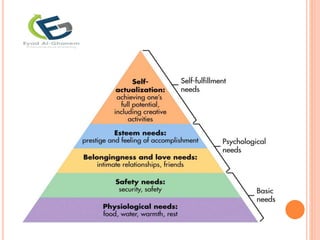
Maslow's hierarchy of needs is a theory in
psychology proposed by Abraham Maslow in his 1943
paper "A Theory of Human Motivation" in
Psychological Review. Maslow subsequently
extended the idea to include his observations of
humans' innate curiosity.
NEEDS THAT ARE RELEVANT TO CONSUMER
BEHAVIOR INCLUDE:
Need for affiliation:
is relevant to products and services for people in
groups, such as participating in team
sports, and hanging out at shopping malls.
Need for power:
(to control one's environment) Many products and
services allow
us to feel that we have mastery over our
surroundings
:
Need for uniqueness
(to assert one's individual identity). Products satisfy
the
need for uniqueness when they pledge to bring out
our distinctive qualities.
MOTIVATION AND EMOTION
Motivation and emotion are two central concepts in
psychology. Motivation is a process that affects the
direction, persistence and strength of goal-oriented
behavior.
Emotions are feelings or affective experiences that
are shaped by a pattern of cognitive, physiological
and behavioral responses to specific stimuli
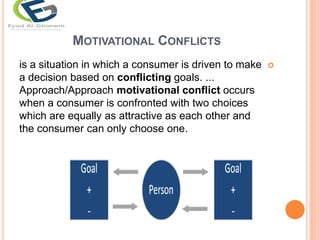
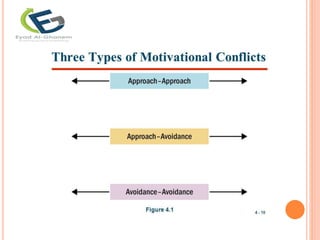
MOTIVATIONAL CONFLICTS

is a situation in which a consumer is driven to make
a decision based on conflicting goals. ...
Approach/Approach motivational conflict occurs
when a consumer is confronted with two choices
which are equally as attractive as each other and
the consumer can only choose one.
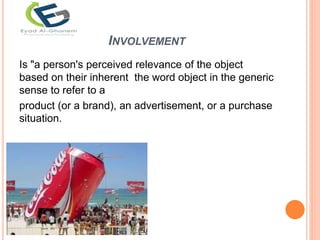
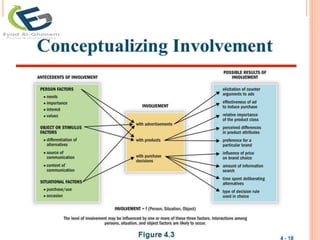
INVOLVEMENT
Is "a person's perceived relevance of the object
based on their inherent the word object in the generic
sense to refer to a
product (or a brand), an advertisement, or a purchase
situation.
+
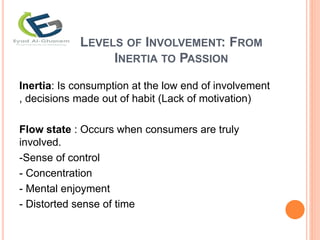
LEVELS OF INVOLVEMENT: FROM
INERTIA TO PASSION
Inertia: Is consumption at the low end of involvement
, decisions made out of habit (Lack of motivation)
Flow state : Occurs when consumers are truly
involved.
-Sense of control
- Concentration
- Mental enjoyment
- Distorted sense of time
Cult product: Command fierce consumer loyalty and
perhaps worship by consumers who are highly
involved in the product.
The Many Faces of involvement:
Product involvement : Related to a consumers level
of interest in a particular product
Message-Response involvement : Refers to a
consumers interest in processing marketing
communications
Purchase situation involvement: Refers to the
differences that may occur when buying the same
product for different contexts
VALUE
is a belief that some condition is preferable to its
opposite
Values shared within a culture
Core Values:
Enculturation : Learning the beliefs and values
of ones own culture
Acculturation: Learning the value system and
behaviors of another culture
HOFSTEDE’S CULTURAL DIMENSIONS
Power distance
Individualism vs . Collectivism
Masculinity vs . Femininity
Uncertainty avoidance
Long – term orientation
TERMINAL AND INSTRUMENTAL VALUES
Terminal values:
A comfortable life
A sense of accomplishment
Wisdom
Instrumental value:
Ambitious
Capable
Self-controlled
means-end chain model: approach assumes
that people link very specific product
attributes (indirectly )

Motivation and global values

  • 1.
  • 3.
    MOTIVATION refers to theprocesses that lead people to behave as they do. It occurs when a need is aroused that the consumer wishes to satisfy.
  • 4.
    MOTIVATIONAL STRENGTH The degreeto which a person will expend energy to reach one goal as opposed to another reflects his or her motivation to attain that goal.
  • 6.
    NEEDS VERSUS WANTS: Need:is state of felt deprivation of some basic satisfaction wants: are desires for a specific satisfier of these deeper needs
  • 7.
    WHAT DO WENEED? 1-Biogenic Needs Needs 2-Psychogenic 3-Utilitarian Needs 4-Hedonic Needs
  • 8.
    Maslow's hierarchy ofneeds is a theory in psychology proposed by Abraham Maslow in his 1943 paper "A Theory of Human Motivation" in Psychological Review. Maslow subsequently extended the idea to include his observations of humans' innate curiosity.
  • 10.
    NEEDS THAT ARERELEVANT TO CONSUMER BEHAVIOR INCLUDE: Need for affiliation: is relevant to products and services for people in groups, such as participating in team sports, and hanging out at shopping malls. Need for power: (to control one's environment) Many products and services allow us to feel that we have mastery over our surroundings
  • 11.
    : Need for uniqueness (toassert one's individual identity). Products satisfy the need for uniqueness when they pledge to bring out our distinctive qualities.
  • 12.
    MOTIVATION AND EMOTION Motivationand emotion are two central concepts in psychology. Motivation is a process that affects the direction, persistence and strength of goal-oriented behavior. Emotions are feelings or affective experiences that are shaped by a pattern of cognitive, physiological and behavioral responses to specific stimuli
  • 13.
    MOTIVATIONAL CONFLICTS  is asituation in which a consumer is driven to make a decision based on conflicting goals. ... Approach/Approach motivational conflict occurs when a consumer is confronted with two choices which are equally as attractive as each other and the consumer can only choose one.
  • 15.
    INVOLVEMENT Is "a person'sperceived relevance of the object based on their inherent the word object in the generic sense to refer to a product (or a brand), an advertisement, or a purchase situation.
  • 16.
  • 17.
    LEVELS OF INVOLVEMENT:FROM INERTIA TO PASSION Inertia: Is consumption at the low end of involvement , decisions made out of habit (Lack of motivation) Flow state : Occurs when consumers are truly involved. -Sense of control - Concentration - Mental enjoyment - Distorted sense of time
  • 18.
    Cult product: Commandfierce consumer loyalty and perhaps worship by consumers who are highly involved in the product. The Many Faces of involvement: Product involvement : Related to a consumers level of interest in a particular product Message-Response involvement : Refers to a consumers interest in processing marketing communications
  • 19.
    Purchase situation involvement:Refers to the differences that may occur when buying the same product for different contexts
  • 20.
    VALUE is a beliefthat some condition is preferable to its opposite Values shared within a culture Core Values: Enculturation : Learning the beliefs and values of ones own culture Acculturation: Learning the value system and behaviors of another culture
  • 21.
    HOFSTEDE’S CULTURAL DIMENSIONS Powerdistance Individualism vs . Collectivism Masculinity vs . Femininity Uncertainty avoidance Long – term orientation
  • 22.
    TERMINAL AND INSTRUMENTALVALUES Terminal values: A comfortable life A sense of accomplishment Wisdom Instrumental value: Ambitious Capable Self-controlled
  • 23.
    means-end chain model:approach assumes that people link very specific product attributes (indirectly )