Motivating and
Rewarding Employee
Performance
Justin Miguel C. Yturralde
MARS MODEL
2
Enjoy Life
Motivation, Abilities, Role Perception and Situational Factors.
MARS Model of
Individual Behavior
and Results
MARS model of individual behavior is a model that
seeks to elaborate individual behavior as a result of
internal and external factors or influences combined
• The name itself is an acronym for individual
Motivation, Abilities, Role Perception and
Situational Factors.
• These are marked as the four major factors in
determining individual behavior and results. The model
can be implemented to a variety of situations, but is
usually applied in Management, Industrial Psychology
or Organizational Behavior studies. This model
represents that these four factors have a mixed effect
on individual performance. If any factor weakens,
performance will decrease.
Enjoy Life 3
MOTIVATION
• Motivation can be described as internal forces that impact the direction,
intensity, and endurance of a person’s voluntary choice of behavior. It
consists of −
• Direction − focused by goals.
• Intensity − bulk of effort allocated.
• Persistence − amount of time taken for the effort to be exerted.
ENJOY LIFE 4
ABILITY
• Ability is the natural tendency and learned capabilities needed to
complete a task successfully. It has four different parts namely −
• Aptitudes − natural talent that helps people learn more efficiently and
perform effectively.
• Learned capabilities − accomplished skills and knowledge.
• Competencies − abilities, individual values, personality traits and other
features of people that result in superior performance.
• Person-job fit − there are three ways to match people with jobs
selecting qualified people
developing employee abilities through training
redesigning job to fit person's existing abilities
ENJOY LIFE 5
ROLE PERCEPTION
• They are the beliefs about what behavior is necessary to achieve
the desired results and have a check that everyone is clear
regarding their part. It is of four types −
• Understanding the tasks to be performed.
• Understanding associated importance of tasks allotted.
• Understanding preferred behaviors to complete respective tasks.
• Clarifying role perceptions
ENJOY LIFE 6
SITUATIONAL
FACTORS
• They are the environmental conditions like given time bound,
team members, budget, and work facilities that limits or
facilitates behavior. Factors that are beyond the individual’s
control in the short run.
• Some situational characteristics—such as consumer
preferences and economic conditions—originate from the
external environment and consequently are beyond the
employee’s and organization’s control. However, some
situational factors—such as time, people, budget, and physical
work facilities— are controlled by others in the organization.
ENJOY LIFE 7
Motivating Employees:A Three-part Model
8
Enjoy Life
MANAGING THROUGH DRIVES AND NEEDS
9
ADD A FOOTER
Managing through Drives and Needs
Ultimately motivation begins with the employee’s own drives and needs.
Drives
• are instinctive tendencies to seek goals
or maintain internal stability. Drives are
hardwired in the brain (that is, everyone
has the same drives), and they most
likely exist to help the species survive
Needs
• are mostly conscious deficiencies that
energize or trigger behaviors to satisfy those
needs. For the most part we are aware of our
needs, whereas drives operate under the
surface to generate our emotions and
sometimes direct behavior. Needs are
produced from our innate drives, but they are
also strengthened or weakened through
learning and social forces such as culture and
childhood upbringing.
Enjoy Life 10
Relationship of
Drives and Needs
MASLOW’S NEEDS HIERARCHY THEORY
Enjoy Life 11
Relationship of
Drives and Needs
12
Enjoy Life
MASLOW’S NEEDS HIERARCHY THEORY
• Needs were categorized as five levels of lower- to higher-
order needs.
Individuals must satisfy lower-order needs before
they can satisfy higher order needs.
Satisfied needs will no longer motivate.
Motivating a person depends on knowing at what
level that person is on the hierarchy.
• Hierarchy of needs
Lower-order (external): physiological, safety
Higher-order (internal): social, esteem, self-
actualization
Management
Implications of
Maslow’s Theory
• Employees have different needs at different times.
Everyone has a hierarchy of needs, but each
person’s hierarchy is different. The practical implication is
that people value different things at different times. One
employee might prefer time off, whereas another might
prefer more pay. Managers need to carefully understand the
needs of their employees and adjust rewards and other
performance outcomes accordingly.
Enjoy Life 13
Management
Implications of
Maslow’s Theory
• Employees have several interdependent needs, not
just one dominant need.
One of Maslow’s most important breakthroughs
was to emphasize that needs should be understood
holistically, not separately. Managers must therefore
remember that employees are motivated by a cluster of
needs, not just one need. Thus managers must consider the
whole person rather than simplistically label each person in
terms of one need (for example, Julie wants a social
environment, Liam is the status climber).
Enjoy Life 14
Management
Implications of
Maslow’s Theory
• At some point, most employees want to achieve
their full potential (self-actualization).
Throughout his career, Maslow emphasized that
people are naturally motivated to reach their potential (self-
actualization), and that organizations and societies need to
be structured to help people continue and develop this
motivation. The recommendation here is that managers
must strive for Maslow’s vision of enlightened management
because the strongest and most sustained motivation tends
to occur when employees try to fulfill their need for self-
actualization.
Enjoy Life 15
Management
Implications of
Maslow’s Theory
• Employee needs are influenced by values and
norms .
Maslow was one of the first motivation scholars to
recognize that higher-order needs are shaped to some
extent by the norms and values of the team, organization,
and society in which the individual lives.
Enjoy Life 16
MANAGING THROUGH GOALS, EXPECTATIONS
AND FEEDBACKS
17
ADD A FOOTER
Managing through
Goals, Expectations
and Feedback
GOAL SETTING
• Goal Setting – is the process of motivating employees and
clarifying their role perceptions by establishing
performance objectives. A goal is a desired future state
that an organization or person attempts to realize.
• Goal setting improves role perceptions and consequently
clarifies the direction of employee effort. When conducted
effectively, goal setting can also increase the intensity and
persistence of effort. It achieves this higher level of
motivation through employee buy-in and by raising the
level of personal goal expectations.
Enjoy Life 18
19
Enjoy Life
ExpectancyTheory of Motivation
• Expectancy theory is based on
the idea that work effort is
directed toward behaviors that
people believe will lead to
desired outcomes.
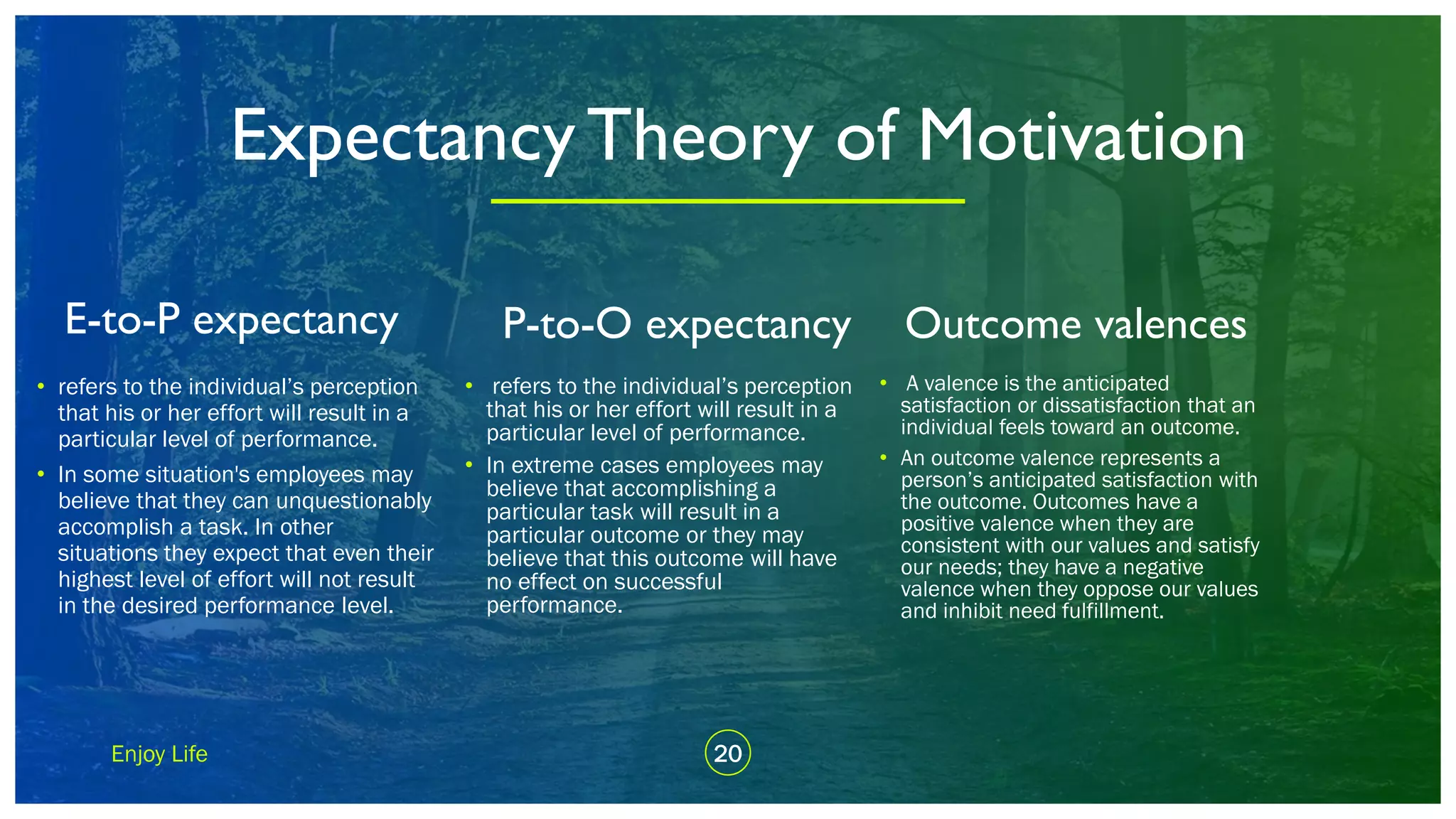
ExpectancyTheory of Motivation
E-to-P expectancy P-to-O expectancy
Enjoy Life 20
Outcome valences
• refers to the individual’s perception
that his or her effort will result in a
particular level of performance.
• In some situation's employees may
believe that they can unquestionably
accomplish a task. In other
situations they expect that even their
highest level of effort will not result
in the desired performance level.
• A valence is the anticipated
satisfaction or dissatisfaction that an
individual feels toward an outcome.
• An outcome valence represents a
person’s anticipated satisfaction with
the outcome. Outcomes have a
positive valence when they are
consistent with our values and satisfy
our needs; they have a negative
valence when they oppose our values
and inhibit need fulfillment.
• refers to the individual’s perception
that his or her effort will result in a
particular level of performance.
• In extreme cases employees may
believe that accomplishing a
particular task will result in a
particular outcome or they may
believe that this outcome will have
no effect on successful
performance.
21
Enjoy Life
Management Implications of Expectancy
Theory
MANAGING THROUGH EXTRINSIC AND INTRINSIC
REWARDS
22
ADD A FOOTER
Managing through Extrinsic and Intrinsic
Rewards
Extrinsic Rewards
• is anything received from another person
that the recipient values and is contingent
on his or her behavior or results.
• Extrinsic rewards include paychecks,
performance bonuses, praise, or some
other form of recognition. Extrinsic rewards
don’t occur naturally with the behavior or
result; instead, someone introduces these
rewards.
Intrinsic Rewards
• is a positive emotional experience resulting
directly and naturally from the individual’s
behavior or results.
• This would include the enjoyment of learning a
new task, a feeling of accomplishment from
performing a job well, and a sense of flow or
engagement when work is performed
smoothly. Notice that these emotions arise
naturally from performing the task.
Enjoy Life 23
24
Enjoy Life
• PERFORMANCE-BASED REWARDS
• JOB STATUS–BASED REWARDS
• COMPETENCY-BASED REWARDS
EXAMPLES OF MOTIVATING EMPLOYEES
THROUGH EXTRINSIC REWARDS
25
Enjoy Life
• JOB CHARACTERISTICS MODEL
• Skill variety: Skill variety refers to the use of different skills
and talents to complete a variety of work activities. For
example, salesclerks who normally only serve customers
might be assigned the additional duties of stocking
inventory and changing storefront displays.
• Task identity: Task identity is the degree to which a job
requires completion of a whole or identifiable piece of
work, such as assembling an entire computer modem
rather than just soldering in the circuitry.
• Autonomy: Jobs with high levels of autonomy provide
freedom, independence, and discretion in scheduling work
and determining the procedures to be used to complete the
work. In autonomous jobs, employees make their own
decisions rather than relying on detailed instructions from
supervisors or procedure manuals
• Job feedback: Job feedback is the degree to which
employees can tell how well they are doing based on direct
sensory information from the job itself. Airline pilots can
feel how smoothly they land their aircraft; road crews can
see how well they have prepared the roadbed and laid the
asphalt.
EXAMPLES OF MOTIVATING EMPLOYEES
THROUGH INTRINSIC REWARDS
26
Enjoy Life
• MOTIVATING EMPLOYEES THROUGH JOB ENRICHMENT
• MOTIVATING EMPLOYEES THROUGH EMPOWERMENT
EXAMPLES OF MOTIVATING EMPLOYEES
THROUGH EXTRINSIC REWARDS
THANKYOU!
Justin Miguel C. Yturralde
Email
jmyturralde25@gmail.com
28
ADD A FOOTER
• https://www.tutorialspoint.com/individual_and_group_behavior/mars_model_individual_beha
vior.htm
• https://www.wisdomjobs.com/e-university/principles-of-management-tutorial-293/motivating-
employees-a-three-part-process-9454.html
• https://www.wisdomjobs.com/e-university/principles-of-management-tutorial-293/part-1-
managing-motivation-through-drives-and-needs-9455.html
• https://www.wisdomjobs.com/e-university/principles-of-management-tutorial-293/part-2-
managing-motivation-through-goals-expectations-and-feedback-9456.html
• https://www.wisdomjobs.com/e-university/principles-of-management-tutorial-293/part-3-
managing-motivation-through-extrinsic-and-intrinsic-rewards-9457.html
References:

Motivating and rewarding employee performance

  • 1.
  • 2.
    MARS MODEL 2 Enjoy Life Motivation,Abilities, Role Perception and Situational Factors.
  • 3.
    MARS Model of IndividualBehavior and Results MARS model of individual behavior is a model that seeks to elaborate individual behavior as a result of internal and external factors or influences combined • The name itself is an acronym for individual Motivation, Abilities, Role Perception and Situational Factors. • These are marked as the four major factors in determining individual behavior and results. The model can be implemented to a variety of situations, but is usually applied in Management, Industrial Psychology or Organizational Behavior studies. This model represents that these four factors have a mixed effect on individual performance. If any factor weakens, performance will decrease. Enjoy Life 3
  • 4.
    MOTIVATION • Motivation canbe described as internal forces that impact the direction, intensity, and endurance of a person’s voluntary choice of behavior. It consists of − • Direction − focused by goals. • Intensity − bulk of effort allocated. • Persistence − amount of time taken for the effort to be exerted. ENJOY LIFE 4
  • 5.
    ABILITY • Ability isthe natural tendency and learned capabilities needed to complete a task successfully. It has four different parts namely − • Aptitudes − natural talent that helps people learn more efficiently and perform effectively. • Learned capabilities − accomplished skills and knowledge. • Competencies − abilities, individual values, personality traits and other features of people that result in superior performance. • Person-job fit − there are three ways to match people with jobs selecting qualified people developing employee abilities through training redesigning job to fit person's existing abilities ENJOY LIFE 5
  • 6.
    ROLE PERCEPTION • Theyare the beliefs about what behavior is necessary to achieve the desired results and have a check that everyone is clear regarding their part. It is of four types − • Understanding the tasks to be performed. • Understanding associated importance of tasks allotted. • Understanding preferred behaviors to complete respective tasks. • Clarifying role perceptions ENJOY LIFE 6
  • 7.
    SITUATIONAL FACTORS • They arethe environmental conditions like given time bound, team members, budget, and work facilities that limits or facilitates behavior. Factors that are beyond the individual’s control in the short run. • Some situational characteristics—such as consumer preferences and economic conditions—originate from the external environment and consequently are beyond the employee’s and organization’s control. However, some situational factors—such as time, people, budget, and physical work facilities— are controlled by others in the organization. ENJOY LIFE 7
  • 8.
  • 9.
    MANAGING THROUGH DRIVESAND NEEDS 9 ADD A FOOTER
  • 10.
    Managing through Drivesand Needs Ultimately motivation begins with the employee’s own drives and needs. Drives • are instinctive tendencies to seek goals or maintain internal stability. Drives are hardwired in the brain (that is, everyone has the same drives), and they most likely exist to help the species survive Needs • are mostly conscious deficiencies that energize or trigger behaviors to satisfy those needs. For the most part we are aware of our needs, whereas drives operate under the surface to generate our emotions and sometimes direct behavior. Needs are produced from our innate drives, but they are also strengthened or weakened through learning and social forces such as culture and childhood upbringing. Enjoy Life 10
  • 11.
    Relationship of Drives andNeeds MASLOW’S NEEDS HIERARCHY THEORY Enjoy Life 11
  • 12.
    Relationship of Drives andNeeds 12 Enjoy Life MASLOW’S NEEDS HIERARCHY THEORY • Needs were categorized as five levels of lower- to higher- order needs. Individuals must satisfy lower-order needs before they can satisfy higher order needs. Satisfied needs will no longer motivate. Motivating a person depends on knowing at what level that person is on the hierarchy. • Hierarchy of needs Lower-order (external): physiological, safety Higher-order (internal): social, esteem, self- actualization
  • 13.
    Management Implications of Maslow’s Theory •Employees have different needs at different times. Everyone has a hierarchy of needs, but each person’s hierarchy is different. The practical implication is that people value different things at different times. One employee might prefer time off, whereas another might prefer more pay. Managers need to carefully understand the needs of their employees and adjust rewards and other performance outcomes accordingly. Enjoy Life 13
  • 14.
    Management Implications of Maslow’s Theory •Employees have several interdependent needs, not just one dominant need. One of Maslow’s most important breakthroughs was to emphasize that needs should be understood holistically, not separately. Managers must therefore remember that employees are motivated by a cluster of needs, not just one need. Thus managers must consider the whole person rather than simplistically label each person in terms of one need (for example, Julie wants a social environment, Liam is the status climber). Enjoy Life 14
  • 15.
    Management Implications of Maslow’s Theory •At some point, most employees want to achieve their full potential (self-actualization). Throughout his career, Maslow emphasized that people are naturally motivated to reach their potential (self- actualization), and that organizations and societies need to be structured to help people continue and develop this motivation. The recommendation here is that managers must strive for Maslow’s vision of enlightened management because the strongest and most sustained motivation tends to occur when employees try to fulfill their need for self- actualization. Enjoy Life 15
  • 16.
    Management Implications of Maslow’s Theory •Employee needs are influenced by values and norms . Maslow was one of the first motivation scholars to recognize that higher-order needs are shaped to some extent by the norms and values of the team, organization, and society in which the individual lives. Enjoy Life 16
  • 17.
    MANAGING THROUGH GOALS,EXPECTATIONS AND FEEDBACKS 17 ADD A FOOTER
  • 18.
    Managing through Goals, Expectations andFeedback GOAL SETTING • Goal Setting – is the process of motivating employees and clarifying their role perceptions by establishing performance objectives. A goal is a desired future state that an organization or person attempts to realize. • Goal setting improves role perceptions and consequently clarifies the direction of employee effort. When conducted effectively, goal setting can also increase the intensity and persistence of effort. It achieves this higher level of motivation through employee buy-in and by raising the level of personal goal expectations. Enjoy Life 18
  • 19.
    19 Enjoy Life ExpectancyTheory ofMotivation • Expectancy theory is based on the idea that work effort is directed toward behaviors that people believe will lead to desired outcomes.
  • 20.
    ExpectancyTheory of Motivation E-to-Pexpectancy P-to-O expectancy Enjoy Life 20 Outcome valences • refers to the individual’s perception that his or her effort will result in a particular level of performance. • In some situation's employees may believe that they can unquestionably accomplish a task. In other situations they expect that even their highest level of effort will not result in the desired performance level. • A valence is the anticipated satisfaction or dissatisfaction that an individual feels toward an outcome. • An outcome valence represents a person’s anticipated satisfaction with the outcome. Outcomes have a positive valence when they are consistent with our values and satisfy our needs; they have a negative valence when they oppose our values and inhibit need fulfillment. • refers to the individual’s perception that his or her effort will result in a particular level of performance. • In extreme cases employees may believe that accomplishing a particular task will result in a particular outcome or they may believe that this outcome will have no effect on successful performance.
  • 21.
  • 22.
    MANAGING THROUGH EXTRINSICAND INTRINSIC REWARDS 22 ADD A FOOTER
  • 23.
    Managing through Extrinsicand Intrinsic Rewards Extrinsic Rewards • is anything received from another person that the recipient values and is contingent on his or her behavior or results. • Extrinsic rewards include paychecks, performance bonuses, praise, or some other form of recognition. Extrinsic rewards don’t occur naturally with the behavior or result; instead, someone introduces these rewards. Intrinsic Rewards • is a positive emotional experience resulting directly and naturally from the individual’s behavior or results. • This would include the enjoyment of learning a new task, a feeling of accomplishment from performing a job well, and a sense of flow or engagement when work is performed smoothly. Notice that these emotions arise naturally from performing the task. Enjoy Life 23
  • 24.
    24 Enjoy Life • PERFORMANCE-BASEDREWARDS • JOB STATUS–BASED REWARDS • COMPETENCY-BASED REWARDS EXAMPLES OF MOTIVATING EMPLOYEES THROUGH EXTRINSIC REWARDS
  • 25.
    25 Enjoy Life • JOBCHARACTERISTICS MODEL • Skill variety: Skill variety refers to the use of different skills and talents to complete a variety of work activities. For example, salesclerks who normally only serve customers might be assigned the additional duties of stocking inventory and changing storefront displays. • Task identity: Task identity is the degree to which a job requires completion of a whole or identifiable piece of work, such as assembling an entire computer modem rather than just soldering in the circuitry. • Autonomy: Jobs with high levels of autonomy provide freedom, independence, and discretion in scheduling work and determining the procedures to be used to complete the work. In autonomous jobs, employees make their own decisions rather than relying on detailed instructions from supervisors or procedure manuals • Job feedback: Job feedback is the degree to which employees can tell how well they are doing based on direct sensory information from the job itself. Airline pilots can feel how smoothly they land their aircraft; road crews can see how well they have prepared the roadbed and laid the asphalt. EXAMPLES OF MOTIVATING EMPLOYEES THROUGH INTRINSIC REWARDS
  • 26.
    26 Enjoy Life • MOTIVATINGEMPLOYEES THROUGH JOB ENRICHMENT • MOTIVATING EMPLOYEES THROUGH EMPOWERMENT EXAMPLES OF MOTIVATING EMPLOYEES THROUGH EXTRINSIC REWARDS
  • 27.
    THANKYOU! Justin Miguel C.Yturralde Email jmyturralde25@gmail.com
  • 28.
    28 ADD A FOOTER •https://www.tutorialspoint.com/individual_and_group_behavior/mars_model_individual_beha vior.htm • https://www.wisdomjobs.com/e-university/principles-of-management-tutorial-293/motivating- employees-a-three-part-process-9454.html • https://www.wisdomjobs.com/e-university/principles-of-management-tutorial-293/part-1- managing-motivation-through-drives-and-needs-9455.html • https://www.wisdomjobs.com/e-university/principles-of-management-tutorial-293/part-2- managing-motivation-through-goals-expectations-and-feedback-9456.html • https://www.wisdomjobs.com/e-university/principles-of-management-tutorial-293/part-3- managing-motivation-through-extrinsic-and-intrinsic-rewards-9457.html References: