MOTION
 Motion is a change in position of an
object over time.
 described in terms of
displacement, distance, velocity, acc
eleration, time, and speed.
 An object's motion cannot change
unless it is acted upon by a force, as
described.
 Momentum is a quantity which is
used for measuring the motion of an
object.
Types of Motion
Linear Motion
Circular Motion
Projectile Motion
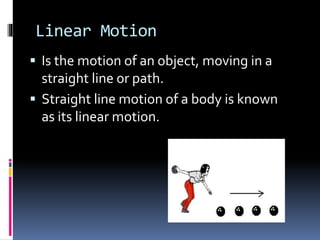
Linear Motion
 Is the motion of an object, moving in a
straight line or path.
 Straight line motion of a body is known
as its linear motion.
Examples
Motion of car on the road
Motion of football
Sliding a boy in straight line
Circular Motion
 The motion of an object in a circular
path is known as circular motion.
 In physics, circular motion is
a movement of an object along the
circumference of a circle or rotation
along a circular path.
Examples
 Motion of electron around the
nucleus
 Motion of toy car on circular
track
 Motion of planets around the
sun
Projectile Motion
 A projectile is any object that once projected
or dropped continues in motion by its own
inertia and is influenced only by the
downward force of gravity.
 By definition, a projectile has a single force
that acts upon it - the force of gravity.
Examples
An arrow fired upward
A ball thrown on the air
LAWS OF MOTION
 Newton's laws of motion are
three physical laws that, together,
laid the foundation for classical
mechanics.They describe the
relationship between a body and
the forces acting upon it, and
its motion in response to those
forces.
LAWS OF MOTION
Law of Inertia
Law of Acceleration
Law of Interaction
Law of Inertia
 Inertia is the tendency of an object to
remain at rest or in motion.
 It is the resistance of any
physical object to any change in its
position and state of motion.
 This includes changes to the
object's speed, direction, or state of
rest.
Examples
 When peddling a bicycle, if you
stop pedaling, the bike continues
going until friction or gravity
slows it down.
 When you stir coffee or tea and
stop, the swirling motion
continues due to inertia.
Law of Acceleration
 The acceleration of an object as
produced by a net force is directly
proportional to the magnitude of the net
force, in the same direction as the net
force, and inversely proportional to the
mass of the object.
 a force upon an object causes it to
accelerate according to the formula net
force = mass x acceleration.
Examples
A cart full of boxes
A loaded car is hard to move
because of its mass.
Law of Interaction
 For every action there is always
an equal or opposite reaction.
 Interaction is a kind
of action that occur as two or
more objects have an effect upon
one another.
Examples
 Interaction of hand and wall
pushing each other.
 Hitting a base ball
 A ball hit the wall.
- LADY EDZELLE D. ALIADO
THANKYOU!

Motion

  • 1.
  • 2.
     Motion isa change in position of an object over time.  described in terms of displacement, distance, velocity, acc eleration, time, and speed.  An object's motion cannot change unless it is acted upon by a force, as described.  Momentum is a quantity which is used for measuring the motion of an object.
  • 3.
    Types of Motion LinearMotion Circular Motion Projectile Motion
  • 4.
    Linear Motion  Isthe motion of an object, moving in a straight line or path.  Straight line motion of a body is known as its linear motion.
  • 5.
    Examples Motion of caron the road Motion of football Sliding a boy in straight line
  • 6.
    Circular Motion  Themotion of an object in a circular path is known as circular motion.  In physics, circular motion is a movement of an object along the circumference of a circle or rotation along a circular path.
  • 7.
    Examples  Motion ofelectron around the nucleus  Motion of toy car on circular track  Motion of planets around the sun
  • 8.
    Projectile Motion  Aprojectile is any object that once projected or dropped continues in motion by its own inertia and is influenced only by the downward force of gravity.  By definition, a projectile has a single force that acts upon it - the force of gravity.
  • 9.
    Examples An arrow firedupward A ball thrown on the air
  • 10.
    LAWS OF MOTION Newton's laws of motion are three physical laws that, together, laid the foundation for classical mechanics.They describe the relationship between a body and the forces acting upon it, and its motion in response to those forces.
  • 11.
    LAWS OF MOTION Lawof Inertia Law of Acceleration Law of Interaction
  • 12.
    Law of Inertia Inertia is the tendency of an object to remain at rest or in motion.  It is the resistance of any physical object to any change in its position and state of motion.  This includes changes to the object's speed, direction, or state of rest.
  • 14.
    Examples  When peddlinga bicycle, if you stop pedaling, the bike continues going until friction or gravity slows it down.  When you stir coffee or tea and stop, the swirling motion continues due to inertia.
  • 15.
    Law of Acceleration The acceleration of an object as produced by a net force is directly proportional to the magnitude of the net force, in the same direction as the net force, and inversely proportional to the mass of the object.  a force upon an object causes it to accelerate according to the formula net force = mass x acceleration.
  • 17.
    Examples A cart fullof boxes A loaded car is hard to move because of its mass.
  • 18.
    Law of Interaction For every action there is always an equal or opposite reaction.  Interaction is a kind of action that occur as two or more objects have an effect upon one another.
  • 20.
    Examples  Interaction ofhand and wall pushing each other.  Hitting a base ball  A ball hit the wall.
  • 21.
    - LADY EDZELLED. ALIADO THANKYOU!