MOSEP -  More Self-Esteem  with my E-Portfolio Development of a train-the-trainer course  for e-portfolio tutors   a Leonardo da Vinci Project Wolf Hilzensauer S a lzburg Research Forschungsgesellschaft m.b.H
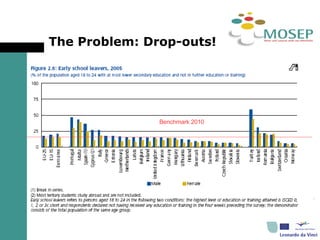
The Problem: Drop-outs! Benchmark 2010
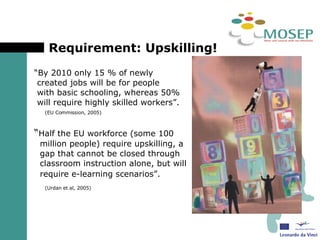
Requirement: Upskilling! “ By 2010 only 15 % of newly  created jobs will be for people  with basic schooling, whereas 50%  will require highly skilled workers”.  (EU Commission, 2005)‏ “ Half the EU workforce (some 100  million people) require upskilling, a  gap that cannot be closed through  classroom instruction alone, but will require e-learning scenarios”.   (Urdan et al, 2005)‏
“ Every act of conscious learning requires the willingness to suffer an injury to one’s self-esteem.  That is why young children, before they are aware of their own self-importance, learn so easily.”  Thomas Szasz
MOSEP - Details 10 parters from 7 EU-countries: Austria Germany France United Kingdom Lithuania Poland Bulgaria Duration: 2 years (August 2006 – July 2008) Funding Programme: Leonardo da Vinci (Pilot Projekts – A/06/B/F/PP – 158.301) Website: http://www.mosep.org
MOSEP - Aims  The age group of 14-16-year-olds will be familiarised with e-portfolio as a method for self directed and life-long learning. Teachers will be traines to support young learners to identify and reflect on their strengths and improvement areas to better develop their skills and competences to improve their self-presentation skills to become aware of their potentials and in this way foster their self-esteem to continue their school careers or vocational trainings
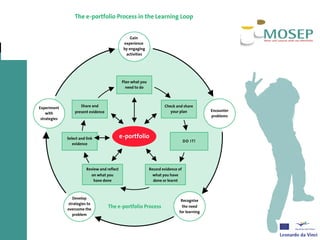
7 e-portfolio processes  (G.Attwell 2007) Recognising Learning  Learners frequently lack the skills to recognise their own learning, especially ongoing learning that does not necessarily lead to formal outcomes. Recording Learning   What should be recorded in a portfolio? Reflecting on learning  Giving meaning to the learning by reflecting on a meta-level Validating learning   Validating is the process of proving that learning has taken place, including the abilities and competencies identified and recorded.
7 e-portfolio processes  (G.Attwell 2007) Presenting learning   Presenting offers an opportunity to select artefacts from the portfolio to tell a story or make a point. Planning learning   Planning is a structured form of reflection – looking back and looking forward. What have I achieved and what do I want to achieve? Assessing learning   Assessing is an external process, not within the control of the learner. Assessing is external judgement of the value of a set of artefacts presented by the learner.
Skills, needed by learners Forming an opinion Expressing an opinion Articulating an opinion Justifying an opinion Defending an opinion Supporting opinions of others Challenging others’ opinions Questioning others Seeking clarification Representing others’ opinions Building on others’ opinions Sorting fact from opinion
Skills, needed by eP tutors |  Play – the capacity to experiment with one’s surroundings |  Performance – the ability to adopt alternative identities |  Simulation – the ability to interpret and construct dynamic models of real-world |  Appropriation – the ability to meaningfully sample and remix media content. |  Multitasking – the ability to scan one’s environment and shift focus  Distributed Cognition – the ability to interact meaningfully with tools  |  Collective Intelligence – the ability to pool knowledge and compare notes  |  Judgment – the ability to evaluate the reliability and credibility of sources. |  Transmedia Navigation – the ability to follow the flow of stories and information |  Networking – the ability to search for, synthesize, and disseminate information. |  Negotiation – the ability to travel across diverse communities
Teachers should be able to .. |  articulate the difference between assessment OF learning and FOR learning; |  implement classroom-based assessment FOR learning strategies; |  provide specific and detailed feedback to learners about their learning; |  support student reflection through modelling and research-based practices; |  create an environment that facilitates students’ deep learning.
 
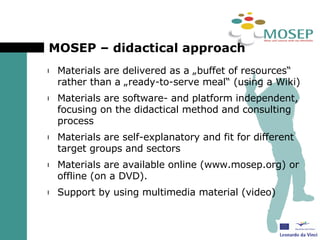
MOSEP – didactical approach Materials are delivered as a „buffet of resources“ rather than a „ready-to-serve meal“ (using a Wiki) Materials are software- and platform independent, focusing on the didactical method and consulting process Materials are self-explanatory and fit for different target groups and sectors Materials are available online (www.mosep.org) or offline (on a DVD). Support by using multimedia material (video)
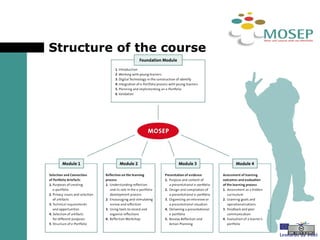
Structure   of the course
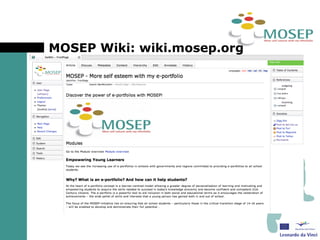
MOSEP Wiki: wiki.mosep.org
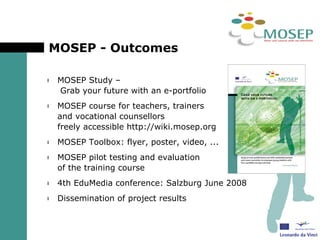
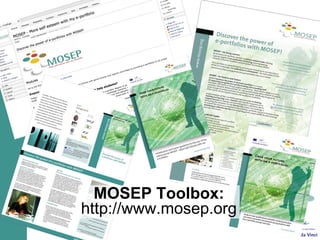
MOSEP - Outcomes  MOSEP Study –  Grab your future with an e-portfolio MOSEP course for teachers, trainers  and vocational counsellors  freely accessible http://wiki.mosep.org MOSEP Toolbox: flyer, poster, video, ...  MOSEP pilot testing and evaluation  of the training course 4th EduMedia conference: Salzburg June 2008 Dissemination of project results
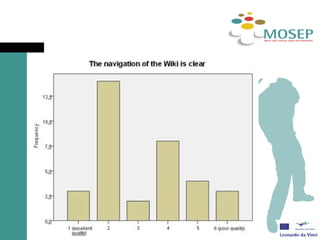
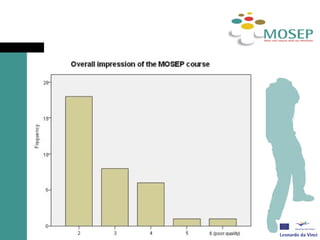
MOSEP Evaluation Design:  Pre-test  (sample: 25 ) Main test  (sample: 80) Focus group interviews  (testing groups) Refinementcycle  Improvements Wiki content tightened & streamlined Navigation improved MOSEP Mahara: bugs fixed MOSEP wiki course: trainer instructions compiled


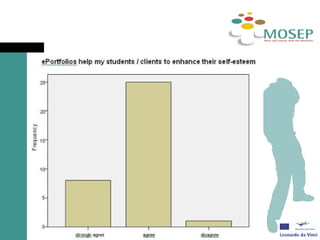
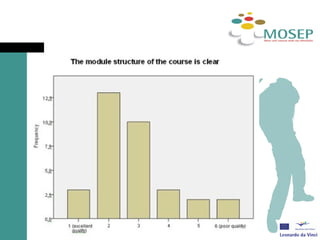
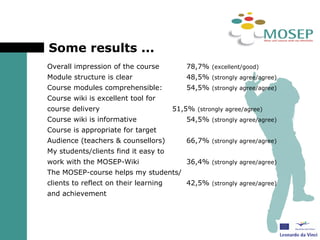
Some results ...  Overall impression of the course 78,7%  (excellent/good) Module structure is clear 48,5%  (strongly agree/agree) Course modules comprehensible: 54,5%  (strongly agree/agree) Course wiki is excellent tool for  course delivery 51,5%  (strongly agree/agree) Course wiki is informative 54,5%  (strongly agree/agree) Course is appropriate for target Audience (teachers & counsellors) 66,7%  (strongly agree/agree) My students/clients find it easy to work with the MOSEP-Wiki 36,4%  (strongly agree/agree) The MOSEP-course helps my students/ clients to reflect on their learning  42,5%  (strongly agree/agree) and achievement
MOSEP Toolbox: http://www.mosep.org
Contact: Wolf Hilzensauer Salzburg Research Forschungsgesellschaft Jakob Haringer Str. 5 5020 Salzburg / Austria [email_address] http://www.salzburgresearch.at http://www.mosep.org

Mosep ICL08, eP08

  • 1.
    MOSEP- More Self-Esteem with my E-Portfolio Development of a train-the-trainer course for e-portfolio tutors a Leonardo da Vinci Project Wolf Hilzensauer S a lzburg Research Forschungsgesellschaft m.b.H
  • 2.
  • 3.
    Requirement: Upskilling! “By 2010 only 15 % of newly created jobs will be for people with basic schooling, whereas 50% will require highly skilled workers”. (EU Commission, 2005)‏ “ Half the EU workforce (some 100 million people) require upskilling, a gap that cannot be closed through classroom instruction alone, but will require e-learning scenarios”. (Urdan et al, 2005)‏
  • 4.
    “ Every actof conscious learning requires the willingness to suffer an injury to one’s self-esteem. That is why young children, before they are aware of their own self-importance, learn so easily.” Thomas Szasz
  • 5.
    MOSEP - Details10 parters from 7 EU-countries: Austria Germany France United Kingdom Lithuania Poland Bulgaria Duration: 2 years (August 2006 – July 2008) Funding Programme: Leonardo da Vinci (Pilot Projekts – A/06/B/F/PP – 158.301) Website: http://www.mosep.org
  • 6.
    MOSEP - Aims The age group of 14-16-year-olds will be familiarised with e-portfolio as a method for self directed and life-long learning. Teachers will be traines to support young learners to identify and reflect on their strengths and improvement areas to better develop their skills and competences to improve their self-presentation skills to become aware of their potentials and in this way foster their self-esteem to continue their school careers or vocational trainings
  • 7.
    7 e-portfolio processes (G.Attwell 2007) Recognising Learning Learners frequently lack the skills to recognise their own learning, especially ongoing learning that does not necessarily lead to formal outcomes. Recording Learning What should be recorded in a portfolio? Reflecting on learning Giving meaning to the learning by reflecting on a meta-level Validating learning Validating is the process of proving that learning has taken place, including the abilities and competencies identified and recorded.
  • 8.
    7 e-portfolio processes (G.Attwell 2007) Presenting learning Presenting offers an opportunity to select artefacts from the portfolio to tell a story or make a point. Planning learning Planning is a structured form of reflection – looking back and looking forward. What have I achieved and what do I want to achieve? Assessing learning Assessing is an external process, not within the control of the learner. Assessing is external judgement of the value of a set of artefacts presented by the learner.
  • 9.
    Skills, needed bylearners Forming an opinion Expressing an opinion Articulating an opinion Justifying an opinion Defending an opinion Supporting opinions of others Challenging others’ opinions Questioning others Seeking clarification Representing others’ opinions Building on others’ opinions Sorting fact from opinion
  • 10.
    Skills, needed byeP tutors | Play – the capacity to experiment with one’s surroundings | Performance – the ability to adopt alternative identities | Simulation – the ability to interpret and construct dynamic models of real-world | Appropriation – the ability to meaningfully sample and remix media content. | Multitasking – the ability to scan one’s environment and shift focus Distributed Cognition – the ability to interact meaningfully with tools | Collective Intelligence – the ability to pool knowledge and compare notes | Judgment – the ability to evaluate the reliability and credibility of sources. | Transmedia Navigation – the ability to follow the flow of stories and information | Networking – the ability to search for, synthesize, and disseminate information. | Negotiation – the ability to travel across diverse communities
  • 11.
    Teachers should beable to .. | articulate the difference between assessment OF learning and FOR learning; | implement classroom-based assessment FOR learning strategies; | provide specific and detailed feedback to learners about their learning; | support student reflection through modelling and research-based practices; | create an environment that facilitates students’ deep learning.
  • 12.
  • 13.
    MOSEP – didacticalapproach Materials are delivered as a „buffet of resources“ rather than a „ready-to-serve meal“ (using a Wiki) Materials are software- and platform independent, focusing on the didactical method and consulting process Materials are self-explanatory and fit for different target groups and sectors Materials are available online (www.mosep.org) or offline (on a DVD). Support by using multimedia material (video)
  • 14.
    Structure of the course
  • 15.
  • 16.
    MOSEP - Outcomes MOSEP Study – Grab your future with an e-portfolio MOSEP course for teachers, trainers and vocational counsellors freely accessible http://wiki.mosep.org MOSEP Toolbox: flyer, poster, video, ... MOSEP pilot testing and evaluation of the training course 4th EduMedia conference: Salzburg June 2008 Dissemination of project results
  • 17.
    MOSEP Evaluation Design: Pre-test (sample: 25 ) Main test (sample: 80) Focus group interviews (testing groups) Refinementcycle Improvements Wiki content tightened & streamlined Navigation improved MOSEP Mahara: bugs fixed MOSEP wiki course: trainer instructions compiled
  • 18.
  • 19.
  • 20.
  • 21.
  • 22.
  • 23.
    Some results ... Overall impression of the course 78,7% (excellent/good) Module structure is clear 48,5% (strongly agree/agree) Course modules comprehensible: 54,5% (strongly agree/agree) Course wiki is excellent tool for course delivery 51,5% (strongly agree/agree) Course wiki is informative 54,5% (strongly agree/agree) Course is appropriate for target Audience (teachers & counsellors) 66,7% (strongly agree/agree) My students/clients find it easy to work with the MOSEP-Wiki 36,4% (strongly agree/agree) The MOSEP-course helps my students/ clients to reflect on their learning 42,5% (strongly agree/agree) and achievement
  • 24.
  • 25.
    Contact: Wolf HilzensauerSalzburg Research Forschungsgesellschaft Jakob Haringer Str. 5 5020 Salzburg / Austria [email_address] http://www.salzburgresearch.at http://www.mosep.org