Compulsory Pooling & Mortgage and Insurance Issues

  Presentation to Compulsory Pooling Study Group
 of the North Caroling Mining & Energy Commission

            Central Carolina Community College
                       Pittsboro, NC
                     February 8, 2013


                      John Humphrey

                   The Humphrey Law Firm
                   107 S. West St., PMB 325
                     Alexandria, VA 22314
                 humphrey.law@earthlink.net
                        703-599-7919
                                                     1
Mortgage Loans & Insurance
• At the January 11, 2013, Meeting of the
  Compulsory Pooling Study Group, members of
  the public raised questions about the potential
  impact of compulsory pooling laws on existing
  mortgages, new mortgages, and property
  insurance.
• This presentation was prepared in response to
  those questions to provide the Study Group and
  public with additional information on these issues
  and lay the groundwork for further research.

                                                   2
Mortgage Risks
• NC DOJ Consumer Protection Report to the
  General Assembly of May 1, 2012, on Impacts on
  Landowners and Consumer Protection Issues
  discusses several potential impacts of natural gas
  leasing on home mortgages:
   – Existing mortgages
   – Ability to refinance
   – Ability to obtain new credit
   - http://portal.ncdenr.org/c/document_library/get_file?uuid=bdd3a76c-a23c-
       4930-9b82-66d673a6d116&groupId=8198095

                                                                                3
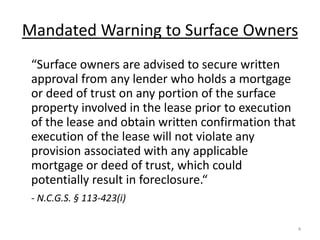
Mandated Warning to Surface Owners
 “Surface owners are advised to secure written
 approval from any lender who holds a mortgage
 or deed of trust on any portion of the surface
 property involved in the lease prior to execution
 of the lease and obtain written confirmation that
 execution of the lease will not violate any
 provision associated with any applicable
 mortgage or deed of trust, which could
 potentially result in foreclosure.“
 - N.C.G.S. § 113-423(i)

                                                     4
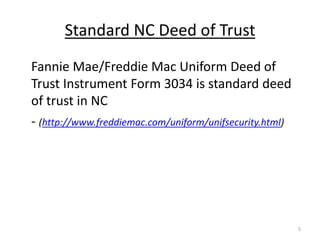
Standard NC Deed of Trust
Fannie Mae/Freddie Mac Uniform Deed of
Trust Instrument Form 3034 is standard deed
of trust in NC
- (http://www.freddiemac.com/uniform/unifsecurity.html)


                                                          5
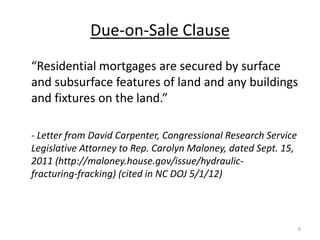
Due-on-Sale Clause
“Residential mortgages are secured by surface
and subsurface features of land and any buildings
and fixtures on the land.”

- Letter from David Carpenter, Congressional Research Service
Legislative Attorney to Rep. Carolyn Maloney, dated Sept. 15,
2011 (http://maloney.house.gov/issue/hydraulic-
fracturing‐fracking) (cited in NC DOJ 5/1/12)


                                                                6
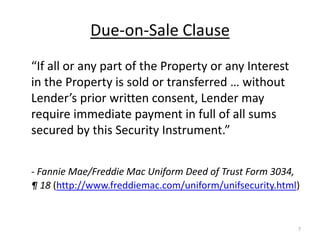
Due-on-Sale Clause
“If all or any part of the Property or any Interest
in the Property is sold or transferred … without
Lender’s prior written consent, Lender may
require immediate payment in full of all sums
secured by this Security Instrument.”


- Fannie Mae/Freddie Mac Uniform Deed of Trust Form 3034,
¶ 18 (http://www.freddiemac.com/uniform/unifsecurity.html)


                                                         7
Due-on-Sale Clause
• Fannie Mae advises loan servicers to approve
  requests to release security interest in mineral
  rights on behalf of Fannie Mae if the lease “is
  customary in the area and the exercise of the
  lease will not have a material effect on the value
  of the property, prevent use of the property as a
  residence, or expose the residents to serious
  health or safety hazards.”
  - Fannie Mae Single Family 2011 Servicing Guide, p. 307-6
  (https://www.fanniemae.com/content/guide/svc061011.pdf)

                                                              8
Due-on-Sale Clause
• In considering approving an release of mineral rights, a Fannie
  Mae servicer should take into consideration:
  “The extent to which the rights granted by the lease infringe
  on the property owner’s rights. For example, if the lease
  permits removal of deposits by directional exploration from
  an area outside of the property, there may be little or no
  adverse effect, depending on the location of the exploration
  area and the attitude of the community. On the other hand, if
  the lease allows for complete ingress and egress to explore
  any part of the property or to store or install equipment on it,
  the property may no longer have any real value as a
  residential property.”
  - Fannie Mae Single Family 2011 Servicing Guide, p. 307-5
  (https://www.fanniemae.com/content/guide/svc061011.pdf

                                                                 9
Form 3034 Hazardous Materials Clause
 “Borrower shall not cause or permit the
 presence, use, disposal, storage, or release of any
 Hazardous Substances … on or in the Property.”

 - Fannie Mae/Freddie Mac Uniform Deed of Trust Form 3034,
 ¶ 21 (http://www.freddiemac.com/uniform/unifsecurity.html)


                                                          10
Form 3034 Hazardous Materials Clause
 “Borrower shall not do, nor allow anyone else to
 do, anything affecting the Property … (c) which,
 due to the presence, use, or release of a
 Hazardous Substance, creates a condition that
 adversely affects the value of the Property.”

 - Fannie Mae/Freddie Mac Uniform Deed of Trust Form 3034,
 ¶ 21 (http://www.freddiemac.com/uniform/unifsecurity.html)


                                                          11
Form 3034 Hazardous Materials Clause
• Hazardous Substances – substances defined as
  toxic or hazardous substances, pollutants, or
  wastes by state or federal law and gasoline,
  kerosene, other flammable or toxic petroleum
  products, toxic pesticides and herbicides, volatile
  solvents, materials containing asbestos or
  formaldehyde, and radioactive materials

  - Fannie Mae/Freddie Mac Uniform Deed of Trust Form 3034,
  ¶ 21 (http://www.freddiemac.com/uniform/unifsecurity.html)

                                                           12
Form 3034 Hazardous Materials Clause
• “Borrower shall not do, nor allow anyone else to
  do, anything affecting the Property … (b) which
  creates an Environmental Condition.”
• Environmental Condition – a condition that
  triggers an environmental cleanup action under
  federal or state law.

  - Fannie Mae/Freddie Mac Uniform Deed of Trust Form 3034,
  ¶ 21 (http://www.freddiemac.com/uniform/unifsecurity.html)

                                                           13
Waste Clause
“Borrower shall not destroy, damage or impair the
Property, allow the Property to deteriorate or commit
waste on the Property. Whether or not Borrower is
residing in the Property, Borrower shall maintain the
Property in order to prevent the Property from
deteriorating or decreasing in value due to its
condition.”

- Fannie Mae/Freddie Mac Uniform Deed of Trust Form 3034,
¶ 7 (http://www.freddiemac.com/uniform/unifsecurity.html)

                                                            14
Waste Clause
• “Do not commit waste” clause provides that if
  landowner does something to the detriment
  of the property, such as dispose of hazardous
  waste on it, the lender could declare the loan
  in default and foreclose.
• Whether this would occur would depend on
  reassessment of loan balance, remaining
  property value, and changes to income from
  activity.

                                               15
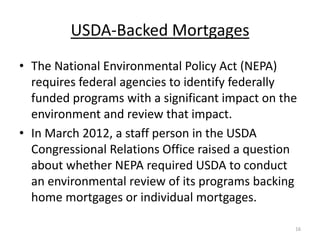
USDA-Backed Mortgages
• The National Environmental Policy Act (NEPA)
  requires federal agencies to identify federally
  funded programs with a significant impact on the
  environment and review that impact.
• In March 2012, a staff person in the USDA
  Congressional Relations Office raised a question
  about whether NEPA required USDA to conduct
  an environmental review of its programs backing
  home mortgages or individual mortgages.

                                                 16
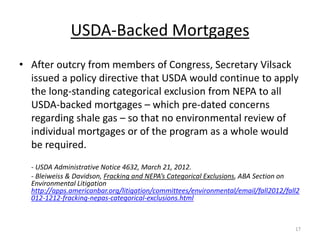
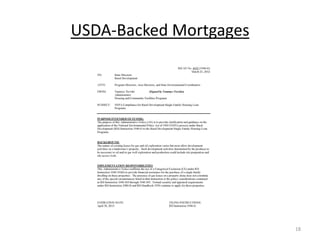
USDA-Backed Mortgages
• After outcry from members of Congress, Secretary Vilsack
  issued a policy directive that USDA would continue to apply
  the long-standing categorical exclusion from NEPA to all
  USDA-backed mortgages – which pre-dated concerns
  regarding shale gas – so that no environmental review of
  individual mortgages or of the program as a whole would
  be required.
  - USDA Administrative Notice 4632, March 21, 2012.
  - Bleiweiss & Davidson, Fracking and NEPA’s Categorical Exclusions, ABA Section on
  Environmental Litigation
  http://apps.americanbar.org/litigation/committees/environmental/email/fall2012/fall2
  012-1212-fracking-nepas-categorical-exclusions.html


                                                                                    17
USDA-Backed Mortgages


                        18
USDA-Backed Mortgages
• The Housing and Community Facilities
  Program has stated in a telephone interview
  on January 25, 2013, that USDA intends to
  continue the policy of exempting mortgages
  from NEPA and renew the Secretary’s directive
  when it expires in April 2013.


                                              19
Lender Mortgage Issues
Portfolio Protection
• In a market without experience with natural gas
  development, lenders lack information to be
  confident gas production would not drive down
  property values and cause loan balances to
  exceed collateral values. (NC DOJ 5/1/12, at 7.)
• Basis of current State Employees Credit Union
  and NC Housing Finance Agency policy to refuse
  mortgages on severed estates and properties
  with gas leases. Concern for other lenders also.
                                                     20
Lender Mortgage Issues
• Lenders are also wary of mortgage defaults that
  would leave lenders with properties having
  significant environmental liabilities, especially
  after bad experiences with foreclosing on
  significant numbers of properties with
  environmental liabilities during housing crisis.
• Even if no actual environmental hazard, the
  possibility of potential environmental problems
  creates risk of significant litigation costs.

                                                      21
Lender Mortgage Issues
• Many lenders need more experience in a NC real
  estate market during period of natural gas
  development and want more regulatory certainty
  about how issues of liability and risk will be
  addressed before they will be prepared to write
  mortgages in areas where natural gas
  development is occurring.
• State Employees Credit Union specifically has
  stated that it will continue to review its policy as
  it gains more experience in the market.

                                                     22
Lender Mortgage Issues
• In some instances lenders have negotiated with
  gas companies to maintain lenders’ priority of
  lease, obtain title insurance, and be indemnified
  by gas companies in the event of environmental
  damages. Such negotiations have extended
  mortgage process for several months and have
  not always resulted in agreements. (NC DOJ
  5/1/12, at 8.)


                                                      23
Lender Mortgage Issues
Secondary Market
• To sell mortgages on secondary market, lenders
  must make warranties and representations to
  purchaser about the condition of the mortgages
  sold along lines of Form 3034.
• If property later must be foreclosed on,
  originating banks are concerned that they could
  be held liable for corresponding damages if
  property undervalued or damaged by hazardous
  waste.
                                                    24
Lender Mortgage Issues
Compulsory Pooling Process
• Mortgage lenders would be necessary parties in
  any process pooling mortgaged properties.
• Under terms of standard mortgages, lenders as
  lienholders have right to determine how much of
  proceeds from sale of a property interest go to
  lender to pay down loan balance and ensure it
  does not exceed value of property securing loan
  and how much go to mortgagee/landowner.
                                                25
Landowner Mortgage Issues
Mortgage Defaults
• Compelling landowners with mortgages into
  pools may cause them to default on mortgages.
• However, NC DOJ Consumer Protection Division is
  unaware of any instance in NC or elsewhere
  where signing of a gas lease has caused a lender
  to declare the loan in default and request
  immediate repayment.
• Nonetheless, such defaults do pose real financial
  risks to landowners.
                                                  26
Landowner Mortgage Issues
Asset Value and Liquidity
• Removal of mineral assets or construction of
  wells on the surface can cause value of property
  acting as collateral to decline below loan amount,
  which creates foreclosure risk, reduces chances
  for refinancing, and complicates sale of land. If
  these results occur, landowner assets will become
  less liquid and available for other purposes.
• Buyers may have fewer mortgage options, which
  decreases demand and resale value.
                                                  27
Landowner Mortgage Issues
Restrictions on Mineral Leasing
• Since granting of mineral leases is not customary
  in North Carolina, and effects of lease and
  mineral extraction on property prices is
  uncertain, Fannie Mae servicing guidelines may
  not allow servicer to act on Fannie Mae’s behalf
  to release Fannie Mae’s security interest in the
  property to enable leases to be signed.


                                                      28
Landowner Mortgage Issues
Severed Estates
• Surface owners of severed estates will be in
  worse position because they will suffer financial
  constraints without benefit of compensation
  from leasing or developing mineral rights.

Landowner Liability
• Hazardous Waste term can be used by lenders to
  hold landowners liable for environmental
  damages by operators in case of loan default.
                                                      29
Insurance
• In July 2012, Nationwide Insurance announced
  that its personal and commercial insurance
  lines would not cover damages caused by
  hydraulic fracturing and other aspects of
  natural gas development.

 - http://www.nationwide.com/newsroom/071312-
 FrackingStatement.jsp


                                                30
Insurance
“Nationwide has not changed our policies or
guidelines, nor are we cancelling policies.
Fracking-related losses have never been a
covered loss under personal or commercial
lines policies.”

- http://www.nationwide.com/newsroom/071312-
FrackingStatement.jsp


                                               31
Insurance
• Nationwide’s coverage position is public, but its
  coverage is likely not different from the position
  of most homeowner and commercial carriers.
• Landowners will need to look to other strategies,
  such as indemnification from gas operators, if
  they enter into gas leases or are near gas
  development activity that may affect their
  property.


                                                   32
Landowner Insurance Issues
• Landowners who are compelled to join a pool
  will not be covered by their homeowners or
  commercial insurance and will not have access
  to another party to which they can shift risks.
• If landowners are compelled to join a pool,
  State action will be required to protect
  landowners by shifting the uninvited risk away
  to the State, gas operators, or other parties.

                                                33
Compulsory Pooling & Mortgage and Insurance Issues

   Presentation to Compulsory Pooling Study Group
   of the North Caroling Mining & Energy Commission
                                                      John Humphrey
   Central Carolina Community College                 The Humphrey Law Firm
   Pittsboro, NC                                      107 S. West St., PMB 325
   February 8, 2013                                   Alexandria, VA 22314
                                                      humphrey.law@earthlink.net
                                                      703-599-7919

                                                                                   34

Compulsory Pooling, Mortgage & Insurance Issues: Presentation to NC MEC 2013

  • 1.
    Compulsory Pooling &Mortgage and Insurance Issues Presentation to Compulsory Pooling Study Group of the North Caroling Mining & Energy Commission Central Carolina Community College Pittsboro, NC February 8, 2013 John Humphrey The Humphrey Law Firm 107 S. West St., PMB 325 Alexandria, VA 22314 humphrey.law@earthlink.net 703-599-7919 1
  • 2.
    Mortgage Loans &Insurance • At the January 11, 2013, Meeting of the Compulsory Pooling Study Group, members of the public raised questions about the potential impact of compulsory pooling laws on existing mortgages, new mortgages, and property insurance. • This presentation was prepared in response to those questions to provide the Study Group and public with additional information on these issues and lay the groundwork for further research. 2
  • 3.
    Mortgage Risks • NCDOJ Consumer Protection Report to the General Assembly of May 1, 2012, on Impacts on Landowners and Consumer Protection Issues discusses several potential impacts of natural gas leasing on home mortgages: – Existing mortgages – Ability to refinance – Ability to obtain new credit - http://portal.ncdenr.org/c/document_library/get_file?uuid=bdd3a76c-a23c- 4930-9b82-66d673a6d116&groupId=8198095 3
  • 4.
    Mandated Warning toSurface Owners “Surface owners are advised to secure written approval from any lender who holds a mortgage or deed of trust on any portion of the surface property involved in the lease prior to execution of the lease and obtain written confirmation that execution of the lease will not violate any provision associated with any applicable mortgage or deed of trust, which could potentially result in foreclosure.“ - N.C.G.S. § 113-423(i) 4
  • 5.
    Standard NC Deedof Trust Fannie Mae/Freddie Mac Uniform Deed of Trust Instrument Form 3034 is standard deed of trust in NC - (http://www.freddiemac.com/uniform/unifsecurity.html) 5
  • 6.
    Due-on-Sale Clause “Residential mortgagesare secured by surface and subsurface features of land and any buildings and fixtures on the land.” - Letter from David Carpenter, Congressional Research Service Legislative Attorney to Rep. Carolyn Maloney, dated Sept. 15, 2011 (http://maloney.house.gov/issue/hydraulic- fracturing‐fracking) (cited in NC DOJ 5/1/12) 6
  • 7.
    Due-on-Sale Clause “If allor any part of the Property or any Interest in the Property is sold or transferred … without Lender’s prior written consent, Lender may require immediate payment in full of all sums secured by this Security Instrument.” - Fannie Mae/Freddie Mac Uniform Deed of Trust Form 3034, ¶ 18 (http://www.freddiemac.com/uniform/unifsecurity.html) 7
  • 8.
    Due-on-Sale Clause • FannieMae advises loan servicers to approve requests to release security interest in mineral rights on behalf of Fannie Mae if the lease “is customary in the area and the exercise of the lease will not have a material effect on the value of the property, prevent use of the property as a residence, or expose the residents to serious health or safety hazards.” - Fannie Mae Single Family 2011 Servicing Guide, p. 307-6 (https://www.fanniemae.com/content/guide/svc061011.pdf) 8
  • 9.
    Due-on-Sale Clause • Inconsidering approving an release of mineral rights, a Fannie Mae servicer should take into consideration: “The extent to which the rights granted by the lease infringe on the property owner’s rights. For example, if the lease permits removal of deposits by directional exploration from an area outside of the property, there may be little or no adverse effect, depending on the location of the exploration area and the attitude of the community. On the other hand, if the lease allows for complete ingress and egress to explore any part of the property or to store or install equipment on it, the property may no longer have any real value as a residential property.” - Fannie Mae Single Family 2011 Servicing Guide, p. 307-5 (https://www.fanniemae.com/content/guide/svc061011.pdf 9
  • 10.
    Form 3034 HazardousMaterials Clause “Borrower shall not cause or permit the presence, use, disposal, storage, or release of any Hazardous Substances … on or in the Property.” - Fannie Mae/Freddie Mac Uniform Deed of Trust Form 3034, ¶ 21 (http://www.freddiemac.com/uniform/unifsecurity.html) 10
  • 11.
    Form 3034 HazardousMaterials Clause “Borrower shall not do, nor allow anyone else to do, anything affecting the Property … (c) which, due to the presence, use, or release of a Hazardous Substance, creates a condition that adversely affects the value of the Property.” - Fannie Mae/Freddie Mac Uniform Deed of Trust Form 3034, ¶ 21 (http://www.freddiemac.com/uniform/unifsecurity.html) 11
  • 12.
    Form 3034 HazardousMaterials Clause • Hazardous Substances – substances defined as toxic or hazardous substances, pollutants, or wastes by state or federal law and gasoline, kerosene, other flammable or toxic petroleum products, toxic pesticides and herbicides, volatile solvents, materials containing asbestos or formaldehyde, and radioactive materials - Fannie Mae/Freddie Mac Uniform Deed of Trust Form 3034, ¶ 21 (http://www.freddiemac.com/uniform/unifsecurity.html) 12
  • 13.
    Form 3034 HazardousMaterials Clause • “Borrower shall not do, nor allow anyone else to do, anything affecting the Property … (b) which creates an Environmental Condition.” • Environmental Condition – a condition that triggers an environmental cleanup action under federal or state law. - Fannie Mae/Freddie Mac Uniform Deed of Trust Form 3034, ¶ 21 (http://www.freddiemac.com/uniform/unifsecurity.html) 13
  • 14.
    Waste Clause “Borrower shallnot destroy, damage or impair the Property, allow the Property to deteriorate or commit waste on the Property. Whether or not Borrower is residing in the Property, Borrower shall maintain the Property in order to prevent the Property from deteriorating or decreasing in value due to its condition.” - Fannie Mae/Freddie Mac Uniform Deed of Trust Form 3034, ¶ 7 (http://www.freddiemac.com/uniform/unifsecurity.html) 14
  • 15.
    Waste Clause • “Donot commit waste” clause provides that if landowner does something to the detriment of the property, such as dispose of hazardous waste on it, the lender could declare the loan in default and foreclose. • Whether this would occur would depend on reassessment of loan balance, remaining property value, and changes to income from activity. 15
  • 16.
    USDA-Backed Mortgages • TheNational Environmental Policy Act (NEPA) requires federal agencies to identify federally funded programs with a significant impact on the environment and review that impact. • In March 2012, a staff person in the USDA Congressional Relations Office raised a question about whether NEPA required USDA to conduct an environmental review of its programs backing home mortgages or individual mortgages. 16
  • 17.
    USDA-Backed Mortgages • Afteroutcry from members of Congress, Secretary Vilsack issued a policy directive that USDA would continue to apply the long-standing categorical exclusion from NEPA to all USDA-backed mortgages – which pre-dated concerns regarding shale gas – so that no environmental review of individual mortgages or of the program as a whole would be required. - USDA Administrative Notice 4632, March 21, 2012. - Bleiweiss & Davidson, Fracking and NEPA’s Categorical Exclusions, ABA Section on Environmental Litigation http://apps.americanbar.org/litigation/committees/environmental/email/fall2012/fall2 012-1212-fracking-nepas-categorical-exclusions.html 17
  • 18.
  • 19.
    USDA-Backed Mortgages • TheHousing and Community Facilities Program has stated in a telephone interview on January 25, 2013, that USDA intends to continue the policy of exempting mortgages from NEPA and renew the Secretary’s directive when it expires in April 2013. 19
  • 20.
    Lender Mortgage Issues PortfolioProtection • In a market without experience with natural gas development, lenders lack information to be confident gas production would not drive down property values and cause loan balances to exceed collateral values. (NC DOJ 5/1/12, at 7.) • Basis of current State Employees Credit Union and NC Housing Finance Agency policy to refuse mortgages on severed estates and properties with gas leases. Concern for other lenders also. 20
  • 21.
    Lender Mortgage Issues •Lenders are also wary of mortgage defaults that would leave lenders with properties having significant environmental liabilities, especially after bad experiences with foreclosing on significant numbers of properties with environmental liabilities during housing crisis. • Even if no actual environmental hazard, the possibility of potential environmental problems creates risk of significant litigation costs. 21
  • 22.
    Lender Mortgage Issues •Many lenders need more experience in a NC real estate market during period of natural gas development and want more regulatory certainty about how issues of liability and risk will be addressed before they will be prepared to write mortgages in areas where natural gas development is occurring. • State Employees Credit Union specifically has stated that it will continue to review its policy as it gains more experience in the market. 22
  • 23.
    Lender Mortgage Issues •In some instances lenders have negotiated with gas companies to maintain lenders’ priority of lease, obtain title insurance, and be indemnified by gas companies in the event of environmental damages. Such negotiations have extended mortgage process for several months and have not always resulted in agreements. (NC DOJ 5/1/12, at 8.) 23
  • 24.
    Lender Mortgage Issues SecondaryMarket • To sell mortgages on secondary market, lenders must make warranties and representations to purchaser about the condition of the mortgages sold along lines of Form 3034. • If property later must be foreclosed on, originating banks are concerned that they could be held liable for corresponding damages if property undervalued or damaged by hazardous waste. 24
  • 25.
    Lender Mortgage Issues CompulsoryPooling Process • Mortgage lenders would be necessary parties in any process pooling mortgaged properties. • Under terms of standard mortgages, lenders as lienholders have right to determine how much of proceeds from sale of a property interest go to lender to pay down loan balance and ensure it does not exceed value of property securing loan and how much go to mortgagee/landowner. 25
  • 26.
    Landowner Mortgage Issues MortgageDefaults • Compelling landowners with mortgages into pools may cause them to default on mortgages. • However, NC DOJ Consumer Protection Division is unaware of any instance in NC or elsewhere where signing of a gas lease has caused a lender to declare the loan in default and request immediate repayment. • Nonetheless, such defaults do pose real financial risks to landowners. 26
  • 27.
    Landowner Mortgage Issues AssetValue and Liquidity • Removal of mineral assets or construction of wells on the surface can cause value of property acting as collateral to decline below loan amount, which creates foreclosure risk, reduces chances for refinancing, and complicates sale of land. If these results occur, landowner assets will become less liquid and available for other purposes. • Buyers may have fewer mortgage options, which decreases demand and resale value. 27
  • 28.
    Landowner Mortgage Issues Restrictionson Mineral Leasing • Since granting of mineral leases is not customary in North Carolina, and effects of lease and mineral extraction on property prices is uncertain, Fannie Mae servicing guidelines may not allow servicer to act on Fannie Mae’s behalf to release Fannie Mae’s security interest in the property to enable leases to be signed. 28
  • 29.
    Landowner Mortgage Issues SeveredEstates • Surface owners of severed estates will be in worse position because they will suffer financial constraints without benefit of compensation from leasing or developing mineral rights. Landowner Liability • Hazardous Waste term can be used by lenders to hold landowners liable for environmental damages by operators in case of loan default. 29
  • 30.
    Insurance • In July2012, Nationwide Insurance announced that its personal and commercial insurance lines would not cover damages caused by hydraulic fracturing and other aspects of natural gas development. - http://www.nationwide.com/newsroom/071312- FrackingStatement.jsp 30
  • 31.
    Insurance “Nationwide has notchanged our policies or guidelines, nor are we cancelling policies. Fracking-related losses have never been a covered loss under personal or commercial lines policies.” - http://www.nationwide.com/newsroom/071312- FrackingStatement.jsp 31
  • 32.
    Insurance • Nationwide’s coverageposition is public, but its coverage is likely not different from the position of most homeowner and commercial carriers. • Landowners will need to look to other strategies, such as indemnification from gas operators, if they enter into gas leases or are near gas development activity that may affect their property. 32
  • 33.
    Landowner Insurance Issues •Landowners who are compelled to join a pool will not be covered by their homeowners or commercial insurance and will not have access to another party to which they can shift risks. • If landowners are compelled to join a pool, State action will be required to protect landowners by shifting the uninvited risk away to the State, gas operators, or other parties. 33
  • 34.
    Compulsory Pooling &Mortgage and Insurance Issues Presentation to Compulsory Pooling Study Group of the North Caroling Mining & Energy Commission John Humphrey Central Carolina Community College The Humphrey Law Firm Pittsboro, NC 107 S. West St., PMB 325 February 8, 2013 Alexandria, VA 22314 humphrey.law@earthlink.net 703-599-7919 34