Managing Your Real Estate  Portfolio
E. Andrew Keeney, Esq. Kaufman & Canoles, P.C. 150 West Main Street, Suite 2100 Norfolk, VA 23510 (757) 624-3153 [email_address] www.kaufmanandcanoles.com Shawn A. Goldfaden, Esq. Stewart Title Guaranty Company 609 Global Way, Suite 122 Linthicum Heights, MD 21090 (410) 789-8400 [email_address] www.stewart.com
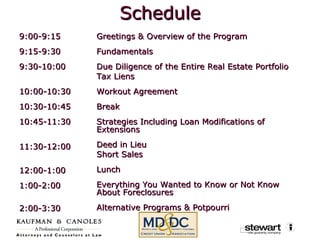
Schedule 9:00-9:15 9:15-9:30 9:30-10:00 10:00-10:30 10:30-10:45 10:45-11:30 11:30-12:00 12:00-1:00 1:00-2:00 2:00-3:30 Greetings & Overview of the Program Fundamentals Due Diligence of the Entire Real Estate Portfolio Tax Liens Workout Agreement Break Strategies Including Loan Modifications of Extensions Deed in Lieu Short Sales Lunch Everything You Wanted to Know or Not Know About Foreclosures Alternative Programs & Potpourri
Fundamentals
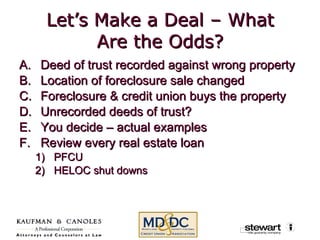
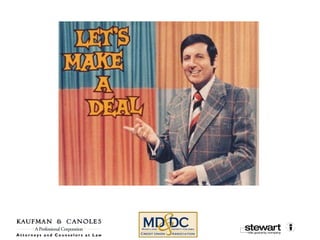
Let’s Make a Deal – What Are the Odds? Deed of trust recorded against wrong property Location of foreclosure sale changed Foreclosure & credit union buys the property Unrecorded deeds of trust? You decide – actual examples Review every real estate loan PFCU HELOC shut downs
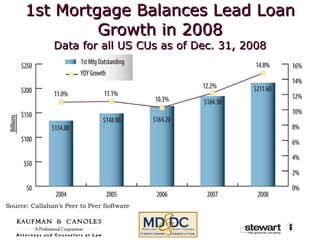
1st Mortgage Balances Lead Loan Growth in 2008 Data for all US CUs as of Dec. 31, 2008 Source: Callahan’s Peer to Peer Software
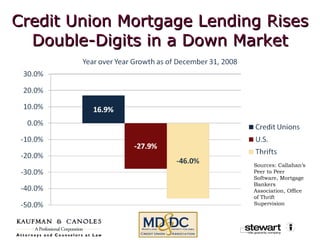
Credit Union Mortgage Lending Rises Double-Digits in a Down Market Sources: Callahan’s Peer to Peer Software, Mortgage Bankers Association, Office of Thrift Supervision
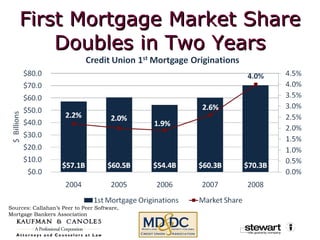
First Mortgage Market Share Doubles in Two Years Sources: Callahan’s Peer to Peer Software, Mortgage Bankers Association
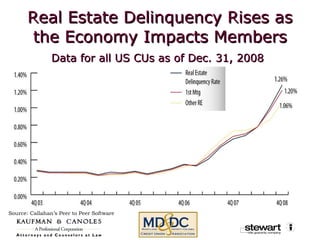
Real Estate Delinquency Rises as the Economy Impacts Members Data for all US CUs as of Dec. 31, 2008   Source: Callahan’s Peer to Peer Software
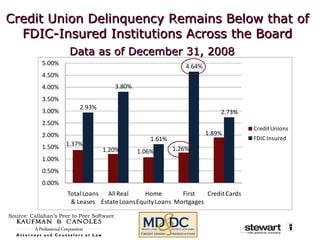
Credit Union Delinquency Remains Below that of FDIC-Insured Institutions Across the Board Data as of December 31, 2008 Source: Callahan’s Peer to Peer Software
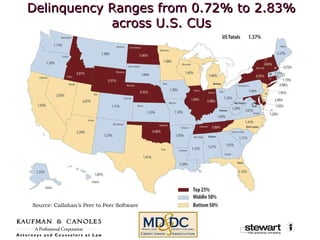
Delinquency Ranges from 0.72% to 2.83% across U.S. CUs Source: Callahan’s Peer to Peer Software
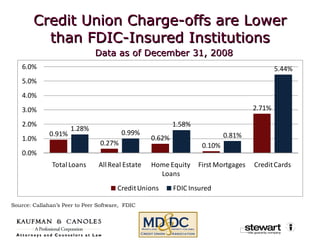
Credit Union Charge-offs are Lower than FDIC-Insured Institutions Data as of December 31, 2008 Source: Callahan’s Peer to Peer Software,  FDIC
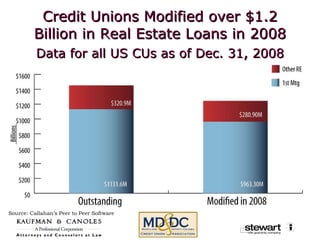
Credit Unions Modified over $1.2 Billion in Real Estate Loans in 2008   Data for all US CUs as of Dec. 31, 2008   Source: Callahan’s Peer to Peer Software


Mortgage Fraud FinCEN reported through suspicious activity reports (SARs) 156,000 mortgage fraud subjects and 2,360 other SAR types for a total of 158,360 in 2008 Mortgage loan fraudsters are using multiple channels Financial institutions Non-depository financial institutions such as: money service businesses, securities brokers, securities dealers, insurance companies, casinos Watch out for the crooks Constantly undertake due diligence
 
 
Due Diligence of the Entire Real Estate Portfolio Tax Liens
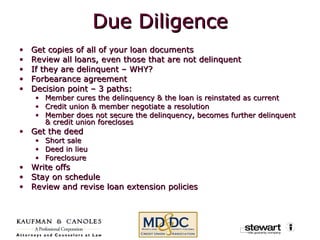
Due Diligence Get copies of all of your loan documents Review all loans, even those that are not delinquent If they are delinquent – WHY? Forbearance agreement Decision point – 3 paths: Member cures the delinquency & the loan is reinstated as current Credit union & member negotiate a resolution Member does not secure the delinquency, becomes further delinquent & credit union forecloses Get the deed Short sale Deed in lieu Foreclosure Write offs Stay on schedule Review and revise loan extension policies
 
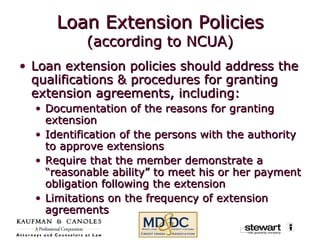
Loan Extension Policies (according to NCUA) Loan extension policies should address the qualifications & procedures for granting extension agreements, including: Documentation of the reasons for granting extension Identification of the persons with the authority to approve extensions Require that the member demonstrate a “reasonable ability” to meet his or her payment obligation following the extension Limitations on the frequency of extension agreements
Real Estate Owned (REO) Property owned by a lender after an unsuccessful sale at a foreclosure auction and held in inventory.  This is common because most of the properties up for sale at these auctions are worth less than the total amount owed to the bank:  the minimum bid in most foreclosure auctions equals the outstanding loan amount, the accrued interest and any fees associated with the foreclosure sale.
Oreo Other real estate; other real estate owned.  Generally, foreclosed property held by lending institutions.  An account at banks or credit unions that includes property other than real estate used for bank operations.
Recognizing Tax Lien Issues
The Impact of Tax Liens Federal tax liens and State tax liens   Term Evidence of Craft v. US Ruggerio v. US Municipal liens Procedures New legislation Ground Rents New ground rent legislation
Forbearance or Workout Agreements
Forbearance or Workout Agreements Update title report Judgment lien search Update credit bureau report Research & update status of real property taxes & insurance Identify sources of recovery, if any Property inspection Obtain appraisal or market analysis
Standstill Agreement Agreement whereby a lender makes no further collection efforts on an unpaid loan, acting in the belief that foreclosure would jeopardize the ability of a borrower in financial difficulty to repay any portion of the debt.  Such agreements are found most frequently in loans secured by real estate, whether both parties agree that a renegotiated loan is better than a defaulted borrower.
 
Strategies Including Loan Modifications of Extensions
Loan Restructuring The Workout & Workout Agreement Initial Actions Learn the facts Talk to member to learn initial problem & discuss desired result(s) Assess what you already know Order the necessary searches & documents Preliminary analysis – look at the current situation as both a modification  &  as if you were doing due diligence on a loan to a new borrower Re-read member’s loan & security documents with the information you learned from the searches and initial analysis questions in mind
 
The Workout & Workout Agreement Drafting the workout agreement Begin by outlining the provisions that concern you or use a standard form Basic types of changes (“Business Terms” vs. “Technical Points”) Specific provisions and issues Recitals Provision stating that the original documents, except as inconsistent with the Workout Agreement, remain in full force & effect Disclaimer stating that the Workout Agreement was drafted by both parties & that both parties were given the opportunity to be represented by counsel Indemnification & hold harmless clause Waiver of jury trial (if not already included) Notice provisions
The Workout & Workout Agreement (cont.) Courts take 3 general approaches as to pre-petition waivers of relief from automatic stay: General enforceable Per se unenforceable Pre-petition waiver is but 1 key factor in deciding whether cause exists to grant relief Strive to reduce exposure to lender liability –  yes , they will blame the credit union
Alternative Measures Extend the loan Lower the payment Lower the interest rate Set up escrow account for taxes & insurance Principal forbearance with the mortgage essentially being divided into 2 loans – borrower makes regular payments on 1 smaller loan & the other loan becomes a 0 interest loan that is paid back when the home is sold Only 1 in 10 homeowners is eligible to refinance due to current market values Currently 78.5% refi requests turned down
Alternative Measures (cont.) If they’ll work with us . . . we’ll work with them Distribute the responsibilities Counseling members Loan rewrites, extensions & modifications Collections OREOs and auto repossessions CEO overview, updates & responsibility
 
Deed in Lieu of Foreclosure
Deed in Lieu of Foreclosure – When Is It Appropriate? Members hands over keys Member transfers all the collateral to the credit union Deed in lieu is more appropriate when property value is less than the debt Deed in lieu is more appropriate when the title is clean
How a Deed in Lieu of Foreclosure Works Member & credit union execute transfer documents Property insurance by credit union Credit union obtains physical possession including the keys Deed of trust often remains in place until the property is sold Credit union obtains new owner’s title insurance policies
Advantages & Disadvantages of Deed in Lieu Advantages Quick Inexpensive Consensual Limited publicity for the member No litigation Disadvantages Existing liens are not extinguished Transfer taxes Fraudulent conveyance risk Title insurance
Deeds in Lieu of Foreclosure  (continued) What are the basic business and legal issues involved with a deed-in-lieu or deed-in-escrow? What are the title insurance issues in deeds-in-lieu / deeds-in-escrow, and what endorsements are applicable and available? What are the risks of recharacterization based on the “clogging” doctrine or a determination that the transaction is in fact an equitable mortgage? What constitutes adequate consideration for a lender receiving a deed-in-escrow as part of a loan workout? What factors do the courts consider when deciding whether to enforce a deed-in-escrow?
 
Short Sales
Short Sales Why are short sales important as an option? What effect is the short sale on the lender’s bottom line? Customer’s bottom line?  Statistics Short sales Deficiency Promissory Note Obligations “ Recourse” vs. “Non-recourse” Debt
Short Sales (cont.) From Wikipedia: A  non-recourse debt  or  nonrecourse loan  is a secured loan (debt) that is secured by a pledge of collateral, typically real property, but for which the borrower is not personally liable. If the borrower defaults, the lender/issuer can seize the collateral, but the lender's recovery is limited to the collateral. If the property is insufficient to cover the outstanding loan balance (for example, if real estate prices have dropped), the lender is simply paid out the difference. Thus, non-recourse debt is typically limited to 80% or 90% loan-to-value ratios, so that the property itself provides "overcollateralization" of the loan. The purpose of non-recourse debt is to require lenders to underwrite their loans on a sustainable and prudent basis since the lender is in the first-loss position with these loans, not the borrower.  Non-recourse debt is usually carried on a company's balance sheet as a liability, and the collateral is carried as an asset.
Short Sales (cont.) Maryland : A recourse state. The State of Maryland has long-standing foreclosure legislation that allows lenders up to three years to file a deficiency judgment for the balance of loans after the proceeds of a foreclosure sale have been applied provided the bank does not purchase the property back at foreclosure.
 
Everything You Wanted to Know or Not Know About Foreclosures
Foreclosures in Maryland and the District of Columbia
Foreclosures & Other Claim Related Issues I. Maryland: A. Procedure: quasi-judicial  B. New foreclosure legislation C. Foreclosure consulting D. Equity stripping  E. Protection of Homeowners in Foreclosure Act (PHIFA) 1. Julian v. Buonassisi, et al., No. 2740, Sept. Term, 2007
Foreclosures & Other Claim Related Issues (cont.) II. District of Columbia: A. Home Equity Protection Act of 2007 (D.C. Act A17-205) - Judicial Foreclosure Available: No    - Non-Judicial Foreclosure Available: Yes    - Primary Security Instruments: Deed of Trust    - Timeline: Typically 60 days    - Right of Redemption: No    - Deficiency Judgments Allowed: Yes  In Washington D.C., lenders may foreclose on deeds of trusts in default using the non-judicial foreclosure process.
Foreclosures & Other Claim Related Issues (cont.) Non-Judicial Foreclosure  The non-judicial process of foreclosure is used when a power of sale clause exists in a mortgage or deed of trust. A "power of sale" clause is the clause in a deed of trust or mortgage, in which the borrower pre-authorizes the sale of property to pay off the balance on a loan in the event of the their default. In deeds of trust or mortgages where a power of sale exists, the power given to the lender to sell the property may be executed by the lender or their representative, typically referred to as the trustee. Regulations for this type of foreclosure process are outlined below in the "Power of Sale Foreclosure Guidelines".
Foreclosures & Other Claim Related Issues (cont.) Power of Sale Foreclosure Guidelines  If the deed of trust or mortgage contains a power of sale clause and specifies the time, place and terms of sale, then the specified procedure must be followed.  If the terms of the sale are not established in the deed of trust, the lender, or his representative, must obtain a court order specifying the terms of the sale.  However, no foreclosure sale may take place unless the lender gives written notice, by certified mail (return receipt requested), to the borrower at his last known address. This notice must also be sent to the Mayor of the District of Columbia, or his designated agent. Both notices must be sent at least thirty (30) days prior to the sale, with the thirty (30) day period beginning on the day the notice is received by the Mayor. This notice must be given in addition to any notices set forth by the court, the mortgage or the deed of trust.  In Washington D.C., lenders may obtain a deficiency judgment against the borrower for the difference between the foreclosure sale amount and the amount remaining on the original loan. The borrower has no rights of redemption.
Foreclosures & Other Claim Related Issues (cont.) Foreclosure with second mortgage lender Bankruptcy of second mortgage lender Title insurance coverage continuation  Mayor and City Council of Baltimore City v. Wells Fargo (reverse redlining case)
How to Avoid Foreclosures Why try and help the borrower avoid foreclosure? The housing market values may continue to weaken thus adding to an over appreciated asset. The home value may deteriorate as homeowners abandon properties and leave them open to depreciation. Title issues may stall foreclosure rights. Homeowners may look for BK protection thus triggering many facets of protection .  Short Sales
How to Avoid Foreclosures (cont.) Restructuring  Misconception: Restructuring violates the contractual rights of investors. Misconception: Restructuring is a bailout of subprime borrowers and/or investors. Misconception: Restructuring will create a windfall for subprime borrowers. Misconception: Restructuring will deny investors their expected return. Misconception: Restructuring is unnecessary based on past levels of credit losses. Modifications Refinance
2006 ALTA Title Insurance Policies
2006 ALTA Title Insurance Policies INTRODUCTION TO ALTA 2006 POLICIES AND ENDORSEMENTS THE HIGHLIGHTS OF THE NEW 2006 POLICIES NEW COVERAGES Coverage for Electronic Transactions Survey Coverage  Tax Coverage Gap Coverage Covered Risks Relating to Excluded Matters  OTHER EXPANSIONS OF COVERAGE
2006 ALTA Title Insurance Policies (cont.) Creditors’ Rights Unmarketable Title Mechanic’s Liens Priority  THE NEW ENDORSEMENTS EXHIBIT 1: Endorsement 7.1 (Manufactured Housing – Conversion; Loan) & 7.1-06 (6-17-06)  EXHIBIT 2: Endorsement 9.3 (Restrictions, Encroachments, Minerals – Loan Policy) & 9.3-06 (6/17/06) EXHIBIT 3: Endorsement 14.3 (Future Advance – Reverse Mortgage) & 14.3-06 (6/17/06) EXHIBIT 4: Endorsement 22 (Location) & 22-06 (6/17/06)  EXHIBIT 5: Endorsement 22.1 (Location and Map) & 22.1-06 (6/17/06) EXHIBIT 6: ALTA Endorsement 11-06 (Mortgage Modification) (Not new but relevant)
2006 ALTA Title Insurance Policies (cont.) THE NEW FORMS EXHIBIT 7: 2006 Lender’s Title Policy (6/17/06) EXHIBIT 8: 2006 Enhanced and Enhanced Short Form Lender’s Policies (1/1/08)  EXHIBIT 9: Lender’s Commitment for Title Insurance (6-17-06) EXHIBIT 10: Insured Closing Protection Letter (1-1-08) THE DIFFERENCES BETWEEN THE 2006 POLICIES AND THE 1992/1970 POLICIES  WHAT THE 2006 POLICIES DO NOT DO  WHAT ENDORSEMENTS TO THE 2006 POLICIES TO ASK FOR
Alternative Programs & Potpourri
1031 EXCHANGES ASSET PRESERVATION, INC. HEADQUARTERS 4160 Douglas Blvd Granite Bay, CA 95746 Toll Free: (800) 282-1031 Phone: (916) 791-5991 Fax: (916) 404-4598 Internet: www.apiexchange.com Email:  [email_address] EASTERN REGIONAL OPERATIONS 4062 Grumman Blvd., Bldg. 81A Calverton, NY 11933 Toll Free: (866) 394-1031 Phone: (631) 369-3617 Fax: (631) 614-7954
1031 Exchanges I. EXCHANGES IN A FORECLOSURE Taxpayer under water due to the loan balance being in  excess of FMV or being unable to pay mortgage balance on the due date Loan balance in excess of basis of property (taxpayer may incur taxable gain if foreclosure is in full satisfaction of debt) Deed in lieu to lender rather than foreclosure No cash to pay any tax liability – resulting from deficiency
1031 Exchanges (cont.) Non-Recourse Debt 1.  Taxpayer will recognize capital gain in an amount equal to the total debt secured by the property less taxpayer’s adjusted basis Recourse Debt:  Two Types of Liability 1.  Taxable Disposition of Property:  Gain or loss recognized-The difference between the fair market value of the property and the taxpayer’s adjusted tax basis immediately prior to the disposition. 2.  Forgiveness of deficiency if FMV is less than recourse liability:  ordinary income to extent of deficiency (unless excepted) Exchange equation applies Trade up or even in value and reinvest all net equity
1031 Exchanges (cont.) Partial tax deferral is another possibility Replacement property may have equal debt so full tax deferral is achievable with minimal cash 11.Sale or assignment of note and mortgage to lender or third party will not qualify for §1031 purposes 12.Deed in lieu constitutes the sale of the relinquished property and starts the 45/180 day periods 13.Exchange must be structured and exchange documents prepared in advance of deed in lieu
II. FINANCIAL BACKING Does the QI offer customers the written backing of a large creditworthy entity? What is the financial rating and balance sheet of this entity? Does the QI conduct due diligence on the depositories holding the funds and monitor them? Does the QI offer segregated accounts? Does the QI offer a qualified escrow account? Does the QI offer a qualified trust account? Does the QI have sufficient fidelity bond coverage? Is the QI audited by a recognized external independent auditor? What types of internal audit controls are in place? Does the QI allow the taxpayer to require notarized signature for the movement of funds? 1031 Exchanges (cont.)
1031 Exchanges (cont.) III. SECUITY QUESTIONS Does the QI have specific written policies for moving exchange funds? Does the QI have a written investment policy? What security mechanisms are in place to protect against the misappropriation of funds?
1031 Exchanges (cont.) IV. EXPERIENCE Is the QI staffed by trained experts CPAs, attorneys and §1031 exchange specialists? Does the QI have significant expertise in reverse and improvement exchanges as well as delayed exchanges Does the QI offer CE approved courses taught nationwide? Will the QI provide §1031 handbooks and up-to-date tax materials? Does the QI provide extensive exchange resources available on the internet? How many years has the QI been in business?  How many exchanges has the QI facilitated?  What is the average dollar size of exchanges facilitated? Will the QI provide a reference and client list? If there is a parent company backing the QI, how many years has the parent company been in business?  What is the level of education and training of the staff?
Bankruptcy – Automatic Stay General standard for relief is either: For cause, including lack of adequate protection of creditor, or Debtor has no equity in property Exceptions for real estate lenders – single asset real estate debtor Secured lender with a claim against “single asset real estate debtor” is entitled to relief from the automatic stay within the latter of: 90 days of the filing of bankruptcy petition, or 30 days after court determination that debtor is a “single asset real estate debtor” UNLESS Exceptions Debtor has filed a plan with a reasonable possibility of being confirmed, or Debtor is making monthly payments equal to non-default contract interest on the unsecured amount of the lender’s claim
Cramdown Factors to be considered Sophistication of the party making the waiver of an automatic stay Whether or not there was any monetary consideration given for the waiver Whether other parties are affected, including unsecured & junior creditors Feasibility of the debtor’s plan Evidence of the fraud or coercion Likelihood of reorganization Potential prejudice to creditor if waiver is not enforced Cramdown – rewrite of the terms of the mortgage The bankruptcy court already has the authority to approve a plan submitted by the debtor that unilaterally rewrites the mortgage Extend term Revise or eliminate amortization schedule Reduce interest rate Strip away unsecured portions
Cramdown (cont.) Requires confirmation of the bankruptcy plan by the bankruptcy court Objections by creditors Cramdown plan must not discriminate unfairly against “cramdown claims” Plan must also treat cramdown claims in a manner that is “fair & equitable” A fair & equitable treatment is 1 of 4 alternatives: Whether or not discrimination has a reasonable basis Whether the debtor can carry out the plan without discrimination Whether the discrimination proposed is in good faith Whether the degree of discrimination is directly related to the basis or rationale of discrimination, i.e. why the different treatment
Cramdown Solutions The bankruptcy court already has the authority to approve a plan submitted by the debtor that unilaterally rewrites the mortgage Extend term Revise or eliminate amortization schedule Reduce interest rate Strip away unsecured portions
 
E. Andrew Keeney, Esq. Kaufman & Canoles, P.C. 150 West Main Street, Suite 2100 Norfolk, VA 23510 (757) 624-3153 [email_address] www.kaufmanandcanoles.com Shawn A. Goldfaden, Esq. Stewart Title Guaranty Company 609 Global Way, Suite 122 Linthicum Heights, MD 21090 (410) 789-8400 [email_address] www.stewart.com

Managing Your Real Estate Portfolio

  • 1.
    Managing Your RealEstate Portfolio
  • 2.
    E. Andrew Keeney,Esq. Kaufman & Canoles, P.C. 150 West Main Street, Suite 2100 Norfolk, VA 23510 (757) 624-3153 [email_address] www.kaufmanandcanoles.com Shawn A. Goldfaden, Esq. Stewart Title Guaranty Company 609 Global Way, Suite 122 Linthicum Heights, MD 21090 (410) 789-8400 [email_address] www.stewart.com
  • 3.
    Schedule 9:00-9:15 9:15-9:309:30-10:00 10:00-10:30 10:30-10:45 10:45-11:30 11:30-12:00 12:00-1:00 1:00-2:00 2:00-3:30 Greetings & Overview of the Program Fundamentals Due Diligence of the Entire Real Estate Portfolio Tax Liens Workout Agreement Break Strategies Including Loan Modifications of Extensions Deed in Lieu Short Sales Lunch Everything You Wanted to Know or Not Know About Foreclosures Alternative Programs & Potpourri
  • 4.
  • 5.
    Let’s Make aDeal – What Are the Odds? Deed of trust recorded against wrong property Location of foreclosure sale changed Foreclosure & credit union buys the property Unrecorded deeds of trust? You decide – actual examples Review every real estate loan PFCU HELOC shut downs
  • 6.
    1st Mortgage BalancesLead Loan Growth in 2008 Data for all US CUs as of Dec. 31, 2008 Source: Callahan’s Peer to Peer Software
  • 7.
    Credit Union MortgageLending Rises Double-Digits in a Down Market Sources: Callahan’s Peer to Peer Software, Mortgage Bankers Association, Office of Thrift Supervision
  • 8.
    First Mortgage MarketShare Doubles in Two Years Sources: Callahan’s Peer to Peer Software, Mortgage Bankers Association
  • 9.
    Real Estate DelinquencyRises as the Economy Impacts Members Data for all US CUs as of Dec. 31, 2008 Source: Callahan’s Peer to Peer Software
  • 10.
    Credit Union DelinquencyRemains Below that of FDIC-Insured Institutions Across the Board Data as of December 31, 2008 Source: Callahan’s Peer to Peer Software
  • 11.
    Delinquency Ranges from0.72% to 2.83% across U.S. CUs Source: Callahan’s Peer to Peer Software
  • 12.
    Credit Union Charge-offsare Lower than FDIC-Insured Institutions Data as of December 31, 2008 Source: Callahan’s Peer to Peer Software, FDIC
  • 13.
    Credit Unions Modifiedover $1.2 Billion in Real Estate Loans in 2008 Data for all US CUs as of Dec. 31, 2008 Source: Callahan’s Peer to Peer Software
  • 14.
  • 15.
  • 16.
  • 17.
  • 18.
    Mortgage Fraud FinCENreported through suspicious activity reports (SARs) 156,000 mortgage fraud subjects and 2,360 other SAR types for a total of 158,360 in 2008 Mortgage loan fraudsters are using multiple channels Financial institutions Non-depository financial institutions such as: money service businesses, securities brokers, securities dealers, insurance companies, casinos Watch out for the crooks Constantly undertake due diligence
  • 19.
  • 20.
  • 21.
    Due Diligence ofthe Entire Real Estate Portfolio Tax Liens
  • 22.
    Due Diligence Getcopies of all of your loan documents Review all loans, even those that are not delinquent If they are delinquent – WHY? Forbearance agreement Decision point – 3 paths: Member cures the delinquency & the loan is reinstated as current Credit union & member negotiate a resolution Member does not secure the delinquency, becomes further delinquent & credit union forecloses Get the deed Short sale Deed in lieu Foreclosure Write offs Stay on schedule Review and revise loan extension policies
  • 23.
  • 24.
    Loan Extension Policies(according to NCUA) Loan extension policies should address the qualifications & procedures for granting extension agreements, including: Documentation of the reasons for granting extension Identification of the persons with the authority to approve extensions Require that the member demonstrate a “reasonable ability” to meet his or her payment obligation following the extension Limitations on the frequency of extension agreements
  • 25.
    Real Estate Owned(REO) Property owned by a lender after an unsuccessful sale at a foreclosure auction and held in inventory. This is common because most of the properties up for sale at these auctions are worth less than the total amount owed to the bank: the minimum bid in most foreclosure auctions equals the outstanding loan amount, the accrued interest and any fees associated with the foreclosure sale.
  • 26.
    Oreo Other realestate; other real estate owned. Generally, foreclosed property held by lending institutions. An account at banks or credit unions that includes property other than real estate used for bank operations.
  • 27.
  • 28.
    The Impact ofTax Liens Federal tax liens and State tax liens Term Evidence of Craft v. US Ruggerio v. US Municipal liens Procedures New legislation Ground Rents New ground rent legislation
  • 29.
  • 30.
    Forbearance or WorkoutAgreements Update title report Judgment lien search Update credit bureau report Research & update status of real property taxes & insurance Identify sources of recovery, if any Property inspection Obtain appraisal or market analysis
  • 31.
    Standstill Agreement Agreementwhereby a lender makes no further collection efforts on an unpaid loan, acting in the belief that foreclosure would jeopardize the ability of a borrower in financial difficulty to repay any portion of the debt. Such agreements are found most frequently in loans secured by real estate, whether both parties agree that a renegotiated loan is better than a defaulted borrower.
  • 32.
  • 33.
    Strategies Including LoanModifications of Extensions
  • 34.
    Loan Restructuring TheWorkout & Workout Agreement Initial Actions Learn the facts Talk to member to learn initial problem & discuss desired result(s) Assess what you already know Order the necessary searches & documents Preliminary analysis – look at the current situation as both a modification & as if you were doing due diligence on a loan to a new borrower Re-read member’s loan & security documents with the information you learned from the searches and initial analysis questions in mind
  • 35.
  • 36.
    The Workout &Workout Agreement Drafting the workout agreement Begin by outlining the provisions that concern you or use a standard form Basic types of changes (“Business Terms” vs. “Technical Points”) Specific provisions and issues Recitals Provision stating that the original documents, except as inconsistent with the Workout Agreement, remain in full force & effect Disclaimer stating that the Workout Agreement was drafted by both parties & that both parties were given the opportunity to be represented by counsel Indemnification & hold harmless clause Waiver of jury trial (if not already included) Notice provisions
  • 37.
    The Workout &Workout Agreement (cont.) Courts take 3 general approaches as to pre-petition waivers of relief from automatic stay: General enforceable Per se unenforceable Pre-petition waiver is but 1 key factor in deciding whether cause exists to grant relief Strive to reduce exposure to lender liability – yes , they will blame the credit union
  • 38.
    Alternative Measures Extendthe loan Lower the payment Lower the interest rate Set up escrow account for taxes & insurance Principal forbearance with the mortgage essentially being divided into 2 loans – borrower makes regular payments on 1 smaller loan & the other loan becomes a 0 interest loan that is paid back when the home is sold Only 1 in 10 homeowners is eligible to refinance due to current market values Currently 78.5% refi requests turned down
  • 39.
    Alternative Measures (cont.)If they’ll work with us . . . we’ll work with them Distribute the responsibilities Counseling members Loan rewrites, extensions & modifications Collections OREOs and auto repossessions CEO overview, updates & responsibility
  • 40.
  • 41.
    Deed in Lieuof Foreclosure
  • 42.
    Deed in Lieuof Foreclosure – When Is It Appropriate? Members hands over keys Member transfers all the collateral to the credit union Deed in lieu is more appropriate when property value is less than the debt Deed in lieu is more appropriate when the title is clean
  • 43.
    How a Deedin Lieu of Foreclosure Works Member & credit union execute transfer documents Property insurance by credit union Credit union obtains physical possession including the keys Deed of trust often remains in place until the property is sold Credit union obtains new owner’s title insurance policies
  • 44.
    Advantages & Disadvantagesof Deed in Lieu Advantages Quick Inexpensive Consensual Limited publicity for the member No litigation Disadvantages Existing liens are not extinguished Transfer taxes Fraudulent conveyance risk Title insurance
  • 45.
    Deeds in Lieuof Foreclosure (continued) What are the basic business and legal issues involved with a deed-in-lieu or deed-in-escrow? What are the title insurance issues in deeds-in-lieu / deeds-in-escrow, and what endorsements are applicable and available? What are the risks of recharacterization based on the “clogging” doctrine or a determination that the transaction is in fact an equitable mortgage? What constitutes adequate consideration for a lender receiving a deed-in-escrow as part of a loan workout? What factors do the courts consider when deciding whether to enforce a deed-in-escrow?
  • 46.
  • 47.
  • 48.
    Short Sales Whyare short sales important as an option? What effect is the short sale on the lender’s bottom line? Customer’s bottom line? Statistics Short sales Deficiency Promissory Note Obligations “ Recourse” vs. “Non-recourse” Debt
  • 49.
    Short Sales (cont.)From Wikipedia: A non-recourse debt or nonrecourse loan is a secured loan (debt) that is secured by a pledge of collateral, typically real property, but for which the borrower is not personally liable. If the borrower defaults, the lender/issuer can seize the collateral, but the lender's recovery is limited to the collateral. If the property is insufficient to cover the outstanding loan balance (for example, if real estate prices have dropped), the lender is simply paid out the difference. Thus, non-recourse debt is typically limited to 80% or 90% loan-to-value ratios, so that the property itself provides "overcollateralization" of the loan. The purpose of non-recourse debt is to require lenders to underwrite their loans on a sustainable and prudent basis since the lender is in the first-loss position with these loans, not the borrower. Non-recourse debt is usually carried on a company's balance sheet as a liability, and the collateral is carried as an asset.
  • 50.
    Short Sales (cont.)Maryland : A recourse state. The State of Maryland has long-standing foreclosure legislation that allows lenders up to three years to file a deficiency judgment for the balance of loans after the proceeds of a foreclosure sale have been applied provided the bank does not purchase the property back at foreclosure.
  • 51.
  • 52.
    Everything You Wantedto Know or Not Know About Foreclosures
  • 53.
    Foreclosures in Marylandand the District of Columbia
  • 54.
    Foreclosures & OtherClaim Related Issues I. Maryland: A. Procedure: quasi-judicial B. New foreclosure legislation C. Foreclosure consulting D. Equity stripping E. Protection of Homeowners in Foreclosure Act (PHIFA) 1. Julian v. Buonassisi, et al., No. 2740, Sept. Term, 2007
  • 55.
    Foreclosures & OtherClaim Related Issues (cont.) II. District of Columbia: A. Home Equity Protection Act of 2007 (D.C. Act A17-205) - Judicial Foreclosure Available: No   - Non-Judicial Foreclosure Available: Yes   - Primary Security Instruments: Deed of Trust   - Timeline: Typically 60 days   - Right of Redemption: No   - Deficiency Judgments Allowed: Yes In Washington D.C., lenders may foreclose on deeds of trusts in default using the non-judicial foreclosure process.
  • 56.
    Foreclosures & OtherClaim Related Issues (cont.) Non-Judicial Foreclosure The non-judicial process of foreclosure is used when a power of sale clause exists in a mortgage or deed of trust. A "power of sale" clause is the clause in a deed of trust or mortgage, in which the borrower pre-authorizes the sale of property to pay off the balance on a loan in the event of the their default. In deeds of trust or mortgages where a power of sale exists, the power given to the lender to sell the property may be executed by the lender or their representative, typically referred to as the trustee. Regulations for this type of foreclosure process are outlined below in the "Power of Sale Foreclosure Guidelines".
  • 57.
    Foreclosures & OtherClaim Related Issues (cont.) Power of Sale Foreclosure Guidelines If the deed of trust or mortgage contains a power of sale clause and specifies the time, place and terms of sale, then the specified procedure must be followed. If the terms of the sale are not established in the deed of trust, the lender, or his representative, must obtain a court order specifying the terms of the sale. However, no foreclosure sale may take place unless the lender gives written notice, by certified mail (return receipt requested), to the borrower at his last known address. This notice must also be sent to the Mayor of the District of Columbia, or his designated agent. Both notices must be sent at least thirty (30) days prior to the sale, with the thirty (30) day period beginning on the day the notice is received by the Mayor. This notice must be given in addition to any notices set forth by the court, the mortgage or the deed of trust. In Washington D.C., lenders may obtain a deficiency judgment against the borrower for the difference between the foreclosure sale amount and the amount remaining on the original loan. The borrower has no rights of redemption.
  • 58.
    Foreclosures & OtherClaim Related Issues (cont.) Foreclosure with second mortgage lender Bankruptcy of second mortgage lender Title insurance coverage continuation Mayor and City Council of Baltimore City v. Wells Fargo (reverse redlining case)
  • 59.
    How to AvoidForeclosures Why try and help the borrower avoid foreclosure? The housing market values may continue to weaken thus adding to an over appreciated asset. The home value may deteriorate as homeowners abandon properties and leave them open to depreciation. Title issues may stall foreclosure rights. Homeowners may look for BK protection thus triggering many facets of protection . Short Sales
  • 60.
    How to AvoidForeclosures (cont.) Restructuring Misconception: Restructuring violates the contractual rights of investors. Misconception: Restructuring is a bailout of subprime borrowers and/or investors. Misconception: Restructuring will create a windfall for subprime borrowers. Misconception: Restructuring will deny investors their expected return. Misconception: Restructuring is unnecessary based on past levels of credit losses. Modifications Refinance
  • 61.
    2006 ALTA TitleInsurance Policies
  • 62.
    2006 ALTA TitleInsurance Policies INTRODUCTION TO ALTA 2006 POLICIES AND ENDORSEMENTS THE HIGHLIGHTS OF THE NEW 2006 POLICIES NEW COVERAGES Coverage for Electronic Transactions Survey Coverage Tax Coverage Gap Coverage Covered Risks Relating to Excluded Matters OTHER EXPANSIONS OF COVERAGE
  • 63.
    2006 ALTA TitleInsurance Policies (cont.) Creditors’ Rights Unmarketable Title Mechanic’s Liens Priority THE NEW ENDORSEMENTS EXHIBIT 1: Endorsement 7.1 (Manufactured Housing – Conversion; Loan) & 7.1-06 (6-17-06) EXHIBIT 2: Endorsement 9.3 (Restrictions, Encroachments, Minerals – Loan Policy) & 9.3-06 (6/17/06) EXHIBIT 3: Endorsement 14.3 (Future Advance – Reverse Mortgage) & 14.3-06 (6/17/06) EXHIBIT 4: Endorsement 22 (Location) & 22-06 (6/17/06) EXHIBIT 5: Endorsement 22.1 (Location and Map) & 22.1-06 (6/17/06) EXHIBIT 6: ALTA Endorsement 11-06 (Mortgage Modification) (Not new but relevant)
  • 64.
    2006 ALTA TitleInsurance Policies (cont.) THE NEW FORMS EXHIBIT 7: 2006 Lender’s Title Policy (6/17/06) EXHIBIT 8: 2006 Enhanced and Enhanced Short Form Lender’s Policies (1/1/08) EXHIBIT 9: Lender’s Commitment for Title Insurance (6-17-06) EXHIBIT 10: Insured Closing Protection Letter (1-1-08) THE DIFFERENCES BETWEEN THE 2006 POLICIES AND THE 1992/1970 POLICIES WHAT THE 2006 POLICIES DO NOT DO WHAT ENDORSEMENTS TO THE 2006 POLICIES TO ASK FOR
  • 65.
  • 66.
    1031 EXCHANGES ASSETPRESERVATION, INC. HEADQUARTERS 4160 Douglas Blvd Granite Bay, CA 95746 Toll Free: (800) 282-1031 Phone: (916) 791-5991 Fax: (916) 404-4598 Internet: www.apiexchange.com Email: [email_address] EASTERN REGIONAL OPERATIONS 4062 Grumman Blvd., Bldg. 81A Calverton, NY 11933 Toll Free: (866) 394-1031 Phone: (631) 369-3617 Fax: (631) 614-7954
  • 67.
    1031 Exchanges I.EXCHANGES IN A FORECLOSURE Taxpayer under water due to the loan balance being in excess of FMV or being unable to pay mortgage balance on the due date Loan balance in excess of basis of property (taxpayer may incur taxable gain if foreclosure is in full satisfaction of debt) Deed in lieu to lender rather than foreclosure No cash to pay any tax liability – resulting from deficiency
  • 68.
    1031 Exchanges (cont.)Non-Recourse Debt 1. Taxpayer will recognize capital gain in an amount equal to the total debt secured by the property less taxpayer’s adjusted basis Recourse Debt: Two Types of Liability 1. Taxable Disposition of Property: Gain or loss recognized-The difference between the fair market value of the property and the taxpayer’s adjusted tax basis immediately prior to the disposition. 2. Forgiveness of deficiency if FMV is less than recourse liability: ordinary income to extent of deficiency (unless excepted) Exchange equation applies Trade up or even in value and reinvest all net equity
  • 69.
    1031 Exchanges (cont.)Partial tax deferral is another possibility Replacement property may have equal debt so full tax deferral is achievable with minimal cash 11.Sale or assignment of note and mortgage to lender or third party will not qualify for §1031 purposes 12.Deed in lieu constitutes the sale of the relinquished property and starts the 45/180 day periods 13.Exchange must be structured and exchange documents prepared in advance of deed in lieu
  • 70.
    II. FINANCIAL BACKINGDoes the QI offer customers the written backing of a large creditworthy entity? What is the financial rating and balance sheet of this entity? Does the QI conduct due diligence on the depositories holding the funds and monitor them? Does the QI offer segregated accounts? Does the QI offer a qualified escrow account? Does the QI offer a qualified trust account? Does the QI have sufficient fidelity bond coverage? Is the QI audited by a recognized external independent auditor? What types of internal audit controls are in place? Does the QI allow the taxpayer to require notarized signature for the movement of funds? 1031 Exchanges (cont.)
  • 71.
    1031 Exchanges (cont.)III. SECUITY QUESTIONS Does the QI have specific written policies for moving exchange funds? Does the QI have a written investment policy? What security mechanisms are in place to protect against the misappropriation of funds?
  • 72.
    1031 Exchanges (cont.)IV. EXPERIENCE Is the QI staffed by trained experts CPAs, attorneys and §1031 exchange specialists? Does the QI have significant expertise in reverse and improvement exchanges as well as delayed exchanges Does the QI offer CE approved courses taught nationwide? Will the QI provide §1031 handbooks and up-to-date tax materials? Does the QI provide extensive exchange resources available on the internet? How many years has the QI been in business? How many exchanges has the QI facilitated? What is the average dollar size of exchanges facilitated? Will the QI provide a reference and client list? If there is a parent company backing the QI, how many years has the parent company been in business? What is the level of education and training of the staff?
  • 73.
    Bankruptcy – AutomaticStay General standard for relief is either: For cause, including lack of adequate protection of creditor, or Debtor has no equity in property Exceptions for real estate lenders – single asset real estate debtor Secured lender with a claim against “single asset real estate debtor” is entitled to relief from the automatic stay within the latter of: 90 days of the filing of bankruptcy petition, or 30 days after court determination that debtor is a “single asset real estate debtor” UNLESS Exceptions Debtor has filed a plan with a reasonable possibility of being confirmed, or Debtor is making monthly payments equal to non-default contract interest on the unsecured amount of the lender’s claim
  • 74.
    Cramdown Factors tobe considered Sophistication of the party making the waiver of an automatic stay Whether or not there was any monetary consideration given for the waiver Whether other parties are affected, including unsecured & junior creditors Feasibility of the debtor’s plan Evidence of the fraud or coercion Likelihood of reorganization Potential prejudice to creditor if waiver is not enforced Cramdown – rewrite of the terms of the mortgage The bankruptcy court already has the authority to approve a plan submitted by the debtor that unilaterally rewrites the mortgage Extend term Revise or eliminate amortization schedule Reduce interest rate Strip away unsecured portions
  • 75.
    Cramdown (cont.) Requiresconfirmation of the bankruptcy plan by the bankruptcy court Objections by creditors Cramdown plan must not discriminate unfairly against “cramdown claims” Plan must also treat cramdown claims in a manner that is “fair & equitable” A fair & equitable treatment is 1 of 4 alternatives: Whether or not discrimination has a reasonable basis Whether the debtor can carry out the plan without discrimination Whether the discrimination proposed is in good faith Whether the degree of discrimination is directly related to the basis or rationale of discrimination, i.e. why the different treatment
  • 76.
    Cramdown Solutions Thebankruptcy court already has the authority to approve a plan submitted by the debtor that unilaterally rewrites the mortgage Extend term Revise or eliminate amortization schedule Reduce interest rate Strip away unsecured portions
  • 77.
  • 78.
    E. Andrew Keeney,Esq. Kaufman & Canoles, P.C. 150 West Main Street, Suite 2100 Norfolk, VA 23510 (757) 624-3153 [email_address] www.kaufmanandcanoles.com Shawn A. Goldfaden, Esq. Stewart Title Guaranty Company 609 Global Way, Suite 122 Linthicum Heights, MD 21090 (410) 789-8400 [email_address] www.stewart.com