Lucy	
  Bradley,	
  Ph.D.	
  
   Urban	
  Horticulture	
  Specialist	
  
   NCSU	
  Cooperative	
  Extension	


                  Joni	
  Torres	
  
  Community	
  Garden	
  Technician	
  
Pitt	
  County	
  Cooperative	
  Extension	


             Maggie	
  Castor	
  
          Community	
  Gardener	
  
—           Health	
  
         Increase	
  levels	
  of	
  physical	
  activity	
  
         Increase	
  consumption	
  of	
  vegetables	
  
         Reduce	
  stress	


   Community	
  Development	
  
              Share	
  resources	
  and	
  skills	
  
              Beautify	
  and	
  improve	
  neighborhoods	
  
              Build	
  and	
  strengthen	
  a	
  community	
  
              Make	
  new	
  friends	


—           Personal	
  Development	
  
         Save	
  money	
  on	
  food	
  costs	
  
         Learn	
  new	
  skills	
  
         Increase	
  knowledge	
  
—  Gather	
  a	
  group	
  of	
  	
  10	
  committed	
  people,	
  assign	
  jobs	
  
and	
  meet	
  to	
  report	
  on	
  progress.	


—  Talk	
  to	
  community	
  members	
  to	
  grow	
  support.	


—  Determine	
  garden	
  needs:	
  find	
  a	
  site,	
  test	
  soil,	
  secure	
  
water	
  source.	


—  Hold	
  a	
  public	
  meeting	
  to	
  recruit	
  gardeners	
  and	
  
begin	
  design	
  process.	
  
—  Establish	
  a	
  garden	
  committee	
  and	
  develop	
  guidelines	
  
—  Identify	
  and	
  reach	
  out	
  to	
  local	
  resources	
  
—  Talk	
  to	
  other	
  community	
  
	
  gardens.	
  
—  Find	
  a	
  garden	
  coordinator	
  
      Create	
  subcommittees	
  
            Fundraising	
  
            Maintenance	
  
            Outreach	
  
            Volunteer	
  coordination	


—  Individual	
  talents	
  and	
  skills	
  within	
  your	
  group.	
  
          Fund	
  raisers,	
  	
  building	
  skills,	
  	
  computer	
  skills,	
  gardening	
  knowledge,	
  
           good	
  organizers	
  etc.	
  
—  Associations	
  
          Civic	
  groups,	
  	
  neighborhood	
  associations,	
  garden	
  clubs,	
  etc.	
  
—  Institutions	
  
          Local	
  government	
  agencies,	
  	
  colleges,	
  medical	
  centers,	
  	
  
—  Land	
  and	
  buildings	
  
          Parks,	
  community	
  centers,	
  churches,	
  schools,	
  recreational	
  centers	
  
—  Local	
  economy	
  
          Nursery,	
  garden	
  center,	
  hardware	
  stores,	
  newspaper,	
  radio	
  station	


—  County	
  Board	
  of	
  Health	
  
—  Cooperative	
  Extension	
  Service	
  
—  Soil	
  and	
  Water	
  Conservation	
  
—  County	
  Planning	
  Department	
  
—  County	
  Engineering	
  Department	
  
—  Schools	
  and	
  Recreation	
  
—  Senior	
  Center	
  
—  Board	
  of	
  Education	
  
—  Public	
  Information	
  Services	
  
—  Local	
  Hospital	
  Foundation	
  
—     Soil	
  test-­‐	
  for	
  heavy	
  metals,	
  pH,	
  fertility	
  
—     Irrigation	
  –	
  hoses,	
  watering	
  cans,	
  wands	
  
—     	
  Tool	
  storage	
  –shed	
  or	
  deck	
  box	
  
—     Tilling	
  costs	
  
—     Soil	
  amendments	
  
             Lime,	
  compost,	
  manure,	
  mulch	
  
—     Equipment	
  
             	
  hand	
  tools,	
  shovels,	
  rakes,	
  hoe,	
  	
  
             garden	
  fork,	
  pitch	
  fork,	
  	
  
             wheelbarrow,	
  buckets	
  
             Hammer,	
  string	
  and	
  stakes	
  
             Tape	
  measure	
  (100	
  foot)	


—     Sign	
  
—     Fence	


—    Find	
  a	
  Sponsor	
  

—    Reduce	
  your	
  needs	
  -­‐	
  Budget	
  
         $1,000	
  -­‐	
  $5,000	
  startup	
  
         $1,000/year	
  on-­‐going	
  

—    Seek	
  In-­‐Kind	
  donations	
  

—    Raise	
  money	
  
         Donations	
  
         Events	
  
         Grants	
  
         Sales	
  
         Dues	
  

—    Tell	
  your	
  story	
  –	
  Evaluation,	
  Annual	
  Report	
  
—  Safe	
  &	
  Convenient	
  
—  6-­‐8	
  hours	
  of	
  direct	
  	
  sun	
  
—  Access	
  to	
  affordable	
  water	
  
—  Well	
  drained	
  site	
  
—  Soil	
  is	
  not	
  contaminated	
  
—  Available	
  for	
  at	
  least	
  5	
  years	
  
—  Available	
  parking	
  
—  Existing	
  Condition	
  	
  
     (weeds,	
  trash,	
  fire	
  ants,etc)	
  
—  Individual	
  or	
  communal	
  plots?	
  
—  Plot	
  size?	
  
—  Tool	
  shed	
  location	
  
—  Composting	
  area	
  
—  Shelter/gathering	
  space	
  
—  Restroom	
  facilities	
  
—  Fencing	


  Welcome	
  garden	
  is	
  main	
  entry	
  point	
  for	
  gardeners	
  and	
  
visitors	
  and	
  serves	
  as	
  a	
  home	
  for	
  beneficial	
  insects.	


—  Separate	
  areas	
  for	
  organic	
  and	
  non-­‐organic	
  gardeners	
  
—  	
  Plot	
  size	
  4’	
  x	
  20’	
  
—  4’	
  paths	
  between	
  beds	
  
—  8’	
  paths	
  in	
  central	
  areas	
  
—  Central	
  location	
  of	
  children’s	
  garden	
  and	
  gathering	
  
space	
  
—  Multiple	
  locations	
  for	
  compost	
  bins	
  and	
  tools	
  
—  Area	
  for	
  bulk	
  delivery	
  is	
  accessible	
  to	
  trucks	
  
—  8’	
  tall	
  fence	
  to	
  keep	
  out	
  deer	
  and	
  other	
  wildlife	
  
Cooperation	
  with	
  all	
  gardeners	
  and	
  a	
  general	
  respect	
  for	
  others’	
  
space	
  is	
  appreciated.	
  Please	
  read	
  each	
  of	
  these	
  rules	
  carefully	
  as	
  
you	
  will	
  be	
  asked	
  to	
  sign	
  an	
  agreement	
  and	
  to	
  abide	
  by	
  them.	
  
                                                   	
  *No	
  animals	
  allowed	
  
                                                   	
  *No	
  weeds	
  going	
  to	
  seed	
  
                                                   	
  *Stay	
  within	
  your	
  boundaries	
  of	
  your	
  plot,	
  as	
  established	


  by	
  the	
  Garden	
  Coordinator	
  at	
  the	
  beginning	
  of	
  the	


  season	
  
                                                   	
  *Don’t	
  shade	
  or	
  water	
  anyone	
  else’s	
  area	


  *	
  Do	
  not	
  harvest	
  from	
  someone	
  else’s	
  plot	
  
                                                   	
  *Keep	
  your	
  space	
  neat	
  and	
  clean	
  and	
  remove	
  trash	
  from	


  site	
  
                                                   	
  *Turn	
  off	
  the	
  water	
  and	
  put	
  hoses	
  back	
  when	
  finished	
  
                                                   	
  *Compost	
  bins	
  are	
  for	
  compost	
  only	


_________Community	
  Garden	
  and	
  all	
  project	
  
volunteers	
  shall	
  be	
  held	
  free	
  from	
  any	
  liability	
  for	
  any	
  
personal	
  injuries	
  or	
  damage	
  to	
  property	
  resulting	
  
from	
  your	
  participation	
  in	
  the	
  _______	
  Community	
  
Garden.	


Gardeners	
  must	
  sign	
  their	
  agreement	
  to	
  follow	
  
guidelines	
  and	
  the	
  hold	
  harmless	
  clause.	


Standard	
  Business	
  Policy	
  	
  
Get	
  added	
  to	
  church	
  or	
  other	
  non	
  profit’s	
  coverage	


(lower	
  cost)	
  
General	
  liability	
  2,000,000/limit	
  1,000,000/occurrence	
  
      Bodily	
  damage	
  
      Property	
  damage	
  
   This	
  would	
  cover	
  all	
  gardeners	
  and	
  visitors	


  (make	
  sure	
  volunteers	
  are	
  covered)	
  
   v Medical	
  $5000/person/yr	
  
       v Name	
  location	
  of	
  garden	
  	
  if	
  it	
  is	
  at	
  a	
  different	
  site	
  
—   Set	
  Garden	
  Guidelines	
  (organic,	
  pesticide	
  free,	
  low	
  
toxic)	
  allow	
  flexibility	


—  Develop	
  a	
  packet	
  of	
  information	
  for	
  gardeners	


—  Hold	
  workshops	
  based	
  on	
  gardener’s	
  needs	
  and	
  
interests.	
  

—    Lots	
  of	
  great	
  resources	
  
         See	
  resource	
  	
  links	
  
—  Plan	
  Events	
  and	
  Educational	
  Opportunities	
  
       Invite	
  the	
  general	
  public	
  

—  Create	
  a	
  communication	
  network:	
  	
  
       	
  email,	
  website,	
  newsletter,	
  bulletin	
  board,	
  phone	
  tree,	
  	
  etc.	
  
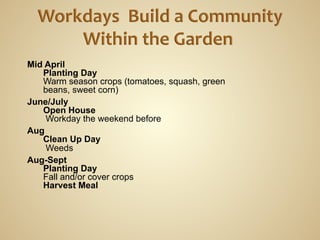
Mid April
   Planting Day
   Warm season crops (tomatoes, squash, green
   beans, sweet corn)
June/July
   Open House
    Workday the weekend before
Aug
   Clean Up Day
    Weeds
Aug-Sept
   Planting Day
   Fall and/or cover crops
   Harvest Meal
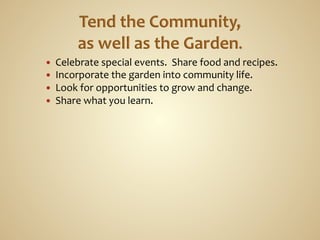
—    Celebrate	
  special	
  events.	
  	
  Share	
  food	
  and	
  recipes.	
  
—    Incorporate	
  the	
  garden	
  into	
  community	
  life.	
  
—    Look	
  for	
  opportunities	
  to	
  grow	
  and	
  change.	
  
—    Share	
  what	
  you	
  learn.	
  
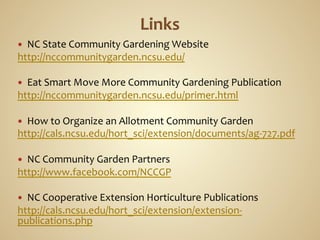
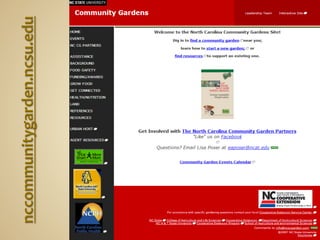
—   NC	
  State	
  Community	
  Gardening	
  Website	
  
http://nccommunitygarden.ncsu.edu/	


—  Eat	
  Smart	
  Move	
  More	
  Community	
  Gardening	
  Publication	
  
http://nccommunitygarden.ncsu.edu/primer.html	


—  How	
  to	
  Organize	
  an	
  Allotment	
  Community	
  Garden	
  
http://cals.ncsu.edu/hort_sci/extension/documents/ag-­‐727.pdf	


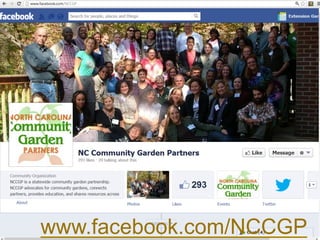
—  NC	
  Community	
  Garden	
  Partners	
  
http://www.facebook.com/NCCGP	


—  NC	
  Cooperative	
  Extension	
  Horticulture	
  Publications	
  
http://cals.ncsu.edu/hort_sci/extension/extension-­‐
publications.php	


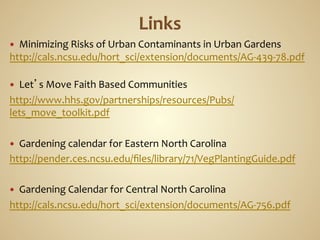
—   Minimizing	
  Risks	
  of	
  Urban	
  Contaminants	
  in	
  Urban	
  Gardens	
  
http://cals.ncsu.edu/hort_sci/extension/documents/AG-­‐439-­‐78.pdf	


—  Let’s	
  Move	
  Faith	
  Based	
  Communities	
  
http://www.hhs.gov/partnerships/resources/Pubs/
lets_move_toolkit.pdf	


—  Gardening	
  calendar	
  for	
  Eastern	
  North	
  Carolina	
  
http://pender.ces.ncsu.edu/files/library/71/VegPlantingGuide.pdf	


—  Gardening	
  Calendar	
  for	
  Central	
  North	
  Carolina	
  
http://cals.ncsu.edu/hort_sci/extension/documents/AG-­‐756.pdf	
  
—   Missouri	
  Community	
  Gardening	
  tool-­‐kit	
  with	
  forms	
  etc.	
  
http://extension.missouri.edu/explorepdf/miscpubs/mp0906.pdf	


—  Food	
  safety	
  in	
  the	
  community	
  garden.	
  
http://g.virbcdn.com/_f/files/0c/FileItem-­‐259929-­‐
FoodSafetyWebCurriculum.pdf	


www.facebook.com/NCCGP
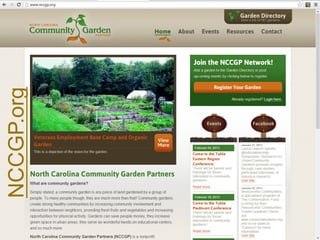
NCCGP.org
In	
  2008	
  –	
  There	
  were	
  an	
  estimated	
  173	
  million	
  Christians	
  in	
  the	
  US	
  
       and	
  almost	
  9	
  million	
  people	
  of	
  other	
  faiths.	


         Captive	
  audience	
  
         Willing	
  to	
  help	
  others	


Source:	
  http://www.census.gov/compendia/statab/2012/tables/12s0075.pdf	


—  Invite	
  various	
  groups,	
  associations,	
  and	
  people	
  in	
  your	
  
congregation	
  or	
  community	
  to	
  help	
  start	
  the	
  garden.	


—  	
  Involve	
  young	
  people	
  as	
  participants	
  in	
  the	
  garden.	


—  Consider	
  devoting	
  a	
  portion	
  of	
  the	
  garden	
  to	
  members	
  
of	
  youth	
  after	
  school	
  groups.	
  
Source:	
  	
  	
  http://www.hhs.gov/partnerships/resources/Pubs/lets_move_toolkit.pdf	
  
—  1.	
  Prayer	
  first.	
  	
  
—  2.Identify	
  who	
  in	
  your	
  Parish	
  is	
  interested	
  in	
  
gardening,	
  as	
  well	
  as	
  the	
  community	
  that	
  your	
  Parish	
  
resides	
  in.	
  There	
  is	
  strength	
  in	
  Unity.	
  	
  
—  3.	
  Prayer	
  before	
  all	
  activities	
  will	
  help	
  make	
  
miraculous	
  things	
  happen,	
  and	
  expect	
  things	
  to	
  happen	
  
in	
  “God’s	
  time”.	
  	
  
—  4.	
  Seek	
  out	
  donations	
  of	
  labor	
  and	
  supplies	
  from	
  your	
  
congregation’s	
  members.	
  
Source:http://g.virbcdn.com/_f/files/e1/FileItem-­‐259582-­‐
Howtostartafaithbasedcommunitygarden2.pdf	
  
 To	
  help	
  unify	
  our	
  local	
  community	
  since	
  food	
  is	
  
our	
  neighborhood	
  commonality.	


  We	
  will	
  accomplish	
  this	
  by	
  improving	
  our	
  local	
  
food	
  sources	
  and	
  by	
  empowering	
  people	
  to	
  feed	
  
themselves	
  with	
  self-­‐grown,	
  nutritious	
  and	
  affordable	
  
food.	


Source:	
  	
  http://g.virbcdn.com/_f/files/e1/FileItem-­‐259582-­‐
Howtostartafaithbasedcommunitygarden2.pdf	
  
—  Schedule	
  group	
  projects,	
  workdays,	
  and	
  garden	
  pot	
  
lucks	
  and	
  include	
  garden	
  prayers	
  services	
  as	
  an	
  
essential	
  component.	
  The	
  good	
  Lord	
  does	
  better	
  work	
  
that	
  we	
  do—keep	
  the	
  faith!	
  	
  
—  Plan	
  Church	
  community	
  workdays	
  to	
  complete	
  large	
  
projects,	
  such	
  as	
  the	
  actual	
  construction	
  of	
  the	
  garden,	
  
irrigation	
  system,	
  or	
  even	
  a	
  shed.	
  	
  
—  Enlist	
  the	
  additional	
  groups	
  from	
  the	
  church,	
  such	
  as	
  
youth	
  groups,	
  boy	
  scouts,	
  social	
  ministry,	
  ladies	
  guilds,	
  
etc.	
  	
  
Source:	
  http://g.virbcdn.com/_f/files/e1/FileItem-­‐259582-­‐
Howtostartafaithbasedcommunitygarden2.pdf	
  
—  Is	
  a	
  great	
  “unity	
  project”	
  that	
  also	
  provides	
  your	
  
church	
  community	
  with	
  an	
  abundance	
  of	
  healthy	
  and	
  
affordable	
  fresh	
  food.	


—  Food	
  is	
  our	
  neighborhood	
  commonality…	


—  Start	
  a	
  faith-­‐based	
  garden	
  today,	
  and	
  help	
  unify	
  your	
  
community!	


Source:	
  	
  http://g.virbcdn.com/_f/files/e1/FileItem-­‐259582-­‐
Howtostartafaithbasedcommunitygarden2.pdf	
  
—  Clear	
  statement	
  of	
  process	
  in	
  guidelines	
  

—  Contact	
  gardener	
  to	
  see	
  if	
  they	
  need	
  help	
  

—  Reassign	
  plot	
  quickly	
  

—  Plant	
  cover	
  crop	
  or	
  designate	
  as	
  shared	
  plot	
  
—  Clear	
  statement	
  in	
  agreement	
  

—  Strong	
  maintenance	
  committee	


—  Assign	
  all	
  plots,	
  or	
  plant	
  cover	
  crops	
  

—  Mulch	
  

—  Manage	
  abandoned	
  plots	
  quickly	
  

—  Don’t	
  allow	
  the	
  weeds	
  to	
  form	
  seeds	
  
—  Recruit	
  neighbors	
  to	
  participate	
  

—  Build	
  positive	
  relationship	


—  Keep	
  garden	
  looking	
  good	
  

—  Listen	
  &	
  Respect	


—  Be	
  considerate	
  –sound,	
  dust,	
  parking	
  
—  Model	
  respect,	
  compassion,	
  humor	
  
—  Build	
  peace	
  into	
  guidelines	
  

—  Design	
  garden	
  to	
  minimize	
  conflict	
  
       Wide	
  pathways	
  
       Group	
  organic	
  gardeners	
  together	
  

—  Act	
  quickly	
  to	
  resolve	
  differences	
  
—  Encourage	
  shared	
  responsibility	
  

—  Support	
  delegating,	
  mentoring	
  

—  Build	
  democratic	
  process	
  

—  Create	
  structure	
  
—     Have	
  clear	
  guidelines	


—     Harvest	
  	
  frequently	
  
—     Recruit	
  support	
  of	
  neighbors,	
  police	
  
—     You-­‐pick	
  garden	
  	
  &	
  sharing	
  basket	
  outside	
  fence	
  
—     Signs	
  
—     Plant	
  root	
  crops	
  and	
  unusual	
  varieties	
  along	
  fence	
  
—     Secure	
  furniture	
  with	
  cables	
  
—     Paint	
  tools	
  bright	
  colors	
  
—  Keep	
  garden	
  clean	
  –	
  lines	
  of	
  sight	
  open	
  

—  Define	
  boundaries	
  

—  Act	
  quickly	
  to	
  repair	
  damage	
  
is	
  the	


community.      	
  

Community gardening 101

  • 1.
    Lucy  Bradley,  Ph.D.   Urban  Horticulture  Specialist   NCSU  Cooperative  Extension     Joni  Torres   Community  Garden  Technician   Pitt  County  Cooperative  Extension     Maggie  Castor   Community  Gardener  
  • 2.
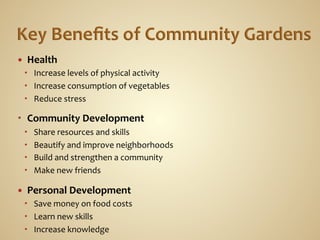
    —  Health      Increase  levels  of  physical  activity      Increase  consumption  of  vegetables      Reduce  stress        Community  Development      Share  resources  and  skills      Beautify  and  improve  neighborhoods      Build  and  strengthen  a  community      Make  new  friends     —  Personal  Development      Save  money  on  food  costs      Learn  new  skills      Increase  knowledge  
  • 3.
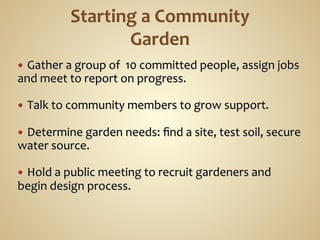
    —  Gather  a  group  of    10  committed  people,  assign  jobs   and  meet  to  report  on  progress.     —  Talk  to  community  members  to  grow  support.     —  Determine  garden  needs:  find  a  site,  test  soil,  secure   water  source.     —  Hold  a  public  meeting  to  recruit  gardeners  and   begin  design  process.  
  • 4.
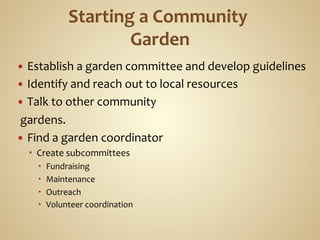
    —  Establish  a  garden  committee  and  develop  guidelines   —  Identify  and  reach  out  to  local  resources   —  Talk  to  other  community    gardens.   —  Find  a  garden  coordinator      Create  subcommittees      Fundraising      Maintenance      Outreach      Volunteer  coordination    
  • 5.
    —  Individual  talents  and  skills  within  your  group.      Fund  raisers,    building  skills,    computer  skills,  gardening  knowledge,   good  organizers  etc.   —  Associations      Civic  groups,    neighborhood  associations,  garden  clubs,  etc.   —  Institutions      Local  government  agencies,    colleges,  medical  centers,     —  Land  and  buildings      Parks,  community  centers,  churches,  schools,  recreational  centers   —  Local  economy      Nursery,  garden  center,  hardware  stores,  newspaper,  radio  station    
  • 6.
    —  County  Board  of  Health   —  Cooperative  Extension  Service   —  Soil  and  Water  Conservation   —  County  Planning  Department   —  County  Engineering  Department   —  Schools  and  Recreation   —  Senior  Center   —  Board  of  Education   —  Public  Information  Services   —  Local  Hospital  Foundation  
  • 7.
    —  Soil  test-­‐  for  heavy  metals,  pH,  fertility   —  Irrigation  –  hoses,  watering  cans,  wands   —   Tool  storage  –shed  or  deck  box   —  Tilling  costs   —  Soil  amendments      Lime,  compost,  manure,  mulch   —  Equipment       hand  tools,  shovels,  rakes,  hoe,        garden  fork,  pitch  fork,        wheelbarrow,  buckets      Hammer,  string  and  stakes      Tape  measure  (100  foot)       —  Sign   —  Fence    
  • 8.
    —  Find  a  Sponsor   —  Reduce  your  needs  -­‐  Budget      $1,000  -­‐  $5,000  startup      $1,000/year  on-­‐going   —  Seek  In-­‐Kind  donations   —  Raise  money      Donations      Events      Grants      Sales      Dues   —  Tell  your  story  –  Evaluation,  Annual  Report  
  • 9.
    —  Safe  &  Convenient   —  6-­‐8  hours  of  direct    sun   —  Access  to  affordable  water   —  Well  drained  site   —  Soil  is  not  contaminated   —  Available  for  at  least  5  years   —  Available  parking   —  Existing  Condition       (weeds,  trash,  fire  ants,etc)  
  • 10.
    —  Individual  or  communal  plots?   —  Plot  size?   —  Tool  shed  location   —  Composting  area   —  Shelter/gathering  space   —  Restroom  facilities   —  Fencing  
  • 11.
           Welcome  garden  is  main  entry  point  for  gardeners  and   visitors  and  serves  as  a  home  for  beneficial  insects.     —  Separate  areas  for  organic  and  non-­‐organic  gardeners   —   Plot  size  4’  x  20’   —  4’  paths  between  beds   —  8’  paths  in  central  areas   —  Central  location  of  children’s  garden  and  gathering   space   —  Multiple  locations  for  compost  bins  and  tools   —  Area  for  bulk  delivery  is  accessible  to  trucks   —  8’  tall  fence  to  keep  out  deer  and  other  wildlife  
  • 12.
    Cooperation  with  all  gardeners  and  a  general  respect  for  others’   space  is  appreciated.  Please  read  each  of  these  rules  carefully  as   you  will  be  asked  to  sign  an  agreement  and  to  abide  by  them.    *No  animals  allowed    *No  weeds  going  to  seed    *Stay  within  your  boundaries  of  your  plot,  as  established                by  the  Garden  Coordinator  at  the  beginning  of  the        season    *Don’t  shade  or  water  anyone  else’s  area                            *  Do  not  harvest  from  someone  else’s  plot    *Keep  your  space  neat  and  clean  and  remove  trash  from        site    *Turn  off  the  water  and  put  hoses  back  when  finished    *Compost  bins  are  for  compost  only                    
  • 13.
    _________Community  Garden  and  all  project   volunteers  shall  be  held  free  from  any  liability  for  any   personal  injuries  or  damage  to  property  resulting   from  your  participation  in  the  _______  Community   Garden.     Gardeners  must  sign  their  agreement  to  follow   guidelines  and  the  hold  harmless  clause.    
  • 14.
    Standard  Business  Policy     Get  added  to  church  or  other  non  profit’s  coverage       (lower  cost)   General  liability  2,000,000/limit  1,000,000/occurrence      Bodily  damage      Property  damage   This  would  cover  all  gardeners  and  visitors                      (make  sure  volunteers  are  covered)   v Medical  $5000/person/yr   v Name  location  of  garden    if  it  is  at  a  different  site  
  • 15.
    —  Set  Garden  Guidelines  (organic,  pesticide  free,  low   toxic)  allow  flexibility     —  Develop  a  packet  of  information  for  gardeners     —  Hold  workshops  based  on  gardener’s  needs  and   interests.   —  Lots  of  great  resources      See  resource    links  
  • 16.
    —  Plan  Events  and  Educational  Opportunities      Invite  the  general  public   —  Create  a  communication  network:         email,  website,  newsletter,  bulletin  board,  phone  tree,    etc.  
  • 17.
    Mid April Planting Day Warm season crops (tomatoes, squash, green beans, sweet corn) June/July Open House Workday the weekend before Aug Clean Up Day Weeds Aug-Sept Planting Day Fall and/or cover crops Harvest Meal
  • 18.
    —  Celebrate  special  events.    Share  food  and  recipes.   —  Incorporate  the  garden  into  community  life.   —  Look  for  opportunities  to  grow  and  change.   —  Share  what  you  learn.  
  • 19.
    —  NC  State  Community  Gardening  Website   http://nccommunitygarden.ncsu.edu/     —  Eat  Smart  Move  More  Community  Gardening  Publication   http://nccommunitygarden.ncsu.edu/primer.html     —  How  to  Organize  an  Allotment  Community  Garden   http://cals.ncsu.edu/hort_sci/extension/documents/ag-­‐727.pdf     —  NC  Community  Garden  Partners   http://www.facebook.com/NCCGP     —  NC  Cooperative  Extension  Horticulture  Publications   http://cals.ncsu.edu/hort_sci/extension/extension-­‐ publications.php    
  • 20.
    —  Minimizing  Risks  of  Urban  Contaminants  in  Urban  Gardens   http://cals.ncsu.edu/hort_sci/extension/documents/AG-­‐439-­‐78.pdf     —  Let’s  Move  Faith  Based  Communities   http://www.hhs.gov/partnerships/resources/Pubs/ lets_move_toolkit.pdf     —  Gardening  calendar  for  Eastern  North  Carolina   http://pender.ces.ncsu.edu/files/library/71/VegPlantingGuide.pdf     —  Gardening  Calendar  for  Central  North  Carolina   http://cals.ncsu.edu/hort_sci/extension/documents/AG-­‐756.pdf  
  • 21.
    —  Missouri  Community  Gardening  tool-­‐kit  with  forms  etc.   http://extension.missouri.edu/explorepdf/miscpubs/mp0906.pdf     —  Food  safety  in  the  community  garden.   http://g.virbcdn.com/_f/files/0c/FileItem-­‐259929-­‐ FoodSafetyWebCurriculum.pdf      
  • 23.
  • 24.
  • 25.
    In  2008  –  There  were  an  estimated  173  million  Christians  in  the  US   and  almost  9  million  people  of  other  faiths.       Captive  audience     Willing  to  help  others     Source:  http://www.census.gov/compendia/statab/2012/tables/12s0075.pdf    
  • 26.
      —  Invite  various  groups,  associations,  and  people  in  your   congregation  or  community  to  help  start  the  garden.     —   Involve  young  people  as  participants  in  the  garden.       —  Consider  devoting  a  portion  of  the  garden  to  members   of  youth  after  school  groups.   Source:      http://www.hhs.gov/partnerships/resources/Pubs/lets_move_toolkit.pdf  
  • 27.
    —  1.  Prayer  first.     —  2.Identify  who  in  your  Parish  is  interested  in   gardening,  as  well  as  the  community  that  your  Parish   resides  in.  There  is  strength  in  Unity.     —  3.  Prayer  before  all  activities  will  help  make   miraculous  things  happen,  and  expect  things  to  happen   in  “God’s  time”.     —  4.  Seek  out  donations  of  labor  and  supplies  from  your   congregation’s  members.   Source:http://g.virbcdn.com/_f/files/e1/FileItem-­‐259582-­‐ Howtostartafaithbasedcommunitygarden2.pdf  
  • 28.
     To  help  unify  our  local  community  since  food  is   our  neighborhood  commonality.      We  will  accomplish  this  by  improving  our  local   food  sources  and  by  empowering  people  to  feed   themselves  with  self-­‐grown,  nutritious  and  affordable   food.     Source:    http://g.virbcdn.com/_f/files/e1/FileItem-­‐259582-­‐ Howtostartafaithbasedcommunitygarden2.pdf  
  • 29.
    —  Schedule  group  projects,  workdays,  and  garden  pot   lucks  and  include  garden  prayers  services  as  an   essential  component.  The  good  Lord  does  better  work   that  we  do—keep  the  faith!     —  Plan  Church  community  workdays  to  complete  large   projects,  such  as  the  actual  construction  of  the  garden,   irrigation  system,  or  even  a  shed.     —  Enlist  the  additional  groups  from  the  church,  such  as   youth  groups,  boy  scouts,  social  ministry,  ladies  guilds,   etc.     Source:  http://g.virbcdn.com/_f/files/e1/FileItem-­‐259582-­‐ Howtostartafaithbasedcommunitygarden2.pdf  
  • 30.
    —  Is  a  great  “unity  project”  that  also  provides  your   church  community  with  an  abundance  of  healthy  and   affordable  fresh  food.     —  Food  is  our  neighborhood  commonality…       —  Start  a  faith-­‐based  garden  today,  and  help  unify  your   community!       Source:    http://g.virbcdn.com/_f/files/e1/FileItem-­‐259582-­‐ Howtostartafaithbasedcommunitygarden2.pdf  
  • 31.
    —  Clear  statement  of  process  in  guidelines   —  Contact  gardener  to  see  if  they  need  help   —  Reassign  plot  quickly   —  Plant  cover  crop  or  designate  as  shared  plot  
  • 32.
    —  Clear  statement  in  agreement   —  Strong  maintenance  committee     —  Assign  all  plots,  or  plant  cover  crops   —  Mulch   —  Manage  abandoned  plots  quickly   —  Don’t  allow  the  weeds  to  form  seeds  
  • 33.
    —  Recruit  neighbors  to  participate   —  Build  positive  relationship     —  Keep  garden  looking  good   —  Listen  &  Respect     —  Be  considerate  –sound,  dust,  parking  
  • 34.
    —  Model  respect,  compassion,  humor   —  Build  peace  into  guidelines   —  Design  garden  to  minimize  conflict      Wide  pathways      Group  organic  gardeners  together   —  Act  quickly  to  resolve  differences  
  • 35.
    —  Encourage  shared  responsibility   —  Support  delegating,  mentoring   —  Build  democratic  process   —  Create  structure  
  • 36.
    —  Have  clear  guidelines     —  Harvest    frequently   —  Recruit  support  of  neighbors,  police   —  You-­‐pick  garden    &  sharing  basket  outside  fence   —  Signs   —  Plant  root  crops  and  unusual  varieties  along  fence   —  Secure  furniture  with  cables   —  Paint  tools  bright  colors  
  • 37.
    —  Keep  garden  clean  –  lines  of  sight  open   —  Define  boundaries   —  Act  quickly  to  repair  damage  
  • 38.
    is  the     community.