Download as PDF, PPTX




























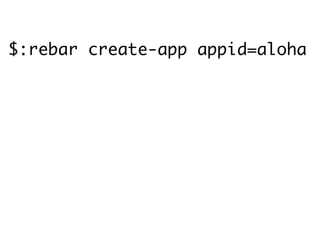

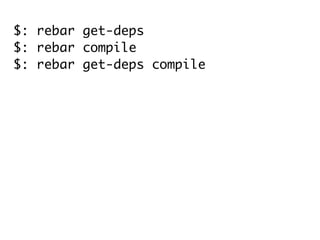
![1 % Compiler Options for rebar
2 {erl_opts, [
3 {src_dirs, ["src", "test"]},
4 debug_info
5 ]}.
6
7 % Dependencies
8 {deps, [
9 {elli, ".*", {git, "git://github.com/knutin/elli.git", "HEAD"}},
10 {etest, ".*", {git, "git://github.com/wooga/etest.git", "HEAD"}},
11 {etest_http, ".*", {git, "git://github.com/wooga/etest_http.git",
HEAD"}}
12 ]}.
13
14 % Which files to cleanup when rebar clean is executed.
15 {clean_files, ["ebin/*.beam"]}.](https://image.slidesharecdn.com/morethansyntax-121009160159-phpapp02/85/More-than-syntax-47-320.jpg)

![1 elli:start_link([
2 {callback, aloha_api},
3 {port, 3000}
4 ])](https://image.slidesharecdn.com/morethansyntax-121009160159-phpapp02/85/More-than-syntax-50-320.jpg)
![1 Path = [<<"foo">>, <<"bar">>],
2 HTTPMethod = "GET",
3 Request = {HTTPMethod, Path},
4 RouteDefinitions = [{{"GET",[<<"foo">>,<<"bar">>]},
{my_handler, my_method, []}}],
5 case erl_route_url:match(Request, RouteDefinitions) of
6 {error, notfound} ->
7 io:format("path not found");
8 {ok, Params, {M,F,_}} ->
9 apply(M,F,Params)
10 end.](https://image.slidesharecdn.com/morethansyntax-121009160159-phpapp02/85/More-than-syntax-52-320.jpg)


![1 handle(Req, _Args) ->
2 Path = elli_request:path(Req),
3 handle(Req#req.method, Path, Req).
4
5 handle('GET',[<<"foo">>, <<"bar"], Req) ->
6 {ok, [], <<"kekahi mau pipi">>};
7
8 handle(_, _, _Req) ->
9 {404, [], <<"wipe out!">>}.](https://image.slidesharecdn.com/morethansyntax-121009160159-phpapp02/85/More-than-syntax-55-320.jpg)
![1 Config = [
2 {mods, [
3 {aloha_ware, []},
4 {mahalo_ware, []},
5 ]}
6 ],
7
8 elli:start_link([
9 {callback, aloha_api},
10 {port, 3000},
11 {callback_args, Config}
12 ]).](https://image.slidesharecdn.com/morethansyntax-121009160159-phpapp02/85/More-than-syntax-57-320.jpg)
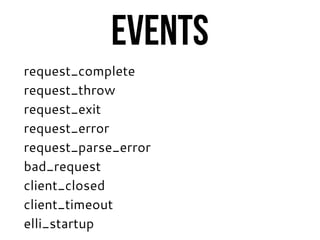
![1 handle_event(request_complete, [
2 Req,
3 ResponseCode,
4 ResponseHeaders,
5 ResponseBody,
6 Timings
7 ], Config) ->
8
9 TimingKeys = [
10 accepted,
11 request_start,
12 heades_end,
13 body_end,
14 user_start,
15 user_end,
16 request_end
17 ],
18 ok;](https://image.slidesharecdn.com/morethansyntax-121009160159-phpapp02/85/More-than-syntax-59-320.jpg)
![1 handle_event(request_throw, [
2 Req,
3 Exception,Stack
4 ], _Config) ->
5 ok;
6
7 handle_event(request_exit, [
8 Req,
9 Exit,
10 Stack
11 ], _Config) ->
12 ok;
13
14 handle_event(request_error, [
15 Req,
16 Error,
17 Stack
18 ], _Config) ->
19 ok;
20](https://image.slidesharecdn.com/morethansyntax-121009160159-phpapp02/85/More-than-syntax-61-320.jpg)

![1 [
Config file
2 {aloha, [
3 {worker_port, 3333}
4 ]
5 },
6
7 {lager, [
8 {handlers, [
9 {lager_console_backend, debug},
10 {lager_file_backend, [
11 {"log/debug.log", debug, 10485760, "$D0", 5},
12 {"log/error.log", error, 10485760, "$D0", 5},
13 {"log/console.log", info, 10485760, "$D0", 5}
14 ]}
15 ]}
16 ]}
17 ].](https://image.slidesharecdn.com/morethansyntax-121009160159-phpapp02/85/More-than-syntax-64-320.jpg)

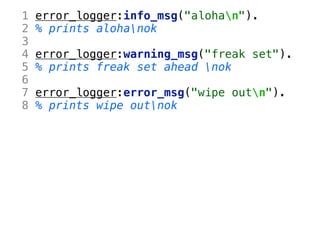

![=PROGRESS REPORT==== 8-Oct-2012::12:06:24 ===
supervisor: {local,sasl_safe_sup}
started: [{pid,<0.39.0>},
{name,overload},
{mfargs,{overload,start_link,
[]}},
{restart_type,permanent},
{shutdown,2000},
{child_type,worker}]
=PROGRESS REPORT==== 8-Oct-2012::12:06:24 ===
supervisor: {local,sasl_sup}
started: [{pid,<0.37.0>},
{name,sasl_safe_sup},
{mfargs,
{supervisor,start_link,
[{local,sasl_safe_sup},sasl,safe]}},](https://image.slidesharecdn.com/morethansyntax-121009160159-phpapp02/85/More-than-syntax-68-320.jpg)


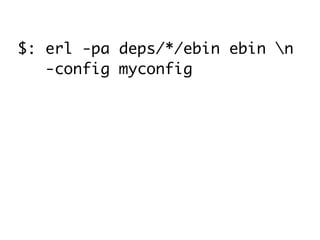
![1 [
Config file
2 {aloha, [
3 {worker_port, 3333}
4 ]
5 },
6
7 {lager, [
8 {handlers, [
9 {lager_console_backend, debug},
10 {lager_file_backend, [
11 {"log/debug.log", debug, 10485760, "$D0", 5},
12 {"log/error.log", error, 10485760, "$D0", 5},
13 {"log/console.log", info, 10485760, "$D0", 5}
14 ]}
15 ]}
16 ]}
17 ].](https://image.slidesharecdn.com/morethansyntax-121009160159-phpapp02/85/More-than-syntax-71-320.jpg)
![1 start(_StartType, _StartArgs) ->
2 ok = application:start(compiler),
3 ok = application:start(syntax_tools),
4 ok = application:start(lager),
5
6 % start mochiweb module reloader
7 reloader:start(),
8
9 elli:start_link([{callback, aloha_api}, {port, 3000}]),
10 aloha_sup:start_link().](https://image.slidesharecdn.com/morethansyntax-121009160159-phpapp02/85/More-than-syntax-72-320.jpg)
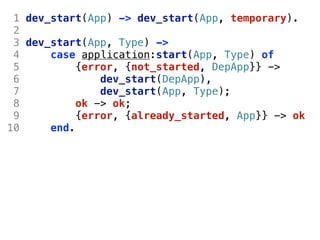
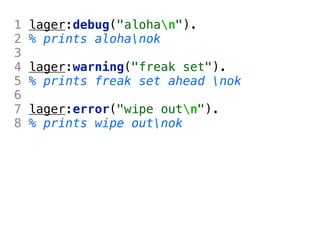




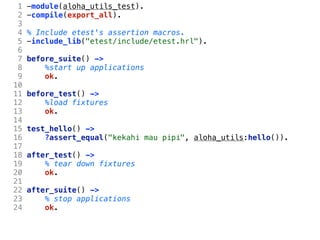



![1 start(_StartType, _StartArgs) ->
2 ok = application:start(compiler),
3 ok = application:start(syntax_tools),
4 ok = application:start(lager),
5
6 % start mochiweb module reloader
7 reloader:start(),
8
9 elli:start_link([{callback, aloha_api}, {port, 3000}]),
10 aloha_sup:start_link().](https://image.slidesharecdn.com/morethansyntax-121009160159-phpapp02/85/More-than-syntax-86-320.jpg)






![1 start(_StartType, _StartArgs) ->
2 ok = application:start(compiler),
3 ok = application:start(syntax_tools),
4 ok = application:start(lager),
5 reloader:start(),
6
7 {ok, DefaultPort} = application:get_env(aloha, worker_port),
8 Port = get_port(DefaultPort),
9
10 elli:start_link([{callback, aloha_api}, {port, Port}]),
11 aloha_sup:start_link().
12
13 get_port(Default) ->
14 Key = "PORT",
15 case os:getenv(Key) of
16 false -> Default;
17 Val -> list_to_integer(Val)
18 end.](https://image.slidesharecdn.com/morethansyntax-121009160159-phpapp02/85/More-than-syntax-98-320.jpg)

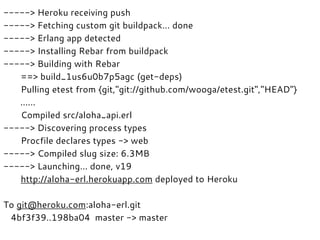



The document discusses the use of Erlang for web APIs with a focus on building a backend for a game application. It covers key aspects such as dependency management using rebar, configuration for routing, middleware support, and unit testing. Additionally, it provides steps for deploying the application to Heroku and lists various resources and acknowledgments related to the project.


