More about electricity an electronics Unit 6 continuation
ALTERNATING AND DIRECT CURRENT: AC DC
DIRECT CURRENT It’s the type of current, we get from batteries. IT’ S ALWAYS THE SAME
ALTERNATING CURRENT IMAGINE A BATTERY CHANGE BETWEEN THE POSITIVE TERMINAL AND THE NEGATIVE.  ALTERNATING CURRENT is the type of current we get from a plug or the main supply. WE DON’T GET ALWAYS THE SAME VALUE, BECAUSE ELECTRONS CHANGE THE  SENSE OF THEIR DIRECTION. THEY CHANGE IT 50 TIMES A SECOND.
WHY WE USE ALTERNATING CURRENT? Because this kind of electricity is easier to transport than the direct one
ELECTRIC ENERGY
What was voltage? The energy that gives a battery to the electrons to keep then moving through the wire.
This energy is given to a bulb, a resistor, a buzz, ... In these components is transformed into another way of energy.
How can we measure this energy? The energy that is consumed by an electrical appliance is calculated knowing the current(I) that pass through it, the voltage (V) that supports and the time working (t): E = V · I · t Unit: Jule, J
Something about electrical appliances Motors transform the electricity in movement Bulbs transform the electricity in light Resistors transform the energy in heat, so they are used in heaters
ELECTRIC POWER
The capacity of an electrical appliance to transform energy in a period of time. UNIT: Watt, W It can be calculate by :  P = V ·I
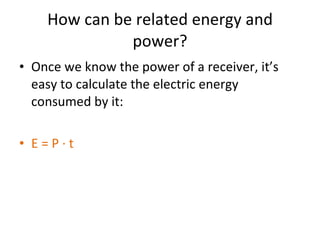
How can be related energy and power? Once we know the power of a receiver, it’s easy to calculate the electric energy consumed by it: E = P · t
El kilowatio hora y la factura de la luz If you express power in Kw and time in hours, you will get a new unit to energy, kwh. These is the unit that measure the consume of energy at home.
ELECTRONIC COMPONENTS
RESISTORS
Variable resistors o potentiometers It’s a kind of resistor with a value that can be adjusted between a cero and a maximum value given by the manufacturer
Resistor that depends of a physical property Light Dependent Resistors, LDR, the more light it receives, the less resistor it has. Thermistors: NTC (Negative Temperature Coefficient), the resistor decreases when the temperature increases PTC (Positive Temperature Coefficient), the resistor increases when the temperature increases
 
CAPACITORS
DIODES

More about electricity an electronics

  • 1.
    More about electricityan electronics Unit 6 continuation
  • 2.
    ALTERNATING AND DIRECTCURRENT: AC DC
  • 3.
    DIRECT CURRENT It’sthe type of current, we get from batteries. IT’ S ALWAYS THE SAME
  • 4.
    ALTERNATING CURRENT IMAGINEA BATTERY CHANGE BETWEEN THE POSITIVE TERMINAL AND THE NEGATIVE. ALTERNATING CURRENT is the type of current we get from a plug or the main supply. WE DON’T GET ALWAYS THE SAME VALUE, BECAUSE ELECTRONS CHANGE THE SENSE OF THEIR DIRECTION. THEY CHANGE IT 50 TIMES A SECOND.
  • 5.
    WHY WE USEALTERNATING CURRENT? Because this kind of electricity is easier to transport than the direct one
  • 6.
  • 7.
    What was voltage?The energy that gives a battery to the electrons to keep then moving through the wire.
  • 8.
    This energy isgiven to a bulb, a resistor, a buzz, ... In these components is transformed into another way of energy.
  • 9.
    How can wemeasure this energy? The energy that is consumed by an electrical appliance is calculated knowing the current(I) that pass through it, the voltage (V) that supports and the time working (t): E = V · I · t Unit: Jule, J
  • 10.
    Something about electricalappliances Motors transform the electricity in movement Bulbs transform the electricity in light Resistors transform the energy in heat, so they are used in heaters
  • 11.
  • 12.
    The capacity ofan electrical appliance to transform energy in a period of time. UNIT: Watt, W It can be calculate by : P = V ·I
  • 13.
    How can berelated energy and power? Once we know the power of a receiver, it’s easy to calculate the electric energy consumed by it: E = P · t
  • 14.
    El kilowatio horay la factura de la luz If you express power in Kw and time in hours, you will get a new unit to energy, kwh. These is the unit that measure the consume of energy at home.
  • 15.
  • 16.
  • 17.
    Variable resistors opotentiometers It’s a kind of resistor with a value that can be adjusted between a cero and a maximum value given by the manufacturer
  • 18.
    Resistor that dependsof a physical property Light Dependent Resistors, LDR, the more light it receives, the less resistor it has. Thermistors: NTC (Negative Temperature Coefficient), the resistor decreases when the temperature increases PTC (Positive Temperature Coefficient), the resistor increases when the temperature increases
  • 19.
  • 20.
  • 21.