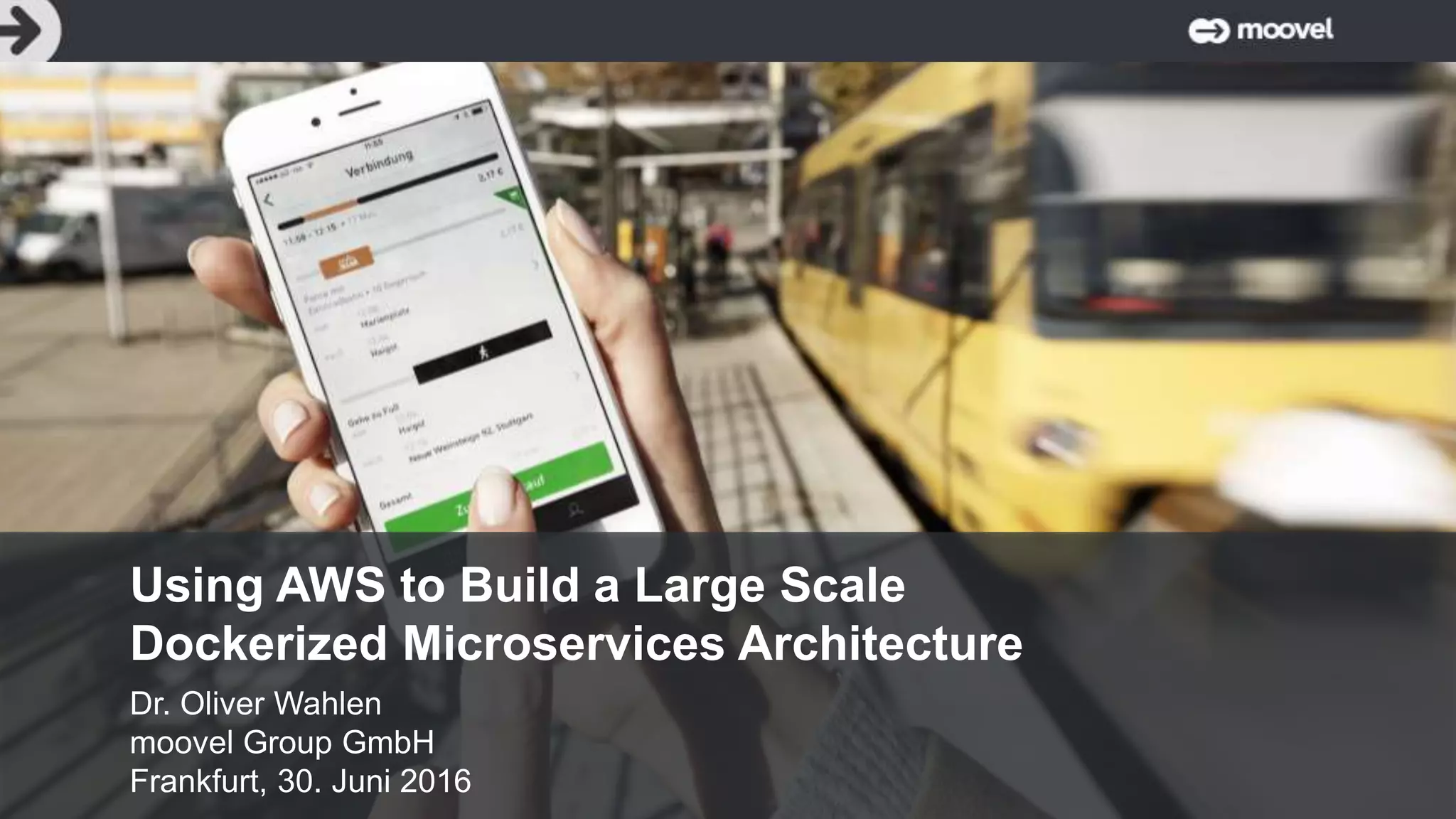

Using AWS to Build a Large Scale
Dockerized Microservices Architecture
Dr. Oliver Wahlen
moovel Group GmbH
Frankfurt, 30. Juni 2016
The moovel Group GmbH
Our vision is an ecosystem that
• simplifies mobility now
• solves the mobility challenges of the future
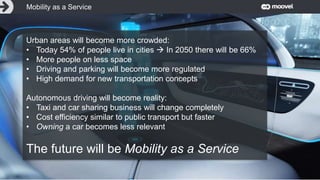
Mobility as a Service
Urban areas will become more crowded:
• Today 54% of people live in cities  In 2050 there will be 66%
• More people on less space
• Driving and parking will become more regulated
• High demand for new transportation concepts
Autonomous driving will become reality:
• Taxi and car sharing business will change completely
• Cost efficiency similar to public transport but faster
• Owning a car becomes less relevant
The future will be Mobility as a Service
Entwicklung 3: Autonomes Fahren
Wir verändern die Art,
wie wir uns fortbewegen.
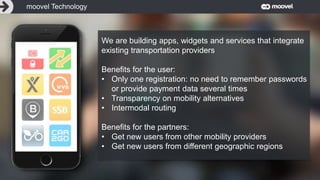
We are building apps, widgets and services that integrate
existing transportation providers
Benefits for the user:
• Only one registration: no need to remember passwords
or provide payment data several times
• Transparency on mobility alternatives
• Intermodal routing
Benefits for the partners:
• Get new users from other mobility providers
• Get new users from different geographic regions
moovel Technology
Entwicklung 3: Autonomes Fahren
Wir verändern die Art,
wie wir uns fortbewegen.
• Scalability up to millions of users
• Future prove: Easy to modify components and update technologies
• Usable on global scale
• Minimal operational effort
• Teams can develop independently
Design Goals of Our System Architecture
Entwicklung 3: Autonomes Fahren
Wir verändern die Art,
wie wir uns fortbewegen.
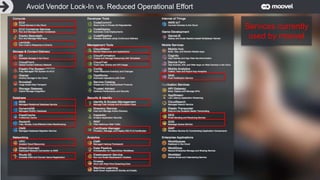
Avoid Vendor Lock-In vs. Reduced Operational Effort
Services currently
used by moovel
Entwicklung 3: Autonomes FahrenWhat and Why Docker?
Docker Containers
• Provide application(s) with a virtual operating system
• Isolate applications from the host OS and other docker containers
(e.g. Files, Network)
• Are self contained  run on any machine without other installs
• Are simple to build  images reference a base image
Docker Registry
• Stores docker images produced by the build system
• Provides access control and maintenance of tags
• Dockerhub (Docker Inc.) vs. Amazon EC2 Container Registry
Entwicklung 3: Autonomes FahrenWhat and Why EC2 Container Service (ECS)?
ECS is a highly scalable, fast, container management service that makes
it easy to run, stop, and manage Docker containers on a cluster of
Amazon EC2 instances.
– AWS documentation
Technology similar to Kubernetes on Google Container Engine
but tailored for AWS and fully managed
Terminology
• ECS cluster: Group of EC2 instances that allow docker execution
• ECS container instance: EC2 instance with ECS container agent
• ECS task: The running docker container on an instance
• ECS task definition: docker image, CPU, mem, port requirements, …
• ECS service: number of parallel tasks, scalability, health checks, …
Entwicklung 3: Autonomes FahrenWhat and Why Microservices?
http://martinfowler.com/articles/microservices.html
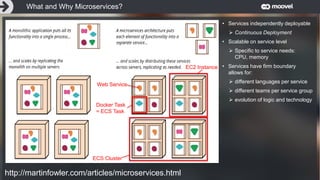
• Services independently deployable
 Continuous Deployment
• Scalable on service level
 Specific to service needs:
CPU, memory
• Services have firm boundary
allows for:
 different languages per service
 different teams per service group
 evolution of logic and technology
ECS Cluster
EC2 Instance
Docker Task
= ECS Task
Web Service
Entwicklung 3: Autonomes FahrenConway’s Law And Microservices: A Good Fit
Organizations which design
systems [...] are constrained to
produce designs which are copies
of the communication structures
of these organizations
– Melvin Conway 1967
Product Owner
App-Developers
Backend-Devs
Search
Squad
Book
Squad
User
Squad
Pay
Squad
moovel product dev is organized in squads (feature teams):
• with a long term business vision
• ability to build and modularize mobile apps / componets
• build their own set of microservices
• choose the technology that best fits their needs
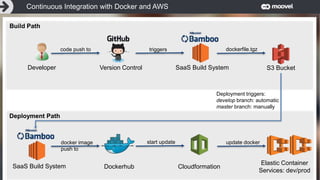
Entwicklung 3: Autonomes FahrenContinuous Integration with Docker and AWS
Developer
code push to
SaaS Build SystemVersion Control
triggers dockerfile.tgz
S3 Bucket
Build Path
SaaS Build System Dockerhub
Deployment triggers:
develop branch: automatic
master branch: manually
Deployment Path
docker image
push to
start update
Cloudformation
Elastic Container
Services: dev/prod
update docker
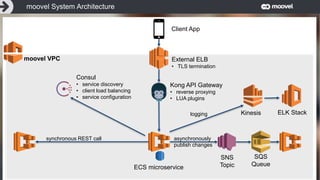
Entwicklung 3: Autonomes Fahrenmoovel System Architecture
moovel VPC
Client App
External ELB
• TLS termination
Kong API Gateway
• reverse proxying
• LUA plugins
Consul
• service discovery
• client load balancing
• service configuration
synchronous REST call
ECS microservice
SNS
Topic
SQS
Queue
asynchronously
publish changes
logging Kinesis ELK Stack
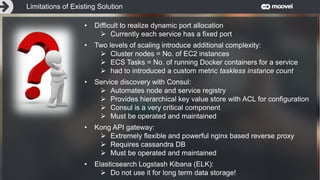
Entwicklung 3: Autonomes FahrenLimitations of Existing Solution
• Difficult to realize dynamic port allocation
 Currently each service has a fixed port
• Two levels of scaling introduce additional complexity:
 Cluster nodes = No. of EC2 instances
 ECS Tasks = No. of running Docker containers for a service
 had to introduced a custom metric taskless instance count
• Service discovery with Consul:
 Automates node and service registry
 Provides hierarchical key value store with ACL for configuration
 Consul is a very critical component
 Must be operated and maintained
• Kong API gateway:
 Extremely flexible and powerful nginx based reverse proxy
 Requires cassandra DB
 Must be operated and maintained
• Elasticsearch Logstash Kibana (ELK):
 Do not use it for long term data storage!
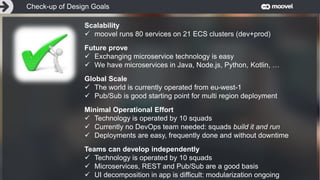
Entwicklung 3: Autonomes FahrenCheck-up of Design Goals
Scalability
 moovel runs 80 services on 21 ECS clusters (dev+prod)
Future prove
 Exchanging microservice technology is easy
 We have microservices in Java, Node.js, Python, Kotlin, …
Global Scale
 The world is currently operated from eu-west-1
 Pub/Sub is good starting point for multi region deployment
Minimal Operational Effort
 Technology is operated by 10 squads
 Currently no DevOps team needed: squads build it and run
 Deployments are easy, frequently done and without downtime
Teams can develop independently
 Technology is operated by 10 squads
 Microservices, REST and Pub/Sub are a good basis
 UI decomposition in app is difficult: modularization ongoing
Thank You

moovel aws summit Frankfurt 2016

  • 1.
    Using AWS toBuild a Large Scale Dockerized Microservices Architecture Dr. Oliver Wahlen moovel Group GmbH Frankfurt, 30. Juni 2016
  • 2.
    The moovel GroupGmbH Our vision is an ecosystem that • simplifies mobility now • solves the mobility challenges of the future
  • 3.
    Mobility as aService Urban areas will become more crowded: • Today 54% of people live in cities  In 2050 there will be 66% • More people on less space • Driving and parking will become more regulated • High demand for new transportation concepts Autonomous driving will become reality: • Taxi and car sharing business will change completely • Cost efficiency similar to public transport but faster • Owning a car becomes less relevant The future will be Mobility as a Service
  • 4.
    Entwicklung 3: AutonomesFahren Wir verändern die Art, wie wir uns fortbewegen. We are building apps, widgets and services that integrate existing transportation providers Benefits for the user: • Only one registration: no need to remember passwords or provide payment data several times • Transparency on mobility alternatives • Intermodal routing Benefits for the partners: • Get new users from other mobility providers • Get new users from different geographic regions moovel Technology
  • 5.
    Entwicklung 3: AutonomesFahren Wir verändern die Art, wie wir uns fortbewegen. • Scalability up to millions of users • Future prove: Easy to modify components and update technologies • Usable on global scale • Minimal operational effort • Teams can develop independently Design Goals of Our System Architecture
  • 6.
    Entwicklung 3: AutonomesFahren Wir verändern die Art, wie wir uns fortbewegen. Avoid Vendor Lock-In vs. Reduced Operational Effort Services currently used by moovel
  • 7.
    Entwicklung 3: AutonomesFahrenWhat and Why Docker? Docker Containers • Provide application(s) with a virtual operating system • Isolate applications from the host OS and other docker containers (e.g. Files, Network) • Are self contained  run on any machine without other installs • Are simple to build  images reference a base image Docker Registry • Stores docker images produced by the build system • Provides access control and maintenance of tags • Dockerhub (Docker Inc.) vs. Amazon EC2 Container Registry
  • 8.
    Entwicklung 3: AutonomesFahrenWhat and Why EC2 Container Service (ECS)? ECS is a highly scalable, fast, container management service that makes it easy to run, stop, and manage Docker containers on a cluster of Amazon EC2 instances. – AWS documentation Technology similar to Kubernetes on Google Container Engine but tailored for AWS and fully managed Terminology • ECS cluster: Group of EC2 instances that allow docker execution • ECS container instance: EC2 instance with ECS container agent • ECS task: The running docker container on an instance • ECS task definition: docker image, CPU, mem, port requirements, … • ECS service: number of parallel tasks, scalability, health checks, …
  • 9.
    Entwicklung 3: AutonomesFahrenWhat and Why Microservices? http://martinfowler.com/articles/microservices.html • Services independently deployable  Continuous Deployment • Scalable on service level  Specific to service needs: CPU, memory • Services have firm boundary allows for:  different languages per service  different teams per service group  evolution of logic and technology ECS Cluster EC2 Instance Docker Task = ECS Task Web Service
  • 10.
    Entwicklung 3: AutonomesFahrenConway’s Law And Microservices: A Good Fit Organizations which design systems [...] are constrained to produce designs which are copies of the communication structures of these organizations – Melvin Conway 1967 Product Owner App-Developers Backend-Devs Search Squad Book Squad User Squad Pay Squad moovel product dev is organized in squads (feature teams): • with a long term business vision • ability to build and modularize mobile apps / componets • build their own set of microservices • choose the technology that best fits their needs
  • 11.
    Entwicklung 3: AutonomesFahrenContinuous Integration with Docker and AWS Developer code push to SaaS Build SystemVersion Control triggers dockerfile.tgz S3 Bucket Build Path SaaS Build System Dockerhub Deployment triggers: develop branch: automatic master branch: manually Deployment Path docker image push to start update Cloudformation Elastic Container Services: dev/prod update docker
  • 12.
    Entwicklung 3: AutonomesFahrenmoovel System Architecture moovel VPC Client App External ELB • TLS termination Kong API Gateway • reverse proxying • LUA plugins Consul • service discovery • client load balancing • service configuration synchronous REST call ECS microservice SNS Topic SQS Queue asynchronously publish changes logging Kinesis ELK Stack
  • 13.
    Entwicklung 3: AutonomesFahrenLimitations of Existing Solution • Difficult to realize dynamic port allocation  Currently each service has a fixed port • Two levels of scaling introduce additional complexity:  Cluster nodes = No. of EC2 instances  ECS Tasks = No. of running Docker containers for a service  had to introduced a custom metric taskless instance count • Service discovery with Consul:  Automates node and service registry  Provides hierarchical key value store with ACL for configuration  Consul is a very critical component  Must be operated and maintained • Kong API gateway:  Extremely flexible and powerful nginx based reverse proxy  Requires cassandra DB  Must be operated and maintained • Elasticsearch Logstash Kibana (ELK):  Do not use it for long term data storage!
  • 14.
    Entwicklung 3: AutonomesFahrenCheck-up of Design Goals Scalability  moovel runs 80 services on 21 ECS clusters (dev+prod) Future prove  Exchanging microservice technology is easy  We have microservices in Java, Node.js, Python, Kotlin, … Global Scale  The world is currently operated from eu-west-1  Pub/Sub is good starting point for multi region deployment Minimal Operational Effort  Technology is operated by 10 squads  Currently no DevOps team needed: squads build it and run  Deployments are easy, frequently done and without downtime Teams can develop independently  Technology is operated by 10 squads  Microservices, REST and Pub/Sub are a good basis  UI decomposition in app is difficult: modularization ongoing
  • 15.