Reference Architecture for a Cloud Native
Digital Enterprise
June, 2021
Hello!
Lakmal Warusawithana
Senior Director - Solutions Architecture
lakmal@wso2.com
Cloud Native
What is cloud native?
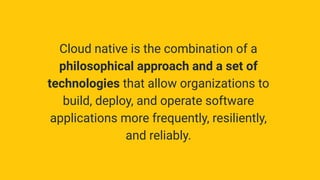
Cloud native is the combination of a
philosophical approach and a set of
technologies that allow organizations to
build, deploy, and operate software
applications more frequently, resiliently,
and reliably.
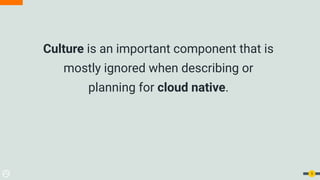
Culture is an important component that is
mostly ignored when describing or
planning for cloud native.
5
Teams which are Autonomous and small
(or correct in size), Releases that are
Frequent, Practices which are Automated
are some of the culture aspects that are
required to make becoming Cloud Native
successful
6
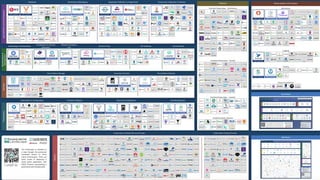
Cloud Native Landscape
Technology landscape for cloud native
8
Cloud Native Digital Architectures
Technology and architecture patterns for a digital enterprise
In an era of digital transformation, (digital)
enterprises are looking for fast innovation
through effective collaboration to deliver
more value to their customers with
dramatically less effort.
10
Digital Transformation requires business
services to be easily consumable - APIs
provide this. APIs alone may not be able to
connect to every endpoint that exists - API
led Integration completes this need.
11
Cloud native does frequent releases. It
requires agile requirements gathering,
design, architecture reviews, development,
testing, and deployment.
12
The combination of cloud native
technologies along with an API-led
integration platform creates an effective
architecture i.e.,
a Cloud Native Digital Enterprise
Reference Architecture: A Cloud Native
Digital Enterprise
Vendor/technology-neutral reference architecture
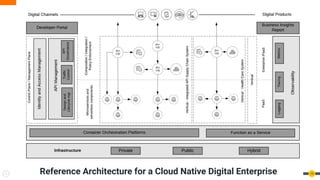
Reference Architecture for a Cloud Native Digital Enterprise
●
15
The control plane is the central location
where policies for services are defined.
These can be usage policies, security
policies etc.
API gateways play a key role by enforcing
policies that are defined in the control and
management plane. The gateway falls into
the data plane.
The data plane can be segregated into two
which are the base services and the
integration services.
18
A self-service developer portal is
important to build an effective API
ecosystem. This developer portal is what
will broaden out into an API Marketplace
portal.
19
The API marketplace is key to building an
API ecosystem by enabling multiple
parties to list and offer their APIs in a
single place.
20
Dashboards and reports help both
business and operations to gain a
360-degree view of the digital business.
21
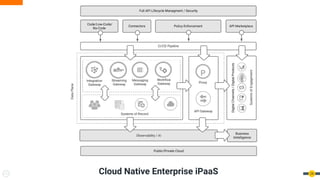
Cloud Native Enterprise iPaaS
A combination of cloud-centric integration technologies with the API
management capabilities
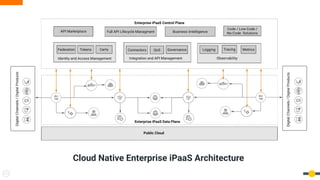
A combination of cloud-centric
integration technologies with the API
management capabilities provide a
significant platform, enterprise iPaaS, to
increase productivity by having agility,
flexibility, and scalability through
automation and services.
Cloud Native Enterprise iPaaS 24
API Lifecycle Management, Security and
the built-in API Observability tools
provides the necessary tooling foundation
for digital transformation. The API
Marketplace provides that common
ground for promoting APIs.
25
Security tooling in the platform brings in
the capability to define security policies,
manage tokens and protect APIs.
No-code/Low-code integration provides
out-of-the-box, cookie-cutter templates
for application integration with
drag-and-drop components.
27
Continuous Integration/Continuous
Delivery pipelines ensure fast rollout of
services while ensuring proper building,
testing and deployment in an automated
manner.
28
Cloud Native Enterprise iPaaS Architecture
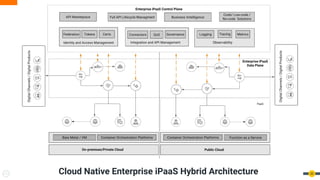
Cloud Native Enterprise iPaaS Hybrid
Architecture
Pragmatic way to scale
Compliance to data regulations, inability
to move legacy systems may require
some of the integration and enforcement
to happen on-prem.
31
Cloud Native Enterprise iPaaS Hybrid Architecture
●
32
32
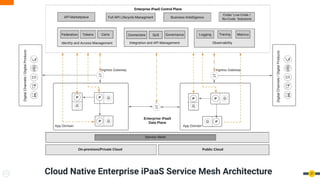
Cloud Native Enterprise iPaaS Service
Mesh Architecture
Service Mesh to address the fallacies of distributed computing
When Decomposing a monolith to
microservices, it is required to address the
fallacies of distributed computing as part
of their application logic.
Addressing these in each and every
microservice created will be too complex
and too tedious.
35
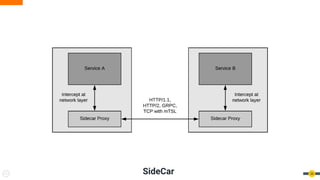
SideCar 36
Cloud Native Enterprise iPaaS Service Mesh Architecture
●
37
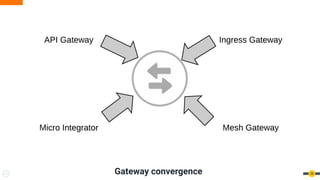
Gateway convergence 38
Read More
● Reference Architecture for a Cloud Native Digital Enterprise
This document describes a vendor/technology-neutral reference architecture for a cloud native digital
enterprise. The architecture defined in this paper can be mapped into different cloud-native platforms
(Kubernetes and service mesh), different cloud providers (Microsoft Azure, Amazon AWS, and Google
GCP), and infrastructure services to perform the implementation. These reference implementations will be
covered in separate papers.
● The Role of EiPaaS in Enterprise Architecture: Part 1
The Role of EiPaaS in Enterprise Architecture: Part 2
Enterprise architecture has evolved in parallel with changes in how organizations operate and advances in
technology — serving as the heart of the technology landscape, the connection between business and
technology, and the driving force in generating value streams. However, to achieve those objectives, an
enterprise architecture requires a future-proof integration platform and that’s where EiPaaS becomes the
neural system of a digitally-driven organization.
39
Read More
● Reference Implementation for a Cloud-Native Digital Enterprise
This paper presents a reference implementation for a cloud-native digital enterprise architecture described
in the Reference Architecture for a Cloud-Native Digital Enterprise. We will focus on an implementation
using Kubernetes and WSO2’s API-led integration platform.
● How to fail at Cloud Native
Every organization wants to move into cloud native to increase innovation and productivity. Many
organizations are failed in the cloud native journey by only adapting a set of cloud platforms, tools, and
techniques. But Cloud native is more than architecture or technology. It is a philosophical approach and a
culture change that allows organizations to utilize the benefits of all modern technologies like microservice
architecture, containers, Kubernetes, and CI/CD.
40
wso2.com
Thanks!

stackconf 2021 | Reference Architecture for a Cloud Native Digital Enterprise

  • 1.
    Reference Architecture fora Cloud Native Digital Enterprise June, 2021
  • 2.
    Hello! Lakmal Warusawithana Senior Director- Solutions Architecture lakmal@wso2.com
  • 3.
    Cloud Native What iscloud native?
  • 4.
    Cloud native isthe combination of a philosophical approach and a set of technologies that allow organizations to build, deploy, and operate software applications more frequently, resiliently, and reliably.
  • 5.
    Culture is animportant component that is mostly ignored when describing or planning for cloud native. 5
  • 6.
    Teams which areAutonomous and small (or correct in size), Releases that are Frequent, Practices which are Automated are some of the culture aspects that are required to make becoming Cloud Native successful 6
  • 7.
    Cloud Native Landscape Technologylandscape for cloud native
  • 8.
  • 9.
    Cloud Native DigitalArchitectures Technology and architecture patterns for a digital enterprise
  • 10.
    In an eraof digital transformation, (digital) enterprises are looking for fast innovation through effective collaboration to deliver more value to their customers with dramatically less effort. 10
  • 11.
    Digital Transformation requiresbusiness services to be easily consumable - APIs provide this. APIs alone may not be able to connect to every endpoint that exists - API led Integration completes this need. 11
  • 12.
    Cloud native doesfrequent releases. It requires agile requirements gathering, design, architecture reviews, development, testing, and deployment. 12
  • 13.
    The combination ofcloud native technologies along with an API-led integration platform creates an effective architecture i.e., a Cloud Native Digital Enterprise
  • 14.
    Reference Architecture: ACloud Native Digital Enterprise Vendor/technology-neutral reference architecture
  • 15.
    Reference Architecture fora Cloud Native Digital Enterprise ● 15
  • 16.
    The control planeis the central location where policies for services are defined. These can be usage policies, security policies etc.
  • 17.
    API gateways playa key role by enforcing policies that are defined in the control and management plane. The gateway falls into the data plane.
  • 18.
    The data planecan be segregated into two which are the base services and the integration services. 18
  • 19.
    A self-service developerportal is important to build an effective API ecosystem. This developer portal is what will broaden out into an API Marketplace portal. 19
  • 20.
    The API marketplaceis key to building an API ecosystem by enabling multiple parties to list and offer their APIs in a single place. 20
  • 21.
    Dashboards and reportshelp both business and operations to gain a 360-degree view of the digital business. 21
  • 22.
    Cloud Native EnterpriseiPaaS A combination of cloud-centric integration technologies with the API management capabilities
  • 23.
    A combination ofcloud-centric integration technologies with the API management capabilities provide a significant platform, enterprise iPaaS, to increase productivity by having agility, flexibility, and scalability through automation and services.
  • 24.
  • 25.
    API Lifecycle Management,Security and the built-in API Observability tools provides the necessary tooling foundation for digital transformation. The API Marketplace provides that common ground for promoting APIs. 25
  • 26.
    Security tooling inthe platform brings in the capability to define security policies, manage tokens and protect APIs.
  • 27.
    No-code/Low-code integration provides out-of-the-box,cookie-cutter templates for application integration with drag-and-drop components. 27
  • 28.
    Continuous Integration/Continuous Delivery pipelinesensure fast rollout of services while ensuring proper building, testing and deployment in an automated manner. 28
  • 29.
    Cloud Native EnterpriseiPaaS Architecture
  • 30.
    Cloud Native EnterpriseiPaaS Hybrid Architecture Pragmatic way to scale
  • 31.
    Compliance to dataregulations, inability to move legacy systems may require some of the integration and enforcement to happen on-prem. 31
  • 32.
    Cloud Native EnterpriseiPaaS Hybrid Architecture ● 32 32
  • 33.
    Cloud Native EnterpriseiPaaS Service Mesh Architecture Service Mesh to address the fallacies of distributed computing
  • 34.
    When Decomposing amonolith to microservices, it is required to address the fallacies of distributed computing as part of their application logic.
  • 35.
    Addressing these ineach and every microservice created will be too complex and too tedious. 35
  • 36.
  • 37.
    Cloud Native EnterpriseiPaaS Service Mesh Architecture ● 37
  • 38.
  • 39.
    Read More ● ReferenceArchitecture for a Cloud Native Digital Enterprise This document describes a vendor/technology-neutral reference architecture for a cloud native digital enterprise. The architecture defined in this paper can be mapped into different cloud-native platforms (Kubernetes and service mesh), different cloud providers (Microsoft Azure, Amazon AWS, and Google GCP), and infrastructure services to perform the implementation. These reference implementations will be covered in separate papers. ● The Role of EiPaaS in Enterprise Architecture: Part 1 The Role of EiPaaS in Enterprise Architecture: Part 2 Enterprise architecture has evolved in parallel with changes in how organizations operate and advances in technology — serving as the heart of the technology landscape, the connection between business and technology, and the driving force in generating value streams. However, to achieve those objectives, an enterprise architecture requires a future-proof integration platform and that’s where EiPaaS becomes the neural system of a digitally-driven organization. 39
  • 40.
    Read More ● ReferenceImplementation for a Cloud-Native Digital Enterprise This paper presents a reference implementation for a cloud-native digital enterprise architecture described in the Reference Architecture for a Cloud-Native Digital Enterprise. We will focus on an implementation using Kubernetes and WSO2’s API-led integration platform. ● How to fail at Cloud Native Every organization wants to move into cloud native to increase innovation and productivity. Many organizations are failed in the cloud native journey by only adapting a set of cloud platforms, tools, and techniques. But Cloud native is more than architecture or technology. It is a philosophical approach and a culture change that allows organizations to utilize the benefits of all modern technologies like microservice architecture, containers, Kubernetes, and CI/CD. 40
  • 41.