” Moodling in Japanese”:   A report on a Moodle-based “Hybrid” First-year Japanese course" Kaoru Ohta University of Washington
Hybrid? One~three hours of classroom instruction is replaced by web-based materials Why? For college, it saves $$ For language program, …
Goals 1) Eliminates time/place constraints (anywhere at anytime), 2) ”Repeatable" format, 3) Learn independently of instructors.
Independently of instructor??? Classroom activities that can be done outside of classroom??? Vocabulary Quiz Kanji Recognition Quiz, etc. Learning activities that students prefer individualized exercises??? Reading comprehension Listening comprehension Activities that technology can expand students involvement???  Audio recording > submission via “collection box”
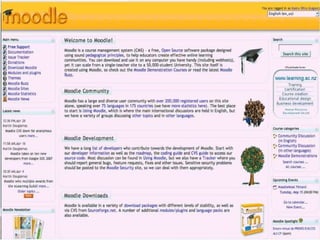
Moodle??? Modular (or Martin) Object-Oriented Dynamic Learning Environment http://moodle.org/
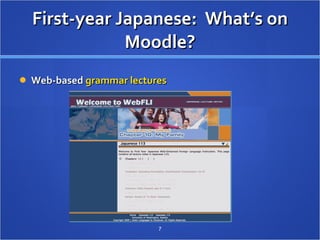
First-year Japanese:  What’s on Moodle? Web-based  grammar lectures
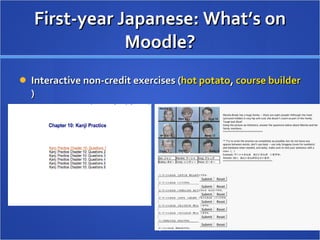
First-year Japanese: What’s on Moodle? Interactive non-credit exercises ( hot potato ,  course builder )
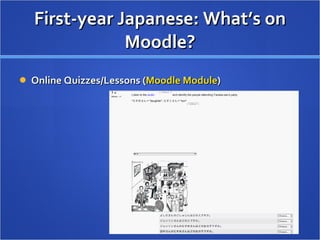
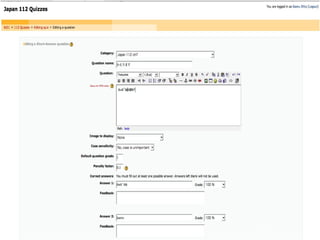
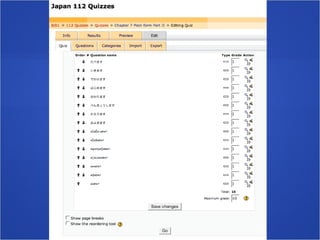
First-year Japanese: What’s on Moodle? Online Quizzes/Lessons ( Moodle  Module )
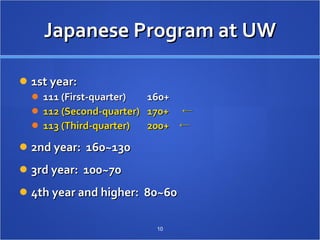
Japanese Program at UW 1st year:  111 (First-quarter) 160+ 112 (Second-quarter) 170+  ← 113 (Third-quarter) 200+ ← 2nd year:  160~130 3rd year:  100~70 4th year and higher:  80~60
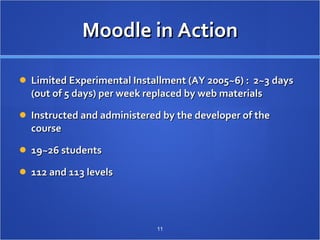
Moodle in Action Limited Experimental Installment (AY 2005~6) :  2~3 days (out of 5 days) per week replaced by web materials Instructed and administered by the developer of the course 19~26 students 112 and 113 levels  
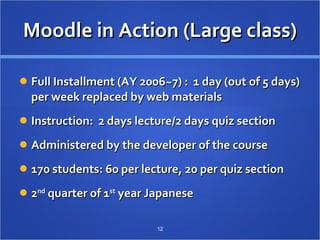
Moodle in Action (Large class) Full Installment (AY 2006~7) :  1 day (out of 5 days) per week replaced by web materials Instruction:  2 days lecture/2 days quiz section Administered by the developer of the course 170 students: 60 per lecture, 20 per quiz section 2 nd  quarter of 1 st  year Japanese  
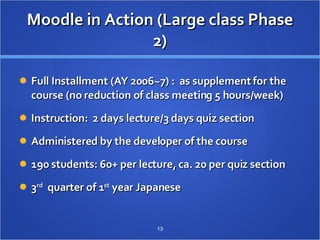
Moodle in Action (Large class Phase 2) Full Installment (AY 2006~7) :  as supplement for the course (no reduction of class meeting 5 hours/week) Instruction:  2 days lecture/3 days quiz section Administered by the developer of the course 190 students: 60+ per lecture, ca. 20 per quiz section 3 rd   quarter of 1 st  year Japanese  
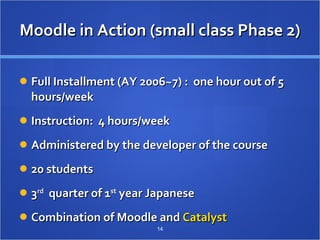
Moodle in Action (small class Phase 2) Full Installment (AY 2006~7) :  one hour out of 5 hours/week Instruction:  4 hours/week Administered by the developer of the course 20 students 3 rd   quarter of 1 st  year Japanese Combination of Moodle and  Catalyst  
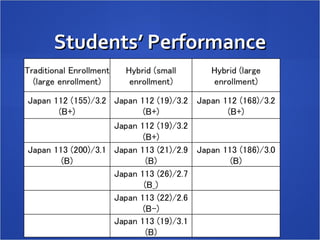
Students’ Performance
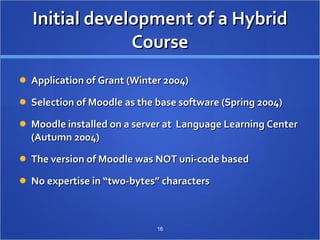
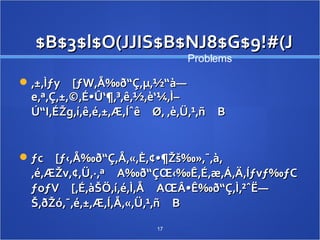
Initial development of a Hybrid Course Application of Grant (Winter 2004) Selection of Moodle as the base software (Spring 2004) Moodle installed on a server at  Language Learning Center (Autumn 2004) The version of Moodle was NOT uni-code based No expertise in “two-bytes” characters
$B$3$l$O(JJIS$B$NJ8$G$9!#(J ‚ ±‚̃y  [ƒW‚ʼnð“Ç‚µ‚½“à—e‚ª‚Ç‚±‚©‚ɕۑ¶‚³‚ꂽ‚葼‚Ì–Ú“I‚ÉŽg‚í‚ê‚邱‚Æ‚Íˆê  Ø‚ ‚è‚Ü‚¹‚ñ  B ƒc  [ƒ‹‚ʼnð“ǂł«‚È‚¢•¶Žš‰»‚¯‚à‚ ‚邯Žv‚¢‚Ü‚·‚ª  A‰ð“ÇŒ‹‰Ê‚É‚æ‚Á‚Ă̓vƒ‰ƒCƒoƒV  [‚É‚àŠÖ‚í‚é‚̂Ё AŒÂ•ʉð“ǂ̂²ˆË—Š‚ðŽó‚¯‚邱‚Ƃ͂ł«‚Ü‚¹‚ñ  B Problems
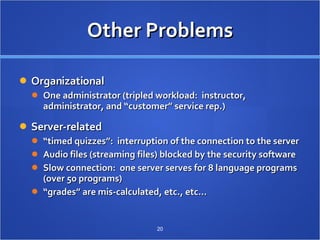
Other Problems Organizational One administrator (tripled workload:  instructor, administrator, and “customer” service rep.) Server-related “ timed quizzes”:  interruption of the connection to the server Audio files (streaming files) blocked by the security software Slow connection:  one server serves for 8 language programs (over 50 programs) “ grades” are mis-calculated, etc., etc…
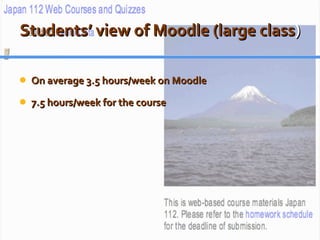
Students’ view of Moodle (large class ) On average 3.5 hours/week on Moodle 7.5 hours/week for the course
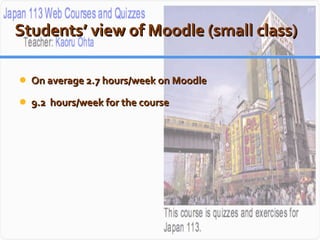
Students’ view of Moodle (small class) On average 2.7 hours/week on Moodle 9.2  hours/week for the course
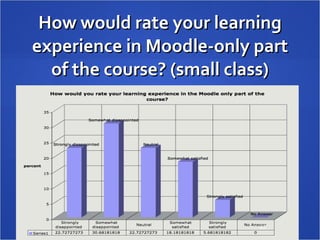
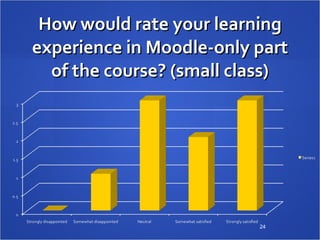
How would rate your learning experience in Moodle-only part of the course? (small class)
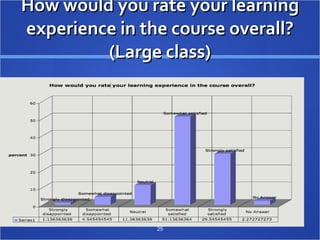
How would you rate your learning experience in the course overall? (Large class)
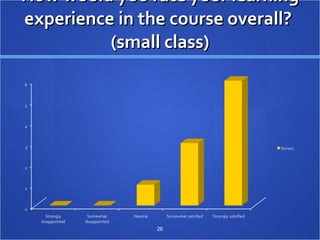
How would you rate your learning experience in the course overall?  (small class)
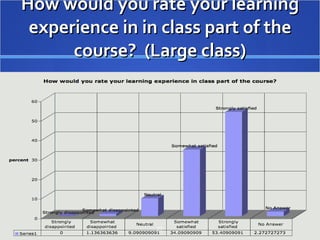
How would you rate your learning experience in in class part of the course?  (Large class)
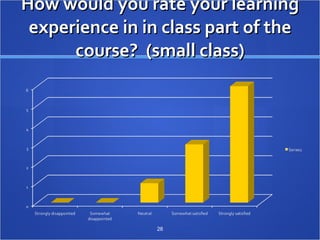
How would you rate your learning experience in in class part of the course?  (small class)
Small Group Discussion Additional Practice (out of classroom experience, repetitive, additional exposure to language) Listening practice (at own pace, something beyond textbook materials, more opportunities) Learn to type in Japanese (and learn the correct pronunciation:  金曜日 (ki-N(nn)-yo-o-bi) ended up with  来尿日 (ki-n-yo-o-bi) ) Helpful for review Self-study Freedom to work at our own pace and according to our own schedule More specific feedback from the main instructor than you get from TAs (depending on TAs) Redundancy (repetition) helps reinforcement
What are students views of Moodle? The only problem i had with Moodle was that for longer answers what was desired was often not explained well enough to pass the activity the first attempt. Other then that i really liked  it especially sense [sic. ]  i knew right away when i made a mistake, rather then having to look later. I am not a huge fan of moodle.  I don't like waiting for it to load because sometimes it is extremely slow.  It is also a hassle   because it only takes one specific answer on some questions when there could be more than one correct answer .  I have spent many nights trying to understand and beat moodle and I am so glad my relationship with it is almost over.
What are students’ views of Moodle? s I liked the Moodle component part of the class. It really help me learn vocabulary by doing the quizzes. The quizzes on Moodle also helped me with understanding the sturcture of the grammar learned in class.  It was another way to practice what we learn in class, which made the material in class easier to understand and I was able to do the quizzes in class because I had practice. It would have been helpful if the feedback response was on because sometimes I was stuck on a question and I didn't know how to answer .  I just kept tying what I know and hope it was right. I liked that we had speech to do because that really helped prepare for the oral interview.
What are students’ views of Moodle? I think that it should give like tips or hints after a while.  Sometimes I would be stuck for a long time unable to figure out  what it was either asking, or what the answer was. I feel that the online quizzes and reading comprehension and listening comprehension components of Moodle were very helpful.  I got a lot of practice reading, writing, and listening Japanese, and it allowed me to see if I really did understand what I was reading or listening to .  It also provided very good resources for extra examples of the different sentence structures and vocabulary words.   It benefited me a lot in this course.
So, what did I learn from this?? the answers for online activities are easily guessable (multiple choice, true/false over fill-in-the-blanks) students feel that online activities give something that traditional in-class activities cannot provide easily online activities aim at reviewing the course contents, rather than testing skills and knowledge just learned, and  hybrid online courses can be effectively done in a small group setting

Moodling in Japanese

  • 1.
    ” Moodling inJapanese”: A report on a Moodle-based “Hybrid” First-year Japanese course" Kaoru Ohta University of Washington
  • 2.
    Hybrid? One~three hoursof classroom instruction is replaced by web-based materials Why? For college, it saves $$ For language program, …
  • 3.
    Goals 1) Eliminatestime/place constraints (anywhere at anytime), 2) ”Repeatable" format, 3) Learn independently of instructors.
  • 4.
    Independently of instructor???Classroom activities that can be done outside of classroom??? Vocabulary Quiz Kanji Recognition Quiz, etc. Learning activities that students prefer individualized exercises??? Reading comprehension Listening comprehension Activities that technology can expand students involvement??? Audio recording > submission via “collection box”
  • 5.
    Moodle??? Modular (orMartin) Object-Oriented Dynamic Learning Environment http://moodle.org/
  • 7.
    First-year Japanese: What’s on Moodle? Web-based grammar lectures
  • 8.
    First-year Japanese: What’son Moodle? Interactive non-credit exercises ( hot potato , course builder )
  • 9.
    First-year Japanese: What’son Moodle? Online Quizzes/Lessons ( Moodle Module )
  • 10.
    Japanese Program atUW 1st year: 111 (First-quarter) 160+ 112 (Second-quarter) 170+  ← 113 (Third-quarter) 200+ ← 2nd year: 160~130 3rd year: 100~70 4th year and higher: 80~60
  • 11.
    Moodle in ActionLimited Experimental Installment (AY 2005~6) : 2~3 days (out of 5 days) per week replaced by web materials Instructed and administered by the developer of the course 19~26 students 112 and 113 levels  
  • 12.
    Moodle in Action(Large class) Full Installment (AY 2006~7) : 1 day (out of 5 days) per week replaced by web materials Instruction: 2 days lecture/2 days quiz section Administered by the developer of the course 170 students: 60 per lecture, 20 per quiz section 2 nd quarter of 1 st year Japanese  
  • 13.
    Moodle in Action(Large class Phase 2) Full Installment (AY 2006~7) : as supplement for the course (no reduction of class meeting 5 hours/week) Instruction: 2 days lecture/3 days quiz section Administered by the developer of the course 190 students: 60+ per lecture, ca. 20 per quiz section 3 rd quarter of 1 st year Japanese  
  • 14.
    Moodle in Action(small class Phase 2) Full Installment (AY 2006~7) : one hour out of 5 hours/week Instruction: 4 hours/week Administered by the developer of the course 20 students 3 rd quarter of 1 st year Japanese Combination of Moodle and Catalyst  
  • 15.
  • 16.
    Initial development ofa Hybrid Course Application of Grant (Winter 2004) Selection of Moodle as the base software (Spring 2004) Moodle installed on a server at Language Learning Center (Autumn 2004) The version of Moodle was NOT uni-code based No expertise in “two-bytes” characters
  • 17.
    $B$3$l$O(JJIS$B$NJ8$G$9!#(J ‚ ±‚̃y [ƒW‚ʼnð“Ç‚µ‚½“à—e‚ª‚Ç‚±‚©‚ɕۑ¶‚³‚ꂽ‚葼‚Ì–Ú“I‚ÉŽg‚í‚ê‚邱‚Æ‚Íˆê  Ø‚ ‚è‚Ü‚¹‚ñ  B ƒc  [ƒ‹‚ʼnð“ǂł«‚È‚¢•¶Žš‰»‚¯‚à‚ ‚邯Žv‚¢‚Ü‚·‚ª  A‰ð“ÇŒ‹‰Ê‚É‚æ‚Á‚Ă̓vƒ‰ƒCƒoƒV  [‚É‚àŠÖ‚í‚é‚̂Ё AŒÂ•ʉð“ǂ̂²ˆË—Š‚ðŽó‚¯‚邱‚Ƃ͂ł«‚Ü‚¹‚ñ  B Problems
  • 20.
    Other Problems OrganizationalOne administrator (tripled workload: instructor, administrator, and “customer” service rep.) Server-related “ timed quizzes”: interruption of the connection to the server Audio files (streaming files) blocked by the security software Slow connection: one server serves for 8 language programs (over 50 programs) “ grades” are mis-calculated, etc., etc…
  • 21.
    Students’ view ofMoodle (large class ) On average 3.5 hours/week on Moodle 7.5 hours/week for the course
  • 22.
    Students’ view ofMoodle (small class) On average 2.7 hours/week on Moodle 9.2 hours/week for the course
  • 23.
    How would rateyour learning experience in Moodle-only part of the course? (small class)
  • 24.
    How would rateyour learning experience in Moodle-only part of the course? (small class)
  • 25.
    How would yourate your learning experience in the course overall? (Large class)
  • 26.
    How would yourate your learning experience in the course overall? (small class)
  • 27.
    How would yourate your learning experience in in class part of the course? (Large class)
  • 28.
    How would yourate your learning experience in in class part of the course? (small class)
  • 29.
    Small Group DiscussionAdditional Practice (out of classroom experience, repetitive, additional exposure to language) Listening practice (at own pace, something beyond textbook materials, more opportunities) Learn to type in Japanese (and learn the correct pronunciation: 金曜日 (ki-N(nn)-yo-o-bi) ended up with 来尿日 (ki-n-yo-o-bi) ) Helpful for review Self-study Freedom to work at our own pace and according to our own schedule More specific feedback from the main instructor than you get from TAs (depending on TAs) Redundancy (repetition) helps reinforcement
  • 30.
    What are studentsviews of Moodle? The only problem i had with Moodle was that for longer answers what was desired was often not explained well enough to pass the activity the first attempt. Other then that i really liked it especially sense [sic. ] i knew right away when i made a mistake, rather then having to look later. I am not a huge fan of moodle. I don't like waiting for it to load because sometimes it is extremely slow. It is also a hassle because it only takes one specific answer on some questions when there could be more than one correct answer . I have spent many nights trying to understand and beat moodle and I am so glad my relationship with it is almost over.
  • 31.
    What are students’views of Moodle? s I liked the Moodle component part of the class. It really help me learn vocabulary by doing the quizzes. The quizzes on Moodle also helped me with understanding the sturcture of the grammar learned in class. It was another way to practice what we learn in class, which made the material in class easier to understand and I was able to do the quizzes in class because I had practice. It would have been helpful if the feedback response was on because sometimes I was stuck on a question and I didn't know how to answer . I just kept tying what I know and hope it was right. I liked that we had speech to do because that really helped prepare for the oral interview.
  • 32.
    What are students’views of Moodle? I think that it should give like tips or hints after a while. Sometimes I would be stuck for a long time unable to figure out what it was either asking, or what the answer was. I feel that the online quizzes and reading comprehension and listening comprehension components of Moodle were very helpful. I got a lot of practice reading, writing, and listening Japanese, and it allowed me to see if I really did understand what I was reading or listening to . It also provided very good resources for extra examples of the different sentence structures and vocabulary words. It benefited me a lot in this course.
  • 33.
    So, what didI learn from this?? the answers for online activities are easily guessable (multiple choice, true/false over fill-in-the-blanks) students feel that online activities give something that traditional in-class activities cannot provide easily online activities aim at reviewing the course contents, rather than testing skills and knowledge just learned, and hybrid online courses can be effectively done in a small group setting