I.S.F.D LENGUAS VIVAS BARILOCHE –
PRÁCTICA DOCENTE III
ENTREGA DE PLANIFICACIÓN
ALUMNO PRACTICANTE: Viñolo, Bárbara
Institución educativa: ISG St George Institute
Año y sección: Teens 4
Nivel lingüístico del curso: Intermediate
Cantidad de alumnos: 13
Tipo de Planificación: Clase
Unidad Temática: Future
Clase Nº: 5
Duración de la clase: 90 minutos
Fecha de la clase: 9th September
Fecha de entrega de la planificación: 4th September
Learning Aims
During this lesson, learners will be able to…
 Learn situations in which misunderstanding can happen.
 Learn phrases to deal with misunderstanding by developing a daily situation in which
they can be used.
 Develop listening skills and speaking skills through production activities.
 Develop language skills and the four essential skills by working in collaborative tasks
in which they have to make use of the phrases learned throughout the lesson in daily
conversations prepared by themselves.
Language Focus
LEXIS FUNCTIONS STRUCTURE
R
E
V
N
E
W
Phrases to show
misunderstanding: wrong
number, got the date wrong,
wrong address, we thought, a
different (person / place),
with the same name, didn´t
recognize / realise, etc.
Dealing with
misunderstandings.
Past Tense + phrases to share
misunderstanding:
 It was a wrong number
 she didn´t recognize / realise.
 It was a different Peter Smith.
 We thought…
 I´d got the wrong address.
Materials
Computer and projector (in the classroom).
Speakers.
Student´s computer (as half of the group will attend to the lesson online)
Student´s academic material: Speak Out Intermediate – Student´s Book.
Video resource: https://www.youtube.com/watch?v=EHmZvu2yAZk
Procedures
For the English lessons, students receive and send activities through a Whatsapp group. I will
send them the link for the videocall meeting through a private Whatsapp group the institution
shares with the students as well as with their parents. Moreover, the lesson plan will be
uploaded to a webpage called “Educabot” which the institution chose as a campus for their
students.
ROUTINE (5 minutes)
Purpose: To get students be ready to start the lesson.
I will greet students and ask them how they are today. While the teacher listens to students´
comments, she will ask each of them to take a seat. As the teacher listens to them, she will
prepare her computer to connect online with the other half of students.
Transition comment to link each stage of the lessonwith the next one: Hello everybody!
Let´s start this lesson with a new topic which I know you know about… Are you ready?
Warm – up (10 - 15 minutes)
Purpose: To introduce the topic.
I will present students a video which is full of different sounds and they have to guess where
is the sound from. The video used will be the following:
https://www.youtube.com/watch?v=EHmZvu2yAZk
Then, I will ask students the following questions:
Do you know any other sound that can be misunderstood?
Have you ever experienced a misunderstanding situation? What happened?
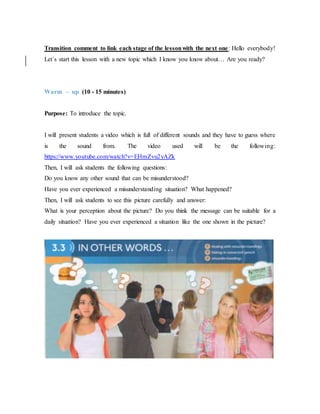
Then, I will ask students to see this picture carefully and answer:
What is your perception about the picture? Do you think the message can be suitable for a
daily situation? Have you ever experienced a situation like the one shown in the picture?
The aim of this activity is to know students´ prior knowledge about misunderstanding issues,
not focusing on the structure used to answer the questions (even though, the structure used
to answer “Have you ever….?” questions are already known by students from previous years
learning English at the institution). In this activity, I will supervise the activity and help
students if they needed, giving them time to work on their use of language and responsibility
on their own learning process.
Transition comment to link each stage of the lessonwith the next one: Well done! You
shared a lot of different situations that can present misunderstood messages… but Do you
know how to tell a person that you don´t understand the message? Let´s see some useful
phrases…
Presentation: (10 – 15 minutes)
Purpose: To encourage students to understand the meaning of a message and how
misunderstanding is presented in simple situations.
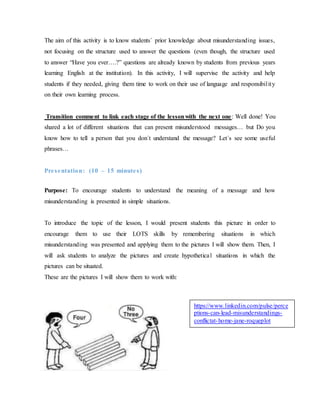
To introduce the topic of the lesson, I would present students this picture in order to
encourage them to use their LOTS skills by remembering situations in which
misunderstanding was presented and applying them to the pictures I will show them. Then, I
will ask students to analyze the pictures and create hypothetical situations in which the
pictures can be situated.
These are the pictures I will show them to work with:
https://www.linkedin.com/pulse/perce
ptions-can-lead-misunderstandings-
conflictat-home-jane-roqueplot
Scaffolding strategies: Visual support (pictures to illustrate situations), open-ended
questions to guide students´ search for the possible answers to each situation.
Transition comment to link each stage of the lessonwith the next one: Well done! Now
we are ready to check our understanding about misunderstanding by completing some
exercises… Are you ready?
DEVELOP M ENT (PRACTI CE and PRODUCTI ON)
Activity 1: (15 - 20 minutes)
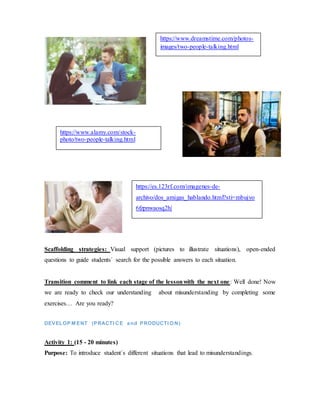
Purpose: To introduce student´s different situations that lead to misunderstandings.
https://www.dreamstime.com/photos-
images/two-people-talking.html
https://www.alamy.com/stock-
photo/two-people-talking.html
https://es.123rf.com/imagenes-de-
archivo/dos_amigas_hablando.html?sti=mbujyo
6fzpnwaosq2h|
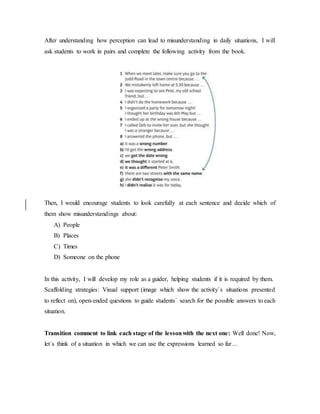
After understanding how perception can lead to misunderstanding in daily situations, I will
ask students to work in pairs and complete the following activity from the book.
Then, I would encourage students to look carefully at each sentence and decide which of
them show misunderstandings about:
A) People
B) Places
C) Times
D) Someone on the phone
In this activity, I will develop my role as a guider, helping students if it is required by them.
Scaffolding strategies: Visual support (image which show the activity´s situations presented
to reflect on), open-ended questions to guide students´ search for the possible answers to each
situation.
Transition comment to link each stage of the lessonwith the next one: Well done! Now,
let´s think of a situation in which we can use the expressions learned so far…
Activity 2: (10 - 15 minutes)
Purpose: To encourage students to check their understanding about misunderstanding
situations by producing a conversation by themselves.
After classifying ways of dealing with misunderstanding, I will encourage students to work
in pairs and present a situation in which misunderstanding is presented and how it can be
solved to create a coherent dialogue between two people. Then, I will ask each pair to present
their situation to the class.
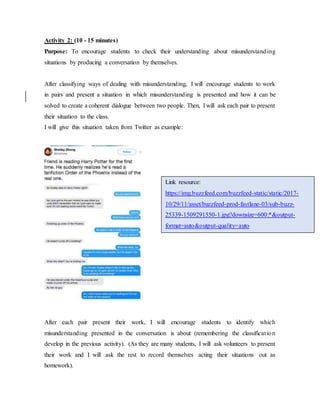
I will give this situation taken from Twitter as example:
After each pair present their work, I will encourage students to identify which
misunderstanding presented in the conversation is about (remembering the classification
develop in the previous activity). (As they are many students, I will ask volunteers to present
their work and I will ask the rest to record themselves acting their situations out as
homework).
Link resource:
https://img.buzzfeed.com/buzzfeed-static/static/2017-
10/29/11/asset/buzzfeed-prod-fastlane-03/sub-buzz-
25339-1509291550-1.jpg?downsize=600:*&output-
format=auto&output-quality=auto
Scaffolding strategies: Visual aids, giving students a situation as an example thinking on
their own interests, encourage collaborative work between students to work on their own
learning process / knowledge through practise tasks.
Transition comment to link each stage of the lessonwith the next one: Well done! Now,
have you ever found yourself weird in a phone conversation because you don´t get the
message? Let´s listen to some conversation and see how misunderstanding is presented in
them.
Activity 3: (15 - 20 minutes)
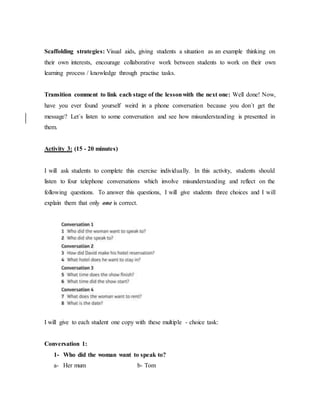
I will ask students to complete this exercise individually. In this activity, students should
listen to four telephone conversations which involve misunderstanding and reflect on the
following questions. To answer this questions, I will give students three choices and I will
explain them that only one is correct.
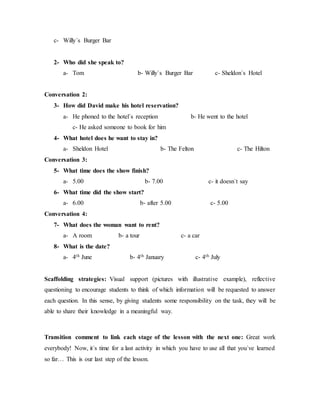
I will give to each student one copy with these multiple - choice task:
Conversation 1:
1- Who did the woman want to speak to?
a- Her mum b- Tom
c- Willy´s Burger Bar
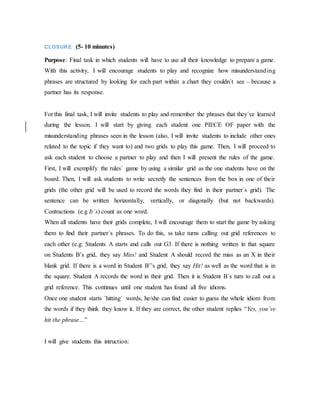
2- Who did she speak to?
a- Tom b- Willy´s Burger Bar c- Sheldon´s Hotel
Conversation 2:
3- How did David make his hotel reservation?
a- He phoned to the hotel´s reception b- He went to the hotel
c- He asked someone to book for him
4- What hotel does he want to stay in?
a- Sheldon Hotel b- The Felton c- The Hilton
Conversation 3:
5- What time does the show finish?
a- 5.00 b- 7.00 c- it doesn´t say
6- What time did the show start?
a- 6.00 b- after 5.00 c- 5.00
Conversation 4:
7- What does the woman want to rent?
a- A room b- a tour c- a car
8- What is the date?
a- 4th June b- 4th January c- 4th July
Scaffolding strategies: Visual support (pictures with illustrative example), reflective
questioning to encourage students to think of which information will be requested to answer
each question. In this sense, by giving students some responsibility on the task, they will be
able to share their knowledge in a meaningful way.
Transition comment to link each stage of the lesson with the next one: Great work
everybody! Now, it´s time for a last activity in which you have to use all that you´ve learned
so far… This is our last step of the lesson.
CLOSURE (5- 10 minutes)
Purpose: Final task in which students will have to use all their knowledge to prepare a game.
With this activity, I will encourage students to play and recognize how misunderstanding
phrases are structured by looking for each part within a chart they couldn´t see – because a
partner has its response.
For this final task, I will invite students to play and remember the phrases that they´ve learned
during the lesson. I will start by giving each student one PIECE OF paper with the
misunderstanding phrases seen in the lesson (also, I will invite students to include other ones
related to the topic if they want to) and two grids to play this game. Then, I will proceed to
ask each student to choose a partner to play and then I will present the rules of the game.
First, I will exemplify the rules´ game by using a similar grid as the one students have on the
board. Then, I will ask students to write secretly the sentences from the box in one of their
grids (the other grid will be used to record the words they find in their partner´s grid). The
sentence can be written horizontally, vertically, or diagonally (but not backwards).
Contractions (e.g It´s) count as one word.
When all students have their grids complete, I will encourage them to start the game by asking
them to find their partner´s phrases. To do this, ss take turns calling out grid references to
each other (e.g: Students A starts and calls out G3. If there is nothing written in that square
on Students B’s grid, they say Miss! and Student A should record the miss as an X in their
blank grid. If there is a word in Student B’’s grid, they say Hit! as well as the word that is in
the square. Student A records the word in their grid. Then it is Student B´s turn to call out a
grid reference. This continues until one student has found all five idioms.
Once one student starts ´hitting´ words, he/she can find easier to guess the whole idiom from
the words if they think they know it. If they are correct, the other student replies “Yes, you´ve
hit the phrase…”
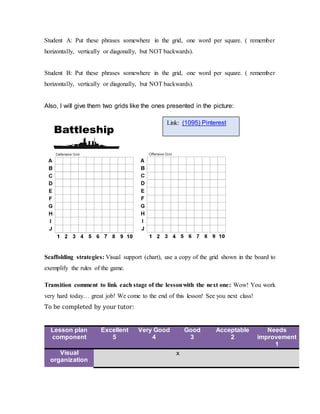
I will give students this intruction:
Student A: Put these phrases somewhere in the grid, one word per square. ( remember
horizontally, vertically or diagonally, but NOT backwards).
Student B: Put these phrases somewhere in the grid, one word per square. ( remember
horizontally, vertically or diagonally, but NOT backwards).
Also, I will give them two grids like the ones presented in the picture:
Scaffolding strategies: Visual support (chart), use a copy of the grid shown in the board to
exemplify the rules of the game.
Transition comment to link each stage of the lessonwith the next one: Wow! You work
very hard today… great job! We come to the end of this lesson! See you next class!
To be completed by your tutor:
Lesson plan
component
Excellent
5
Very Good
4
Good
3
Acceptable
2
Needs
improvement
1
Visual
organization
x
Link: (1095) Pinterest
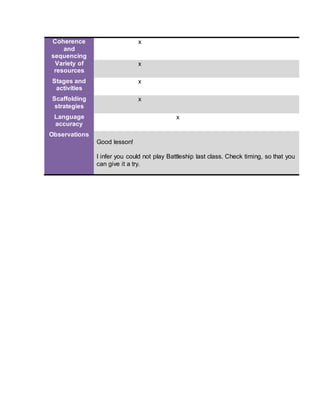
Coherence
and
sequencing
x
Variety of
resources
x
Stages and
activities
x
Scaffolding
strategies
x
Language
accuracy
x
Observations
Good lesson!
I infer you could not play Battleship last class. Check timing, so that you
can give it a try.

Lesson 9th September

  • 1.
    I.S.F.D LENGUAS VIVASBARILOCHE – PRÁCTICA DOCENTE III ENTREGA DE PLANIFICACIÓN ALUMNO PRACTICANTE: Viñolo, Bárbara Institución educativa: ISG St George Institute Año y sección: Teens 4 Nivel lingüístico del curso: Intermediate Cantidad de alumnos: 13 Tipo de Planificación: Clase Unidad Temática: Future Clase Nº: 5 Duración de la clase: 90 minutos Fecha de la clase: 9th September Fecha de entrega de la planificación: 4th September Learning Aims During this lesson, learners will be able to…  Learn situations in which misunderstanding can happen.  Learn phrases to deal with misunderstanding by developing a daily situation in which they can be used.  Develop listening skills and speaking skills through production activities.  Develop language skills and the four essential skills by working in collaborative tasks in which they have to make use of the phrases learned throughout the lesson in daily conversations prepared by themselves. Language Focus LEXIS FUNCTIONS STRUCTURE R E V
  • 2.
    N E W Phrases to show misunderstanding:wrong number, got the date wrong, wrong address, we thought, a different (person / place), with the same name, didn´t recognize / realise, etc. Dealing with misunderstandings. Past Tense + phrases to share misunderstanding:  It was a wrong number  she didn´t recognize / realise.  It was a different Peter Smith.  We thought…  I´d got the wrong address. Materials Computer and projector (in the classroom). Speakers. Student´s computer (as half of the group will attend to the lesson online) Student´s academic material: Speak Out Intermediate – Student´s Book. Video resource: https://www.youtube.com/watch?v=EHmZvu2yAZk Procedures For the English lessons, students receive and send activities through a Whatsapp group. I will send them the link for the videocall meeting through a private Whatsapp group the institution shares with the students as well as with their parents. Moreover, the lesson plan will be uploaded to a webpage called “Educabot” which the institution chose as a campus for their students. ROUTINE (5 minutes) Purpose: To get students be ready to start the lesson. I will greet students and ask them how they are today. While the teacher listens to students´ comments, she will ask each of them to take a seat. As the teacher listens to them, she will prepare her computer to connect online with the other half of students.
  • 3.
    Transition comment tolink each stage of the lessonwith the next one: Hello everybody! Let´s start this lesson with a new topic which I know you know about… Are you ready? Warm – up (10 - 15 minutes) Purpose: To introduce the topic. I will present students a video which is full of different sounds and they have to guess where is the sound from. The video used will be the following: https://www.youtube.com/watch?v=EHmZvu2yAZk Then, I will ask students the following questions: Do you know any other sound that can be misunderstood? Have you ever experienced a misunderstanding situation? What happened? Then, I will ask students to see this picture carefully and answer: What is your perception about the picture? Do you think the message can be suitable for a daily situation? Have you ever experienced a situation like the one shown in the picture?
  • 4.
    The aim ofthis activity is to know students´ prior knowledge about misunderstanding issues, not focusing on the structure used to answer the questions (even though, the structure used to answer “Have you ever….?” questions are already known by students from previous years learning English at the institution). In this activity, I will supervise the activity and help students if they needed, giving them time to work on their use of language and responsibility on their own learning process. Transition comment to link each stage of the lessonwith the next one: Well done! You shared a lot of different situations that can present misunderstood messages… but Do you know how to tell a person that you don´t understand the message? Let´s see some useful phrases… Presentation: (10 – 15 minutes) Purpose: To encourage students to understand the meaning of a message and how misunderstanding is presented in simple situations. To introduce the topic of the lesson, I would present students this picture in order to encourage them to use their LOTS skills by remembering situations in which misunderstanding was presented and applying them to the pictures I will show them. Then, I will ask students to analyze the pictures and create hypothetical situations in which the pictures can be situated. These are the pictures I will show them to work with: https://www.linkedin.com/pulse/perce ptions-can-lead-misunderstandings- conflictat-home-jane-roqueplot
  • 5.
    Scaffolding strategies: Visualsupport (pictures to illustrate situations), open-ended questions to guide students´ search for the possible answers to each situation. Transition comment to link each stage of the lessonwith the next one: Well done! Now we are ready to check our understanding about misunderstanding by completing some exercises… Are you ready? DEVELOP M ENT (PRACTI CE and PRODUCTI ON) Activity 1: (15 - 20 minutes) Purpose: To introduce student´s different situations that lead to misunderstandings. https://www.dreamstime.com/photos- images/two-people-talking.html https://www.alamy.com/stock- photo/two-people-talking.html https://es.123rf.com/imagenes-de- archivo/dos_amigas_hablando.html?sti=mbujyo 6fzpnwaosq2h|
  • 6.
    After understanding howperception can lead to misunderstanding in daily situations, I will ask students to work in pairs and complete the following activity from the book. Then, I would encourage students to look carefully at each sentence and decide which of them show misunderstandings about: A) People B) Places C) Times D) Someone on the phone In this activity, I will develop my role as a guider, helping students if it is required by them. Scaffolding strategies: Visual support (image which show the activity´s situations presented to reflect on), open-ended questions to guide students´ search for the possible answers to each situation. Transition comment to link each stage of the lessonwith the next one: Well done! Now, let´s think of a situation in which we can use the expressions learned so far…
  • 7.
    Activity 2: (10- 15 minutes) Purpose: To encourage students to check their understanding about misunderstanding situations by producing a conversation by themselves. After classifying ways of dealing with misunderstanding, I will encourage students to work in pairs and present a situation in which misunderstanding is presented and how it can be solved to create a coherent dialogue between two people. Then, I will ask each pair to present their situation to the class. I will give this situation taken from Twitter as example: After each pair present their work, I will encourage students to identify which misunderstanding presented in the conversation is about (remembering the classification develop in the previous activity). (As they are many students, I will ask volunteers to present their work and I will ask the rest to record themselves acting their situations out as homework). Link resource: https://img.buzzfeed.com/buzzfeed-static/static/2017- 10/29/11/asset/buzzfeed-prod-fastlane-03/sub-buzz- 25339-1509291550-1.jpg?downsize=600:*&output- format=auto&output-quality=auto
  • 8.
    Scaffolding strategies: Visualaids, giving students a situation as an example thinking on their own interests, encourage collaborative work between students to work on their own learning process / knowledge through practise tasks. Transition comment to link each stage of the lessonwith the next one: Well done! Now, have you ever found yourself weird in a phone conversation because you don´t get the message? Let´s listen to some conversation and see how misunderstanding is presented in them. Activity 3: (15 - 20 minutes) I will ask students to complete this exercise individually. In this activity, students should listen to four telephone conversations which involve misunderstanding and reflect on the following questions. To answer this questions, I will give students three choices and I will explain them that only one is correct. I will give to each student one copy with these multiple - choice task: Conversation 1: 1- Who did the woman want to speak to? a- Her mum b- Tom
  • 9.
    c- Willy´s BurgerBar 2- Who did she speak to? a- Tom b- Willy´s Burger Bar c- Sheldon´s Hotel Conversation 2: 3- How did David make his hotel reservation? a- He phoned to the hotel´s reception b- He went to the hotel c- He asked someone to book for him 4- What hotel does he want to stay in? a- Sheldon Hotel b- The Felton c- The Hilton Conversation 3: 5- What time does the show finish? a- 5.00 b- 7.00 c- it doesn´t say 6- What time did the show start? a- 6.00 b- after 5.00 c- 5.00 Conversation 4: 7- What does the woman want to rent? a- A room b- a tour c- a car 8- What is the date? a- 4th June b- 4th January c- 4th July Scaffolding strategies: Visual support (pictures with illustrative example), reflective questioning to encourage students to think of which information will be requested to answer each question. In this sense, by giving students some responsibility on the task, they will be able to share their knowledge in a meaningful way. Transition comment to link each stage of the lesson with the next one: Great work everybody! Now, it´s time for a last activity in which you have to use all that you´ve learned so far… This is our last step of the lesson.
  • 10.
    CLOSURE (5- 10minutes) Purpose: Final task in which students will have to use all their knowledge to prepare a game. With this activity, I will encourage students to play and recognize how misunderstanding phrases are structured by looking for each part within a chart they couldn´t see – because a partner has its response. For this final task, I will invite students to play and remember the phrases that they´ve learned during the lesson. I will start by giving each student one PIECE OF paper with the misunderstanding phrases seen in the lesson (also, I will invite students to include other ones related to the topic if they want to) and two grids to play this game. Then, I will proceed to ask each student to choose a partner to play and then I will present the rules of the game. First, I will exemplify the rules´ game by using a similar grid as the one students have on the board. Then, I will ask students to write secretly the sentences from the box in one of their grids (the other grid will be used to record the words they find in their partner´s grid). The sentence can be written horizontally, vertically, or diagonally (but not backwards). Contractions (e.g It´s) count as one word. When all students have their grids complete, I will encourage them to start the game by asking them to find their partner´s phrases. To do this, ss take turns calling out grid references to each other (e.g: Students A starts and calls out G3. If there is nothing written in that square on Students B’s grid, they say Miss! and Student A should record the miss as an X in their blank grid. If there is a word in Student B’’s grid, they say Hit! as well as the word that is in the square. Student A records the word in their grid. Then it is Student B´s turn to call out a grid reference. This continues until one student has found all five idioms. Once one student starts ´hitting´ words, he/she can find easier to guess the whole idiom from the words if they think they know it. If they are correct, the other student replies “Yes, you´ve hit the phrase…” I will give students this intruction:
  • 11.
    Student A: Putthese phrases somewhere in the grid, one word per square. ( remember horizontally, vertically or diagonally, but NOT backwards). Student B: Put these phrases somewhere in the grid, one word per square. ( remember horizontally, vertically or diagonally, but NOT backwards). Also, I will give them two grids like the ones presented in the picture: Scaffolding strategies: Visual support (chart), use a copy of the grid shown in the board to exemplify the rules of the game. Transition comment to link each stage of the lessonwith the next one: Wow! You work very hard today… great job! We come to the end of this lesson! See you next class! To be completed by your tutor: Lesson plan component Excellent 5 Very Good 4 Good 3 Acceptable 2 Needs improvement 1 Visual organization x Link: (1095) Pinterest
  • 12.
    Coherence and sequencing x Variety of resources x Stages and activities x Scaffolding strategies x Language accuracy x Observations Goodlesson! I infer you could not play Battleship last class. Check timing, so that you can give it a try.