#CETIS13
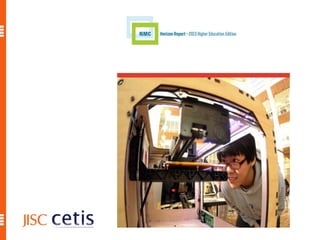
Open for Education:
Technology Innovation in
Universities and Colleges
  Presented by Paul Hollins (co) Director JISC CETIS
  Birmingham March 12 & 13 2013
  Email pah1@bolton.ac.uk    Twitter @paulhollins
Priorities ...
The Wi Fi Code is ...
 Ctis2013WiFi p/w: Ct152013
The Twitter Hashtag ...
#cetis13
The CETIS Conferences ...
1. e-Learning tools, Standards and Systems.
2. e-Framework and Reference Models.
3. Linking Formal and Informal learning
4. Beyond Standards - Holistic Approaches to Educational
   Technology and Interoperability.
5. Technology for Learning Teaching and the Institution
6. A Brave New World?
7. Never Waste a Good Crisis, Innovation & Technology in
   Institutions.
8. The Future Just Happened? Technology Innovation in
   Universities and Colleges
Introduction

•
    Definitions and distinctions
•
    Examples
•
    Limitations and challenges
•
    Opportunities for Education


                                   6
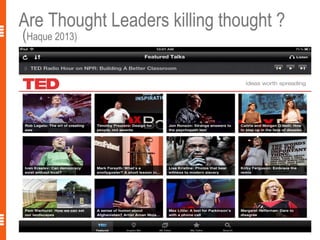
Are Thought Leaders killing thought ?
(Haque 2013)
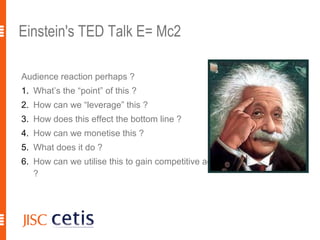
Einstein's TED Talk E= Mc2

Audience reaction perhaps ?
1. What’s the “point” of this ?
2. How can we “leverage” this ?
3. How does this effect the bottom line ?
4. How can we monetise this ?
5. What does it do ?
6. How can we utilise this to gain competitive advantage
   ?
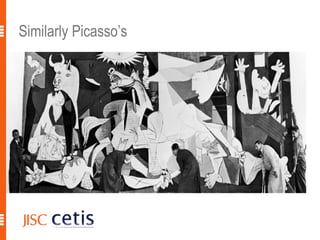
Similarly Picasso’s
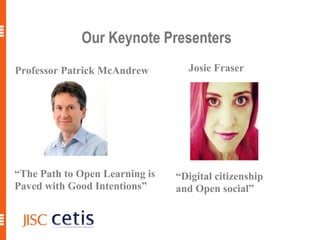
Our Keynote Presenters
Professor Patrick McAndrew        Josie Fraser


“The Path to Open Learning is   “Digital citizenship
Paved with Good Intentions”     and Open social”
Questions
• What’s happening with JISC ?
• What’s happening or going to happen
  to CETIS ?
• Will there be a CETIS conference next
  year ?
• And the most important question of
  what’s happening in TEL ?
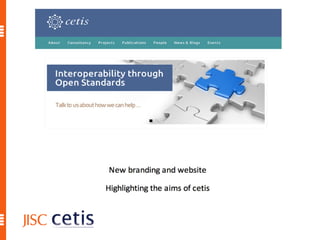
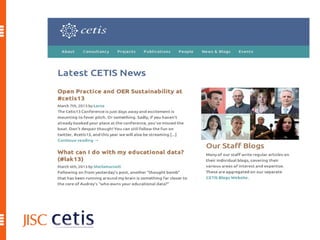
The “New” CETIS ...
Key Trends (NMC Horizon scan 2013)…
•   Openness , concepts like open content, open data, and open resources,
    along with notions of transparency and easy access to data and
    information is becoming a value.
•   The workforce demands skills from college graduates that are more often
    acquired from informal learning experiences than in universities.
•   Massively open online courses are being widely explored as alternatives
    and supplements to traditional university courses.
•   There is an increasing interest in using new sources of data for
    personalizing the learning experience and for performance measurement.
•   The role of educators continues to change due to the vast resources that
    are accessible to students via the Internet.
•   Education paradigms are shifting to include online learning, hybrid
    learning, and collaborative models.
Key Challenges (NMC Horizon scan 2013)…
•   Faculty training still does not acknowledge the fact that digital media
    literacy continues its rise in importance as a key skill in every
    discipline and profession.
•   The emergence of new scholarly forms of authoring, publishing, and
    researching outpace sufficient and scalable modes of assessment.
•   Too often it is education’s own processes and practices that limit
    broader uptake of new technologies.
•   The demand for personalized learning is not adequately supported by
    current technology or practices.
•   New models of education are bringing unprecedented competition to
    the traditional models of higher education.
•   Most academics are not using new technologies for learning and
    teaching, nor for organizing their own research.
Today’s Sessions ...

Room 4B - IMS QTI v2.1 courtesy of Wilbert Kraan
Room 4A - HE Information Landscape –Seize the
 Day courtesy of Adam Cooper
Room 5/6 - Open Practice and OER sustainability
 – courtesy of Lorna Campbell and Phil Barker
Room I - The future of CETIS (Today’s premier
 session) courtesy Of Li Yuan and me

                                                   18
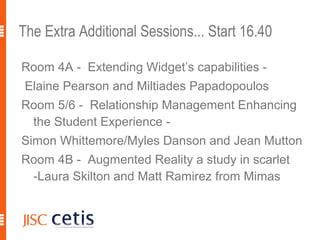
The Extra Additional Sessions... Start 16.40

Room 4A - Extending Widget’s capabilities -
 Elaine Pearson and Miltiades Papadopoulos
Room 5/6 - Relationship Management Enhancing
 the Student Experience -
Simon Whittemore/Myles Danson and Jean Mutton
Room 4B - Augmented Reality a study in scarlet
 -Laura Skilton and Matt Ramirez from Mimas
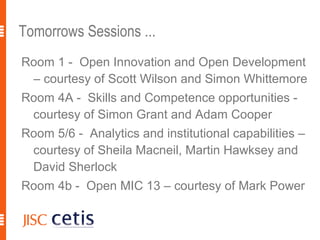
Tomorrows Sessions ...
Room 1 - Open Innovation and Open Development
 – courtesy of Scott Wilson and Simon Whittemore
Room 4A - Skills and Competence opportunities -
 courtesy of Simon Grant and Adam Cooper
Room 5/6 - Analytics and institutional capabilities –
 courtesy of Sheila Macneil, Martin Hawksey and
 David Sherlock
Room 4b - Open MIC 13 – courtesy of Mark Power
Thank You !
                           References :
Johnson, L., Adams Becker, S., Cummins, M., Estrada, V., Freeman, A., and
   Ludgate, H. (2013). NMC Horizon Report: 2013 Higher Education Edition.
   Austin, Texas: The New Media Consortium
Haque, U. (2013) Let's Save Great Ideas from the Ideas Industry
http://blogs.hbr.org/haque/2013/03/lets_save_great_ideas_from_the.html
   (Accessed March 2013)


Email pah1@bolton.ac.uk    Twitter @paulhollins

Paul Hollins Cetis13 introduction

  • 2.
    #CETIS13 Open for Education: TechnologyInnovation in Universities and Colleges Presented by Paul Hollins (co) Director JISC CETIS Birmingham March 12 & 13 2013 Email pah1@bolton.ac.uk Twitter @paulhollins
  • 3.
    Priorities ... The WiFi Code is ... Ctis2013WiFi p/w: Ct152013 The Twitter Hashtag ... #cetis13
  • 5.
    The CETIS Conferences... 1. e-Learning tools, Standards and Systems. 2. e-Framework and Reference Models. 3. Linking Formal and Informal learning 4. Beyond Standards - Holistic Approaches to Educational Technology and Interoperability. 5. Technology for Learning Teaching and the Institution 6. A Brave New World? 7. Never Waste a Good Crisis, Innovation & Technology in Institutions. 8. The Future Just Happened? Technology Innovation in Universities and Colleges
  • 6.
    Introduction • Definitions and distinctions • Examples • Limitations and challenges • Opportunities for Education 6
  • 7.
    Are Thought Leaderskilling thought ? (Haque 2013)
  • 8.
    Einstein's TED TalkE= Mc2 Audience reaction perhaps ? 1. What’s the “point” of this ? 2. How can we “leverage” this ? 3. How does this effect the bottom line ? 4. How can we monetise this ? 5. What does it do ? 6. How can we utilise this to gain competitive advantage ?
  • 9.
  • 11.
    Our Keynote Presenters ProfessorPatrick McAndrew Josie Fraser “The Path to Open Learning is “Digital citizenship Paved with Good Intentions” and Open social”
  • 12.
    Questions • What’s happeningwith JISC ? • What’s happening or going to happen to CETIS ? • Will there be a CETIS conference next year ? • And the most important question of what’s happening in TEL ?
  • 14.
  • 16.
    Key Trends (NMCHorizon scan 2013)… • Openness , concepts like open content, open data, and open resources, along with notions of transparency and easy access to data and information is becoming a value. • The workforce demands skills from college graduates that are more often acquired from informal learning experiences than in universities. • Massively open online courses are being widely explored as alternatives and supplements to traditional university courses. • There is an increasing interest in using new sources of data for personalizing the learning experience and for performance measurement. • The role of educators continues to change due to the vast resources that are accessible to students via the Internet. • Education paradigms are shifting to include online learning, hybrid learning, and collaborative models.
  • 17.
    Key Challenges (NMCHorizon scan 2013)… • Faculty training still does not acknowledge the fact that digital media literacy continues its rise in importance as a key skill in every discipline and profession. • The emergence of new scholarly forms of authoring, publishing, and researching outpace sufficient and scalable modes of assessment. • Too often it is education’s own processes and practices that limit broader uptake of new technologies. • The demand for personalized learning is not adequately supported by current technology or practices. • New models of education are bringing unprecedented competition to the traditional models of higher education. • Most academics are not using new technologies for learning and teaching, nor for organizing their own research.
  • 18.
    Today’s Sessions ... Room4B - IMS QTI v2.1 courtesy of Wilbert Kraan Room 4A - HE Information Landscape –Seize the Day courtesy of Adam Cooper Room 5/6 - Open Practice and OER sustainability – courtesy of Lorna Campbell and Phil Barker Room I - The future of CETIS (Today’s premier session) courtesy Of Li Yuan and me 18
  • 19.
    The Extra AdditionalSessions... Start 16.40 Room 4A - Extending Widget’s capabilities - Elaine Pearson and Miltiades Papadopoulos Room 5/6 - Relationship Management Enhancing the Student Experience - Simon Whittemore/Myles Danson and Jean Mutton Room 4B - Augmented Reality a study in scarlet -Laura Skilton and Matt Ramirez from Mimas
  • 20.
    Tomorrows Sessions ... Room1 - Open Innovation and Open Development – courtesy of Scott Wilson and Simon Whittemore Room 4A - Skills and Competence opportunities - courtesy of Simon Grant and Adam Cooper Room 5/6 - Analytics and institutional capabilities – courtesy of Sheila Macneil, Martin Hawksey and David Sherlock Room 4b - Open MIC 13 – courtesy of Mark Power
  • 21.
    Thank You ! References : Johnson, L., Adams Becker, S., Cummins, M., Estrada, V., Freeman, A., and Ludgate, H. (2013). NMC Horizon Report: 2013 Higher Education Edition. Austin, Texas: The New Media Consortium Haque, U. (2013) Let's Save Great Ideas from the Ideas Industry http://blogs.hbr.org/haque/2013/03/lets_save_great_ideas_from_the.html (Accessed March 2013) Email pah1@bolton.ac.uk Twitter @paulhollins