122
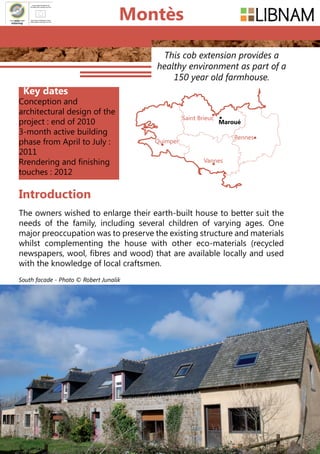
This cob extension provides a
healthy environment as part of a
150 year old farmhouse.
Key dates
Conception and
architectural design of the
project : end of 2010
3-month active building
phase from April to July :
2011
Rrendering and finishing
touches : 2012
The owners wished to enlarge their earth-built house to better suit the
needs of the family, including several children of varying ages. One
major preoccupation was to preserve the existing structure and materials
whilst complementing the house with other eco-materials (recycled
newspapers, wool, fibres and wood) that are available locally and used
with the knowledge of local craftsmen.
Introduction
Saint Brieuc
Quimper
Vannes
Rennes
Maroué
Montès
South facade - Photo © Robert Junalik
www.libnam.eu 2
The Objective for the owners
was to expand the living area of
the house (from 105 sq m to 220
sq m in total) in order to create
interdependent living spaces for
each member of the family (there
is a mixture of adolescents and
young children). The aim was to
build three bedrooms, one living
room and one bathroom. The idea
was to «compartmentalise» the
building and create separate and
Context
autonomous living spaces. The
owners, aware of the eco nature of
the build, wanted the work carried
out using sustainable materials
and to enable the use of traditional
building techniques. The extensions
were planned to be built on the east
and west sides of the property; the
northern side is not an option as it
is attached to a hangar.
Plans © Cabinet l’Epineguen
N
French-British collective Libnam3
Building overview
The existing frame of the building
had been made with stone and earth
mortar. The equipment room of the
house that has not been renovated
has a wood pellet boiler installed.
This room has been insulated from
the outside : installation of a wooden
framework in OSB (Oriented Strand
Board), Fibragglos (rigid insulating
wood cement panels) and an
insulation of cellulose padding. The
final coat is a lime and sand render.
The extension to the east was built
using the remains of a barn. The
existing walls (made of Cob) were
raised by 50 cm so the roof would
be at the same level as the roof of
the main building as well as allowing
for more living space in the upper
storey of the extension.
The walls of the extension were
brought back to their original state
using a coating of earth, sand and
straw on the outside of the walls,
with no topcoat or insulation added
in order to preserve the natural
inert thermal capacity of the earth
wall and its hygroscopic properties.
A raw earth plaster was used on the
interior walls.
The floor was excavated and a
granular infill of stone was laid
(dimension 20/40) this was covered
with a 60 mm layer of cork panels
(with a thermal resistance of 1.71)
and a thin lime and sand screed
that incorporated the under-floor
Earth/sand/fibre plaster - Photo © Robert Junalik
www.libnam.eu 4
heating. The floor is finished using
terracotta tiles and a lime grout.
In addition the partitioning of one of
the rooms of the east side extension
has been done in wattle and daub.
Openings have also been created
to link the extension to the original
building both on the ground floor
and upstairs. The installation of
wooden frames for the windows
and door allows more light into the
building.
Finally the roof of the extension
was covered in larch shingles. The
building has been insulated with
wood-wool in wooden fibre panels
and covered in either lambris
(wooden tongue and groove
panelling) or gypsum (Fermacell) on
the inside.
As for the western extension that
houses the indoor garden  , the
chosen solution was a timber frame
made of Douglas fir insulated with
sheep wool. The roof was covered in
Zinc that has been cut to measure.
An under-floor heating system
using wood pellets and thermal
solar panels has been installed.
Laying shingles - Photo © Robert Junalik
French-British collective Libnam5
Technical focus :
Wattle and daub
The «wattle-and-daub» partitioning
in one of the rooms on the ground
floor was designed for comfort
and better heat insulation. The
partitioning is also intended to
improve the humidity levels in the
building by improving the flow
of water vapour in the walls and
the uptake of excess humidity in
the room. In addition to this, the
mixture of earth and straw provides
better sound insulation.
To achieve these partitions, after
laying a resilient strip in cork on the
ground and a smooth bottom plate
in Douglas fir, they fixed vertical
rafters 8 cm thick every 40 cm.
After installing all the electrical
boxes and sheaths, latticework was
nailed either side of the rafters. On
one side of the frame it was nailed
horizontally every 5 cm top to
bottom and on the other side it was
only fixed every 30 cm to allow the
manual filling of the earth and straw
insulating mixture. The latticework
was then completed after this
process.
The moisture in the mixture should
be that of soft dough. It is very
difficult to form balls with the mix,
which should be very sticky and
Wattle and daub partition - Photo © Robert Junalik
www.libnam.eu 6
muddy and have water content of
between 20% and 35%. The wattle
and daub mix requires 2 m3 of clay
and 1 extra m3 is needed for the
topcoat render ( hemp chippings
are then added to the mixture).
The quantity of earth and soil in the
mixture will change its sound and
heat insulating qualities, if you add
earth it will be more sound proof, if
you add hemp it will provide more
thermal insulation.
Before the wattle and daub filling
is applied, you must mark the
edge of the render with a wooden
plate boundary on which the door
mounts are fixed.
While filling the partition any
excess mixture coming through the
latticework is plastered on to it to
fully form a topcoat render. This
will then be smoothed off using a
trowel.
The wattle and daub is then left to
dry out naturally ; the length of time
this takes will depend on the airflow
within the room, or may be speeded
up with the use of a dehumidifier.
Once the mixture is dry you can then
apply the topcoat. For the interior
walls of the room they used a mix of
earth,clay, sand and vegetable fibres
(hemp chippings). On the corridor
side of the walls the topcoat is sand
and lime mix. The wattle and daub
partitioning provides an exceptional
level of comfort to the room. The
earth used in the wattle and daub
partitioning is sourced from a quarry
only 5km away from the house.
Barriers and solutions
Each section of the build was carried
out successfully within the time
limits specified.
The owners also acted as project
supervisors, allowing the working
relationship between each section
of the build to proceed without
major problems.
Each craftsman understood and
practised the traditional techniques
used during this build (roofing: larch
shingles, wattle and daub partitions,
earth render and cob walls). These
craftsmen also pride themselves
on providing work of the highest
quality.
Window frame - Photo © Robert Junalik
French-British collective Libnam7
The work was carried out by a
small work force that worked well
together. One example is how the
stonemason was able to modify the
system that was suggested by the
carpenter for the upstairs flooring
in one of the extensions. He wanted
to make a lintel supported by posts
at each corner of the room, having
only moderate confidence in the cob
walls, in order to support the joists.
Ultimately, he succeeded in securing
the joists straight into the cob walls.
Among the obstacles encountered
during the project : the owners
wished to replace the conventional
septic tank with a phytodepuration
system (Waste water treatment
system through plants ) that
encountered a problem in getting
planning approval. The CSTB
(Centre Scientifique et Technique
du Bâtiment) had only validated the
system for households containing 4
inhabitants and not 5 as would be
the case in this house. In the face
of this setback this particular project
has been abandoned for now.
In addition, an eco-interest loan was
denied on first request. It required
the installation of a single form of
insulation contrary to the two that
were planned. Finally, the loan will
be issued after some clarification
but the work has been delayed by
three months.
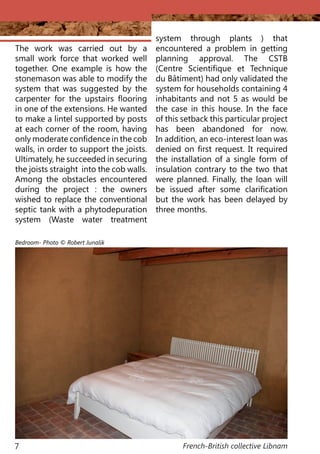
Bedroom- Photo © Robert Junalik
8
Stakeholders
Owner : Mr. and Mrs. Montès
Architect : Cabinet l’Epineguen (Guingamp)
Extension and framework : Habitat et
Environment (Kerfot)
Masonry and terracotta floors : Entreprise
Junalik (St Vran)
Under-floor Heating : ABE (Trégueux)
Pellet boiler : Armor Energies Nouvelles
(Pléneuf Val André)
Exterior insulation : Avalenn Productions
(Plouër-sur-Rance)
Timber frames and Wood : Tamm Koad
(Plouër-sur-Rance)
Costs
The total cost of construction amounted
to £70,605 VAT, including £23,535 for the
single West extension. Eco-interest loan
obtained amounts to £23,535 and covers 3
main areas: the replacement of woodwork,
insulation from outside of the equipment
room and the installation of solar panels
(5sq m).
Roof shingles cost £5,491 for 30sq m of
roof area. The cost is high but the result is
remarkable.
The boiler (power 14kW) uses 6 tonnes of wood pellets per year
for a 220 sq m living area, with an annual cost of £1,355. Hot water is
provided by the boiler and the solar panels (for 60% of yearly needs)
and electricity complements the system when not heated by the sun.
The electric bill is about £390 / year.
The owners also have a rainwater collection project thanks to 700 sq m
roof (shed included).
Performance
Terracotta tiles - Photo © Robert Junalik
Contact
études ET chantiers
www.ecbpdl.org

Montès-en

  • 1.
    122 This cob extensionprovides a healthy environment as part of a 150 year old farmhouse. Key dates Conception and architectural design of the project : end of 2010 3-month active building phase from April to July : 2011 Rrendering and finishing touches : 2012 The owners wished to enlarge their earth-built house to better suit the needs of the family, including several children of varying ages. One major preoccupation was to preserve the existing structure and materials whilst complementing the house with other eco-materials (recycled newspapers, wool, fibres and wood) that are available locally and used with the knowledge of local craftsmen. Introduction Saint Brieuc Quimper Vannes Rennes Maroué Montès South facade - Photo © Robert Junalik
  • 2.
    www.libnam.eu 2 The Objectivefor the owners was to expand the living area of the house (from 105 sq m to 220 sq m in total) in order to create interdependent living spaces for each member of the family (there is a mixture of adolescents and young children). The aim was to build three bedrooms, one living room and one bathroom. The idea was to «compartmentalise» the building and create separate and Context autonomous living spaces. The owners, aware of the eco nature of the build, wanted the work carried out using sustainable materials and to enable the use of traditional building techniques. The extensions were planned to be built on the east and west sides of the property; the northern side is not an option as it is attached to a hangar. Plans © Cabinet l’Epineguen N
  • 3.
    French-British collective Libnam3 Buildingoverview The existing frame of the building had been made with stone and earth mortar. The equipment room of the house that has not been renovated has a wood pellet boiler installed. This room has been insulated from the outside : installation of a wooden framework in OSB (Oriented Strand Board), Fibragglos (rigid insulating wood cement panels) and an insulation of cellulose padding. The final coat is a lime and sand render. The extension to the east was built using the remains of a barn. The existing walls (made of Cob) were raised by 50 cm so the roof would be at the same level as the roof of the main building as well as allowing for more living space in the upper storey of the extension. The walls of the extension were brought back to their original state using a coating of earth, sand and straw on the outside of the walls, with no topcoat or insulation added in order to preserve the natural inert thermal capacity of the earth wall and its hygroscopic properties. A raw earth plaster was used on the interior walls. The floor was excavated and a granular infill of stone was laid (dimension 20/40) this was covered with a 60 mm layer of cork panels (with a thermal resistance of 1.71) and a thin lime and sand screed that incorporated the under-floor Earth/sand/fibre plaster - Photo © Robert Junalik
  • 4.
    www.libnam.eu 4 heating. Thefloor is finished using terracotta tiles and a lime grout. In addition the partitioning of one of the rooms of the east side extension has been done in wattle and daub. Openings have also been created to link the extension to the original building both on the ground floor and upstairs. The installation of wooden frames for the windows and door allows more light into the building. Finally the roof of the extension was covered in larch shingles. The building has been insulated with wood-wool in wooden fibre panels and covered in either lambris (wooden tongue and groove panelling) or gypsum (Fermacell) on the inside. As for the western extension that houses the indoor garden  , the chosen solution was a timber frame made of Douglas fir insulated with sheep wool. The roof was covered in Zinc that has been cut to measure. An under-floor heating system using wood pellets and thermal solar panels has been installed. Laying shingles - Photo © Robert Junalik
  • 5.
    French-British collective Libnam5 Technicalfocus : Wattle and daub The «wattle-and-daub» partitioning in one of the rooms on the ground floor was designed for comfort and better heat insulation. The partitioning is also intended to improve the humidity levels in the building by improving the flow of water vapour in the walls and the uptake of excess humidity in the room. In addition to this, the mixture of earth and straw provides better sound insulation. To achieve these partitions, after laying a resilient strip in cork on the ground and a smooth bottom plate in Douglas fir, they fixed vertical rafters 8 cm thick every 40 cm. After installing all the electrical boxes and sheaths, latticework was nailed either side of the rafters. On one side of the frame it was nailed horizontally every 5 cm top to bottom and on the other side it was only fixed every 30 cm to allow the manual filling of the earth and straw insulating mixture. The latticework was then completed after this process. The moisture in the mixture should be that of soft dough. It is very difficult to form balls with the mix, which should be very sticky and Wattle and daub partition - Photo © Robert Junalik
  • 6.
    www.libnam.eu 6 muddy andhave water content of between 20% and 35%. The wattle and daub mix requires 2 m3 of clay and 1 extra m3 is needed for the topcoat render ( hemp chippings are then added to the mixture). The quantity of earth and soil in the mixture will change its sound and heat insulating qualities, if you add earth it will be more sound proof, if you add hemp it will provide more thermal insulation. Before the wattle and daub filling is applied, you must mark the edge of the render with a wooden plate boundary on which the door mounts are fixed. While filling the partition any excess mixture coming through the latticework is plastered on to it to fully form a topcoat render. This will then be smoothed off using a trowel. The wattle and daub is then left to dry out naturally ; the length of time this takes will depend on the airflow within the room, or may be speeded up with the use of a dehumidifier. Once the mixture is dry you can then apply the topcoat. For the interior walls of the room they used a mix of earth,clay, sand and vegetable fibres (hemp chippings). On the corridor side of the walls the topcoat is sand and lime mix. The wattle and daub partitioning provides an exceptional level of comfort to the room. The earth used in the wattle and daub partitioning is sourced from a quarry only 5km away from the house. Barriers and solutions Each section of the build was carried out successfully within the time limits specified. The owners also acted as project supervisors, allowing the working relationship between each section of the build to proceed without major problems. Each craftsman understood and practised the traditional techniques used during this build (roofing: larch shingles, wattle and daub partitions, earth render and cob walls). These craftsmen also pride themselves on providing work of the highest quality. Window frame - Photo © Robert Junalik
  • 7.
    French-British collective Libnam7 Thework was carried out by a small work force that worked well together. One example is how the stonemason was able to modify the system that was suggested by the carpenter for the upstairs flooring in one of the extensions. He wanted to make a lintel supported by posts at each corner of the room, having only moderate confidence in the cob walls, in order to support the joists. Ultimately, he succeeded in securing the joists straight into the cob walls. Among the obstacles encountered during the project : the owners wished to replace the conventional septic tank with a phytodepuration system (Waste water treatment system through plants ) that encountered a problem in getting planning approval. The CSTB (Centre Scientifique et Technique du Bâtiment) had only validated the system for households containing 4 inhabitants and not 5 as would be the case in this house. In the face of this setback this particular project has been abandoned for now. In addition, an eco-interest loan was denied on first request. It required the installation of a single form of insulation contrary to the two that were planned. Finally, the loan will be issued after some clarification but the work has been delayed by three months. Bedroom- Photo © Robert Junalik
  • 8.
    8 Stakeholders Owner : Mr.and Mrs. Montès Architect : Cabinet l’Epineguen (Guingamp) Extension and framework : Habitat et Environment (Kerfot) Masonry and terracotta floors : Entreprise Junalik (St Vran) Under-floor Heating : ABE (Trégueux) Pellet boiler : Armor Energies Nouvelles (Pléneuf Val André) Exterior insulation : Avalenn Productions (Plouër-sur-Rance) Timber frames and Wood : Tamm Koad (Plouër-sur-Rance) Costs The total cost of construction amounted to £70,605 VAT, including £23,535 for the single West extension. Eco-interest loan obtained amounts to £23,535 and covers 3 main areas: the replacement of woodwork, insulation from outside of the equipment room and the installation of solar panels (5sq m). Roof shingles cost £5,491 for 30sq m of roof area. The cost is high but the result is remarkable. The boiler (power 14kW) uses 6 tonnes of wood pellets per year for a 220 sq m living area, with an annual cost of £1,355. Hot water is provided by the boiler and the solar panels (for 60% of yearly needs) and electricity complements the system when not heated by the sun. The electric bill is about £390 / year. The owners also have a rainwater collection project thanks to 700 sq m roof (shed included). Performance Terracotta tiles - Photo © Robert Junalik Contact études ET chantiers www.ecbpdl.org