92
A family home made by hand
with wood, lime and clay.
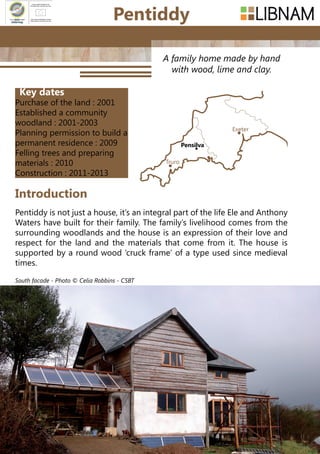
Pentiddy is not just a house, it’s an integral part of the life Ele and Anthony
Waters have built for their family. The family’s livelihood comes from the
surrounding woodlands and the house is an expression of their love and
respect for the land and the materials that come from it. The house is
supported by a round wood ‘cruck frame’ of a type used since medieval
times.
Introduction
Pentiddy
Key dates
Purchase of the land : 2001
Established a community
woodland : 2001-2003
Planning permission to build a
permanent residence : 2009
Felling trees and preparing
materials : 2010
Construction : 2011-2013
Truro
Exeter
Pensilva
South facade - Photo © Celia Robbins - CSBT
www.libnam.eu 2
Context
For Anthony and Ele, Pentiddy is a
long term project through which
they have achieved the goals of
making a living from the land, and
creating their family home. They are
deeply committed to the land and
working to preserve and enhance
it while building a secure future for
their family. The house they have
built is intrinsic to their stewardship
of the land and is part of a larger
project, rather than being an end in
itself.
Their overarching aim is to care
for the land using permaculture
principlesandtoearnalivingthrough
green woodworking, workshops,
a forest school and green burials.
Achieving this has been a long term
commitment, starting with their
purchase of 27 acres of land in 2001
and culminating, twelve years and
two children later, when they moved
into the house at Christmas in 2013.
The ethos of the house was to use
as many local materials as possible
and to make it resilient to future
changes in the climate and society;
integral to this is independence
from mains electricity and other
external services. The other guiding
principal was to design a house the
family could build themselves, with
help from friends and volunteers.
Anthony’s existing skills in green
woodworking thus influenced many
of the design decisions.
Plan © Anthony Waters
N
French-British collective Libnam3
Building overview
Layout and orientation
Pentiddy is a 95 sq m L-shaped two-
storey house, with an open living
area on the ground floor, three
bedrooms and a bathroom on the
upper floor. The layout is designed
to allow heat to circulate naturally
from a centrally placed wood
burning stove, with a small gravity-
fed radiator serving the bathroom.
The house sits on granite pad
foundations which support the
cruck frame, the posts of which
accommodate the sloping site. The
house is oriented a few degrees
off south to make the best use of
its views, as well as solar gain. The
hillside position is exposed, which
has necessitated protection of the
natural materials being used.
Services
The house is not connected to any
mains services; the family use wood
for heating and a small Air 403 wind
turbine and 250 W solar array for
power. They are more interested
in reducing their need for power
than increasing generating capacity.
The house has an outside dry
composting toilet; a choice which
both minimises water use and
necessitates regular interaction with
the outdoors! Water is harvested
from the adjoining barn for washing
and grey water treated by a reed
bed.
Materials
Specially harvested and tightly
compacted barley and oat straw
bales measuring 100 x 50 x 35 cm
form the core of the exterior walls.
External lime render was applied to
the straw over a substrate of reed
matting. Hydraulic lime was used,
which came as a powder and was
mixed on site. The exterior treatment
was informed by university research
demonstrating that, in the Cornish
Storage of straw- Photo © Anthony Waters
www.libnam.eu 4
Technical focus :
Round wood cruck
frame and frame
raising
Round wood cruck frame
The cruck frame is a traditional
method of supporting a timber
building which allows the wood to
be used in its natural round state.
V-shaped cruck frames are erected
separately and tied along the roof
ridge with long ridge pole. Anthony
and Ele learned about this type of
building through time spent with
Ben Law, an expert in green wood
construction and they were inspired
and informed by his books.
The larch used for the cruck frame
came from Stara Woods at nearby
Upton Cross. By coincidence,
Anthony discovered that the
timber selected for the build had
been planted in the year of his
birth. The sawn wood came from
St Neot, and was milled on site at
climate, lime works best when
protected by an air gap and
cladding. Hence, larch cladding
has been placed over 2inch stud
walls creating an air gap. The whole
upper storey is clad in larch, and the
lime render on the lower storey is
protected by a verandah running
the full length of the house. On the
inside, sub-layers of clay made from
the soil surrounding the house sit
beneath clay plaster.
The roof is made from reclaimed
Cornish Delabole slates; pitches on
both the main roof and adjoining
lean-to were calculated to maximise
solar generation. The roof and floor
are insulated with Warmcel recycled
cellulose.
« Butter pat joints » assembling - Photo © An-
thony Waters
French-British collective Libnam5
Pentiddy. Douglas fir was used for
the floor joists, tongue and groove
floorboards, rafters, window frames
and studwork.
Frame raising
Having started on site on the spring
solstice in 2011, the frame raising
took place over a windy weekend
in May ’11. Hard work and nerve
racking – the process was also a
celebration and brought together
over 40 friends and helpers who
raised the building using tripods
and winches counter-weighted by
vehicles. The frame is tied together
using oak pegs. A key technique is
the ‘butter pat’ joint which creates
flat surfaces where two posts meet;
a laser spirit-level ensured the
precision needed to achieve a sound
building from irregular materials.
The raising of the frame, including a
video and many other aspects of the
build are documented on Pentiddy’s
blog : http://pentiddy.blogspot.
co.uk/.
Barriers and solutions
Sharing skills through the
building process
Ele and Anthony recognise and
value their house build as a process,
not just a product. The inevitable
problems, delays and stresses all
have their outcome in lessons
learned that will help both Pentiddy
itself and others in the future. The
acquisition of skills, rather than
reliance on paid experts, was thus
central to the undertaking. The
V-shaped “full cruck” frame » - Photo © Anthony Waters
www.libnam.eu 6
consuming. Simply accommodating
the irregularities in round wood
was a huge part of the build, and
if there were a ‘next time’, Anthony
would substitute non-visible round
wood with sawn wood, e.g. in
the underfloor support beams.
Another challenging area has been
in supporting the bale walls above
window openings.
The use of lime and clay was a big
learning process, helped by advice
from Cornish Lime and Clayworks
plasters. Anthony found it difficult
to get definitive advice on the
appropriate lime render mix, settling
eventually on 2:1 sand to lime.
Attempts were made to produce a
clay finish for the interior walls from
on-site materials, but this proved
unsuccessful and clay plasters were
purchased from Clayworks.
learning of skills was shared with
volunteers who lived and worked
with the family during the build,
and with larger groups on special
occasions like the frame raising.
Over 50 people attended open days
to experience the application of clay
plaster.
Keeping the Cornish rain out
The Cornish climate will always
make itself felt; the house is
designed to withstand it, but the
build was frequently influenced by
it. There was great time pressure
in the autumn of 2011, when the
straw was due to be harvested and
delivered, but the team were not
ready to begin installing it. A difficult
decision was taken to delay its use
and store the straw over winter, to
keep it dry. Another factor here was
that the external lime render cannot
be applied in cold weather. Once
the straw started going in during
April 2012, Pentiddy was hit by an
exceptional period of rain, which led
to further delays and worries about
whether the straw had got wet.
Time-consuming tasks
Many of the lessons from the build
lie simply in underestimating how
long things take, these include;
stripping bark from the wood, fitting
the bales, applying the lime and clay.
The L-shaped design is successful
and Anthony would not want to
change it, but it created valleys in
the roof and added complexity to
the frame, all of which were time
Focus : Gaining
planning permission
to build a permanent
residence on a
woodland site
The UK planning system restricts
the construction of new homes
in the countryside. An exception
can be the «agricultural tie» where
a home is built to accommodate
those working on farmland. These
decisions are related to the farm’s
income and ability to support a
French-British collective Libnam7
The first winter, 2013-14, was
a stormy one and the house
weathered it well. After living in a
mobile home for years, the family
are enjoying a warm and cosy space
that is easily heated from its wood
burning range. Electricity use is
minimal, with the family adapting
Performance
number of livelihoods.
Anthony and Ele originally
established the principle of an
agricultural tie to the land, and
gained temporary planning
permission to occupy the land
for five years. This gave them the
time to make a case for permanent
permission. Initially, the agricultural
appraisal officers did not accept
there was a need for the family to
live on site in order to work the
land. Eventually, the permission
was granted on the grounds of the
family making a subsistence living–
this means they did not have to
demonstrate the level of income
that would normally be associated
with conventional farming. Their
plans to burn charcoal helped sway
the decision. The family found more
than once that reluctance on the
part of the authorities changed to
support when they showed officials
around the property, discussed
their plans and demonstrated their
commitment.
Interior - Photo © Servane Guihaire - Constructys
Bretagne
to its availability. They currently
make occasional use of a generator,
but hope to acquire an additional
second hand turbine and batteries
from a neighbour.
Looking ahead, a quote from
Anthony’s blog sums up how they
hope others can benefit from the
experiences won at Pentiddy:
«We are excited at the thought of
actually venturing out of our inward
looking past few years to explore
the wider community and lend our
knowledge and help to other people
venturing into exciting projects of a
similar nature.»
8
Stakeholders
Design & project management : Anthony
Waters and Ele Waters
Structural Engineer : Adams Consulting
Building regulations : JHAI Ltd
Wood : Stara Wood, Glencross Estate an
Pentiddy
Granite : 	from the De Lank quarry on
Bodmin moor
Lime : The Cornish Lime Company, Bodmin
Clay plaster : Clayworks, Manaccan,The
Lizard
Ceiling plastering : Mark Stanley
Straw : John and James Kendall, Tencreek
Farm
Slate : Kenyon Canopy, Saltash
Windows : FD Hall & Sons, Liskeard
Costs
Materials and equipment : £50,000
Labour :	 £10,000
The total cost is £60,000, of which around
£10,000 will be recovered through the
sale of equipment, including the mill and
scaffolding, which is no longer required.
The build was realised through a huge
amount of volunteer help, and enthusiasm.
Link
http://pentiddy.blogspot.co.uk/
Interior - Photo © Servane Guihaire - Constructys Bretagne
Contact
Cornwall Sustainable Building Trust
http://csbt.org.uk/

Pentiddy-en

  • 1.
    92 A family homemade by hand with wood, lime and clay. Pentiddy is not just a house, it’s an integral part of the life Ele and Anthony Waters have built for their family. The family’s livelihood comes from the surrounding woodlands and the house is an expression of their love and respect for the land and the materials that come from it. The house is supported by a round wood ‘cruck frame’ of a type used since medieval times. Introduction Pentiddy Key dates Purchase of the land : 2001 Established a community woodland : 2001-2003 Planning permission to build a permanent residence : 2009 Felling trees and preparing materials : 2010 Construction : 2011-2013 Truro Exeter Pensilva South facade - Photo © Celia Robbins - CSBT
  • 2.
    www.libnam.eu 2 Context For Anthonyand Ele, Pentiddy is a long term project through which they have achieved the goals of making a living from the land, and creating their family home. They are deeply committed to the land and working to preserve and enhance it while building a secure future for their family. The house they have built is intrinsic to their stewardship of the land and is part of a larger project, rather than being an end in itself. Their overarching aim is to care for the land using permaculture principlesandtoearnalivingthrough green woodworking, workshops, a forest school and green burials. Achieving this has been a long term commitment, starting with their purchase of 27 acres of land in 2001 and culminating, twelve years and two children later, when they moved into the house at Christmas in 2013. The ethos of the house was to use as many local materials as possible and to make it resilient to future changes in the climate and society; integral to this is independence from mains electricity and other external services. The other guiding principal was to design a house the family could build themselves, with help from friends and volunteers. Anthony’s existing skills in green woodworking thus influenced many of the design decisions. Plan © Anthony Waters N
  • 3.
    French-British collective Libnam3 Buildingoverview Layout and orientation Pentiddy is a 95 sq m L-shaped two- storey house, with an open living area on the ground floor, three bedrooms and a bathroom on the upper floor. The layout is designed to allow heat to circulate naturally from a centrally placed wood burning stove, with a small gravity- fed radiator serving the bathroom. The house sits on granite pad foundations which support the cruck frame, the posts of which accommodate the sloping site. The house is oriented a few degrees off south to make the best use of its views, as well as solar gain. The hillside position is exposed, which has necessitated protection of the natural materials being used. Services The house is not connected to any mains services; the family use wood for heating and a small Air 403 wind turbine and 250 W solar array for power. They are more interested in reducing their need for power than increasing generating capacity. The house has an outside dry composting toilet; a choice which both minimises water use and necessitates regular interaction with the outdoors! Water is harvested from the adjoining barn for washing and grey water treated by a reed bed. Materials Specially harvested and tightly compacted barley and oat straw bales measuring 100 x 50 x 35 cm form the core of the exterior walls. External lime render was applied to the straw over a substrate of reed matting. Hydraulic lime was used, which came as a powder and was mixed on site. The exterior treatment was informed by university research demonstrating that, in the Cornish Storage of straw- Photo © Anthony Waters
  • 4.
    www.libnam.eu 4 Technical focus: Round wood cruck frame and frame raising Round wood cruck frame The cruck frame is a traditional method of supporting a timber building which allows the wood to be used in its natural round state. V-shaped cruck frames are erected separately and tied along the roof ridge with long ridge pole. Anthony and Ele learned about this type of building through time spent with Ben Law, an expert in green wood construction and they were inspired and informed by his books. The larch used for the cruck frame came from Stara Woods at nearby Upton Cross. By coincidence, Anthony discovered that the timber selected for the build had been planted in the year of his birth. The sawn wood came from St Neot, and was milled on site at climate, lime works best when protected by an air gap and cladding. Hence, larch cladding has been placed over 2inch stud walls creating an air gap. The whole upper storey is clad in larch, and the lime render on the lower storey is protected by a verandah running the full length of the house. On the inside, sub-layers of clay made from the soil surrounding the house sit beneath clay plaster. The roof is made from reclaimed Cornish Delabole slates; pitches on both the main roof and adjoining lean-to were calculated to maximise solar generation. The roof and floor are insulated with Warmcel recycled cellulose. « Butter pat joints » assembling - Photo © An- thony Waters
  • 5.
    French-British collective Libnam5 Pentiddy.Douglas fir was used for the floor joists, tongue and groove floorboards, rafters, window frames and studwork. Frame raising Having started on site on the spring solstice in 2011, the frame raising took place over a windy weekend in May ’11. Hard work and nerve racking – the process was also a celebration and brought together over 40 friends and helpers who raised the building using tripods and winches counter-weighted by vehicles. The frame is tied together using oak pegs. A key technique is the ‘butter pat’ joint which creates flat surfaces where two posts meet; a laser spirit-level ensured the precision needed to achieve a sound building from irregular materials. The raising of the frame, including a video and many other aspects of the build are documented on Pentiddy’s blog : http://pentiddy.blogspot. co.uk/. Barriers and solutions Sharing skills through the building process Ele and Anthony recognise and value their house build as a process, not just a product. The inevitable problems, delays and stresses all have their outcome in lessons learned that will help both Pentiddy itself and others in the future. The acquisition of skills, rather than reliance on paid experts, was thus central to the undertaking. The V-shaped “full cruck” frame » - Photo © Anthony Waters
  • 6.
    www.libnam.eu 6 consuming. Simplyaccommodating the irregularities in round wood was a huge part of the build, and if there were a ‘next time’, Anthony would substitute non-visible round wood with sawn wood, e.g. in the underfloor support beams. Another challenging area has been in supporting the bale walls above window openings. The use of lime and clay was a big learning process, helped by advice from Cornish Lime and Clayworks plasters. Anthony found it difficult to get definitive advice on the appropriate lime render mix, settling eventually on 2:1 sand to lime. Attempts were made to produce a clay finish for the interior walls from on-site materials, but this proved unsuccessful and clay plasters were purchased from Clayworks. learning of skills was shared with volunteers who lived and worked with the family during the build, and with larger groups on special occasions like the frame raising. Over 50 people attended open days to experience the application of clay plaster. Keeping the Cornish rain out The Cornish climate will always make itself felt; the house is designed to withstand it, but the build was frequently influenced by it. There was great time pressure in the autumn of 2011, when the straw was due to be harvested and delivered, but the team were not ready to begin installing it. A difficult decision was taken to delay its use and store the straw over winter, to keep it dry. Another factor here was that the external lime render cannot be applied in cold weather. Once the straw started going in during April 2012, Pentiddy was hit by an exceptional period of rain, which led to further delays and worries about whether the straw had got wet. Time-consuming tasks Many of the lessons from the build lie simply in underestimating how long things take, these include; stripping bark from the wood, fitting the bales, applying the lime and clay. The L-shaped design is successful and Anthony would not want to change it, but it created valleys in the roof and added complexity to the frame, all of which were time Focus : Gaining planning permission to build a permanent residence on a woodland site The UK planning system restricts the construction of new homes in the countryside. An exception can be the «agricultural tie» where a home is built to accommodate those working on farmland. These decisions are related to the farm’s income and ability to support a
  • 7.
    French-British collective Libnam7 Thefirst winter, 2013-14, was a stormy one and the house weathered it well. After living in a mobile home for years, the family are enjoying a warm and cosy space that is easily heated from its wood burning range. Electricity use is minimal, with the family adapting Performance number of livelihoods. Anthony and Ele originally established the principle of an agricultural tie to the land, and gained temporary planning permission to occupy the land for five years. This gave them the time to make a case for permanent permission. Initially, the agricultural appraisal officers did not accept there was a need for the family to live on site in order to work the land. Eventually, the permission was granted on the grounds of the family making a subsistence living– this means they did not have to demonstrate the level of income that would normally be associated with conventional farming. Their plans to burn charcoal helped sway the decision. The family found more than once that reluctance on the part of the authorities changed to support when they showed officials around the property, discussed their plans and demonstrated their commitment. Interior - Photo © Servane Guihaire - Constructys Bretagne to its availability. They currently make occasional use of a generator, but hope to acquire an additional second hand turbine and batteries from a neighbour. Looking ahead, a quote from Anthony’s blog sums up how they hope others can benefit from the experiences won at Pentiddy: «We are excited at the thought of actually venturing out of our inward looking past few years to explore the wider community and lend our knowledge and help to other people venturing into exciting projects of a similar nature.»
  • 8.
    8 Stakeholders Design & projectmanagement : Anthony Waters and Ele Waters Structural Engineer : Adams Consulting Building regulations : JHAI Ltd Wood : Stara Wood, Glencross Estate an Pentiddy Granite : from the De Lank quarry on Bodmin moor Lime : The Cornish Lime Company, Bodmin Clay plaster : Clayworks, Manaccan,The Lizard Ceiling plastering : Mark Stanley Straw : John and James Kendall, Tencreek Farm Slate : Kenyon Canopy, Saltash Windows : FD Hall & Sons, Liskeard Costs Materials and equipment : £50,000 Labour : £10,000 The total cost is £60,000, of which around £10,000 will be recovered through the sale of equipment, including the mill and scaffolding, which is no longer required. The build was realised through a huge amount of volunteer help, and enthusiasm. Link http://pentiddy.blogspot.co.uk/ Interior - Photo © Servane Guihaire - Constructys Bretagne Contact Cornwall Sustainable Building Trust http://csbt.org.uk/