    The Olympic Games began over 2,700 years ago in
    Olympia, in southwest Greece.

     The Games were part of a religious festival and
    they were held in honour of Zeus. They were staged
    every four years at Olympia. People from all over
    the Greek world came to watch and take part.

 The Baron Pierre de Coubertin founded the modern
    Olympics in Athens in 1896 to reunite the world
    through sports.
The motto
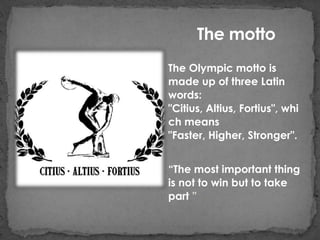
The Olympic motto is
made up of three Latin
words:
"Citius, Altius, Fortius", whi
ch means
"Faster, Higher, Stronger".


“The most important thing
is not to win but to take
part ”
The Olympic Values
   The founder of the Olympic
   Games, Pierre de Coubertin, saw in
   the Games an ideal opportunity to
   develop a set of universal principles
   or values that could be applied to
   education and society as a whole, as
   well as to sport itself.
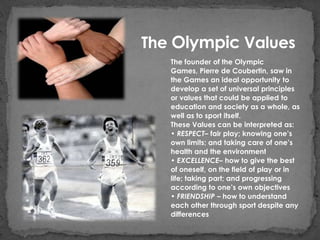
   These Values can be interpreted as:
   • RESPECT– fair play; knowing one’s
   own limits; and taking care of one’s
   health and the environment
   • EXCELLENCE– how to give the best
   of oneself, on the field of play or in
   life; taking part; and progressing
   according to one’s own objectives
   • FRIENDSHIP – how to understand
   each other through sport despite any
   differences
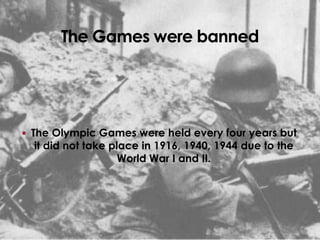
 The Olympic Games were held every four years but
  it did not take place in 1916, 1940, 1944 due to the
                    World War I and II.
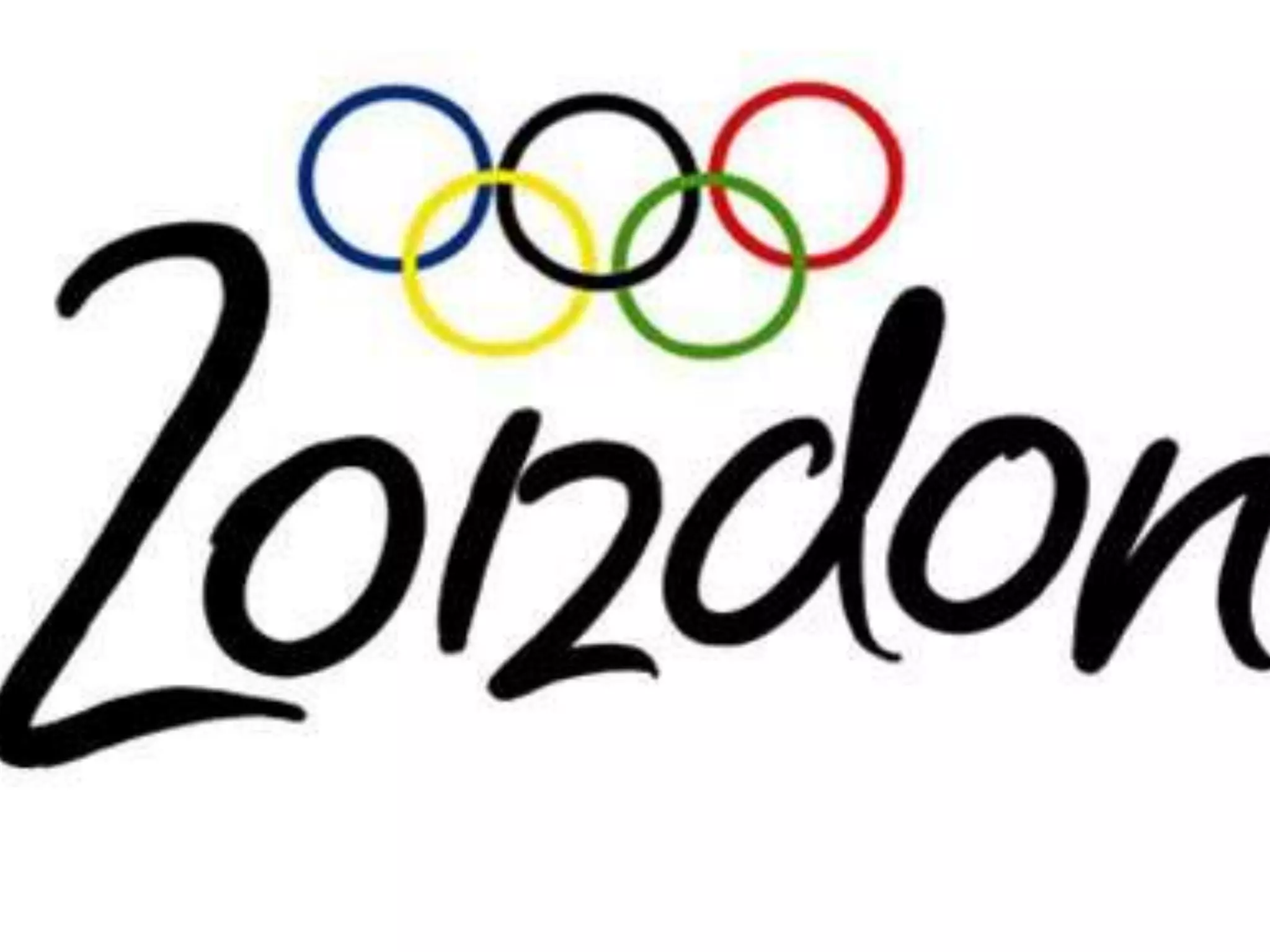
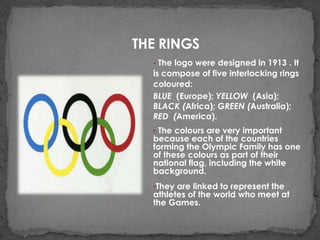
THE RINGS
  • The logo were designed in 1913 . It
  is compose of five interlocking rings
  coloured:
  BLUE (Europe); YELLOW (Asia);
  BLACK (Africa); GREEN (Australia);
  RED (America).
  • The colours are very important
  because each of the countries
  forming the Olympic Family has one
  of these colours as part of their
  national flag, including the white
  background.
  •They are linked to represent the
  athletes of the world who meet at
  the Games.
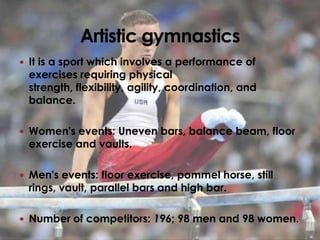
 It is a sport which involves a performance of
 exercises requiring physical
 strength, flexibility, agility, coordination, and
 balance.

 Women's events: Uneven bars, balance beam, floor
 exercise and vaults.

 Men's events: floor exercise, pommel horse, still
 rings, vault, parallel bars and high bar.

 Number of competitors: 196; 98 men and 98 women.
Scores are given by
a panel of judges
and they take into
account the
degree of difficulty
and the quality of
the execution.

Strength, flexibility
and balance are
keys to success in
this breathtaking
and hugely
competitive sport.
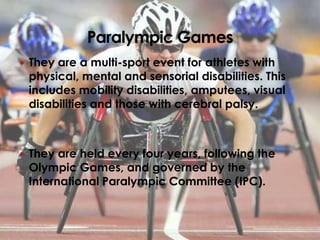
 They are a multi-sport event for athletes with
 physical, mental and sensorial disabilities. This
 includes mobility disabilities, amputees, visual
 disabilities and those with cerebral palsy.


 They are held every four years, following the
 Olympic Games, and governed by the
 International Paralympic Committee (IPC).
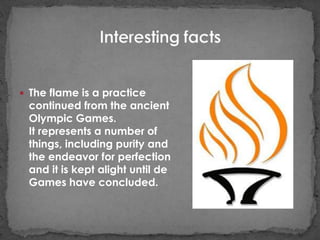
 The flame is a practice
 continued from the ancient
 Olympic Games.
 It represents a number of
 things, including purity and
 the endeavor for perfection
 and it is kept alight until de
 Games have concluded.
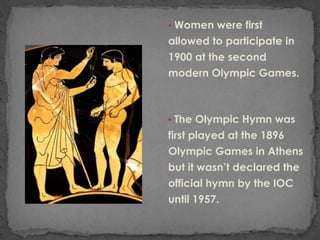
• Women were first
allowed to participate in
1900 at the second
modern Olympic Games.


• The Olympic Hymn was
first played at the 1896
Olympic Games in Athens
but it wasn’t declared the
official hymn by the IOC
until 1957.
Montenegro_Porcú_Ramirez

Montenegro_Porcú_Ramirez

  • 2.
    The Olympic Games began over 2,700 years ago in Olympia, in southwest Greece.  The Games were part of a religious festival and they were held in honour of Zeus. They were staged every four years at Olympia. People from all over the Greek world came to watch and take part.  The Baron Pierre de Coubertin founded the modern Olympics in Athens in 1896 to reunite the world through sports.
  • 3.
    The motto The Olympicmotto is made up of three Latin words: "Citius, Altius, Fortius", whi ch means "Faster, Higher, Stronger". “The most important thing is not to win but to take part ”
  • 4.
    The Olympic Values The founder of the Olympic Games, Pierre de Coubertin, saw in the Games an ideal opportunity to develop a set of universal principles or values that could be applied to education and society as a whole, as well as to sport itself. These Values can be interpreted as: • RESPECT– fair play; knowing one’s own limits; and taking care of one’s health and the environment • EXCELLENCE– how to give the best of oneself, on the field of play or in life; taking part; and progressing according to one’s own objectives • FRIENDSHIP – how to understand each other through sport despite any differences
  • 5.
     The OlympicGames were held every four years but it did not take place in 1916, 1940, 1944 due to the World War I and II.
  • 6.
    THE RINGS • The logo were designed in 1913 . It is compose of five interlocking rings coloured: BLUE (Europe); YELLOW (Asia); BLACK (Africa); GREEN (Australia); RED (America). • The colours are very important because each of the countries forming the Olympic Family has one of these colours as part of their national flag, including the white background. •They are linked to represent the athletes of the world who meet at the Games.
  • 7.
     It isa sport which involves a performance of exercises requiring physical strength, flexibility, agility, coordination, and balance.  Women's events: Uneven bars, balance beam, floor exercise and vaults.  Men's events: floor exercise, pommel horse, still rings, vault, parallel bars and high bar.  Number of competitors: 196; 98 men and 98 women.
  • 8.
    Scores are givenby a panel of judges and they take into account the degree of difficulty and the quality of the execution. Strength, flexibility and balance are keys to success in this breathtaking and hugely competitive sport.
  • 9.
     They area multi-sport event for athletes with physical, mental and sensorial disabilities. This includes mobility disabilities, amputees, visual disabilities and those with cerebral palsy.  They are held every four years, following the Olympic Games, and governed by the International Paralympic Committee (IPC).
  • 10.
     The flameis a practice continued from the ancient Olympic Games. It represents a number of things, including purity and the endeavor for perfection and it is kept alight until de Games have concluded.
  • 11.
    • Women werefirst allowed to participate in 1900 at the second modern Olympic Games. • The Olympic Hymn was first played at the 1896 Olympic Games in Athens but it wasn’t declared the official hymn by the IOC until 1957.