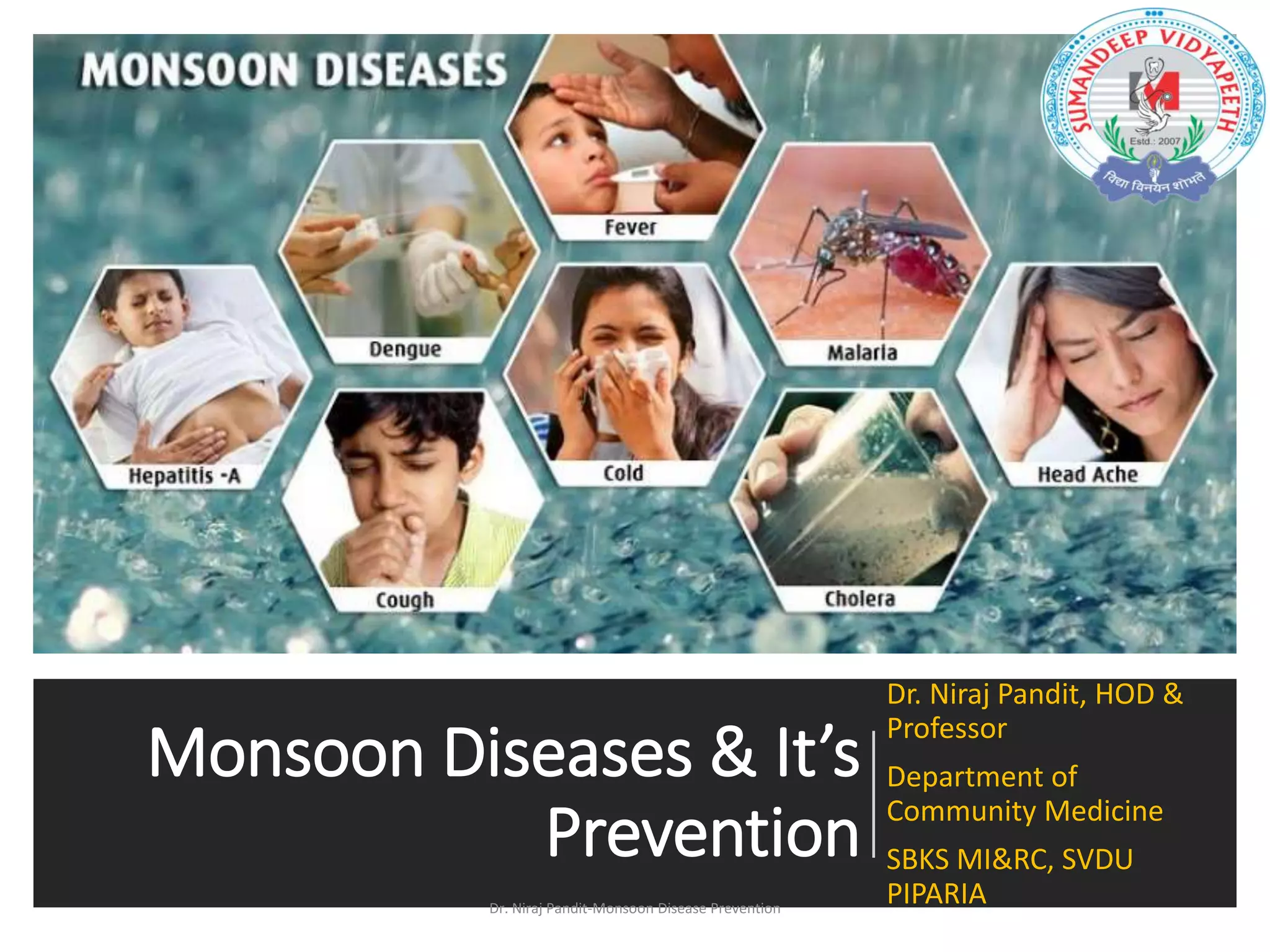
Monsoon Diseases & It’s
Prevention
Dr. Niraj Pandit, HOD &
Professor
Department of
Community Medicine
SBKS MI&RC, SVDU
PIPARIA
Dr. Niraj Pandit-Monsoon Disease Prevention
Objectives
of session
Understanding of changes of
environment
Human host adjustment –
acclimatization
Diseases to know and mode of
transmission
Prevention and control at
home level
When to go for treatment or
management
Dr. Niraj Pandit-Monsoon Disease Prevention
Understanding of change of
environment
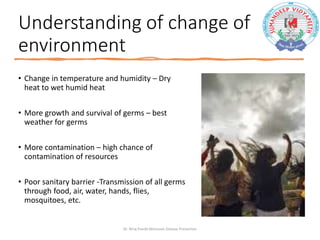
• Change in temperature and humidity – Dry
heat to wet humid heat
• More growth and survival of germs – best
weather for germs
• More contamination – high chance of
contamination of resources
• Poor sanitary barrier -Transmission of all germs
through food, air, water, hands, flies,
mosquitoes, etc.
Dr. Niraj Pandit-Monsoon Disease Prevention
Water
Collections
Dr. Niraj Pandit-Monsoon Disease
Prevention
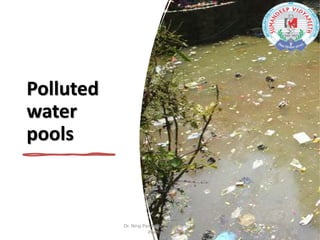
Polluted
water
pools
Dr. Niraj Pandit-Monsoon Disease
Prevention
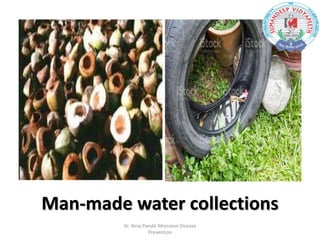
Man-made water collections
Dr. Niraj Pandit-Monsoon Disease
Prevention
Rresources
contamination
and
opportunity for
growth
• Humidity is key requirement for any
organism to grow
• Water contamination
• Surface which is contaminated mix with
drinking water
• Land pollution
• Mixing of sewage drainage with drinking
water
• Poor hygiene
• Repeated movement in rain leads to poor
hygiene – opportunity for germs
• Sudden drop of temperature
• Host poor immunity due to poor adjustment
Dr. Niraj Pandit-Monsoon Disease Prevention
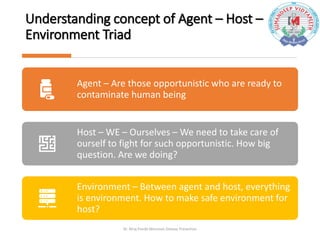
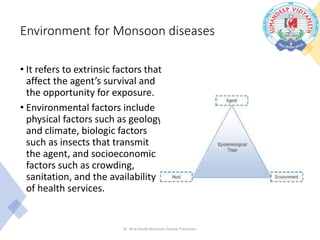
Understanding concept of Agent – Host –
Environment Triad
Agent – Are those opportunistic who are ready to
contaminate human being
Host – WE – Ourselves – We need to take care of
ourself to fight for such opportunistic. How big
question. Are we doing?
Environment – Between agent and host, everything
is environment. How to make safe environment for
host?
Dr. Niraj Pandit-Monsoon Disease Prevention
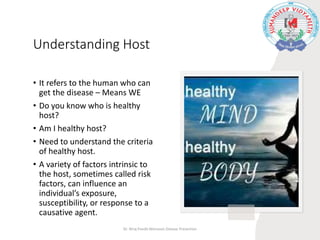
Understanding Host
• It refers to the human who can
get the disease – Means WE
• Do you know who is healthy
host?
• Am I healthy host?
• Need to understand the criteria
of healthy host.
• A variety of factors intrinsic to
the host, sometimes called risk
factors, can influence an
individual’s exposure,
susceptibility, or response to a
causative agent.
Dr. Niraj Pandit-Monsoon Disease Prevention
Just 5 min test to know ourselves
•I request participants to join this small survey
and answer
•https://forms.gle/DmUH52xQQPeMnsVS9
•The link is available in Chat box please click
and participate
•This is healthy host search and awareness
Dr. Niraj Pandit-Monsoon Disease Prevention
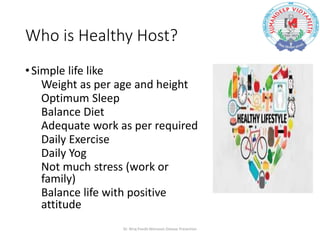
Who is Healthy Host?
•Simple life like
Weight as per age and height
Optimum Sleep
Balance Diet
Adequate work as per required
Daily Exercise
Daily Yog
Not much stress (work or
family)
Balance life with positive
attitude
Dr. Niraj Pandit-Monsoon Disease Prevention
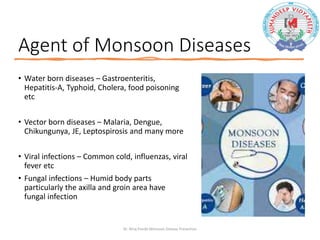
Agent of Monsoon Diseases
• Water born diseases – Gastroenteritis,
Hepatitis-A, Typhoid, Cholera, food poisoning
etc
• Vector born diseases – Malaria, Dengue,
Chikungunya, JE, Leptospirosis and many more
• Viral infections – Common cold, influenzas, viral
fever etc
• Fungal infections – Humid body parts
particularly the axilla and groin area have
fungal infection
Dr. Niraj Pandit-Monsoon Disease Prevention
Environment for Monsoon diseases
• It refers to extrinsic factors that
affect the agent’s survival and
the opportunity for exposure.
• Environmental factors include
physical factors such as geology
and climate, biologic factors
such as insects that transmit
the agent, and socioeconomic
factors such as crowding,
sanitation, and the availability
of health services.
Dr. Niraj Pandit-Monsoon Disease Prevention
Influenza (Cold and Flu)
• Most commonly occurring
health sickness,
• Highly contagious disease,
• Symptoms involve runny or
stuffy nose, body ache,
throat irritation and
soreness and fever,
• It’s always advisable to
consult a physician and get
the required medicines
prescribed for getting
cured from the infection.
Dr. Niraj Pandit-Monsoon Disease Prevention
Gastroenteritis
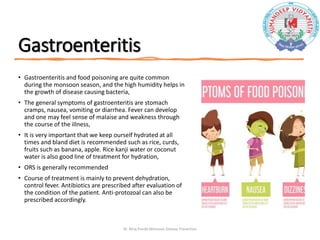
• Gastroenteritis and food poisoning are quite common
during the monsoon season, and the high humidity helps in
the growth of disease causing bacteria,
• The general symptoms of gastroenteritis are stomach
cramps, nausea, vomiting or diarrhea. Fever can develop
and one may feel sense of malaise and weakness through
the course of the illness,
• It is very important that we keep ourself hydrated at all
times and bland diet is recommended such as rice, curds,
fruits such as banana, apple. Rice kanji water or coconut
water is also good line of treatment for hydration,
• ORS is generally recommended
• Course of treatment is mainly to prevent dehydration,
control fever. Antibiotics are prescribed after evaluation of
the condition of the patient. Anti-protozoal can also be
prescribed accordingly.
Dr. Niraj Pandit-Monsoon Disease Prevention
Hepatitis A
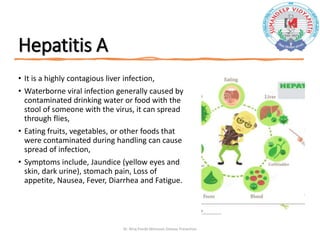
• It is a highly contagious liver infection,
• Waterborne viral infection generally caused by
contaminated drinking water or food with the
stool of someone with the virus, it can spread
through flies,
• Eating fruits, vegetables, or other foods that
were contaminated during handling can cause
spread of infection,
• Symptoms include, Jaundice (yellow eyes and
skin, dark urine), stomach pain, Loss of
appetite, Nausea, Fever, Diarrhea and Fatigue.
Dr. Niraj Pandit-Monsoon Disease Prevention
Dengue
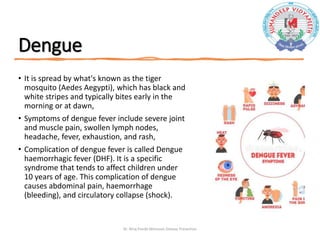
• It is spread by what's known as the tiger
mosquito (Aedes Aegypti), which has black and
white stripes and typically bites early in the
morning or at dawn,
• Symptoms of dengue fever include severe joint
and muscle pain, swollen lymph nodes,
headache, fever, exhaustion, and rash,
• Complication of dengue fever is called Dengue
haemorrhagic fever (DHF). It is a specific
syndrome that tends to affect children under
10 years of age. This complication of dengue
causes abdominal pain, haemorrhage
(bleeding), and circulatory collapse (shock).
Dr. Niraj Pandit-Monsoon Disease Prevention
Malaria
• It is spread by bite of Female Anopheles mosquito,
• Most deaths are caused by P. falciparum and is the most
dangerous type of malaria also known as cerebral
malaria. Other forms of malaria are P. vivax, P. ovale, and
P. malariae,
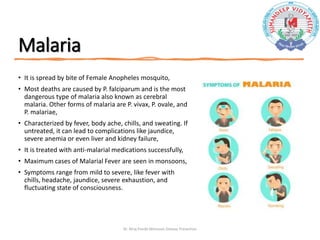
• Characterized by fever, body ache, chills, and sweating. If
untreated, it can lead to complications like jaundice,
severe anemia or even liver and kidney failure,
• It is treated with anti-malarial medications successfully,
• Maximum cases of Malarial Fever are seen in monsoons,
• Symptoms range from mild to severe, like fever with
chills, headache, jaundice, severe exhaustion, and
fluctuating state of consciousness.
Dr. Niraj Pandit-Monsoon Disease Prevention
Viral Fever
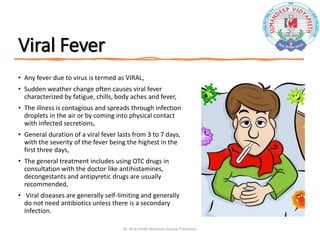
• Any fever due to virus is termed as VIRAL,
• Sudden weather change often causes viral fever
characterized by fatigue, chills, body aches and fever,
• The illness is contagious and spreads through infection
droplets in the air or by coming into physical contact
with infected secretions,
• General duration of a viral fever lasts from 3 to 7 days,
with the severity of the fever being the highest in the
first three days,
• The general treatment includes using OTC drugs in
consultation with the doctor like antihistamines,
decongestants and antipyretic drugs are usually
recommended,
• Viral diseases are generally self-limiting and generally
do not need antibiotics unless there is a secondary
infection.
Dr. Niraj Pandit-Monsoon Disease Prevention
Prevention and Control of Monsoon Diseases
• Your action can Prevent you to get Monsoon Diseases
• One must drink only clean water and use boiled water or water purifiers.
• One should change their hand towels after a day's use.
• One should cover their mouth and nose with a handkerchief while coughing
or sneezing.
• Use mosquito repellents and nets (dengue transmitting mosquitoes usually
bite during day time; either early morning or late evening).
• Avoid eating out and consume as much fresh food as possible.
• Drink warm water every two hours and carry home-boiled water while
travelling.
• Avoid visiting crowded places such as theatres or exhibitions.
• Use hand sanitizers while travelling.
• Cover our nose while travelling on a bike/while seated next to the window in
a bus or train.
• Avoid getting wet in the rain.
Dr. Niraj Pandit-Monsoon Disease Prevention
How to
improve
Host
Immunity
• Is it possible to strengthen one’s Immunity?
• Yes
• Just look at the tool
• https://forms.gle/KCuwpP7dcyCA64JB9
• Click on tool and assess your immunity
• Do regular assessment of your immunity
and if you have less score improve with
change in life style to get best help
• Healthy life style is best answer
Dr. Niraj Pandit-Monsoon Disease Prevention
When to Visit Doctor?
• There are various home remedy
for few symptoms But not for all.
• You can try home remedy for a
day or mild symptoms
• Serious and intolerable
symptoms one needs to visit
doctor immediately without
delay
• Hope you have family physician –
Take help of family physician first
• No need to go consultant directly
• Your family physician is knowing
you best rather Consultant
doctor
Dr. Niraj Pandit-Monsoon Disease Prevention
Thank You
• Enjoy Monsoon with Precautions
• If any query ask or write
drniraj74@yahoo.com
• Acknowledgement –
• Thank you to IOHA, Vadodara – Dr.
Milan Thakar and Team
• Dr. Sandipkumar Thakkar and Hero
MotCorp Ltd
• My Sumandeep Vidyapeeth
• Few material I took form internet
and citied them
• Dr. Bhaskar Jyoti who helped to
prepare PPT
Dr. Niraj Pandit-Monsoon Disease Prevention

Monsoon Diseases & it's Prevention.pptx

  • 1.
    Monsoon Diseases &It’s Prevention Dr. Niraj Pandit, HOD & Professor Department of Community Medicine SBKS MI&RC, SVDU PIPARIA Dr. Niraj Pandit-Monsoon Disease Prevention
  • 2.
    Objectives of session Understanding ofchanges of environment Human host adjustment – acclimatization Diseases to know and mode of transmission Prevention and control at home level When to go for treatment or management Dr. Niraj Pandit-Monsoon Disease Prevention
  • 3.
    Understanding of changeof environment • Change in temperature and humidity – Dry heat to wet humid heat • More growth and survival of germs – best weather for germs • More contamination – high chance of contamination of resources • Poor sanitary barrier -Transmission of all germs through food, air, water, hands, flies, mosquitoes, etc. Dr. Niraj Pandit-Monsoon Disease Prevention
  • 4.
  • 5.
  • 6.
    Man-made water collections Dr.Niraj Pandit-Monsoon Disease Prevention
  • 7.
    Rresources contamination and opportunity for growth • Humidityis key requirement for any organism to grow • Water contamination • Surface which is contaminated mix with drinking water • Land pollution • Mixing of sewage drainage with drinking water • Poor hygiene • Repeated movement in rain leads to poor hygiene – opportunity for germs • Sudden drop of temperature • Host poor immunity due to poor adjustment Dr. Niraj Pandit-Monsoon Disease Prevention
  • 8.
    Understanding concept ofAgent – Host – Environment Triad Agent – Are those opportunistic who are ready to contaminate human being Host – WE – Ourselves – We need to take care of ourself to fight for such opportunistic. How big question. Are we doing? Environment – Between agent and host, everything is environment. How to make safe environment for host? Dr. Niraj Pandit-Monsoon Disease Prevention
  • 9.
    Understanding Host • Itrefers to the human who can get the disease – Means WE • Do you know who is healthy host? • Am I healthy host? • Need to understand the criteria of healthy host. • A variety of factors intrinsic to the host, sometimes called risk factors, can influence an individual’s exposure, susceptibility, or response to a causative agent. Dr. Niraj Pandit-Monsoon Disease Prevention
  • 10.
    Just 5 mintest to know ourselves •I request participants to join this small survey and answer •https://forms.gle/DmUH52xQQPeMnsVS9 •The link is available in Chat box please click and participate •This is healthy host search and awareness Dr. Niraj Pandit-Monsoon Disease Prevention
  • 11.
    Who is HealthyHost? •Simple life like Weight as per age and height Optimum Sleep Balance Diet Adequate work as per required Daily Exercise Daily Yog Not much stress (work or family) Balance life with positive attitude Dr. Niraj Pandit-Monsoon Disease Prevention
  • 12.
    Agent of MonsoonDiseases • Water born diseases – Gastroenteritis, Hepatitis-A, Typhoid, Cholera, food poisoning etc • Vector born diseases – Malaria, Dengue, Chikungunya, JE, Leptospirosis and many more • Viral infections – Common cold, influenzas, viral fever etc • Fungal infections – Humid body parts particularly the axilla and groin area have fungal infection Dr. Niraj Pandit-Monsoon Disease Prevention
  • 13.
    Environment for Monsoondiseases • It refers to extrinsic factors that affect the agent’s survival and the opportunity for exposure. • Environmental factors include physical factors such as geology and climate, biologic factors such as insects that transmit the agent, and socioeconomic factors such as crowding, sanitation, and the availability of health services. Dr. Niraj Pandit-Monsoon Disease Prevention
  • 14.
    Influenza (Cold andFlu) • Most commonly occurring health sickness, • Highly contagious disease, • Symptoms involve runny or stuffy nose, body ache, throat irritation and soreness and fever, • It’s always advisable to consult a physician and get the required medicines prescribed for getting cured from the infection. Dr. Niraj Pandit-Monsoon Disease Prevention
  • 15.
    Gastroenteritis • Gastroenteritis andfood poisoning are quite common during the monsoon season, and the high humidity helps in the growth of disease causing bacteria, • The general symptoms of gastroenteritis are stomach cramps, nausea, vomiting or diarrhea. Fever can develop and one may feel sense of malaise and weakness through the course of the illness, • It is very important that we keep ourself hydrated at all times and bland diet is recommended such as rice, curds, fruits such as banana, apple. Rice kanji water or coconut water is also good line of treatment for hydration, • ORS is generally recommended • Course of treatment is mainly to prevent dehydration, control fever. Antibiotics are prescribed after evaluation of the condition of the patient. Anti-protozoal can also be prescribed accordingly. Dr. Niraj Pandit-Monsoon Disease Prevention
  • 16.
    Hepatitis A • Itis a highly contagious liver infection, • Waterborne viral infection generally caused by contaminated drinking water or food with the stool of someone with the virus, it can spread through flies, • Eating fruits, vegetables, or other foods that were contaminated during handling can cause spread of infection, • Symptoms include, Jaundice (yellow eyes and skin, dark urine), stomach pain, Loss of appetite, Nausea, Fever, Diarrhea and Fatigue. Dr. Niraj Pandit-Monsoon Disease Prevention
  • 17.
    Dengue • It isspread by what's known as the tiger mosquito (Aedes Aegypti), which has black and white stripes and typically bites early in the morning or at dawn, • Symptoms of dengue fever include severe joint and muscle pain, swollen lymph nodes, headache, fever, exhaustion, and rash, • Complication of dengue fever is called Dengue haemorrhagic fever (DHF). It is a specific syndrome that tends to affect children under 10 years of age. This complication of dengue causes abdominal pain, haemorrhage (bleeding), and circulatory collapse (shock). Dr. Niraj Pandit-Monsoon Disease Prevention
  • 18.
    Malaria • It isspread by bite of Female Anopheles mosquito, • Most deaths are caused by P. falciparum and is the most dangerous type of malaria also known as cerebral malaria. Other forms of malaria are P. vivax, P. ovale, and P. malariae, • Characterized by fever, body ache, chills, and sweating. If untreated, it can lead to complications like jaundice, severe anemia or even liver and kidney failure, • It is treated with anti-malarial medications successfully, • Maximum cases of Malarial Fever are seen in monsoons, • Symptoms range from mild to severe, like fever with chills, headache, jaundice, severe exhaustion, and fluctuating state of consciousness. Dr. Niraj Pandit-Monsoon Disease Prevention
  • 19.
    Viral Fever • Anyfever due to virus is termed as VIRAL, • Sudden weather change often causes viral fever characterized by fatigue, chills, body aches and fever, • The illness is contagious and spreads through infection droplets in the air or by coming into physical contact with infected secretions, • General duration of a viral fever lasts from 3 to 7 days, with the severity of the fever being the highest in the first three days, • The general treatment includes using OTC drugs in consultation with the doctor like antihistamines, decongestants and antipyretic drugs are usually recommended, • Viral diseases are generally self-limiting and generally do not need antibiotics unless there is a secondary infection. Dr. Niraj Pandit-Monsoon Disease Prevention
  • 20.
    Prevention and Controlof Monsoon Diseases • Your action can Prevent you to get Monsoon Diseases • One must drink only clean water and use boiled water or water purifiers. • One should change their hand towels after a day's use. • One should cover their mouth and nose with a handkerchief while coughing or sneezing. • Use mosquito repellents and nets (dengue transmitting mosquitoes usually bite during day time; either early morning or late evening). • Avoid eating out and consume as much fresh food as possible. • Drink warm water every two hours and carry home-boiled water while travelling. • Avoid visiting crowded places such as theatres or exhibitions. • Use hand sanitizers while travelling. • Cover our nose while travelling on a bike/while seated next to the window in a bus or train. • Avoid getting wet in the rain. Dr. Niraj Pandit-Monsoon Disease Prevention
  • 21.
    How to improve Host Immunity • Isit possible to strengthen one’s Immunity? • Yes • Just look at the tool • https://forms.gle/KCuwpP7dcyCA64JB9 • Click on tool and assess your immunity • Do regular assessment of your immunity and if you have less score improve with change in life style to get best help • Healthy life style is best answer Dr. Niraj Pandit-Monsoon Disease Prevention
  • 22.
    When to VisitDoctor? • There are various home remedy for few symptoms But not for all. • You can try home remedy for a day or mild symptoms • Serious and intolerable symptoms one needs to visit doctor immediately without delay • Hope you have family physician – Take help of family physician first • No need to go consultant directly • Your family physician is knowing you best rather Consultant doctor Dr. Niraj Pandit-Monsoon Disease Prevention
  • 23.
    Thank You • EnjoyMonsoon with Precautions • If any query ask or write drniraj74@yahoo.com • Acknowledgement – • Thank you to IOHA, Vadodara – Dr. Milan Thakar and Team • Dr. Sandipkumar Thakkar and Hero MotCorp Ltd • My Sumandeep Vidyapeeth • Few material I took form internet and citied them • Dr. Bhaskar Jyoti who helped to prepare PPT Dr. Niraj Pandit-Monsoon Disease Prevention