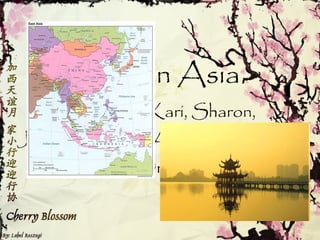
Monsoon Asia By: Elizabeth, Kari, Sharon, Jessica, Dakota, Annika, Edgar, and Omar
History World’s earliest civilizations arose here Rulers united parts of the region into empires Colonized later by European countries Now have gained their independence First civilization in Indus River Valley in 2500 BC Vanished by 1700 BC China was split into kingdoms Ruled by dynasties Qin Built Great Wall Mauryas conquered and united India in 320 BC Mughals then ruled India from 1526 to 1700s In 1400s Europeans colonized Monsoon Asia India freed in 1947 and Southeast Asia in 1950s
Culture Very diverse and cultural region, from  the food they eat, to traditions they have Food is a very important part of the culture Art, dance, music, and cinema Much of the population of Asia is very friendly with one another, and they look out for each other greatly Respect is highly valued and taught in, and is common courtesy towards others, especially towards elders Education is highly valued, and many parents  enforce this value to their children.
Language Bengali Bhatanese Khmer Mandarin Hindi English Bahasa Indonesia Japanese Korean Lao Chinese Malay Tamil Sinhala Thai Vietnamese Bahasa Melayu Khalkha Mongol Napali Filipino
Population Population 3.7 billion More than half world’s people Mostly rural Many religious traditions Hindu, Islam, Christian, Buddhism (main religion), Indigenous, Judaism, Shinto, Confucianism
Economy Mix of old and new Farming and fishing Industry and finance centers Commercial fishing by seacoast Resources Coal Produces most on earth Petroleum Hydroelectric power Land use  Subsistence farmers Rice, tea, cotton, spices, tobacco, 90% of world’s rubber Commercial fishing Shrimp, tuna Nomadic herding International trade Machinery and consumer goods Japan is world leader in production of cars and electronics
Geography Mountains are the most commanding  feature of the landscape Rugged Himalayas form Monsoon Asia’s western border Mt. Everest- highest mountain in the world, 29,035 feet Indus, Ganges, and Brahmaputra are the main rivers Meet to form one of the world’s largest river deltas Ghats Mountain Range Chang Jiang- third longest river in the world, China Taklamakan and Gobi (one of world’s largest) deserts Japan’s islands formed by volcanoes
Climate Shaped by Monsoons Strong winds that create rainfall patterns South Arid to tropical Northwest Dry Himalayas Highlands climate South Tropical wet North Central Humid subtropical East Highlands climate Humid continental Southeast Tropical
Vegetation Varies as climate and elevation does Drier parts Desert scrub Tropical zones Rainforests Highlands Ice and snow Central Tropical grasslands Lower Himalayas Mixed forest Tropical climate zones Broadleaf evergreen forests North Deciduous forest Southeast Rainforests and tropical grassland Bamboo

Monsoon asia

  • 1.
    Monsoon Asia By:Elizabeth, Kari, Sharon, Jessica, Dakota, Annika, Edgar, and Omar
  • 2.
    History World’s earliestcivilizations arose here Rulers united parts of the region into empires Colonized later by European countries Now have gained their independence First civilization in Indus River Valley in 2500 BC Vanished by 1700 BC China was split into kingdoms Ruled by dynasties Qin Built Great Wall Mauryas conquered and united India in 320 BC Mughals then ruled India from 1526 to 1700s In 1400s Europeans colonized Monsoon Asia India freed in 1947 and Southeast Asia in 1950s
  • 3.
    Culture Very diverseand cultural region, from the food they eat, to traditions they have Food is a very important part of the culture Art, dance, music, and cinema Much of the population of Asia is very friendly with one another, and they look out for each other greatly Respect is highly valued and taught in, and is common courtesy towards others, especially towards elders Education is highly valued, and many parents enforce this value to their children.
  • 4.
    Language Bengali BhataneseKhmer Mandarin Hindi English Bahasa Indonesia Japanese Korean Lao Chinese Malay Tamil Sinhala Thai Vietnamese Bahasa Melayu Khalkha Mongol Napali Filipino
  • 5.
    Population Population 3.7billion More than half world’s people Mostly rural Many religious traditions Hindu, Islam, Christian, Buddhism (main religion), Indigenous, Judaism, Shinto, Confucianism
  • 6.
    Economy Mix ofold and new Farming and fishing Industry and finance centers Commercial fishing by seacoast Resources Coal Produces most on earth Petroleum Hydroelectric power Land use Subsistence farmers Rice, tea, cotton, spices, tobacco, 90% of world’s rubber Commercial fishing Shrimp, tuna Nomadic herding International trade Machinery and consumer goods Japan is world leader in production of cars and electronics
  • 7.
    Geography Mountains arethe most commanding feature of the landscape Rugged Himalayas form Monsoon Asia’s western border Mt. Everest- highest mountain in the world, 29,035 feet Indus, Ganges, and Brahmaputra are the main rivers Meet to form one of the world’s largest river deltas Ghats Mountain Range Chang Jiang- third longest river in the world, China Taklamakan and Gobi (one of world’s largest) deserts Japan’s islands formed by volcanoes
  • 8.
    Climate Shaped byMonsoons Strong winds that create rainfall patterns South Arid to tropical Northwest Dry Himalayas Highlands climate South Tropical wet North Central Humid subtropical East Highlands climate Humid continental Southeast Tropical
  • 9.
    Vegetation Varies asclimate and elevation does Drier parts Desert scrub Tropical zones Rainforests Highlands Ice and snow Central Tropical grasslands Lower Himalayas Mixed forest Tropical climate zones Broadleaf evergreen forests North Deciduous forest Southeast Rainforests and tropical grassland Bamboo