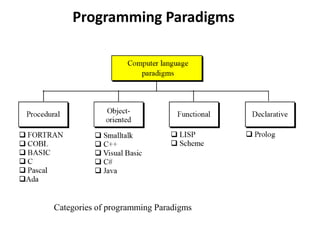
Categories of programming Paradigms
Programming Paradigms
The procedural paradigm
In the procedural paradigm (or imperative paradigm) we can
think of a program as an active agent that manipulates
passive objects. We encounter many passive objects in our
daily life: a stone, a book, a lamp, and so on. A passive
object cannot initiate an action by itself, but it can receive
actions from active agents.
A program in a procedural paradigm is an active agent
that uses passive objects that we refer to as data or data
items. To manipulate a piece of data, the active agent
(program) issues an action, referred to as a procedure. For
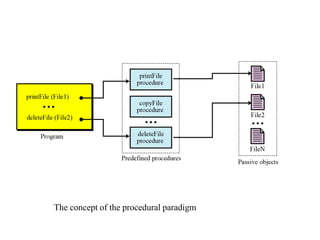
example, think of a program that prints the contents of a file.
The file is a passive object. To print the file, the program
uses a procedure, which we call print.
The concept of the procedural paradigm
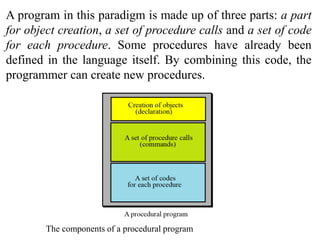
A program in this paradigm is made up of three parts: a part
for object creation, a set of procedure calls and a set of code
for each procedure. Some procedures have already been
defined in the language itself. By combining this code, the
programmer can create new procedures.
The components of a procedural program
Some procedural languages
 FORTRAN (FORmula TRANslation)
 COBOL (COmmon Business-Oriented Language)
 Pascal
 C
 Ada
The object-oriented paradigm
The object-oriented paradigm deals with active objects
instead of passive objects. We encounter many active objects
in our daily life: a vehicle, an automatic door, a dishwasher
and so on. The action to be performed on these objects are
included in the object: the objects need only to receive the
appropriate stimulus from outside to perform one of the
actions.
A file in an object-oriented paradigm can be packed
with all the procedures—called methods in the object-
oriented paradigm—to be performed by the file: printing,
copying, deleting and so on. The program in this paradigm
just sends the corresponding request to the object.
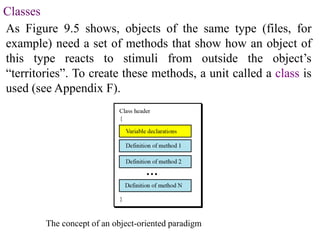
The concept of an object-oriented paradigm
Classes
As Figure 9.5 shows, objects of the same type (files, for
example) need a set of methods that show how an object of
this type reacts to stimuli from outside the object’s
“territories”. To create these methods, a unit called a class is
used (see Appendix F).
The concept of an object-oriented paradigm
Methods
In general, the format of methods are very similar to the
functions used in some procedural languages. Each method
has its header, its local variables and its statement. This
means that most of the features we discussed for procedural
languages are also applied to methods written for an object-
oriented program. In other words, we can claim that object-
oriented languages are actually an extension of procedural
languages with some new ideas and some new features. The
C++ language, for example, is an object-oriented extension
of the C language.
Inheritance
In the object-oriented paradigm, as in nature, an object can
inherit from another object. This concept is called
inheritance. When a general class is defined, we can define a
more specific class that inherits some of the characteristics of
the general class, but also has some new characteristics. For
example, when an object of the type GeometricalShapes is
defined, we can define a class called Rectangles. Rectangles
are geometrical shapes with additional characteristics.
Polymorphism
Polymorphism means “many forms”. Polymorphism in the
object-oriented paradigm means that we can define several
operations with the same name that can do different things in
related classes. For example, assume that we define two
classes, Rectangles and Circles, both inherited from the class
GeometricalShapes. We define two operations both named
area, one in Rectangles and one in Circles, that calculate the
area of a rectangle or a circle. The two operations have the
same name
Some object-oriented languages
 C++
 Java
The functional paradigm
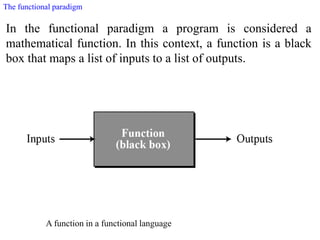
In the functional paradigm a program is considered a
mathematical function. In this context, a function is a black
box that maps a list of inputs to a list of outputs.
A function in a functional language
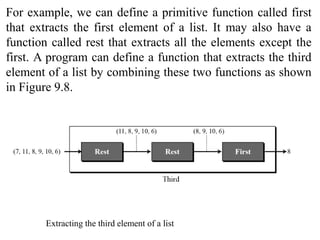
For example, we can define a primitive function called first
that extracts the first element of a list. It may also have a
function called rest that extracts all the elements except the
first. A program can define a function that extracts the third
element of a list by combining these two functions as shown
in Figure 9.8.
Extracting the third element of a list
Some functional languages
 LISP (LISt Programming)
 Scheme
OOP has the following important features.
Class:
• A class is the core of any modern Object
Oriented Programming language such as C++.
• In OOP languages it is must to create a class
for representing data.
• Class is a blueprint of an object that contains
variables for storing data and functions to
performing operations on these data.
9.16
The declarative paradigm
A declarative paradigm uses the principle of logical
reasoning to answer queries. It is based on formal logic
defined by Greek mathematicians and later developed into
first-order predicate calculus.
Logical reasoning is based on deduction. Some
statements (facts) are given that are assumed to be true, and
the logician uses solid rules of logical reasoning to deduce
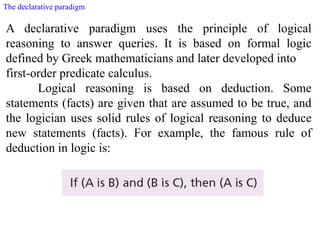
new statements (facts). For example, the famous rule of
deduction in logic is:
Using this rule and the two following facts,
we can deduce a new fact:
Prolog
One of the famous declarative languages is Prolog
(PROgramming in LOGic), developed by A. Colmerauer in
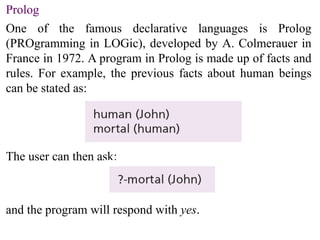
France in 1972. A program in Prolog is made up of facts and
rules. For example, the previous facts about human beings
can be stated as:
The user can then ask:
and the program will respond with yes.

Paradigms.pptx

  • 1.
    Categories of programmingParadigms Programming Paradigms
  • 2.
    The procedural paradigm Inthe procedural paradigm (or imperative paradigm) we can think of a program as an active agent that manipulates passive objects. We encounter many passive objects in our daily life: a stone, a book, a lamp, and so on. A passive object cannot initiate an action by itself, but it can receive actions from active agents. A program in a procedural paradigm is an active agent that uses passive objects that we refer to as data or data items. To manipulate a piece of data, the active agent (program) issues an action, referred to as a procedure. For example, think of a program that prints the contents of a file. The file is a passive object. To print the file, the program uses a procedure, which we call print.
  • 3.
    The concept ofthe procedural paradigm
  • 4.
    A program inthis paradigm is made up of three parts: a part for object creation, a set of procedure calls and a set of code for each procedure. Some procedures have already been defined in the language itself. By combining this code, the programmer can create new procedures. The components of a procedural program
  • 5.
    Some procedural languages FORTRAN (FORmula TRANslation)  COBOL (COmmon Business-Oriented Language)  Pascal  C  Ada
  • 6.
    The object-oriented paradigm Theobject-oriented paradigm deals with active objects instead of passive objects. We encounter many active objects in our daily life: a vehicle, an automatic door, a dishwasher and so on. The action to be performed on these objects are included in the object: the objects need only to receive the appropriate stimulus from outside to perform one of the actions. A file in an object-oriented paradigm can be packed with all the procedures—called methods in the object- oriented paradigm—to be performed by the file: printing, copying, deleting and so on. The program in this paradigm just sends the corresponding request to the object.
  • 7.
    The concept ofan object-oriented paradigm
  • 8.
    Classes As Figure 9.5shows, objects of the same type (files, for example) need a set of methods that show how an object of this type reacts to stimuli from outside the object’s “territories”. To create these methods, a unit called a class is used (see Appendix F). The concept of an object-oriented paradigm
  • 9.
    Methods In general, theformat of methods are very similar to the functions used in some procedural languages. Each method has its header, its local variables and its statement. This means that most of the features we discussed for procedural languages are also applied to methods written for an object- oriented program. In other words, we can claim that object- oriented languages are actually an extension of procedural languages with some new ideas and some new features. The C++ language, for example, is an object-oriented extension of the C language.
  • 10.
    Inheritance In the object-orientedparadigm, as in nature, an object can inherit from another object. This concept is called inheritance. When a general class is defined, we can define a more specific class that inherits some of the characteristics of the general class, but also has some new characteristics. For example, when an object of the type GeometricalShapes is defined, we can define a class called Rectangles. Rectangles are geometrical shapes with additional characteristics.
  • 11.
    Polymorphism Polymorphism means “manyforms”. Polymorphism in the object-oriented paradigm means that we can define several operations with the same name that can do different things in related classes. For example, assume that we define two classes, Rectangles and Circles, both inherited from the class GeometricalShapes. We define two operations both named area, one in Rectangles and one in Circles, that calculate the area of a rectangle or a circle. The two operations have the same name
  • 12.
  • 13.
    The functional paradigm Inthe functional paradigm a program is considered a mathematical function. In this context, a function is a black box that maps a list of inputs to a list of outputs. A function in a functional language
  • 14.
    For example, wecan define a primitive function called first that extracts the first element of a list. It may also have a function called rest that extracts all the elements except the first. A program can define a function that extracts the third element of a list by combining these two functions as shown in Figure 9.8. Extracting the third element of a list
  • 15.
    Some functional languages LISP (LISt Programming)  Scheme
  • 16.
    OOP has thefollowing important features. Class: • A class is the core of any modern Object Oriented Programming language such as C++. • In OOP languages it is must to create a class for representing data. • Class is a blueprint of an object that contains variables for storing data and functions to performing operations on these data. 9.16
  • 17.
    The declarative paradigm Adeclarative paradigm uses the principle of logical reasoning to answer queries. It is based on formal logic defined by Greek mathematicians and later developed into first-order predicate calculus. Logical reasoning is based on deduction. Some statements (facts) are given that are assumed to be true, and the logician uses solid rules of logical reasoning to deduce new statements (facts). For example, the famous rule of deduction in logic is:
  • 18.
    Using this ruleand the two following facts, we can deduce a new fact:
  • 19.
    Prolog One of thefamous declarative languages is Prolog (PROgramming in LOGic), developed by A. Colmerauer in France in 1972. A program in Prolog is made up of facts and rules. For example, the previous facts about human beings can be stated as: The user can then ask: and the program will respond with yes.