Balkan Civic Practices # 9
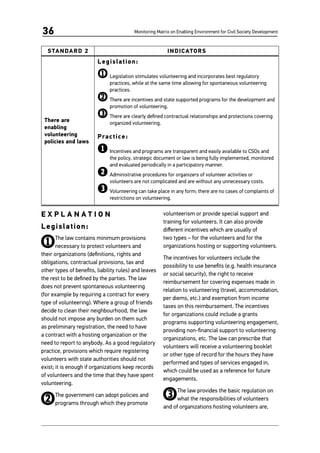
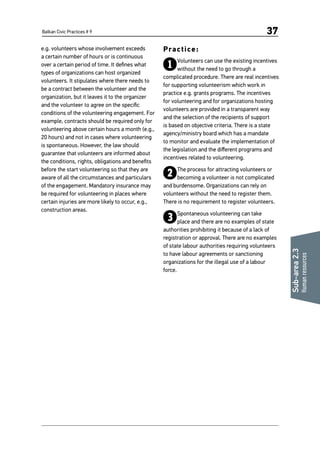
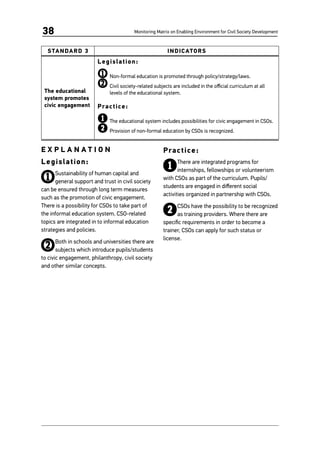
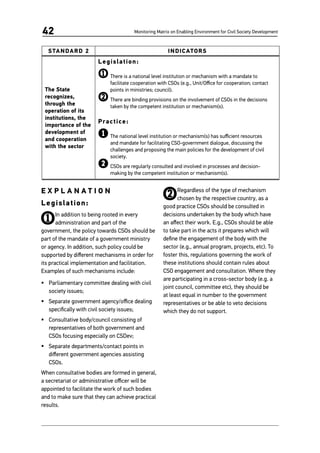
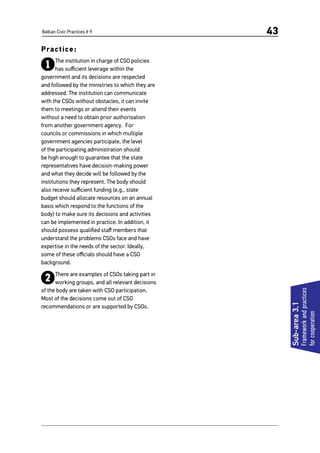
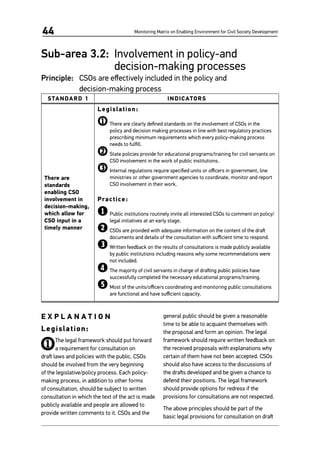
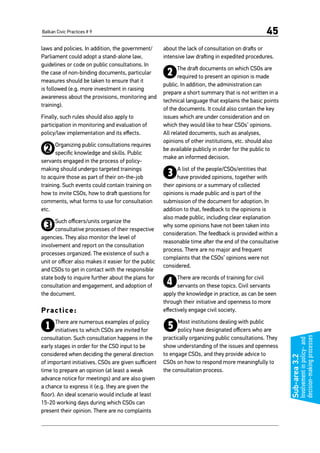
MONITORING MATRIX
ON ENABLING
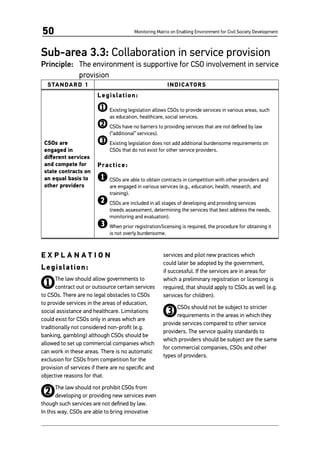
ENVIRONMENT
FOR CIVIL SOCIETY
DEVELOPMENT
THE TOOL-KIT
In partnership with
BalkanCivicPractices
[6#]
Balkan Civic Practices # 9 1
Monitoring Matrix on Enabling
Environment for Civil Society Development
The Tool-Kit
This publication is made possible by the generous support of the American people through the
United States Agency for International Development (USAID). The contents are the responsibility of
the authors and do not necessarily reflect the views of USAID or the United States Government.
Balkan Civic Practices # 9
B A L K A N
C I V I L
S O C I E T Y
DEVELOPMENT
N E T W O R K
Monitoring Matrix on Enabling Environment for Civil Society Development2
Copyright © 2013 by the Balkan Civil Society Development Network, the European Center for
Not-for-Profit Law and the International Center for Not-for-Profit Law. All rights reserved.
Copies of the publication can be order by post or e-mail bellow.
Balkan Civil Society Development Network (BCSDN)
Address: Bel Kamen Street no. 6/8, 1000-Skopje, Macedonia
E-mail: executiveoffice@balkancsd.net
Website: http://www.balkancsd.net
Publisher: Balkan Civil Society Development Network (BCSDN)
Editor: Tanja Hafner Ademi, Katerina Hadzi-Miceva Evans
Experts: Julijana Hoxha (Partners Albania), Slavisa Prorok (CPCD), Luben Panov (BCNL),
Vanja Skoric and Nives Miosic Lisjak (GONG), Taulant Hoxha (KCSF), Emina Nuredinoska
(MCIC), Ana Novakovic (CRNVO), Miljenko Dereta and Maja Stojanovic (Civic Initiatives), Tina
Divjak (CNVOS) and Başak Ersen (TUSEV).
Design and preparation: Koma lab.
Print: Borografika
Published in Macedonia, January, 2013
CIP - Каталогизација во публикација
Национална и универзитетска библиотека “Св. Климент Охридски”,
Скопје
316.323.64/.7:341.24
MONITORING matrix on enabling environment for civil society
development : the tool-kit / [editor Tanja Hafner-Ademi, Katerina
Hadzi-Miceva Evans]. - Skopje : Balkan civil society development
network, 2013. - 71 стр. ; 30 см. - (Balkan civic practices ; 9)
Фусноти кон текстот. - Содржи и: Annex
ISBN 978-608-65119-9-9
а) Граѓанско општество - Принципи и стандарди
COBISS.MK-ID 93386250
Balkan Civic Practices # 9 3
Contents
Acronyms.....................................................................................4
Acknowledgment........................................................................5
The Monitoring Matrix on Enabling Environment
for Civil Society Development ..................................................7
Area 1: Basic Legal Guarantees of Freedoms.........................9
Area 2: Framework for CSO Financial Viability
and Sustainability......................................................................25
Area 3: Government – CSO Relationship................................39
How to Use it.............................................................................56
Annex.........................................................................................59
Monitoring Matrix on Enabling Environment for Civil Society Development4
Acronyms
BCSDN 	 Balkan Civil Society Development Network
CSO	 civil society organization
CSDev 	 civil society development
CD 	 civil dialogue
CoE 	 Council of Europe
COM	 Communication
EU 	 European Union
EC 	 European Commission
ECHR 	 European Convention for the Protection of
	 Human Rights and Fundamental Freedoms
ECNL 	 European Center for Not-for-Profit Law
ICCPR 	 International Covenant of Civil and Political Rights
ICNL 	 International Center for Not-for-Profit Law
ICT 	 Internet and Communication Technologies
IPA 	 Instrument for Pre-accession Assistance
LGBT 	 Lesbian, gay, bisexual, and transgender community
NED 	 National Endowment for Democracy
NGO 	 Non-governmental organization
ODIHR 	 Office for Democratic Institutions and Human Rights
OSCE 	 Organization for Security and Cooperation in Europe
Rec 	 Recommendations
UN 	 United Nations
Balkan Civic Practices # 9 5
Acknowledgment
Developing the Matrix has been the most excit-
ing, but at the same time the most challenging
endeavour BCSDN has taken on since it was
founded in 2001. We are as proud of the joint
work done by BCSDN members’ and part-
ners’ experts as we are motivated to subject
the Matrix to scrutiny by CSOs colleagues and
stakeholders. Through this scrutiny and the
forthcoming review after a 1 year “test” period,
our hope is that we can truly respond to and
embrace the need of CSOs in driving positive
change and the development of the environment
in which they operate. Such change and devel-
opment will allow them to fully contribute to
their communities in creating positive societal
changes.
The development of the Monitoring Matrix on
enabling environment for CSDev was made pos-
sible as part of a collective effort of CSO experts
and practitioners from the BCSDN network of
members and partners. The 11-member expert
team spanned a variety of non-profit and CSO
specific knowledge and experience, both legal
and practical, and included experts from 10
Balkan countries. This enabled the Matrix to
take into account and span over country-specific
differences. Five expert working meetings were
held in a period of 8 months during 2012, com-
bined with regular e-mail and Skype exchanges
to enable the complex issue of CSDev and
enabling environment development to be for the
first time defined in a coherent and unified man-
ner. The experts involved in the development of
the Matrix are (in alphabetical order): Julijana
Hoxha (Partners Albania, Albania), Slavisa Pro-
rok (CPCD, BiH), Luben Panov (BCNL, Bulgaria),
Vanja Skoric and Nives Miosic Lisjak (GONG,
Croatia), Taulant Hoxha (KCSF, Kosovo), Emina
Nuredinoska (MCIC, Macedonia), Ana Novakovic
(CRNVO, Montenegro), Miljenko Dereta and
Maja Stojanovic (Civic Initiatives, Serbia), Tina
Divjak (CNVOS, Slovenia) and Başak Ersen
(TUSEV, Turkey). The Tool-kit was developed
with the support of Luben Panov (BCNL, Bul-
garia) and Katerina Hadzi-Miceva Evans (ECNL).
The Matrix has already been subjected to scru-
tiny by several target groups. In its initial ver-
sion, the Matrix was presented and discussed
at a Brussels policy event on 30th May, 2012
with European-level stakeholders, including the
European Commission, DG Enlargement, Euro-
pean Parliament and European Economic and
Social Committee (EESC). On 26th September,
2012, a special focus group meeting was held
with representatives of Government agencies
responsible for civil society cooperation and de-
velopment from IPA countries. This group was
tasked with testing the Matrix against expecta-
tions and capacities of responsible institutions
before being put to the real monitoring scrutiny.
Finally, the Matrix in its final version was sub-
jected to public consultation in November 2012.
Special appreciation goes to the DG Enlarge-
ment IPA Civil Society Team, who provided
invaluable input into the Matrix, and have shown
interest in using it to monitor and benchmark
country progress in civil society support under
the IPA mechanism. The Croatian Government
Office for Cooperation with NGOs, headed by
Igor Vidacak, and the Serbian Government Office
for Cooperation with NGOs, headed by Ivana
Cirkovic, are credited for supporting the initial
idea, and for providing feedback and comments
against the realities faced by Governments so
that the Matrix could have a true, concrete,
but also realistic impact on the work of such
government interlocutors for civil society. We
would like to thank Lorenzo Fioramonti, As-
sociate Professor of Political Science at the
University of Pretoria (South Africa) and Senior
Fellow at the Centre for Social Investment of
the University of Heidelberg and at the Hertie
School of Governance (Germany), for his help in
raising and addressing methodology issues in
developing the Matrix. We would like to thank
Ben Evans (Greenacre Associates, England) for
Monitoring Matrix on Enabling Environment for Civil Society Development6
providing his expertise in reviewing the Matrix
and Toolkit.
The biggest appreciation and thanks goes to the
team at the International Center for Non-profit
Law (ICNL) and the European Center for Non-
profit Law (ECNL) for their strategic coopera-
tion, support and expertise, which helped guide
the expert team through the methodological
and thematic issues, as well as providing a
wider international and legal perspective so
that the Matrix and the Tool-kit can potentially
serve civil society communities outside of the
Balkans. Katerina Hadzi-Miceva Evans and
Nilda Bullain take the biggest credit in providing
concrete expertise in developing and revising
the Matrix and the Toolkit.
Finally, we would like to thank the USAID, Pact.
Inc, and ICNL for their support of the overall
process of expertise, workshop and publication
of this Tool-kit, which was provided under the
Legal Enabling Environment Program (LEEP)/
Legal Innovation Grant. We also thank the Bal-
kan Trust for Democracy (BTD) which financially
supported part of the work of the experts.
Tanja Hafner Ademi
Executive Director
BCSDN
Balkan Civic Practices # 9 7
The Monitoring
Matrix on Enabling
Environment
for Civil Society
Development
The Monitoring Matrix presents the main
principles and standards that have been
identified as crucial to exist in order for the legal
environment to be considered as supportive
and enabling for the operations of CSOs. It
underscores the fact that enabling environment
is a complex concept, which includes various
areas and depends on several factors and
phases of development of the society and the
civil society sector.
This Matrix does not aim to embrace all
enabling environment issues, rather those that
the experts have found to be most important for
the countries which they operate in. Therefore,
the standards and indicators have been
formulated with consideration of the current
state of development of and diversity in the
countries of the Western Balkans and Turkey.
They have been drawn from the experiences
of the CSOs in the countries in terms of the
legal environment as well as the practice and
challenges with its implementation. Thus, it is
recognized that other issue areas may need to
be revised and added to reflect on emerging
issues or areas of importance for other regions
and countries in future reviews of the Matrix.
The development of the principles, standards
and indicators have been done with
consideration of the internationally guaranteed
freedoms and rights and best regulatory
practices at the European Union level and in
European countries.
The Matrix is organized around three areas,
each divided by sub-areas. The main areas are:
1.	 Basic Legal Guarantees of Freedoms;
2.	 Framework for CSOs’ Financial Viability
and Sustainability;
3.	 Government – CSO Relationship.
The areas are defined by key principles which
are further elaborated by specific standards.
In order to enable local CSOs, donors or other
interested parties to review and monitor
the legal environment and practices of its
application, the standards are further explained
through indicators.
The first area is ‘Basic Legal Guarantees of
Freedoms’. This addresses issues which are
core to the existence of civil society – the
fundamental freedom of everybody to join
together, to improve their lives, and to pursue
common goals and dreams: the freedom
of association. The freedom of association,
however, does not stand alone. It is guaranteed
and should be exercised in conjunction with
the freedom to assemble and the freedom of
individuals or groups to express their opinions.
The Matrix highlights the key principle that the
three fundamental freedoms of association,
assembly and expression should be guaranteed
and exercised freely by everybody.
Once CSOs are formed, they require access to
resources in order to sustain their activities.
The Matrix details the types of resources
that are typically used by CSOs, in the form
of financial benefits (tax benefits, income
generation, philanthropy and state support)
and human resources (reliance on employees
and volunteers). The main principles in this
section highlight that CSOs and donors should
enjoy favourable tax treatment to support
CSO’s ability to generate their own income
and mobilize local resources. In case of state
support, the key principle is that it should be
provided in a transparent way and used in
an accountable manner. The third principle
emphasises the need for state policies and the
legal environment to stimulate and facilitate
development of sustainable human resources
for the sector via employment, volunteering and
other engagement with CSOs.
The third and last area is focused on the
relationship between CSOs and the government,
although the principles could also apply
to the relationship with parliament and
local authorities. This is perhaps the most
Monitoring Matrix on Enabling Environment for Civil Society Development8
challenging area, because the application of the
principles and standards varies greatly between
countries depending on a variety of challenges,
the most significant being the attitude of public
authorities towards civil society and the ability
of civil society to be a credible and strong
partner. When defining the standards and
indicators, the experts considered the significant
diversity in practice, but were also mindful of the
minimum which would be necessary to ensure
that there is meaningful relationship building for
the good of the citizens.
This third area is divided in three sub areas.
The first sub-area deals with the framework
and practices for cooperation, and the main
principle requires an established strategic
approach to furthering state-CSO cooperation
and CSO development as a foundation for the
relationship. The second sub-area addresses
the increasing demand to ensure that policies
and laws are made with high participation by
citizens and CSOs. The third area incorporates
the new area of increased collaboration and
inclusion of CSOs in provision of various
services which are contracted out or delegated
to CSOs (e.g., health, social services, research,
etc).
The indicators of the matrix do not aim to create
points or ranks among countries. Rather, they
are descriptive indicators. They aim to guide
the interested parties (CSOs, governments
and donors) in understanding better the legal
and policy environments and its practical
implementation against the international
standards and practices. The goals is to help
them to draw lessons as to what are the areas
that require further reform, how to address
the challenges and to help them prioritize the
issues for reform.
Finally, as a background approach to
development of the Matrix is based on ECNL’s
framework to assess and measure enabling
environment in various countries; the full
description of each level and component is
available from ECNL.1
1	 www.ecnl.org
Level 1 – Minimum standards. In countries
with repressive regimes or conflict/post-conflict
situations the aim should be to establish the
minimum standards in law and in practice that
are required by international law (most often
conventions that the partner governments
have signed, such as the ICCPR, ECHR). The
Defending Civil Society Report spells out those
minimum standards clearly, including (i) freedom
of association; (ii) freedom of expression; (iii)
right to operate free of unwarranted state
interference; (iv) right to access resources; (v)
right to communication and cooperation, including
internationally; (vi) state’s duty to protect.
Level 2 – CSO sector development. In countries
where minimum standards are guaranteed but the
CSO sector is still evolving and needs support for
its development, it is important to recognize that
it is also the responsibility of the government to
invest in this process. Usually in such countries
CSO sector development (e.g., capacity building
so they can run more effective organizations and
projects) is financed by international donors which
leads to a general dependence on foreign funding.
If the aim is that there be meaningful partnership
between government and civil society, this
trend has to be countered by strategic enabling
environment investments and interventions at this
stage by the governments as well as donors.
Level 3 – Partnership. In countries where there
is a broad based CSO sector that has a certain
level of its own resources, and where there has
been sufficient diversification (i.e. emergence of
segments of CSOs, such as advocacy and service
oriented, community organizations, foundations,
think tanks etc.), the focus can be on making the
public-private partnership more effective so that
the citizens can be the ultimate, true beneficiaries
in this relationship. It is at this stage where it
makes most sense to propose such things as
institutionalized mechanisms for cooperation, or
contracting CSOs for social service delivery.2
2	 This is an excerpt from ECNL submission to the
EC “Consultation Paper Preparing the European
Commission Communication on Civil Society
Organisations in Development”, 2012. For more
information, contact ECNL.
1
Balkan Civic Practices # 9 9
Area 1:
Basic Legal
Guarantees
of Freedoms
Monitoring Matrix on Enabling Environment for Civil Society Development10
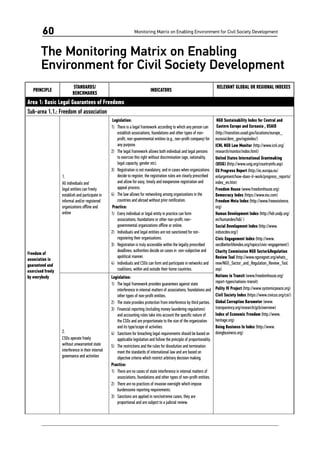
Sub-area 1.1: Freedom of association
Principle:	 Freedom of association is guaranteed and exercised freely
by everybody
STANDARD 1 INDICATORS
All individuals
and legal entities
can freely
establish, join
and participate
in informal and/
or registered
organizations
offline and online
Legislation:
1	There is a legal framework according to which any person can establish
associations, foundations and other types of non-profit, non-governmental
entities (e.g., non-profit company) for any purpose.
2	The legal framework allows both individual and legal persons to exercise
this right without discrimination (age, nationality, legal capacity, gender etc).
3	Registration is not mandatory, and in cases when organizations decide to
register, the registration rules are clearly prescribed and allow for easy,
timely and inexpensive registration and appeal process.
4	The law allows for networking among organizations in the countries and
abroad without prior notification.
Practice:
1	Every individual or legal entity in practice can form associations, foundations
or other non-profit, non-governmental organizations offline or online.
2	Individuals and legal entities are not sanctioned for not-registering their
organizations.
3	Registration is truly accessible within the legally prescribed deadlines;
authorities decide on cases in a non-subjective and apolitical manner.
4	Individuals and CSOs can form and participate in networks and coalitions,
within and outside their home countries.
E X P L A N A T I O N
Legislation
1The guarantees of freedom of association
should be contained in the Constitution of
a country, and also further developed and made
functional through a law which governs the
whole lifecycle of organizations from establish-
ment, operation, governance, activities through
to termination or dissolution.
According to international human rights law,
freedom of association extends to any person,
whether it is a citizen, foreigner, refugee,
women, child, and person with disabilities or
other. The freedom of association does not only
mean that one can establish an association
or other legal non-profit form (organization/
CSO) but that one can join (or not) an existing
organization/CSO as a member taking part in
its everyday activities or governance. There
should not be a legal obligation to become a
member of an association in order to participate
in the work of an association. At the same time,
organizations/CSOs should not be prevented
from limiting membership to certain categories
or groups. Related to this, there should not be a
legal limitation on the number of organizations
that can exist which have similar purposes,
where people can join to achieve a certain result
or goal in the field, or to express their views (in
other words, the existence of one organization
dealing with women’s rights should not mean
that other organizations for women’s rights
cannot exist).
Balkan Civic Practices # 9 11
of gender, nationality and age has the right to
join (or not to join) an organization. While there
may be some requirements with regard to the
legal capacity and the legal age of the persons
that can become founders of an organization,
those requirements should not prevent them
from freely deciding to become members, join
or govern their CSOs.6
According to the UN Convention on the
Rights of Persons with Disabilities, people
with disabilities, including those with
intellectual disabilities and psycho-social
(mental health) disabilities, have the right
to participate in political and public life. The
right is unqualified, meaning that it applies
to everyone, regardless of irrelevant factors
such as gender, type of disability, severity of
disability, and disability related legal status
such as guardianship6
.
3There should be no legal requirement for
registering CSOs and the decision to do so
should rest solely with the founders/members.
An example of a violation of this principle is the
case where people who associate are fined or
persecuted should they start with implementa-
tion of activities before their registration as a
legal entity is confirmed.
Where founders decide to register the
organization, the procedure for acquiring
legal status is clearly described in a law.
Organizations that complete all the legal
requirements are granted legal personality.
There are no burdensome requirements, such
as the need to have a large number of founders
(good practice is between 2 and 5 founders).
The fees collected by the registering agency
(court, ministry, central registry, etc.) are
not considered high compared to the living
standard in the respective country. They do not
discourage application and everybody should be
able to afford to pay them.
6 	 Comments developed by the Mental Disability Advocacy
Center (2013).
This freedom does not extend only to one legal
form – association. It also embraces the right
to form or join foundations, political parties,
religious organizations, trade unions, employer
associations, non-profit companies, and various
other forms of association.3
The objectives of registered CSOs should be
diverse and the only limitations are the ones
recognized by international law. CSOs should be
allowed to operate in different areas and pursue
all legitimate aims including the protection of
human rights, prevention of discrimination,
etc. A CSO can even promote a change in the
constitutional order but only: “a) if this is done
in a legal manner by democratic means; and b)
if the wanted change is in itself compatible with
basic democratic principles.”4
The freedom of association extends also to
association through the Internet or different
social groups such as Facebook. Based on this,
blocking Internet or certain applications (Skype,
Facebook) through which groups can form or
undertake activities would be considered a
violation of this freedom.5
2Freedom of association does not only
extend to individuals but also to legal enti-
ties (e.g. corporations). Therefore, laws in the
country should allow for businesses or other
types of legal entities to establish or join as-
sociations, foundations, federations or other
types of non-profit, non-governmental entities.
Further, as noted above, any person, regardless
3	 As noted in the Introduction, the Matrix discusses
predominantly issues surrounding freedoms to form
associations, foundations and non-profit companies
as the most common forms in which the right is
expressed. The experts recognize the existence of other
forms (e.g., business associations, trade unions) and
that some issues in this Matrix also extend to those
other types of entities (e.g., participation in policy-
making).
4	 Mataga, Zvonimir, The Right to Freedom of Association
under the European Convention on the Protection of
Human Rights and Fundamental Freedoms, October
2006, p.10.
5	 Statement by Maina Kiai, Special Rapporteur on
the rights to freedom of peaceful assembly and of
association, at 20th session of the Human Rights
Council.
Sub-area1.1
Freedomofassociation
Monitoring Matrix on Enabling Environment for Civil Society Development12
Registration decisions are made quickly
(between 5 and 30 days) and applicants are
informed about the decision in writing. Negative
decisions for registration are subject to an
appeal in a court or another independent
body. In cases where there is no decision
within the prescribed deadline, there should
be an assumption that organization can
start operating and this is accepted by other
state bodies (if there is a need for a following
registration e.g. with the social security agency,
it accepts that the organization is registered and
does not require a written registration decision).
4Freedom of association extends to net-
works of organizations, their coalitions,
federations or other types of unions. Communi-
cation with groups outside of the country should
be possible and there should be no limitations. It
also extends to online association. Blocking so-
cial network initiatives with the attempt to hin-
der communication between people/organiza-
tions has to follow the allowed limitations which
apply to freedom of association. An example of
limitation on the right to join networks or asso-
ciate outside of the country are requirements for
CSOs to inform or gain permission from state
authorities to do so, and face fines if they fail to
do it.
Practice:
1There are various types of CSOs in prac-
tice; there are examples of organizations
set up by women, and people with limited legal
capacity or other disadvantaged groups. Com-
panies and individuals or other groups can form
associations, foundations and non-profit entities
– there are examples of such or in case there
are not, there are no complaints that companies
cannot be founders or co-founders of CSOs. In
addition, by being a founder or president who
does not receive remuneration, the individual is
not considered an employee per se, and does
not lose unemployment benefits or status.
Moreover, the state does not consider working
for a CSO to mean that the person is undertak-
ing a public function and is therefore subject to
the same scrutiny as a public official.
There are no restrictions to Internet
applications, Facebook groups are not banned,
web sites of organizations or accounts blocked
or hacked, their passwords are not stolen, or
entries changed, and Skype or other similar chat
tools are not monitored. Groups or individuals
use ICT tools to perform joint activities and
there are no complaints of restrictions by the
government or harassment of moderators
(informal leaders of the groups) or members of
groups.
2The government in practice does not re-
quire founders to register organizations in
order to undertake activities or impose fines for
not registering legal entities. There are no cases
or complaints of unreasonable or unjustified
denials of registration. There are unregistered
organizations in society. As a good practice,
unregistered organizations are present in pub-
lic life, and cooperate with other CSOs or state
bodies.
3There are no reported cases of political
influence over the registration process.
Decisions are based on the law and not based
on subjective interpretation of the legal require-
ments. No additional documents, other than
the ones described in the law, are required for
registration.
4The practice is enabling, and there are ex-
amples of free networking among organi-
zations both within and outside of the country.
Organizations can join international umbrella
groups or federations, join networks online by
using various ICT tools, can undertake activities
(by going to or inviting network members in the
country, organizing them at national, regional
or international level) and promote their goals.
Registration of networks is easy. Organizations
don’t face burdensome bureaucratic require-
ments designed to make networking difficult,
such as requiring organizations to notify certain
state body if they plan to join a network.
Balkan Civic Practices # 9 13
STANDARD 2 INDICATORS
CSOs operate
freely without
unwarranted
state interference
in their internal
governance and
activities
Legislation:
1	The legal framework provides guarantees against state interference in
internal matters of associations, foundations and other types of non-profit
entities.
2	The state provides protection from interference by third parties.
3	Financial reporting (including money laundering regulations) and accounting
rules take into account the specific nature of the CSOs and are proportionate
to the size of the organization and its type/scope of activities.
4	Sanctions for breaching legal requirements should be based on applicable
legislation and follow the principle of proportionality.
5	Restrictions and the rules for dissolution and termination meet the
standards of international law and are based on objective criteria which
restrict arbitrary decision-making.
Practice:
1	There are no cases of state interference in internal matters of associations,
foundations and other types of non-profit entities.
2	There are no practices of invasive oversight which impose burdensome
reporting requirements.
3	Sanctions are applied in rare/extreme cases; they are proportional and are
subject to a judicial review.
E X P L A N A T I O N
Legislation:
1There are very limited grounds for state
interference with freedom of association
and those are prescribed in international
law. Most relevant for European countries is
the ECHR and the case law of the European
Court for Human rights which prescribes the
grounds for limitations and provides further
interpretations through case law. According
to the ECHR, the limitations to the freedom
of association are allowed if: (1) they are
prescribed by law; (2) pursue a legitimate aim;
and (3) are necessary in a democratic society.
Further to point 2, ECHR allows the following
aims as legitimate: (1) in the interest of national
security or public safety; (2) for the prevention
of disorder or crime; (3) for the protection of
health or morals; and (4) for the protection of
the rights and freedoms of others.
CSOs are autonomous from the state and
the law should guarantee their right to
regulate their internal structure and operating
procedures. For example, the law should
not allow the state to interfere in the internal
management of their affairs. Requirements
such as the mandatory participation of a
state representative in the meetings of an
organizational body would violate this indicator.
Similarly, the law should not allow states to
interfere in the process of appointment of Board
members.
The law should not require that CSOs receive
advance approval from the state for carrying
out their activities. The state may require those
organizations to undergo certain registration/
licensing for certain areas when organizations
Sub-area1.1
Freedomofassociation
Monitoring Matrix on Enabling Environment for Civil Society Development14
want to work in or where interests of
disadvantaged groups should be protected (e.g.,
services for children). However, those situations
must be clearly prescribed by law and CSOs
should not be discriminated against compared
with other providers of such services (see Sub-
area 3.3 for further discussion on this).
2States have not only the negative
obligation – not to violate the freedom
of association and to allow the operation of
CSOs, but also a positive obligation – to protect
freedom of association, including preventing
third parties from violating the freedom of
association. This would mean that the state
has set up measures to protect the right – e.g.,
police force to protect people against violations
of their rights by state or non-state actors,
and an independent judiciary able to provide
remedies.7
Thus, if a certain group’s operation
is hindered by another (e.g., Roma associations
or LGBT groups), the legal framework should
have guarantees that the state can protect their
operation.
3The regulations on CSO reporting to the
state should be based on the specific
characteristics of the work CSOs do. The reports
they submit should be adapted to the CSOs
activities. A good regulatory practice is to have
separate legislation on non-profit accounting
and reporting forms for CSOs which are different
from the reporting forms of businesses. In
this way, the information collected by the
authorities would give a better picture of
what the CSO sector is actually doing without
adding unnecessary burden on the sector. A
good regulatory practice is to introduce lighter
reporting requirements for small organizations
that fall below a certain threshold.
CSOs should not be subject to stricter
requirements with regard to money laundering
regulation than other similar subjects e.g.
businesses or other types of non-profit
7 	 World Movement for Democracy at the National
Endowment for Democracy and ICNL, Defending Civil
Society Report, 2nd
edition, 2012.
organizations. Regulations requiring specific
financial reporting or specific measures
regarding counter-terrorism requirements
which are not proportionate to the size of the
organizations and which treat CSOs differently
from other providers would be in violation of
this indicator.
4All sanctions to which CSOs are subject
should be prescribed by law and should
be clear to avoid potential misinterpretation
in practice. Sanctions for CSOs should be the
same or lower as compared to the sanctions
of companies for similar breaches. If there are
material sanctions (fines, etc.) these should
take into consideration the financial situation of
the organization as well. All sanctions should
be proportionate to the breaches made. Fines
to responsible individuals should be exceptions;
they should only be applied in case of intentional
and serious breach of law. Laws should not
impose higher fines on responsible individuals
than on the organization.
5The law should allow for CSO to choose
to dissolve at any time by a resolution
of the highest governing body. The law
should prescribe precisely and narrowly the
situations where organization have to dissolve
and grounds for involuntary termination
(e.g., in cases of violations of statute or law).
Termination should occur only as a last resort
and appeal should be allowed. As a good
practice termination should be decided in
a court case. It should be applied only after
previous sanctions have been exhausted and
there is no other way to remedy the situation.
An example of a disproportionate termination
is a case in which an organization is terminated
for failing to submit its annual report on time.
Even if this is considered a serious violation, the
organization should be given the chance e.g.
to submit its report or pay a fine. Only if failing
to do so should the sanction of termination be
considered.
Balkan Civic Practices # 9 15
Practice:
1Practice shows that CSOs operate
independently and there are no reports
where CSOs have been subject to threats from
the government in their work. There are no
examples of government intrusion into the
premises of private legal entities, or ‘surprise’
visits/inspections to the offices or board
meetings. Requirements for CSOs to work only
with specific government-controlled banks or
use only government-provided services would
not be in line with this indicator. There are no
interferences especially against organizations
which are critical of the government. There
should be no examples of state attempts to
harass such critical organizations.
2State interference/harassment could
take the form of excessive audits of
an organization with the purpose of putting
administrative burden and sanctioning
the organization. Other examples include
targeted inspections and excessive control of
employment regulations or other administrative
measures.
3Sanctioning an organization should have
the aim of remedying a breach and not
hindering the operation of the organization.
When imposing the sanction, attention should
be paid to the specific character of the CSO and
the type of the violation. The practice should
show that when there are differences between
minimum and maximum penalties the fines
are applied with consideration of the size of
the organization, the gravity of the breach and
in general to show that there is a tendency to
apply lower rather than higher fines. Decisions
to restrict the rights or terminate organizations
in practice take place in a judicial process in an
apolitical manner, decisions are explained and
organizations can appeal against them.
Sub-area1.1
Freedomofassociation
Monitoring Matrix on Enabling Environment for Civil Society Development16
STANDARD 3 INDICATORS
CSOs can
freely seek and
secure financial
resources
from various
domestic and
foreign sources
to support their
activities
Legislation:
1	Legislation allows CSOs to engage in economic activities.
2	CSOs are allowed to receive foreign funding.
3	CSO are allowed to receive funding from individuals, corporations and other
sources.
Practice:
1	Legislation on CSOs engaging in economic activities is implemented and is
not burdensome for CSOs.
2	There are no restrictions (e.g. administrative or financial burden,
preapprovals, or channeling such funds via specific bodies) on CSOs to
receive foreign funding.
3	Receipt of funding from individuals, corporations and other sources is easy,
effective and without any unnecessary cost or administrative burden.
E X P L A N A T I O N
Legislation:
1“Economic activities” means the active
sale of goods or services, referred to as
“trade or business” activities; it entails sale of
goods and services that are pursued with fre-
quency or continuity.8
This can include: fees for
services, sales, rents, investments and business
ventures. Legislation should allow CSOs to en-
gage both directly (as a CSO) and indirectly (by
registering or owning shares of a commercial
company) in economic activity. Internationally
this is considered an important right as it al-
lows CSOs to generate income through devel-
oping their own services, to improve reach to
their communities, to adjust services to meet
real needs, and to have a stable income source
which is independent from the state.
There could be some limitation to engaging
in a direct economic activity. For example:
the economic activity may have to be related
to the mission of the organization (e.g. an
organization for people with disabilities could
8	 Survey of the Treatment of Economic Activities of Non-
Profit Organizations in Europe, ICNL, ECNL, MCIC, 2007
provide transportation services to such people,
or association for blind people can sell walking
canes); the economic activity may have to be
additional to the non-profit activity; or rules
may require that all income should be used for
the purposes of the organization. There should
be a restriction on distributing net revenues
to private parties who may be in a position
to control the organization for personal gain,
such as founders, members, officers, directors,
agents, or employees (prohibition on the
distribution of income). State authorities should
provide guidance on engagement in economic
activities to facilitate the process.
2Legislation should not limit the possibility
for CSOs to receive funding from foreign
public or private sources. The treatment of such
funding should be similar to the treatment of
funding received from local sources. Any legal
requirements for registration of foreign grants
(except funding from bilateral donors which
falls under the EU regulations), their preliminary
approval from the government, requirement
to channel foreign funding through state-
controlled body or bank, are inconsistent with
this indicator.
Balkan Civic Practices # 9 17
3There is no legal limitation that would
prohibit the receipt of funds from any
private or commercial person, the state,
local authorities, foundations or other legal
entities, agencies, etc. In other words, CSOs
should be able to raise funds from individuals
and corporations, and take part in public
procurement or grant or service tenders by the
state or donors.
Practice:
1CSOs engage in economic activities. They
can set up companies for that purpose
or directly engage. The state authorities do not
impose implementing regulations that will limit
this right. When engaging in economic activity,
CSOs are only subject to any licensing/registra-
tion or other specialized regime if it is required
for everybody that engages in the respective
field of work.
2CSOs receive foreign funds and can use
them for any purpose for which the
grant is given. In the case of receipt of foreign
funding, there are no specific administrative
procedures that obstruct organizations
from receiving foreign funds. There are no
special taxes for foreign funds received. If
VAT exemption is provided, the procedure for
obtaining it is simple, easy-to-implement and
not too burdensome.
3CSOs can freely receive funding from
different private sources, and do not face
complicated procedures to access the funding.
Sub-area1.1
Freedomofassociation
Monitoring Matrix on Enabling Environment for Civil Society Development18
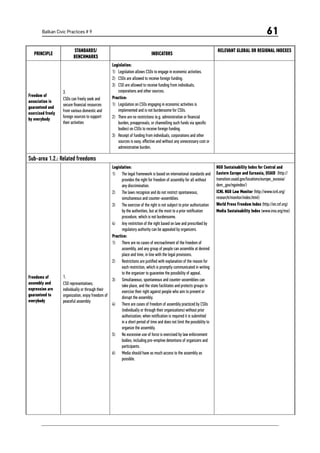
Sub-area 1.2: Related Freedoms
Principle: 	 Freedoms of assembly and expression are guaranteed to
everybody
STANDARD 1 INDICATORS
CSO
representatives,
individually or
through their
organizations,
enjoy freedom
of peaceful
assembly
Legislation:
1	The legal framework is based on international standards and provides the
right for freedom of assembly for all without any discrimination.
2	The laws recognize and do not restrict spontaneous, simultaneous and
counter-assemblies.
3	The exercise of the right is not subject to prior authorization by the
authorities, but at the most to a prior notification procedure, which is not
burdensome.
4	Any restriction of the right based on law and prescribed by regulatory
authority can be appealed by organizers.
Practice:
1	There are no cases of encroachment of the freedom of assembly, and any
group of people can assemble at desired place and time, in line with the
legal provisions.
2	Restrictions are justified with explanations of the reason for each restriction,
which is promptly communicated in writing to the organizer to guarantee
the possibility of appeal.
3	Simultaneous, spontaneous and counter-assemblies can take place, and the
state facilitates and protects groups to exercise their right against people
who aim to prevent or disrupt the assembly.
4	There are cases of freedom of assembly practiced by CSOs (individually or
through their organizations) without prior authorization; when notification
is required it is submitted in a short period of time and does not limit the
possibility to organize the assembly.
5	No excessive use of force is exercised by law enforcement bodies, including
preemptive detentions of organizers and participants.
6	Media should have as much access to the assembly as possible.
E X P L A N A T I O N
Legislation
1Freedom of peaceful assembly is a
fundamental human right, enshrined
in the International Covenant on Civil and
Political Rights, the ECHR, the Charter of
Fundamental Rights of the European Union and
other international and regional treaties, and
is inextricably intertwined with the freedom of
association. The State has a positive obligation
to facilitate and protect peaceful assembly –
freedom of assembly insofar as possible should
be enjoyed without restrictions, guaranteed
by law and should not be preempted by
administrative procedures or undue regulation.9
9	 OSCE/OIDHR-Venice Commission Guidelines on
Freedom of Peaceful Assembly, 2nd edition, 2010
Balkan Civic Practices # 9 19
Sub-area1.2
RelatedFreedoms
The law should guarantee freedom of assembly
to all, individuals and legal entities, stateless
persons, refugees, foreign nationals, asylum
seekers, migrants and others.
2The law should allow for peaceful
assemblies to be held at the same time
and in the same place (simultaneously) or
for counter-assemblies (those of opposing
groups) to take place. In case several groups
plan to hold assemblies in the same place
and the same time, they should be entitled
to do so if physical circumstances permit. In
case of counter-assemblies, the law has to
recognize the state’s responsibility to undertake
measures to protect the participants in the
peaceful assembly from individuals or groups of
individuals, including agents provocateurs and
counter demonstrators, who aim at disrupting
or dispersing such assemblies.
3The law should contain a presumption
in favor of holding assemblies. Those
seeking to assemble should not be required to
obtain permission to do so. If such requirement
exists it should be reduced to notification
(information that it will happen), rather
than authorization (asking for permission
to do it). There should be no limitations
on advertisement of the event before such
permission is acquired. Requirements for
notification may be justified by the state’s duty
to protect public order, public safety, and the
rights and freedoms of others.
4The law should guarantee the right to
appeal against decisions to limit the
assembly.
Practice:
1There are cases of freedom of assembly
practiced by CSOs (individually or through
their organizations) without prior authorization.
When notification is required it is submitted in
a short period of time and does not limit the
possibility to organize the assembly. There
are no complaints about the restriction on
assembly, groups are not required to ask for
authorization, nor does the police require one
when assemblies take place. Any restriction
follows the legally prescribed cases for the
limitation. Assemblies are organized in any area
the groups want. A violation of this right will be
situations where the state deliberately books
a place in order to prevent assemblies to be
organized. As a general rule assemblies should
take place within “sight and sound” of their
target audience.
2Regulatory authorities provide prompt,
detailed and objective written explanation
for any limitation to assembly. Where there is
arbitrary denial or a failure of the regulatory
authorities to respond promptly, then this
is considered as an excessive restriction on
freedom of assembly. “Where there is a failure
to respond promptly, then the law should
presume that the organizers of the assembly
may proceed according to terms of notice.”10
Where the authorities restrict this right, there is
a possibility for appeal.
3The state does not interfere in
spontaneous assemblies by raising the
argument for a need to notify the authorities.
Simultaneous and counter-assemblies can
take place and the law-enforcement authorities
exercise necessary control to protect peaceful
protestors, accepting that the assembly
should take place within sound and sight of the
target group. Assemblies are not prohibited at
large because there is possibility for counter-
10	 World Movement for Democracy at the National
Endowment for Democracy and ICNL, Defending Civil
Society Report, 2nd
edition, 2012
Monitoring Matrix on Enabling Environment for Civil Society Development20
assembly, rather protective methods are used
to separate the groups, and minimize potential
violence and disruption of public order.
4CSOs or individuals organize assemblies
and these are not dispersed because there
are no prior authorizations issued by the state
authorities. In case of spontaneous assemblies
prior notification is not used as reason to
disperse peaceful assemblies.
5The participants of peaceful assemblies
are not subject to detention. There are
no cases where organizers of assemblies
or known protestors are detained in order
to prevent assembly from happening. Law
enforcement officials do not use force against
participants nor use such methods to disperse
peaceful protests. There are no complaints
of disproportionate use of force to the threat
imposed.
6As the main purpose of any assembly is
to convey a message to the target group,
media should be guaranteed access to the
assembly.
Balkan Civic Practices # 9 21
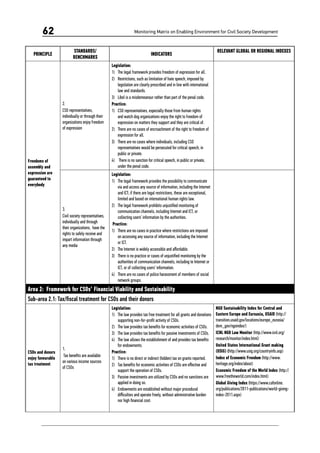
STANDARD 2 INDICATORS
CSO
representatives,
individually or
through their
organizations
enjoy freedom of
expression
Legislation:
1	The legal framework provides freedom of expression for all.
2	Restrictions, such as limitation of hate speech, imposed by legislation are
clearly prescribed and in line with international law and standards.
3	Libel is a misdemeanor rather than part of the penal code.
Practice:
1	CSO representatives, especially those from human rights and watchdog
organizations, enjoy the right to freedom of expression on matters they
support and they are critical of.
2	There are no cases of encroachment of the right to freedom of expression
for all.
3	There are no cases where individuals, including CSO representatives, would
be persecuted for critical speech in public or private.
4	There is no sanction for critical speech, in public or private, under the penal
code.
E X P L A N A T I O N
Legislation:
1Freedom of expression is a fundamental
freedom which is regulated in several
international documents including the ECHR
and the EU Charter on Fundamental Rights.
This is an important freedom for individuals and
CSOs. It is particularly relevant for CSOs which
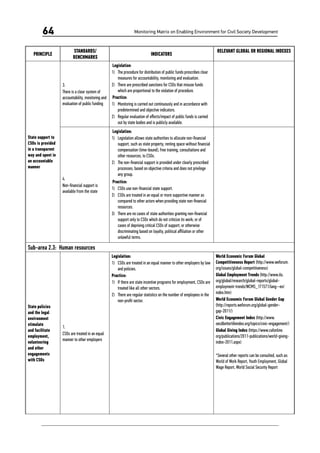
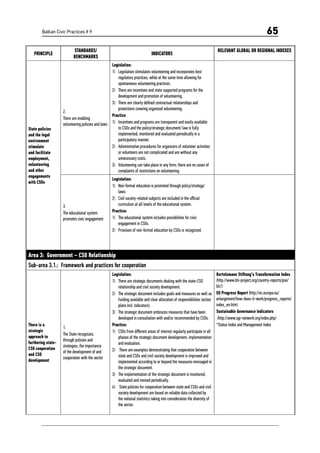
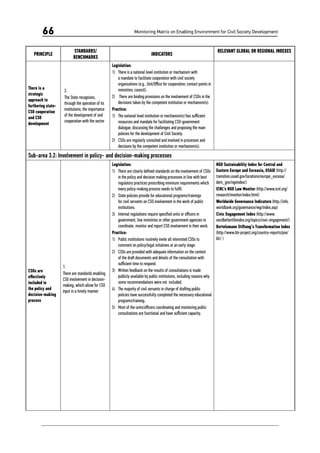
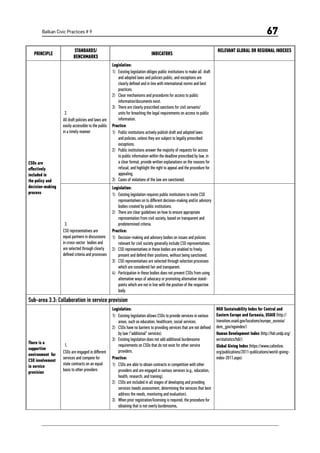
are engaged in human rights and democracy
promotion as it allows them not only to speak
freely but also to engage in advocacy. The legal
framework should guarantee this right to all.
There are no legislative initiatives to limit the
right to receive information and the freedom of
expression, including on the internet.
2Any limitation to the freedom of
expression should be prescribed by law,
legitimate and necessary. An indication can be
the comments to the existing laws by various
experts, which recognize that the laws are in
line with the international standards. Some
violations that should be avoided include:
the law should not require permission to
speak publicly or deliver presentation/lecture;
and there should not be a requirement that
publications of organizations must be pre-
approved. The law should not contain broad,
confusing statements that may give rise to
subjective interpretation. The courts protect
the right to freedom of expression when it is
violated by undertaking cases and deciding in a
timely manner.
3The penal code does not regulate libel.
For purpose of the Matrix, this indicator
should be considered as much as it affects CSOs
and its members in exercising their freedom of
expression.
Sub-area1.2
RelatedFreedoms
Monitoring Matrix on Enabling Environment for Civil Society Development22
Practice:
1There are continuous cases in practice
where human rights and watchdog
organizations can exercise their right to speak,
criticize and undertake action to achieve their
mission, which may target state policies. The
tools for their communication (web site, emails,
Facebook pages) are not blocked nor hacked.
2There are no unjustified complaints from
the groups, organizations, media or
individuals that they are in any way prevented
from expressing their opinions or views, within
legal limitations.
3There are no unjustified complaints,
media reports or reports by national
or international organizations that groups,
organizations or individuals are threatened or
persecuted, or that they fear for their safety.
4Court cases regarding libel are dealt
with at the misdemeanor courts. There
is no prison sentence for critical speech.
Compensation adjudicated in such cases is
reasonable.
Balkan Civic Practices # 9 23
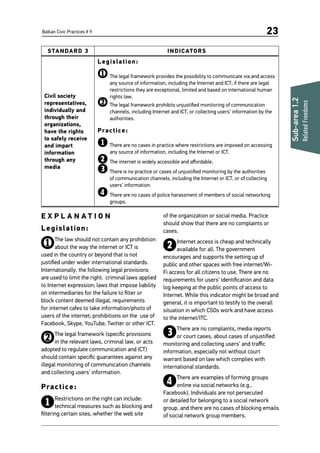
STANDARD 3 INDICATORS
Civil society
representatives,
individually and
through their
organizations,
have the rights
to safely receive
and impart
information
through any
media
Legislation:
1	The legal framework provides the possibility to communicate via and access
any source of information, including the Internet and ICT; if there are legal
restrictions they are exceptional, limited and based on international human
rights law.
2	The legal framework prohibits unjustified monitoring of communication
channels, including Internet and ICT, or collecting users’ information by the
authorities.
Practice:
1	There are no cases in practice where restrictions are imposed on accessing
any source of information, including the Internet or ICT.
2	The internet is widely accessible and affordable.
3	There is no practice or cases of unjustified monitoring by the authorities
of communication channels, including the Internet or ICT, or of collecting
users’ information.
4	There are no cases of police harassment of members of social networking
groups.
E X P L A N A T I O N
Legislation:
1The law should not contain any prohibition
about the way the internet or ICT is
used in the country or beyond that is not
justified under wider international standards.
Internationally, the following legal provisions
are used to limit the right: criminal laws applied
to Internet expression; laws that impose liability
on intermediaries for the failure to filter or
block content deemed illegal, requirements
for internet cafes to take information/photo of
users of the internet; prohibitions on the use of
Facebook, Skype, YouTube, Twitter or other ICT.
2The legal framework (specific provisions
in the relevant laws, criminal law, or acts
adopted to regulate communication and ICT)
should contain specific guarantees against any
illegal monitoring of communication channels
and collecting users’ information.
Practice:
1Restrictions on the right can include:
technical measures such as blocking and
filtering certain sites, whether the web site
of the organization or social media. Practice
should show that there are no complaints or
cases.
2Internet access is cheap and technically
available for all. The government
encourages and supports the setting up of
public and other spaces with free internet/Wi-
Fi access for all citizens to use. There are no
requirements for users’ identification and data
log keeping at the public points of access to
Internet. While this indicator might be broad and
general, it is important to testify to the overall
situation in which CSOs work and have access
to the internet/ITC.
3There are no complaints, media reports
or court cases, about cases of unjustified
monitoring and collecting users’ and traffic
information, especially not without court
warrant based on law which complies with
international standards.
4There are examples of forming groups
online via social networks (e.g.,
Facebook). Individuals are not persecuted
or detailed for belonging to a social network
group, and there are no cases of blocking emails
of social network group members.
Sub-area1.2
RelatedFreedoms
Monitoring Matrix on Enabling Environment for Civil Society Development24
Balkan Civic Practices # 9 25
Area 2:
Framework for
CSO Financial
Viability and
Sustainability
Monitoring Matrix on Enabling Environment for Civil Society Development26
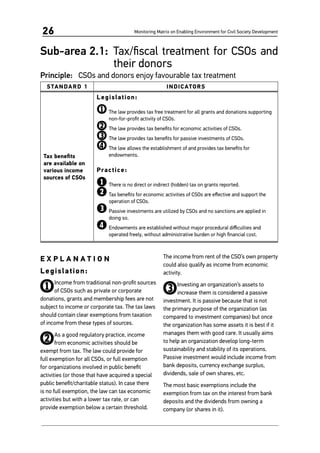
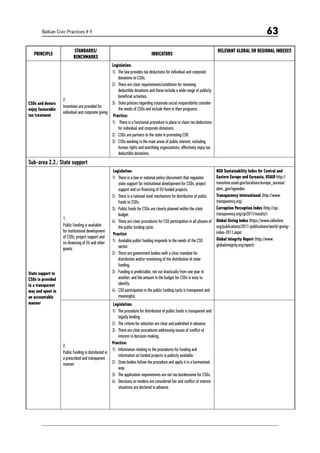
Sub-area 2.1:	 Tax/fiscal treatment for CSOs and
their donors
Principle: 	 CSOs and donors enjoy favourable tax treatment
STANDARD 1 INDICATORS
Tax benefits
are available on
various income
sources of CSOs
Legislation:
1	The law provides tax free treatment for all grants and donations supporting
non-for-profit activity of CSOs.
2	The law provides tax benefits for economic activities of CSOs.
3	The law provides tax benefits for passive investments of CSOs.
4	The law allows the establishment of and provides tax benefits for
endowments.
Practice:
1	There is no direct or indirect (hidden) tax on grants reported.
2	Tax benefits for economic activities of CSOs are effective and support the
operation of CSOs.
3	Passive investments are utilized by CSOs and no sanctions are applied in
doing so.
4	Endowments are established without major procedural difficulties and
operated freely, without administrative burden or high financial cost.
E X P L A N A T I O N
Legislation:
1Income from traditional non-profit sources
of CSOs such as private or corporate
donations, grants and membership fees are not
subject to income or corporate tax. The tax laws
should contain clear exemptions from taxation
of income from these types of sources.
2As a good regulatory practice, income
from economic activities should be
exempt from tax. The law could provide for
full exemption for all CSOs, or full exemption
for organizations involved in public benefit
activities (or those that have acquired a special
public benefit/charitable status). In case there
is no full exemption, the law can tax economic
activities but with a lower tax rate, or can
provide exemption below a certain threshold.
The income from rent of the CSO’s own property
could also qualify as income from economic
activity.
3Investing an organization’s assets to
increase them is considered a passive
investment. It is passive because that is not
the primary purpose of the organization (as
compared to investment companies) but once
the organization has some assets it is best if it
manages them with good care. It usually aims
to help an organization develop long-term
sustainability and stability of its operations.
Passive investment would include income from
bank deposits, currency exchange surplus,
dividends, sale of own shares, etc.
The most basic exemptions include the
exemption from tax on the interest from bank
deposits and the dividends from owning a
company (or shares in it).
Balkan Civic Practices # 9 27
Sub-area2.1
Tax/fiscaltreatment
forCSOsandtheirdonors
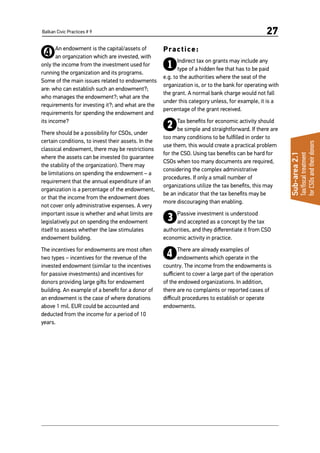
4An endowment is the capital/assets of
an organization which are invested, with
only the income from the investment used for
running the organization and its programs.
Some of the main issues related to endowments
are: who can establish such an endowment?;
who manages the endowment?; what are the
requirements for investing it?; and what are the
requirements for spending the endowment and
its income?
There should be a possibility for CSOs, under
certain conditions, to invest their assets. In the
classical endowment, there may be restrictions
where the assets can be invested (to guarantee
the stability of the organization). There may
be limitations on spending the endowment – a
requirement that the annual expenditure of an
organization is a percentage of the endowment,
or that the income from the endowment does
not cover only administrative expenses. A very
important issue is whether and what limits are
legislatively put on spending the endowment
itself to assess whether the law stimulates
endowment building.
The incentives for endowments are most often
two types – incentives for the revenue of the
invested endowment (similar to the incentives
for passive investments) and incentives for
donors providing large gifts for endowment
building. An example of a benefit for a donor of
an endowment is the case of where donations
above 1 mil. EUR could be accounted and
deducted from the income for a period of 10
years.
Practice:
1Indirect tax on grants may include any
type of a hidden fee that has to be paid
e.g. to the authorities where the seat of the
organization is, or to the bank for operating with
the grant. A normal bank charge would not fall
under this category unless, for example, it is a
percentage of the grant received.
2Tax benefits for economic activity should
be simple and straightforward. If there are
too many conditions to be fulfilled in order to
use them, this would create a practical problem
for the CSO. Using tax benefits can be hard for
CSOs when too many documents are required,
considering the complex administrative
procedures. If only a small number of
organizations utilize the tax benefits, this may
be an indicator that the tax benefits may be
more discouraging than enabling.
3Passive investment is understood
and accepted as a concept by the tax
authorities, and they differentiate it from CSO
economic activity in practice.
4There are already examples of
endowments which operate in the
country. The income from the endowments is
sufficient to cover a large part of the operation
of the endowed organizations. In addition,
there are no complaints or reported cases of
difficult procedures to establish or operate
endowments.
Monitoring Matrix on Enabling Environment for Civil Society Development28
STANDARD 2 INDICATORS
Incentives are
provided for
individual and
corporate giving
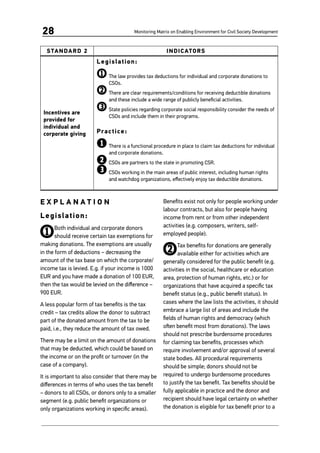
Legislation:
1	The law provides tax deductions for individual and corporate donations to
CSOs.
2	There are clear requirements/conditions for receiving deductible donations
and these include a wide range of publicly beneficial activities.
3	State policies regarding corporate social responsibility consider the needs of
CSOs and include them in their programs.
Practice:
1	There is a functional procedure in place to claim tax deductions for individual
and corporate donations.
2	CSOs are partners to the state in promoting CSR.
3	CSOs working in the main areas of public interest, including human rights
and watchdog organizations, effectively enjoy tax deductible donations.
E X P L A N A T I O N
Legislation:
1Both individual and corporate donors
should receive certain tax exemptions for
making donations. The exemptions are usually
in the form of deductions – decreasing the
amount of the tax base on which the corporate/
income tax is levied. E.g. if your income is 1000
EUR and you have made a donation of 100 EUR,
then the tax would be levied on the difference –
900 EUR.
A less popular form of tax benefits is the tax
credit – tax credits allow the donor to subtract
part of the donated amount from the tax to be
paid, i.e., they reduce the amount of tax owed.
There may be a limit on the amount of donations
that may be deducted, which could be based on
the income or on the profit or turnover (in the
case of a company).
It is important to also consider that there may be
differences in terms of who uses the tax benefit
– donors to all CSOs, or donors only to a smaller
segment (e.g. public benefit organizations or
only organizations working in specific areas).
Benefits exist not only for people working under
labour contracts, but also for people having
income from rent or from other independent
activities (e.g. composers, writers, self-
employed people).
2Tax benefits for donations are generally
available either for activities which are
generally considered for the public benefit (e.g.
activities in the social, healthcare or education
area, protection of human rights, etc.) or for
organizations that have acquired a specific tax
benefit status (e.g., public benefit status). In
cases where the law lists the activities, it should
embrace a large list of areas and include the
fields of human rights and democracy (which
often benefit most from donations). The laws
should not prescribe burdensome procedures
for claiming tax benefits, processes which
require involvement and/or approval of several
state bodies. All procedural requirements
should be simple; donors should not be
required to undergo burdensome procedures
to justify the tax benefit. Tax benefits should be
fully applicable in practice and the donor and
recipient should have legal certainty on whether
the donation is eligible for tax benefit prior to a
Balkan Civic Practices # 9 29
donation commitment being made. Donors are
not held responsible for the actual use of the
donation for public benefit (except in cases of
corruption).
3In all strategic or policy documents related
to corporate social responsibility, CSOs
are considered as a key partner and beneficiary
and the needs of CSOs are addressed.
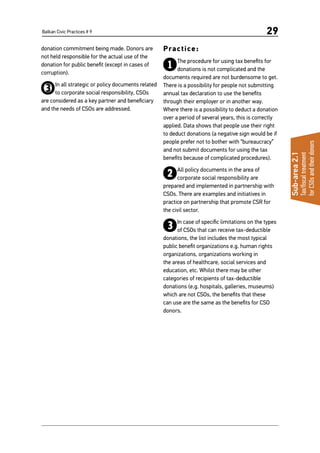
Practice:
1The procedure for using tax benefits for
donations is not complicated and the
documents required are not burdensome to get.
There is a possibility for people not submitting
annual tax declaration to use the benefits
through their employer or in another way.
Where there is a possibility to deduct a donation
over a period of several years, this is correctly
applied. Data shows that people use their right
to deduct donations (a negative sign would be if
people prefer not to bother with “bureaucracy”
and not submit documents for using the tax
benefits because of complicated procedures).
2All policy documents in the area of
corporate social responsibility are
prepared and implemented in partnership with
CSOs. There are examples and initiatives in
practice on partnership that promote CSR for
the civil sector.
3In case of specific limitations on the types
of CSOs that can receive tax-deductible
donations, the list includes the most typical
public benefit organizations e.g. human rights
organizations, organizations working in
the areas of healthcare, social services and
education, etc. Whilst there may be other
categories of recipients of tax-deductible
donations (e.g. hospitals, galleries, museums)
which are not CSOs, the benefits that these
can use are the same as the benefits for CSO
donors.
Sub-area2.1
Tax/fiscaltreatment
forCSOsandtheirdonors
Monitoring Matrix on Enabling Environment for Civil Society Development30
Sub-area 2.2: State support
Principle 4: State support to CSOs is provided in a transparent way and
spent in an accountable manner
STANDARD 1 INDICATORS
Public funding
is available for
institutional
development of
CSOs, project
support and co-
financing of EU
and other grants
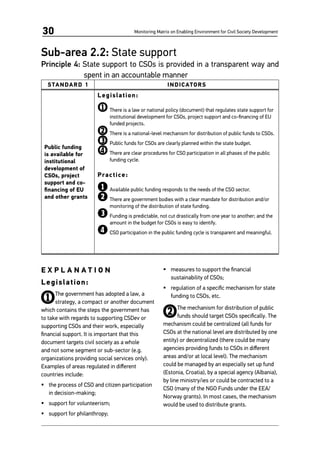
Legislation:
1	There is a law or national policy (document) that regulates state support for
institutional development for CSOs, project support and co-financing of EU
funded projects.
2	There is a national-level mechanism for distribution of public funds to CSOs.
3	Public funds for CSOs are clearly planned within the state budget.
4	There are clear procedures for CSO participation in all phases of the public
funding cycle.
Practice:
1	Available public funding responds to the needs of the CSO sector.
2	There are government bodies with a clear mandate for distribution and/or
monitoring of the distribution of state funding.
3	Funding is predictable, not cut drastically from one year to another; and the
amount in the budget for CSOs is easy to identify.
4	CSO participation in the public funding cycle is transparent and meaningful.
E X P L A N A T I O N
Legislation:
1The government has adopted a law, a
strategy, a compact or another document
which contains the steps the government has
to take with regards to supporting CSDev or
supporting CSOs and their work, especially
financial support. It is important that this
document targets civil society as a whole
and not some segment or sub-sector (e.g.
organizations providing social services only).
Examples of areas regulated in different
countries include:
	the process of CSO and citizen participation
in decision-making;
	support for volunteerism;
	support for philanthropy;
	measures to support the financial
sustainability of CSOs;
	regulation of a specific mechanism for state
funding to CSOs, etc.
2The mechanism for distribution of public
funds should target CSOs specifically. The
mechanism could be centralized (all funds for
CSOs at the national level are distributed by one
entity) or decentralized (there could be many
agencies providing funds to CSOs in different
areas and/or at local level). The mechanism
could be managed by an especially set up fund
(Estonia, Croatia), by a special agency (Albania),
by line ministry/ies or could be contracted to a
CSO (many of the NGO Funds under the EEA/
Norway grants). In most cases, the mechanism
would be used to distribute grants.
Balkan Civic Practices # 9 31
Sub-area2.2
Statesupport
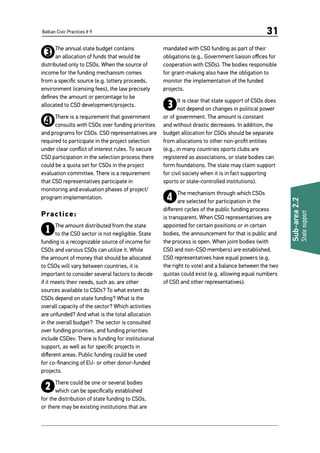
3The annual state budget contains
an allocation of funds that would be
distributed only to CSOs. When the source of
income for the funding mechanism comes
from a specific source (e.g. lottery proceeds,
environment licensing fees), the law precisely
defines the amount or percentage to be
allocated to CSO development/projects.
4There is a requirement that government
consults with CSOs over funding priorities
and programs for CSOs. CSO representatives are
required to participate in the project selection
under clear conflict of interest rules. To secure
CSO participation in the selection process there
could be a quota set for CSOs in the project
evaluation committee. There is a requirement
that CSO representatives participate in
monitoring and evaluation phases of project/
program implementation.
Practice:
1The amount distributed from the state
to the CSO sector is not negligible. State
funding is a recognizable source of income for
CSOs and various CSOs can utilize it. While
the amount of money that should be allocated
to CSOs will vary between countries, it is
important to consider several factors to decide
if it meets their needs, such as: are other
sources available to CSOs? To what extent do
CSOs depend on state funding? What is the
overall capacity of the sector? Which activities
are unfunded? And what is the total allocation
in the overall budget? The sector is consulted
over funding priorities, and funding priorities
include CSDev. There is funding for institutional
support, as well as for specific projects in
different areas. Public funding could be used
for co-financing of EU- or other donor-funded
projects.
2There could be one or several bodies
which can be specifically established
for the distribution of state funding to CSOs,
or there may be existing institutions that are
mandated with CSO funding as part of their
obligations (e.g., Government liaison offices for
cooperation with CSOs). The bodies responsible
for grant-making also have the obligation to
monitor the implementation of the funded
projects.
3It is clear that state support of CSOs does
not depend on changes in political power
or of government. The amount is constant
and without drastic decreases. In addition, the
budget allocation for CSOs should be separate
from allocations to other non-profit entities
(e.g., in many countries sports clubs are
registered as associations, or state bodies can
form foundations. The state may claim support
for civil society when it is in fact supporting
sports or state-controlled institutions).
4The mechanism through which CSOs
are selected for participation in the
different cycles of the public funding process
is transparent. When CSO representatives are
appointed for certain positions or in certain
bodies, the announcement for that is public and
the process is open. When joint bodies (with
CSO and non-CSO members) are established,
CSO representatives have equal powers (e.g.
the right to vote) and a balance between the two
quotas could exist (e.g. allowing equal numbers
of CSO and other representatives).
Monitoring Matrix on Enabling Environment for Civil Society Development32
STANDARD 2 INDICATORS
Public funding
is distributed
in a prescribed
and transparent
manner
Legislation:
1	The procedure for distribution of public funds is transparent and legally
binding.
2	The criteria for selection are clear and published in advance.
3	There are clear procedures addressing issues of conflict of interest in
decision-making.
Practice:
1	Information relating to the procedures for funding and information on
funded projects is publicly available.
2	State bodies follow the procedure and apply it in a harmonized way.
3	The application requirements are not too burdensome for CSOs.
4	Decisions on tenders are considered fair and conflict of interest situations
are declared in advance.
E X P L A N A T I O N
Legislation:
1There is a clear and legally binding
mechanism through which the whole
process of announcing the grant procedure and
selecting the supported projects is carried out.
The announcement for the procedure is public
and it provides for sufficient time to prepare
and submit project proposals and all required
accompanying documents. Where there is a
non-binding document, i.e., a Code, specific
provisions should be included to ensure that
the state authorities follow the procedure and
remedies exist in case on non-implementation
or breach.
2The criteria and methodology for
evaluation of projects are publicly known
and available in advance. It is clear which
components make a proposal stronger and
how they will be evaluated. Rejected proposals
receive information on the reasons for not being
selected.
3Conflict of interest rules are part of the
regulations or Codes and clearly prescribe
the situations and how to avoid them. For
example, the law can provide that individuals
related to the applicant organizations cannot
evaluate their proposals. The law should require
that individuals should disclose the possible
conflict in advance and they should be replaced
with another qualified evaluator.
Practice:
1The government or the state institutions
involved in the process of funding CSOs
are required to publish online information on the
funded projects – the name and contacts of the
recipient organization, the amounts provided
and the goals and activities of the supported
projects.
2The required documents to be submitted
with the application for a grant are not
difficult to acquire and do not cost too much.
They are limited in number and most of them
are required at the stage of signing the contract.
The application forms are clear and the whole
application package is easy to prepare. There
are no discriminatory requirements which
limit the participation of a large number of
organizations in advance.
3There are no signals that the recipients
of grants are somehow related to the
institution or members of the commission
that has taken decisions on the grant
allocation. There are no cases where awarded
organizations are created especially for the
purpose of applying for particular funding.
Balkan Civic Practices # 9 33
STANDARD 3 INDICATORS
There is a
clear system of
accountability,
monitoring and
evaluation of
public funding
Legislation:
1	The procedure for distribution of public funds prescribes clear measures for
accountability, monitoring and evaluation.
2	There are prescribed sanctions for CSOs that misuse funds which are
proportional to the violation of procedure.
Practice:
1	Monitoring is carried out continuously and in accordance with
predetermined and objective indicators.
2	Regular evaluation on effects/impact of public funds is carried out by state
bodies and is publicly available.
E X P L A N A T I O N
Legislation:
1The documents regulating the procedure
contain clear rules about how the project
funding will be evaluated and monitored and
they are an integral part of the distribution
system/process. All recipients of state funds are
required to submit reports detailing the use of
funds received. Both desk-based monitoring of
documents and quality assessments through
visits of activities is undertaken.
2The prescribed sanctions for violations
are proportionate to the level of the
breach and consider the size of the grant
and the organization. The law should provide
for procedures whereby CSOs are given an
opportunity to remedy the situation before
the sanction is applied. When sanctions are
applied, the respective authorities take into
consideration the seriousness and the intent
of the violation. The purpose of sanctions for
small/first-time violations is to discipline the
respective CSO.
Practice:
1There are monitoring experts that pay
visits to the implementing organization
or the events/activities it organizes with
public funding to evaluate the quality of
implementation. Such visits are conducted
with prior notification given to the organization.
In addition, organizations’ expenditures are
monitored against the proposed budget. There
are no cases of administrative harassment on
the side of the monitoring experts. There is
a mechanism to amend project activities or
budget based on reasonable requests.
2The state administration carries out
regular (every 3-5 years) evaluation
of the public funding it provides to CSOs and
determines how to improve the program.
Such evaluation could be carried out by an
independent entity. The reports from the
evaluations are posted on the web site of
the respective public institutions in an easily
accessible manner.
Sub-area2.2
Statesupport
Monitoring Matrix on Enabling Environment for Civil Society Development34
STANDARD 4 INDICATORS
Non-financial
support is
available from
the state
Legislation:
1	Legislation allows state authorities to allocate non-financial support, such
as state property, renting space without financial compensation (time-
bound), free training, consultations and other resources, to CSOs.
2	The non-financial support is provided under clearly prescribed processes,
based on objective criteria and does not privilege any group.
Practice:
1	CSOs use non-financial state support.
2	CSOs are treated in an equal or more supportive manner compared to other
actors when providing state non-financial resources.
3	There are no cases of state authorities granting non-financial support only
to CSOs which do not criticize its work; or of cases of depriving critical CSOs
of support or otherwise discriminating based on loyalty, political affiliation
or other unlawful terms.
E X P L A N A T I O N
Legislation:
1There is a law or regulation which
contains provision that authorize state
authorities to provide non-financial support to
CSOs. Other possible forms of non-financial
support include the creation of consultative/
resource centres for CSOs that are supported
by the state, and organization of specialized
trainings for increasing the capacity of CSOs
(free of charge), etc.
2The procedure for providing non-financial
support to CSOs is clear and could be used
by different CSOs. Some of the support could be
available for longer term periods. Termination
of the agreement for renting the property or
other type of longer term support could only
happen for limited and objectively measurable
conditions after sufficient advance notice is
provided.
Practice:
1There are examples and reports of CSOs
receiving property or other types of non-
financial support. CSOs recognize the possibility
and apply for such support.
2CSOs, especially the ones carrying out
public benefit activities, receive support
free of charge or at a lower than market rate.
CSOs do not report cases of burdensome
requirements (high rent fee or criteria which
only a small group of CSOs can meet),
preferential treatment of certain groups or
different procedures each time.
3The process of granting non-financial
support to CSOs is not politically
biased and different organizations, including
organizations which are critical to the
government, may benefit from it. There are no
examples of organizations that have received
property or other type of support under a
previous government being expelled before
the end of their contract because the new
government associates them with a different
political power.
Balkan Civic Practices # 9 35
Sub-area 2.3: Human resources
Principle: 	 State policies and the legal environment stimulate and
facilitate employment, volunteering and other engagements
with CSOs
STANDARD 1 INDICATORS
CSOs are treated
in an equal
manner to other
employers
Legislation:
1	CSOs are treated in an equal manner to other employers by law and policies.
Practice:
1	If there are state incentive programs for employment, CSOs are treated like
all other sectors.
2	There are regular statistics on the number of employees in the non-profit
sector.
E X P L A N A T I O N
Legislation:
1When CSOs employ people, there are no
additional requirements or registrations
for them as compared to commercial
companies.
Practice:
1CSOs are not excluded from different
incentive programs for employment and
they can receive support from the state on an
equal basis to other sectors of the economy.
Examples of incentive programs include
supported employment of representatives of
vulnerable groups, tax incentives for employers
of representatives of vulnerable groups,
supported practice in CSOs of newly graduated
students, support for employment of graduates,
subsidies for employing long-term/first-time
employees, non-financial support, etc.
2The national statistics collects information
on the employed people in the civil society
sector, as well as other information relevant to
CSOs. The information could include full-time
employees, part-time employees, consultants
or people with short-term contracts and
volunteers.
Sub-area2.2
Statesupport
Monitoring Matrix on Enabling Environment for Civil Society Development36
STANDARD 2 INDICATORS
There are
enabling
volunteering
policies and laws
Legislation:
1	Legislation stimulates volunteering and incorporates best regulatory
practices, while at the same time allowing for spontaneous volunteering
practices.
2	There are incentives and state supported programs for the development and
promotion of volunteering.
3	There are clearly defined contractual relationships and protections covering
organized volunteering.
Practice:
1	Incentives and programs are transparent and easily available to CSOs and
the policy, strategic document or law is being fully implemented, monitored
and evaluated periodically in a participatory manner.
2	Administrative procedures for organizers of volunteer activities or
volunteers are not complicated and are without any unnecessary costs.
3	Volunteering can take place in any form; there are no cases of complaints of
restrictions on volunteering.
E X P L A N A T I O N
Legislation:
1The law contains minimum provisions
necessary to protect volunteers and
their organizations (definitions, rights and
obligations, contractual provisions, tax and
other types of benefits, liability rules) and leaves
the rest to be defined by the parties. The law
does not prevent spontaneous volunteering
(for example by requiring a contract for every
type of volunteering). Where a group of friends
decide to clean their neighbourhood, the law
should not impose any burden on them such
as preliminary registration, the need to have
a contract with a hosting organization or the
need to report to anybody. As a good regulatory
practice, provisions which require registering
volunteers with state authorities should not
exist; it is enough if organizations keep records
of volunteers and the time that they have spent
volunteering.
2The government can adopt policies and
programs through which they promote
volunteerism or provide special support and
training for volunteers. It can also provide
different incentives which are usually of
two types – for the volunteers and for the
organizations hosting or supporting volunteers.
The incentives for volunteers include the
possibility to use benefits (e.g. health insurance
or social security), the right to receive
reimbursement for covering expenses made in
relation to volunteering (travel, accommodation,
per diems, etc.) and exemption from income
taxes on this reimbursement. The incentives
for organizations could include a grants
programs supporting volunteering engagement,
providing non-financial support to volunteering
organizations, etc. The law can prescribe that
volunteers will receive a volunteering booklet
or other type of record for the hours they have
performed and types of services engaged in,
which could be used as a reference for future
engagements.
3The law provides the basic regulation on
what the responsibilities of volunteers
and of organizations hosting volunteers are,
Balkan Civic Practices # 9 37
Sub-area2.3
Humanresources
e.g. volunteers whose involvement exceeds
a certain number of hours or is continuous
over a certain period of time. It defines what
types of organizations can host organized
volunteers. It stipulates where there needs to
be a contract between the volunteer and the
organization, but it leaves it to the organizer
and the volunteer to agree on the specific
conditions of the volunteering engagement. For
example, contracts should be required only for
volunteering above certain hours a month (e.g.,
20 hours) and not in cases where volunteering
is spontaneous. However, the law should
guarantee that volunteers are informed about
the conditions, rights, obligations and benefits
before the start volunteering so that they are
aware of all the circumstances and particulars
of the engagement. Mandatory insurance may
be required for volunteering in places where
certain injuries are more likely to occur, e.g.,
construction areas.
Practice:
1Volunteers can use the existing incentives
without the need to go through a
complicated procedure. There are real incentives
for supporting volunteerism which work in
practice e.g. grants programs. The incentives
for volunteering and for organizations hosting
volunteers are provided in a transparent way
and the selection of the recipients of support
is based on objective criteria. There is a state
agency/ministry board which has a mandate
to monitor and evaluate the implementation of
the legislation and the different programs and
incentives related to volunteering.
2The process for attracting volunteers or
becoming a volunteer is not complicated
and burdensome. Organizations can rely on
volunteers without the need to register them.
There is no requirement to register volunteers.
3Spontaneous volunteering can take
place and there are no examples of state
authorities prohibiting it because of a lack of
registration or approval. There are no examples
of state labour authorities requiring volunteers
to have labour agreements or sanctioning
organizations for the illegal use of a labour
force.
Monitoring Matrix on Enabling Environment for Civil Society Development38
STANDARD 3 INDICATORS
The educational
system promotes
civic engagement
Legislation:
1	Non-formal education is promoted through policy/strategy/laws.
2	Civil society-related subjects are included in the official curriculum at all
levels of the educational system.
Practice:
1	The educational system includes possibilities for civic engagement in CSOs.
2	Provision of non-formal education by CSOs is recognized.
E X P L A N A T I O N
Legislation:
1Sustainability of human capital and
general support and trust in civil society
can be ensured through long term measures
such as the promotion of civic engagement.
There is a possibility for CSOs to take part of
the informal education system. CSO-related
topics are integrated in to informal education
strategies and policies.
2Both in schools and universities there are
subjects which introduce pupils/students
to civic engagement, philanthropy, civil society
and other similar concepts.
Practice:
1There are integrated programs for
internships, fellowships or volunteerism
with CSOs as part of the curriculum. Pupils/
students are engaged in different social
activities organized in partnership with CSOs.
2CSOs have the possibility to be recognized
as training providers. Where there are
specific requirements in order to become a
trainer, CSOs can apply for such status or
license.
Balkan Civic Practices # 9 39
Area 3:
Government –
CSO Relationship
Monitoring Matrix on Enabling Environment for Civil Society Development40
Sub-area 3.1.:	Framework and practices for
cooperation
Principle:	 There is a strategic approach to furthering state-CSO
cooperation and CSO development
STANDARD 1 INDICATORS
The State
recognizes,
through policies
and strategies,
the importance of
the development
of and
cooperation with
the sector
Legislation:
1	There are strategic documents dealing with the state-CSO relationship and
CSDev.
2	The strategic document includes goals and measures as well as funding
available and clear allocation of responsibilities (action plans including
indicators).
3	The strategic document embraces measures that have been developed in
consultation with and/or recommended by CSOs.
Practice:
1	CSOs from different areas of interest regularly participate in all phases of the
strategic document development, implementation and evaluation.
2	There are examples demonstrating that cooperation between state and
CSOs and CSDev is improved and implemented according to or beyond the
measures envisaged in the strategic document.
3	The implementation of the strategic document is monitored, evaluated and
revised periodically.
4	State policies for cooperation between state and CSOs and CSDev are based
on reliable data collected by the national statistics taking into consideration
the diversity of the sector.
E X P L A N A T I O N
Legislation:
1Civil society development and partnership
with CSOs can be included in more
general strategic documents e.g. the country
development plans. Many countries, though,
adopt specific documents related to civil
society. These include unilateral documents
(government strategies for CSDev which
stipulate undertakings only for the government)
or bilateral agreements (compacts, programs)
which detail undertakings for both parties.
All these documents should be developed
together and formally approved by the
government or parliament. These documents
can also be adopted by line ministries for the
specific cooperation with CSOs in their field of
competence, in addition to or instead of one
general document adopted by government or
parliament. The existence of such documents
provides the framework for overall cooperation,
and details the priorities for support over a
period of a year. In general, it is considered that
the existence of such documents support the
promotion of policies and laws for an enabling
environment.
2The strategic documents are usually
accompanied by implementation/action
plans which prescribe specific measures
and actions to be taken, the responsible
authorities, and provide the timeframe in which
Balkan Civic Practices # 9 41
Sub-area3.1
Frameworkandpractices
forcooperation
that should happen. It is very important that
the implementation of activities under the
strategies is supported financially from the state
budget through specific budget allocations for
the plan.
3A true document on CSDev and/or
partnership between CSOs and the
state body cannot be developed without the
participation of CSOs. Good policy-making
requires that CSOs are included in the planning
and drafting process from the very beginning.
It is important that the process of inclusion of
CSOs is public and transparent and it reflects the
needs of most CSOs.
Practice:
1In addition to being developed with CSOs,
the strategic document should involve
CSOs in its implementation and monitoring.
There should be attempts for this process to
be as inclusive as possible and to involve CSOs
from the main areas of the CSO sector. Joint
reports on the implementation of the document
would be one more concrete indicator that CSOs
have been considered and consulted in imple-
mentation and assessment.
2Cooperation by the state with CSOs should
become rooted in the operations of state
institutions. It should be an integral part in the
development of policies and legislation. There
should be no examples of cooperation limitation
e.g. by setting up consultative councils which
are not used in the policy-making or involving
CSOs in consultation processes just so that
they can report that there is cooperation. There
are reports and examples which show that
the government and CSOs have undertaken
activities together, or that the government has
implemented obligations in adopted strategic
documents.
3There is a need to regularly monitor the
implementation of the actions/measures
envisioned in the strategic document. This
should happen annually, while a more general
evaluation could be undertaken after a longer
implementation period (e.g. 3 to 5 years). Based
on such monitoring and evaluation, the strategic
document should be revised to reflect the
changes in the environment and make sure the
document is up-to-date. The responsible body
for implementation of the document should
have developed guidance for monitoring and
reporting on the results for other actors. CSOs
should be part of the process.
4In order for the state policy for civil
society to respond to the needs of the
sector, it should be based on reliable data.
This data should be collected by the national
statistics or reports on the development of the
sector by different organizations and donors.
The information collected should be able to
give answer to questions including (but not
limited to): How many CSOs are active? In what
sectors do they operate? How many people are
employed by the sector full-time and part-time?
How many volunteers are engaged with CSOs?
What are the income sources of CSOs? What is
their income? What is the product prepared by
the sector? What are the main obstacles to the
functioning of different sub-sectors?
Monitoring Matrix on Enabling Environment for Civil Society Development42
STANDARD 2 INDICATORS
The State
recognizes,
through the
operation of its
institutions, the
importance of the
development of
and cooperation
with the sector
Legislation:
1	There is a national level institution or mechanism with a mandate to
facilitate cooperation with CSOs (e.g., Unit/Office for cooperation; contact
points in ministries; council).
2	There are binding provisions on the involvement of CSOs in the decisions
taken by the competent institution or mechanism(s).
Practice:
1	The national level institution or mechanism(s) has sufficient resources
and mandate for facilitating CSO-government dialogue, discussing the
challenges and proposing the main policies for the development of civil
society.
2	CSOs are regularly consulted and involved in processes and decision-
making by the competent institution or mechanism(s).
E X P L A N A T I O N
Legislation:
1In addition to being rooted in every
administration and part of the
government, the policy towards CSOs should be
part of the mandate of a government ministry
or agency. In addition, such policy could be
supported by different mechanisms in order for
its practical implementation and facilitation.
Examples of such mechanisms include:
	Parliamentary committee dealing with civil
society issues;
	Separate government agency/office dealing
specifically with civil society issues;
	Consultative body/council consisting of
representatives of both government and
CSOs focusing especially on CSDev;
	Separate departments/contact points in
different government agencies assisting
CSOs.
When consultative bodies are formed in general,
a secretariat or administrative officer will be
appointed to facilitate the work of such bodies
and to make sure that they can achieve practical
results.
2Regardless of the type of mechanism
chosen by the respective country, as a
good practice CSOs should be consulted in
decisions undertaken by the body which have
an affect their work. E.g., CSOs should be able
to take part in the acts it prepares which will
define the engagement of the body with the
sector (e.g., annual program, projects, etc). To
foster this, regulations governing the work of
these institutions should contain rules about
CSO engagement and consultation. Where they
are participating in a cross-sector body (e.g. a
joint council, committee etc), they should be
at least equal in number to the government
representatives or be able to veto decisions
which they do not support.
Balkan Civic Practices # 9 43
Practice:
1The institution in charge of CSO policies
has sufficient leverage within the
government and its decisions are respected
and followed by the ministries to which they are
addressed. The institution can communicate
with the CSOs without obstacles, it can invite
them to meetings or attend their events
without a need to obtain prior authorisation
from another government agency. For
councils or commissions in which multiple
government agencies participate, the level
of the participating administration should
be high enough to guarantee that the state
representatives have decision-making power
and what they decide will be followed by the
institutions they represent. The body should
also receive sufficient funding (e.g., state
budget should allocate resources on an annual
basis which respond to the functions of the
body) to make sure its decisions and activities
can be implemented in practice. In addition, it
should possess qualified staff members that
understand the problems CSOs face and have
expertise in the needs of the sector. Ideally,
some of these officials should have a CSO
background.
2There are examples of CSOs taking part in
working groups, and all relevant decisions
of the body are taken with CSO participation.
Most of the decisions come out of CSO
recommendations or are supported by CSOs.
Sub-area3.1
Frameworkandpractices
forcooperation
Monitoring Matrix on Enabling Environment for Civil Society Development44
Sub-area 3.2: 	Involvement in policy-and
decision-making processes
Principle: 	 CSOs are effectively included in the policy and
decision-making process
STANDARD 1 INDICATORS
There are
standards
enabling CSO
involvement in
decision-making,
which allow for
CSO input in a
timely manner
Legislation:
1	There are clearly defined standards on the involvement of CSOs in the
policy and decision making processes in line with best regulatory practices
prescribing minimum requirements which every policy-making process
needs to fulfill.
2	State policies provide for educational programs/training for civil servants on
CSO involvement in the work of public institutions.
3	Internal regulations require specified units or officers in government, line
ministries or other government agencies to coordinate, monitor and report
CSO involvement in their work.
Practice:
1	Public institutions routinely invite all interested CSOs to comment on policy/
legal initiatives at an early stage.
2	CSOs are provided with adequate information on the content of the draft
documents and details of the consultation with sufficient time to respond.
3	Written feedback on the results of consultations is made publicly available
by public institutions including reasons why some recommendations were
not included.
4	The majority of civil servants in charge of drafting public policies have
successfully completed the necessary educational programs/training.
5	Most of the units/officers coordinating and monitoring public consultations
are functional and have sufficient capacity.
E X P L A N A T I O N
Legislation:
1The legal framework should put forward
a requirement for consultation on
draft laws and policies with the public. CSOs
should be involved from the very beginning
of the legislative/policy process. Each policy-
making process, in addition to other forms
of consultation, should be subject to written
consultation in which the text of the act is made
publicly available and people are allowed to
provide written comments to it. CSOs and the
general public should be given a reasonable
time to be able to acquaint themselves with
the proposal and form an opinion. The legal
framework should require written feedback on
the received proposals with explanations why
certain of them have not been accepted. CSOs
should also have access to the discussions of
the drafts developed and be given a chance to
defend their positions. The legal framework
should provide options for redress if the
provisions for consultations are not respected.
The above principles should be part of the
basic legal provisions for consultation on draft
Balkan Civic Practices # 9 45
Sub-area3.2
Involvementinpolicy-and
decision-makingprocesses
laws and policies. In addition, the government/
Parliament could adopt a stand-alone law,
guidelines or code on public consultations. In
the case of non-binding documents, particular
measures should be taken to ensure that it
is followed (e.g. more investment in raising
awareness about the provisions, monitoring and
training).
Finally, such rules should also apply to
participation in monitoring and evaluation of
policy/law implementation and its effects.
2Organizing public consultations requires
specific knowledge and skills. Public
servants engaged in the process of policy-
making should undergo targeted trainings
to acquire those as part of their on-the-job
training. Such events could contain training on
how to invite CSOs, how to draft questions for
comments, what forms to use for consultation
etc.
3Such officers/units organize the
consultative processes of their respective
agencies. They also monitor the level of
involvement and report on the consultation
processes organized. The existence of such a
unit or officer also makes it easier for the public
and CSOs to get in contact with the responsible
state body to inquire further about the plans for
consultation and engagement, and adoption of
the document.
Practice:
1There are numerous examples of policy
initiatives to which CSOs are invited for
consultation. Such consultation happens in the
early stages in order for the CSO input to be
considered when deciding the general direction
of important initiatives. CSOs are given sufficient
time to prepare an opinion (at least a weak
advance notice for meetings) and are also given
a chance to express it (e.g. they are given the
floor). An ideal scenario would include at least
15-20 working days during which CSOs can
present their opinion. There are no complaints
about the lack of consultation on drafts or
intensive law drafting in expedited procedures.
2The draft documents on which CSOs are
required to present an opinion is made
public. In addition, the administration can
prepare a short summary that is not written in a
technical language that explains the basic points
of the documents. It could also contain the key
issues which are under consideration and on
which they would like to hear CSOs’ opinions.
All related documents, such as analyses,
opinions of other institutions, etc. should also
be available publicly in order for the public to
make an informed decision.
3A list of the people/CSOs/entities that
have provided opinions, together with
their opinions or a summary of collected
opinions is made public and is part of the
submission of the document for adoption. In
addition to that, feedback to the opinions is
also made public, including clear explanation
why some opinions have not been taken into
consideration. The feedback is provided within a
reasonable time after the end of the consultative
process. There are no major and frequent
complaints that the CSOs’ opinions were not
considered.
4There are records of training for civil
servants on these topics. Civil servants
apply the knowledge in practice, as can be seen
through their initiative and openness to more
effectively engage civil society.
5Most institutions dealing with public
policy have designated officers who are
practically organizing public consultations. They
show understanding of the issues and openness
to engage CSOs, and they provide advice to
CSOs on how to respond more meaningfully to
the consultation process.
Monitoring Matrix on Enabling Environment for Civil Society Development46
STANDARD 2 INDICATORS
All draft policies
and laws are
easily accessible
to the public in a
timely manner
Legislation:
1	Existing legislation obliges public institutions to make all draft and adopted
laws and policies public, and exceptions are clearly defined and in line with
international norms and best practices.
2	Clear mechanisms and procedures for access to public information/
documents exist.
3	There are clearly prescribed sanctions for civil servants/units for breaching
the legal requirements on access to public information.
Practice:
1	Public institutions actively publish draft and adopted laws and policies,
unless they are subject to legally prescribed exceptions.
2	Public institutions answer the majority of requests for access to public
information within the deadline prescribed by law, in a clear format, provide
written explanations on the reasons for refusal, and highlight the right to
appeal and the procedure for appealing.
3	Cases of violations of the law are sanctioned.
E X P L A N A T I O N
Legislation:
1There should be a requirement for the
government to publish draft legislation
or policy documents. If citizens and CSOs do
not know what is on the government agenda,
they cannot be expected to take active part
in the policy-making process. As a first step,
government institutions should publish their
legislative/policy agenda – a list of the topics/
acts it wants to work on annually and for
a period of several months. This will help
interested CSOs to prepare and get in contact
with the respective institutions. A second step
is to publish the concept of the draft, and then
the text of the draft documents. This should
apply to both government and parliament. The
publication of documents should not be based
on requests for information but should be an
obligation of the respective institutions.
2The legislation should provide clear rules
on the obligation of the state authorities
to provide information based on requests. There
should be limited exceptions to the general
requirement for provision of information,
(usually related to national security) subject
to a public interest test. The requests should
be dealt with promptly and the timeline for
answering such requests should not be too long
(usually 14 days).
3If the legal rules are not followed and the
requested information is not provided,
the court can sanction the wrongful party. This
is true also for excessive delays in answering
requests.
Balkan Civic Practices # 9 47
Practice:
1Institutions publish concepts, draft and
adopted laws in a proactive manner.
The easiest way is to use the Internet –
each institution can have a section on its
website where it publishes draft documents
for consultation. Some countries have also
created unified portals where all laws subject
to consultation are published. These are
specialized websites where citizens can post
their opinions also online. Adopted laws should
also be made available to the public free of
charge.
2There are no complaints of violations of
this principle or laws. Reports confirm
that institutions are complying with the laws,
are willing to collaborate and are generally
open.
3The courts apply the law on access to
information impartially, and any state
institutions that hinder citizens’ right to
information are sanctioned according to the law.
Sub-area3.2
Involvementinpolicy-and
decision-makingprocesses
Monitoring Matrix on Enabling Environment for Civil Society Development48
STANDARD 3 INDICATORS
CSO
representatives
are equal
partners in
discussions in
cross-sector
bodies and are
selected through
clearly defined
criteria and
processes
Legislation:
1	Existing legislation requires public institutions to invite CSO representatives
on to different decision-making and/or advisory bodies created by public
institutions.
2	There are clear guidelines on how to ensure appropriate representation from
civil society, based on transparent and predetermined criteria.
Practice:
1	Decision-making and advisory bodies on issues and policies relevant for
civil society generally include CSO representatives.
2	CSO representatives in these bodies are enabled to freely present and defend
their positions, without being sanctioned.
3	CSO representatives are selected through selection processes which are
considered fair and transparent.
4	Participation in these bodies does not prevent CSOs from using alternative
ways of advocacy or promoting alternative stand-points which are not in line
with the position of the respective body.
E X P L A N A T I O N
Legislation:
1When the administration creates
advisory bodies, there is a requirement
to include in it representatives of civil society
from the respective area in which the body is
created. CSO representatives are subject to the
same requirements as other members of the
consultative body and have the same rights
(they can vote, and are not limited to observer
status).
2When CSOs are invited to consultative
bodies, this should happen through
a public procedure (the announcement for
nominations is publicized) and there are clear
criteria for the members. The process through
which CSOs are selected is also transparent.
Another option is to allow CSOs to nominate
their own representatives. In the latter case,
more time should be give for CSOs to be able to
organize their internal selection process.
Practice:
1Practice shows that CSO representatives
take part in advisory/consultative/
working group bodies and committees. It is
important that in such bodies representatives
from associations, foundations and non-
profit companies participate, in addition to
associations of municipalities or of businesses
which in their legal form are also CSOs. The
CSOs are informed about the meetings in timely
manner to be able to organize themselves to
attend and prepare for the meeting.
2There should be no examples of CSO
representatives that speak critically of the
government and its policies during meetings
of bodies being subjected to excessive state
control or harassment. CSOs are given time
during the discussions of the respective bodies
to speak and express their positions and to
debate on issues.
3It is not enough to have CSO
representatives in cross-sector bodies,
but representatives should also be selected
Balkan Civic Practices # 9 49
through a public and transparent procedure.
There should be no examples of a non-
transparent selection process. Sometimes
state bodies may decide to invite CSOs with
whom they cooperate, but such decision should
be made in a transparent and timely manner,
with other CSOs also having the right to request
to attend. State authorities do not invite only
those CSOs which are close to their opinions or
tendencies.
The work of such advisory bodies should be
transparent. Information about their members,
meetings and decisions should be public. In
addition, there should be the possibility for non-
members of the advisory councils to participate
in the council meetings when issues of concern
to such organizations are discussed.
4Participation in cross-sector bodies is only
one way for CSOs to achieve their mission.
It does not preclude CSOs from organizing
advocacy measures, demonstrations, petitions
or any other advocacy measures to promote
their opinions if they feel that they have not be
considered or adopted,. CSO representatives in
the body should be able to communicate and
consult with their counterparts in the sector,
especially those that they have been selected to
represent.
Sub-area3.2
Involvementinpolicy-and
decision-makingprocesses
Monitoring Matrix on Enabling Environment for Civil Society Development50
Sub-area 3.3: Collaboration in service provision
Principle: 	 The environment is supportive for CSO involvement in service
provision
STANDARD 1 INDICATORS
CSOs are
engaged in
different services
and compete for
state contracts on
an equal basis to
other providers
Legislation:
1	Existing legislation allows CSOs to provide services in various areas, such
as education, healthcare, social services.
2	CSOs have no barriers to providing services that are not defined by law
(“additional” services).
3	Existing legislation does not add additional burdensome requirements on
CSOs that do not exist for other service providers.
Practice:
1	CSOs are able to obtain contracts in competition with other providers and
are engaged in various services (e.g., education, health, research, and
training).
2	CSOs are included in all stages of developing and providing services
(needs assessment, determining the services that best address the needs,
monitoring and evaluation).
3	When prior registration/licensing is required, the procedure for obtaining it
is not overly burdensome.
E X P L A N A T I O N
Legislation:
1The law should allow governments to
contract out or outsource certain services
to CSOs. There are no legal obstacles to CSOs
to provide services in the areas of education,
social assistance and healthcare. Limitations
could exist for CSOs only in areas which are
traditionally not considered non-profit (e.g.
banking, gambling) although CSOs should be
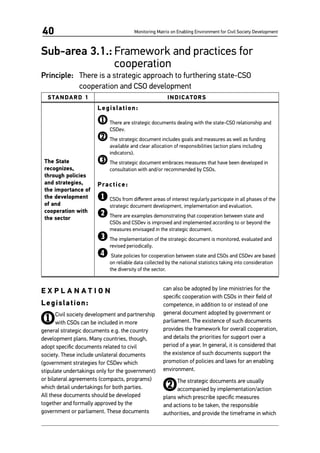
allowed to set up commercial companies which
can work in these areas. There is no automatic
exclusion for CSOs from competition for the
provision of services if there are no specific and
objective reasons for that.
2The law should not prohibit CSOs from
developing or providing new services even
though such services are not defined by law.
In this way, CSOs are able to bring innovative
services and pilot new practices which
could later be adopted by the government,
if successful. If the services are in areas for
which a preliminary registration or licensing is
required, that should apply to CSOs as well (e.g.
services for children).
3CSOs should not be subject to stricter
requirements in the areas in which they
provide services compared to other service
providers. The service quality standards to
which providers should be subject are the same
for commercial companies, CSOs and other
types of providers.
Balkan Civic Practices # 9 51
Practice:
1There are examples of CSOs being
awarded contracts for services in various
areas of service provision and this is not an
exception. CSOs are one of the main providers
of services in its traditional areas – social
assistance, healthcare and education. CSOs are
increasingly engaged in social entrepreneurship
not only by providing services in social areas but
also by engaging in other economic activities
which support their mission, including providing
employment to their beneficiaries.
2CSOs are partners to the state not only
in service provision. Very often CSOs are
closer to people’s needs and could bring added
value in determining the service needs and how
it is best to address them. In addition, CSOs
have expertise and could provide a different
perspective on the process of evaluation of
services provided by the state.
3The requirements for prior registration/
licensing of service providers in certain
areas should not push away potential CSO
service providers because of burdensome
procedures. Such procedures should be
relatively quick and cheap.
Sub-area3.2
Collaborationin
serviceprovision
Monitoring Matrix on Enabling Environment for Civil Society Development52
STANDARD 2 INDICATORS
The state has
committed to
funding services
and the funding
is predictable and
available over
a longer-term
period
Legislation:
1	The budget provides funding for various types of services which could be
provided by CSOs including multi-year funding.
2	There are no legal barriers to CSOs receiving public funding for the provision
of different services (either through procurement or through another
contracting or grants mechanism).
3	CSOs can sign long-term contracts for provision of services.
Practice:
1	CSOs are recipients of funding for services.
2	CSOs receive sufficient funding to cover the basic costs of the services they
are contracted to provide, including proportionate institutional (overhead)
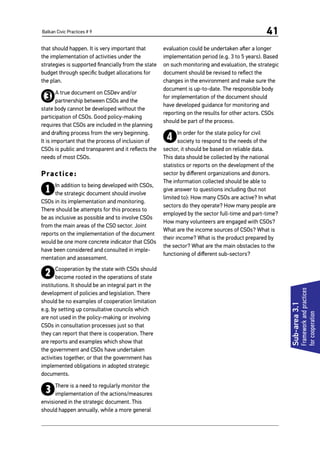
costs.
3	There are no delays in payments and the funding is flexible with the aim of
providing the best quality of services.
E X P L A N A T I O N
Legislation:
1The state budget should provide enough
resources to allow for the financing of
basic services in the key areas in which CSOs
traditionally operate (education, social area and
healthcare). In the social area, social services
are an important tool for improving the lives of
vulnerable groups and cannot be replaced only
by social assistance (provision of food, money
or other types of material assistance to the
most underprivileged). The legal framework
should also allow for multi-year funding to
promote further effectiveness in delivering the
service and achieving results.
2CSOs are allowed to participate in all of
the mechanism through which the state
delegates the provision of services to outside
providers (public procurement, grants, social
contracting, and other mechanisms).
3Even though in most countries the
budget is adopted on an annual basis,
competitions for service providers (including
CSOs) cover longer periods of time and the
contracts signed could be long-term. Once a
contract is signed, the respective state agencies
are obliged to provide the funding necessary for
the provision of the contracted services for the
whole duration of the contract and possibly to
consider including advance payments.
Balkan Civic Practices # 9 53
Practice:
1When the state contracts services, it
needs to provide sufficient funding to
cover the basic costs of the services they wish
to receive (even though the providers may be
non-profit organizations). In the service costs it
should also calculate all the administrative and
institutional costs associated with maintaining
the service. Even though CSOs may use
volunteers it should not be presupposed that
CSOs rely only on volunteers, but that they will
use employees or consultants.
2The CSO income for provision of services
coming from the state is increasing. There
are no complaints that CSOs are excluded from
service tenders.
3Once funding is provided to CSOs, it
should be allowed to use the money in
such a way as to maximize the impact and
fulfil the respective quality standards. Where
funding is provided under a budget, CSOs
should be allowed to move money between
different budget items, as long as they follow
certain procedures. If funding is provided in
tranches, there should be no delays and any
losses suffered because of delays should be
compensated.
Sub-area3.2
Collaborationin
serviceprovision
Monitoring Matrix on Enabling Environment for Civil Society Development54
STANDARD 3 INDICATORS
The state has
clearly defined
procedures for
contracting
services which
allow for
transparent
selection of
service providers,
including CSOs
Legislation:
1	There is a clear and transparent procedure through which the funding for
services is distributed among providers.
2	Price is not the lead criterion for selection of service providers and best
value is determined by both service quality and a financial assessment of
contenders.
3	There are clear guidelines on how to ensure transparency and avoid conflicts
of interests.
4	There is a right to appeal against competition results.
Practice:
1	Many services are contracted to CSOs.
2	Competitions are considered fair and conflicts of interest are avoided.
3	State officials have sufficient capacity to organize the procedures.
E X P L A N A T I O N
Legislation:
1The selection of service providers is
carried out under an open competition
whereby all eligible providers are allowed to
participate. The evaluation criteria are publicly
announced in advance.
2In certain areas of service provision
e.g. social areas, the lead criteria for
evaluation of bids should be the experience of
the provider and the staff that will deliver the
service. In this area, it is important to provide
the best possible quality or to serve the biggest
number of people for the budget that the state
has, rather than make savings from the existing
budget. In such areas, the financial bid should
not be the most important evaluation criteria.
3The evaluators of bids have to declare
any conflict of interests in advance of the
process. All procedures for selection of service
providers are public, in line with the good
regulatory practice on distribution of funding as
outlined above.
4The legal framework should allow for an
appeal before an independent entity and
eventually to the court.
Practice:
1There are sufficient examples in different
areas of CSOs receiving contracts
for service provision from the state. In the
traditional CSO areas such contracts are a usual
practice, and CSOs (associations, foundations
and non-profit companies) are recognized as
important contractors of the state.
2The calls for service providers are not only
formalistic and are not tailored only for
a specific organization. There are no cases in
which the procedure seems at first transparent,
but organizations linked to the competition
organizers receive the contracts. Explanations
about conflicts of interest statements are
available on request.
3The respective state officials are familiar
with the procedures through which
CSOs can be contracted to provide services
and have no technical problems in organizing
competitions. There are no cases of authorities
deciding not to outsource the provision of
services because they are not certain what
procedure to use and are concerned that
controlling institutions might sanction them. As
a good practice, civil state officials are trained to
undertake such processes.
Balkan Civic Practices # 9 55
STANDARD 4 INDICATORS
There is a
clear system of
accountability,
monitoring and
evaluation of
service provision
Legislation:
1	There is legal possibility for monitoring both spending and the quality of
service providers.
2	There are clear quality standards and monitoring procedures for services.
Practice:
1	CSOs are not subject to excessive control.
2	Monitoring is performed on a regular basis according to pre-announced
procedures and criteria.
3	Regular evaluation of quality and effects/impact of services provided is
carried out and publicly available.
E X P L A N A T I O N
Legislation:
1Service providers have to be monitored
for both the quality of the services they
provide and for the spending related to the
provision of these services. Monitors should
have the right to inspect the premises in
which services are provided, based on prior
notification.
2Monitoring is based on clear standards
and criteria. For the main types of
services, there are minimum quality standards
which providers should follow. Information on
awarded contracts, activities carried out and the
number of people served is public.
Practice:
1CSOs are not subject to excessive control,
as compared to other providers. Where
onsite controls are performed they follow a
prior notification which clearly indicates the
purpose and timing of the visit.
2CSOs are clear as to what and to whom
they should report. They are regularly
monitored.
3State institutions make regular evaluation
of the services provided and their impact.
The results of such evaluations are public and
used to shape the policy of the government in
the respective area.
Sub-area3.2
Collaborationin
serviceprovision
Monitoring Matrix on Enabling Environment for Civil Society Development56
STEP 1
Adapting the matrix to the country
situation
In order to be ready for monitoring, the sub-
areas, including principles, standards and given
indicators (legislation and implementation)
need to be reviewed and adapted against
the given country legislative background and
factual situation. It might be that an area is
not regulated, not relevant or for various
reasons CSOs decide not to cover it with their
monitoring. It might also be the case that in
some countries secondary data will not be
available to check the indicators and thus apply
the sub-area.
The given country situation should define
whether an expert approach by an organization
or group of CSO experts is enough to adapt and
validate the Matrix for the given country, or
the situation requires a consultative approach
whereby the Matrix is adapted and validated via
a (series) of consultation meetings with CSOs
and/or stakeholders.
STEP 2
Initial baseline monitoring
Once the Matrix is adapted and validated, the
initial, first monitoring can starts. As the
Matrix is designed to provide for a longer-
term/continuous monitoring mechanism, the
monitoring intervals are best set at an annual
basis. This is also a way to ensure that the
monitoring data can feed into (and use) the
already existing global and regional monitoring
indexes in the specific thematic area of CSDev
and vice-versa. However, in the initial year,
year 0, it is useful if a preliminary baseline
monitoring is developed a few months (e.g.
6 months) after the adaptation and start of
monitoring. The second step will be to test the
The monitoring Matrix contains standards
which have been agreed as common standards
necessary to ensure that there is an optimum
enabling environment for CSDev. The Matrix
has been designed by CSO practitioners and
experts from BCSDN members and partners
primarily as a CSO monitoring tool for CSDev.
However, with the adaptation of appropriate
methodologies, the Matrix may also inspire and
promote development of self-assessment tools
for government officials and monitoring tools
by various donors. Notwithstanding this, the
following section will outline only ways that this
Matrix can be used by CSOs.
The matrix is a new, fresh tool that is designed
for CSOs already following the enabling
environment for CSDev or its sub-areas and
who are interested in a more comprehensive
approach to monitoring and advocacy on the
enabling environment in their country. By
building on already existing international,
regional or national standards (in (sub-) areas
where they exist) and regulatory best practices,
the Matrix is an easy-to-use tool for any CSO
interested in an already-made monitoring
tool for the all or part of the enabling
environment for CSDev. During its development,
consideration was given to designing indicators
that can be monitored via secondary data
and information, thus requiring the minimum
of primary research, and reducing the need
for financial commitments or specific data-
collection expertise. Finally, since this is the first
ever attempt to build a monitoring mechanism
for a comprehensive and complex area such as
CSDev, the tool-kit in its initial state offers only
basic guidelines on how the Matrix should be
used and the monitoring conducted. The aim is
to review both the Matrix and the monitoring
methodology after a one- year “test” period.
Broadly, four steps have been envisaged in
order to apply and use the Matrix:
How to Use it
Balkan Civic Practices # 9 57
adapted monitoring against available data,
the available expertise of CSOs leading the
monitoring, as well expertise available in the
wider sector. This initial base line monitoring
can best be presented and checked against a
CSO and/or stakeholder focus group to adjust
if necessary the indicators as per available data
and expertise.
STEP 3
Implementation (consultation/
expert approach)
Similar as per the adaptation itself, the specific
country circumstances and background should
dictate whether the monitoring is conducted via
consultation (thematic per sub-area, regional
etc.) or via a CSO expert team/panel. What is
extremely important to consider in choosing
the approach is the validity and legitimacy
of the findings to be developed at the end. This
is the only way to assure that the Matrix does
not simply become one more piece of research
about the civil society sector, but rather a
tool that devises common agendas, priorities
and inspires actions and improvement in the
advancement of the enabling environment for
CSDev in a particular country.
STEP 4
Advocacy
Finally, the annual/periodic monitoring
results, best presented in the form of a
policy paper or brief, should be compiled and
presented to the civil society community as well
as to stakeholders. This can be at the national
level, or through a sequence of sub-national/
thematic events. The aim is to recapitulate the
work done in the past period, identify gaps (both
legislative and in practice) and propose possible
action to improve the situation.
Monitoring Matrix on Enabling Environment for Civil Society Development58
Balkan Civic Practices # 9 59
Annnex
Monitoring Matrix on Enabling Environment for Civil Society Development60
PRINCIPLE
STANDARDS/
BENCHMARKS
INDICATORS
RELEVANT GLOBAL OR REGIONAL INDEXES
Area 1: Basic Legal Guarantees of Freedoms
Sub-area 1.1.: Freedom of association
Freedom of
association is
guaranteed and
exercised freely
by everybody
1.	
All individuals and
legal entities can freely
establish and participate in
informal and/or registered
organizations offline and
online
Legislation:
1)	 There is a legal framework according to which any person can
establish associations, foundations and other types of non-
profit, non-governmental entities (e.g., non-profit company) for
any purpose.
2)	 The legal framework allows both individual and legal persons
to exercise this right without discrimination (age, nationality,
legal capacity, gender etc).
3)	 Registration is not mandatory, and in cases when organizations
decide to register, the registration rules are clearly prescribed
and allow for easy, timely and inexpensive registration and
appeal process.
4)	 The law allows for networking among organizations in the
countries and abroad without prior notification.
Practice:
1)	 Every individual or legal entity in practice can form
associations, foundations or other non-profit, non-
governmental organizations offline or online.
2)	 Individuals and legal entities are not sanctioned for not-
registering their organizations.
3)	 Registration is truly accessible within the legally prescribed
deadlines; authorities decide on cases in non-subjective and
apolitical manner.
4)	 Individuals and CSOs can form and participate in networks and
coalitions, within and outside their home countries.
NGO Sustainability Index for Central and
Eastern Europe and Euroasia , USAID
(http://transition.usaid.gov/locations/europe_
eurasia/dem_gov/ngoindex/)
ICNL NGO Law Monitor (http://www.icnl.org/
research/monitor/index.html)
United States International Grantmaking
(USIG) (http://www.usig.org/countryinfo.asp)
EU Progress Report (http://ec.europa.eu/
enlargement/how-does-it-work/progress_reports/
index_en.htm)
Freedom House (www.freedomhouse.org)
Democracy Index (https://www.eiu.com)
Freedom Meta Index (http://www.freeexistence.
org)
Human Development Index (http://hdr.undp.org/
en/humandev/hdi/ )
Social Development Index (http://www.
indsocdev.org/)
Civic Engagement Index (http://www.
oecdbetterlifeindex.org/topics/civic-engagement/)
Charity Commission NGO Sector&Regulation
Review Tool (http://www.ngoregnet.org/whats_
new/NGO_Sector_and_Regulation_Review_Tool.
asp)
Nations in Transit (www.freedomhouse.org/
report-types/nations-transit)
Polity IV Project (http://www.systemicpeace.org)
Civil Society Index (https://www.civicus.org/csi/)
Global Corruption Barometer (www.
transparency.org/research/gcb/overview)
Index of Economic Freedom (http://www.
heritage.org)
Doing Business In Index (http://www.
doingbusiness.org)2.	
CSOs operate freely
without unwarranted state
interference in their internal
governance and activities
Legislation:
1)	 The legal framework provides guarantees against state
interference in internal matters of associations, foundations and
other types of non-profit entities.
2)	 The state provides protection from interference by third parties.
3)	 Financial reporting (including money laundering regulations)
and accounting rules take into account the specific nature of
the CSOs and are proportionate to the size of the organization
and its type/scope of activities.
4)	 Sanctions for breaching legal requirements should be based on
applicable legislation and follow the principle of proportionality.
5)	 The restrictions and the rules for dissolution and termination
meet the standards of international law and are based on
objective criteria which restrict arbitrary decision making.
Practice:
1)	 There are no cases of state interference in internal matters of
associations, foundations and other types of non-profit entities.
2)	 There are no practices of invasive oversight which impose
burdensome reporting requirements.
3)	 Sanctions are applied in rare/extreme cases, they are
proportional and are subject to a judicial review.
The Monitoring Matrix on Enabling
Environment for Civil Society Development
Balkan Civic Practices # 9 61
PRINCIPLE
STANDARDS/
BENCHMARKS
INDICATORS
RELEVANT GLOBAL OR REGIONAL INDEXES
Freedom of
association is
guaranteed and
exercised freely
by everybody
3.	
CSOs can freely seek and
secure financial resources
from various domestic and
foreign sources to support
their activities
Legislation:
1)	 Legislation allows CSOs to engage in economic activities.
2)	 CSOs are allowed to receive foreign funding.
3)	 CSO are allowed to receive funding from individuals,
corporations and other sources.
Practice:
1)	 Legislation on CSOs engaging in economic activities is
implemented and is not burdensome for CSOs.
2)	 There are no restrictions (e.g. administrative or financial
burden, preapprovals, or channelling such funds via specific
bodies) on CSOs to receive foreign funding.
3)	 Receipt of funding from individuals, corporations and other
sources is easy, effective and without any unnecessary cost or
administrative burden.
Sub-area 1.2.: Related freedoms
Freedoms of
assembly and
expression are
guaranteed to
everybody
1.
CSO representatives,
individually or through their
organization, enjoy freedom of
peaceful assembly
Legislation:
1)	 The legal framework is based on international standards and
provides the right for freedom of assembly for all without
any discrimination.
2)	 The laws recognize and do not restrict spontaneous,
simultaneous and counter-assemblies.
3)	 The exercise of the right is not subject to prior authorization
by the authorities, but at the most to a prior notification
procedure, which is not burdensome.
4)	 Any restriction of the right based on law and prescribed by
regulatory authority can be appealed by organizers.
Practice:
1)	 There are no cases of encroachment of the freedom of
assembly, and any group of people can assemble at desired
place and time, in line with the legal provisions.
2)	 Restrictions are justified with explanation of the reason for
each restriction, which is promptly communicated in writing
to the organizer to guarantee the possibility of appeal.
3)	 Simultaneous, spontaneous and counter-assemblies can
take place, and the state facilitates and protects groups to
exercise their right against people who aim to prevent or
disrupt the assembly.
4)	 There are cases of freedom of assembly practiced by CSOs
(individually or through their organizations) without prior
authorization; when notification is required it is submitted
in a short period of time and does not limit the possibility to
organize the assembly.
5)	 No excessive use of force is exercised by law enforcement
bodies, including pre-emptive detentions of organizers and
participants.
6)	 Media should have as much access to the assembly as
possible.
NGO Sustainability Index for Central and
Eastern Europe and Euroasia, USAID (http://
transition.usaid.gov/locations/europe_eurasia/
dem_gov/ngoindex/)
ICNL NGO Law Monitor (http://www.icnl.org/
research/monitor/index.html)
World Press Freedom Index (http://en.rsf.org)
Media Sustainability Index (www.irex.org/msi)
Monitoring Matrix on Enabling Environment for Civil Society Development62
PRINCIPLE
STANDARDS/
BENCHMARKS
INDICATORS
RELEVANT GLOBAL OR REGIONAL INDEXES
Freedoms of
assembly and
expression are
guaranteed to
everybody
2.	
CSO representatives,
individually or through their
organizations enjoy freedom
of expression
Legislation:
1)	 The legal framework provides freedom of expression for all.
2)	 Restrictions, such as limitation of hate speech, imposed by
legislation are clearly prescribed and in line with international
law and standards.
3)	 Libel is a misdemeanour rather than part of the penal code.
Practice:
1)	 CSO representatives, especially those from human rights
and watch dog organizations enjoy the right to freedom of
expression on matters they support and they are critical of.
2)	 There are no cases of encroachment of the right to freedom of
expression for all.
3)	 There are no cases where individuals, including CSO
representatives would be persecuted for critical speech, in
public or private.
4)	 There is no sanction for critical speech, in public or private,
under the penal code.
3.	
Civil society representatives,
individually and through
their organizations, have the
rights to safely receive and
impart information through
any media
Legislation:
1)	 The legal framework provides the possibility to communicate
via and access any source of information, including the Internet
and ICT; if there are legal restrictions, these are exceptional,
limited and based on international human rights law.
2)	 The legal framework prohibits unjustified monitoring of
communication channels, including Internet and ICT, or
collecting users’ information by the authorities.
Practice:
1)	 There are no cases in practice where restrictions are imposed
on accessing any source of information, including the Internet
or ICT.
2)	 The Internet is widely accessible and affordable.
3)	 There is no practice or cases of unjustified monitoring by the
authorities of communication channels, including te Internet or
ICT, or of collecting users’ information.
4)	 There are no cases of police harassment of members of social
network groups.
Area 2: Framework for CSOs’ Financial Viability and Sustainability
Sub-area 2.1: Tax/fiscal treatment for CSOs and their donors
CSOs and donors
enjoy favourable
tax treatment
1.	
Tax benefits are available
on various income sources
of CSOs
Legislation:
1)	 The law provides tax free treatment for all grants and donations
supporting non-for-profit activity of CSOs.
2)	 The law provides tax benefits for economic activities of CSOs.
3)	 The law provides tax benefits for passive investments of CSOs.
4)	 The law allows the establishment of and provides tax benefits
for endowments.
Practice:
1)	 There is no direct or indirect (hidden) tax on grants reported.
2)	 Tax benefits for economic activities of CSOs are effective and
support the operation of CSOs.
3)	 Passive investments are utilized by CSOs and no sanctions are
applied in doing so.
4)	 Endowments are established without major procedural
difficulties and operate freely, without administrative burden
nor high financial cost.
NGO Sustainability Index for Central and
Eastern Europe and Euroasia, USAID (http://
transition.usaid.gov/locations/europe_eurasia/
dem_gov/ngoindex/)
ICNL NGO Law Monitor (http://www.icnl.org/
research/monitor/index.html)
United States International Grant making
(USIG) (http://www.usig.org/countryinfo.asp)
Index of Economic Freedom (http://www.
heritage.org/index/about)
Economic Freedom of the World Index (http://
www.freetheworld.com/index.html)
Global Giving Index (https://www.cafonline.
org/publications/2011-publications/world-giving-
index-2011.aspx)
Balkan Civic Practices # 9 63
PRINCIPLE
STANDARDS/
BENCHMARKS
INDICATORS
RELEVANT GLOBAL OR REGIONAL INDEXES
CSOs and donors
enjoy favourable
tax treatment
2.	
Incentives are provided for
individual and corporate giving
Legislation:
1)	 The law provides tax deductions for individual and corporate
donations to CSOs.
2)	 There are clear requirements/conditions for receiving
deductible donations and these include a wide range of publicly
beneficial activities.
3)	 State policies regarding corporate social responsibility consider
the needs of CSOs and include them in their programs.
Practice:
1)	 There is a functional procedure in place to claim tax deductions
for individual and corporate donations.
2)	 CSOs are partners to the state in promoting CSR.
3)	 CSOs working in the main areas of public interest, including
human rights and watchdog organizations, effectively enjoy tax
deductible donations.
Sub-area 2.2.: State support
State support to
CSOs is provided
in a transparent
way and spent in
an accountable
manner
1.	
Public funding is available
for institutional development
of CSOs, project support and
co-financing of EU and other
grants
Legislation:
1)	 There is a law or national policy (document) that regulates
state support for institutional development for CSOs, project
support and co-financing of EU funded projects.
2)	 There is a national level mechanism for distribution of public
funds to CSOs.
3)	 Public funds for CSOs are clearly planned within the state
budget.
4)	 There are clear procedures for CSO participation in all phases of
the public funding cycle.
Practice:
1)	 Available public funding responds to the needs of the CSO
sector.
2)	 There are government bodies with a clear mandate for
distribution and/or monitoring of the distribution of state
funding.
3)	 Funding is predictable, not cut drastically from one year to
another; and the amount in the budget for CSOs is easy to
identify.
4)	 CSO participation in the public funding cycle is transparent and
meaningful.
NGO Sustainability Index for Central and
Eastern Europe and Euroasia, USAID http://
transition.usaid.gov/locations/europe_eurasia/
dem_gov/ngoindex
Transparency International (http://www.
transparency.org)
Corruption Perception Index (http://cpi.
transparency.org/cpi2011/results/)
Global Giving Index (https://www.cafonline.
org/publications/2011-publications/world-giving-
index-2011.aspx)
Global Integrity Report (http://www.
globalintegrity.org/report)
2.	
Public funding is distributed in
a prescribed and transparent
manner
Legislation:
1)	 The procedure for distribution of public funds is transparent and
legally binding.
2)	 The criteria for selection are clear and published in advance.
3)	 There are clear procedures addressing issues of conflict of
interest in decision-making.
Practice:
1)	 Information relating to the procedures for funding and
information on funded projects is publicly available.
2)	 State bodies follow the procedure and apply it in a harmonized
way.
3)	 The application requirements are not too burdensome for CSOs.
4)	 Decisions on tenders are considered fair and conflict of interest
situations are declared in advance.
Monitoring Matrix on Enabling Environment for Civil Society Development64
PRINCIPLE
STANDARDS/
BENCHMARKS
INDICATORS
RELEVANT GLOBAL OR REGIONAL INDEXES
State support to
CSOs is provided
in a transparent
way and spent in
an accountable
manner
3.	
There is a clear system of
accountability, monitoring and
evaluation of public funding
Legislation:
1)	 The procedure for distribution of public funds prescribes clear
measures for accountability, monitoring and evaluation.
2)	 There are prescribed sanctions for CSOs that misuse funds
which are proportional to the violation of procedure.
Practice:
1)	 Monitoring is carried out continuously and in accordance with
predetermined and objective indicators.
2)	 Regular evaluation of effects/impact of public funds is carried
out by state bodies and is publicly available.
4.
Non-financial support is
available from the state
Legislation:
1)	 Legislation allows state authorities to allocate non-financial
support, such as state property, renting space without financial
compensation (time-bound), free training, consultations and
other resources, to CSOs.
2)	 The non-financial support is provided under clearly prescribed
processes, based on objective criteria and does not privilege
any group.
Practice:
1)	 CSOs use non-financial state support.
2)	 CSOs are treated in an equal or more supportive manner as
compared to other actors when providing state non-financial
resources.
3)	 There are no cases of state authorities granting non-financial
support only to CSOs which do not criticize its work; or of
cases of depriving critical CSOs of support; or otherwise
discriminating based on loyalty, political affiliation or other
unlawful terms.
Sub-area 2.3: Human resources
State policies
and the legal
environment
stimulate
and facilitate
employment,
volunteering
and other
engagements
with CSOs
1.
CSOs are treated in an equal
manner to other employers
Legislation:
1)	 CSOs are treated in an equal manner to other employers by law
and policies.
Practice:
1)	 If there are state incentive programs for employment, CSOs are
treated like all other sectors.
2)	 There are regular statistics on the number of employees in the
non-profit sector.
World Economic Forum Global
Competitiveness Report (http://www.weforum.
org/issues/global-competitiveness)
Global Employment Trends (http://www.ilo.
org/global/research/global-reports/global-
employment-trends/WCMS_171571/lang--en/
index.htm)
World Economic Forum Global Gender Gap
(http://reports.weforum.org/global-gender-
gap-2011/)
Civic Engagement Index (http://www.
oecdbetterlifeindex.org/topics/civic-engagement/)
Global Giving Index (https://www.cafonline.
org/publications/2011-publications/world-giving-
index-2011.aspx)
*Several other reports can be consulted, such as:
World of Work Report, Youth Employment, Global
Wage Report, World Social Security Report
Balkan Civic Practices # 9 65
PRINCIPLE
STANDARDS/
BENCHMARKS
INDICATORS
RELEVANT GLOBAL OR REGIONAL INDEXES
State policies
and the legal
environment
stimulate
and facilitate
employment,
volunteering
and other
engagements
with CSOs
2.
There are enabling
volunteering policies and laws
Legislation:
1)	 Legislation stimulates volunteering and incorporates best
regulatory practices, while at the same time allowing for
spontaneous volunteering practices.
2)	 There are incentives and state supported programs for the
development and promotion of volunteering.
3)	 There are clearly defined contractual relationships and
protections covering organized volunteering.
Practice
1)	 Incentives and programs are transparent and easily available
to CSOs and the policy/strategic document/ law is fully
implemented, monitored and evaluated periodically in a
participatory manner.
2)	 Administrative procedures for organizers of volunteer activities
or volunteers are not complicated and are without any
unnecessary costs.
3)	 Volunteering can take place in any form; there are no cases of
complaints of restrictions on volunteering.
3.
The educational system
promotes civic engagement
Legislation:
1)	 Non-formal education is promoted through policy/strategy/
laws.
2)	 Civil society-related subjects are included in the official
curriculum at all levels of the educational system.
Practice:
1)	 The educational system includes possibilities for civic
engagement in CSOs.
2)	 Provision of non-formal education by CSOs is recognized.
Area 3: Government – CSO Relationship
Sub-area 3.1.: Framework and practices for cooperation
There is a
strategic
approach to
furthering state-
CSO cooperation
and CSO
development
1.
The State recognizes,
through policies and
strategies, the importance
of the development of and
cooperation with the sector
Legislation:
1)	 There are strategic documents dealing with the state-CSO
relationship and civil society development.
2)	 The strategic document includes goals and measures as well as
funding available and clear allocation of responsibilities (action
plans incl. indicators).
3)	 The strategic document embraces measures that have been
developed in consultation with and/or recommended by CSOs.
Practice:
1)	 CSOs from different areas of interest regularly participate in all
phases of the strategic document development, implementation
and evaluation.
2)	 There are examples demonstrating that cooperation between
state and CSOs and civil society development is improved and
implemented according to or beyond the measures envisaged in
the strategic document.
3)	 The implementation of the strategic document is monitored,
evaluated and revised periodically.
4)	 State policies for cooperation between state and CSOs and civil
society development are based on reliable data collected by
the national statistics taking into consideration the diversity of
the sector.
Bertelsmann Stiftung’s Transformation Index
(http://www.bti-project.org/country-reports/pse/
blr/)
EU Progress Report (http://ec.europa.eu/
enlargement/how-does-it-work/progress_reports/
index_en.htm)
Sustainable Governance Indicators
(http://www.sgi-network.org/index.php)
*Status Index and Management Index
Monitoring Matrix on Enabling Environment for Civil Society Development66
PRINCIPLE
STANDARDS/
BENCHMARKS
INDICATORS
RELEVANT GLOBAL OR REGIONAL INDEXES
There is a
strategic
approach to
furthering state-
CSO cooperation
and CSO
development
2.
The State recognizes,
through the operation of its
institutions, the importance
of the development of and
cooperation with the sector
Legislation:
1)	 There is a national level institution or mechanism with
a mandate to facilitate cooperation with civil society
organizations (e.g., Unit/Office for cooperation; contact points in
ministries; council).
2)	 There are binding provisions on the involvement of CSOs in the
decisions taken by the competent institution or mechanism(s).
Practice:
1)	 The national level institution or mechanism(s) has sufficient
resources and mandate for facilitating CSO-government
dialogue, discussing the challenges and proposing the main
policies for the development of Civil Society.
2)	 CSOs are regularly consulted and involved in processes and
decisions by the competent institution or mechanism(s).
Sub-area 3.2: Involvement in policy- and decision-making processes
CSOs are
effectively
included in
the policy and
decision-making
process
1.
There are standards enabling
CSO involvement in decision-
making, which allow for CSO
input in a timely manner
Legislation:
1)	 There are clearly defined standards on the involvement of CSOs
in the policy and decision making processes in line with best
regulatory practices prescribing minimum requirements which
every policy-making process needs to fulfil.
2)	 State policies provide for educational programs/trainings
for civil servants on CSO involvement in the work of public
institutions.
3)	 Internal regulations require specified units or officers in
government, line ministries or other government agencies to
coordinate, monitor and report CSO involvement in their work.
Practice:
1)	 Public institutions routinely invite all interested CSOs to
comment on policy/legal initiatives at an early stage.
2)	 CSOs are provided with adequate information on the content
of the draft documents and details of the consultation with
sufficient time to respond.
3)	 Written feedback on the results of consultations is made
publicly available by public institutions, including reasons why
some recommendations were not included.
4)	 The majority of civil servants in charge of drafting public
policies have successfully completed the necessary educational
programs/training.
5)	 Most of the units/officers coordinating and monitoring public
consultations are functional and have sufficient capacity.
NGO Sustainability Index for Central and
Eastern Europe and Euroasia, USAID (http://
transition.usaid.gov/locations/europe_eurasia/
dem_gov/ngoindex/)
ICNL’s NGO Law Monitor (http://www.icnl.org/
research/monitor/index.html)
Worldwide Governance Indicators (http://info.
worldbank.org/governance/wgi/index.asp)
Civic Engagement Index (http://www.
oecdbetterlifeindex.org/topics/civic-engagement/)
Bertelsmann Stiftung’s Transformation Index
(http://www.bti-project.org/country-reports/pse/
blr/ )
Balkan Civic Practices # 9 67
PRINCIPLE
STANDARDS/
BENCHMARKS
INDICATORS
RELEVANT GLOBAL OR REGIONAL INDEXES
CSOs are
effectively
included in
the policy and
decision-making
process
2.
All draft policies and laws are
easily accessible to the public
in a timely manner
Legislation:
1)	 Existing legislation obliges public institutions to make all draft
and adopted laws and policies public, and exceptions are
clearly defined and in line with international norms and best
practices.
2)	 Clear mechanisms and procedures for access to public
information/documents exist.
3)	 There are clearly prescribed sanctions for civil servants/
units for breaching the legal requirements on access to public
information.
Practice:
1)	 Public institutions actively publish draft and adopted laws
and policies, unless they are subject to legally prescribed
exceptions.
2)	 Public institutions answer the majority of requests for access
to public information within the deadline prescribed by law, in
a clear format, provide written explanations on the reasons for
refusal, and highlight the right to appeal and the procedure for
appealing.
3)	 Cases of violations of the law are sanctioned.
3.
CSO representatives are
equal partners in discussions
in cross-sector bodies and
are selected through clearly
defined criteria and processes
Legislation:
1)	 Existing legislation requires public institutions to invite CSO
representatives on to different decision-making and/or advisory
bodies created by public institutions.
2)	 There are clear guidelines on how to ensure appropriate
representation from civil society, based on transparent and
predetermined criteria.
Practice:
1)	 Decision-making and advisory bodies on issues and policies
relevant for civil society generally include CSO representatives.
2)	 CSO representatives in these bodies are enabled to freely.
present and defend their positions, without being sanctioned.
3)	 CSO representatives are selected through selection processes
which are considered fair and transparent.
4)	 Participation in these bodies does not prevent CSOs from using
alternative ways of advocacy or promoting alternative stand-
points which are not in line with the position of the respective
body.
Sub-area 3.3: Collaboration in service provision
There is a
supportive
environment for
CSO involvement
in service
provision
1.
CSOs are engaged in different
services and compete for
state contracts on an equal
basis to other providers
Legislation:
1)	 Existing legislation allows CSOs to provide services in various
areas, such as education, healthcare, social services.
2)	 CSOs have no barriers to providing services that are not defined
by law (“additional” services).
3)	 Existing legislation does not add additional burdensome
requirements on CSOs that do not exist for other service
providers.
Practice:
1)	 CSOs are able to obtain contracts in competition with other
providers and are engaged in various services (e.g., education,
health, research, and training).
2)	 CSOs are included in all stages of developing and providing
services (needs assessment, determining the services that best
address the needs, monitoring and evaluation).
3)	 When prior registration/licensing is required, the procedure for
obtaining that is not overly burdensome.
NGO Sustainability Index for Central and
Eastern Europe and Euroasia, USAID (http://
transition.usaid.gov/locations/europe_eurasia/
dem_gov/ngoindex/)
Human Development Index (http://hdr.undp.org/
en/statistics/hdi/)
Global Giving Index (https://www.cafonline.
org/publications/2011-publications/world-giving-
index-2011.aspx)
Monitoring Matrix on Enabling Environment for Civil Society Development68
PRINCIPLE
STANDARDS/
BENCHMARKS
INDICATORS
RELEVANT GLOBAL OR REGIONAL INDEXES
There is a
supportive
environment for
CSO involvement
in service
provision
2.
The state has committed
to funding services and the
funding is predictable and
available over a longer-term
period
Legislation:
1)	 The budget provides funding for various types of services which
could be provided by CSOs including multi-year funding.
2)	 There are no legal barriers to CSOs receiving public funding for
the provision of different services (either through procurement
or through another contracting or grants mechanism).
3)	 CSOs can sign long-term contracts for provision of services.
Practice:
1)	 CSOs are recipients of funding for services.
2)	 CSOs receive sufficient funding to cover the basic costs of the
services they are contracted to provide including proportionate
institutional (overhead) costs.
3)	 There are no delays in payments and the funding is flexible with
the aim of providing the best quality of services.
3.
The state has clearly defined
procedures for contracting
services which allow for
transparent selection of
service providers, including
CSOs
Legislation:
1)	 There is a clear and transparent procedure through which the
funding for services is distributed among providers.
2)	 Price is not the lead criterion for selection of service providers
and best value is determined by both service quality and a
financial assessment of contenders.
3)	 There are clear guidelines on how to ensure transparency and
avoid conflict of interests.
4)	 There is a right to appeal against competition results.
Practice:
1)	 Many services are contracted to CSOs.
2)	 Competitions are considered fair and conflicts of interest are
avoided.
3)	 State officials have sufficient capacity to organize the
procedures.
4.
There is a clear system of
accountability, monitoring and
evaluation of service provision
Legislation:
1)	 There is legal possibility for monitoring both spending and the
quality of service providers.
2)	 There are clear quality standards and monitoring procedures
for services.
Practice:
1)	 CSOs are not subject to excessive control.
2)	 Monitoring is performed on a regular basis according to pre-
announced procedures and criteria.
3)	 Regular evaluation of quality and effects/impact of services
provided is carried out and publicly available.
Balkan Civic Practices # 9 69
Reference documents
Area 1: Basic Legal Guarantees to Freedoms
Charter of Fundamental Rights of the European Union, (2000/C 364/01), 2000
Council of Europe (CoE) Recommendation CM/Rec (2007)14 of the Committee of Ministers of the Council of
Europe to member states on the legal status of non-governmental organisations in Europe
https://wcd.coe.int/ViewDoc.jsp?id=1194609&Site=CM&BackColorInternet=9999CC&BackColorIntran
et=FFBB55&BackColorLogged=FFAC75
Council of Europe (CoE) Recommendation CM/Rec(2007)14 of the Committee of Ministers to member states
on the legal status of non-governmental organisations in Europe
https://wcd.coe.int/ViewDoc.jsp?id=1194609
Defending Civil Society Report, 2nd edition, 2012, International Center for Not-for-Profit Law and  World
Movement for Democracy Secretariat at the National Endowment for Democracy (NED) http://www.icnl.
org/research/resources/dcs/DCS_Report_Second_Edition_English.pdf
Defending Civil Society Toolkit: Tips for Engaging in NGO Law Reforms, International Center for Not-for-Profit
Law and  World Movement for Democracy Secretariat at the National Endowment for Democracy (NED)
http://prod.defendingcivilsociety.org/en/index.php/home
European Convention for the Protection of Human Rights and Fundamental Freedoms –ECHR http://
conventions.coe.int/Treaty/en/Summaries/Html/005.htm
European Court of Human Rights Case Law  
http://www.echr.coe.int/ECHR/EN/Header/Case-Law/Decisions+and+judgments/HUDOC+database/
European Parliament resolution of 11 December 2012 on a Digital Freedom Strategy in EU Foreign Policy
(2012/2094(INI))
	 http://www.europarl.europa.eu/sides/getDoc.do?type=TA&language=EN&reference=P7-
TA-2012-470
ILO Declaration on Fundamental Principles and Rights at Work
http://www.ilo.org/dyn/declaris/DECLARATIONWEB.static_jump?var_language=EN&var_
pagename=DECLARATIONTEXT
International Covenant for Civil and Political Rights – ICCPR
	http://www.ohchr.org/english/law/ccpr.htm
International Covenant on Economic, Social and Cultural Rights
	 http://www2.ohchr.org/english/law/cescr.htm
International Convention on the Elimination of All Forms of Racial Discrimination
	http://www2.ohchr.org/english/law/cerd.htm
Monitoring Matrix on Enabling Environment for Civil Society Development70
OSCE/ODIHR Key Guiding Principles of Freedom of Association with an Emphasis on Non-Governmental
Organizations
	http://www.legislationline.org/upload/lawreviews/46/a8/24ea8fac61f2ba6514e5d38af6b2.pdf
OSCE/ODIHR, 2007, Guidelines on Freedom of Peaceful Assembly
http://www.osce.org/odihr/24523
OSCE/ODIHR, 2010, Guidelines on Freedom of Peaceful Assembly. Office for Democratic Institutions and
Human Rights and the Venice Commission http://www.osce.org/odihr/73405?download=true
OSCE/ODIHR – Venice Commission, 2010, Guidelines on Freedom of Peaceful Assembly (2nd edition)
http://www.venice.coe.int/docs/2010/CDL-AD%282010%29020-e.pdf
The Johannesburg Principles on National Security, Freedom of Expression and Access to Information
	 http://www.article19.org/data/files/pdfs/standards/joburgprinciples.pdf
United Nations (UN) Convention on the Elimination of All Forms of Discrimination against Women  http://
www2.ohchr.org/english/law/cedaw.htm
UN Convention on the Rights of the Child http://www2.ohchr.org/english/law/crc.htm
UN Convention on the Rights of Persons with Disabilities http://untreaty.un.org/English/notpubl/IV_15_
english.pdf
Universal Declaration of Human Rights
http://www.ohchr.org/english/about/publications/docs/fs2.htm
UN Declaration on the Right and Responsibility of Individuals, Groups and Organs of Society to Promote and
Protect Universally Recognized Human Rights and Fundamental Freedoms, adopted by General Assembly
in Resolution 53/144 of 9 December 1998.
	 http://www2.ohchr.org/english/law/freedom.htm
UN, Economic and Social Council, U.N. Sub-Commission on Prevention of Discrimination and Protection
of Minorities, Siracusa Principles on the Limitation and Derogation of Provisions in the International
Covenant on Civil and Political Rights, Annex, UN Doc E/CN.4/1985/4 (1984)
	 http://www.unhcr.org/refworld/pdfid/4672bc122.pdf
UN First Optional Protocol to the International Covenant on Civil and Political Rights
	 http://www2.ohchr.org/english/law/ccpr.htm
UN Human Rights Council, Resolution 12/16, Freedom of opinion and expression, 12 October 2009
	 http://daccess-dds-ny.un.org/doc/RESOLUTION/LTD/G09/161/50/PDF/G0916150.pdf?OpenElement
UN Human Rights Council Resolution 15/21 on the Rights to Freedom of Peaceful Assembly and Association,
6 October 2010
	http://daccess-dds-ny.un.org/doc/UNDOC/LTD/G10/164/82/PDF/G1016482.pdf?OpenElement
Balkan Civic Practices # 9 71
UN Human Rights Council Resolution 15/21 on the Rights to Freedom of Peaceful Assembly and of
Association, 12 October 2012
	 http://daccess-dds-ny.un.org/doc/RESOLUTION/GEN/G12/174/63/PDF/G1217463.pdf?OpenElement
UN Human Rights Council Resolution on The promotion, protection and enjoyment of human rights on the
Internet, A/HRC/20/L.13, 29 June 2012,
http://daccess-dds-ny.un.org/doc/UNDOC/LTD/G12/146/89/PDF/G1214689.pdf?OpenElement
Report of the Special Rapporteur on the rights to freedom of peaceful assembly and of association, Maina
Kiai, June 2012
	http://www.ohchr.org/Documents/HRBodies/HRCouncil/RegularSession/Session20/A-HRC-20-27_
en.pdf
Report of the United Nations High Commissioner for Human Rights, Effective measures and best practices
to ensure the promotion and protection of human rights in the context of peaceful protests, 2013, A/
HRC/22/28,
http://www.ohchr.org/Documents/HRBodies/HRCouncil/RegularSession/Session22/A.HRC.22.28.pdf
US State Department, The Guiding Principles on Non-Governmental Organizations (issued on December 14,
2006)
	 http://www.icnl.org/research/journal/vol9iss1/art_9.htm
Area 2: Framework for CSOs’ Financial Viability and Sustainability
Council of Europe (CoE) Recommendation CM/Rec (2007)14 of the Committee of Ministers of the Council of
Europe to member states on the legal status of non-governmental organisations in Europe
	 https://wcd.coe.int/ViewDoc.jsp?id=1194609&Site=CM&BackColorInternet=9999CC&BackColorIntran
et=FFBB55&BackColorLogged=FFAC75
Communication from the Commission to the European Parliament, the Council, the European Economic
and Social Committee and the Committee of the Regions, The roots of democracy and sustainable
development: Europe’s engagement with Civil, Society in external relations, European Commission,
Brussels, 12.9.2012, COM(2012) 492
	http://eur-lex.europa.eu/LexUriServ/LexUriServ.do?uri=COM:2012:0492:FIN:EN:PDF
Defending Civil Society Report, 2nd edition, 2012, International Center for Not-for-Profit Law and  World
Movement for Democracy Secretariat at the National Endowment for Democracy (NED) http://www.icnl.
org/research/resources/dcs/DCS_Report_Second_Edition_English.pdf
Area 3: Government – CSO Relationship
Consolidated Version of the Treaty on European Union, article 10 and 11
	http://eurlex.europa.eu/LexUriServ/LexUriServ.do?uri=OJ:C:2010:083:0013:0046:EN:PDF
Monitoring Matrix on Enabling Environment for Civil Society Development72
Council of Europe (CoE), Code of Good Practice for Civil Participation in the Decision-Making Process,
adopted by the Conference of INGOs, 2009
	https://wcd.coe.int/ViewDoc.jsp?id=1514961
Council of Europe (CoE), Declaration by the Committee of Ministers on the Code of Good Practice for Civil
Participation in the Decision-Making Process, 2009
	https://wcd.coe.int/ViewDoc.jsp?id=1525009&Site=CM
Council of Europe (CoE), Recommendation CM/Rec(2010)5 of the Committee of Ministers to member states
on measures to combat discrimination on grounds of sexual orientation or gender identity.
	 https://wcd.coe.int/ViewDoc.jsp?id=1606669
Communication from the Commission to the European Parliament, the Council, the European Economic
and Social Committee and the Committee of the Regions, The roots of democracy and sustainable
development: Europe’s engagement with Civil, Society in external relations, European Commission,
Brussels, 12.9.2012, COM(2012) 492
	http://eur-lex.europa.eu/LexUriServ/LexUriServ.do?uri=COM:2012:0492:FIN:EN:PDF
European Commission, White Paper on European Governance, COM(2001) 428
	 http://ec.europa.eu/governance/white_paper/en.pdf
European Commission Communication, Towards a Reinforced Culture of Consultation and Dialogue - General
principles and minimum standards for consultation of interested parties by the Commission, COM (2002)
704.
	 http://ec.europa.eu/governance/docs/comm_standards_en.pdf
ECNL Social Contracting Handbook
	http://www.ecnl.org.hu/index.php?part=13publications&pubid=30
European Parliament Resolution Developing Civil Dialogue under the Treaty of Lisbon, P6_TA(2009)0007, 13
January 2009
	 http://www.europarl.europa.eu/sides/getDoc.do?pubRef=-//EP//TEXT+TA+P6-TA-2009-
0007+0+DOC+XML+V0//EN
OECD, Citizens as Partners: Information, Consultation and Active Participation in Policy- Making, 2001
	 http://www.ecnl.org/dindocuments/214_OECD_Engaging%20Citizens%20in%20Policy-Making.pdf
World Bank, A Call for Participatory Decision-Making: Discussion Paper on World Bank-Civil Society
Engagement, 2005
	http://siteresources.worldbank.org/CSO/Resources/World_Bank_Civil_Society_Discussion_Paper_
FINAL_VERSION.pdf
Balkan Civic Practices # 9
MONITORING MATRIX
ON ENABLING
ENVIRONMENT
FOR CIVIL SOCIETY
DEVELOPMENT
THE TOOL-KIT
In partnership with
BalkanCivicPractices
[6#]

Monitoring Matrix on Enabling Environment for Civil Society Development The Tool-Kit

  • 1.
    Balkan Civic Practices# 9 MONITORING MATRIX ON ENABLING ENVIRONMENT FOR CIVIL SOCIETY DEVELOPMENT THE TOOL-KIT In partnership with BalkanCivicPractices [6#]
  • 3.
    Balkan Civic Practices# 9 1 Monitoring Matrix on Enabling Environment for Civil Society Development The Tool-Kit This publication is made possible by the generous support of the American people through the United States Agency for International Development (USAID). The contents are the responsibility of the authors and do not necessarily reflect the views of USAID or the United States Government. Balkan Civic Practices # 9 B A L K A N C I V I L S O C I E T Y DEVELOPMENT N E T W O R K
  • 4.
    Monitoring Matrix onEnabling Environment for Civil Society Development2 Copyright © 2013 by the Balkan Civil Society Development Network, the European Center for Not-for-Profit Law and the International Center for Not-for-Profit Law. All rights reserved. Copies of the publication can be order by post or e-mail bellow. Balkan Civil Society Development Network (BCSDN) Address: Bel Kamen Street no. 6/8, 1000-Skopje, Macedonia E-mail: executiveoffice@balkancsd.net Website: http://www.balkancsd.net Publisher: Balkan Civil Society Development Network (BCSDN) Editor: Tanja Hafner Ademi, Katerina Hadzi-Miceva Evans Experts: Julijana Hoxha (Partners Albania), Slavisa Prorok (CPCD), Luben Panov (BCNL), Vanja Skoric and Nives Miosic Lisjak (GONG), Taulant Hoxha (KCSF), Emina Nuredinoska (MCIC), Ana Novakovic (CRNVO), Miljenko Dereta and Maja Stojanovic (Civic Initiatives), Tina Divjak (CNVOS) and Başak Ersen (TUSEV). Design and preparation: Koma lab. Print: Borografika Published in Macedonia, January, 2013 CIP - Каталогизација во публикација Национална и универзитетска библиотека “Св. Климент Охридски”, Скопје 316.323.64/.7:341.24 MONITORING matrix on enabling environment for civil society development : the tool-kit / [editor Tanja Hafner-Ademi, Katerina Hadzi-Miceva Evans]. - Skopje : Balkan civil society development network, 2013. - 71 стр. ; 30 см. - (Balkan civic practices ; 9) Фусноти кон текстот. - Содржи и: Annex ISBN 978-608-65119-9-9 а) Граѓанско општество - Принципи и стандарди COBISS.MK-ID 93386250
  • 5.
    Balkan Civic Practices# 9 3 Contents Acronyms.....................................................................................4 Acknowledgment........................................................................5 The Monitoring Matrix on Enabling Environment for Civil Society Development ..................................................7 Area 1: Basic Legal Guarantees of Freedoms.........................9 Area 2: Framework for CSO Financial Viability and Sustainability......................................................................25 Area 3: Government – CSO Relationship................................39 How to Use it.............................................................................56 Annex.........................................................................................59
  • 6.
    Monitoring Matrix onEnabling Environment for Civil Society Development4 Acronyms BCSDN Balkan Civil Society Development Network CSO civil society organization CSDev civil society development CD civil dialogue CoE Council of Europe COM Communication EU European Union EC European Commission ECHR European Convention for the Protection of Human Rights and Fundamental Freedoms ECNL European Center for Not-for-Profit Law ICCPR International Covenant of Civil and Political Rights ICNL International Center for Not-for-Profit Law ICT Internet and Communication Technologies IPA Instrument for Pre-accession Assistance LGBT Lesbian, gay, bisexual, and transgender community NED National Endowment for Democracy NGO Non-governmental organization ODIHR Office for Democratic Institutions and Human Rights OSCE Organization for Security and Cooperation in Europe Rec Recommendations UN United Nations
  • 7.
    Balkan Civic Practices# 9 5 Acknowledgment Developing the Matrix has been the most excit- ing, but at the same time the most challenging endeavour BCSDN has taken on since it was founded in 2001. We are as proud of the joint work done by BCSDN members’ and part- ners’ experts as we are motivated to subject the Matrix to scrutiny by CSOs colleagues and stakeholders. Through this scrutiny and the forthcoming review after a 1 year “test” period, our hope is that we can truly respond to and embrace the need of CSOs in driving positive change and the development of the environment in which they operate. Such change and devel- opment will allow them to fully contribute to their communities in creating positive societal changes. The development of the Monitoring Matrix on enabling environment for CSDev was made pos- sible as part of a collective effort of CSO experts and practitioners from the BCSDN network of members and partners. The 11-member expert team spanned a variety of non-profit and CSO specific knowledge and experience, both legal and practical, and included experts from 10 Balkan countries. This enabled the Matrix to take into account and span over country-specific differences. Five expert working meetings were held in a period of 8 months during 2012, com- bined with regular e-mail and Skype exchanges to enable the complex issue of CSDev and enabling environment development to be for the first time defined in a coherent and unified man- ner. The experts involved in the development of the Matrix are (in alphabetical order): Julijana Hoxha (Partners Albania, Albania), Slavisa Pro- rok (CPCD, BiH), Luben Panov (BCNL, Bulgaria), Vanja Skoric and Nives Miosic Lisjak (GONG, Croatia), Taulant Hoxha (KCSF, Kosovo), Emina Nuredinoska (MCIC, Macedonia), Ana Novakovic (CRNVO, Montenegro), Miljenko Dereta and Maja Stojanovic (Civic Initiatives, Serbia), Tina Divjak (CNVOS, Slovenia) and Başak Ersen (TUSEV, Turkey). The Tool-kit was developed with the support of Luben Panov (BCNL, Bul- garia) and Katerina Hadzi-Miceva Evans (ECNL). The Matrix has already been subjected to scru- tiny by several target groups. In its initial ver- sion, the Matrix was presented and discussed at a Brussels policy event on 30th May, 2012 with European-level stakeholders, including the European Commission, DG Enlargement, Euro- pean Parliament and European Economic and Social Committee (EESC). On 26th September, 2012, a special focus group meeting was held with representatives of Government agencies responsible for civil society cooperation and de- velopment from IPA countries. This group was tasked with testing the Matrix against expecta- tions and capacities of responsible institutions before being put to the real monitoring scrutiny. Finally, the Matrix in its final version was sub- jected to public consultation in November 2012. Special appreciation goes to the DG Enlarge- ment IPA Civil Society Team, who provided invaluable input into the Matrix, and have shown interest in using it to monitor and benchmark country progress in civil society support under the IPA mechanism. The Croatian Government Office for Cooperation with NGOs, headed by Igor Vidacak, and the Serbian Government Office for Cooperation with NGOs, headed by Ivana Cirkovic, are credited for supporting the initial idea, and for providing feedback and comments against the realities faced by Governments so that the Matrix could have a true, concrete, but also realistic impact on the work of such government interlocutors for civil society. We would like to thank Lorenzo Fioramonti, As- sociate Professor of Political Science at the University of Pretoria (South Africa) and Senior Fellow at the Centre for Social Investment of the University of Heidelberg and at the Hertie School of Governance (Germany), for his help in raising and addressing methodology issues in developing the Matrix. We would like to thank Ben Evans (Greenacre Associates, England) for
  • 8.
    Monitoring Matrix onEnabling Environment for Civil Society Development6 providing his expertise in reviewing the Matrix and Toolkit. The biggest appreciation and thanks goes to the team at the International Center for Non-profit Law (ICNL) and the European Center for Non- profit Law (ECNL) for their strategic coopera- tion, support and expertise, which helped guide the expert team through the methodological and thematic issues, as well as providing a wider international and legal perspective so that the Matrix and the Tool-kit can potentially serve civil society communities outside of the Balkans. Katerina Hadzi-Miceva Evans and Nilda Bullain take the biggest credit in providing concrete expertise in developing and revising the Matrix and the Toolkit. Finally, we would like to thank the USAID, Pact. Inc, and ICNL for their support of the overall process of expertise, workshop and publication of this Tool-kit, which was provided under the Legal Enabling Environment Program (LEEP)/ Legal Innovation Grant. We also thank the Bal- kan Trust for Democracy (BTD) which financially supported part of the work of the experts. Tanja Hafner Ademi Executive Director BCSDN
  • 9.
    Balkan Civic Practices# 9 7 The Monitoring Matrix on Enabling Environment for Civil Society Development The Monitoring Matrix presents the main principles and standards that have been identified as crucial to exist in order for the legal environment to be considered as supportive and enabling for the operations of CSOs. It underscores the fact that enabling environment is a complex concept, which includes various areas and depends on several factors and phases of development of the society and the civil society sector. This Matrix does not aim to embrace all enabling environment issues, rather those that the experts have found to be most important for the countries which they operate in. Therefore, the standards and indicators have been formulated with consideration of the current state of development of and diversity in the countries of the Western Balkans and Turkey. They have been drawn from the experiences of the CSOs in the countries in terms of the legal environment as well as the practice and challenges with its implementation. Thus, it is recognized that other issue areas may need to be revised and added to reflect on emerging issues or areas of importance for other regions and countries in future reviews of the Matrix. The development of the principles, standards and indicators have been done with consideration of the internationally guaranteed freedoms and rights and best regulatory practices at the European Union level and in European countries. The Matrix is organized around three areas, each divided by sub-areas. The main areas are: 1. Basic Legal Guarantees of Freedoms; 2. Framework for CSOs’ Financial Viability and Sustainability; 3. Government – CSO Relationship. The areas are defined by key principles which are further elaborated by specific standards. In order to enable local CSOs, donors or other interested parties to review and monitor the legal environment and practices of its application, the standards are further explained through indicators. The first area is ‘Basic Legal Guarantees of Freedoms’. This addresses issues which are core to the existence of civil society – the fundamental freedom of everybody to join together, to improve their lives, and to pursue common goals and dreams: the freedom of association. The freedom of association, however, does not stand alone. It is guaranteed and should be exercised in conjunction with the freedom to assemble and the freedom of individuals or groups to express their opinions. The Matrix highlights the key principle that the three fundamental freedoms of association, assembly and expression should be guaranteed and exercised freely by everybody. Once CSOs are formed, they require access to resources in order to sustain their activities. The Matrix details the types of resources that are typically used by CSOs, in the form of financial benefits (tax benefits, income generation, philanthropy and state support) and human resources (reliance on employees and volunteers). The main principles in this section highlight that CSOs and donors should enjoy favourable tax treatment to support CSO’s ability to generate their own income and mobilize local resources. In case of state support, the key principle is that it should be provided in a transparent way and used in an accountable manner. The third principle emphasises the need for state policies and the legal environment to stimulate and facilitate development of sustainable human resources for the sector via employment, volunteering and other engagement with CSOs. The third and last area is focused on the relationship between CSOs and the government, although the principles could also apply to the relationship with parliament and local authorities. This is perhaps the most
  • 10.
    Monitoring Matrix onEnabling Environment for Civil Society Development8 challenging area, because the application of the principles and standards varies greatly between countries depending on a variety of challenges, the most significant being the attitude of public authorities towards civil society and the ability of civil society to be a credible and strong partner. When defining the standards and indicators, the experts considered the significant diversity in practice, but were also mindful of the minimum which would be necessary to ensure that there is meaningful relationship building for the good of the citizens. This third area is divided in three sub areas. The first sub-area deals with the framework and practices for cooperation, and the main principle requires an established strategic approach to furthering state-CSO cooperation and CSO development as a foundation for the relationship. The second sub-area addresses the increasing demand to ensure that policies and laws are made with high participation by citizens and CSOs. The third area incorporates the new area of increased collaboration and inclusion of CSOs in provision of various services which are contracted out or delegated to CSOs (e.g., health, social services, research, etc). The indicators of the matrix do not aim to create points or ranks among countries. Rather, they are descriptive indicators. They aim to guide the interested parties (CSOs, governments and donors) in understanding better the legal and policy environments and its practical implementation against the international standards and practices. The goals is to help them to draw lessons as to what are the areas that require further reform, how to address the challenges and to help them prioritize the issues for reform. Finally, as a background approach to development of the Matrix is based on ECNL’s framework to assess and measure enabling environment in various countries; the full description of each level and component is available from ECNL.1 1 www.ecnl.org Level 1 – Minimum standards. In countries with repressive regimes or conflict/post-conflict situations the aim should be to establish the minimum standards in law and in practice that are required by international law (most often conventions that the partner governments have signed, such as the ICCPR, ECHR). The Defending Civil Society Report spells out those minimum standards clearly, including (i) freedom of association; (ii) freedom of expression; (iii) right to operate free of unwarranted state interference; (iv) right to access resources; (v) right to communication and cooperation, including internationally; (vi) state’s duty to protect. Level 2 – CSO sector development. In countries where minimum standards are guaranteed but the CSO sector is still evolving and needs support for its development, it is important to recognize that it is also the responsibility of the government to invest in this process. Usually in such countries CSO sector development (e.g., capacity building so they can run more effective organizations and projects) is financed by international donors which leads to a general dependence on foreign funding. If the aim is that there be meaningful partnership between government and civil society, this trend has to be countered by strategic enabling environment investments and interventions at this stage by the governments as well as donors. Level 3 – Partnership. In countries where there is a broad based CSO sector that has a certain level of its own resources, and where there has been sufficient diversification (i.e. emergence of segments of CSOs, such as advocacy and service oriented, community organizations, foundations, think tanks etc.), the focus can be on making the public-private partnership more effective so that the citizens can be the ultimate, true beneficiaries in this relationship. It is at this stage where it makes most sense to propose such things as institutionalized mechanisms for cooperation, or contracting CSOs for social service delivery.2 2 This is an excerpt from ECNL submission to the EC “Consultation Paper Preparing the European Commission Communication on Civil Society Organisations in Development”, 2012. For more information, contact ECNL. 1
  • 11.
    Balkan Civic Practices# 9 9 Area 1: Basic Legal Guarantees of Freedoms
  • 12.
    Monitoring Matrix onEnabling Environment for Civil Society Development10 Sub-area 1.1: Freedom of association Principle: Freedom of association is guaranteed and exercised freely by everybody STANDARD 1 INDICATORS All individuals and legal entities can freely establish, join and participate in informal and/ or registered organizations offline and online Legislation: 1 There is a legal framework according to which any person can establish associations, foundations and other types of non-profit, non-governmental entities (e.g., non-profit company) for any purpose. 2 The legal framework allows both individual and legal persons to exercise this right without discrimination (age, nationality, legal capacity, gender etc). 3 Registration is not mandatory, and in cases when organizations decide to register, the registration rules are clearly prescribed and allow for easy, timely and inexpensive registration and appeal process. 4 The law allows for networking among organizations in the countries and abroad without prior notification. Practice: 1 Every individual or legal entity in practice can form associations, foundations or other non-profit, non-governmental organizations offline or online. 2 Individuals and legal entities are not sanctioned for not-registering their organizations. 3 Registration is truly accessible within the legally prescribed deadlines; authorities decide on cases in a non-subjective and apolitical manner. 4 Individuals and CSOs can form and participate in networks and coalitions, within and outside their home countries. E X P L A N A T I O N Legislation 1The guarantees of freedom of association should be contained in the Constitution of a country, and also further developed and made functional through a law which governs the whole lifecycle of organizations from establish- ment, operation, governance, activities through to termination or dissolution. According to international human rights law, freedom of association extends to any person, whether it is a citizen, foreigner, refugee, women, child, and person with disabilities or other. The freedom of association does not only mean that one can establish an association or other legal non-profit form (organization/ CSO) but that one can join (or not) an existing organization/CSO as a member taking part in its everyday activities or governance. There should not be a legal obligation to become a member of an association in order to participate in the work of an association. At the same time, organizations/CSOs should not be prevented from limiting membership to certain categories or groups. Related to this, there should not be a legal limitation on the number of organizations that can exist which have similar purposes, where people can join to achieve a certain result or goal in the field, or to express their views (in other words, the existence of one organization dealing with women’s rights should not mean that other organizations for women’s rights cannot exist).
  • 13.
    Balkan Civic Practices# 9 11 of gender, nationality and age has the right to join (or not to join) an organization. While there may be some requirements with regard to the legal capacity and the legal age of the persons that can become founders of an organization, those requirements should not prevent them from freely deciding to become members, join or govern their CSOs.6 According to the UN Convention on the Rights of Persons with Disabilities, people with disabilities, including those with intellectual disabilities and psycho-social (mental health) disabilities, have the right to participate in political and public life. The right is unqualified, meaning that it applies to everyone, regardless of irrelevant factors such as gender, type of disability, severity of disability, and disability related legal status such as guardianship6 . 3There should be no legal requirement for registering CSOs and the decision to do so should rest solely with the founders/members. An example of a violation of this principle is the case where people who associate are fined or persecuted should they start with implementa- tion of activities before their registration as a legal entity is confirmed. Where founders decide to register the organization, the procedure for acquiring legal status is clearly described in a law. Organizations that complete all the legal requirements are granted legal personality. There are no burdensome requirements, such as the need to have a large number of founders (good practice is between 2 and 5 founders). The fees collected by the registering agency (court, ministry, central registry, etc.) are not considered high compared to the living standard in the respective country. They do not discourage application and everybody should be able to afford to pay them. 6 Comments developed by the Mental Disability Advocacy Center (2013). This freedom does not extend only to one legal form – association. It also embraces the right to form or join foundations, political parties, religious organizations, trade unions, employer associations, non-profit companies, and various other forms of association.3 The objectives of registered CSOs should be diverse and the only limitations are the ones recognized by international law. CSOs should be allowed to operate in different areas and pursue all legitimate aims including the protection of human rights, prevention of discrimination, etc. A CSO can even promote a change in the constitutional order but only: “a) if this is done in a legal manner by democratic means; and b) if the wanted change is in itself compatible with basic democratic principles.”4 The freedom of association extends also to association through the Internet or different social groups such as Facebook. Based on this, blocking Internet or certain applications (Skype, Facebook) through which groups can form or undertake activities would be considered a violation of this freedom.5 2Freedom of association does not only extend to individuals but also to legal enti- ties (e.g. corporations). Therefore, laws in the country should allow for businesses or other types of legal entities to establish or join as- sociations, foundations, federations or other types of non-profit, non-governmental entities. Further, as noted above, any person, regardless 3 As noted in the Introduction, the Matrix discusses predominantly issues surrounding freedoms to form associations, foundations and non-profit companies as the most common forms in which the right is expressed. The experts recognize the existence of other forms (e.g., business associations, trade unions) and that some issues in this Matrix also extend to those other types of entities (e.g., participation in policy- making). 4 Mataga, Zvonimir, The Right to Freedom of Association under the European Convention on the Protection of Human Rights and Fundamental Freedoms, October 2006, p.10. 5 Statement by Maina Kiai, Special Rapporteur on the rights to freedom of peaceful assembly and of association, at 20th session of the Human Rights Council. Sub-area1.1 Freedomofassociation
  • 14.
    Monitoring Matrix onEnabling Environment for Civil Society Development12 Registration decisions are made quickly (between 5 and 30 days) and applicants are informed about the decision in writing. Negative decisions for registration are subject to an appeal in a court or another independent body. In cases where there is no decision within the prescribed deadline, there should be an assumption that organization can start operating and this is accepted by other state bodies (if there is a need for a following registration e.g. with the social security agency, it accepts that the organization is registered and does not require a written registration decision). 4Freedom of association extends to net- works of organizations, their coalitions, federations or other types of unions. Communi- cation with groups outside of the country should be possible and there should be no limitations. It also extends to online association. Blocking so- cial network initiatives with the attempt to hin- der communication between people/organiza- tions has to follow the allowed limitations which apply to freedom of association. An example of limitation on the right to join networks or asso- ciate outside of the country are requirements for CSOs to inform or gain permission from state authorities to do so, and face fines if they fail to do it. Practice: 1There are various types of CSOs in prac- tice; there are examples of organizations set up by women, and people with limited legal capacity or other disadvantaged groups. Com- panies and individuals or other groups can form associations, foundations and non-profit entities – there are examples of such or in case there are not, there are no complaints that companies cannot be founders or co-founders of CSOs. In addition, by being a founder or president who does not receive remuneration, the individual is not considered an employee per se, and does not lose unemployment benefits or status. Moreover, the state does not consider working for a CSO to mean that the person is undertak- ing a public function and is therefore subject to the same scrutiny as a public official. There are no restrictions to Internet applications, Facebook groups are not banned, web sites of organizations or accounts blocked or hacked, their passwords are not stolen, or entries changed, and Skype or other similar chat tools are not monitored. Groups or individuals use ICT tools to perform joint activities and there are no complaints of restrictions by the government or harassment of moderators (informal leaders of the groups) or members of groups. 2The government in practice does not re- quire founders to register organizations in order to undertake activities or impose fines for not registering legal entities. There are no cases or complaints of unreasonable or unjustified denials of registration. There are unregistered organizations in society. As a good practice, unregistered organizations are present in pub- lic life, and cooperate with other CSOs or state bodies. 3There are no reported cases of political influence over the registration process. Decisions are based on the law and not based on subjective interpretation of the legal require- ments. No additional documents, other than the ones described in the law, are required for registration. 4The practice is enabling, and there are ex- amples of free networking among organi- zations both within and outside of the country. Organizations can join international umbrella groups or federations, join networks online by using various ICT tools, can undertake activities (by going to or inviting network members in the country, organizing them at national, regional or international level) and promote their goals. Registration of networks is easy. Organizations don’t face burdensome bureaucratic require- ments designed to make networking difficult, such as requiring organizations to notify certain state body if they plan to join a network.
  • 15.
    Balkan Civic Practices# 9 13 STANDARD 2 INDICATORS CSOs operate freely without unwarranted state interference in their internal governance and activities Legislation: 1 The legal framework provides guarantees against state interference in internal matters of associations, foundations and other types of non-profit entities. 2 The state provides protection from interference by third parties. 3 Financial reporting (including money laundering regulations) and accounting rules take into account the specific nature of the CSOs and are proportionate to the size of the organization and its type/scope of activities. 4 Sanctions for breaching legal requirements should be based on applicable legislation and follow the principle of proportionality. 5 Restrictions and the rules for dissolution and termination meet the standards of international law and are based on objective criteria which restrict arbitrary decision-making. Practice: 1 There are no cases of state interference in internal matters of associations, foundations and other types of non-profit entities. 2 There are no practices of invasive oversight which impose burdensome reporting requirements. 3 Sanctions are applied in rare/extreme cases; they are proportional and are subject to a judicial review. E X P L A N A T I O N Legislation: 1There are very limited grounds for state interference with freedom of association and those are prescribed in international law. Most relevant for European countries is the ECHR and the case law of the European Court for Human rights which prescribes the grounds for limitations and provides further interpretations through case law. According to the ECHR, the limitations to the freedom of association are allowed if: (1) they are prescribed by law; (2) pursue a legitimate aim; and (3) are necessary in a democratic society. Further to point 2, ECHR allows the following aims as legitimate: (1) in the interest of national security or public safety; (2) for the prevention of disorder or crime; (3) for the protection of health or morals; and (4) for the protection of the rights and freedoms of others. CSOs are autonomous from the state and the law should guarantee their right to regulate their internal structure and operating procedures. For example, the law should not allow the state to interfere in the internal management of their affairs. Requirements such as the mandatory participation of a state representative in the meetings of an organizational body would violate this indicator. Similarly, the law should not allow states to interfere in the process of appointment of Board members. The law should not require that CSOs receive advance approval from the state for carrying out their activities. The state may require those organizations to undergo certain registration/ licensing for certain areas when organizations Sub-area1.1 Freedomofassociation
  • 16.
    Monitoring Matrix onEnabling Environment for Civil Society Development14 want to work in or where interests of disadvantaged groups should be protected (e.g., services for children). However, those situations must be clearly prescribed by law and CSOs should not be discriminated against compared with other providers of such services (see Sub- area 3.3 for further discussion on this). 2States have not only the negative obligation – not to violate the freedom of association and to allow the operation of CSOs, but also a positive obligation – to protect freedom of association, including preventing third parties from violating the freedom of association. This would mean that the state has set up measures to protect the right – e.g., police force to protect people against violations of their rights by state or non-state actors, and an independent judiciary able to provide remedies.7 Thus, if a certain group’s operation is hindered by another (e.g., Roma associations or LGBT groups), the legal framework should have guarantees that the state can protect their operation. 3The regulations on CSO reporting to the state should be based on the specific characteristics of the work CSOs do. The reports they submit should be adapted to the CSOs activities. A good regulatory practice is to have separate legislation on non-profit accounting and reporting forms for CSOs which are different from the reporting forms of businesses. In this way, the information collected by the authorities would give a better picture of what the CSO sector is actually doing without adding unnecessary burden on the sector. A good regulatory practice is to introduce lighter reporting requirements for small organizations that fall below a certain threshold. CSOs should not be subject to stricter requirements with regard to money laundering regulation than other similar subjects e.g. businesses or other types of non-profit 7 World Movement for Democracy at the National Endowment for Democracy and ICNL, Defending Civil Society Report, 2nd edition, 2012. organizations. Regulations requiring specific financial reporting or specific measures regarding counter-terrorism requirements which are not proportionate to the size of the organizations and which treat CSOs differently from other providers would be in violation of this indicator. 4All sanctions to which CSOs are subject should be prescribed by law and should be clear to avoid potential misinterpretation in practice. Sanctions for CSOs should be the same or lower as compared to the sanctions of companies for similar breaches. If there are material sanctions (fines, etc.) these should take into consideration the financial situation of the organization as well. All sanctions should be proportionate to the breaches made. Fines to responsible individuals should be exceptions; they should only be applied in case of intentional and serious breach of law. Laws should not impose higher fines on responsible individuals than on the organization. 5The law should allow for CSO to choose to dissolve at any time by a resolution of the highest governing body. The law should prescribe precisely and narrowly the situations where organization have to dissolve and grounds for involuntary termination (e.g., in cases of violations of statute or law). Termination should occur only as a last resort and appeal should be allowed. As a good practice termination should be decided in a court case. It should be applied only after previous sanctions have been exhausted and there is no other way to remedy the situation. An example of a disproportionate termination is a case in which an organization is terminated for failing to submit its annual report on time. Even if this is considered a serious violation, the organization should be given the chance e.g. to submit its report or pay a fine. Only if failing to do so should the sanction of termination be considered.
  • 17.
    Balkan Civic Practices# 9 15 Practice: 1Practice shows that CSOs operate independently and there are no reports where CSOs have been subject to threats from the government in their work. There are no examples of government intrusion into the premises of private legal entities, or ‘surprise’ visits/inspections to the offices or board meetings. Requirements for CSOs to work only with specific government-controlled banks or use only government-provided services would not be in line with this indicator. There are no interferences especially against organizations which are critical of the government. There should be no examples of state attempts to harass such critical organizations. 2State interference/harassment could take the form of excessive audits of an organization with the purpose of putting administrative burden and sanctioning the organization. Other examples include targeted inspections and excessive control of employment regulations or other administrative measures. 3Sanctioning an organization should have the aim of remedying a breach and not hindering the operation of the organization. When imposing the sanction, attention should be paid to the specific character of the CSO and the type of the violation. The practice should show that when there are differences between minimum and maximum penalties the fines are applied with consideration of the size of the organization, the gravity of the breach and in general to show that there is a tendency to apply lower rather than higher fines. Decisions to restrict the rights or terminate organizations in practice take place in a judicial process in an apolitical manner, decisions are explained and organizations can appeal against them. Sub-area1.1 Freedomofassociation
  • 18.
    Monitoring Matrix onEnabling Environment for Civil Society Development16 STANDARD 3 INDICATORS CSOs can freely seek and secure financial resources from various domestic and foreign sources to support their activities Legislation: 1 Legislation allows CSOs to engage in economic activities. 2 CSOs are allowed to receive foreign funding. 3 CSO are allowed to receive funding from individuals, corporations and other sources. Practice: 1 Legislation on CSOs engaging in economic activities is implemented and is not burdensome for CSOs. 2 There are no restrictions (e.g. administrative or financial burden, preapprovals, or channeling such funds via specific bodies) on CSOs to receive foreign funding. 3 Receipt of funding from individuals, corporations and other sources is easy, effective and without any unnecessary cost or administrative burden. E X P L A N A T I O N Legislation: 1“Economic activities” means the active sale of goods or services, referred to as “trade or business” activities; it entails sale of goods and services that are pursued with fre- quency or continuity.8 This can include: fees for services, sales, rents, investments and business ventures. Legislation should allow CSOs to en- gage both directly (as a CSO) and indirectly (by registering or owning shares of a commercial company) in economic activity. Internationally this is considered an important right as it al- lows CSOs to generate income through devel- oping their own services, to improve reach to their communities, to adjust services to meet real needs, and to have a stable income source which is independent from the state. There could be some limitation to engaging in a direct economic activity. For example: the economic activity may have to be related to the mission of the organization (e.g. an organization for people with disabilities could 8 Survey of the Treatment of Economic Activities of Non- Profit Organizations in Europe, ICNL, ECNL, MCIC, 2007 provide transportation services to such people, or association for blind people can sell walking canes); the economic activity may have to be additional to the non-profit activity; or rules may require that all income should be used for the purposes of the organization. There should be a restriction on distributing net revenues to private parties who may be in a position to control the organization for personal gain, such as founders, members, officers, directors, agents, or employees (prohibition on the distribution of income). State authorities should provide guidance on engagement in economic activities to facilitate the process. 2Legislation should not limit the possibility for CSOs to receive funding from foreign public or private sources. The treatment of such funding should be similar to the treatment of funding received from local sources. Any legal requirements for registration of foreign grants (except funding from bilateral donors which falls under the EU regulations), their preliminary approval from the government, requirement to channel foreign funding through state- controlled body or bank, are inconsistent with this indicator.
  • 19.
    Balkan Civic Practices# 9 17 3There is no legal limitation that would prohibit the receipt of funds from any private or commercial person, the state, local authorities, foundations or other legal entities, agencies, etc. In other words, CSOs should be able to raise funds from individuals and corporations, and take part in public procurement or grant or service tenders by the state or donors. Practice: 1CSOs engage in economic activities. They can set up companies for that purpose or directly engage. The state authorities do not impose implementing regulations that will limit this right. When engaging in economic activity, CSOs are only subject to any licensing/registra- tion or other specialized regime if it is required for everybody that engages in the respective field of work. 2CSOs receive foreign funds and can use them for any purpose for which the grant is given. In the case of receipt of foreign funding, there are no specific administrative procedures that obstruct organizations from receiving foreign funds. There are no special taxes for foreign funds received. If VAT exemption is provided, the procedure for obtaining it is simple, easy-to-implement and not too burdensome. 3CSOs can freely receive funding from different private sources, and do not face complicated procedures to access the funding. Sub-area1.1 Freedomofassociation
  • 20.
    Monitoring Matrix onEnabling Environment for Civil Society Development18 Sub-area 1.2: Related Freedoms Principle: Freedoms of assembly and expression are guaranteed to everybody STANDARD 1 INDICATORS CSO representatives, individually or through their organizations, enjoy freedom of peaceful assembly Legislation: 1 The legal framework is based on international standards and provides the right for freedom of assembly for all without any discrimination. 2 The laws recognize and do not restrict spontaneous, simultaneous and counter-assemblies. 3 The exercise of the right is not subject to prior authorization by the authorities, but at the most to a prior notification procedure, which is not burdensome. 4 Any restriction of the right based on law and prescribed by regulatory authority can be appealed by organizers. Practice: 1 There are no cases of encroachment of the freedom of assembly, and any group of people can assemble at desired place and time, in line with the legal provisions. 2 Restrictions are justified with explanations of the reason for each restriction, which is promptly communicated in writing to the organizer to guarantee the possibility of appeal. 3 Simultaneous, spontaneous and counter-assemblies can take place, and the state facilitates and protects groups to exercise their right against people who aim to prevent or disrupt the assembly. 4 There are cases of freedom of assembly practiced by CSOs (individually or through their organizations) without prior authorization; when notification is required it is submitted in a short period of time and does not limit the possibility to organize the assembly. 5 No excessive use of force is exercised by law enforcement bodies, including preemptive detentions of organizers and participants. 6 Media should have as much access to the assembly as possible. E X P L A N A T I O N Legislation 1Freedom of peaceful assembly is a fundamental human right, enshrined in the International Covenant on Civil and Political Rights, the ECHR, the Charter of Fundamental Rights of the European Union and other international and regional treaties, and is inextricably intertwined with the freedom of association. The State has a positive obligation to facilitate and protect peaceful assembly – freedom of assembly insofar as possible should be enjoyed without restrictions, guaranteed by law and should not be preempted by administrative procedures or undue regulation.9 9 OSCE/OIDHR-Venice Commission Guidelines on Freedom of Peaceful Assembly, 2nd edition, 2010
  • 21.
    Balkan Civic Practices# 9 19 Sub-area1.2 RelatedFreedoms The law should guarantee freedom of assembly to all, individuals and legal entities, stateless persons, refugees, foreign nationals, asylum seekers, migrants and others. 2The law should allow for peaceful assemblies to be held at the same time and in the same place (simultaneously) or for counter-assemblies (those of opposing groups) to take place. In case several groups plan to hold assemblies in the same place and the same time, they should be entitled to do so if physical circumstances permit. In case of counter-assemblies, the law has to recognize the state’s responsibility to undertake measures to protect the participants in the peaceful assembly from individuals or groups of individuals, including agents provocateurs and counter demonstrators, who aim at disrupting or dispersing such assemblies. 3The law should contain a presumption in favor of holding assemblies. Those seeking to assemble should not be required to obtain permission to do so. If such requirement exists it should be reduced to notification (information that it will happen), rather than authorization (asking for permission to do it). There should be no limitations on advertisement of the event before such permission is acquired. Requirements for notification may be justified by the state’s duty to protect public order, public safety, and the rights and freedoms of others. 4The law should guarantee the right to appeal against decisions to limit the assembly. Practice: 1There are cases of freedom of assembly practiced by CSOs (individually or through their organizations) without prior authorization. When notification is required it is submitted in a short period of time and does not limit the possibility to organize the assembly. There are no complaints about the restriction on assembly, groups are not required to ask for authorization, nor does the police require one when assemblies take place. Any restriction follows the legally prescribed cases for the limitation. Assemblies are organized in any area the groups want. A violation of this right will be situations where the state deliberately books a place in order to prevent assemblies to be organized. As a general rule assemblies should take place within “sight and sound” of their target audience. 2Regulatory authorities provide prompt, detailed and objective written explanation for any limitation to assembly. Where there is arbitrary denial or a failure of the regulatory authorities to respond promptly, then this is considered as an excessive restriction on freedom of assembly. “Where there is a failure to respond promptly, then the law should presume that the organizers of the assembly may proceed according to terms of notice.”10 Where the authorities restrict this right, there is a possibility for appeal. 3The state does not interfere in spontaneous assemblies by raising the argument for a need to notify the authorities. Simultaneous and counter-assemblies can take place and the law-enforcement authorities exercise necessary control to protect peaceful protestors, accepting that the assembly should take place within sound and sight of the target group. Assemblies are not prohibited at large because there is possibility for counter- 10 World Movement for Democracy at the National Endowment for Democracy and ICNL, Defending Civil Society Report, 2nd edition, 2012
  • 22.
    Monitoring Matrix onEnabling Environment for Civil Society Development20 assembly, rather protective methods are used to separate the groups, and minimize potential violence and disruption of public order. 4CSOs or individuals organize assemblies and these are not dispersed because there are no prior authorizations issued by the state authorities. In case of spontaneous assemblies prior notification is not used as reason to disperse peaceful assemblies. 5The participants of peaceful assemblies are not subject to detention. There are no cases where organizers of assemblies or known protestors are detained in order to prevent assembly from happening. Law enforcement officials do not use force against participants nor use such methods to disperse peaceful protests. There are no complaints of disproportionate use of force to the threat imposed. 6As the main purpose of any assembly is to convey a message to the target group, media should be guaranteed access to the assembly.
  • 23.
    Balkan Civic Practices# 9 21 STANDARD 2 INDICATORS CSO representatives, individually or through their organizations enjoy freedom of expression Legislation: 1 The legal framework provides freedom of expression for all. 2 Restrictions, such as limitation of hate speech, imposed by legislation are clearly prescribed and in line with international law and standards. 3 Libel is a misdemeanor rather than part of the penal code. Practice: 1 CSO representatives, especially those from human rights and watchdog organizations, enjoy the right to freedom of expression on matters they support and they are critical of. 2 There are no cases of encroachment of the right to freedom of expression for all. 3 There are no cases where individuals, including CSO representatives, would be persecuted for critical speech in public or private. 4 There is no sanction for critical speech, in public or private, under the penal code. E X P L A N A T I O N Legislation: 1Freedom of expression is a fundamental freedom which is regulated in several international documents including the ECHR and the EU Charter on Fundamental Rights. This is an important freedom for individuals and CSOs. It is particularly relevant for CSOs which are engaged in human rights and democracy promotion as it allows them not only to speak freely but also to engage in advocacy. The legal framework should guarantee this right to all. There are no legislative initiatives to limit the right to receive information and the freedom of expression, including on the internet. 2Any limitation to the freedom of expression should be prescribed by law, legitimate and necessary. An indication can be the comments to the existing laws by various experts, which recognize that the laws are in line with the international standards. Some violations that should be avoided include: the law should not require permission to speak publicly or deliver presentation/lecture; and there should not be a requirement that publications of organizations must be pre- approved. The law should not contain broad, confusing statements that may give rise to subjective interpretation. The courts protect the right to freedom of expression when it is violated by undertaking cases and deciding in a timely manner. 3The penal code does not regulate libel. For purpose of the Matrix, this indicator should be considered as much as it affects CSOs and its members in exercising their freedom of expression. Sub-area1.2 RelatedFreedoms
  • 24.
    Monitoring Matrix onEnabling Environment for Civil Society Development22 Practice: 1There are continuous cases in practice where human rights and watchdog organizations can exercise their right to speak, criticize and undertake action to achieve their mission, which may target state policies. The tools for their communication (web site, emails, Facebook pages) are not blocked nor hacked. 2There are no unjustified complaints from the groups, organizations, media or individuals that they are in any way prevented from expressing their opinions or views, within legal limitations. 3There are no unjustified complaints, media reports or reports by national or international organizations that groups, organizations or individuals are threatened or persecuted, or that they fear for their safety. 4Court cases regarding libel are dealt with at the misdemeanor courts. There is no prison sentence for critical speech. Compensation adjudicated in such cases is reasonable.
  • 25.
    Balkan Civic Practices# 9 23 STANDARD 3 INDICATORS Civil society representatives, individually and through their organizations, have the rights to safely receive and impart information through any media Legislation: 1 The legal framework provides the possibility to communicate via and access any source of information, including the Internet and ICT; if there are legal restrictions they are exceptional, limited and based on international human rights law. 2 The legal framework prohibits unjustified monitoring of communication channels, including Internet and ICT, or collecting users’ information by the authorities. Practice: 1 There are no cases in practice where restrictions are imposed on accessing any source of information, including the Internet or ICT. 2 The internet is widely accessible and affordable. 3 There is no practice or cases of unjustified monitoring by the authorities of communication channels, including the Internet or ICT, or of collecting users’ information. 4 There are no cases of police harassment of members of social networking groups. E X P L A N A T I O N Legislation: 1The law should not contain any prohibition about the way the internet or ICT is used in the country or beyond that is not justified under wider international standards. Internationally, the following legal provisions are used to limit the right: criminal laws applied to Internet expression; laws that impose liability on intermediaries for the failure to filter or block content deemed illegal, requirements for internet cafes to take information/photo of users of the internet; prohibitions on the use of Facebook, Skype, YouTube, Twitter or other ICT. 2The legal framework (specific provisions in the relevant laws, criminal law, or acts adopted to regulate communication and ICT) should contain specific guarantees against any illegal monitoring of communication channels and collecting users’ information. Practice: 1Restrictions on the right can include: technical measures such as blocking and filtering certain sites, whether the web site of the organization or social media. Practice should show that there are no complaints or cases. 2Internet access is cheap and technically available for all. The government encourages and supports the setting up of public and other spaces with free internet/Wi- Fi access for all citizens to use. There are no requirements for users’ identification and data log keeping at the public points of access to Internet. While this indicator might be broad and general, it is important to testify to the overall situation in which CSOs work and have access to the internet/ITC. 3There are no complaints, media reports or court cases, about cases of unjustified monitoring and collecting users’ and traffic information, especially not without court warrant based on law which complies with international standards. 4There are examples of forming groups online via social networks (e.g., Facebook). Individuals are not persecuted or detailed for belonging to a social network group, and there are no cases of blocking emails of social network group members. Sub-area1.2 RelatedFreedoms
  • 26.
    Monitoring Matrix onEnabling Environment for Civil Society Development24
  • 27.
    Balkan Civic Practices# 9 25 Area 2: Framework for CSO Financial Viability and Sustainability
  • 28.
    Monitoring Matrix onEnabling Environment for Civil Society Development26 Sub-area 2.1: Tax/fiscal treatment for CSOs and their donors Principle: CSOs and donors enjoy favourable tax treatment STANDARD 1 INDICATORS Tax benefits are available on various income sources of CSOs Legislation: 1 The law provides tax free treatment for all grants and donations supporting non-for-profit activity of CSOs. 2 The law provides tax benefits for economic activities of CSOs. 3 The law provides tax benefits for passive investments of CSOs. 4 The law allows the establishment of and provides tax benefits for endowments. Practice: 1 There is no direct or indirect (hidden) tax on grants reported. 2 Tax benefits for economic activities of CSOs are effective and support the operation of CSOs. 3 Passive investments are utilized by CSOs and no sanctions are applied in doing so. 4 Endowments are established without major procedural difficulties and operated freely, without administrative burden or high financial cost. E X P L A N A T I O N Legislation: 1Income from traditional non-profit sources of CSOs such as private or corporate donations, grants and membership fees are not subject to income or corporate tax. The tax laws should contain clear exemptions from taxation of income from these types of sources. 2As a good regulatory practice, income from economic activities should be exempt from tax. The law could provide for full exemption for all CSOs, or full exemption for organizations involved in public benefit activities (or those that have acquired a special public benefit/charitable status). In case there is no full exemption, the law can tax economic activities but with a lower tax rate, or can provide exemption below a certain threshold. The income from rent of the CSO’s own property could also qualify as income from economic activity. 3Investing an organization’s assets to increase them is considered a passive investment. It is passive because that is not the primary purpose of the organization (as compared to investment companies) but once the organization has some assets it is best if it manages them with good care. It usually aims to help an organization develop long-term sustainability and stability of its operations. Passive investment would include income from bank deposits, currency exchange surplus, dividends, sale of own shares, etc. The most basic exemptions include the exemption from tax on the interest from bank deposits and the dividends from owning a company (or shares in it).
  • 29.
    Balkan Civic Practices# 9 27 Sub-area2.1 Tax/fiscaltreatment forCSOsandtheirdonors 4An endowment is the capital/assets of an organization which are invested, with only the income from the investment used for running the organization and its programs. Some of the main issues related to endowments are: who can establish such an endowment?; who manages the endowment?; what are the requirements for investing it?; and what are the requirements for spending the endowment and its income? There should be a possibility for CSOs, under certain conditions, to invest their assets. In the classical endowment, there may be restrictions where the assets can be invested (to guarantee the stability of the organization). There may be limitations on spending the endowment – a requirement that the annual expenditure of an organization is a percentage of the endowment, or that the income from the endowment does not cover only administrative expenses. A very important issue is whether and what limits are legislatively put on spending the endowment itself to assess whether the law stimulates endowment building. The incentives for endowments are most often two types – incentives for the revenue of the invested endowment (similar to the incentives for passive investments) and incentives for donors providing large gifts for endowment building. An example of a benefit for a donor of an endowment is the case of where donations above 1 mil. EUR could be accounted and deducted from the income for a period of 10 years. Practice: 1Indirect tax on grants may include any type of a hidden fee that has to be paid e.g. to the authorities where the seat of the organization is, or to the bank for operating with the grant. A normal bank charge would not fall under this category unless, for example, it is a percentage of the grant received. 2Tax benefits for economic activity should be simple and straightforward. If there are too many conditions to be fulfilled in order to use them, this would create a practical problem for the CSO. Using tax benefits can be hard for CSOs when too many documents are required, considering the complex administrative procedures. If only a small number of organizations utilize the tax benefits, this may be an indicator that the tax benefits may be more discouraging than enabling. 3Passive investment is understood and accepted as a concept by the tax authorities, and they differentiate it from CSO economic activity in practice. 4There are already examples of endowments which operate in the country. The income from the endowments is sufficient to cover a large part of the operation of the endowed organizations. In addition, there are no complaints or reported cases of difficult procedures to establish or operate endowments.
  • 30.
    Monitoring Matrix onEnabling Environment for Civil Society Development28 STANDARD 2 INDICATORS Incentives are provided for individual and corporate giving Legislation: 1 The law provides tax deductions for individual and corporate donations to CSOs. 2 There are clear requirements/conditions for receiving deductible donations and these include a wide range of publicly beneficial activities. 3 State policies regarding corporate social responsibility consider the needs of CSOs and include them in their programs. Practice: 1 There is a functional procedure in place to claim tax deductions for individual and corporate donations. 2 CSOs are partners to the state in promoting CSR. 3 CSOs working in the main areas of public interest, including human rights and watchdog organizations, effectively enjoy tax deductible donations. E X P L A N A T I O N Legislation: 1Both individual and corporate donors should receive certain tax exemptions for making donations. The exemptions are usually in the form of deductions – decreasing the amount of the tax base on which the corporate/ income tax is levied. E.g. if your income is 1000 EUR and you have made a donation of 100 EUR, then the tax would be levied on the difference – 900 EUR. A less popular form of tax benefits is the tax credit – tax credits allow the donor to subtract part of the donated amount from the tax to be paid, i.e., they reduce the amount of tax owed. There may be a limit on the amount of donations that may be deducted, which could be based on the income or on the profit or turnover (in the case of a company). It is important to also consider that there may be differences in terms of who uses the tax benefit – donors to all CSOs, or donors only to a smaller segment (e.g. public benefit organizations or only organizations working in specific areas). Benefits exist not only for people working under labour contracts, but also for people having income from rent or from other independent activities (e.g. composers, writers, self- employed people). 2Tax benefits for donations are generally available either for activities which are generally considered for the public benefit (e.g. activities in the social, healthcare or education area, protection of human rights, etc.) or for organizations that have acquired a specific tax benefit status (e.g., public benefit status). In cases where the law lists the activities, it should embrace a large list of areas and include the fields of human rights and democracy (which often benefit most from donations). The laws should not prescribe burdensome procedures for claiming tax benefits, processes which require involvement and/or approval of several state bodies. All procedural requirements should be simple; donors should not be required to undergo burdensome procedures to justify the tax benefit. Tax benefits should be fully applicable in practice and the donor and recipient should have legal certainty on whether the donation is eligible for tax benefit prior to a
  • 31.
    Balkan Civic Practices# 9 29 donation commitment being made. Donors are not held responsible for the actual use of the donation for public benefit (except in cases of corruption). 3In all strategic or policy documents related to corporate social responsibility, CSOs are considered as a key partner and beneficiary and the needs of CSOs are addressed. Practice: 1The procedure for using tax benefits for donations is not complicated and the documents required are not burdensome to get. There is a possibility for people not submitting annual tax declaration to use the benefits through their employer or in another way. Where there is a possibility to deduct a donation over a period of several years, this is correctly applied. Data shows that people use their right to deduct donations (a negative sign would be if people prefer not to bother with “bureaucracy” and not submit documents for using the tax benefits because of complicated procedures). 2All policy documents in the area of corporate social responsibility are prepared and implemented in partnership with CSOs. There are examples and initiatives in practice on partnership that promote CSR for the civil sector. 3In case of specific limitations on the types of CSOs that can receive tax-deductible donations, the list includes the most typical public benefit organizations e.g. human rights organizations, organizations working in the areas of healthcare, social services and education, etc. Whilst there may be other categories of recipients of tax-deductible donations (e.g. hospitals, galleries, museums) which are not CSOs, the benefits that these can use are the same as the benefits for CSO donors. Sub-area2.1 Tax/fiscaltreatment forCSOsandtheirdonors
  • 32.
    Monitoring Matrix onEnabling Environment for Civil Society Development30 Sub-area 2.2: State support Principle 4: State support to CSOs is provided in a transparent way and spent in an accountable manner STANDARD 1 INDICATORS Public funding is available for institutional development of CSOs, project support and co- financing of EU and other grants Legislation: 1 There is a law or national policy (document) that regulates state support for institutional development for CSOs, project support and co-financing of EU funded projects. 2 There is a national-level mechanism for distribution of public funds to CSOs. 3 Public funds for CSOs are clearly planned within the state budget. 4 There are clear procedures for CSO participation in all phases of the public funding cycle. Practice: 1 Available public funding responds to the needs of the CSO sector. 2 There are government bodies with a clear mandate for distribution and/or monitoring of the distribution of state funding. 3 Funding is predictable, not cut drastically from one year to another; and the amount in the budget for CSOs is easy to identify. 4 CSO participation in the public funding cycle is transparent and meaningful. E X P L A N A T I O N Legislation: 1The government has adopted a law, a strategy, a compact or another document which contains the steps the government has to take with regards to supporting CSDev or supporting CSOs and their work, especially financial support. It is important that this document targets civil society as a whole and not some segment or sub-sector (e.g. organizations providing social services only). Examples of areas regulated in different countries include:  the process of CSO and citizen participation in decision-making;  support for volunteerism;  support for philanthropy;  measures to support the financial sustainability of CSOs;  regulation of a specific mechanism for state funding to CSOs, etc. 2The mechanism for distribution of public funds should target CSOs specifically. The mechanism could be centralized (all funds for CSOs at the national level are distributed by one entity) or decentralized (there could be many agencies providing funds to CSOs in different areas and/or at local level). The mechanism could be managed by an especially set up fund (Estonia, Croatia), by a special agency (Albania), by line ministry/ies or could be contracted to a CSO (many of the NGO Funds under the EEA/ Norway grants). In most cases, the mechanism would be used to distribute grants.
  • 33.
    Balkan Civic Practices# 9 31 Sub-area2.2 Statesupport 3The annual state budget contains an allocation of funds that would be distributed only to CSOs. When the source of income for the funding mechanism comes from a specific source (e.g. lottery proceeds, environment licensing fees), the law precisely defines the amount or percentage to be allocated to CSO development/projects. 4There is a requirement that government consults with CSOs over funding priorities and programs for CSOs. CSO representatives are required to participate in the project selection under clear conflict of interest rules. To secure CSO participation in the selection process there could be a quota set for CSOs in the project evaluation committee. There is a requirement that CSO representatives participate in monitoring and evaluation phases of project/ program implementation. Practice: 1The amount distributed from the state to the CSO sector is not negligible. State funding is a recognizable source of income for CSOs and various CSOs can utilize it. While the amount of money that should be allocated to CSOs will vary between countries, it is important to consider several factors to decide if it meets their needs, such as: are other sources available to CSOs? To what extent do CSOs depend on state funding? What is the overall capacity of the sector? Which activities are unfunded? And what is the total allocation in the overall budget? The sector is consulted over funding priorities, and funding priorities include CSDev. There is funding for institutional support, as well as for specific projects in different areas. Public funding could be used for co-financing of EU- or other donor-funded projects. 2There could be one or several bodies which can be specifically established for the distribution of state funding to CSOs, or there may be existing institutions that are mandated with CSO funding as part of their obligations (e.g., Government liaison offices for cooperation with CSOs). The bodies responsible for grant-making also have the obligation to monitor the implementation of the funded projects. 3It is clear that state support of CSOs does not depend on changes in political power or of government. The amount is constant and without drastic decreases. In addition, the budget allocation for CSOs should be separate from allocations to other non-profit entities (e.g., in many countries sports clubs are registered as associations, or state bodies can form foundations. The state may claim support for civil society when it is in fact supporting sports or state-controlled institutions). 4The mechanism through which CSOs are selected for participation in the different cycles of the public funding process is transparent. When CSO representatives are appointed for certain positions or in certain bodies, the announcement for that is public and the process is open. When joint bodies (with CSO and non-CSO members) are established, CSO representatives have equal powers (e.g. the right to vote) and a balance between the two quotas could exist (e.g. allowing equal numbers of CSO and other representatives).
  • 34.
    Monitoring Matrix onEnabling Environment for Civil Society Development32 STANDARD 2 INDICATORS Public funding is distributed in a prescribed and transparent manner Legislation: 1 The procedure for distribution of public funds is transparent and legally binding. 2 The criteria for selection are clear and published in advance. 3 There are clear procedures addressing issues of conflict of interest in decision-making. Practice: 1 Information relating to the procedures for funding and information on funded projects is publicly available. 2 State bodies follow the procedure and apply it in a harmonized way. 3 The application requirements are not too burdensome for CSOs. 4 Decisions on tenders are considered fair and conflict of interest situations are declared in advance. E X P L A N A T I O N Legislation: 1There is a clear and legally binding mechanism through which the whole process of announcing the grant procedure and selecting the supported projects is carried out. The announcement for the procedure is public and it provides for sufficient time to prepare and submit project proposals and all required accompanying documents. Where there is a non-binding document, i.e., a Code, specific provisions should be included to ensure that the state authorities follow the procedure and remedies exist in case on non-implementation or breach. 2The criteria and methodology for evaluation of projects are publicly known and available in advance. It is clear which components make a proposal stronger and how they will be evaluated. Rejected proposals receive information on the reasons for not being selected. 3Conflict of interest rules are part of the regulations or Codes and clearly prescribe the situations and how to avoid them. For example, the law can provide that individuals related to the applicant organizations cannot evaluate their proposals. The law should require that individuals should disclose the possible conflict in advance and they should be replaced with another qualified evaluator. Practice: 1The government or the state institutions involved in the process of funding CSOs are required to publish online information on the funded projects – the name and contacts of the recipient organization, the amounts provided and the goals and activities of the supported projects. 2The required documents to be submitted with the application for a grant are not difficult to acquire and do not cost too much. They are limited in number and most of them are required at the stage of signing the contract. The application forms are clear and the whole application package is easy to prepare. There are no discriminatory requirements which limit the participation of a large number of organizations in advance. 3There are no signals that the recipients of grants are somehow related to the institution or members of the commission that has taken decisions on the grant allocation. There are no cases where awarded organizations are created especially for the purpose of applying for particular funding.
  • 35.
    Balkan Civic Practices# 9 33 STANDARD 3 INDICATORS There is a clear system of accountability, monitoring and evaluation of public funding Legislation: 1 The procedure for distribution of public funds prescribes clear measures for accountability, monitoring and evaluation. 2 There are prescribed sanctions for CSOs that misuse funds which are proportional to the violation of procedure. Practice: 1 Monitoring is carried out continuously and in accordance with predetermined and objective indicators. 2 Regular evaluation on effects/impact of public funds is carried out by state bodies and is publicly available. E X P L A N A T I O N Legislation: 1The documents regulating the procedure contain clear rules about how the project funding will be evaluated and monitored and they are an integral part of the distribution system/process. All recipients of state funds are required to submit reports detailing the use of funds received. Both desk-based monitoring of documents and quality assessments through visits of activities is undertaken. 2The prescribed sanctions for violations are proportionate to the level of the breach and consider the size of the grant and the organization. The law should provide for procedures whereby CSOs are given an opportunity to remedy the situation before the sanction is applied. When sanctions are applied, the respective authorities take into consideration the seriousness and the intent of the violation. The purpose of sanctions for small/first-time violations is to discipline the respective CSO. Practice: 1There are monitoring experts that pay visits to the implementing organization or the events/activities it organizes with public funding to evaluate the quality of implementation. Such visits are conducted with prior notification given to the organization. In addition, organizations’ expenditures are monitored against the proposed budget. There are no cases of administrative harassment on the side of the monitoring experts. There is a mechanism to amend project activities or budget based on reasonable requests. 2The state administration carries out regular (every 3-5 years) evaluation of the public funding it provides to CSOs and determines how to improve the program. Such evaluation could be carried out by an independent entity. The reports from the evaluations are posted on the web site of the respective public institutions in an easily accessible manner. Sub-area2.2 Statesupport
  • 36.
    Monitoring Matrix onEnabling Environment for Civil Society Development34 STANDARD 4 INDICATORS Non-financial support is available from the state Legislation: 1 Legislation allows state authorities to allocate non-financial support, such as state property, renting space without financial compensation (time- bound), free training, consultations and other resources, to CSOs. 2 The non-financial support is provided under clearly prescribed processes, based on objective criteria and does not privilege any group. Practice: 1 CSOs use non-financial state support. 2 CSOs are treated in an equal or more supportive manner compared to other actors when providing state non-financial resources. 3 There are no cases of state authorities granting non-financial support only to CSOs which do not criticize its work; or of cases of depriving critical CSOs of support or otherwise discriminating based on loyalty, political affiliation or other unlawful terms. E X P L A N A T I O N Legislation: 1There is a law or regulation which contains provision that authorize state authorities to provide non-financial support to CSOs. Other possible forms of non-financial support include the creation of consultative/ resource centres for CSOs that are supported by the state, and organization of specialized trainings for increasing the capacity of CSOs (free of charge), etc. 2The procedure for providing non-financial support to CSOs is clear and could be used by different CSOs. Some of the support could be available for longer term periods. Termination of the agreement for renting the property or other type of longer term support could only happen for limited and objectively measurable conditions after sufficient advance notice is provided. Practice: 1There are examples and reports of CSOs receiving property or other types of non- financial support. CSOs recognize the possibility and apply for such support. 2CSOs, especially the ones carrying out public benefit activities, receive support free of charge or at a lower than market rate. CSOs do not report cases of burdensome requirements (high rent fee or criteria which only a small group of CSOs can meet), preferential treatment of certain groups or different procedures each time. 3The process of granting non-financial support to CSOs is not politically biased and different organizations, including organizations which are critical to the government, may benefit from it. There are no examples of organizations that have received property or other type of support under a previous government being expelled before the end of their contract because the new government associates them with a different political power.
  • 37.
    Balkan Civic Practices# 9 35 Sub-area 2.3: Human resources Principle: State policies and the legal environment stimulate and facilitate employment, volunteering and other engagements with CSOs STANDARD 1 INDICATORS CSOs are treated in an equal manner to other employers Legislation: 1 CSOs are treated in an equal manner to other employers by law and policies. Practice: 1 If there are state incentive programs for employment, CSOs are treated like all other sectors. 2 There are regular statistics on the number of employees in the non-profit sector. E X P L A N A T I O N Legislation: 1When CSOs employ people, there are no additional requirements or registrations for them as compared to commercial companies. Practice: 1CSOs are not excluded from different incentive programs for employment and they can receive support from the state on an equal basis to other sectors of the economy. Examples of incentive programs include supported employment of representatives of vulnerable groups, tax incentives for employers of representatives of vulnerable groups, supported practice in CSOs of newly graduated students, support for employment of graduates, subsidies for employing long-term/first-time employees, non-financial support, etc. 2The national statistics collects information on the employed people in the civil society sector, as well as other information relevant to CSOs. The information could include full-time employees, part-time employees, consultants or people with short-term contracts and volunteers. Sub-area2.2 Statesupport
  • 38.
    Monitoring Matrix onEnabling Environment for Civil Society Development36 STANDARD 2 INDICATORS There are enabling volunteering policies and laws Legislation: 1 Legislation stimulates volunteering and incorporates best regulatory practices, while at the same time allowing for spontaneous volunteering practices. 2 There are incentives and state supported programs for the development and promotion of volunteering. 3 There are clearly defined contractual relationships and protections covering organized volunteering. Practice: 1 Incentives and programs are transparent and easily available to CSOs and the policy, strategic document or law is being fully implemented, monitored and evaluated periodically in a participatory manner. 2 Administrative procedures for organizers of volunteer activities or volunteers are not complicated and are without any unnecessary costs. 3 Volunteering can take place in any form; there are no cases of complaints of restrictions on volunteering. E X P L A N A T I O N Legislation: 1The law contains minimum provisions necessary to protect volunteers and their organizations (definitions, rights and obligations, contractual provisions, tax and other types of benefits, liability rules) and leaves the rest to be defined by the parties. The law does not prevent spontaneous volunteering (for example by requiring a contract for every type of volunteering). Where a group of friends decide to clean their neighbourhood, the law should not impose any burden on them such as preliminary registration, the need to have a contract with a hosting organization or the need to report to anybody. As a good regulatory practice, provisions which require registering volunteers with state authorities should not exist; it is enough if organizations keep records of volunteers and the time that they have spent volunteering. 2The government can adopt policies and programs through which they promote volunteerism or provide special support and training for volunteers. It can also provide different incentives which are usually of two types – for the volunteers and for the organizations hosting or supporting volunteers. The incentives for volunteers include the possibility to use benefits (e.g. health insurance or social security), the right to receive reimbursement for covering expenses made in relation to volunteering (travel, accommodation, per diems, etc.) and exemption from income taxes on this reimbursement. The incentives for organizations could include a grants programs supporting volunteering engagement, providing non-financial support to volunteering organizations, etc. The law can prescribe that volunteers will receive a volunteering booklet or other type of record for the hours they have performed and types of services engaged in, which could be used as a reference for future engagements. 3The law provides the basic regulation on what the responsibilities of volunteers and of organizations hosting volunteers are,
  • 39.
    Balkan Civic Practices# 9 37 Sub-area2.3 Humanresources e.g. volunteers whose involvement exceeds a certain number of hours or is continuous over a certain period of time. It defines what types of organizations can host organized volunteers. It stipulates where there needs to be a contract between the volunteer and the organization, but it leaves it to the organizer and the volunteer to agree on the specific conditions of the volunteering engagement. For example, contracts should be required only for volunteering above certain hours a month (e.g., 20 hours) and not in cases where volunteering is spontaneous. However, the law should guarantee that volunteers are informed about the conditions, rights, obligations and benefits before the start volunteering so that they are aware of all the circumstances and particulars of the engagement. Mandatory insurance may be required for volunteering in places where certain injuries are more likely to occur, e.g., construction areas. Practice: 1Volunteers can use the existing incentives without the need to go through a complicated procedure. There are real incentives for supporting volunteerism which work in practice e.g. grants programs. The incentives for volunteering and for organizations hosting volunteers are provided in a transparent way and the selection of the recipients of support is based on objective criteria. There is a state agency/ministry board which has a mandate to monitor and evaluate the implementation of the legislation and the different programs and incentives related to volunteering. 2The process for attracting volunteers or becoming a volunteer is not complicated and burdensome. Organizations can rely on volunteers without the need to register them. There is no requirement to register volunteers. 3Spontaneous volunteering can take place and there are no examples of state authorities prohibiting it because of a lack of registration or approval. There are no examples of state labour authorities requiring volunteers to have labour agreements or sanctioning organizations for the illegal use of a labour force.
  • 40.
    Monitoring Matrix onEnabling Environment for Civil Society Development38 STANDARD 3 INDICATORS The educational system promotes civic engagement Legislation: 1 Non-formal education is promoted through policy/strategy/laws. 2 Civil society-related subjects are included in the official curriculum at all levels of the educational system. Practice: 1 The educational system includes possibilities for civic engagement in CSOs. 2 Provision of non-formal education by CSOs is recognized. E X P L A N A T I O N Legislation: 1Sustainability of human capital and general support and trust in civil society can be ensured through long term measures such as the promotion of civic engagement. There is a possibility for CSOs to take part of the informal education system. CSO-related topics are integrated in to informal education strategies and policies. 2Both in schools and universities there are subjects which introduce pupils/students to civic engagement, philanthropy, civil society and other similar concepts. Practice: 1There are integrated programs for internships, fellowships or volunteerism with CSOs as part of the curriculum. Pupils/ students are engaged in different social activities organized in partnership with CSOs. 2CSOs have the possibility to be recognized as training providers. Where there are specific requirements in order to become a trainer, CSOs can apply for such status or license.
  • 41.
    Balkan Civic Practices# 9 39 Area 3: Government – CSO Relationship
  • 42.
    Monitoring Matrix onEnabling Environment for Civil Society Development40 Sub-area 3.1.: Framework and practices for cooperation Principle: There is a strategic approach to furthering state-CSO cooperation and CSO development STANDARD 1 INDICATORS The State recognizes, through policies and strategies, the importance of the development of and cooperation with the sector Legislation: 1 There are strategic documents dealing with the state-CSO relationship and CSDev. 2 The strategic document includes goals and measures as well as funding available and clear allocation of responsibilities (action plans including indicators). 3 The strategic document embraces measures that have been developed in consultation with and/or recommended by CSOs. Practice: 1 CSOs from different areas of interest regularly participate in all phases of the strategic document development, implementation and evaluation. 2 There are examples demonstrating that cooperation between state and CSOs and CSDev is improved and implemented according to or beyond the measures envisaged in the strategic document. 3 The implementation of the strategic document is monitored, evaluated and revised periodically. 4 State policies for cooperation between state and CSOs and CSDev are based on reliable data collected by the national statistics taking into consideration the diversity of the sector. E X P L A N A T I O N Legislation: 1Civil society development and partnership with CSOs can be included in more general strategic documents e.g. the country development plans. Many countries, though, adopt specific documents related to civil society. These include unilateral documents (government strategies for CSDev which stipulate undertakings only for the government) or bilateral agreements (compacts, programs) which detail undertakings for both parties. All these documents should be developed together and formally approved by the government or parliament. These documents can also be adopted by line ministries for the specific cooperation with CSOs in their field of competence, in addition to or instead of one general document adopted by government or parliament. The existence of such documents provides the framework for overall cooperation, and details the priorities for support over a period of a year. In general, it is considered that the existence of such documents support the promotion of policies and laws for an enabling environment. 2The strategic documents are usually accompanied by implementation/action plans which prescribe specific measures and actions to be taken, the responsible authorities, and provide the timeframe in which
  • 43.
    Balkan Civic Practices# 9 41 Sub-area3.1 Frameworkandpractices forcooperation that should happen. It is very important that the implementation of activities under the strategies is supported financially from the state budget through specific budget allocations for the plan. 3A true document on CSDev and/or partnership between CSOs and the state body cannot be developed without the participation of CSOs. Good policy-making requires that CSOs are included in the planning and drafting process from the very beginning. It is important that the process of inclusion of CSOs is public and transparent and it reflects the needs of most CSOs. Practice: 1In addition to being developed with CSOs, the strategic document should involve CSOs in its implementation and monitoring. There should be attempts for this process to be as inclusive as possible and to involve CSOs from the main areas of the CSO sector. Joint reports on the implementation of the document would be one more concrete indicator that CSOs have been considered and consulted in imple- mentation and assessment. 2Cooperation by the state with CSOs should become rooted in the operations of state institutions. It should be an integral part in the development of policies and legislation. There should be no examples of cooperation limitation e.g. by setting up consultative councils which are not used in the policy-making or involving CSOs in consultation processes just so that they can report that there is cooperation. There are reports and examples which show that the government and CSOs have undertaken activities together, or that the government has implemented obligations in adopted strategic documents. 3There is a need to regularly monitor the implementation of the actions/measures envisioned in the strategic document. This should happen annually, while a more general evaluation could be undertaken after a longer implementation period (e.g. 3 to 5 years). Based on such monitoring and evaluation, the strategic document should be revised to reflect the changes in the environment and make sure the document is up-to-date. The responsible body for implementation of the document should have developed guidance for monitoring and reporting on the results for other actors. CSOs should be part of the process. 4In order for the state policy for civil society to respond to the needs of the sector, it should be based on reliable data. This data should be collected by the national statistics or reports on the development of the sector by different organizations and donors. The information collected should be able to give answer to questions including (but not limited to): How many CSOs are active? In what sectors do they operate? How many people are employed by the sector full-time and part-time? How many volunteers are engaged with CSOs? What are the income sources of CSOs? What is their income? What is the product prepared by the sector? What are the main obstacles to the functioning of different sub-sectors?
  • 44.
    Monitoring Matrix onEnabling Environment for Civil Society Development42 STANDARD 2 INDICATORS The State recognizes, through the operation of its institutions, the importance of the development of and cooperation with the sector Legislation: 1 There is a national level institution or mechanism with a mandate to facilitate cooperation with CSOs (e.g., Unit/Office for cooperation; contact points in ministries; council). 2 There are binding provisions on the involvement of CSOs in the decisions taken by the competent institution or mechanism(s). Practice: 1 The national level institution or mechanism(s) has sufficient resources and mandate for facilitating CSO-government dialogue, discussing the challenges and proposing the main policies for the development of civil society. 2 CSOs are regularly consulted and involved in processes and decision- making by the competent institution or mechanism(s). E X P L A N A T I O N Legislation: 1In addition to being rooted in every administration and part of the government, the policy towards CSOs should be part of the mandate of a government ministry or agency. In addition, such policy could be supported by different mechanisms in order for its practical implementation and facilitation. Examples of such mechanisms include:  Parliamentary committee dealing with civil society issues;  Separate government agency/office dealing specifically with civil society issues;  Consultative body/council consisting of representatives of both government and CSOs focusing especially on CSDev;  Separate departments/contact points in different government agencies assisting CSOs. When consultative bodies are formed in general, a secretariat or administrative officer will be appointed to facilitate the work of such bodies and to make sure that they can achieve practical results. 2Regardless of the type of mechanism chosen by the respective country, as a good practice CSOs should be consulted in decisions undertaken by the body which have an affect their work. E.g., CSOs should be able to take part in the acts it prepares which will define the engagement of the body with the sector (e.g., annual program, projects, etc). To foster this, regulations governing the work of these institutions should contain rules about CSO engagement and consultation. Where they are participating in a cross-sector body (e.g. a joint council, committee etc), they should be at least equal in number to the government representatives or be able to veto decisions which they do not support.
  • 45.
    Balkan Civic Practices# 9 43 Practice: 1The institution in charge of CSO policies has sufficient leverage within the government and its decisions are respected and followed by the ministries to which they are addressed. The institution can communicate with the CSOs without obstacles, it can invite them to meetings or attend their events without a need to obtain prior authorisation from another government agency. For councils or commissions in which multiple government agencies participate, the level of the participating administration should be high enough to guarantee that the state representatives have decision-making power and what they decide will be followed by the institutions they represent. The body should also receive sufficient funding (e.g., state budget should allocate resources on an annual basis which respond to the functions of the body) to make sure its decisions and activities can be implemented in practice. In addition, it should possess qualified staff members that understand the problems CSOs face and have expertise in the needs of the sector. Ideally, some of these officials should have a CSO background. 2There are examples of CSOs taking part in working groups, and all relevant decisions of the body are taken with CSO participation. Most of the decisions come out of CSO recommendations or are supported by CSOs. Sub-area3.1 Frameworkandpractices forcooperation
  • 46.
    Monitoring Matrix onEnabling Environment for Civil Society Development44 Sub-area 3.2: Involvement in policy-and decision-making processes Principle: CSOs are effectively included in the policy and decision-making process STANDARD 1 INDICATORS There are standards enabling CSO involvement in decision-making, which allow for CSO input in a timely manner Legislation: 1 There are clearly defined standards on the involvement of CSOs in the policy and decision making processes in line with best regulatory practices prescribing minimum requirements which every policy-making process needs to fulfill. 2 State policies provide for educational programs/training for civil servants on CSO involvement in the work of public institutions. 3 Internal regulations require specified units or officers in government, line ministries or other government agencies to coordinate, monitor and report CSO involvement in their work. Practice: 1 Public institutions routinely invite all interested CSOs to comment on policy/ legal initiatives at an early stage. 2 CSOs are provided with adequate information on the content of the draft documents and details of the consultation with sufficient time to respond. 3 Written feedback on the results of consultations is made publicly available by public institutions including reasons why some recommendations were not included. 4 The majority of civil servants in charge of drafting public policies have successfully completed the necessary educational programs/training. 5 Most of the units/officers coordinating and monitoring public consultations are functional and have sufficient capacity. E X P L A N A T I O N Legislation: 1The legal framework should put forward a requirement for consultation on draft laws and policies with the public. CSOs should be involved from the very beginning of the legislative/policy process. Each policy- making process, in addition to other forms of consultation, should be subject to written consultation in which the text of the act is made publicly available and people are allowed to provide written comments to it. CSOs and the general public should be given a reasonable time to be able to acquaint themselves with the proposal and form an opinion. The legal framework should require written feedback on the received proposals with explanations why certain of them have not been accepted. CSOs should also have access to the discussions of the drafts developed and be given a chance to defend their positions. The legal framework should provide options for redress if the provisions for consultations are not respected. The above principles should be part of the basic legal provisions for consultation on draft
  • 47.
    Balkan Civic Practices# 9 45 Sub-area3.2 Involvementinpolicy-and decision-makingprocesses laws and policies. In addition, the government/ Parliament could adopt a stand-alone law, guidelines or code on public consultations. In the case of non-binding documents, particular measures should be taken to ensure that it is followed (e.g. more investment in raising awareness about the provisions, monitoring and training). Finally, such rules should also apply to participation in monitoring and evaluation of policy/law implementation and its effects. 2Organizing public consultations requires specific knowledge and skills. Public servants engaged in the process of policy- making should undergo targeted trainings to acquire those as part of their on-the-job training. Such events could contain training on how to invite CSOs, how to draft questions for comments, what forms to use for consultation etc. 3Such officers/units organize the consultative processes of their respective agencies. They also monitor the level of involvement and report on the consultation processes organized. The existence of such a unit or officer also makes it easier for the public and CSOs to get in contact with the responsible state body to inquire further about the plans for consultation and engagement, and adoption of the document. Practice: 1There are numerous examples of policy initiatives to which CSOs are invited for consultation. Such consultation happens in the early stages in order for the CSO input to be considered when deciding the general direction of important initiatives. CSOs are given sufficient time to prepare an opinion (at least a weak advance notice for meetings) and are also given a chance to express it (e.g. they are given the floor). An ideal scenario would include at least 15-20 working days during which CSOs can present their opinion. There are no complaints about the lack of consultation on drafts or intensive law drafting in expedited procedures. 2The draft documents on which CSOs are required to present an opinion is made public. In addition, the administration can prepare a short summary that is not written in a technical language that explains the basic points of the documents. It could also contain the key issues which are under consideration and on which they would like to hear CSOs’ opinions. All related documents, such as analyses, opinions of other institutions, etc. should also be available publicly in order for the public to make an informed decision. 3A list of the people/CSOs/entities that have provided opinions, together with their opinions or a summary of collected opinions is made public and is part of the submission of the document for adoption. In addition to that, feedback to the opinions is also made public, including clear explanation why some opinions have not been taken into consideration. The feedback is provided within a reasonable time after the end of the consultative process. There are no major and frequent complaints that the CSOs’ opinions were not considered. 4There are records of training for civil servants on these topics. Civil servants apply the knowledge in practice, as can be seen through their initiative and openness to more effectively engage civil society. 5Most institutions dealing with public policy have designated officers who are practically organizing public consultations. They show understanding of the issues and openness to engage CSOs, and they provide advice to CSOs on how to respond more meaningfully to the consultation process.
  • 48.
    Monitoring Matrix onEnabling Environment for Civil Society Development46 STANDARD 2 INDICATORS All draft policies and laws are easily accessible to the public in a timely manner Legislation: 1 Existing legislation obliges public institutions to make all draft and adopted laws and policies public, and exceptions are clearly defined and in line with international norms and best practices. 2 Clear mechanisms and procedures for access to public information/ documents exist. 3 There are clearly prescribed sanctions for civil servants/units for breaching the legal requirements on access to public information. Practice: 1 Public institutions actively publish draft and adopted laws and policies, unless they are subject to legally prescribed exceptions. 2 Public institutions answer the majority of requests for access to public information within the deadline prescribed by law, in a clear format, provide written explanations on the reasons for refusal, and highlight the right to appeal and the procedure for appealing. 3 Cases of violations of the law are sanctioned. E X P L A N A T I O N Legislation: 1There should be a requirement for the government to publish draft legislation or policy documents. If citizens and CSOs do not know what is on the government agenda, they cannot be expected to take active part in the policy-making process. As a first step, government institutions should publish their legislative/policy agenda – a list of the topics/ acts it wants to work on annually and for a period of several months. This will help interested CSOs to prepare and get in contact with the respective institutions. A second step is to publish the concept of the draft, and then the text of the draft documents. This should apply to both government and parliament. The publication of documents should not be based on requests for information but should be an obligation of the respective institutions. 2The legislation should provide clear rules on the obligation of the state authorities to provide information based on requests. There should be limited exceptions to the general requirement for provision of information, (usually related to national security) subject to a public interest test. The requests should be dealt with promptly and the timeline for answering such requests should not be too long (usually 14 days). 3If the legal rules are not followed and the requested information is not provided, the court can sanction the wrongful party. This is true also for excessive delays in answering requests.
  • 49.
    Balkan Civic Practices# 9 47 Practice: 1Institutions publish concepts, draft and adopted laws in a proactive manner. The easiest way is to use the Internet – each institution can have a section on its website where it publishes draft documents for consultation. Some countries have also created unified portals where all laws subject to consultation are published. These are specialized websites where citizens can post their opinions also online. Adopted laws should also be made available to the public free of charge. 2There are no complaints of violations of this principle or laws. Reports confirm that institutions are complying with the laws, are willing to collaborate and are generally open. 3The courts apply the law on access to information impartially, and any state institutions that hinder citizens’ right to information are sanctioned according to the law. Sub-area3.2 Involvementinpolicy-and decision-makingprocesses
  • 50.
    Monitoring Matrix onEnabling Environment for Civil Society Development48 STANDARD 3 INDICATORS CSO representatives are equal partners in discussions in cross-sector bodies and are selected through clearly defined criteria and processes Legislation: 1 Existing legislation requires public institutions to invite CSO representatives on to different decision-making and/or advisory bodies created by public institutions. 2 There are clear guidelines on how to ensure appropriate representation from civil society, based on transparent and predetermined criteria. Practice: 1 Decision-making and advisory bodies on issues and policies relevant for civil society generally include CSO representatives. 2 CSO representatives in these bodies are enabled to freely present and defend their positions, without being sanctioned. 3 CSO representatives are selected through selection processes which are considered fair and transparent. 4 Participation in these bodies does not prevent CSOs from using alternative ways of advocacy or promoting alternative stand-points which are not in line with the position of the respective body. E X P L A N A T I O N Legislation: 1When the administration creates advisory bodies, there is a requirement to include in it representatives of civil society from the respective area in which the body is created. CSO representatives are subject to the same requirements as other members of the consultative body and have the same rights (they can vote, and are not limited to observer status). 2When CSOs are invited to consultative bodies, this should happen through a public procedure (the announcement for nominations is publicized) and there are clear criteria for the members. The process through which CSOs are selected is also transparent. Another option is to allow CSOs to nominate their own representatives. In the latter case, more time should be give for CSOs to be able to organize their internal selection process. Practice: 1Practice shows that CSO representatives take part in advisory/consultative/ working group bodies and committees. It is important that in such bodies representatives from associations, foundations and non- profit companies participate, in addition to associations of municipalities or of businesses which in their legal form are also CSOs. The CSOs are informed about the meetings in timely manner to be able to organize themselves to attend and prepare for the meeting. 2There should be no examples of CSO representatives that speak critically of the government and its policies during meetings of bodies being subjected to excessive state control or harassment. CSOs are given time during the discussions of the respective bodies to speak and express their positions and to debate on issues. 3It is not enough to have CSO representatives in cross-sector bodies, but representatives should also be selected
  • 51.
    Balkan Civic Practices# 9 49 through a public and transparent procedure. There should be no examples of a non- transparent selection process. Sometimes state bodies may decide to invite CSOs with whom they cooperate, but such decision should be made in a transparent and timely manner, with other CSOs also having the right to request to attend. State authorities do not invite only those CSOs which are close to their opinions or tendencies. The work of such advisory bodies should be transparent. Information about their members, meetings and decisions should be public. In addition, there should be the possibility for non- members of the advisory councils to participate in the council meetings when issues of concern to such organizations are discussed. 4Participation in cross-sector bodies is only one way for CSOs to achieve their mission. It does not preclude CSOs from organizing advocacy measures, demonstrations, petitions or any other advocacy measures to promote their opinions if they feel that they have not be considered or adopted,. CSO representatives in the body should be able to communicate and consult with their counterparts in the sector, especially those that they have been selected to represent. Sub-area3.2 Involvementinpolicy-and decision-makingprocesses
  • 52.
    Monitoring Matrix onEnabling Environment for Civil Society Development50 Sub-area 3.3: Collaboration in service provision Principle: The environment is supportive for CSO involvement in service provision STANDARD 1 INDICATORS CSOs are engaged in different services and compete for state contracts on an equal basis to other providers Legislation: 1 Existing legislation allows CSOs to provide services in various areas, such as education, healthcare, social services. 2 CSOs have no barriers to providing services that are not defined by law (“additional” services). 3 Existing legislation does not add additional burdensome requirements on CSOs that do not exist for other service providers. Practice: 1 CSOs are able to obtain contracts in competition with other providers and are engaged in various services (e.g., education, health, research, and training). 2 CSOs are included in all stages of developing and providing services (needs assessment, determining the services that best address the needs, monitoring and evaluation). 3 When prior registration/licensing is required, the procedure for obtaining it is not overly burdensome. E X P L A N A T I O N Legislation: 1The law should allow governments to contract out or outsource certain services to CSOs. There are no legal obstacles to CSOs to provide services in the areas of education, social assistance and healthcare. Limitations could exist for CSOs only in areas which are traditionally not considered non-profit (e.g. banking, gambling) although CSOs should be allowed to set up commercial companies which can work in these areas. There is no automatic exclusion for CSOs from competition for the provision of services if there are no specific and objective reasons for that. 2The law should not prohibit CSOs from developing or providing new services even though such services are not defined by law. In this way, CSOs are able to bring innovative services and pilot new practices which could later be adopted by the government, if successful. If the services are in areas for which a preliminary registration or licensing is required, that should apply to CSOs as well (e.g. services for children). 3CSOs should not be subject to stricter requirements in the areas in which they provide services compared to other service providers. The service quality standards to which providers should be subject are the same for commercial companies, CSOs and other types of providers.
  • 53.
    Balkan Civic Practices# 9 51 Practice: 1There are examples of CSOs being awarded contracts for services in various areas of service provision and this is not an exception. CSOs are one of the main providers of services in its traditional areas – social assistance, healthcare and education. CSOs are increasingly engaged in social entrepreneurship not only by providing services in social areas but also by engaging in other economic activities which support their mission, including providing employment to their beneficiaries. 2CSOs are partners to the state not only in service provision. Very often CSOs are closer to people’s needs and could bring added value in determining the service needs and how it is best to address them. In addition, CSOs have expertise and could provide a different perspective on the process of evaluation of services provided by the state. 3The requirements for prior registration/ licensing of service providers in certain areas should not push away potential CSO service providers because of burdensome procedures. Such procedures should be relatively quick and cheap. Sub-area3.2 Collaborationin serviceprovision
  • 54.
    Monitoring Matrix onEnabling Environment for Civil Society Development52 STANDARD 2 INDICATORS The state has committed to funding services and the funding is predictable and available over a longer-term period Legislation: 1 The budget provides funding for various types of services which could be provided by CSOs including multi-year funding. 2 There are no legal barriers to CSOs receiving public funding for the provision of different services (either through procurement or through another contracting or grants mechanism). 3 CSOs can sign long-term contracts for provision of services. Practice: 1 CSOs are recipients of funding for services. 2 CSOs receive sufficient funding to cover the basic costs of the services they are contracted to provide, including proportionate institutional (overhead) costs. 3 There are no delays in payments and the funding is flexible with the aim of providing the best quality of services. E X P L A N A T I O N Legislation: 1The state budget should provide enough resources to allow for the financing of basic services in the key areas in which CSOs traditionally operate (education, social area and healthcare). In the social area, social services are an important tool for improving the lives of vulnerable groups and cannot be replaced only by social assistance (provision of food, money or other types of material assistance to the most underprivileged). The legal framework should also allow for multi-year funding to promote further effectiveness in delivering the service and achieving results. 2CSOs are allowed to participate in all of the mechanism through which the state delegates the provision of services to outside providers (public procurement, grants, social contracting, and other mechanisms). 3Even though in most countries the budget is adopted on an annual basis, competitions for service providers (including CSOs) cover longer periods of time and the contracts signed could be long-term. Once a contract is signed, the respective state agencies are obliged to provide the funding necessary for the provision of the contracted services for the whole duration of the contract and possibly to consider including advance payments.
  • 55.
    Balkan Civic Practices# 9 53 Practice: 1When the state contracts services, it needs to provide sufficient funding to cover the basic costs of the services they wish to receive (even though the providers may be non-profit organizations). In the service costs it should also calculate all the administrative and institutional costs associated with maintaining the service. Even though CSOs may use volunteers it should not be presupposed that CSOs rely only on volunteers, but that they will use employees or consultants. 2The CSO income for provision of services coming from the state is increasing. There are no complaints that CSOs are excluded from service tenders. 3Once funding is provided to CSOs, it should be allowed to use the money in such a way as to maximize the impact and fulfil the respective quality standards. Where funding is provided under a budget, CSOs should be allowed to move money between different budget items, as long as they follow certain procedures. If funding is provided in tranches, there should be no delays and any losses suffered because of delays should be compensated. Sub-area3.2 Collaborationin serviceprovision
  • 56.
    Monitoring Matrix onEnabling Environment for Civil Society Development54 STANDARD 3 INDICATORS The state has clearly defined procedures for contracting services which allow for transparent selection of service providers, including CSOs Legislation: 1 There is a clear and transparent procedure through which the funding for services is distributed among providers. 2 Price is not the lead criterion for selection of service providers and best value is determined by both service quality and a financial assessment of contenders. 3 There are clear guidelines on how to ensure transparency and avoid conflicts of interests. 4 There is a right to appeal against competition results. Practice: 1 Many services are contracted to CSOs. 2 Competitions are considered fair and conflicts of interest are avoided. 3 State officials have sufficient capacity to organize the procedures. E X P L A N A T I O N Legislation: 1The selection of service providers is carried out under an open competition whereby all eligible providers are allowed to participate. The evaluation criteria are publicly announced in advance. 2In certain areas of service provision e.g. social areas, the lead criteria for evaluation of bids should be the experience of the provider and the staff that will deliver the service. In this area, it is important to provide the best possible quality or to serve the biggest number of people for the budget that the state has, rather than make savings from the existing budget. In such areas, the financial bid should not be the most important evaluation criteria. 3The evaluators of bids have to declare any conflict of interests in advance of the process. All procedures for selection of service providers are public, in line with the good regulatory practice on distribution of funding as outlined above. 4The legal framework should allow for an appeal before an independent entity and eventually to the court. Practice: 1There are sufficient examples in different areas of CSOs receiving contracts for service provision from the state. In the traditional CSO areas such contracts are a usual practice, and CSOs (associations, foundations and non-profit companies) are recognized as important contractors of the state. 2The calls for service providers are not only formalistic and are not tailored only for a specific organization. There are no cases in which the procedure seems at first transparent, but organizations linked to the competition organizers receive the contracts. Explanations about conflicts of interest statements are available on request. 3The respective state officials are familiar with the procedures through which CSOs can be contracted to provide services and have no technical problems in organizing competitions. There are no cases of authorities deciding not to outsource the provision of services because they are not certain what procedure to use and are concerned that controlling institutions might sanction them. As a good practice, civil state officials are trained to undertake such processes.
  • 57.
    Balkan Civic Practices# 9 55 STANDARD 4 INDICATORS There is a clear system of accountability, monitoring and evaluation of service provision Legislation: 1 There is legal possibility for monitoring both spending and the quality of service providers. 2 There are clear quality standards and monitoring procedures for services. Practice: 1 CSOs are not subject to excessive control. 2 Monitoring is performed on a regular basis according to pre-announced procedures and criteria. 3 Regular evaluation of quality and effects/impact of services provided is carried out and publicly available. E X P L A N A T I O N Legislation: 1Service providers have to be monitored for both the quality of the services they provide and for the spending related to the provision of these services. Monitors should have the right to inspect the premises in which services are provided, based on prior notification. 2Monitoring is based on clear standards and criteria. For the main types of services, there are minimum quality standards which providers should follow. Information on awarded contracts, activities carried out and the number of people served is public. Practice: 1CSOs are not subject to excessive control, as compared to other providers. Where onsite controls are performed they follow a prior notification which clearly indicates the purpose and timing of the visit. 2CSOs are clear as to what and to whom they should report. They are regularly monitored. 3State institutions make regular evaluation of the services provided and their impact. The results of such evaluations are public and used to shape the policy of the government in the respective area. Sub-area3.2 Collaborationin serviceprovision
  • 58.
    Monitoring Matrix onEnabling Environment for Civil Society Development56 STEP 1 Adapting the matrix to the country situation In order to be ready for monitoring, the sub- areas, including principles, standards and given indicators (legislation and implementation) need to be reviewed and adapted against the given country legislative background and factual situation. It might be that an area is not regulated, not relevant or for various reasons CSOs decide not to cover it with their monitoring. It might also be the case that in some countries secondary data will not be available to check the indicators and thus apply the sub-area. The given country situation should define whether an expert approach by an organization or group of CSO experts is enough to adapt and validate the Matrix for the given country, or the situation requires a consultative approach whereby the Matrix is adapted and validated via a (series) of consultation meetings with CSOs and/or stakeholders. STEP 2 Initial baseline monitoring Once the Matrix is adapted and validated, the initial, first monitoring can starts. As the Matrix is designed to provide for a longer- term/continuous monitoring mechanism, the monitoring intervals are best set at an annual basis. This is also a way to ensure that the monitoring data can feed into (and use) the already existing global and regional monitoring indexes in the specific thematic area of CSDev and vice-versa. However, in the initial year, year 0, it is useful if a preliminary baseline monitoring is developed a few months (e.g. 6 months) after the adaptation and start of monitoring. The second step will be to test the The monitoring Matrix contains standards which have been agreed as common standards necessary to ensure that there is an optimum enabling environment for CSDev. The Matrix has been designed by CSO practitioners and experts from BCSDN members and partners primarily as a CSO monitoring tool for CSDev. However, with the adaptation of appropriate methodologies, the Matrix may also inspire and promote development of self-assessment tools for government officials and monitoring tools by various donors. Notwithstanding this, the following section will outline only ways that this Matrix can be used by CSOs. The matrix is a new, fresh tool that is designed for CSOs already following the enabling environment for CSDev or its sub-areas and who are interested in a more comprehensive approach to monitoring and advocacy on the enabling environment in their country. By building on already existing international, regional or national standards (in (sub-) areas where they exist) and regulatory best practices, the Matrix is an easy-to-use tool for any CSO interested in an already-made monitoring tool for the all or part of the enabling environment for CSDev. During its development, consideration was given to designing indicators that can be monitored via secondary data and information, thus requiring the minimum of primary research, and reducing the need for financial commitments or specific data- collection expertise. Finally, since this is the first ever attempt to build a monitoring mechanism for a comprehensive and complex area such as CSDev, the tool-kit in its initial state offers only basic guidelines on how the Matrix should be used and the monitoring conducted. The aim is to review both the Matrix and the monitoring methodology after a one- year “test” period. Broadly, four steps have been envisaged in order to apply and use the Matrix: How to Use it
  • 59.
    Balkan Civic Practices# 9 57 adapted monitoring against available data, the available expertise of CSOs leading the monitoring, as well expertise available in the wider sector. This initial base line monitoring can best be presented and checked against a CSO and/or stakeholder focus group to adjust if necessary the indicators as per available data and expertise. STEP 3 Implementation (consultation/ expert approach) Similar as per the adaptation itself, the specific country circumstances and background should dictate whether the monitoring is conducted via consultation (thematic per sub-area, regional etc.) or via a CSO expert team/panel. What is extremely important to consider in choosing the approach is the validity and legitimacy of the findings to be developed at the end. This is the only way to assure that the Matrix does not simply become one more piece of research about the civil society sector, but rather a tool that devises common agendas, priorities and inspires actions and improvement in the advancement of the enabling environment for CSDev in a particular country. STEP 4 Advocacy Finally, the annual/periodic monitoring results, best presented in the form of a policy paper or brief, should be compiled and presented to the civil society community as well as to stakeholders. This can be at the national level, or through a sequence of sub-national/ thematic events. The aim is to recapitulate the work done in the past period, identify gaps (both legislative and in practice) and propose possible action to improve the situation.
  • 60.
    Monitoring Matrix onEnabling Environment for Civil Society Development58
  • 61.
  • 62.
    Monitoring Matrix onEnabling Environment for Civil Society Development60 PRINCIPLE STANDARDS/ BENCHMARKS INDICATORS RELEVANT GLOBAL OR REGIONAL INDEXES Area 1: Basic Legal Guarantees of Freedoms Sub-area 1.1.: Freedom of association Freedom of association is guaranteed and exercised freely by everybody 1. All individuals and legal entities can freely establish and participate in informal and/or registered organizations offline and online Legislation: 1) There is a legal framework according to which any person can establish associations, foundations and other types of non- profit, non-governmental entities (e.g., non-profit company) for any purpose. 2) The legal framework allows both individual and legal persons to exercise this right without discrimination (age, nationality, legal capacity, gender etc). 3) Registration is not mandatory, and in cases when organizations decide to register, the registration rules are clearly prescribed and allow for easy, timely and inexpensive registration and appeal process. 4) The law allows for networking among organizations in the countries and abroad without prior notification. Practice: 1) Every individual or legal entity in practice can form associations, foundations or other non-profit, non- governmental organizations offline or online. 2) Individuals and legal entities are not sanctioned for not- registering their organizations. 3) Registration is truly accessible within the legally prescribed deadlines; authorities decide on cases in non-subjective and apolitical manner. 4) Individuals and CSOs can form and participate in networks and coalitions, within and outside their home countries. NGO Sustainability Index for Central and Eastern Europe and Euroasia , USAID (http://transition.usaid.gov/locations/europe_ eurasia/dem_gov/ngoindex/) ICNL NGO Law Monitor (http://www.icnl.org/ research/monitor/index.html) United States International Grantmaking (USIG) (http://www.usig.org/countryinfo.asp) EU Progress Report (http://ec.europa.eu/ enlargement/how-does-it-work/progress_reports/ index_en.htm) Freedom House (www.freedomhouse.org) Democracy Index (https://www.eiu.com) Freedom Meta Index (http://www.freeexistence. org) Human Development Index (http://hdr.undp.org/ en/humandev/hdi/ ) Social Development Index (http://www. indsocdev.org/) Civic Engagement Index (http://www. oecdbetterlifeindex.org/topics/civic-engagement/) Charity Commission NGO Sector&Regulation Review Tool (http://www.ngoregnet.org/whats_ new/NGO_Sector_and_Regulation_Review_Tool. asp) Nations in Transit (www.freedomhouse.org/ report-types/nations-transit) Polity IV Project (http://www.systemicpeace.org) Civil Society Index (https://www.civicus.org/csi/) Global Corruption Barometer (www. transparency.org/research/gcb/overview) Index of Economic Freedom (http://www. heritage.org) Doing Business In Index (http://www. doingbusiness.org)2. CSOs operate freely without unwarranted state interference in their internal governance and activities Legislation: 1) The legal framework provides guarantees against state interference in internal matters of associations, foundations and other types of non-profit entities. 2) The state provides protection from interference by third parties. 3) Financial reporting (including money laundering regulations) and accounting rules take into account the specific nature of the CSOs and are proportionate to the size of the organization and its type/scope of activities. 4) Sanctions for breaching legal requirements should be based on applicable legislation and follow the principle of proportionality. 5) The restrictions and the rules for dissolution and termination meet the standards of international law and are based on objective criteria which restrict arbitrary decision making. Practice: 1) There are no cases of state interference in internal matters of associations, foundations and other types of non-profit entities. 2) There are no practices of invasive oversight which impose burdensome reporting requirements. 3) Sanctions are applied in rare/extreme cases, they are proportional and are subject to a judicial review. The Monitoring Matrix on Enabling Environment for Civil Society Development
  • 63.
    Balkan Civic Practices# 9 61 PRINCIPLE STANDARDS/ BENCHMARKS INDICATORS RELEVANT GLOBAL OR REGIONAL INDEXES Freedom of association is guaranteed and exercised freely by everybody 3. CSOs can freely seek and secure financial resources from various domestic and foreign sources to support their activities Legislation: 1) Legislation allows CSOs to engage in economic activities. 2) CSOs are allowed to receive foreign funding. 3) CSO are allowed to receive funding from individuals, corporations and other sources. Practice: 1) Legislation on CSOs engaging in economic activities is implemented and is not burdensome for CSOs. 2) There are no restrictions (e.g. administrative or financial burden, preapprovals, or channelling such funds via specific bodies) on CSOs to receive foreign funding. 3) Receipt of funding from individuals, corporations and other sources is easy, effective and without any unnecessary cost or administrative burden. Sub-area 1.2.: Related freedoms Freedoms of assembly and expression are guaranteed to everybody 1. CSO representatives, individually or through their organization, enjoy freedom of peaceful assembly Legislation: 1) The legal framework is based on international standards and provides the right for freedom of assembly for all without any discrimination. 2) The laws recognize and do not restrict spontaneous, simultaneous and counter-assemblies. 3) The exercise of the right is not subject to prior authorization by the authorities, but at the most to a prior notification procedure, which is not burdensome. 4) Any restriction of the right based on law and prescribed by regulatory authority can be appealed by organizers. Practice: 1) There are no cases of encroachment of the freedom of assembly, and any group of people can assemble at desired place and time, in line with the legal provisions. 2) Restrictions are justified with explanation of the reason for each restriction, which is promptly communicated in writing to the organizer to guarantee the possibility of appeal. 3) Simultaneous, spontaneous and counter-assemblies can take place, and the state facilitates and protects groups to exercise their right against people who aim to prevent or disrupt the assembly. 4) There are cases of freedom of assembly practiced by CSOs (individually or through their organizations) without prior authorization; when notification is required it is submitted in a short period of time and does not limit the possibility to organize the assembly. 5) No excessive use of force is exercised by law enforcement bodies, including pre-emptive detentions of organizers and participants. 6) Media should have as much access to the assembly as possible. NGO Sustainability Index for Central and Eastern Europe and Euroasia, USAID (http:// transition.usaid.gov/locations/europe_eurasia/ dem_gov/ngoindex/) ICNL NGO Law Monitor (http://www.icnl.org/ research/monitor/index.html) World Press Freedom Index (http://en.rsf.org) Media Sustainability Index (www.irex.org/msi)
  • 64.
    Monitoring Matrix onEnabling Environment for Civil Society Development62 PRINCIPLE STANDARDS/ BENCHMARKS INDICATORS RELEVANT GLOBAL OR REGIONAL INDEXES Freedoms of assembly and expression are guaranteed to everybody 2. CSO representatives, individually or through their organizations enjoy freedom of expression Legislation: 1) The legal framework provides freedom of expression for all. 2) Restrictions, such as limitation of hate speech, imposed by legislation are clearly prescribed and in line with international law and standards. 3) Libel is a misdemeanour rather than part of the penal code. Practice: 1) CSO representatives, especially those from human rights and watch dog organizations enjoy the right to freedom of expression on matters they support and they are critical of. 2) There are no cases of encroachment of the right to freedom of expression for all. 3) There are no cases where individuals, including CSO representatives would be persecuted for critical speech, in public or private. 4) There is no sanction for critical speech, in public or private, under the penal code. 3. Civil society representatives, individually and through their organizations, have the rights to safely receive and impart information through any media Legislation: 1) The legal framework provides the possibility to communicate via and access any source of information, including the Internet and ICT; if there are legal restrictions, these are exceptional, limited and based on international human rights law. 2) The legal framework prohibits unjustified monitoring of communication channels, including Internet and ICT, or collecting users’ information by the authorities. Practice: 1) There are no cases in practice where restrictions are imposed on accessing any source of information, including the Internet or ICT. 2) The Internet is widely accessible and affordable. 3) There is no practice or cases of unjustified monitoring by the authorities of communication channels, including te Internet or ICT, or of collecting users’ information. 4) There are no cases of police harassment of members of social network groups. Area 2: Framework for CSOs’ Financial Viability and Sustainability Sub-area 2.1: Tax/fiscal treatment for CSOs and their donors CSOs and donors enjoy favourable tax treatment 1. Tax benefits are available on various income sources of CSOs Legislation: 1) The law provides tax free treatment for all grants and donations supporting non-for-profit activity of CSOs. 2) The law provides tax benefits for economic activities of CSOs. 3) The law provides tax benefits for passive investments of CSOs. 4) The law allows the establishment of and provides tax benefits for endowments. Practice: 1) There is no direct or indirect (hidden) tax on grants reported. 2) Tax benefits for economic activities of CSOs are effective and support the operation of CSOs. 3) Passive investments are utilized by CSOs and no sanctions are applied in doing so. 4) Endowments are established without major procedural difficulties and operate freely, without administrative burden nor high financial cost. NGO Sustainability Index for Central and Eastern Europe and Euroasia, USAID (http:// transition.usaid.gov/locations/europe_eurasia/ dem_gov/ngoindex/) ICNL NGO Law Monitor (http://www.icnl.org/ research/monitor/index.html) United States International Grant making (USIG) (http://www.usig.org/countryinfo.asp) Index of Economic Freedom (http://www. heritage.org/index/about) Economic Freedom of the World Index (http:// www.freetheworld.com/index.html) Global Giving Index (https://www.cafonline. org/publications/2011-publications/world-giving- index-2011.aspx)
  • 65.
    Balkan Civic Practices# 9 63 PRINCIPLE STANDARDS/ BENCHMARKS INDICATORS RELEVANT GLOBAL OR REGIONAL INDEXES CSOs and donors enjoy favourable tax treatment 2. Incentives are provided for individual and corporate giving Legislation: 1) The law provides tax deductions for individual and corporate donations to CSOs. 2) There are clear requirements/conditions for receiving deductible donations and these include a wide range of publicly beneficial activities. 3) State policies regarding corporate social responsibility consider the needs of CSOs and include them in their programs. Practice: 1) There is a functional procedure in place to claim tax deductions for individual and corporate donations. 2) CSOs are partners to the state in promoting CSR. 3) CSOs working in the main areas of public interest, including human rights and watchdog organizations, effectively enjoy tax deductible donations. Sub-area 2.2.: State support State support to CSOs is provided in a transparent way and spent in an accountable manner 1. Public funding is available for institutional development of CSOs, project support and co-financing of EU and other grants Legislation: 1) There is a law or national policy (document) that regulates state support for institutional development for CSOs, project support and co-financing of EU funded projects. 2) There is a national level mechanism for distribution of public funds to CSOs. 3) Public funds for CSOs are clearly planned within the state budget. 4) There are clear procedures for CSO participation in all phases of the public funding cycle. Practice: 1) Available public funding responds to the needs of the CSO sector. 2) There are government bodies with a clear mandate for distribution and/or monitoring of the distribution of state funding. 3) Funding is predictable, not cut drastically from one year to another; and the amount in the budget for CSOs is easy to identify. 4) CSO participation in the public funding cycle is transparent and meaningful. NGO Sustainability Index for Central and Eastern Europe and Euroasia, USAID http:// transition.usaid.gov/locations/europe_eurasia/ dem_gov/ngoindex Transparency International (http://www. transparency.org) Corruption Perception Index (http://cpi. transparency.org/cpi2011/results/) Global Giving Index (https://www.cafonline. org/publications/2011-publications/world-giving- index-2011.aspx) Global Integrity Report (http://www. globalintegrity.org/report) 2. Public funding is distributed in a prescribed and transparent manner Legislation: 1) The procedure for distribution of public funds is transparent and legally binding. 2) The criteria for selection are clear and published in advance. 3) There are clear procedures addressing issues of conflict of interest in decision-making. Practice: 1) Information relating to the procedures for funding and information on funded projects is publicly available. 2) State bodies follow the procedure and apply it in a harmonized way. 3) The application requirements are not too burdensome for CSOs. 4) Decisions on tenders are considered fair and conflict of interest situations are declared in advance.
  • 66.
    Monitoring Matrix onEnabling Environment for Civil Society Development64 PRINCIPLE STANDARDS/ BENCHMARKS INDICATORS RELEVANT GLOBAL OR REGIONAL INDEXES State support to CSOs is provided in a transparent way and spent in an accountable manner 3. There is a clear system of accountability, monitoring and evaluation of public funding Legislation: 1) The procedure for distribution of public funds prescribes clear measures for accountability, monitoring and evaluation. 2) There are prescribed sanctions for CSOs that misuse funds which are proportional to the violation of procedure. Practice: 1) Monitoring is carried out continuously and in accordance with predetermined and objective indicators. 2) Regular evaluation of effects/impact of public funds is carried out by state bodies and is publicly available. 4. Non-financial support is available from the state Legislation: 1) Legislation allows state authorities to allocate non-financial support, such as state property, renting space without financial compensation (time-bound), free training, consultations and other resources, to CSOs. 2) The non-financial support is provided under clearly prescribed processes, based on objective criteria and does not privilege any group. Practice: 1) CSOs use non-financial state support. 2) CSOs are treated in an equal or more supportive manner as compared to other actors when providing state non-financial resources. 3) There are no cases of state authorities granting non-financial support only to CSOs which do not criticize its work; or of cases of depriving critical CSOs of support; or otherwise discriminating based on loyalty, political affiliation or other unlawful terms. Sub-area 2.3: Human resources State policies and the legal environment stimulate and facilitate employment, volunteering and other engagements with CSOs 1. CSOs are treated in an equal manner to other employers Legislation: 1) CSOs are treated in an equal manner to other employers by law and policies. Practice: 1) If there are state incentive programs for employment, CSOs are treated like all other sectors. 2) There are regular statistics on the number of employees in the non-profit sector. World Economic Forum Global Competitiveness Report (http://www.weforum. org/issues/global-competitiveness) Global Employment Trends (http://www.ilo. org/global/research/global-reports/global- employment-trends/WCMS_171571/lang--en/ index.htm) World Economic Forum Global Gender Gap (http://reports.weforum.org/global-gender- gap-2011/) Civic Engagement Index (http://www. oecdbetterlifeindex.org/topics/civic-engagement/) Global Giving Index (https://www.cafonline. org/publications/2011-publications/world-giving- index-2011.aspx) *Several other reports can be consulted, such as: World of Work Report, Youth Employment, Global Wage Report, World Social Security Report
  • 67.
    Balkan Civic Practices# 9 65 PRINCIPLE STANDARDS/ BENCHMARKS INDICATORS RELEVANT GLOBAL OR REGIONAL INDEXES State policies and the legal environment stimulate and facilitate employment, volunteering and other engagements with CSOs 2. There are enabling volunteering policies and laws Legislation: 1) Legislation stimulates volunteering and incorporates best regulatory practices, while at the same time allowing for spontaneous volunteering practices. 2) There are incentives and state supported programs for the development and promotion of volunteering. 3) There are clearly defined contractual relationships and protections covering organized volunteering. Practice 1) Incentives and programs are transparent and easily available to CSOs and the policy/strategic document/ law is fully implemented, monitored and evaluated periodically in a participatory manner. 2) Administrative procedures for organizers of volunteer activities or volunteers are not complicated and are without any unnecessary costs. 3) Volunteering can take place in any form; there are no cases of complaints of restrictions on volunteering. 3. The educational system promotes civic engagement Legislation: 1) Non-formal education is promoted through policy/strategy/ laws. 2) Civil society-related subjects are included in the official curriculum at all levels of the educational system. Practice: 1) The educational system includes possibilities for civic engagement in CSOs. 2) Provision of non-formal education by CSOs is recognized. Area 3: Government – CSO Relationship Sub-area 3.1.: Framework and practices for cooperation There is a strategic approach to furthering state- CSO cooperation and CSO development 1. The State recognizes, through policies and strategies, the importance of the development of and cooperation with the sector Legislation: 1) There are strategic documents dealing with the state-CSO relationship and civil society development. 2) The strategic document includes goals and measures as well as funding available and clear allocation of responsibilities (action plans incl. indicators). 3) The strategic document embraces measures that have been developed in consultation with and/or recommended by CSOs. Practice: 1) CSOs from different areas of interest regularly participate in all phases of the strategic document development, implementation and evaluation. 2) There are examples demonstrating that cooperation between state and CSOs and civil society development is improved and implemented according to or beyond the measures envisaged in the strategic document. 3) The implementation of the strategic document is monitored, evaluated and revised periodically. 4) State policies for cooperation between state and CSOs and civil society development are based on reliable data collected by the national statistics taking into consideration the diversity of the sector. Bertelsmann Stiftung’s Transformation Index (http://www.bti-project.org/country-reports/pse/ blr/) EU Progress Report (http://ec.europa.eu/ enlargement/how-does-it-work/progress_reports/ index_en.htm) Sustainable Governance Indicators (http://www.sgi-network.org/index.php) *Status Index and Management Index
  • 68.
    Monitoring Matrix onEnabling Environment for Civil Society Development66 PRINCIPLE STANDARDS/ BENCHMARKS INDICATORS RELEVANT GLOBAL OR REGIONAL INDEXES There is a strategic approach to furthering state- CSO cooperation and CSO development 2. The State recognizes, through the operation of its institutions, the importance of the development of and cooperation with the sector Legislation: 1) There is a national level institution or mechanism with a mandate to facilitate cooperation with civil society organizations (e.g., Unit/Office for cooperation; contact points in ministries; council). 2) There are binding provisions on the involvement of CSOs in the decisions taken by the competent institution or mechanism(s). Practice: 1) The national level institution or mechanism(s) has sufficient resources and mandate for facilitating CSO-government dialogue, discussing the challenges and proposing the main policies for the development of Civil Society. 2) CSOs are regularly consulted and involved in processes and decisions by the competent institution or mechanism(s). Sub-area 3.2: Involvement in policy- and decision-making processes CSOs are effectively included in the policy and decision-making process 1. There are standards enabling CSO involvement in decision- making, which allow for CSO input in a timely manner Legislation: 1) There are clearly defined standards on the involvement of CSOs in the policy and decision making processes in line with best regulatory practices prescribing minimum requirements which every policy-making process needs to fulfil. 2) State policies provide for educational programs/trainings for civil servants on CSO involvement in the work of public institutions. 3) Internal regulations require specified units or officers in government, line ministries or other government agencies to coordinate, monitor and report CSO involvement in their work. Practice: 1) Public institutions routinely invite all interested CSOs to comment on policy/legal initiatives at an early stage. 2) CSOs are provided with adequate information on the content of the draft documents and details of the consultation with sufficient time to respond. 3) Written feedback on the results of consultations is made publicly available by public institutions, including reasons why some recommendations were not included. 4) The majority of civil servants in charge of drafting public policies have successfully completed the necessary educational programs/training. 5) Most of the units/officers coordinating and monitoring public consultations are functional and have sufficient capacity. NGO Sustainability Index for Central and Eastern Europe and Euroasia, USAID (http:// transition.usaid.gov/locations/europe_eurasia/ dem_gov/ngoindex/) ICNL’s NGO Law Monitor (http://www.icnl.org/ research/monitor/index.html) Worldwide Governance Indicators (http://info. worldbank.org/governance/wgi/index.asp) Civic Engagement Index (http://www. oecdbetterlifeindex.org/topics/civic-engagement/) Bertelsmann Stiftung’s Transformation Index (http://www.bti-project.org/country-reports/pse/ blr/ )
  • 69.
    Balkan Civic Practices# 9 67 PRINCIPLE STANDARDS/ BENCHMARKS INDICATORS RELEVANT GLOBAL OR REGIONAL INDEXES CSOs are effectively included in the policy and decision-making process 2. All draft policies and laws are easily accessible to the public in a timely manner Legislation: 1) Existing legislation obliges public institutions to make all draft and adopted laws and policies public, and exceptions are clearly defined and in line with international norms and best practices. 2) Clear mechanisms and procedures for access to public information/documents exist. 3) There are clearly prescribed sanctions for civil servants/ units for breaching the legal requirements on access to public information. Practice: 1) Public institutions actively publish draft and adopted laws and policies, unless they are subject to legally prescribed exceptions. 2) Public institutions answer the majority of requests for access to public information within the deadline prescribed by law, in a clear format, provide written explanations on the reasons for refusal, and highlight the right to appeal and the procedure for appealing. 3) Cases of violations of the law are sanctioned. 3. CSO representatives are equal partners in discussions in cross-sector bodies and are selected through clearly defined criteria and processes Legislation: 1) Existing legislation requires public institutions to invite CSO representatives on to different decision-making and/or advisory bodies created by public institutions. 2) There are clear guidelines on how to ensure appropriate representation from civil society, based on transparent and predetermined criteria. Practice: 1) Decision-making and advisory bodies on issues and policies relevant for civil society generally include CSO representatives. 2) CSO representatives in these bodies are enabled to freely. present and defend their positions, without being sanctioned. 3) CSO representatives are selected through selection processes which are considered fair and transparent. 4) Participation in these bodies does not prevent CSOs from using alternative ways of advocacy or promoting alternative stand- points which are not in line with the position of the respective body. Sub-area 3.3: Collaboration in service provision There is a supportive environment for CSO involvement in service provision 1. CSOs are engaged in different services and compete for state contracts on an equal basis to other providers Legislation: 1) Existing legislation allows CSOs to provide services in various areas, such as education, healthcare, social services. 2) CSOs have no barriers to providing services that are not defined by law (“additional” services). 3) Existing legislation does not add additional burdensome requirements on CSOs that do not exist for other service providers. Practice: 1) CSOs are able to obtain contracts in competition with other providers and are engaged in various services (e.g., education, health, research, and training). 2) CSOs are included in all stages of developing and providing services (needs assessment, determining the services that best address the needs, monitoring and evaluation). 3) When prior registration/licensing is required, the procedure for obtaining that is not overly burdensome. NGO Sustainability Index for Central and Eastern Europe and Euroasia, USAID (http:// transition.usaid.gov/locations/europe_eurasia/ dem_gov/ngoindex/) Human Development Index (http://hdr.undp.org/ en/statistics/hdi/) Global Giving Index (https://www.cafonline. org/publications/2011-publications/world-giving- index-2011.aspx)
  • 70.
    Monitoring Matrix onEnabling Environment for Civil Society Development68 PRINCIPLE STANDARDS/ BENCHMARKS INDICATORS RELEVANT GLOBAL OR REGIONAL INDEXES There is a supportive environment for CSO involvement in service provision 2. The state has committed to funding services and the funding is predictable and available over a longer-term period Legislation: 1) The budget provides funding for various types of services which could be provided by CSOs including multi-year funding. 2) There are no legal barriers to CSOs receiving public funding for the provision of different services (either through procurement or through another contracting or grants mechanism). 3) CSOs can sign long-term contracts for provision of services. Practice: 1) CSOs are recipients of funding for services. 2) CSOs receive sufficient funding to cover the basic costs of the services they are contracted to provide including proportionate institutional (overhead) costs. 3) There are no delays in payments and the funding is flexible with the aim of providing the best quality of services. 3. The state has clearly defined procedures for contracting services which allow for transparent selection of service providers, including CSOs Legislation: 1) There is a clear and transparent procedure through which the funding for services is distributed among providers. 2) Price is not the lead criterion for selection of service providers and best value is determined by both service quality and a financial assessment of contenders. 3) There are clear guidelines on how to ensure transparency and avoid conflict of interests. 4) There is a right to appeal against competition results. Practice: 1) Many services are contracted to CSOs. 2) Competitions are considered fair and conflicts of interest are avoided. 3) State officials have sufficient capacity to organize the procedures. 4. There is a clear system of accountability, monitoring and evaluation of service provision Legislation: 1) There is legal possibility for monitoring both spending and the quality of service providers. 2) There are clear quality standards and monitoring procedures for services. Practice: 1) CSOs are not subject to excessive control. 2) Monitoring is performed on a regular basis according to pre- announced procedures and criteria. 3) Regular evaluation of quality and effects/impact of services provided is carried out and publicly available.
  • 71.
    Balkan Civic Practices# 9 69 Reference documents Area 1: Basic Legal Guarantees to Freedoms Charter of Fundamental Rights of the European Union, (2000/C 364/01), 2000 Council of Europe (CoE) Recommendation CM/Rec (2007)14 of the Committee of Ministers of the Council of Europe to member states on the legal status of non-governmental organisations in Europe https://wcd.coe.int/ViewDoc.jsp?id=1194609&Site=CM&BackColorInternet=9999CC&BackColorIntran et=FFBB55&BackColorLogged=FFAC75 Council of Europe (CoE) Recommendation CM/Rec(2007)14 of the Committee of Ministers to member states on the legal status of non-governmental organisations in Europe https://wcd.coe.int/ViewDoc.jsp?id=1194609 Defending Civil Society Report, 2nd edition, 2012, International Center for Not-for-Profit Law and World Movement for Democracy Secretariat at the National Endowment for Democracy (NED) http://www.icnl. org/research/resources/dcs/DCS_Report_Second_Edition_English.pdf Defending Civil Society Toolkit: Tips for Engaging in NGO Law Reforms, International Center for Not-for-Profit Law and World Movement for Democracy Secretariat at the National Endowment for Democracy (NED) http://prod.defendingcivilsociety.org/en/index.php/home European Convention for the Protection of Human Rights and Fundamental Freedoms –ECHR http:// conventions.coe.int/Treaty/en/Summaries/Html/005.htm European Court of Human Rights Case Law http://www.echr.coe.int/ECHR/EN/Header/Case-Law/Decisions+and+judgments/HUDOC+database/ European Parliament resolution of 11 December 2012 on a Digital Freedom Strategy in EU Foreign Policy (2012/2094(INI)) http://www.europarl.europa.eu/sides/getDoc.do?type=TA&language=EN&reference=P7- TA-2012-470 ILO Declaration on Fundamental Principles and Rights at Work http://www.ilo.org/dyn/declaris/DECLARATIONWEB.static_jump?var_language=EN&var_ pagename=DECLARATIONTEXT International Covenant for Civil and Political Rights – ICCPR http://www.ohchr.org/english/law/ccpr.htm International Covenant on Economic, Social and Cultural Rights http://www2.ohchr.org/english/law/cescr.htm International Convention on the Elimination of All Forms of Racial Discrimination http://www2.ohchr.org/english/law/cerd.htm
  • 72.
    Monitoring Matrix onEnabling Environment for Civil Society Development70 OSCE/ODIHR Key Guiding Principles of Freedom of Association with an Emphasis on Non-Governmental Organizations http://www.legislationline.org/upload/lawreviews/46/a8/24ea8fac61f2ba6514e5d38af6b2.pdf OSCE/ODIHR, 2007, Guidelines on Freedom of Peaceful Assembly http://www.osce.org/odihr/24523 OSCE/ODIHR, 2010, Guidelines on Freedom of Peaceful Assembly. Office for Democratic Institutions and Human Rights and the Venice Commission http://www.osce.org/odihr/73405?download=true OSCE/ODIHR – Venice Commission, 2010, Guidelines on Freedom of Peaceful Assembly (2nd edition) http://www.venice.coe.int/docs/2010/CDL-AD%282010%29020-e.pdf The Johannesburg Principles on National Security, Freedom of Expression and Access to Information http://www.article19.org/data/files/pdfs/standards/joburgprinciples.pdf United Nations (UN) Convention on the Elimination of All Forms of Discrimination against Women http:// www2.ohchr.org/english/law/cedaw.htm UN Convention on the Rights of the Child http://www2.ohchr.org/english/law/crc.htm UN Convention on the Rights of Persons with Disabilities http://untreaty.un.org/English/notpubl/IV_15_ english.pdf Universal Declaration of Human Rights http://www.ohchr.org/english/about/publications/docs/fs2.htm UN Declaration on the Right and Responsibility of Individuals, Groups and Organs of Society to Promote and Protect Universally Recognized Human Rights and Fundamental Freedoms, adopted by General Assembly in Resolution 53/144 of 9 December 1998. http://www2.ohchr.org/english/law/freedom.htm UN, Economic and Social Council, U.N. Sub-Commission on Prevention of Discrimination and Protection of Minorities, Siracusa Principles on the Limitation and Derogation of Provisions in the International Covenant on Civil and Political Rights, Annex, UN Doc E/CN.4/1985/4 (1984) http://www.unhcr.org/refworld/pdfid/4672bc122.pdf UN First Optional Protocol to the International Covenant on Civil and Political Rights http://www2.ohchr.org/english/law/ccpr.htm UN Human Rights Council, Resolution 12/16, Freedom of opinion and expression, 12 October 2009 http://daccess-dds-ny.un.org/doc/RESOLUTION/LTD/G09/161/50/PDF/G0916150.pdf?OpenElement UN Human Rights Council Resolution 15/21 on the Rights to Freedom of Peaceful Assembly and Association, 6 October 2010 http://daccess-dds-ny.un.org/doc/UNDOC/LTD/G10/164/82/PDF/G1016482.pdf?OpenElement
  • 73.
    Balkan Civic Practices# 9 71 UN Human Rights Council Resolution 15/21 on the Rights to Freedom of Peaceful Assembly and of Association, 12 October 2012 http://daccess-dds-ny.un.org/doc/RESOLUTION/GEN/G12/174/63/PDF/G1217463.pdf?OpenElement UN Human Rights Council Resolution on The promotion, protection and enjoyment of human rights on the Internet, A/HRC/20/L.13, 29 June 2012, http://daccess-dds-ny.un.org/doc/UNDOC/LTD/G12/146/89/PDF/G1214689.pdf?OpenElement Report of the Special Rapporteur on the rights to freedom of peaceful assembly and of association, Maina Kiai, June 2012 http://www.ohchr.org/Documents/HRBodies/HRCouncil/RegularSession/Session20/A-HRC-20-27_ en.pdf Report of the United Nations High Commissioner for Human Rights, Effective measures and best practices to ensure the promotion and protection of human rights in the context of peaceful protests, 2013, A/ HRC/22/28, http://www.ohchr.org/Documents/HRBodies/HRCouncil/RegularSession/Session22/A.HRC.22.28.pdf US State Department, The Guiding Principles on Non-Governmental Organizations (issued on December 14, 2006) http://www.icnl.org/research/journal/vol9iss1/art_9.htm Area 2: Framework for CSOs’ Financial Viability and Sustainability Council of Europe (CoE) Recommendation CM/Rec (2007)14 of the Committee of Ministers of the Council of Europe to member states on the legal status of non-governmental organisations in Europe https://wcd.coe.int/ViewDoc.jsp?id=1194609&Site=CM&BackColorInternet=9999CC&BackColorIntran et=FFBB55&BackColorLogged=FFAC75 Communication from the Commission to the European Parliament, the Council, the European Economic and Social Committee and the Committee of the Regions, The roots of democracy and sustainable development: Europe’s engagement with Civil, Society in external relations, European Commission, Brussels, 12.9.2012, COM(2012) 492 http://eur-lex.europa.eu/LexUriServ/LexUriServ.do?uri=COM:2012:0492:FIN:EN:PDF Defending Civil Society Report, 2nd edition, 2012, International Center for Not-for-Profit Law and World Movement for Democracy Secretariat at the National Endowment for Democracy (NED) http://www.icnl. org/research/resources/dcs/DCS_Report_Second_Edition_English.pdf Area 3: Government – CSO Relationship Consolidated Version of the Treaty on European Union, article 10 and 11 http://eurlex.europa.eu/LexUriServ/LexUriServ.do?uri=OJ:C:2010:083:0013:0046:EN:PDF
  • 74.
    Monitoring Matrix onEnabling Environment for Civil Society Development72 Council of Europe (CoE), Code of Good Practice for Civil Participation in the Decision-Making Process, adopted by the Conference of INGOs, 2009 https://wcd.coe.int/ViewDoc.jsp?id=1514961 Council of Europe (CoE), Declaration by the Committee of Ministers on the Code of Good Practice for Civil Participation in the Decision-Making Process, 2009 https://wcd.coe.int/ViewDoc.jsp?id=1525009&Site=CM Council of Europe (CoE), Recommendation CM/Rec(2010)5 of the Committee of Ministers to member states on measures to combat discrimination on grounds of sexual orientation or gender identity. https://wcd.coe.int/ViewDoc.jsp?id=1606669 Communication from the Commission to the European Parliament, the Council, the European Economic and Social Committee and the Committee of the Regions, The roots of democracy and sustainable development: Europe’s engagement with Civil, Society in external relations, European Commission, Brussels, 12.9.2012, COM(2012) 492 http://eur-lex.europa.eu/LexUriServ/LexUriServ.do?uri=COM:2012:0492:FIN:EN:PDF European Commission, White Paper on European Governance, COM(2001) 428 http://ec.europa.eu/governance/white_paper/en.pdf European Commission Communication, Towards a Reinforced Culture of Consultation and Dialogue - General principles and minimum standards for consultation of interested parties by the Commission, COM (2002) 704. http://ec.europa.eu/governance/docs/comm_standards_en.pdf ECNL Social Contracting Handbook http://www.ecnl.org.hu/index.php?part=13publications&pubid=30 European Parliament Resolution Developing Civil Dialogue under the Treaty of Lisbon, P6_TA(2009)0007, 13 January 2009 http://www.europarl.europa.eu/sides/getDoc.do?pubRef=-//EP//TEXT+TA+P6-TA-2009- 0007+0+DOC+XML+V0//EN OECD, Citizens as Partners: Information, Consultation and Active Participation in Policy- Making, 2001 http://www.ecnl.org/dindocuments/214_OECD_Engaging%20Citizens%20in%20Policy-Making.pdf World Bank, A Call for Participatory Decision-Making: Discussion Paper on World Bank-Civil Society Engagement, 2005 http://siteresources.worldbank.org/CSO/Resources/World_Bank_Civil_Society_Discussion_Paper_ FINAL_VERSION.pdf
  • 76.
    Balkan Civic Practices# 9 MONITORING MATRIX ON ENABLING ENVIRONMENT FOR CIVIL SOCIETY DEVELOPMENT THE TOOL-KIT In partnership with BalkanCivicPractices [6#]