ANNUAL
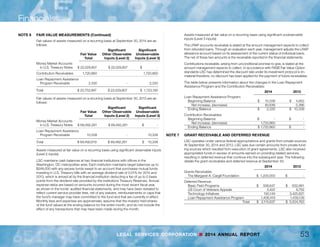
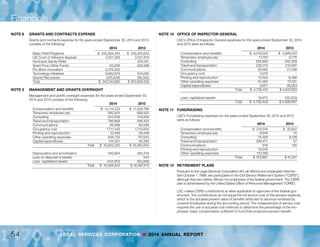
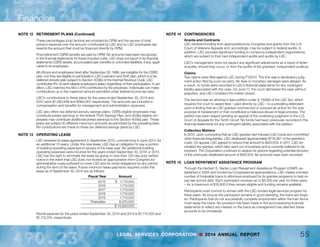
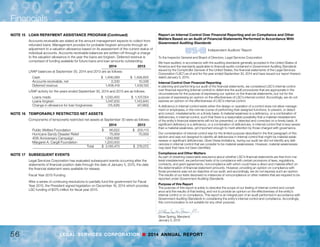
REPORT2014
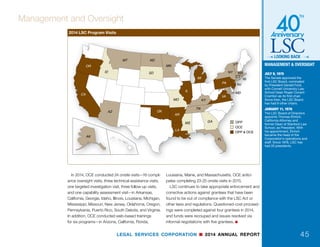
Legal Services Corporation
America’s Partner For Equal Justice
LEGAL SERVICES CORPORATION n 2014 ANNUAL REPORT
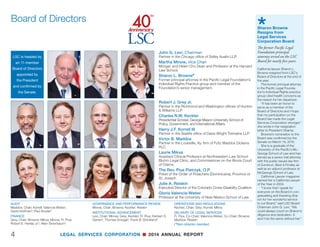
Board of Directors
John G. Levi, Chairman
Martha Minow, Vice Chair
Robert J. Grey Jr.
Charles N.W. Keckler
Harry J.F. Korrell III
Victor B. Maddox
Laurie Mikva
The Rev. Pius Pietrzyk, O.P.
Julie A. Reiskin
Gloria Valencia-Weber
Officers
James J. Sandman, President
Ronald Flagg, General Counsel, Corporate
	 Secretary and Vice President of Legal Affairs
Lynn A. Jennings, Vice President for Grants
	Management
David L. Richardson, Teasurer and Comptroller
Inspector General
Jeffrey E. Schanz, Inspector General
LSC Board of Directors & Officers
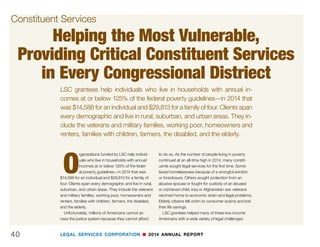
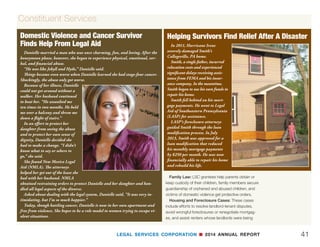
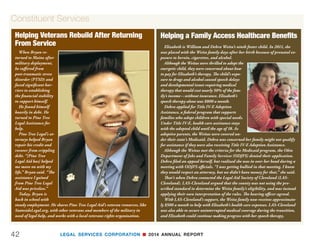
The Legal Services Corporation is the single largest
funder of civil legal services in the country and plays
a vital role in a public-private partnership focused on
fulfilling America’s pledge of equal justice for all. Since
its founding four decades ago, LSC has been making
a difference in the lives of low-income Americans by funding high-quality civil legal
assistance to veterans, the elderly, victims of domestic abuse, tenants facing un-
lawful evictions, and others who cannot afford to pay for legal assistance.
“The Congress finds and declares that—
(1) there is a need to provide equal access to the system of justice in our Nation for
individuals who seek redress of grievances;
(2) there is a need to provide high quality legal assistance to those who would be
otherwise unable to afford adequate legal counsel and to continue the present
vital legal services program;
(3) providing legal assistance to those who face an economic barrier to adequate legal
counsel will serve best the ends of justice and assist in improving opportunities for
low-income persons consistent with the purposes of this Act.”
—Excerpt from the Legal Services Corporation Act
Public Law 93-355, July 25, 1974
LEGAL SERVICES CORPORATION n 2014 ANNUAL REPORT
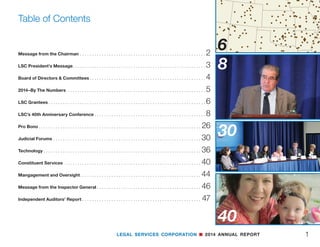
Message from the Chairman  . . . . . . . . . . . . . . . . . . . . . . . . . . . . . . . . . . . . . . . . . . . . . . . . . . .  2
LSC President’s Message . . . . . . . . . . . . . . . . . . . . . . . . . . . . . . . . . . . . . . . . . . . . . . . . . . . . . .  3
Board of Directors  Committees  . . . . . . . . . . . . . . . . . . . . . . . . . . . . . . . . . . . . . . . . . . . . . . .  4
2014–By The Numbers . . . . . . . . . . . . . . . . . . . . . . . . . . . . . . . . . . . . . . . . . . . . . . . . . . . . . . . . .  5
LSC Grantees  . . . . . . . . . . . . . . . . . . . . . . . . . . . . . . . . . . . . . . . . . . . . . . . . . . . . . . . . . . . . . . . .  6
LSC’s 40th Anniversary Conference  . . . . . . . . . . . . . . . . . . . . . . . . . . . . . . . . . . . . . . . . . . . . .  8
Pro Bono  . . . . . . . . . . . . . . . . . . . . . . . . . . . . . . . . . . . . . . . . . . . . . . . . . . . . . . . . . . . . . . . . . . . 26
Judicial Forums . . . . . . . . . . . . . . . . . . . . . . . . . . . . . . . . . . . . . . . . . . . . . . . . . . . . . . . . . . . . . . 30
Technology  . . . . . . . . . . . . . . . . . . . . . . . . . . . . . . . . . . . . . . . . . . . . . . . . . . . . . . . . . . . . . . . . . 36
Constituent Services  . . . . . . . . . . . . . . . . . . . . . . . . . . . . . . . . . . . . . . . . . . . . . . . . . . . . . . . . . 40
Mangagement and Oversight . . . . . . . . . . . . . . . . . . . . . . . . . . . . . . . . . . . . . . . . . . . . . . . . . . 44
Message from the Inspector General  . . . . . . . . . . . . . . . . . . . . . . . . . . . . . . . . . . . . . . . . . . . 46
Independent Auditors’ Report . . . . . . . . . . . . . . . . . . . . . . . . . . . . . . . . . . . . . . . . . . . . . . . . . 47
Table of Contents
1
6
8
30
40
LEGAL SERVICES CORPORATION n 2014 ANNUAL REPORT
This was a particularly significant year for LSC, the 40th anniversary of our founding.
Created in 1974 as one of the last acts of the Nixon administration, LSC has enjoyed
four decades of bipartisan congressional support in its mission to help expand access to
civil justice for low-income Americans.
We are grateful for that support, but facing enormous unmet need for legal services for
the poor all across the country, we require more support—much more. Throughout the
year, LSC has used this anniversary observance to help raise public awareness of
this crisis in civil legal aid and LSC’s important role in addressing it.
In September, LSC convened a three-day conference in Washington featuring
Vice President Joe Biden, former Secretary of State and former LSC Board Chair
Hillary Clinton, U.S. Supreme Court Justices Elena Kagan and Antonin Scalia, for-
mer Attorney General Eric Holder and ABA President William Hubbard. They joined
more than 100 distinguished panelists and speakers from the legal community,
government, and the private sector in wide ranging discussions of the status and
future of civil legal aid in America.
A month later in New York City, LSC continued this commemoration with
an event featuring Congressman Jerry Nadler (NY-10th), CBS Vice Chair Shari
Redstone, and the deans of three distinguished New York law schools. Leaders from the
city’s legal, legal aid, and business communities also took part in discussions of ways to
increase pro bono services and access to justice in their sectors.
In addition to raising public awareness through such events, LSC also launched the
40th Anniversary Campaign for Justice, a targeted, private fundraising effort to try to ex-
pand access to justice through technology, fellowships, leadership development, collab-
orations with public libraries and research, but in a broader sense, it will help LSC and its
grantees better tell their story.
As we marked LSC’s significant history and chartered news paths for the future, we also
took stock of the many challenges that remain, some even more daunting than when LSC
was formed.
In 1976, LSC’s first year of full congressional funding when the percent of the population
eligible for LSC-funded legal assistance stood at 12%, the fledgling LSC was allocated by
Congress, in inflation-adjusted terms, more than $468 million, rising three years later to its
all-time high of what today would be more than $880 million.
Despite our best efforts, the FY 2015 allocation of $375 million is less than half of that.
Even 10 years ago, LSC’s actual funding was $400 million.
Since then, as LSC funding has been reduced and remained low, the population el-
igible for LSC-funded assistance has grown to all-time highs. In 2013, the most recent
year for which U.S. Census Bureau data are available, 63.6 million people—one in five
Americans—had annual incomes below the threshold for LSC-funded legal assistance
of 125% of the federal poverty line. Another 32.4 million people had incomes below that
level for at least two consecutive months during the year and thus were eligible for our
assistance. In other words, nearly one in three Americans—96 million people—qualified for
LSC-funded services at some time during 2013—a staggering figure.
Not surprisingly, our grantees and other providers cannot keep up with this
demand and are being forced to turn away scores of low-income Americans
who are fighting to avert unlawful foreclosure, escape domestic violence, secure
veterans’ benefits, or address many other legal challenges that go to the heart of
their security and well-being.
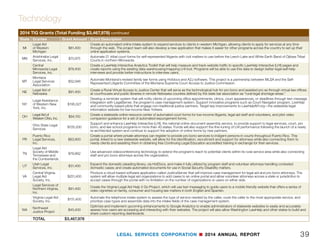
LSC has been attempting to address this problem through innovative technol-
ogy and pro bono programs to help stretch every dollar as far as it can possibly
go. But as Justice Elena Kagan observed at LSC’s conference in Washington,
what civil legal aid really needs is “more money.”
LSC funding is just a rounding error in the federal budget even though the val-
ues we are entrusted to uphold are anything but a fiscal afterthought.
As Justice Antonin Scalia powerfully observed at the September conference, there can-
not be true justice without equal access.
“The American ideal is not for some justice, it is as the Pledge of Allegiance says,
‘Liberty and justice for all,’ or as the Supreme Court pediment has it, ‘equal justice.’ I’ve al-
ways thought that’s somewhat redundant. Can there be justice if it is not equal? Can there
be a just society when some do not have justice? Equality, equal treatment is perhaps the
most fundamental element of justice.”
The protection of this basic American ideal has been central to LSC’s mission since its
founding. And as we move to the conclusion of our recognition of this anniversary year, we
will strive to keep faith with LSC’s founding mission to help “provide equal access to the
system of justice in our nation” and “to provide high quality legal assistance to those who
would be otherwise unable to afford adequate legal counsel.”
John G. Levi
Chairman, LSC Board of Directors
July 16, 2015
Message from the Chairman
JOHN G. LEVI
2
Raising Public Awareness as We Marked Our 40th Anniversary
LEGAL SERVICES CORPORATION n 2014 ANNUAL REPORT 3
LSC observed its 40th anniversary in 2014, and while we highlighted the significant
accomplishments of our first four decades in a variety of ways, LSC and its grantees also
took important steps to chart a course for the future.
LSC broadened its commitment to promoting pro bono support for civil legal aid with
the inauguration of the Pro Bono Innovation Fund. LSC’s Pro Bono Task Force recom-
mended the creation of the fund in 2012, and Congress allocated $2.5 million for it in its
FY 2014 budget.
With these funds, LSC established a new competitive grant project modeled
on our successful Technology Initiative Grants (TIG) program. LSC received 79
applications from 41 states, 58% of LSC’s grantees submitted applications or
were involved as partners in proposed projects, and the average request was
$196,000. LSC awarded 11 grants to support a variety of innovative projects,
including using legal aid technology to reach rural populations and creating ex-
tensive pro bono partnerships with local law schools, community organizations,
and corporate attorneys. At year’s end, I was especially pleased that Congress
increased the appropriation for the Pro Bono Innovation Fund by 60%, to $4 mil-
lion, in its FY 2015 budget.
LSC also established the Midwest Legal Disaster Coordination Fund to sup-
port the development of coordinated plans between disaster preparedness organizations
and legal service providers in Midwestern states. Two legal aid providers received grants
from the privately funded project:
• Iowa Legal Aid will use a $367,700 grant to develop mobile technology to help disas-
ter survivors better reach legal aid programs after a disaster occurs and to create a
multi-component toolkit for use by other legal aid organizations across the country.
• Legal Aid of Nebraska will use a $400,000 grant to create an interactive web portal
and a statewide legal disaster response training program for attorneys and others to
improve Nebraskans’ access to free legal services when disaster strikes.
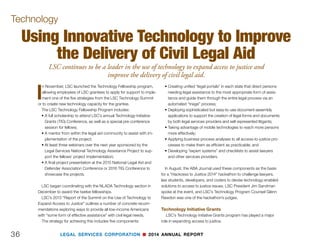
In November, LSC launched yet another new initiative—the Technology Fellowship pro-
gram, which allows employees of LSC grantees to apply for support to implement one of
the five strategies from the LSC Technology Summit or new technology capacities for the
grantee program.
Fellows receive a full scholarship to attend the annual TIG Conference, as well as a
special pre-conference session for fellows; a mentor from within the legal aid communi-
ty to assist with the implementation of the project; and at least three webinars
sponsored by the Legal Services National Technology Assistance Project to
support the fellows in their project implementation.
LSC also improved oversight and accountability by adding staff in the Office
of Compliance and Enforcement and the Office of Program Performance
and by increasing the number of grantee visits. Important recognition of
LSC’s improved management came during the year when the Government
Accountability Office informed us that it had closed out the last of the 17 recom-
mendations in its 2010 report on LSC.
In recognizing these new programs and accomplishments, I do not want to
overlook our most important allies in pursuing our mission—the legal aid law-
yers of the programs we fund.
The lowest paid attorneys in the profession, they labor day in and day out with crush-
ing caseloads to breathe life into America’s promise of justice and to serve the highest
ideals of our profession and our nation.
Supporting the vital work of these lawyers continues to be a highlight of my career.
James J. Sandman
LSC President
July 16, 2015
LSC President’s Message
JAMES J. SANDMAN
LSC Launches New Pro Bono, Disaster Relief, and Technology Initiatives
LEGAL SERVICES CORPORATION n 2014 ANNUAL REPORT4
Board of Directors
John G. Levi, Chairman
Partner in the Chicago office of Sidley Austin LLP.
Martha Minow, Vice Chair
Morgan and Helen Chu Dean and Professor at the Harvard
Law School.
Sharon L. Browne*
Former principal attorney in the Pacific Legal Foundation’s
Individual Rights Practice group and member of the
Foundation’s senior management.
Robert J. Grey Jr.
Partner in the Richmond and Washington offices of Hunton
 Williams LLP.
Charles N.W. Keckler
Presidential Scholar, George Mason University School of
Policy, Government, and International Affairs.
Harry J.F. Korrell III
Partner in the Seattle office of Davis Wright Tremaine LLP.
Victor B. Maddox
Partner in the Louisville, Ky. firm of Fultz Maddox Dickens
PLC.
Laurie Mikva
Assistant Clinical Professor at Northwestern Law School
Bluhm Legal Clinic, and Commissioner on the Illinois Court
of Claims.
The Rev. Pius Pietrzyk, O.P.
Priest of the Order of Preachers (Dominicans), Province of
St. Joseph.
Julie A. Reiskin
Executive Director of the Colorado Cross-Disability Coalition.
Gloria Valencia-Weber
Professor at the University of New Mexico School of Law.
AUDIT
Maddox, Chair; Korrell; Valencia-Weber;
David Hoffman*; Paul Snyder*
FINANCE
Grey, Chair; Browne; Mikva; Minow; Fr. Pius;
Robert E. Henley Jr.*; Allan Tanenbaum*
GOVERNANCE AND PERFORMANCE REVIEW
Minow, Chair; Browne; Keckler; Reiskin
INSTITUTIONAL ADVANCEMENT
Levi, Chair; Minow; Grey; Keckler; Fr. Pius; Herbert S.
Garten*; Thomas Smegal*; Frank B. Strickland*
OPERATIONS AND REGULATIONS
Keckler, Chair; Grey; Korrell; Mikva
DELIVERY OF LEGAL SERVICES
Fr. Pius, Co-Chair; Valencia-Weber, Co-Chair; Browne;
Maddox; Reiskin
(*Non-director member)
LSC is headed by
an 11-member
Board of Directors
appointed by
the President
and confirmed by
the Senate.
Sharon Browne
Resigns from
Legal Services
Corporation Board
The former Pacific Legal
Foundation principal
attorney served on the LSC
Board for nearly five years.
California lawyer Sharon L.
Browne resigned from LSC’s
Board of Directors at the end of
the year.
	 The former principal attorney
in the Pacific Legal Founda-
tion’s Individual Rights practice
group cited health concerns as
the reason for her departure.
	 “It has been an honor to
serve as a member of the
Board of Directors and I hope
that my participation on the
Board has made the Legal
Services Corporation stronger,”
she wrote in her resignation
letter to President Obama.
	 Browne’s nomination to the
Board was confirmed by the
Senate on March 19, 2010.
	 She is a graduate of the
University of the Pacific’s Mc-
George School of Law and has
served as a senior trial attorney
with the public issues law firm
of Zumbrun, Best  Findley as
well as an adjunct professor at
McGeorge School of Law.
	 California Lawyer magazine
named her a California Lawyer
of the Year in 2004.
	 “I know that I speak for
everyone on the Board in con-
gratulating and thanking Sha-
ron for her wonderful service
to our Board,” said LSC Board
Chairman John G. Levi. “We
could always count on Sharon’s
diligence and dedication. It
won’t be the same without her.”
*
LEGAL SERVICES CORPORATION n 2014 ANNUAL REPORT 5
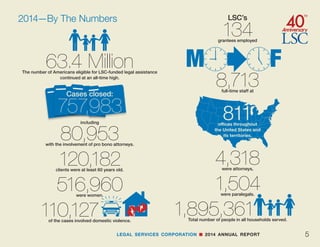
2014—By The Numbers LSC’s
134grantees employed
8,713full-time staff at
811offices throughout
the United States and
its territories.
4,318were attorneys,
1,504were paralegals.
	1,895,361Total number of people in all households served.
63.4 MillionThe number of Americans eligible for LSC-funded legal assistance
continued at an all-time high.
Cases closed:
757,983
including
80,953with the involvement of pro bono attorneys.
120,182clients were at least 60 years old.
516,960were women.
			110,127of the cases involved domestic violence.
¶M F
LEGAL SERVICES CORPORATION n 2014 ANNUAL REPORT
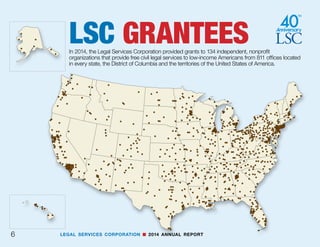
LSC GRANTEESIn 2014, the Legal Services Corporation provided grants to 134 independent, nonprofit
organizations that provide free civil legal services to low-income Americans from 811 offices located
in every state, the District of Columbia and the territories of the United States of America.
LEGAL SERVICES CORPORATION n 2014 ANNUAL REPORT6
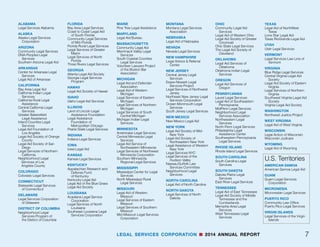
FLORIDA
Bay Area Legal Services
Coast to Coast Legal Aid
	 of South Florida
Community Legal Services
	 of Mid-Florida
Florida Rural Legal Services
Legal Services of Greater
	Miami
Legal Services of North
	Florida
Three Rivers Legal Services
GEORGIA
Atlanta Legal Aid Society
Georgia Legal Services
	Program
HAWAII
Legal Aid Society of Hawaii
IDAHO
Idaho Legal Aid Services
ILLINOIS
Land of Lincoln Legal
	 Assistance Foundation
Legal Assistance
	 Foundation of
	 Metropolitan Chicago
Prairie State Legal Services
INDIANA
Indiana Legal Services
IOWA
Iowa Legal Aid
KANSAS
Kansas Legal Services
KENTUCKY
Appalachian Research and
	 Defense Fund
	 of Kentucky
Kentucky Legal Aid
Legal Aid of the Blue Grass
Legal Aid Society
LOUISIANA
Acadiana Legal Service
	Corporation
Legal Services of North
	Louisiana
Southeast Louisiana Legal
	 Services Corporation
MAINE
Pine Tree Legal Assistance
MARYLAND
Legal Aid Bureau
MASSACHUSETTS
Community Legal Aid
Merrimack Valley Legal
	Services
South Coastal Counties
	 Legal Services
Volunteer Lawyers Project
	 of the Boston Bar
	Association
MICHIGAN
Legal Aid and Defender
	Association
Legal Aid of Western
	Michigan
Legal Services of Eastern
	Michigan
Legal Services of Northern
	Michigan
Legal Services of South
	 Central Michigan
Michigan Indian Legal
	Services
MINNESOTA
Anishinabe Legal Services
Central Minnesota Legal
	Services
Legal Aid Service of
	 Northeastern Minnesota
Legal Services of Northwest
	 Minnesota Corporation
Southern Minnesota
	 Regional Legal Services
MISSISSIPPI
Mississippi Center for Legal
	Services
North Mississippi Rural
	 Legal Services
MISSOURI
Legal Aid of Western
	Missouri
Legal Services of Eastern
	Missouri
Legal Services of Southern
	Missouri
Mid-Missouri Legal Services
	Corporation
MONTANA
Montana Legal Services
	Association
NEBRASKA
Legal Aid of Nebraska
NEVADA
Nevada Legal Services
NEW HAMPSHIRE
Legal Advice  Referral
	Center
NEW JERSEY
Central Jersey Legal
	Services
Essex-Newark Legal
	 Services Project
Legal Services of Northwest
	Jersey
Northeast New Jersey Legal
	 Services Corporation
Ocean-Monmouth Legal
	Services
South Jersey Legal Services
NEW MEXICO
New Mexico Legal Aid
NEW YORK
Legal Aid Society of Mid-
	 New York
Legal Aid Society of
	 Northeastern New York
Legal Assistance of Western
	 New York
Legal Services NYC
Legal Services of the
	 Hudson Valley
Nassau/Suffolk Law
	 Services Committee
Neighborhood Legal
	Services
NORTH CAROLINA
Legal Aid of North Carolina
NORTH DAKOTA
Legal Services of North
	Dakota
OHIO
Community Legal Aid
	Services
Legal Aid of Western Ohio
Legal Aid Society of Greater
	Cincinnati
Ohio State Legal Services
The Legal Aid Society of
	Cleveland
OKLAHOMA
Legal Aid Services of
	Oklahoma
Oklahoma Indian Legal
	Services
OREGON
Legal Aid Services of
	Oregon
PENNSYLVANIA
Laurel Legal Services
Legal Aid of Southeastern
	Pennsylvania
MidPenn Legal Services
Neighborhood Legal
	 Services Association
Northwestern Legal
	Services
North Penn Legal Services
Philadelphia Legal
	 Assistance Center
Southwestern Pennsylvania
	 Legal Services
RHODE ISLAND
Rhode Island Legal Services
SOUTH CAROLINA
South Carolina Legal
	Services
SOUTH DAKOTA
Dakota Plains Legal
	Services
East River Legal Services
TENNESSEE
Legal Aid of East Tennessee
Legal Aid Society of Middle
	 Tennessee and the
	Cumberlands
Memphis Area Legal
	Services
West Tennessee Legal
	Services
TEXAS
Legal Aid of NorthWest
	Texas
Lone Star Legal Aid
Texas RioGrande Legal Aid
UTAH
Utah Legal Services
VERMONT
Legal Services Law Line of
	Vermont
VIRGINIA
Blue Ridge Legal Services
Central Virginia Legal Aid
	Society
Legal Aid Society of Eastern
	Virginia
Legal Services of Northern
	Virginia
Southwest Virginia Legal Aid
	Society
Virginia Legal Aid Society
WASHINGTON
Northwest Justice Project
WEST VIRGINIA
Legal Aid of West Virginia
WISCONSIN
Legal Action of Wisconsin
Wisconsin Judicare
WYOMING
Legal Aid of Wyoming
U.S. Territories
AMERICAN SAMOA
American Samoa Legal Aid
GUAM
Guam Legal Services
	Corporation
MICRONESIA
Micronesian Legal Services
PUERTO RICO
Community Law Office
Puerto Rico Legal Services
VIRGIN ISLANDS
Legal Services of the Virgin
	Islands
ALABAMA
Legal Services Alabama
ALASKA
Alaska Legal Services
	Corporation
ARIZONA
Community Legal Services
DNA-Peoples Legal
	Services
Southern Arizona Legal Aid
ARKANSAS
Center for Arkansas Legal
	Services
Legal Aid of Arkansas
CALIFORNIA
Bay Area Legal Aid
California Indian Legal
	Services
California Rural Legal
	Assistance
Central California Legal
	Services
Greater Bakersfield
	 Legal Assistance
Inland Counties Legal
	Services
Legal Aid Foundation of
	 Los Angeles
Legal Aid Society of Orange
	County
Legal Aid Society of San
	Diego
Legal Services of Northern
	California
Neighborhood Legal
	Services of Los
Angeles County
COLORADO
Colorado Legal Services
CONNECTICUT
Statewide Legal Services
	 of Connecticut
DELAWARE
Legal Services Corporation
	 of Delaware
DISTRICT OF COLUMBIA
Neighborhood Legal
	 Services Program of
	 the District of Columbia
LEGAL SERVICES CORPORATION n 2014 ANNUAL REPORT 7
8 LEGAL SERVICES CORPORATION n 2014 ANNUAL REPORT
LSC Marks
40th Anniversary
with Public
Events,
Fundraising
Campaign
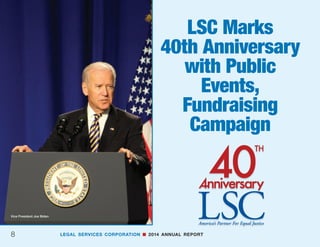
Vice President Joe Biden
LEGAL SERVICES CORPORATION n 2014 ANNUAL REPORT 9
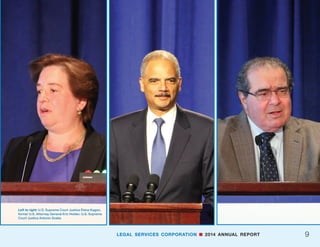
Left to right: U.S. Supreme Court Justice Elena Kagan;
former U.S. Attorney General Eric Holder; U.S. Supreme
Court Justice Antonin Scalia
LEGAL SERVICES CORPORATION n 2014 ANNUAL REPORT
I
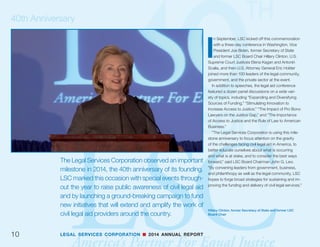
n September, LSC kicked off this commemoration
with a three-day conference in Washington. Vice
President Joe Biden, former Secretary of State
and former LSC Board Chair Hillary Clinton, U.S.
Supreme Court Justices Elena Kagan and Antonin
Scalia, and then-U.S. Attorney General Eric Holder
joined more than 100 leaders of the legal community,
government, and the private sector at the event.
In addition to speeches, the legal aid conference
featured a dozen panel discussions on a wide vari-
ety of topics, including “Expanding and Diversifying
Sources of Funding,” “Stimulating Innovation to
Increase Access to Justice,” “The Impact of Pro Bono
Lawyers on the Justice Gap,” and “The Importance
of Access to Justice and the Rule of Law to American
Business.”
“The Legal Services Corporation is using this mile-
stone anniversary to focus attention on the gravity
of the challenges facing civil legal aid in America, to
better educate ourselves about what is occurring
and what is at stake, and to consider the best ways
forward,” said LSC Board Chairman John G. Levi.
“By convening leaders from government, business,
and philanthropy as well as the legal community, LSC
hopes to forge broad strategies for sustaining and im-
proving the funding and delivery of civil legal services.”
The Legal Services Corporation observed an important
milestone in 2014, the 40th anniversary of its founding.
LSC marked this occasion with special events through-
out the year to raise public awareness of civil legal aid
and by launching a ground-breaking campaign to fund
new initiatives that will extend and amplify the work of
civil legal aid providers around the country.
40th Anniversary
10
Hillary Clinton, former Secretary of State and former LSC
Board Chair
LEGAL SERVICES CORPORATION n 2014 ANNUAL REPORT
40th Anniversary
11
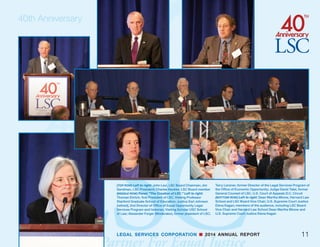
(TOP ROW) Left to right: John Levi, LSC Board Chairman; Jim
Sandman, LSC President; Charles Keckler, LSC Board member
(MIDDLE ROW) Panel: “The Creation of LSC.” Left to right:
Thomas Ehrlich, first President of LSC, Visiting Professor
Stanford Graduate School of Education; Justice Earl Johnson
(retired), 2nd Director of Office of Equal Opportunity Legal
Services Program and historian, Visiting Scholar USC School
of Law; Alexander Forger (Moderator), former president of LSC;
Terry Lenzner, former Director of the Legal Services Program of
the Office of Economic Opportunity; Judge David Tatel, former
General Counsel of LSC, U.S. Court of Appeals D.C. Circuit
(BOTTOM ROW) Left to right: Dean Martha Minow, Harvard Law
School and LSC Board Vice Chair; U.S. Supreme Court Justice
Elena Kagan; members of the audience, including LSC Board
Vice Chair and Harvard Law School Dean Martha Minow and
U.S. Supreme Court Justice Elena Kagan
40th Anniversary
12
Although speakers and panels explored a variety
of topics, there was general agreement across the
board and the political spectrum that equal access
to justice is a core American value that must be
preserved. As Hillary Clinton, LSC’s second Board
Chair, observed:
“Guaranteeing legal services for all Americans
makes us a better country and a fairer country. It
helps by empowering people to solve those prob-
lems and it helps to level the playing field. It is not
just a fair shot at the justice system, but it is a fair
shot at the American dream.”
Justice Antonin Scalia echoed that theme in his
remarks:
“The American ideal is not for some justice, it is
as the Pledge of Allegiance says, ‘Liberty and jus-
tice for all,’ or as the Supreme Court pediment has
it, ‘equal justice.’ I’ve always thought that’s some-
what redundant. Can there be justice if it is not
equal? Can there be a just society when some do
not have justice? Equality, equal treatment is per-
haps the most fundamental element of justice.”
The event was intended in part to raise public
awareness of the justice gap and ways to narrow it,
which Texas Supreme Court Chief Justice Nathan
Hecht said was crucial:
LEGAL SERVICES CORPORATION n 2014 ANNUAL REPORT
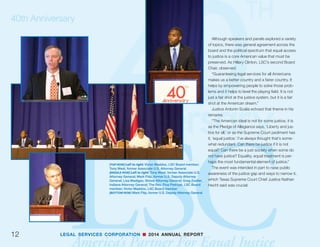
(TOP ROW) Left to right: Victor Maddox, LSC Board member;
Tony West, former Associate U.S. Attorney General
(MIDDLE ROW) Left to right: Tony West, former Associate U.S.
Attorney General; Mark Filip, former U.S. Deputy Attorney
General; Lisa Madigan, Illinois Attorney General; Greg Zoeller,
Indiana Attorney General; The Rev. Pius Pietrzyk, LSC Board
member; Victor Maddox, LSC Board member
(BOTTOM ROW) Mark Filip, former U.S. Deputy Attorney General
40th Anniversary
“We hope that justice has few enemies. Most of
what we struggle with, I don’t think is opposition to
justice, but ignorance of what is going on. It is im-
portant for us in our communications with legislators,
who provide public support, and others to put a face
on the problem. To say, as specifically as we can, this
is what we are doing, these are the lives who were
changed, this is why a difference is being made.”
Speakers from both sides of the aisle noted that the
creation of LSC was a bipartisan effort. “When LSC was
created and started, it was never a partisan division,”
said Maryland Senator Ben Cardin. “It wasn’t even a
philosophical division in our country over the basic core
value of America, our rule of law and justice.”
President George W. Bush’s former White House
Counsel and Locke Lord partner Harriet Miers said
LSC deserves bipartisan support now:
“We’ve seen a dramatic turnaround—I hope you
have—in the views of some who used to be opposed
to legal services, but now because they have heard
from and been approached by people that they
trust, that they respect and admire, their views have
changed. Legal Services, as we know, deserves non-
partisan and bipartisan support because it has proven
itself, and LSC is consistent with the principles upon
which this country was founded.”
The participation of CEOs such as David
Rubenstein of the Carlyle Group, Ken Frazier of
Merck, and Arne Sorenson of Marriott International
13LEGAL SERVICES CORPORATION n 2014 ANNUAL REPORT
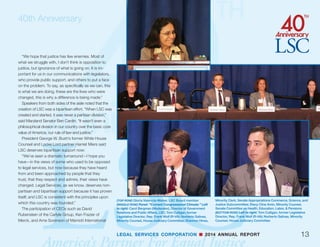
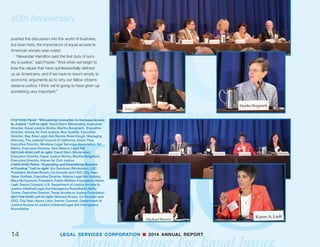
(TOP ROW) Gloria Valencia-Weber, LSC Board member
(MIDDLE ROW) Panel: “Current Congressional Climate.” Left
to right: Carol Bergman (Moderator), Director of Government
Relations and Public Affairs, LSC; Tom Culligan, former
Legislative Director, Rep. Frank Wolf (R-VA); Norberto Salinas,
Minority Counsel, House Judiciary Committee; Shannon Hines,
Minority Clerk, Senate Appropriations Commerce, Science, and
Justice Subcommittee; Stacy Cline Amin, Minority Counsel,
Senate Committee on Health, Education, Labor,  Pensions
(BOTTOM ROW) Left to right: Tom Culligan, former Legislative
Director, Rep. Frank Wolf (R-VA); Norberto Salinas, Minority
Counsel, House Judiciary Committee
40th Anniversary
pushed the discussion into the world of business,
but even here, the importance of equal access to
American society was noted:
“Alexander Hamilton said the first duty of soci-
ety is justice,” said Frazier. “And when we begin to
lose the values that have quintessentially defined
us as Americans, and if we have to resort simply to
economic arguments as to why our fellow citizens
deserve justice, I think we’re going to have given up
something very important.”
14 LEGAL SERVICES CORPORATION n 2014 ANNUAL REPORT
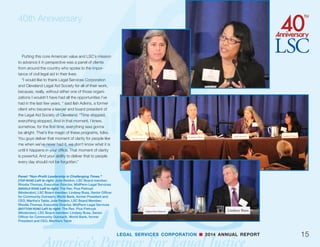
(TOP ROW) Panel: “Stimulating Innovation to Increase Access
to Justice.” Left to right: David Stern (Moderator), Executive
Director, Equal Justice Works; Martha Bergmark, Executive
Director, Voices for Civil Justice; Alex Gulotta, Executive
Director, Bay Area Legal Aid; Bonnie Rose Hough, Managing
Attorney, The Judicial Council of California; Alison Paul,
Executive Director, Montana Legal Services Association; Ed
Marks, Executive Director, New Mexico Legal Aid
(SECOND ROW) Left to right: David Stern (Moderator),
Executive Director, Equal Justice Works; Martha Bergmark,
Executive Director, Voices for Civil Justice
(THIRD ROW) Panel: “Expanding and Diversifying Sources
of Funding.” Left to right: Jim Sandman (Moderator), LSC
President; Michael Brown, Co-founder and CEO, City Year;
Steve Gottlieb, Executive Director, Atlanta Legal Aid Society;
Mary McClymont, President, Public Welfare Foundation; Karen
Lash, Senior Counsel, U.S. Department of Justice Access to
Justice Initiative/Legal Aid Interagency Roundtable; Betty
Torres, Executive Director, Texas Access to Justice Foundation
(BOTTOM ROW) Left to right: Michael Brown, Co-founder and
CEO, City Year; Karen Lash, Senior Counsel, Department of
Justice Access to Justice Initiative/Legal Aid Interagency
Roundtable
40th Anniversary
15LEGAL SERVICES CORPORATION n 2014 ANNUAL REPORT
Putting this core American value and LSC’s mission
to advance it in perspective was a panel of clients
from around the country who spoke to the impor-
tance of civil legal aid in their lives:
“I would like to thank Legal Services Corporation
and Cleveland Legal Aid Society for all of their work,
because, really, without either one of those organi-
zations I wouldn’t have had all the opportunities I’ve
had in the last few years, “ said Ilah Adkins, a former
client who became a lawyer and board president of
the Legal Aid Society of Cleveland. “Time stopped,
everything stopped. And in that moment, I knew,
somehow, for the first time, everything was gonna
be alright. That’s the magic of these programs, folks.
You guys deliver that moment of clarity for people like
me when we’ve never had it, we don’t know what it is
until it happens in your office. That moment of clarity
is powerful. And your ability to deliver that to people
every day should not be forgotten.”
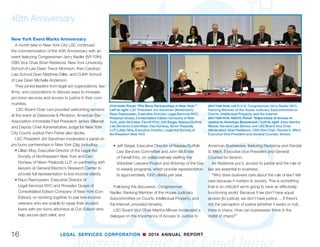
Panel: “Non-Profit Leadership in Challenging Times.”
(TOP ROW) Left to right: Julie Reiskin, LSC Board member;
Rhodia Thomas, Executive Director, MidPenn Legal Services
(MIDDLE ROW) Left to right: The Rev. Pius Pietrzyk
(Moderator), LSC Board member; Lindsey Buss, Senior Officer
for Community Outreach, World Bank, former President and
CEO, Martha’s Table; Julie Reiskin, LSC Board Member;
Rhodia Thomas, Executive Director, MidPenn Legal Services
(BOTTOM ROW) Left to right: The Rev. Pius Pietrzyk
(Moderator), LSC Board member; Lindsey Buss, Senior
Officer for Community Outreach, World Bank, former
President and CEO, Martha’s Table
LEGAL SERVICES CORPORATION n 2014 ANNUAL REPORT
• Jeff Seigel, Executive Director of Nassau/Suffolk
Law Services Committee and John McEntee
of Farrell Fritz, on collaboratively staffing the
Volunteer Lawyers Project and Attorney of the Day
bi-weekly programs, which provide representation
to approximately 1000 clients per year.
Following the discussion, Congressman
Nadler, Ranking Member of the House Judiciary
Subcommittee on Courts, Intellectual Property, and
the Internet, provided remarks.
LSC Board Vice Chair Martha Minow moderated a
dialogue on the Importance of Access to Justice to
American Businesses, featuring Redstone and Randal
S. Milch, Executive Vice President and General
Counsel for Verizon.
As Redstone put it, access to justice and the rule of
law are essential to business:
“Why does business care about the rule of law? We
care because it matters to society. This is something
that is so critical if we’re going to have an effectively
functioning world. Because if we don’t have equal
access [to justice], we don’t have justice…. If there’s
not the perception of justice (whether it exists or not),
there is chaos. How can businesses thrive in the
midst of chaos?”
New York Event Marks Anniversary
A month later in New York City LSC continued
the commemoration of the 40th Anniversary with an
event featuring Congressman Jerry Nadler (NY-10th),
CBS Vice Chair Shari Redstone, New York University
School of Law Dean Trevor Morrison, then-Cardozo
Law School Dean Matthew Diller, and CUNY School
of Law Dean Michelle Anderson.
They joined leaders from legal aid organizations, law
firms, and corporations to discuss ways to increase
pro bono services and access to justice in their com-
munities.
LSC Board Chair Levi provided welcoming remarks
at the event at Debevoise  Plimpton. American Bar
Association immediate Past President James Silkenat
and Deputy Chief Administrative Judge for New York
City Courts Justice Fern Fisher also spoke.
LSC President Jim Sandman moderated a panel on
pro bono partnerships in New York City, including:
• Lillian Moy, Executive Director of the Legal Aid
Society of Northeastern New York and Dan
Hurteau of Nixon Peabody LLP, on partnering with
lawyers at General Electric’s Research Center to
provide full representation to low-income clients;
• Raun Rasmussen, Executive Director of
Legal Services NYC and Rossalyn Quaye of
Consolidated Edison Company of New York (Con
Edison), on working together to pair low-income
veterans who are unable to repay their student
loans with pro bono attorneys at Con Edison who
help secure debt relief; and
16
40th Anniversary
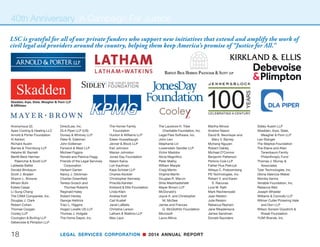
(TOP ROW) Panel: “Pro Bono Partnerships in New York.”
Left to right: LSC President Jim Sandman (Moderator);
Raun Rasmussen, Executive Director, Legal Services NYC;
Rossalyn Quaye, Consolidated Edison Company of New
York; John McEntee, Farrell Fritz; Jeff Seigel, Nassau/Suffolk
Law Services Committee; Dan Hurteau, Nixon Peabody
LLP; Lillian Moy, Executive Director, Legal Aid Society of
Northeastern New York
(BOTTOM ROW, LEFT) U.S. Congressman Jerry Nadler (NY),
Ranking Member of the House Judiciary Subcommittee on
Courts, Intellectual Property, and the Internet
(BOTTOM ROW, RIGHT): Panel: “Importance of Access to
Justice to American Businesses.” Left to right: Dean Martha
Minow, Harvard Law School, and LSC Board Vice Chair
(Moderator); Shari Redstone, CBS Vice Chair; Randal S. Milch,
Executive Vice President and General Counsel, Verizon
LEGAL SERVICES CORPORATION n 2014 ANNUAL REPORT 17
The 40th Anniversary
Campaign for Justice
In addition to public events,
LSC marked this milestone year
by launching a 40th anniversary
campaign to fund projects and programs that extend
the work of civil legal aid providers across the country.
The campaign focused on expanding access to jus-
tice through technology, fellowships, leadership devel-
opment, research, and public engagement.
Technology: The 40th Anniversary Campaign for
Justice is raising funds to build on and expand the
technological innovations that LSC has fostered over
the last 20 years to improve access to civil legal assis-
tance through integrated service delivery platforms,
expanding LSC’s technology innovation funds, and
innovation replication.
Fellowships: LSC plans to launch and support
three fellowship programs: a year-long program for 25
law school graduates to work in a civil legal aid pro-
gram; a rural legal summer corps for law students to
expand legal services in remote areas; and an emeri-
tus fellows program that will support the growth of pro
bono engagement in civil legal aid.
(TOP ROW) Left to right: Laurie Mikva, LSC Board member;
Harriett Miers, former White House Counsel
(MIDDLE ROW) Left to right: W. Neil Eggleston, White House
Counsel; Harriett Miers, former White House Counsel; Bob
Bauer, former White House Counsel
(BOTTOM ROW) Left to right: W. Neil Eggleston, White House
Counsel; Bob Bauer, former White House Counsel
40th Anniversary
continued on page 19
LEGAL SERVICES CORPORATION n 2014 ANNUAL REPORT18
Anonymous (2)
Apex Cooling  Heating LLC
Arnold  Porter Foundation
IV Ashton
Richard Austin
Barnes  Thornburg LLP
Helaine M. Barnett
Bartlit Beck Herman
	 Palenchar  Scott LLP
LaVeeda Battle
Donald Birnbaum
Scott J. Braden
Sharon L. Browne
Miriam Buhl
Estela Casas
Li-Sung Chang
The CIMA Companies, Inc.
Douglas J. Clark
Robert Cohen
Thomas Coogan
Cooley LLP
Covington  Burling LLP
Debevoise  Plimpton LLP
DirectLaw, Inc.
DLA Piper LLP (US)
Dorsey  Whitney LLP
Peter B. Edelman
John Eidleman
Fenwick  West LLP
Michael Figgins
Ronald and Patricia Flagg
Friends of the Legal Services
	Corporation
Herbert Garten
Nancy J. Glickman
Charles Greenfield
Teresa Grosch and
	 Thomas Roberts
Reginald Haley
Robert Henley
George Hettrick
Traci L. Higgins
Hogan Lovells US LLP
Thomas J. Holgate
The Home Depot, Inc.
The Horner Family
	Foundation
Hunton  Williams LLP
Eileen Husselbaugh
Jenner  Block LLP
Earl Johnson
Marian Johnston
Jones Day Foundation
Nalani Kaina
Lori Kaufman
Kaye Scholer LLP
Charles Keckler
Christopher Kennedy
Priscilla Kersten
Kirkland  Ellis Foundation
Linda Klein
Andrea Kott
Carl Kustell
Janet LaBella
Christine Larson
Latham  Watkins LLP
Max Laun
The Laurence H. Tribe
	 Charitable Foundation, Inc.
Legal Files Software, Inc.
John Levi
Stephanie Lin
Lowenstein Sandler LLP
Victor Maddox
Alicia Magnifico
Peter Malloy
William Marple
Craig Martin
Virginia Martin
Douglas R. Marvin
Shila Mashhadishafe
Mayer Brown LLP
McDonald’s
Joyce A. and Christopher
	 M. McGee
James and Frances
	 G. McGlothlin Foundation
Microsoft
Laura Mikva
Martha Minow
Andrew Nason
David B. Neumeyer and
	 Mary V. Barney
Mytrang Nguyen
Robert Oakley
Michael O’Connor
Benjamin Patterson
Perkins Coie LLP
Father Pius Pietrzyk
Atitaya C. Pratoomtong
PS Technologies, Inc.
Robert V. and Karen
	 S. Racunas
Lora M. Rath
Mark Recktenwald
Joan Reiskin
Julie Reiskin
Rebecca Reyhani
Jane Ribadeneyra
James Sandman
Donald Saunders
Sidley Austin LLP
Skadden, Arps, Slate,
	 Meagher  Flom LLP
Leo Stanger
The Steptoe Foundation
The Elaine and Allan
	 Tanenbaum Family
	 Philanthropic Fund
Thomas J. Murray 
	Associates
Tyler Technologies, Inc.
Gloria Valencia-Weber
Monika Varma
Venable Foundation, Inc.
Rebecca Weir
Joseph Wheeler
Williams  Connolly LLP
Wilmer Cutler Pickering Hale
	 and Dorr LLP
Wilson Sonsini Goodrich 
	 Rosati Foundation
YUM! Brands, Inc.
LSC is grateful for all of our private funders who support new initiatives that extend and amplify the work of
civil legal aid providers around the country, helping them keep America’s promise of “Justice for All.”
40th Anniversary: A Campaign For Justice
LEGAL SERVICES CORPORATION n 2014 ANNUAL REPORT
Leadership Development: Eighty percent of the
executive directors of LSC-funded civil legal aid pro-
grams have more than 30 years experience, and many
will retire in the coming years. LSC is offering training
and leadership development opportunities for new
and emerging leaders in nonprofit management, com-
pliance, fiscal management, and grants management.
Research and Public Engagement: The
Campaign for Justice capitalizes on LSC’s role as a
national convener by raising awareness of the crisis
in civil legal aid with new audiences and partners
through national and regional meetings and confer-
ences. In addition, as the largest network of civil legal
aid providers in the country, LSC is championing re-
search into the justice gap, technology, and evaluation
to expand access and to make investments that are
strategic and data-driven.
19
40th Anniversary
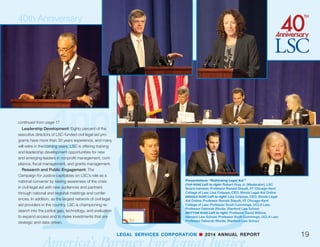
Presentations: “Rethinking Legal Aid.”
(TOP ROW) Left to right: Robert Grey Jr. (Moderator), LSC
Board member; Professor Ronald Staudt, IIT Chicago-Kent
College of Law; Lisa Colpoys, CEO, Illinois Legal Aid Online
(MIDDLE ROW) Left to right: Lisa Colpoys, CEO, Illinois Legal
Aid Online; Professor Ronald Staudt, IIT Chicago-Kent
College of Law; Professor Scott Cummings, UCLA Law;
Professor Deborah Rhode, Stanford Law School
(BOTTOM ROW) Left to right: Professor David Wilkins,
Harvard Law School; Professor Scott Cummings, UCLA Law;
Professor Deborah Rhode, Stanford Law School
continued from page 17
LEGAL SERVICES CORPORATION n 2014 ANNUAL REPORT
Disaster Response Grants
The Campaign for Justice also addressed other
needs, and through LSC’s Midwest Legal Disaster
Coordination Fund awarded Iowa Legal Aid and Legal
Aid of Nebraska grants to support projects that develop
coordinated plans between disaster preparedness or-
ganizations and legal service providers in the Midwest.
These grants, funded by a private donor, are in-
tended to help the legal aid organizations address the
need for civil legal aid in the aftermath of natural and
manmade disasters and integrate a legal component
for low-income individuals into statewide disaster pre-
paredness plans.
20
40th Anniversary
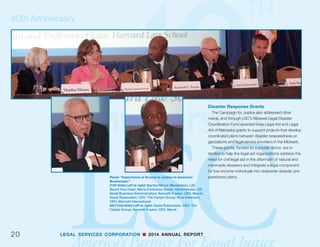
Panel: “Importance of Access to Justice to American
Businesses.”
(TOP ROW) Left to right: Martha Minow (Moderator), LSC
Board Vice Chair; Maria Contreras-Sweet, Administrator, US
Small Business Administration; Kenneth Frazier, CEO, Merck;
David Rubenstein, CEO, The Carlyle Group; Arne Sorenson,
CEO, Marriott International
(BOTTOM ROW) Left to right: David Rubenstein, CEO, The
Carlyle Group; Kenneth Frazier, CEO, Merck
LEGAL SERVICES CORPORATION n 2014 ANNUAL REPORT
“Disaster survivors can face years of legal repercus-
sions. They may need help replacing legal identifica-
tion papers, applying for disaster benefits, and dealing
with insurance claim issues,” said LSC President Jim
Sandman. “In addition, survivors often face a variety
of legal issues involving their housing – from prevent-
ing unlawful evictions and foreclosures to combating
contractor scams.”
The 2014 Midwest Legal/Disaster Coordination
Fund grants supported the following projects:
Iowa Legal Aid - $367,700 (20 months)
Using its extensive experience in disaster recovery,
Iowa Legal Aid will develop mobile technology to help
disaster survivors better reach legal aid programs
after a disaster occurs. Iowa Legal Aid will partner
with Pro Bono Net to adapt its mobile template for an
application that provides disaster-related resources
to clients and attorneys. In addition, Iowa Legal Aid
will create a multi-component toolkit for use by other
21
40th Anniversary
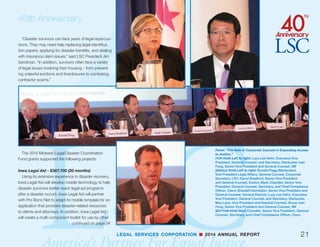
Panel: “The Role of Corporate Counsel in Expanding Access
to Justice.”
(TOP ROW) Left to right: Lucy Lee Helm, Executive Vice
President, General Counsel, and Secretary, Starbucks; Ivan
Fong, Senior Vice President and General Counsel, 3M
(MIDDLE ROW) Left to right: Ronald Flagg (Moderator),
Vice President Legal Affairs, General Counsel, Corporate
Secretary, LSC; Darryl Bradford, Senior Vice President
and General Counsel, Exelon; Mark Chandler, Senior Vice
President, General Counsel, Secretary, and Chief Compliance
Officer, Cisco; Brackett Denniston, Senior Vice President and
General Counsel, General Electric; Lucy Lee Helm, Executive
Vice President, General Counsel, and Secretary, Starbucks;
Max Laun, Vice President and General Counsel, Alcoa; Ivan
Fong, Senior Vice President and General Counsel, 3M
(BOTTOM ROW) Mark Chandler, Senior Vice President, General
Counsel, Secretary, and Chief Compliance Officer, Cisco
continued on page 24
LEGAL SERVICES CORPORATION n 2014 ANNUAL REPORT22
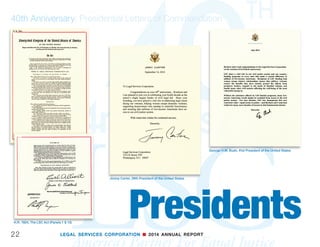
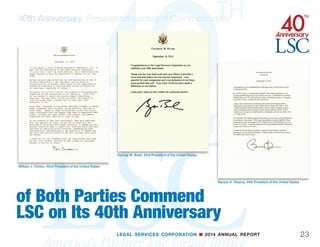
40th Anniversary: Presidential Letters of Commendation
PresidentsLEGAL SERVICES CORPORATION n 2014 ANNUAL REPORT
Jimmy Carter, 39th President of the United States
George H.W. Bush, 41st President of the United States
H.R. 7824, The LSC Act (Panels 1  13)
LEGAL SERVICES CORPORATION n 2014 ANNUAL REPORT 23
40th Anniversary: Presidential Letters of Commendation
of Both Parties Commend
LSC on Its 40th Anniversary
LEGAL SERVICES CORPORATION n 2014 ANNUAL REPORT
William J. Clinton, 42nd President of the United States
George W. Bush, 43rd President of the United States
Barack H. Obama, 44th President of the United States
LEGAL SERVICES CORPORATION n 2014 ANNUAL REPORT
legal aid organizations across the country. The toolkit
will help legal aid programs prepare in advance for
the legal responses often needed after disasters and
provide best practices for responding to a disaster, in-
cluding assisting with long-term recovery. The project
will help legal aid grantees cultivate relationships with
their statewide disaster recovery community and de-
velop training materials for legal and non-legal disaster
responders.
Legal Aid of Nebraska - $400,000 (20 months)
Legal Aid of Nebraska will create an interactive web
portal and a statewide legal disaster response training
program for attorneys and other stakeholders to bet-
ter prepare Nebraskans to access free legal services
when disaster strikes. Legal Aid of Nebraska will host
disaster preparedness workshops throughout the
state, and work closely with local pro bono attorneys
to provide free onsite legal aid services to disaster vic-
tims in afflicted areas. Legal Aid of Nebraska will also
leverage its experience with automated forms prepa-
ration and online guidance for people without legal
representation to be replicated in other regions. n
24
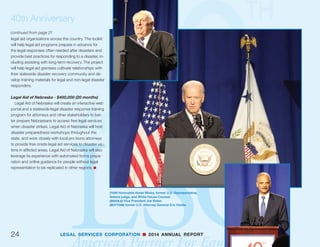
40th Anniversary
(TOP) Honorable Abner Mivka, former U.S. Representative,
federal judge, and White House Counsel
(MIDDLE) Vice President Joe Biden
(BOTTOM) former U.S. Attorney General Eric Holder
continued from page 21
25
40th Anniversary
LEGAL SERVICES CORPORATION n 2014 ANNUAL REPORT
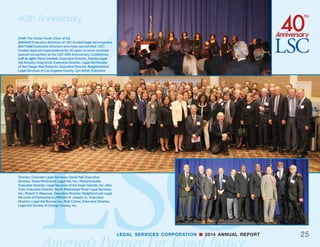
(TOP) The Urban Youth Choir of DC
(MIDDLE) Executive directors of LSC-funded legal aid programs
(BOTTOM) Executive directors who have served their LSC-
funded legal aid organizations for 40 years or more received
special recognition at the LSC 40th Anniversary Conference
Left to right: Steve Gottlieb, Executive Director, Atlanta Legal
Aid Society; Greg Knoll, Executive Director, Legal Aid Society
of San Diego; Neil Dudovitz, Executive Director, Neighborhood
Legal Services of Los Angeles County; Jon Asher, Executive
Director, Colorado Legal Services; David Hall, Executive
Director, Texas RioGrande Legal Aid, Inc.; Richard Austin,
Executive Director, Legal Services of the Virgin Islands, Inc.; Ben
Cole, Executive Director, North Mississippi Rural Legal Services,
Inc.; Robert V. Racunas, Executive Director, Neighborhood Legal
Services of Pennsylvania; Wilhelm H. Joseph Jr., Executive
Director, Legal Aid Bureau Inc.; Bob Cohen, Executive Director,
Legal Aid Society of Orange County, Inc.
LEGAL SERVICES CORPORATION n 2014 ANNUAL REPORT26
Pro Bono
Pro Bono Innovation Fund Bolsters
LSC’s Support for Private Bar Efforts
The inauguration of LSC’s Pro Bono Innovation Fund in 2014 enhanced
LSC’s efforts to promote and expand pro bono service by the private
bar. Congress appropriated $2.5 million for the fund in FY 2014, allowing
LSC to implement a new competitive grant program modeled on the
successful Technology Initiative Grants program.
T
he first grant-making cycle of the Pro Bono
Innovation Fund was extremely competitive,
with substantial interest from LSC grantees and
justice stakeholders. LSC received 79 applications
from 41 states, and 58% of LSC’s grantees submitted
applications or were involved as partners in proposed
projects totaling more than $15 million.
The applications reflected important trends and
challenges for legal services organizations and the pro
bono delivery system. They included:
• Rural delivery and remote access. 43% of the appli-
cations sought to improve access for rural clients.
• Technology to expand services and efficiency. 34%
sought to expand services, streamline volunteer
management, or improve access to of legal informa-
tion or volunteer opportunities using technology.
• Leveraging partnerships. Applicants proposed to
collaborate with partners to reach more clients,
target special populations, and recruit new volun-
teers to pro bono service. Partners include large
law firms, corporate legal departments, law schools,
state courts, bar associations, state Access to
Justice Commissions, community service providers,
and health care providers.
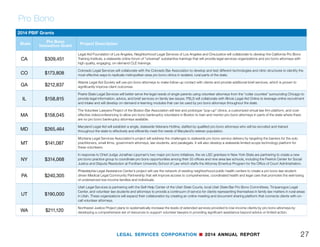
LSC awarded 11 grants to support innovative and
collaborative projects.
Other Pro Bono Efforts
Although pro bono volunteers cannot replace the
work of legal aid lawyers, many of whom are sub-
ject-matter experts, the private bar continues to be
LEGAL SERVICES CORPORATION n 2014 ANNUAL REPORT 27
Pro Bono
State
Pro Bono
Innovation Grant
Project Description
CA $309,451
Legal Aid Foundation of Los Angeles, Neighborhood Legal Services of Los Angeles and OneJustice will collaborate to develop the California Pro Bono
Training Institute, a statewide online forum of “universal” substantive trainings that will provide legal services organizations and pro bono attorneys with
high quality, engaging, on-demand CLE trainings.
CO $173,808
Colorado Legal Services will collaborate with the Colorado Bar Association to develop and test different technologies and clinic structures to identify the
most effective ways to replicate metropolitan-area pro bono clinics in isolated, rural parts of the state.
GA $212,837
Atlanta Legal Aid Society will use pro bono attorneys to make follow-up contact with clients and provide additional brief services, which is proven to
significantly improve client outcomes.
IL $158,815
Prairie State Legal Services will better serve the legal needs of single parents using volunteer attorneys from the “collar counties” surrounding Chicago to
provide legal information, advice, and brief services on family law issues. PSLS will collaborate with Illinois Legal Aid Online to leverage online recruitment
and intake and will develop on-demand e-learning modules that can be used by pro bono attorneys throughout the state.
MA $158,045
The Volunteer Lawyers Project of the Boston Bar Association will test and prototype “pop-up” clinics, a customized virtual law firm platform, and cost-
effective videoconferencing to allow pro bono bankruptcy volunteers in Boston to train and mentor pro bono attorneys in parts of the state where there
are no pro bono bankruptcy attorneys available.
MD $265,464
Maryland Legal Aid will establish a single, statewide Veterans Hotline, staffed by qualified pro bono attorneys who will be recruited and trained
throughout the state to effectively and efficiently meet the needs of Maryland’s veteran population.
MT $141,087
Montana Legal Services Association’s project will address the challenges to statewide pro bono service delivery by targeting the barriers for the solo
practitioners, small firms, government attorneys, law students, and paralegals. It will also develop a statewide limited-scope technology platform for
these volunteers.
NY $314,068
In response to Chief Judge Jonathan Lippman’s two major pro bono initiatives, the six LSC grantees in New York State are partnering to create a new
pro bono practice group to coordinate pro bono opportunities among their 33 offices and nine area law schools, including the Feerick Center for Social
Justice and Dispute Resolution at Fordham University School of Law which staffs the Attorney Emeritus Program for the Office of Court Administration.
PA $240,305
Philadelphia Legal Assistance Center’s project will use the network of existing neighborhood public health centers to create a pro bono law student-
driven Medical Legal Community Partnership that will improve access to comprehensive, coordinated health and legal care that promotes the well-being
of underserved low-income families and individuals.
UT $190,000
Utah Legal Services is partnering with the Self-Help Center of the Utah State Courts, local Utah State Bar Pro Bono Committees, Timpanogos Legal
Center, and volunteer law students and attorneys to provide a continuum of service for clients representing themselves in family law matters in rural areas
in Utah. These organizations will expand their collaboration by creating an online meeting and document sharing platform that connects clients with on-
call volunteer attorneys.
WA $211,120
Northwest Justice Project plans to systematically increase the levels of extended services provided to low-income clients by pro bono attorneys by
developing a comprehensive set of resources to support volunteer lawyers in providing significant assistance beyond advice or limited action.
2014 PBIF Grants
LEGAL SERVICES CORPORATION n 2014 ANNUAL REPORT
Pro Bono
28
(OPPOSITE, TOP LEFT) Left to
right: Texas 2014 Pro Bono
Award Reception: Richard L.
Tate, Partner, Tate, Moerer
 King L.L.C., Chair, Texas
Access to Justice Foundation;
Eduardo V. Rodriquez,
Managing Attorney, Malaise
Law Firm, pro bono volunteer,
Texas RioGrande Legal Aid;
Bruce Moseley, attorney,
program director, Paralegal
Studies at Amarillo College,
pro bono volunteer, Legal
Aid of Northwest Texas;
Jane S. Shin, sole practi-
tioner; Christopher V. Bacon,
Counsel, Vinson  Elkins;
Sally L. Crawford, partner and
public service coordinator,
Jones Day
(OPPOSITE, TOP RIGHT) Left
to right: Iowa 2014 Pro Bono
Award Reception: John Levi,
LSC Board Chairman; Tim
Tripp, attorney, Tripp, P.C., pro
bono volunteer, Iowa Legal
Aid; Brian Peters, attorney,
Kintzinger Law Firm PLC, pro
bono volunteer, Iowa Legal
Aid; Steve Jackson, attorney,
Lynch Dallas P.C., pro bono
volunteer, Iowa Legal Aid;
Scott M. Brennan, accepting
on behalf of the Davis Brown
law firm; and Jim Sandman,
LSC President. (Not Pictured:
Tommy Lynn Miller, retired
attorney, Iowa Legal Aid, pro
bono volunteer, HELP Legal
Assistance.)
a critical resource in addressing the civil legal needs
of the low-income community. Private practitioners,
in-house corporate counsel, retired lawyers, law stu-
dents, and paralegals are eager to assist by donating
their time.
Every LSC grantee is required to spend an amount
equal to 12.5% of its basic field grant to involve private
attorneys in the delivery of civil legal assistance to
eligible clients. In 2014, pro bono cases represented
12.8% of all cases closed—the largest number in
LSC’s history. LSC has worked diligently to expand
pro bono services by implementing the recommen-
dations of the LSC Board of Directors’ Pro Bono Task
Force, which issued a report in 2012. LSC has:
• Published a new Private Attorney Involvement
(PAI) regulation in the Federal Register that be-
came effective in November 2014.
• Developed a new pro bono toolkit web page that in-
cludes approximately 40 examples of best practices.
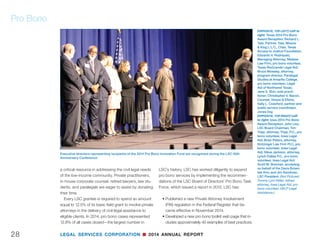
Executive directors representing recipients of the 2014 Pro Bono Innovation Fund are recognized during the LSC 40th
Anniversary Conference.
LEGAL SERVICES CORPORATION n 2014 ANNUAL REPORT
Pro Bono
29
• Compiled a state-by-state inventory of rules to
foster and promote pro bono participation.
• In conjunction with LSC’s 40th Anniversary,
initiated a campaign to raise private funds to help
LSC launch several fellowship programs, including
a one-year program for senior or emeritus attor-
neys to support bono programs at LSC grantees.
The LSC Board of Directors also continued its tradi-
tion of recognizing exemplary pro bono work done for
clients of LSC-funded legal aid programs by awarding
LSC Pro Bono Service awards at its three quarterly
Board Meetings held outside Washington, D.C.
In 2014, lawyers in Texas, Iowa and New York were
recognized. n
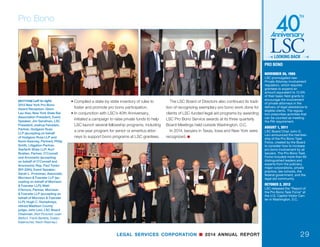
(BOTTOM) Left to right:
2014 New York Pro Bono
Award Reception: Glenn
Lau-Kee, New York State Bar
Association President, Event
Speaker; Jim Sandman, LSC
President; Joshua Feinstein,
Partner, Hodgson Russ
LLP (accepting on behalf
of Hodgson Russ LLP and
Kevin Kearney, Partner); Philip
Smith, Litigation Partner,
Seyfarth Shaw LLP; Kurt
Bratten, Partner, O’Connell
and Aronowitz (accepting
on behalf of O’Connell and
Aronowitz); Rep. Paul Tonko
(NY-20th), Event Speaker;
Sarah L. Prutzman, Associate,
Morrison  Foerster LLP (ac-
cepting on behalf of Morrison
 Foerster LLP); Matt
D’Amore, Partner, Morrison
 Foerster LLP (accepting on
behalf of Morrison  Foerster
LLP); Hugh C. Humphreys,
retired Madison County
judge; John Levi, LSC Board
Chairman. (Not Pictured: Leah
Belfort, Frank Beretta, Evelyn
Kalenscher, Kevin Kearney.)
NOVEMBER 26, 1985
LSC promulgated new
Private Attorney Involvement
regulation, which requires
grantees to expend an
amount equivalent to 12.5%
of their basic field grants to
encourage the involvement
of private attorneys in the
delivery of legal assistance to
eligible clients. The regula-
tion prescribes activities that
can be counted as meeting
the PAI requirement.
AUGUST 1, 2011
LSC Board Chair John G.
Levi announced the member-
ship of the Pro Bono Task
Force, created by the Board
to consider how to increase
pro bono involvement by all
lawyers. The Pro Bono Task
Force included more than 60
distinguished leaders and
experts from the judiciary,
major corporations, private
practice, law schools, the
federal government, and the
legal aid community.
OCTOBER 2, 2012
LSC released the “Report of
the Pro Bono Task Force” at
the U.S. Capitol Visitor Cen-
ter in Washington, D.C.
 LOOKING BACK 
PRO BONO
LEGAL SERVICES CORPORATION n 2014 ANNUAL REPORT30
I
n 2014, LSC continued to promote a national con-
versation on strengthening legal aid and improving
access to justice for low-income Americans.
LSC co-hosted its third White House forum in April
to discuss ways to increase access to justice, expand
pro bono opportunities, spread technological innova-
tion, and examine other matters of importance to the
legal aid community.
The forum featured United States Solicitor General
Donald Verrilli, Associate Attorney General Tony West,
White House Counsel Kathryn Ruemmler, and other
leaders of the legal community.
Tina Tchen, Chief of Staff to the First Lady; James
Silkenat, ABA President; and Glenn Rawdon, LSC
Program Counsel, also spoke at the event.
In his opening remarks, LSC Board Chairman John
G. Levi discussed the challenges facing civil legal aid
and identified an important objective for LSC and its
grantees: “Our goal, quite simply, is to provide all low-in-
come Americans some form of effective assistance with
Promoting Equal Justice at White House
and Judicial Forums
LEGAL SERVICES CORPORATION n 2014 ANNUAL REPORT 31
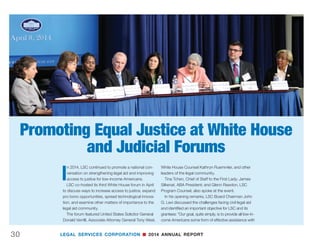
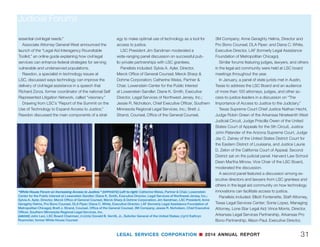
“White House Forum on Increasing Access to Justice.” (OPPOSITE) Left to right: Catherine Weiss, Partner  Chair, Lowenstein
Center for the Public Interest at Lowenstein Sandler; Diane K. Smith, Executive Director, Legal Services of Northwest Jersey, Inc.;
Sylvia A. Ayler, Director, Merck Office of General Counsel, Merck Sharp  Dohme Corporation; Jim Sandman, LSC President; Anne
Geraghty Helms, Pro Bono Counsel, DLA Piper; Diana C. White, Executive Director, LAF (formerly Legal Assistance Foundation of
Metropolitan Chicago); Brett J. Strand, Counsel, Office of the General Counsel, 3M Company; Jessie R. Nicholson, Chief Executive
Officer, Southern Minnesota Regional Legal Services, Inc.
(ABOVE) John Levi, LSC Board Chairman; (middle) Donald B. Verrilli, Jr., Solicitor General of the United States; (right) Kathryn
Ruemmler, former White House Counsel
3M Company; Anne Geraghty Helms, Director and
Pro Bono Counsel, DLA Piper; and Diana C. White,
Executive Director, LAF (formerly Legal Assistance
Foundation of Metropolitan Chicago).
Similar forums featuring judges, lawyers, and others
in the legal aid community were held at LSC board
meetings throughout the year.
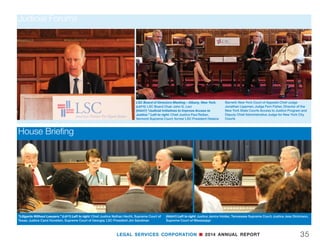
In January, a panel of state jurists met in Austin,
Texas to address the LSC Board and an audience
of more than 100 attorneys, judges, and other ac-
cess-to-justice leaders in a discussion on “The
Importance of Access to Justice to the Judiciary.”
Texas Supreme Court Chief Justice Nathan Hecht,
Judge Robin Green of the Arkansas Nineteenth West
Judicial Circuit, Judge Priscilla Owen of the United
States Court of Appeals for the 5th Circuit, Justice
John Pelander of the Arizona Supreme Court, Judge
Jay C. Zainey of the United States District Court for
the Eastern District of Louisiana, and Justice Laurie
D. Zelon of the California Court of Appeal, Second
District sat on the judicial panel. Harvard Law School
Dean Martha Minow, Vice Chair of the LSC Board,
moderated the discussion.
A second panel featured a discussion among ex-
ecutive directors and lawyers from LSC grantees and
others in the legal aid community on how technology
innovations can facilitate access to justice.
Panelists included: Elliott Fontenette, Staff Attorney,
Texas Legal Services Center; Sonia Lopez, Managing
Attorney, Lone Star Legal Aid; Vince Morris, Director,
Arkansas Legal Services Partnership, Arkansas Pro
Bono Partnership; Alison Paul, Executive Director,
Judicial Forums
essential civil legal needs.”
Associate Attorney General West announced the
launch of the “Legal Aid Interagency Roundtable
Toolkit,” an online guide explaining how civil legal
services can enhance federal strategies for serving
vulnerable and underserved populations.
Rawdon, a specialist in technology issues at
LSC, discussed ways technology can improve the
delivery of civil legal assistance in a speech that
Richard Zorza, former coordinator of the national Self
Represented Litigation Network, called “visionary.”
Drawing from LSC’s “Report of the Summit on the
Use of Technology to Expand Access to Justice,”
Rawdon discussed the main components of a strat-
egy to make optimal use of technology as a tool for
access to justice.
LSC President Jim Sandman moderated a
wide-ranging panel discussion on successful pub-
lic-private partnerships with LSC grantees.
Panelists included: Sylvia A. Ayler, Director,
Merck Office of General Counsel, Merck Sharp 
Dohme Corporation; Catherine Weiss, Partner 
Chair, Lowenstein Center for the Public Interest
at Lowenstein Sandler; Diane K. Smith, Executive
Director, Legal Services of Northwest Jersey, Inc.;
Jessie R. Nicholson, Chief Executive Officer, Southern
Minnesota Regional Legal Services, Inc.; Brett J.
Strand, Counsel, Office of the General Counsel,
LEGAL SERVICES CORPORATION n 2014 ANNUAL REPORT32
Judicial Forums
by representatives of their community partners:
Mindy Murphy, President  CEO of The Spring of
Tampa Bay; Barbara Kamenir Siegel of the University
of Southern California Gould School of Law; and Eric
Tabor, Chief Deputy Attorney General for the Iowa
Attorney General’s office.
David Stern, Executive Director of Equal Justice
Works, delivered the keynote speech at a luncheon
following the panel discussions, with welcoming re-
marks from Alan O. Olson, Board President of Iowa
Legal Aid.
In October, leading jurists from New York and
Vermont gathered at the New York State Court of
Appeals for a panel discussion on judicial initiatives
to improve access to justice for low-income legal aid
clients.
The discussion featured New York State Chief
Judge Jonathan Lippman, Vermont Supreme Court
Chief Justice Paul L. Reiber, and Deputy Chief
Administrative Judge for New York City Courts Justice
Fern Fisher.
A panel of state supreme court justices provided a
congressional briefing in May for members and staff
of the U.S. House of Representatives on the growing
problem of unrepresented litigants.
“Litigants Without Lawyers: Equal Justice Under
Threat in State Courts” featured Chief Justice Nathan
Hecht of the Supreme Court of Texas and Justices
Jess Dickinson of Mississippi, Janice Holder of
Tennessee, and Carol Hunstein of Georgia. All four
justices addressed the alarming spike in the number
of litigants without lawyers and its impact on the
court system. n
Montana Legal Services Association; Glenn Rawdon,
Program Counsel, LSC; and Diana C. White,
Executive Director, LAF (Legal Aid Foundation of
Metropolitan Chicago).
LSC President Jim Sandman moderated the panel,
and former White House Counsel and Locke Lord
Partner Harriet Miers spoke at a luncheon following
the panels.
In July, Iowa Supreme Court Justice David Wiggins
and Judge Robert W. Pratt of the U.S. District Court
for the Southern District of Iowa joined five state su-
preme court justices at Drake Law School in Des
Moines for panel discussions on civil legal aid.
LSC held the forum in conjunction with the Board of
Directors’ summer meeting.
Joining Justice Wiggins and Judge Pratt were North
Dakota Supreme Court Justice Daniel J. Crothers,
Illinois Supreme Court Justice Thomas L. Kilbride,
Minnesota Supreme Court Justice David R. Stras,
Missouri Supreme Court Judge Richard B. Teitelman,
and Nebraska Supreme Court Justice John F. Wright.
LSC Board Vice Chair Martha Minow, Dean of
Harvard Law School, moderated the panel.
A second panel examined the importance of com-
munity partnerships in delivering legal aid to low-in-
come people, focusing on best practices to improve
the delivery of holistic services.
Moderated by LSC President Jim Sandman, the
panel included directors from three LSC-funded legal
aid offices: Joan Boles of Bay Area Legal Services
in Florida; Neal S. Dudovitz of Neighborhood
Legal Services of Los Angeles County; and Dennis
Groenenboom of Iowa Legal Aid. They were joined
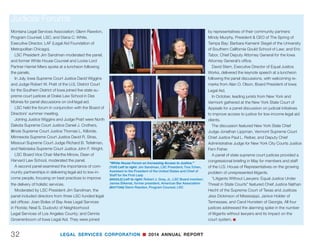
“White House Forum on Increasing Access to Justice.”
(TOP) Left to right: Jim Sandman, LSC President; Tina Tchen,
Assistant to the President of the United States and Chief of
Staff for the First Lady
(MIDDLE) Left to right: Robert J. Grey, Jr., LSC Board member;
James Silkenat, former president, American Bar Association
(BOTTOM) Glenn Rawdon, Program Counsel, LSC
LEGAL SERVICES CORPORATION n 2014 ANNUAL REPORT 33
Judicial Forums
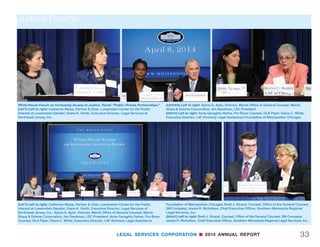
White House Forum on Increasing Access to Justice. Panel: “Public-Private Partnerships.”
(LEFT) Left to right: Catherine Weiss, Partner  Chair, Lowenstein Center for the Public
Interest at Lowenstein Sandler; Diane K. Smith, Executive Director, Legal Services of
Northwest Jersey, Inc.
(CENTER) Left to right: Sylvia A. Ayler, Director, Merck Office of General Counsel, Merck
Sharp  Dohme Corporation; Jim Sandman, LSC President
(RIGHT) Left to right: Anne Geraghty Helms, Pro Bono Counsel, DLA Piper; Diana C. White,
Executive Director, LAF (formerly Legal Assistance Foundation of Metropolitan Chicago)
(LEFT) Left to right: Catherine Weiss, Partner  Chair, Lowenstein Center for the Public
Interest at Lowenstein Sandler; Diane K. Smith, Executive Director, Legal Services of
Northwest Jersey, Inc.; Sylvia A. Ayler, Director, Merck Office of General Counsel, Merck
Sharp  Dohme Corporation; Jim Sandman, LSC President; Anne Geraghty Helms, Pro Bono
Counsel, DLA Piper; Diana C. White, Executive Director, LAF (formerly Legal Assistance
Foundation of Metropolitan Chicago); Brett J. Strand, Counsel, Office of the General Counsel,
3M Company; Jessie R. Nicholson, Chief Executive Officer, Southern Minnesota Regional
Legal Services, Inc.
(RIGHT) Left to right: Brett J. Strand, Counsel, Office of the General Counsel, 3M Company;
Jessie R. Nicholson, Chief Executive Officer, Southern Minnesota Regional Legal Services, Inc.
LEGAL SERVICES CORPORATION n 2014 ANNUAL REPORT34
Judicial Forums
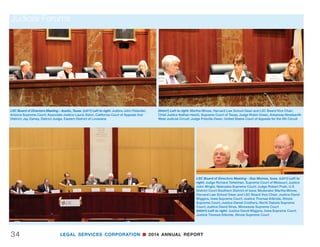
LSC Board of Directors Meeting - Austin, Texas. (LEFT) Left to right: Justice John Pelander,
Arizona Supreme Court; Associate Justice Laurie Zelon, California Court of Appeals 2nd
District; Jay Zainey, District Judge, Eastern District of Louisiana
(RIGHT) Left to right: Martha Minow, Harvard Law School Dean and LSC Board Vice Chair;
Chief Justice Nathan Hecht, Supreme Court of Texas; Judge Robin Green, Arkansas Nineteenth
West Judicial Circuit; Judge Priscilla Owen, United States Court of Appeals for the 5th Circuit
LSC Board of Directors Meeting - Des Moines, Iowa. (LEFT) Left to
right: Judge Richard Teitelman, Supreme Court of Missouri; Justice
John Wright, Nebraska Supreme Court; Judge Robert Pratt, U.S
District Court Southern District of Iowa; Moderator Martha Minow,
Harvard Law School Dean and LSC Board Vice Chair; Justice David
Wiggins, Iowa Supreme Court; Justice Thomas Kilbride, Illinois
Supreme Court; Justice Daniel Crothers, North Dakota Supreme
Court; Justice David Stras, Minnesota Supreme Court
(RIGHT) Left to right: Justice David Wiggins, Iowa Supreme Court;
Justice Thomas Kilbride, Illinois Supreme Court
LEGAL SERVICES CORPORATION n 2014 ANNUAL REPORT 35
Judicial Forums
LSC Board of Directors Meeting – Albany, New York.
(LEFT): LSC Board Chair John G. Levi
(RIGHT) “Judicial Initiatives to Improve Access to
Justice.” Left to right: Chief Justice Paul Reiber,
Vermont Supreme Court; former LSC President Helaine
Barnett; New York Court of Appeals Chief Judge
Jonathan Lippman; Judge Fern Fisher, Director of the
New York State Courts Access to Justice Program and
Deputy Chief Administrative Judge for New York City
Courts
“Litigants Without Lawyers.” (LEFT) Left to right: Chief Justice Nathan Hecht, Supreme Court of
Texas; Justice Carol Hunstein, Supreme Court of Georgia; LSC President Jim Sandman
(RIGHT) Left to right: Justice Janice Holder, Tennessee Supreme Court; Justice Jess Dickinson,
Supreme Court of Mississippi
House Briefing
LEGAL SERVICES CORPORATION n 2014 ANNUAL REPORT
I
n November, LSC launched the Technology Fellowship program,
allowing employees of LSC grantees to apply for support to imple-
ment one of the five strategies from the LSC Technology Summit
or to create new technology capacity for the grantee.
The LSC Technology Fellowship Program includes:
• A full scholarship to attend LSC’s annual Technology Initiative
Grants (TIG) Conference, as well as a special pre-conference
session for fellows;
• A mentor from within the legal aid community to assist with im-
plementation of the project;
• At least three webinars over the next year sponsored by the
Legal Services National Technology Assistance Project to sup-
port the fellows’ project implementation;
• A final project presentation at the 2015 National Legal Aid and
Defender Association Conference or 2016 TIG Conference to
showcase the projects.
LSC began coordinating with the NLADA Technology section in
December to award the twelve fellowships.
LSC’s 2013 “Report of the Summit on the Use of Technology to
Expand Access to Justice” outlines a number of concrete recom-
mendations exploring ways to provide all low-income Americans
with “some form of effective assistance” with civil legal needs.
The strategy for achieving this includes five components:
• Creating unified “legal portals” in each state that direct persons
needing legal assistance to the most appropriate form of assis-
tance and guide them through the entire legal process via an
automated “triage” process;
• Deploying sophisticated but easy-to-use document-assembly
applications to support the creation of legal forms and documents
by both legal services providers and self-represented litigants;
• Taking advantage of mobile technologies to reach more persons
more effectively;
• Applying business process analyses to all access-to-justice pro-
cesses to make them as efficient as practicable; and
• Developing “expert systems” and checklists to assist lawyers
and other services providers.
In August, the ABA Journal used these components as the basis
for a “Hackcess to Justice 2014” hackathon to challenge lawyers,
law students, developers, and coders to devise technology-enabled
solutions to access to justice issues. LSC President Jim Sandman
spoke at the event, and LSC’s Technology Program Counsel Glenn
Rawdon was one of the hackathon’s judges.
Technology Initiative Grants
LSC’s Technology Initiative Grants program has played a major
role in expanding access to justice.
36
Technology
Using Innovative Technology to Improve
the Delivery of Civil Legal Aid
LSC continues to be a leader in the use of technology to expand access to justice and
improve the delivery of civil legal aid.
LEGAL SERVICES CORPORATION n 2014 ANNUAL REPORT
Technology
Since its inception in 2000, TIG has funded 570
technology projects totaling more than $46 million.
With this funding, LSC grantees have built a net-
work of websites serving both attorneys and clients
nationwide, developed easy-to-use online forms, in-
corporated video technology into service delivery, and
enhanced support for pro bono lawyers.
In 2014, LSC awarded 38 grants to support a vari-
ety of initiatives, including user-friendly online tools for
women vezterans, mobile delivery of legal services
for clients using text messaging, and video-confer-
encing technology that reaches low-income clients
in rural areas.
TIG Conference
LSC has hosted an annual technology confer-
ence every year since 2000, bringing together LSC
grantees and members of the technology com-
munity to explore effective uses of technology in legal
aid and to cultivate project ideas that could lead to
successful Technology Initiative Grants applications.
All recipients of Technology Initiative Grants are re-
quired to attend this conference. Session topics cover
a range of issues, such as how the use of technology
can enhance internal legal services operations, im-
prove client service, address access issues, and ef-
fectively provide legal information to low-income peo-
ple. Sessions also cover management of TIG projects,
including reporting and evaluation requirements.
More than 200 people gathered in Jacksonville, Fla.,
in January for the 2014 TIG Conference.
Carla Goldstein, Associate General Counsel and
Director of Strategic Initiatives for Bank of Montreal,
discussed doing more with less during the opening
plenary, focusing on both the private sector and legal
assistance organizations. Attendees learned how to
incorporate process improvement, standardization,
and technology into law practice while still providing
the necessary human touch for clients.
“Get Your Game On!: Using Games to Engage and
Learn about Legal Services” highlighted two projects
to develop games that empower lower-income peo-
ple with civil legal knowledge on estate planning and
mortgage foreclosure. Other sessions focused on
cloud computing at legal aid law firms; using online
instruction to increase access to justice for self-rep-
resented litigants; collaborating with public libraries;
and remote service delivery using mobile technology,
apps, Telelaw, and virtual law offices.
To access TIG Conference materials and session
videos, go to http://bit.ly/LSC-TIGCon14. n
SEPTEMBER 16-17, 1998
LSC co-sponsored the
“Technology and the Future
of Legal Services Confer-
ence” in Warrenton, Virginia.
The conference identified
emerging technology innova-
tions that could revolutionize
how low-income people in
search of legal aid access
vital information.
2000
LSC awarded its first
Technology Initiative Grants
(TIG) to legal aid organiza-
tions in 27 states, totaling
$4,149,765. The grants
covered a range of technol-
ogy projects, including early
website development, video
conferencing, and self-help
resources.
JUNE 21, 2012
LSC convened “The Summit
on the Use of Technology to
Expand Access to Justice”
in Silver Spring, Md., with
a second session following
seven months later in Jack-
sonville, Fla.
DECEMBER 30, 2013
LSC released the report of
“The Summit on the Use
of Technology to Expand
Access to Justice,” present-
ing a number of recom-
mendations to broaden and
improve civil legal assis-
tance through an integrated
service-delivery system.
 LOOKING BACK 
TECHNOLOGY
37
FL
NE
IA
MN
MT
UTCA
ID
WA
ME
NY
MI CT
OH
IL
VA
TN
KY
AR
LA
HI
Award Recipient States
2014 Technology Initiative Grants
LEGAL SERVICES CORPORATION n 2014 ANNUAL REPORT
Technology
38
2014 TIG Grants (Total Funding $3,467,978)
State Grantee Grant Amount Grant Description
AR
Center for
Arkansas Legal
Services
$81,400
Support the development of a mobile-compatible website, including content modification and technical enhancements to ensure that the site
works across mobile devices. Upgrade statewide website to automatically provide users a more personalized, user-friendly experience.
CA
Bay Area Legal
Aid
$168,324
Use a cloud-based communication platform that sends and receives text messages—allowing staff to connect directly to clients to schedule
appointments and send reminders. Automate manual tasks to allow pro bono attorneys, law students, and staff attorneys to more efficiently assist
self-represented individuals in consumer law cases.
Legal Aid
Foundation of
Los Angeles
$24,069
Enhance client accessibility and program productivity by using videoconferencing technology to bridge geographic barriers among LAFLA’s six
offices, the LA Law Library, and other community libraries in the greater Los Angeles area.
Legal Services
of Northern
California
$88,650
Develop and improve the organization’s case management software so that it integrates seamlessly with Google Apps. This will allow staff to
search contents of a gmail message and any file attachments; access and manage client-specific Google Drive folders; and receive case-specific
gmail notifications of time sensitive files.
CT
Statewide Legal
Services of
Connecticut
$129,726
Develop an interactive online simulation to provide self-represented people a basic understanding of how to self-advocate in court and before
regulatory agencies. Establish a national portal for legal aid organizations and law schools to build online trainings and share content.
FL
Legal Services of
Greater Miami
$104,756
Create a multi-program online intake system available in English, Spanish, and Creole. The system will integrate with FloridaLawHelp.org, which
provides legal service providers’ contact information and legal information including self-help information, forms and videos to assist low-income
Floridians.
HI
Legal Aid Society
of Hawaii
$92,917
Create automated online court forms using HotDocs and A2J document assembly software and a series of videos in multi-languages on
substantive law areas including housing, family and consumer law, and to provide information about the program’s A2J document assembly
project.
IA Iowa Legal Aid $36,372
Implement a new live chat, real-time assistance technology platform that improves upon a variety of features in the existing LiveHelp platform used
in ten states to help self-represented litigants navigate free web-based legal resources.
ID
Idaho Legal Aid
Services, Inc.
$35,487
Implement a text messaging keyword system to help pro se litigants quickly address problems that arise during their case. This will also include a
text messaging appointment and court reminder system for ILAS and its clients to save staff resources and better serve program clients.
IL
Land of Lincoln
Legal Assistance
Foundation, Inc.
$102,845
Develop a system, using SharePoint Online that will allow advocates across the program to collaborate and locate best practice resources and
documents. The system will also pull relevant content from the Illinois Legal Aid Online statewide websites and incorporate workflows developed
through ongoing business process analysis efforts.
Legal Assistance
Foundation
$68,900
Improve the Illinois statewide website by leveraging strategic workflow design and innovative technology solutions developed through a
partnership with business process analysis experts. New systems will ensure that the site content is updated in a timely, consistent, and
comprehensive manner.
KY Legal Aid Society $182,445
Create KY Justice Online, a web-based, tiered approach to pro bono assistance utilizing librarians and volunteer attorneys. Develop a secure,
enterprise-level information management system through Microsoft SharePoint 2013 that will expand the organization’s capacity to provide client
services while improving case managers’ efficiency and quality of work.
LA
Acadiana
Legal Service
Corporation
$58,788
Develop a series of eight expert systems that will lead users to appropriate referral sources, relevant legal information, document assembly self-
help forms, and application procedures for additional assistance.
Southeast
Louisiana
Legal Services
Corporation
$31,400
Develop automated online forms and accompanying instructions to assist public libraries provide legal information in four substantive areas—
expungement, modification of child support, custody by mandate, and small claims matters. The project includes trainings for librarians on the
new system.
ME
Pine Tree Legal
Assistance, Inc.
$138,139
Develop new user-friendly tools specifically for women veterans on Stateside Legal, a national veteran’s legal assistance website. Create web-
based expert systems involving key legal issues associated with debt collection defense in Maine.
LEGAL SERVICES CORPORATION n 2014 ANNUAL REPORT
Technology
39
2014 TIG Grants (Total Funding $3,467,978) continued
State Grantee Grant Amount Grant Description
MI
Legal Aid
of Western
Michigan
$81,400
Create an automated online intake system to expand services to clients in western Michigan, allowing clients to apply for services at any time
through the web. The project team will also develop a new application that makes it easier for other programs across the country to set up their
online application systems.
MN
Anishinabe Legal
Services, Inc.
$70,975
Automate 21 tribal court forms for self-represented litigants with civil matters to use before the Leech Lake and White Earth Band of Ojibwa Tribal
Courts in northern Minnesota.
Central
Minnesota Legal
Services, Inc.
$78,400
Create a LawHelp Interactive Analytics Toolkit that will help measure and track website traffic to specific LawHelp Interactive (LHI) pages and
create reports using the existing data warehousing/mapping LHI tool. Programs will be able to use this data to design better legal self-help
interviews and provide better instructions to interview users.
MT
Montana
Legal Services
Association
$52,946
Automate Montana’s revised family law forms using Hotdocs and A2J software. This project is a partnership between MLSA and the Self-
Represented Litigants Committee of the Montana Supreme Court Access to Justice Commission.
NE
Legal Aid of
Nebraska
$91,400
Create a Rural Virtual Access to Justice Center that will serve as the technological hub for pro bono and assisted pro se through virtual law offices
at courthouses and public libraries in remote Nebraska counties defined by the state bar association as “rural legal shortage areas.”
NY
Legal Assistance
of Western New
York, Inc.
$195,527
Develop a reminder system that will notify clients of upcoming office appointments, clinics, court appearances, or deadlines through text message
integration with LegalServer, the program’s case management system. Support innovative programs such as Court Navigator program, LiveHelp
and community-based pilots that engage non-traditional justice partners. Target key improvements to LawHelpNY.org—the statewide legal
information website for low-income New Yorkers.
OH
Legal Aid of
Western Ohio, Inc.
$94,150
Create a statewide online resource center of automated court forms for low-income litigants, legal aid staff and volunteers, and pilot video
companion guidance for a set of automated expungement forms.
Ohio State Legal
Services
$725,200
Support and enhance LawHelp Interactive (LHI), the national online document assembly service, to provide support to legal services, court, pro
bono, and law school programs in more than 40 states. Funds will also support the fine-tuning of LHI performance following the launch of a newly
re-architected system and continue to support the adoption of online forms by new partners.
PR
Puerto Rico
Legal Services,
Inc.
$83,900
Create a portal where private attorneys can register to provide pro bono services to indigent persons in courts throughout Puerto Rico. This
portal, linked to a new statewide website, will allow for the identification, recruitment and support for attorneys while also connecting them to
needy clients and assisting them in obtaining free Continuing Legal Education accredited training in exchange for their services.
TN
Legal Aid
Society of Middle
Tennessee and
the Cumberlands
$78,862
Use advanced videoconferencing technology to extend the program's reach to potential clients within its rural service area while also connecting
staff and pro bono attorneys across the organization.
UT
Utah Legal
Services, Inc.
$31,400
Expand the domestic pleading library, via HotDocs, and make it fully utilized by program staff and volunteer attorneys handling contested
domestic cases; and create automated documents for use in Social Security Disability matters.
VA
Central Virginia
Legal Aid
Society, Inc.
$251,400
Produce a cloud-based software application called JusticeServer that will improve case management for legal aid and pro bono attorneys. The
system will allow multiple legal aid organizations to add cases to an online portal and allow volunteer attorneys across a state or jurisdiction to
accept cases through the portal with no limitation on the number of organizations or users on either side.
Legal Services of
Northern Virginia,
Inc.
$91,400
Create the Virginia Legal Aid Help 2 Go Project, which will use text messaging to guide users to a mobile friendly website that offers a series of
video vignettes on family, consumer and housing law matters in both English and Spanish.
Virginia Legal Aid
Society, Inc.
$151,400
Automate the telephone intake system to assess the type of service needed by the caller, route the caller to the most appropriate service, and
prioritize case types and assemble data into the intake fields of the case management system.
WA
Northwest
Justice Project
$45,400
Optimize and implement upcoming enhancements to Google Analytics to enable administrators of statewide websites to easily and accurately
assess how users are accessing and interacting with their websites. The project will also allow Washington LawHelp and other states to build and
share custom reporting dashboards.
TOTAL $3,467,978
LEGAL SERVICES CORPORATION n 2014 ANNUAL REPORT40
Constituent Services
Helping the Most Vulnerable,
Providing Critical Constituent Services
in Every Congressional Distriect
LSC grantees help individuals who live in households with annual in-
comes at or below 125% of the federal poverty guidelines—in 2014 that
was $14,588 for an individual and $29,813 for a family of four. Clients span
every demographic and live in rural, suburban, and urban areas. They in-
clude the veterans and military families, working poor, homeowners and
renters, families with children, farmers, the disabled, and the elderly.
O
rganizations funded by LSC help individ-
uals who live in households with annual
incomes at or below 125% of the feder-
al poverty guidelines—in 2014 that was
$14,588 for an individual and $29,813 for a family of
four. Clients span every demographic and live in rural,
suburban, and urban areas. They include the veterans
and military families, working poor, homeowners and
renters, families with children, farmers, the disabled,
and the elderly.
Unfortunately, millions of Americans cannot ac-
cess the justice system because they cannot afford
to do so. As the number of people living in poverty
continued at an all-time high in 2014, many constit-
uents sought legal services for the first time. Some
faced homelessness because of a wrongful eviction
or foreclosure. Others sought protection from an
abusive spouse or fought for custody of an abused
or orphaned child. Iraq or Afghanistan war veterans
returned home to economic strain and legal problems.
Elderly citizens fell victim to consumer scams and lost
their life savings.
LSC grantees helped many of these low-income
Americans with a wide variety of legal challenges.
LEGAL SERVICES CORPORATION n 2014 ANNUAL REPORT 41
Constituent Services
Family Law: LSC grantees help parents obtain or
keep custody of their children, family members secure
guardianship of orphaned and abused children, and
victims of domestic violence get protective orders.
Housing and Foreclosure Cases: These cases
include efforts to resolve landlord-tenant disputes,
avoid wrongful foreclosures or renegotiate mortgag-
es, and assist renters whose landlords were being
Domestic Violence and Cancer Survivor
Finds Help From Legal Aid
Helping Survivors Find Relief After A Disaster
Danielle married a man who was once charming, fun, and loving. After the
honeymoon phase, however, she began to experience physical, emotional, ver-
bal, and financial abuse.
“He was like Jekyll and Hyde,” Danielle said.
Things became even worse when Danielle learned she had stage-four cancer.
Shockingly, the abuse only got worse.
Because of her illness, Danielle
could not get around without a
walker. Her husband continued
to beat her. “He assaulted me
ten times in two months. He held
me over a balcony and threw me
down a flight of stairs.”
In an effort to protect her
daughter from seeing the abuse
and to protect her own sense of
dignity, Danielle decided she
had to make a change. “I didn’t
know what to say or where to
go,” she said.
She found New Mexico Legal
Aid (NMLA). The attorneys
helped her get out of the lease she
had with her husband. NMLA
obtained restraining orders to protect Danielle and her daughter and han-
dled all legal aspects of the divorce.
Asked about dealing with the legal system, Danielle said, “It was very in-
timidating, but I’m so much happier.”
Today, though battling cancer, Danielle is now in her own apartment and
free from violence. She hopes to be a role model to women trying to escape vi-
olent situations.
In 2011, Hurricane Irene
severely damaged Smith’s
Collegeville, PA home.
Smith, a single father, incurred
relocation costs and experienced
significant delays receiving assis-
tance from FEMA and his insur-
ance company. In the meantime,
Smith began to use his own funds to
repair his home.
Smith fell behind on his mort-
gage payments. He went to Legal
Aid of Southeastern Pennsylvania
(LASP) for assistance.
LASP’s foreclosure attorneys
guided Smith through the loan
modification process. In July
2013, Smith was approved for a
loan modification that reduced
his monthly mortgage payments
by $250 per month. He was now
financially able to repair his home
and rebuild his life.
LEGAL SERVICES CORPORATION n 2014 ANNUAL REPORT42
Constituent Services
Helping Veterans Rebuild After Returning
From Service
When Bryan re-
turned to Maine after
military deployment,
he suffered from
post-traumatic stress
disorder (PTSD) and
faced significant bar-
riers to establishing
the financial stability
to support himself.
He found himself
heavily in debt. He
turned to Pine Tree
Legal Assistance for
help.
Pine Tree Legal’s at-
torneys helped Bryan
repair his credit and
recover from crippling
debt. “[Pine Tree
Legal Aid has] helped
me move on with my
life,” Bryan said. “The
assistance I gained
from Pine Tree Legal
Aid was priceless.”
Today, Bryan is
back in school with
steady employment. He shares Pine Tree Legal Aid’s veteran resources, like
StatesideLegal.org, with other veterans and members of the military in
need of legal help, and works with a local veterans rights organization.
Helping a Family Access Healthcare Benefits
Elizabeth is William and Debra Weita’s ninth foster child. In 2011, she
was placed with the Weita family days after her birth because of prenatal ex-
posure to heroin, cigarettes, and alcohol.
Although the Weitas were thrilled to adopt the
energetic child, they were concerned about how
to pay for Elizabeth’s therapy. The child’s expo-
sure to drugs and alcohol caused speech delays
and developmental issues requiring medical
therapy that would cost nearly 50% of the fam-
ily’s income—without insurance. Elizabeth’s
speech therapy alone was $800 a month.
Debra applied for Title IV-E Adoption
Assistance, a federal program that supports
families who adopt children with special needs.
Under Title IV-E, health care assistance stays
with the adopted child until the age of 18. As
adoptive parents, the Weitas were covered un-
der their state’s Medicaid. Debra was concerned her family might not qualify
for assistance if they were also receiving Title IV-E Adoption Assistance.
Although the Weitas met the criteria for the Medicaid program, the Ohio
Department of Jobs and Family Services (ODJFS) denied their application.
Debra filed an appeal herself, but realized she was in over her head during a
meeting with ODJFS officials. “I was getting bullied in that meeting. I knew
they would respect an attorney, but we didn’t have money for that,” she said.
That’s when Debra contacted the Legal Aid Society of Cleveland (LAS-
Cleveland). LAS-Cleveland argued that the county was not using the pre-
scribed standard to determine the Weita family’s eligibility, and was instead
applying their own interpretation of the rules. The hearing officer agreed.
With LAS-Cleveland’s support, the Weita family now receives approximate-
ly $500 a month to help with Elizabeth’s health care expenses. LAS-Cleveland
was also able to secure uninterrupted medical coverage during the transition,
and Elizabeth could continue making progress with her speech therapy.
LEGAL SERVICES CORPORATION n 2014 ANNUAL REPORT
Constituent Services
—Bryan Noyes, former client
foreclosed upon.
Consumer Issues: Many cases involve protecting
the elderly and other vulnerable individuals from being
victimized by unscrupulous lenders or merchants and
providing legal advice about consumer rights as well
as debt management and mitigation.
Income Maintenance: LSC grantees also help cli-
ents obtain veterans’, unemployment, disability, and
healthcare benefits for which they are eligible and
provided representation in cases when benefits were
wrongfully denied.
Disaster Response: LSC grantees continued to help
victims of Hurricane Sandy and other disasters, calling
on a network of legal services and other organizations. n
MAY 5, 1971
President Richard M. Nixon
urged Congress to create
LSC as an independent,
nonprofit, federally funded
organization responsible for
providing and overseeing
grants to legal aid organiza-
tions around the country. At
the time, this function was
the purview of the now-de-
funct Office of Economic
Opportunity (OEO).
JULY 25, 1974
After a bipartisan vote of
support in both houses of
Congress, President Nixon
signed the Legal Services
Corporation Act, creating LSC
and solidifying the nation’s
commitment to ensuring equal
access to justice regardless of
income. “[W]e must provide a
mechanism to overcome eco-
nomic barriers to adequate
legal assistance,” President
Nixon said.
 LOOKING BACK 
Education
0.8%
Juvenile
1.8%
Individual Rights
2.0%
Employment
3.0%
Health
3.6%
Miscellaneous
5.4%
Family
32.9%
Income
Maintenance
12.1%
Housing
27.4%
Consumer
Issues
11.0%
2013 Cases Closed
[Pine Tree Legal Aid has] helped me move on with my life. The
assistance I gained from Pine Tree Legal Aid was priceless.
“ ”
43
LEGAL SERVICES CORPORATION n 2014 ANNUAL REPORT44
Management and Oversight
A
s a result of LSC’s work, in August 2014
the U.S. Government Accountability Office
(GAO) determined that LSC had fully imple-
mented all recommendations from GAO’s
2010 report on LSC (GAO 10-540). LSC has improved
its internal processes for awarding grants and over-
seeing grantee performance and compliance. GAO’s
close-out of its recommendations is reflected on their
website at www.gao.gov/products/GAO-10-540.
LSC added staff in the Office of Compliance
and Enforcement (OCE) and the Office of Program
Performance (OPP), increased the number of grantee
visits, ensured compliance with good fiscal practice
and regulatory and statutory requirements, and im-
proved its grantees’ service delivery to clients.
Oversight Visits Completed in 2014
LSC’s Office of Program Performance continues to
invest in program assessment visits, technical assis-
tance, and other initiatives to support grantees. OPP
has the primary responsibility for administering the
competitive grants application and awards process,
assessing the quality of grantees’ legal services de-
livery, sharing best practices for providing high quality
civil legal services, and promoting innovative uses of
technology by grantees.
In 2014, OPP conducted 36 onsite assessment visits
in Alaska, Arizona, Arkansas, California, Connecticut,
Florida, Illinois, Kentucky, Louisiana, Maryland,
Massachusetts, Michigan, Minnesota, Montana, New
Jersey, New York, North Dakota, Oklahoma, Oregon,
Pennsylvania, Rhode Island, Tennessee, Vermont,
Virginia, and the Virgin Islands. OPP anticipates com-
pleting 38 onsite assessment visits in 2015.
LSC’s Office of Compliance and Enforcement (OCE)
has the primary responsibility for monitoring grantee
compliance with the LSC Act, regulations, and fund-
ing restrictions. OCE also ensures compliance with
LSC’s Accounting Guide; conducts oversight reviews
regarding compliance with the LSC Act and other LSC
guidance, including fiscal-related regulations; initiates
questioned-cost proceedings; identifies required cor-
rective actions; and provides technical assistance and
training to grantees.
Improving Management,
Oversight and Accountability
LSC is committed to funding the most efficient and effective delivery of legal services
through prudent management and rigourous oversight and accountability.
LEGAL SERVICES CORPORATION n 2014 ANNUAL REPORT
Louisiana, Maine, and Massachusetts. OCE antici-
pates completing 23-25 onsite visits in 2015.
LSC continues to take appropriate enforcement and
corrective actions against grantees that have been
found to be out of compliance with the LSC Act or
other laws and regulations. Questioned-cost proceed-
ings were completed against four grantees in 2014,
and funds were recouped and issues resolved via
informal negotiations with five grantees. n
In 2014, OCE conducted 24 onsite visits—16 compli-
ance oversight visits, three technical assistance visits,
one targeted investigation visit, three follow-up visits,
and one capability assessment visit—in Arkansas,
California, Georgia, Idaho, Illinois, Louisiana, Michigan,
Mississippi, Missouri, New Jersey, Oklahoma, Oregon,
Pennsylvania, Puerto Rico, South Dakota, and Virginia.
In addition, OCE conducted web-based trainings
for six programs—in Arizona, California, Florida,
Management and Oversight
FL
ID
MD
SD
ND
OKAZ
AK
OR
CA
KY
NY
PA
MI RI
MA
CT
VA
MT
IL
TN
VT
GAMS
AR
LA
MO
MN
NJ
OPP
OCE
OPP  OCE
JULY 9, 1975
The Senate approved the
first LSC Board, nominated
by President Gerald Ford,
with Cornell University Law
School Dean Roger Conant
Cramton as its first chair.
Since then, the LSC Board
has had 9 other chairs.
JANUARY 11, 1976
The LSC Board of Directors
appoints Thomas Ehrlich,
California Attorney and
former Dean of Stanford Law
School, as President. With
his appointment, Ehrlich
became the head of the
Corporation’s operations and
staff. Since 1976, LSC has
had 20 presidents.
 LOOKING BACK 
MANAGEMENT  OVERSIGHT
45
2014 LSC Program Visits
LEGAL SERVICES CORPORATION n 2014 ANNUAL REPORT46
Message From The Inspector General
T
he Office of Inspector General (OIG) was established under the federal
Inspector General Act as an independent office within LSC. It has the
dual mission of preventing and detecting fraud and abuse and of pro-
moting economy, efficiency and effectiveness in LSC’s programs and
operations. I believe this is a role that is especially vital in the legal ser-
vices arena, where the resource needs are so urgent and the consequences so
important for the clients of LSC-funded programs.
I am pleased to report that throughout FY 2014 we continued to make substan-
tial contributions to protecting and improving the programs of LSC and its grant
recipients. Some highlights included:
• Overseeing the annual audit process for all of LSC’s 134 grantees.
• Entering the fourth year of a comprehensive quality control initiative for grantee
audits, which marked the first complete cycle under the program. All firms
conducting grantee audits are now subject to special
review at least once every four years.
• Having over $259,000 in questioned costs, identified
by OIG audits, sustained by LSC management, pro-
ducing added funds that can be used to provide legal
services to the client community.
• Issuing 88 recommendations for program and opera-
tional improvements at the grantee level.
• Identifying opportunities for improvements in LSC’s
own operations and policies in the areas of acquisition
and grants management, regulatory oversight, informa-
tion technology, and human capital management.
• Closing 21 investigations, including criminal investigations involving fraud and
other financial crimes, and regulatory matters such as the unauthorized outside
practice of law, time and attendance abuse, and the improper use of LSC funds.
• Recovering over $30,000, and identifying over $103,000 in additional ques-
tioned costs, as a result of OIG investigations.
I am especially pleased that our efforts continued to reflect strong and effective
working relationships with our stakeholders.
• We kept Congress informed of our activities through periodic meetings and
reports, and responded to multiple Congressional requests.
• We worked in coordination with LSC management on many policy initiatives,
providing comments and recommendations with respect to the Corporation’s
risk management program, procurement policies and practices, personnel
recruitment, the use of electronic devices and services, whistleblower and
non-discrimination/anti-harassment policies, and revisions to the private attor-
ney involvement rule.
• LSC management worked closely with our auditors and contractor to promptly
address Information Technology (IT) system deficiencies and security vulner-
abilities identified by an OIG IT security assessment. As a result of manage-
ment’s positive response and the coordinated efforts between our staffs, all
areas of significant concern identified in the review were corrected.
• We continued to place special emphasis on fraud prevention through a vigor-
ous program of outreach and education activities. We conducted 38 briefings
for grantees across the nation, to improve staff awareness of vulnerabilities
to fraud and better equip them to protect their own
programs from abuse. We also performed a series of
onsite fraud and regulatory vulnerability assessments
to help identify specific weaknesses in programs’ con-
trols and operations. In connection with these efforts,
we published the first edition of our handbook, “Fraud
Prevention Guide for LSC Grantees,” and distributed it
to all grantees. The guide discusses patterns of fraud
and abuse encountered in actual OIG cases, and pro-
vides specific suggestions to help grantee staff prevent
or detect such activities and avoid the loss of critically
needed funds.
I am gratified at the contributions we have been able to make. Together with all
the OIG’s staff members, I am dedicated to doing all that we can to help improve
and protect LSC’s programs. I look forward to continuing to work with LSC’s
Board of Directors, its President, and the LSC staff in support of our common
commitment to equal access to justice for low-income Americans.
Jeffrey Schanz,
LSC Inspector General
July 16, 2015
Protecting LSC and Its Grantees
I believe this
is a role
that is
especially
vital in the
legal services
arena, where
the resource
needs are so
urgent and the
consequences
so important
for the clients
of LSC-funded
programs.
“
”
47
Financials
LEGAL SERVICES CORPORATION n 2014 ANNUAL REPORT
LEGAL SERVICES CORPORATION n 2014 ANNUAL REPORT48 LEGAL SERVICES CORPORATION n 2014 ANNUAL REPORT
Financials
49LEGAL SERVICES CORPORATION n 2014 ANNUAL REPORT
Financials
Statement of Financial Position
September 30, 2014 and 2013
				
ASSETS	 2014 	 2013
Current Assets
	 Cash and cash equivalents 	 $ 79,156,042	 $ 71,080,835
	 Accounts receivable, net 	 53,337	 16,935	
	 Contributions, receivable 	 346,220 	 -
	 Grant receivable 	 800,000 	 -	
	 Prepaid expenses and deposits 	 319,953 	 305,584	
		 Total current assets 	 80,675,592 	 71,403,354
Property and equipment, net 	 376,465	 463,096
Contributions receivable	 1,374,640	 -	
Grant receivable	 400,000	 -	
			 $ 82,826,697	 $ 71,866,450	
LIABILITIES AND NET ASSETS	 	
Current Liabilities
	 Grants and contracts payable 	 $ 67,367,277	 $ 57,581,223
	 Accounts payable 	 823,307	 305,261	
	 Accrued vacation and other liabilities 	 1,200,355 	 1,145,307
	 Deferred revenue 	 2,115,637 	 5,504,763	
		 Total current liabilities 	 71,506,576 	 64,536,554
Net Assets
Unrestricted 		
	 Undesignated 	 7,240,800	 6,256,633	
	 Board designated 	 517,383 	 334,095
	 Net investment in fixed assets 	 376,465 	 463,096	
		 Total unrestricted 	 8,134,648 	 7,053,824
	 Temporarily restricted	 3,185,473 	 276,072	
	 Total net assets	 11,320,121	 7,329,896	
			 $ 82,826,697	 $ 71,866,450	
Statement of Activities and Change in Net Assets
Year Ended September 30, 2014
				 Temporarily
SUPPORT and REVENUES 	 Unrestricted 	 Restricted 	 Total
	 Federal appropriations 	 $ 365,000,000	 $ - 	 $ 365,000,000
	 Grant revenue 	 2,500,000 	 1,200,000	 3,700,000
	 Contributions 	 - 	 2,241,899 	 2,241,899
	 Special events 	 - 	 89,815 	 89,815
	 Other income 	 100,402 	 - 	 100,402
	 Change in deferred revenue 	 3,389,126 	 -	 3,389,126
	 Net assets released from restriction 	 622,313 	 (622,313)	 -
Total Revenue 	 371,611,841	 2,909,401 	 374,521,242
EXPENSES	 	
	 Program services
		 Grants and contracts 	 347,120,980	 -	 347,120,980
		 Herbert S. Garten Loan Repayment 			
			 Assistance Program 	 1,030,774 	 -	 1,030,774
	 Supporting services
		 Management and grants oversight 	 16,928,933 	 -	 16,928,933
		 Office of Inspector General 	 4,726,439 	 -	 4,726,439
		 Fundraising 	 723,891 	 -	 723,891
Total Expenses 	 370,531,017 	 - 	 370,531,017
Change in net assets 	 1,080,824	 2,909,401	 3,990,225
Net assets, beginning of year	 7,053,824 	 276,072 	 7,329,896	
Net assets, end of year	 $ 8,134,648 	 $ 3,185,473 	 $ 11,320,121	
The Notes to Financial Statements are an integral part of these statements.
Financials
LEGAL SERVICES CORPORATION n 2014 ANNUAL REPORT50
Statement of Cash Flows
Year Ended September 30, 2014 and 2013
				
CASH FLOWS FROM OPERATING ACTIVITIES	 2014 	 2013
Change in net assets 	 $ 3,990,225	 $ (1,611,855)
Adjustments to reconcile change in net assets to net cash
	 and cash equivalents provided by operating activities:
		 Depreciation and amoritzation 	 262,709 	 315,820
		 Loss on disposal of assets 	 544 	 -
Changes in assets and liabilities:
	 Accounts receivable 	 12,138 	 (12,600)
	 Prepaid expenses and deposits 	 (76,744) 	 (53,965)
	 Grants and contracts payable 	 (2,620,296) 	 (3,986,334)
	 Accounts payable 	 (295,616) 	 (367,451)
	 Accrued vacation and other liabilities 	 46,972 	 (126,955)
	 Deferred revenue 	 1,874,374 	 (3,044,274)
		 Net cash used by operations 	 (2,407,774) 	 (6,351,618)
CASH FLOWS FROM INVESTING ACTIVITIES
	 Purchase of property and equipment 	 (88,548) 	 (199,383)
		 Net cash used by investing activities 	 (88,548) 	 (199,383)
Net decrease in cash and cash equivalents 	 (2,496,322) 	 (6,551,001)
CASH AND CASH EQUIVALENTS
	 Beginning of year 	 73,577,157 	 80,128,158
	 End of year 	 $ 71,080,835 	 $ 73,577,157
SUPPLEMENTAL INFORMATION
	 Income taxes paid 	 $ 0 	 $ 0
	 Interest paid 	 $ 0 	 $ 0
Statement of Activities and Change in Net Assets
Year Ended September 30, 2013
				 Temporarily
SUPPORT and REVENUES 	 Unrestricted 	 Restricted 	 Total
	 Federal appropriations 	 $ 339,926,164	 $ 950,000 	 $ 340,876,164
	 Grant revenue 	 2,519,572 	 -	 2,519,572
	 Other income 	 29,657 	 - 	 29,657
	 Change in deferred revenue 	 (1,874,374) 	 -	 (1,874,374)
	 Net assets released from restriction 	 961,119 	 (961,119)	
Total Revenue 	 341,562,138	 (11,119) 	 341,551,019
EXPENSES	 	
	 Program services
		 Grants and contracts 	 320,928,559	 -	 320,928,559
		 Herbert S. Garten Loan Repayment 			
			 Assistance Program 	 1,095,858 	 -	 1,095,858
	 Supporting services
		 Management and grants oversight 	 16,497,513 	 -	 16,497,513
		 Office of Inspector General 	 4,599,697 	 -	 4,599,697
		 Fundraising 	 41,247 	 -	 41,247
Total Expenses 	 343,162,874 	 - 	 343,162,874
Change in net assets 	 (1,600,736)		 (11,119)	 (1,611,855)	
Net assets, beginning of year	 8,654,560 	 287,191 	 8,941,751	
Net assets, end of year	 $ 7,053,824 	 $ 276,072 	 $ 7,329,896	
The Notes to Financial Statements are an integral part of these statements.
Financials
LEGAL SERVICES CORPORATION n 2014 ANNUAL REPORT 51
NOTE 1 	 ORGANIZATION AND PURPOSE
Legal Services Corporation (“LSC”) is a private non-membership District of Columbia
nonprofit corporation, established by Congress in the Legal Services Corporation
Act of 1974, Public Law 93-355, and amended in 1977 by Public Law 95-222. The
purpose of LSC is to provide financial support to independent organizations that
directly provide legal assistance in non-criminal proceedings or matters to persons
financially unable to afford such counsel.
NOTE 2	 SUMMARY OF SIGNIFICANT ACCOUNTING POLICIES
Basis of Accounting
LCS’s financial statements are prepared on the accrual basis of accounting.
Accordingly, revenue is recognized when earned, and expenses are recorded when
incurred in accordance with accounting principles generally accepted in the United
States of America.
Basis of Presentation
Financial reporting by not-for-profit organizations requires that resources be classi-
fied for accounting and reporting purposes into net asset categories according to
externally (donor) imposed restrictions. For the years ended September 30, 2014
and 2013, LSC had accounting transactions in the unrestricted net asset category,
which represents net assets that are not subject to donor imposed restriction. LSC
classifies the unrestricted net assets into undesignated, board designated and net
investment in fixed assets. Board designated net assets represent amounts that have
been earmarked by the Board of Directors for continuing programs and administra-
tive activities. Net assets invested in fixed assets represent investments in property,
equipment and computer software, net of accumulated depreciation and amorti-
zation. LSC also has transactions in the temporarily restricted net asset category,
which represents net assets that are subject to donor imposed restrictions.	
Cash and Cash Equivalents
LSC’s cash and cash equivalents includes a fund balance with U.S. Treasury of
$40,117,581 and $1,359,145 as of September 30, 2014 and 2013, respectively.
Accounts Receivable
Accounts receivable are net of an allowance of $518,240 and $534,666 as of
September 30, 2014 and 2013, respectively, determined based on historical experi-
ence and an analysis of specific amounts.
Contributions Receivable
Contributions received, including unconditional promises to give (pledges), are
recognized as revenue in the period received. In accordance with FASB Fair Value
Option standards LSC has determined the discount rate under its investment proto-
col is immaterial therefore, no discount has been applied for the payment of future
receivables. LSC deems all the contributions to be fully collectible, therefore no al-
lowance has been established for doubtful accounts.
Property and Equipment
Capital assets are stated at cost and depreciated using the straight-line method over
the estimated useful lives of the assets of five to ten years. Depreciation is reported
as an unallocated expense and is not directly identified with individual functions.
Revenues and Support Recognition
LSC receives federal appropriations for Management and Grants Oversight, and
Office of Inspector General funding which are reported as support and revenue in
the period the public law makes them available. Unexpended portions of these ap-
propriations are reported as unrestricted net assets.
In addition, LSC receives federal appropriations for Basic Field Programs,
Technology Initiatives, LRAP program, and the Pro Bono Innovation. Management
considers these earned when LSC has fully executed the related award agreements
to third parties. Amounts received for the unearned portions are therefore reported
as deferred revenue.
LSC recognizes contributions as revenue when they are received or unconditionally
pledged and records these revenues as unrestricted or restricted support according
to donor stipulations that limit the use of these assets due to time or purpose restric-
tions. When a donor restriction expires, temporarily restricted net assets are reclassi-
fied to unrestricted net assets and reported in the combined statements of activities
and changes in net assets as net assets released from restrictions.
LSC also has grant revenues which are treated as exchange transactions in the state-
ments of activities and changes in net assets. Funds received in advance of their use
are accounted for as deferred revenue in the statements of financial position.
Grant Recoveries
Grantees who have not complied with the requirements of the Legal Services
Corporation Act of 1974 and implementing regulations may be subject to actions that
result in a recovery of grant funds. Sources of grant refunds may include recoveries
of disallowed costs, excess fund balances, unexpended funds on Private Attorney
Involvement programs and sanctions imposed by LSC for failure to comply with
other regulatory requirements, as well as other types of recoveries. Grant recoveries
are reported as a reduction of grant and contract expenses on the accompanying
statements of activities.
Estimates
The preparation of financial statements in conformity with generally accepted ac-
counting principles requires management to make estimates and assumptions that
affect certain reported amounts and disclosures. Accordingly, actual results may
differ from those estimates.
Income Taxes
LSC is exempt from federal income tax under section 501(c)(3) of the Internal
Revenue Code and the applicable income tax regulations of the District of Columbia,
except for unrelated business income. No provision for income taxes was required
Financials
52 LEGAL SERVICES CORPORATION n 2014 ANNUAL REPORT
NOTE 2 	 SUMMARY OF SIGNIFICANT ACCOUNTING POLICIES (Continued)
for the year ended September 30, 2014 and 2013, as LSC had no net unrelated busi-
ness income.
LSC has determined there were no uncertain tax positions as of September 30, 2014
and 2013. There was also no tax related to interest and penalties reported in the finan-
cial statements. LSC’s Forms 990, Return of Organization Exempt from Income Tax,
for the years ending September 30, 2012, 2013 and 2014 are subject to examination by
the IRS, generally for 3 years after they were filed.
Concentration of Revenue
LSC receives substantially all of its revenue from direct federal government appropri-
ations. Should there be a significant reduction in this revenue, LSC’s programs and
activities could be negatively affected.
Reclassification
In 2014, LSC has changed its presentation of certain expenses, by now including
fundraising expenses as a separate caption. Previously, fundraising expenses were
reported in the caption Management and Grants Oversight. Amounts presented for
the year ended September 30, 2013 have been reclassified to conform to the cur-
rent presentation. These reclassifications had no effect on previously reported total
expenses or changes in net assets. The amount reclassified from Management and
Grants Oversight to Fundraising totaled $41,427.
See notes 9 and 11 for detail of the Management and Grants Oversight expenses
and Fundraising expenses, respectively.
NOTE 3 	 CONCENTRATION OF CREDIT RISK – DEPOSITS
In January 2013, LSC started using sweep accounts when the unlimited Federal
Deposit Insurance Corporation (FDIC) insurance coverage ended, and invested
amounts over $250,000 in high-quality, short-term mutual funds that consist of U.S.
Treasury obligations. At September 30, 2014 and 2013, LSC had $38,509,366 and
$31,251,793 in excess of FDIC insured limits, respectively. LSC believes any risks it is
exposed to are minimal.
NOTE 4	 EQUIPMENT
Property and equipment consists of the following at September 30, 2014:
	 Beginning 			 Ending
	 Balance 	 Additions	 Disposals 	 Balance
Furniture and equipment 	 $ 2,343,229 	 $ 154,323 	$ (182,060) 	 $ 2,315,492
Software 	 572,201 	 -	 -	 572,201
Leasehold improvements 	 5,545 	 - 	 - 	 5,545
Subtotal 	 2,920,975 	 154,323 	 (182,060) 	 2,893,238
Less: Accumulated depreciation
/amortization	 (2,457,879) 	 (240,954) 	 182,060 	 (2,516,773)
Capital assets (net) 	 $ 463,096 	 $ (86,631) 	$ - 	 $ 376,465
Property and equipment consists of the following at September 30, 2013:
	 Beginning 			 Ending
	 Balance 	 Additions	 Disposals 	 Balance
Furniture and equipment 	 $ 2,333,827 	 $ 76,988 	 $ (67,586) 	$ 2,343,229
Software 	 566,188 	 6,013	 -	 572,201
Leasehold improvements 	 455,647 	 5,546 	 (455,648) 	 5,545
Subtotal 	 3,355,662 	 88,547	 (523,234) 	 2,920,975
Less: Accumulated depreciation
/amortization	 (2,717,860) 	 (262,709) 	 522,690 	 (2,457,879)
Capital assets (net) 	 $ 637,802 	 $ (174,162) 	 $ (544) 	 $ 463,096
Depreciation/amortization expense for the years ended September 30, 2014 and
2013 was $240,954 and $262,709, respectively.
NOTE 5	 FINANCIAL INSTRUMENTS
Certain financial instruments are required to be recorded at fair value. Changes in
assumptions or estimation methods could affect the fair value estimates; however,
we do not believe any such changes would have a material impact on financial con-
dition, results of operations or cash flows. Other financial instruments, including cash
equivalents, other investments and short-term debt, are recorded at cost, which
approximates fair value.
NOTE 6	 FAIR VALUE MEASUREMENTS
The Financial Accounting Standards Board established a framework for measuring
fair value. That framework provides a fair value hierarchy that prioritizes the inputs
to valuation techniques used to measure fair value. The hierarchy gives the highest
priority to unadjusted quoted prices in active markets for identical assets or liabilities
(Level 1 measurements) and the lowest priority to unobservable inputs (Level 3 mea-
surements). The three levels of the fair value hierarchy are described below:
Level 1 – Inputs to the valuation methodology are unadjusted quoted prices for iden-
tical assets or liabilities in active markets that LSC has the ability to access.
Level 2 - Observable inputs other than Level 1 prices, such as quoted prices for sim-
ilar assets or liabilities; or other inputs that are observable or can be corroborated by
observable market data for substantially the full term of the assets or liabilities.
Level 3 - Unobservable inputs that are supported by little or no market activity and
that are financial instruments whose values are determined using pricing models,
discounted cash flow methodologies, or similar techniques, as well as instruments
for which the determination of fair value requires significant judgment or estimation.
Financials
53LEGAL SERVICES CORPORATION n 2014 ANNUAL REPORT
NOTE 6 	 FAIR VALUE MEASUREMENTS (Continued)
Fair values of assets measured on a recurring basis at September 30, 2014 are as
follows:
	 	 Significant 	 Significant
	 Fair Value 	 Other Observable 	 Unobservable
	 Total 	 Inputs (Level 2) 	 Inputs (Level 3)
Money Market Accounts 	 	 	
	 in U.S. Treasury Notes 	 $ 22,029,807 	 $ 22,029,807 	 $ -
Contribution Receivables 	 1,720,860 	 	 1,720,860
Loan Repayment Assistance 	 	 	
	 Program Receivable 	 2,330 	 - 	 2,330
Total 	 $ 23,752,997 	 $ 22,029,807 	 $ 1,723,190
Fair values of assets measured on a recurring basis at September 30, 2013 are as
follows:
	 	 Significant 	 Significant
	 Fair Value 	 Other Observable 	 Unobservable
	 Total 	 Inputs (Level 2) 	 Inputs (Level 3)
Money Market Accounts 	 	 	
	 in U.S. Treasury Notes 	 $ 69,482,281 	 $ 69,482,281 	 $ -
Loan Repayment Assistance 	 	 	
	 Program Receivable 	 10,338 	 - 	 10,338
Total 	 $ 69,492,619 	 $ 69,482,281 	 $ 10,338
Assets measured at fair value on a recurring basis using significant observable inputs
(Level 2 inputs):
LSC maintains cash balances at two financial institutions with offices in the
Washington, DC metropolitan area. Each institution maintains target balances up to
$248,000 with any excess funds swept to an account that purchases mutual funds
investing in U.S. Treasury bills with an average dividend rate of 0.01% for 2014 and
2013, which is arrived at by the financial institution deducting a fee of up to 0 basis
points from the dividend rate provided by the institutions Treasury Reserves. Annual
expense ratios are based on amounts incurred during the most recent fiscal year,
as shown in the funds’ audited financial statements, and may have been restated to
reflect current service provider fees, net of any waivers, reimbursements or caps that
the fund’s manager may have committed to the fund and that are currently in effect.
Monthly fees and expenses are approximate, assume that the investor held shares
of the fund valued at the ending balance for the entire month, and do not include the
effect of any transactions that may have been made during the month.
Assets measured at fair value on a recurring basis using significant unobservable
inputs (Level 3 inputs):
The LRAP accounts receivable is stated at the amount management expects to collect
from refunded loans. Through an evaluation each year, management adjusts the LRAP
allowance account based on its assessment of the current status of individual loans.
The net of these two amounts is the receivable reported in the financial statements.
Contributions receivable, arising from unconditional promise to give, is stated at the
amount management expects to collect. In accordance with FASB Fair Value Option
standards LSC has determined the discount rate under its investment protocol is im-
material therefore, no discount has been applied for the payment of future receivables.
The table below presents information about the changes in the Loan Repayment
Assistance Program and the Contribution Receivables:
	 2014 	 2013
Loan Repayment Assistance Program: 	 	 	
	 Beginning Balance 	 $ 10,338 	 $ 4,952
		 Net increase, (decrease) 	 (8,008) 	 5,386
	 Ending Balance 	 $ 2,330 	 $ 10,338
Contribution Receivables: 	 	 	
	 Beginning Balance 	 $ - 	 $ -
		 Net increase, (decrease) 	 1,720,860 	 -
	 Ending Balance 	 $ 1,720,860 	 $ -
NOTE 7	 GRANT RECEIVABLE AND DEFERRED REVENUE
LSC operates under various federal appropriations and grants from private sources.
At September 30, 2014 and 2013, LSC was due certain amounts from private fund-
ing sources which resulted from execution of grant agreements. LSC also received
appropriated funds in excess of amounts earned on providing related services,
resulting in deferred revenue that continue into the subsequent year. The following
details the grant receivables and deferred revenue at September 30:
	 2014 	 2013
Grants Receivable: 	 	 	
	 The Margaret A. Cargill Foundation 	 $ 1,200,000 	 $ -
Deferred Revenue: 	 	 	
	 Basic Field Programs 	 $ 508,647 	 $ 632,991
	 US Court of Veterans Appeals 	 5,422 	 6,752
	 Technology Initiatives 	 193,149 	 3,425,827
	 Loan Repayment Assistance Program 	 1,408,419 	 1,439,139
		 Total 	 $ 2,115,637 	 $ 5,504,763
LEGAL SERVICES CORPORATION n 2014 ANNUAL REPORT
Financials
54
NOTE 8	 GRANTS AND CONTRACTS EXPENSE
Grants and contracts expense for the years ended September 30, 2014 and 2013
consists of the following:
	 2014 	 2013
	 Basic Field Programs 	 $ 335,824,344 	 $ 316,345,623 	
	 US Court of Veterans Appeals 	 2,501,329 	 2,521,819
	 Hurricane Sandy Relief 	 - 	 874,041
	 Grant From Other Funds 	 63,266 	 329,298
	 Pro Bono Innovation 	 2,375,000 	 -
	 Technology Initiatives 	 6,682,679 	 914,080
	 Grants Recoveries 	 (325,638) 	 (56,302)
	 Total 		 $ 347,120,980 	 $ 320,928,559
NOTE 9	 MANAGEMENT AND GRANTS OVERSIGHT
Management and grants oversight expenses for the years ended September 30,
2014 and 2013 consists of the following:
	 2014 	 2013
	 Compensation and benefits 	 $ 12,114,233 	 $ 11,939,766 	
	 Temporary employee pay 	 580,203 	 628,522
	 Consulting 	 543,546 	 419,958
	 Travel and transportation 	 786,868 	 646,424
	 Communications 	 85,499 	 83,088
	 Occupancy cost 	 1,711,442 	 1,710,000
	 Printing and reproduction 	 57,456 	 59,448
	 Other operating expenses 	 808,732 	 747,054
	 Capital expenditures 	 144,351 	 50,294
		 Total 	 $ 16,832,330 	 $ 16,284,554
	 Depreciation and amortization 	 240,954 	 262,709
	 Loss on disposal of assets 	 - 	 544
	 Less: capitalized assets 	 (144,351) 	 (50,294)
		 Total 	 $ 16,928,933 	 $ 16,497,513
NOTE 10	 OFFICE OF INSPECTOR GENERAL
LSC’s Office of Inspector General expenses for the years ended September 30, 2014
and 2013 were as follows:
	 2014 	 2013
	 Compensation and benefits 	 $ 4,018,029 	 $ 3,928,043 	
	 Temporary employee pay 	 11,150 	 9,775
	 Consulting 	 332,890 	 340,229
	 Travel and transportation 	 236,310 	 218,597
	 Communications 	 29,482 	 21,436
	 Occupancy cost 	 4,075 	 -
	 Printing and reproduction 	 13,020 	 8,496
	 Other operating expenses 	 81,483 	 73,121
	 Capital expenditures 	 9,971 	 38,253
		 Total 	 $ 4,736,410 	 $ 4,637,950
	 Less: capitalized assets 	 (9,971) 	 (38,253)
		 Total 	 $ 4,726,439 	 $ 4,599,697
NOTE 11	 FUNDRAISING
LSC’s Fundraising expenses for the years ended September 30, 2014 and 2013
were as follows:
	 2014 	 2013
	 Compensation and benefits 	 $ 218,516 	 $ 32,852 	
	 Temporary employee pay 	 9,945 	 70
	 Consulting 	 74,329 	 8,138
	 Travel and transportation 	 299,471 	 57
	 Communications 	 816 	 130
	 Printing and reproduction 	 10,045 	 -
	 Other operating expenses 	 110,769 	 -
		 Total 	 $ 723,891 	 $ 41,247
NOTE 12	 RETIREMENT PLANS
Pursuant to the Legal Services Corporation Act, all officers and employees hired be-
fore October 1, 1988, are participants in the Civil Service Retirement System (“CSRS”),
although they are neither officers nor employees of the federal government. The CSRS
plan is administered by the United States Office of Personnel Management (“OPM”).
LSC makes CSRS contributions at rates applicable to agencies of the federal gov-
ernment. The contributions do not equal the full service cost of the pension expense,
which is the actuarial present value of benefits attributed to services rendered by
covered employees during the accounting period. The measurement of service cost
requires the use of actuarial cost methods to determine the percentage of the em-
ployees’ basic compensation sufficient to fund their projected pension benefit.
LEGAL SERVICES CORPORATION n 2014 ANNUAL REPORT
Financials
55
NOTE 12 	 RETIREMENT PLANS (Continued)
These percentages (cost factors) are provided by OPM and the excess of total
pension expense over the amount contributed by LSC and by LSC employees rep-
resents the amount that must be financed directly by OPM.
Post-retirement CSRS benefits are paid by OPM. No amounts have been recognized
in the financial statements for these imputed costs. LSC does not report in its financial
statements CSRS assets, accumulated plan benefits or unfunded liabilities, if any, appli-
cable to its employees.
All officers and employees hired after September 30, 1988, are ineligible for the CSRS
plan, but they are eligible to participate in LSC’s pension and thrift plan, which is a tax
deferred annuity plan subject to Section 403(b) of the Internal Revenue Code. LSC
contributes 6% of each eligible employee’s salary regardless of their participation. In ad-
dition, LSC matches the first 2.51% contributed by the employee. Individuals can make
contributions up to the maximum amount permitted under federal income tax rules.
LSC’s contributions to these plans for the years ended September 30, 2014 and
2013 were $1,063,938 and $992,067, respectively. The amounts are included in
compensation and benefits for management and administration expenses.
LSC also offers tax deferred annuity savings plans. CSRS eligible employees may
contribute pretax earnings to the federal Thrift Savings Plan, and 403(b) eligible em-
ployees may contribute additional pretax earnings to the Section 403(b) plan. These
plans are subject to different maximum amounts as permitted by the prevailing laws.
No contributions are made to these tax deferred savings plans by LSC.
NOTE 13	 OPERATING LEASE
LSC renewed its lease agreement in September 2012, commencing in June 2013, for
an additional 10 years. Under the new lease, LSC has an obligation to pay a portion
of building operating expenses in excess of the base year. No additional building
operating expenses were incurred for the years ended September 30, 2014 or 2013.
LSC has the right to terminate the lease by giving no less than 120-day prior written
notice in the event that LSC does not receive an appropriation from Congress for
administrative costs sufficient to cover LSC and its rental obligations for any period
during the term of the lease. Future minimum lease payments required under this
lease as of September 30, 2014 are as follows:
	 Fiscal Year 	 Amount
		 2015 	 $ 1,710,000 	
		 2016 	 1,710,000
	 2017 	 1,710,000
	 2018 	 1,710,000
	 2019 	 1,710,000
	 Thereafter 	 6,270,000
	 	 $ 14,820,000
Rental expense for the years ended September 30, 2014 and 2013 is $1,714,503 and
$1,712,316, respectively.
NOTE 14	 CONTINGENCIES
Grants and Contracts
LSC received funding from appropriations by Congress and grants from the U.S.
Court of Veterans Appeals and, accordingly, may be subject to federal audits. In
addition, LSC provides significant funding to numerous independent organizations,
which are subject to their own independent audits and audits by LSC.
LSC’s management does not expect any significant adjustments as a result of feder-
al audits, should they occur, or from the audits of the grantees’ independent auditors.
Claims
Two claims were filed against LSC during FY2014. The first was a declaratory judg-
ment action filed by a pro se party. No fees or monetary damages were alleged. As
a result, no funds were recorded in LSC’s financial statements for any contingent
liability associated with the case. On June 17, the court dismissed the case without
prejudice, and LSC considers the matter closed.
The second was an attorney’s fees petition under § 1006(f) of the LSC Act, which
requires the court to award fees – paid directly by LSC – to a prevailing defendant
upon a finding that an LSC grantee commenced or pursued an action for the sole
purpose of harassment or that constituted a malicious abuse of legal process. The
petition has been stayed pending an appeal of the underlying judgment to the U.S.
Court of Appeals for the Tenth Circuit. No funds had been previously recorded in the
financial statements for any contingent liability associated with the petition.
Collection Matters
In 2010, upon concluding that an LSC grantee had misused LSC funds and committed
other financial irregularities, LSC disallowed approximately $716,261 of the grantee’s
costs. On appeal, LSC agreed to reduce that amount to $467,619. In 2011, LSC ter-
minated the grantee, which later went out of business and is currently believed to be
insolvent. The Corporation continues to explore its options regarding potential recovery
of the previously disallowed amount of $467,619. No amounts have been recorded.
NOTE 15	 LOAN REPAYMENT ASSISTANCE PROGRAM
Through the Herbert S. Garten Loan Repayment Assistance Program (LRAP), es-
tablished in 2005 and funded by Congressional appropriations, LSC makes a limited
number of forgivable loans to attorneys employed by its grantee programs to help re-
pay law school debt. Each participant receives up to $5,600 per year for three years
– for a maximum of $16,800 if they remain eligible and funding remains available.
Participants must commit to remain with the LSC-funded legal services program for
three years. As long as the participant remains in good standing, the loans are forgiv-
en. Participants that do not successfully complete employment within the loan terms
must repay the loans. No provision has been made in the accompanying financial
statements to reflect any interest on the loans as management has deemed these
amounts to be immaterial.
Financials
56 LEGAL SERVICES CORPORATION n 2014 ANNUAL REPORT
NOTE 15 	 LOAN REPAYMENT ASSISTANCE PROGRAM (Continued)
Accounts receivable are stated at the amount management expects to collect from
refunded loans. Management provides for probable forgiven amounts through an
adjustment to a valuation allowance based on its assessment of the current status of
individual accounts. Accounts receivable balances are written-off through a charge
to the valuation allowance in the year the loans are forgiven. Deferred revenue is
comprised of funding available for future loans and loan amounts outstanding.
	 2014 	 2013
LRAP balances at September 30, 2014 and 2013 are as follows:
	 Cash 	 $ 1,406,089 	 $ 1,428,855 	
	 Accounts receivable, net 	 2,330 	 10,338
	 Deferred revenue 	 1,408,419 	 1,439,193
LRAP activity for the years ended September 30, 2014 and 2013 are as follows:
	 Loans made 	 $ 1,030,400 	 $ 1,107,054 	
	 Loans forgiven 	 1,047,200 	 1,143,840
	 Change in allowance for loan forgiveness 	 (16,426) 	 (47,982)
NOTE 16	 TEMPORARILY RESTRICTED NET ASSETS
Components of temporarily restricted net assets at September 30 were as follows:
	 2014 	 2013
	 Public Welfare Foundation 	 $ 66,622 	 $ 200,113 	
	 Hurricane Sandy Disaster Relief 	 75,959 	 75,959
	 40th Anniversary Campaign 	 1,842,892 	 -
	 Margaret A. Cargill Foundation 	 1,200,000 	 -
		 Total 	 $ 3,185,473 	 $ 276,072
NOTE 17	 SUBSEQUENT EVENTS
Legal Services Corporation has evaluated subsequent events occurring after the
statements of financial position date through the date of January 5, 2015, the date
the financial statement were available for release.
Fiscal Year 2015 Funding
After a series of continuing resolutions to partially fund the government for Fiscal
Year 2015, the President signed legislation on December 16, 2014 which provides
LSC funding of $375 million for fiscal year 2015.
Report on Internal Control Over Financial Reporting and on Compliance and Other
Matters Based on an Audit of Financial Statements Performed in Accordance With
Government Auditing Standards
Independent Auditors’ Report
To the Inspector General and Board of Directors, Legal Services Corporation
We have audited, in accordance with the auditing standards generally accepted in the United States of
America and the standards applicable to financial audits contained in Government Auditing Standards
issued by the Comptroller General of the United States, the financial statements of the Legal Services
Corporation (‘LSC’) as of and for the year ended September 30, 2014 and have issued our report thereon
dated January 5, 2015.
Internal Control Over Financial Reporting
In planning and performing our audit of the financial statements, we considered LSC’s internal control
over financial reporting (internal control) to determine the audit procedures that are appropriate in the
circumstances for the purpose of expressing our opinion on the financial statements, but not for the
purpose of expressing an opinion on the effectiveness of LSC’s internal control. Accordingly, we do not
express an opinion on the effectiveness of LSC’s internal control.
A deficiency in internal control exists when the design or operation of a control does not allow manage-
ment or employees, in the normal course of performing their assigned functions, to prevent, or detect
and correct, misstatements on a timely basis. A material weakness is a deficiency, or a combination of
deficiencies, in internal control, such that there is a reasonable possibility that a material misstatement
of the entity’s financial statements will not be prevented, or detected and corrected on a timely basis. A
significant deficiency is a deficiency, or a combination of deficiencies, in internal control that is less severe
than a material weakness, yet important enough to merit attention by those charged with governance.
Our consideration of internal control was for the limited purpose described in the first paragraph of this
section and was not designed to identify all deficiencies in internal control that might be material weak-
nesses or significant deficiencies. Given these limitations, during our audit we did not identify any defi-
ciencies in internal control that we consider to be material weaknesses. However, material weaknesses
may exist that have not been identified.
Compliance and Other Matters
As part of obtaining reasonable assurance about whether LSC’s financial statements are free from ma-
terial misstatement, we performed tests of its compliance with certain provisions of laws, regulations,
contracts, and grant agreements, noncompliance with which could have a direct and material effect on
the determination of financial statement amounts. However, providing an opinion on compliance with
those provisions was not an objective of our audit, and accordingly, we do not express such an opinion.
The results of our tests disclosed no instances of noncompliance or other matters that are required to be
reported under Government Auditing Standards.
Purpose of this Report
The purpose of this report is solely to describe the scope of our testing of internal control and compli-
ance and the results of that testing, and not to provide an opinion on the effectiveness of the entity’s
internal control or on compliance. This report is an integral part of an audit performed in accordance with
Government Auditing Standards in considering the entity’s internal control and compliance. Accordingly,
this communication is not suitable for any other purpose.
Silver Spring, Maryland
January 5, 2015
LEGAL SERVICES CORPORATION n 2014 ANNUAL REPORT
For further information
Office of Government Relations and Public Affairs
Legal Services Corporation
3333 K Street, NW
Washington, DC 20007
202.295.1500 / www.lsc.gov
Follow LSC on
Facebook at facebook.com/LegalServicesCorporation
Twitter at twitter.com/LSCtweets
LinkedIn at https://www.linkedin.com/company/legal-services-corporation
Vimeo at vimeo.com/user10746153
Thank You
Where it was possible to provide photo credit for images used, we did so. Unfortunately, however, space did
not allow for acknowledgements. Here, in alphabetical order, are those we wish to credit for the use of their art
in this Annual Report:
Manvi Drona, Web Content Manager; Ashley Matthews, Communications Manager; Marcos A. Navarro, Design Director;
Brett Belleau; and WANA IMAGE

LSC 2014 Annual Report

  • 1.
  • 2.
    LEGAL SERVICES CORPORATIONn 2014 ANNUAL REPORT Board of Directors John G. Levi, Chairman Martha Minow, Vice Chair Robert J. Grey Jr. Charles N.W. Keckler Harry J.F. Korrell III Victor B. Maddox Laurie Mikva The Rev. Pius Pietrzyk, O.P. Julie A. Reiskin Gloria Valencia-Weber Officers James J. Sandman, President Ronald Flagg, General Counsel, Corporate Secretary and Vice President of Legal Affairs Lynn A. Jennings, Vice President for Grants Management David L. Richardson, Teasurer and Comptroller Inspector General Jeffrey E. Schanz, Inspector General LSC Board of Directors & Officers The Legal Services Corporation is the single largest funder of civil legal services in the country and plays a vital role in a public-private partnership focused on fulfilling America’s pledge of equal justice for all. Since its founding four decades ago, LSC has been making a difference in the lives of low-income Americans by funding high-quality civil legal assistance to veterans, the elderly, victims of domestic abuse, tenants facing un- lawful evictions, and others who cannot afford to pay for legal assistance. “The Congress finds and declares that— (1) there is a need to provide equal access to the system of justice in our Nation for individuals who seek redress of grievances; (2) there is a need to provide high quality legal assistance to those who would be otherwise unable to afford adequate legal counsel and to continue the present vital legal services program; (3) providing legal assistance to those who face an economic barrier to adequate legal counsel will serve best the ends of justice and assist in improving opportunities for low-income persons consistent with the purposes of this Act.” —Excerpt from the Legal Services Corporation Act Public Law 93-355, July 25, 1974
  • 4.
    LEGAL SERVICES CORPORATIONn 2014 ANNUAL REPORT Message from the Chairman . . . . . . . . . . . . . . . . . . . . . . . . . . . . . . . . . . . . . . . . . . . . . . . . . . . 2 LSC President’s Message . . . . . . . . . . . . . . . . . . . . . . . . . . . . . . . . . . . . . . . . . . . . . . . . . . . . . . 3 Board of Directors Committees . . . . . . . . . . . . . . . . . . . . . . . . . . . . . . . . . . . . . . . . . . . . . . . 4 2014–By The Numbers . . . . . . . . . . . . . . . . . . . . . . . . . . . . . . . . . . . . . . . . . . . . . . . . . . . . . . . . . 5 LSC Grantees . . . . . . . . . . . . . . . . . . . . . . . . . . . . . . . . . . . . . . . . . . . . . . . . . . . . . . . . . . . . . . . . 6 LSC’s 40th Anniversary Conference . . . . . . . . . . . . . . . . . . . . . . . . . . . . . . . . . . . . . . . . . . . . . 8 Pro Bono . . . . . . . . . . . . . . . . . . . . . . . . . . . . . . . . . . . . . . . . . . . . . . . . . . . . . . . . . . . . . . . . . . . 26 Judicial Forums . . . . . . . . . . . . . . . . . . . . . . . . . . . . . . . . . . . . . . . . . . . . . . . . . . . . . . . . . . . . . . 30 Technology . . . . . . . . . . . . . . . . . . . . . . . . . . . . . . . . . . . . . . . . . . . . . . . . . . . . . . . . . . . . . . . . . 36 Constituent Services . . . . . . . . . . . . . . . . . . . . . . . . . . . . . . . . . . . . . . . . . . . . . . . . . . . . . . . . . 40 Mangagement and Oversight . . . . . . . . . . . . . . . . . . . . . . . . . . . . . . . . . . . . . . . . . . . . . . . . . . 44 Message from the Inspector General . . . . . . . . . . . . . . . . . . . . . . . . . . . . . . . . . . . . . . . . . . . 46 Independent Auditors’ Report . . . . . . . . . . . . . . . . . . . . . . . . . . . . . . . . . . . . . . . . . . . . . . . . . 47 Table of Contents 1 6 8 30 40
  • 5.
    LEGAL SERVICES CORPORATIONn 2014 ANNUAL REPORT This was a particularly significant year for LSC, the 40th anniversary of our founding. Created in 1974 as one of the last acts of the Nixon administration, LSC has enjoyed four decades of bipartisan congressional support in its mission to help expand access to civil justice for low-income Americans. We are grateful for that support, but facing enormous unmet need for legal services for the poor all across the country, we require more support—much more. Throughout the year, LSC has used this anniversary observance to help raise public awareness of this crisis in civil legal aid and LSC’s important role in addressing it. In September, LSC convened a three-day conference in Washington featuring Vice President Joe Biden, former Secretary of State and former LSC Board Chair Hillary Clinton, U.S. Supreme Court Justices Elena Kagan and Antonin Scalia, for- mer Attorney General Eric Holder and ABA President William Hubbard. They joined more than 100 distinguished panelists and speakers from the legal community, government, and the private sector in wide ranging discussions of the status and future of civil legal aid in America. A month later in New York City, LSC continued this commemoration with an event featuring Congressman Jerry Nadler (NY-10th), CBS Vice Chair Shari Redstone, and the deans of three distinguished New York law schools. Leaders from the city’s legal, legal aid, and business communities also took part in discussions of ways to increase pro bono services and access to justice in their sectors. In addition to raising public awareness through such events, LSC also launched the 40th Anniversary Campaign for Justice, a targeted, private fundraising effort to try to ex- pand access to justice through technology, fellowships, leadership development, collab- orations with public libraries and research, but in a broader sense, it will help LSC and its grantees better tell their story. As we marked LSC’s significant history and chartered news paths for the future, we also took stock of the many challenges that remain, some even more daunting than when LSC was formed. In 1976, LSC’s first year of full congressional funding when the percent of the population eligible for LSC-funded legal assistance stood at 12%, the fledgling LSC was allocated by Congress, in inflation-adjusted terms, more than $468 million, rising three years later to its all-time high of what today would be more than $880 million. Despite our best efforts, the FY 2015 allocation of $375 million is less than half of that. Even 10 years ago, LSC’s actual funding was $400 million. Since then, as LSC funding has been reduced and remained low, the population el- igible for LSC-funded assistance has grown to all-time highs. In 2013, the most recent year for which U.S. Census Bureau data are available, 63.6 million people—one in five Americans—had annual incomes below the threshold for LSC-funded legal assistance of 125% of the federal poverty line. Another 32.4 million people had incomes below that level for at least two consecutive months during the year and thus were eligible for our assistance. In other words, nearly one in three Americans—96 million people—qualified for LSC-funded services at some time during 2013—a staggering figure. Not surprisingly, our grantees and other providers cannot keep up with this demand and are being forced to turn away scores of low-income Americans who are fighting to avert unlawful foreclosure, escape domestic violence, secure veterans’ benefits, or address many other legal challenges that go to the heart of their security and well-being. LSC has been attempting to address this problem through innovative technol- ogy and pro bono programs to help stretch every dollar as far as it can possibly go. But as Justice Elena Kagan observed at LSC’s conference in Washington, what civil legal aid really needs is “more money.” LSC funding is just a rounding error in the federal budget even though the val- ues we are entrusted to uphold are anything but a fiscal afterthought. As Justice Antonin Scalia powerfully observed at the September conference, there can- not be true justice without equal access. “The American ideal is not for some justice, it is as the Pledge of Allegiance says, ‘Liberty and justice for all,’ or as the Supreme Court pediment has it, ‘equal justice.’ I’ve al- ways thought that’s somewhat redundant. Can there be justice if it is not equal? Can there be a just society when some do not have justice? Equality, equal treatment is perhaps the most fundamental element of justice.” The protection of this basic American ideal has been central to LSC’s mission since its founding. And as we move to the conclusion of our recognition of this anniversary year, we will strive to keep faith with LSC’s founding mission to help “provide equal access to the system of justice in our nation” and “to provide high quality legal assistance to those who would be otherwise unable to afford adequate legal counsel.” John G. Levi Chairman, LSC Board of Directors July 16, 2015 Message from the Chairman JOHN G. LEVI 2 Raising Public Awareness as We Marked Our 40th Anniversary
  • 6.
    LEGAL SERVICES CORPORATIONn 2014 ANNUAL REPORT 3 LSC observed its 40th anniversary in 2014, and while we highlighted the significant accomplishments of our first four decades in a variety of ways, LSC and its grantees also took important steps to chart a course for the future. LSC broadened its commitment to promoting pro bono support for civil legal aid with the inauguration of the Pro Bono Innovation Fund. LSC’s Pro Bono Task Force recom- mended the creation of the fund in 2012, and Congress allocated $2.5 million for it in its FY 2014 budget. With these funds, LSC established a new competitive grant project modeled on our successful Technology Initiative Grants (TIG) program. LSC received 79 applications from 41 states, 58% of LSC’s grantees submitted applications or were involved as partners in proposed projects, and the average request was $196,000. LSC awarded 11 grants to support a variety of innovative projects, including using legal aid technology to reach rural populations and creating ex- tensive pro bono partnerships with local law schools, community organizations, and corporate attorneys. At year’s end, I was especially pleased that Congress increased the appropriation for the Pro Bono Innovation Fund by 60%, to $4 mil- lion, in its FY 2015 budget. LSC also established the Midwest Legal Disaster Coordination Fund to sup- port the development of coordinated plans between disaster preparedness organizations and legal service providers in Midwestern states. Two legal aid providers received grants from the privately funded project: • Iowa Legal Aid will use a $367,700 grant to develop mobile technology to help disas- ter survivors better reach legal aid programs after a disaster occurs and to create a multi-component toolkit for use by other legal aid organizations across the country. • Legal Aid of Nebraska will use a $400,000 grant to create an interactive web portal and a statewide legal disaster response training program for attorneys and others to improve Nebraskans’ access to free legal services when disaster strikes. In November, LSC launched yet another new initiative—the Technology Fellowship pro- gram, which allows employees of LSC grantees to apply for support to implement one of the five strategies from the LSC Technology Summit or new technology capacities for the grantee program. Fellows receive a full scholarship to attend the annual TIG Conference, as well as a special pre-conference session for fellows; a mentor from within the legal aid communi- ty to assist with the implementation of the project; and at least three webinars sponsored by the Legal Services National Technology Assistance Project to support the fellows in their project implementation. LSC also improved oversight and accountability by adding staff in the Office of Compliance and Enforcement and the Office of Program Performance and by increasing the number of grantee visits. Important recognition of LSC’s improved management came during the year when the Government Accountability Office informed us that it had closed out the last of the 17 recom- mendations in its 2010 report on LSC. In recognizing these new programs and accomplishments, I do not want to overlook our most important allies in pursuing our mission—the legal aid law- yers of the programs we fund. The lowest paid attorneys in the profession, they labor day in and day out with crush- ing caseloads to breathe life into America’s promise of justice and to serve the highest ideals of our profession and our nation. Supporting the vital work of these lawyers continues to be a highlight of my career. James J. Sandman LSC President July 16, 2015 LSC President’s Message JAMES J. SANDMAN LSC Launches New Pro Bono, Disaster Relief, and Technology Initiatives
  • 7.
    LEGAL SERVICES CORPORATIONn 2014 ANNUAL REPORT4 Board of Directors John G. Levi, Chairman Partner in the Chicago office of Sidley Austin LLP. Martha Minow, Vice Chair Morgan and Helen Chu Dean and Professor at the Harvard Law School. Sharon L. Browne* Former principal attorney in the Pacific Legal Foundation’s Individual Rights Practice group and member of the Foundation’s senior management. Robert J. Grey Jr. Partner in the Richmond and Washington offices of Hunton Williams LLP. Charles N.W. Keckler Presidential Scholar, George Mason University School of Policy, Government, and International Affairs. Harry J.F. Korrell III Partner in the Seattle office of Davis Wright Tremaine LLP. Victor B. Maddox Partner in the Louisville, Ky. firm of Fultz Maddox Dickens PLC. Laurie Mikva Assistant Clinical Professor at Northwestern Law School Bluhm Legal Clinic, and Commissioner on the Illinois Court of Claims. The Rev. Pius Pietrzyk, O.P. Priest of the Order of Preachers (Dominicans), Province of St. Joseph. Julie A. Reiskin Executive Director of the Colorado Cross-Disability Coalition. Gloria Valencia-Weber Professor at the University of New Mexico School of Law. AUDIT Maddox, Chair; Korrell; Valencia-Weber; David Hoffman*; Paul Snyder* FINANCE Grey, Chair; Browne; Mikva; Minow; Fr. Pius; Robert E. Henley Jr.*; Allan Tanenbaum* GOVERNANCE AND PERFORMANCE REVIEW Minow, Chair; Browne; Keckler; Reiskin INSTITUTIONAL ADVANCEMENT Levi, Chair; Minow; Grey; Keckler; Fr. Pius; Herbert S. Garten*; Thomas Smegal*; Frank B. Strickland* OPERATIONS AND REGULATIONS Keckler, Chair; Grey; Korrell; Mikva DELIVERY OF LEGAL SERVICES Fr. Pius, Co-Chair; Valencia-Weber, Co-Chair; Browne; Maddox; Reiskin (*Non-director member) LSC is headed by an 11-member Board of Directors appointed by the President and confirmed by the Senate. Sharon Browne Resigns from Legal Services Corporation Board The former Pacific Legal Foundation principal attorney served on the LSC Board for nearly five years. California lawyer Sharon L. Browne resigned from LSC’s Board of Directors at the end of the year. The former principal attorney in the Pacific Legal Founda- tion’s Individual Rights practice group cited health concerns as the reason for her departure. “It has been an honor to serve as a member of the Board of Directors and I hope that my participation on the Board has made the Legal Services Corporation stronger,” she wrote in her resignation letter to President Obama. Browne’s nomination to the Board was confirmed by the Senate on March 19, 2010. She is a graduate of the University of the Pacific’s Mc- George School of Law and has served as a senior trial attorney with the public issues law firm of Zumbrun, Best Findley as well as an adjunct professor at McGeorge School of Law. California Lawyer magazine named her a California Lawyer of the Year in 2004. “I know that I speak for everyone on the Board in con- gratulating and thanking Sha- ron for her wonderful service to our Board,” said LSC Board Chairman John G. Levi. “We could always count on Sharon’s diligence and dedication. It won’t be the same without her.” *
  • 8.
    LEGAL SERVICES CORPORATIONn 2014 ANNUAL REPORT 5 2014—By The Numbers LSC’s 134grantees employed 8,713full-time staff at 811offices throughout the United States and its territories. 4,318were attorneys, 1,504were paralegals. 1,895,361Total number of people in all households served. 63.4 MillionThe number of Americans eligible for LSC-funded legal assistance continued at an all-time high. Cases closed: 757,983 including 80,953with the involvement of pro bono attorneys. 120,182clients were at least 60 years old. 516,960were women. 110,127of the cases involved domestic violence. ¶M F
  • 9.
    LEGAL SERVICES CORPORATIONn 2014 ANNUAL REPORT LSC GRANTEESIn 2014, the Legal Services Corporation provided grants to 134 independent, nonprofit organizations that provide free civil legal services to low-income Americans from 811 offices located in every state, the District of Columbia and the territories of the United States of America. LEGAL SERVICES CORPORATION n 2014 ANNUAL REPORT6
  • 10.
    FLORIDA Bay Area LegalServices Coast to Coast Legal Aid of South Florida Community Legal Services of Mid-Florida Florida Rural Legal Services Legal Services of Greater Miami Legal Services of North Florida Three Rivers Legal Services GEORGIA Atlanta Legal Aid Society Georgia Legal Services Program HAWAII Legal Aid Society of Hawaii IDAHO Idaho Legal Aid Services ILLINOIS Land of Lincoln Legal Assistance Foundation Legal Assistance Foundation of Metropolitan Chicago Prairie State Legal Services INDIANA Indiana Legal Services IOWA Iowa Legal Aid KANSAS Kansas Legal Services KENTUCKY Appalachian Research and Defense Fund of Kentucky Kentucky Legal Aid Legal Aid of the Blue Grass Legal Aid Society LOUISIANA Acadiana Legal Service Corporation Legal Services of North Louisiana Southeast Louisiana Legal Services Corporation MAINE Pine Tree Legal Assistance MARYLAND Legal Aid Bureau MASSACHUSETTS Community Legal Aid Merrimack Valley Legal Services South Coastal Counties Legal Services Volunteer Lawyers Project of the Boston Bar Association MICHIGAN Legal Aid and Defender Association Legal Aid of Western Michigan Legal Services of Eastern Michigan Legal Services of Northern Michigan Legal Services of South Central Michigan Michigan Indian Legal Services MINNESOTA Anishinabe Legal Services Central Minnesota Legal Services Legal Aid Service of Northeastern Minnesota Legal Services of Northwest Minnesota Corporation Southern Minnesota Regional Legal Services MISSISSIPPI Mississippi Center for Legal Services North Mississippi Rural Legal Services MISSOURI Legal Aid of Western Missouri Legal Services of Eastern Missouri Legal Services of Southern Missouri Mid-Missouri Legal Services Corporation MONTANA Montana Legal Services Association NEBRASKA Legal Aid of Nebraska NEVADA Nevada Legal Services NEW HAMPSHIRE Legal Advice Referral Center NEW JERSEY Central Jersey Legal Services Essex-Newark Legal Services Project Legal Services of Northwest Jersey Northeast New Jersey Legal Services Corporation Ocean-Monmouth Legal Services South Jersey Legal Services NEW MEXICO New Mexico Legal Aid NEW YORK Legal Aid Society of Mid- New York Legal Aid Society of Northeastern New York Legal Assistance of Western New York Legal Services NYC Legal Services of the Hudson Valley Nassau/Suffolk Law Services Committee Neighborhood Legal Services NORTH CAROLINA Legal Aid of North Carolina NORTH DAKOTA Legal Services of North Dakota OHIO Community Legal Aid Services Legal Aid of Western Ohio Legal Aid Society of Greater Cincinnati Ohio State Legal Services The Legal Aid Society of Cleveland OKLAHOMA Legal Aid Services of Oklahoma Oklahoma Indian Legal Services OREGON Legal Aid Services of Oregon PENNSYLVANIA Laurel Legal Services Legal Aid of Southeastern Pennsylvania MidPenn Legal Services Neighborhood Legal Services Association Northwestern Legal Services North Penn Legal Services Philadelphia Legal Assistance Center Southwestern Pennsylvania Legal Services RHODE ISLAND Rhode Island Legal Services SOUTH CAROLINA South Carolina Legal Services SOUTH DAKOTA Dakota Plains Legal Services East River Legal Services TENNESSEE Legal Aid of East Tennessee Legal Aid Society of Middle Tennessee and the Cumberlands Memphis Area Legal Services West Tennessee Legal Services TEXAS Legal Aid of NorthWest Texas Lone Star Legal Aid Texas RioGrande Legal Aid UTAH Utah Legal Services VERMONT Legal Services Law Line of Vermont VIRGINIA Blue Ridge Legal Services Central Virginia Legal Aid Society Legal Aid Society of Eastern Virginia Legal Services of Northern Virginia Southwest Virginia Legal Aid Society Virginia Legal Aid Society WASHINGTON Northwest Justice Project WEST VIRGINIA Legal Aid of West Virginia WISCONSIN Legal Action of Wisconsin Wisconsin Judicare WYOMING Legal Aid of Wyoming U.S. Territories AMERICAN SAMOA American Samoa Legal Aid GUAM Guam Legal Services Corporation MICRONESIA Micronesian Legal Services PUERTO RICO Community Law Office Puerto Rico Legal Services VIRGIN ISLANDS Legal Services of the Virgin Islands ALABAMA Legal Services Alabama ALASKA Alaska Legal Services Corporation ARIZONA Community Legal Services DNA-Peoples Legal Services Southern Arizona Legal Aid ARKANSAS Center for Arkansas Legal Services Legal Aid of Arkansas CALIFORNIA Bay Area Legal Aid California Indian Legal Services California Rural Legal Assistance Central California Legal Services Greater Bakersfield Legal Assistance Inland Counties Legal Services Legal Aid Foundation of Los Angeles Legal Aid Society of Orange County Legal Aid Society of San Diego Legal Services of Northern California Neighborhood Legal Services of Los Angeles County COLORADO Colorado Legal Services CONNECTICUT Statewide Legal Services of Connecticut DELAWARE Legal Services Corporation of Delaware DISTRICT OF COLUMBIA Neighborhood Legal Services Program of the District of Columbia LEGAL SERVICES CORPORATION n 2014 ANNUAL REPORT 7
  • 11.
    8 LEGAL SERVICESCORPORATION n 2014 ANNUAL REPORT LSC Marks 40th Anniversary with Public Events, Fundraising Campaign Vice President Joe Biden
  • 12.
    LEGAL SERVICES CORPORATIONn 2014 ANNUAL REPORT 9 Left to right: U.S. Supreme Court Justice Elena Kagan; former U.S. Attorney General Eric Holder; U.S. Supreme Court Justice Antonin Scalia
  • 13.
    LEGAL SERVICES CORPORATIONn 2014 ANNUAL REPORT I n September, LSC kicked off this commemoration with a three-day conference in Washington. Vice President Joe Biden, former Secretary of State and former LSC Board Chair Hillary Clinton, U.S. Supreme Court Justices Elena Kagan and Antonin Scalia, and then-U.S. Attorney General Eric Holder joined more than 100 leaders of the legal community, government, and the private sector at the event. In addition to speeches, the legal aid conference featured a dozen panel discussions on a wide vari- ety of topics, including “Expanding and Diversifying Sources of Funding,” “Stimulating Innovation to Increase Access to Justice,” “The Impact of Pro Bono Lawyers on the Justice Gap,” and “The Importance of Access to Justice and the Rule of Law to American Business.” “The Legal Services Corporation is using this mile- stone anniversary to focus attention on the gravity of the challenges facing civil legal aid in America, to better educate ourselves about what is occurring and what is at stake, and to consider the best ways forward,” said LSC Board Chairman John G. Levi. “By convening leaders from government, business, and philanthropy as well as the legal community, LSC hopes to forge broad strategies for sustaining and im- proving the funding and delivery of civil legal services.” The Legal Services Corporation observed an important milestone in 2014, the 40th anniversary of its founding. LSC marked this occasion with special events through- out the year to raise public awareness of civil legal aid and by launching a ground-breaking campaign to fund new initiatives that will extend and amplify the work of civil legal aid providers around the country. 40th Anniversary 10 Hillary Clinton, former Secretary of State and former LSC Board Chair
  • 14.
    LEGAL SERVICES CORPORATIONn 2014 ANNUAL REPORT 40th Anniversary 11 (TOP ROW) Left to right: John Levi, LSC Board Chairman; Jim Sandman, LSC President; Charles Keckler, LSC Board member (MIDDLE ROW) Panel: “The Creation of LSC.” Left to right: Thomas Ehrlich, first President of LSC, Visiting Professor Stanford Graduate School of Education; Justice Earl Johnson (retired), 2nd Director of Office of Equal Opportunity Legal Services Program and historian, Visiting Scholar USC School of Law; Alexander Forger (Moderator), former president of LSC; Terry Lenzner, former Director of the Legal Services Program of the Office of Economic Opportunity; Judge David Tatel, former General Counsel of LSC, U.S. Court of Appeals D.C. Circuit (BOTTOM ROW) Left to right: Dean Martha Minow, Harvard Law School and LSC Board Vice Chair; U.S. Supreme Court Justice Elena Kagan; members of the audience, including LSC Board Vice Chair and Harvard Law School Dean Martha Minow and U.S. Supreme Court Justice Elena Kagan
  • 15.
    40th Anniversary 12 Although speakersand panels explored a variety of topics, there was general agreement across the board and the political spectrum that equal access to justice is a core American value that must be preserved. As Hillary Clinton, LSC’s second Board Chair, observed: “Guaranteeing legal services for all Americans makes us a better country and a fairer country. It helps by empowering people to solve those prob- lems and it helps to level the playing field. It is not just a fair shot at the justice system, but it is a fair shot at the American dream.” Justice Antonin Scalia echoed that theme in his remarks: “The American ideal is not for some justice, it is as the Pledge of Allegiance says, ‘Liberty and jus- tice for all,’ or as the Supreme Court pediment has it, ‘equal justice.’ I’ve always thought that’s some- what redundant. Can there be justice if it is not equal? Can there be a just society when some do not have justice? Equality, equal treatment is per- haps the most fundamental element of justice.” The event was intended in part to raise public awareness of the justice gap and ways to narrow it, which Texas Supreme Court Chief Justice Nathan Hecht said was crucial: LEGAL SERVICES CORPORATION n 2014 ANNUAL REPORT (TOP ROW) Left to right: Victor Maddox, LSC Board member; Tony West, former Associate U.S. Attorney General (MIDDLE ROW) Left to right: Tony West, former Associate U.S. Attorney General; Mark Filip, former U.S. Deputy Attorney General; Lisa Madigan, Illinois Attorney General; Greg Zoeller, Indiana Attorney General; The Rev. Pius Pietrzyk, LSC Board member; Victor Maddox, LSC Board member (BOTTOM ROW) Mark Filip, former U.S. Deputy Attorney General
  • 16.
    40th Anniversary “We hopethat justice has few enemies. Most of what we struggle with, I don’t think is opposition to justice, but ignorance of what is going on. It is im- portant for us in our communications with legislators, who provide public support, and others to put a face on the problem. To say, as specifically as we can, this is what we are doing, these are the lives who were changed, this is why a difference is being made.” Speakers from both sides of the aisle noted that the creation of LSC was a bipartisan effort. “When LSC was created and started, it was never a partisan division,” said Maryland Senator Ben Cardin. “It wasn’t even a philosophical division in our country over the basic core value of America, our rule of law and justice.” President George W. Bush’s former White House Counsel and Locke Lord partner Harriet Miers said LSC deserves bipartisan support now: “We’ve seen a dramatic turnaround—I hope you have—in the views of some who used to be opposed to legal services, but now because they have heard from and been approached by people that they trust, that they respect and admire, their views have changed. Legal Services, as we know, deserves non- partisan and bipartisan support because it has proven itself, and LSC is consistent with the principles upon which this country was founded.” The participation of CEOs such as David Rubenstein of the Carlyle Group, Ken Frazier of Merck, and Arne Sorenson of Marriott International 13LEGAL SERVICES CORPORATION n 2014 ANNUAL REPORT (TOP ROW) Gloria Valencia-Weber, LSC Board member (MIDDLE ROW) Panel: “Current Congressional Climate.” Left to right: Carol Bergman (Moderator), Director of Government Relations and Public Affairs, LSC; Tom Culligan, former Legislative Director, Rep. Frank Wolf (R-VA); Norberto Salinas, Minority Counsel, House Judiciary Committee; Shannon Hines, Minority Clerk, Senate Appropriations Commerce, Science, and Justice Subcommittee; Stacy Cline Amin, Minority Counsel, Senate Committee on Health, Education, Labor, Pensions (BOTTOM ROW) Left to right: Tom Culligan, former Legislative Director, Rep. Frank Wolf (R-VA); Norberto Salinas, Minority Counsel, House Judiciary Committee
  • 17.
    40th Anniversary pushed thediscussion into the world of business, but even here, the importance of equal access to American society was noted: “Alexander Hamilton said the first duty of soci- ety is justice,” said Frazier. “And when we begin to lose the values that have quintessentially defined us as Americans, and if we have to resort simply to economic arguments as to why our fellow citizens deserve justice, I think we’re going to have given up something very important.” 14 LEGAL SERVICES CORPORATION n 2014 ANNUAL REPORT (TOP ROW) Panel: “Stimulating Innovation to Increase Access to Justice.” Left to right: David Stern (Moderator), Executive Director, Equal Justice Works; Martha Bergmark, Executive Director, Voices for Civil Justice; Alex Gulotta, Executive Director, Bay Area Legal Aid; Bonnie Rose Hough, Managing Attorney, The Judicial Council of California; Alison Paul, Executive Director, Montana Legal Services Association; Ed Marks, Executive Director, New Mexico Legal Aid (SECOND ROW) Left to right: David Stern (Moderator), Executive Director, Equal Justice Works; Martha Bergmark, Executive Director, Voices for Civil Justice (THIRD ROW) Panel: “Expanding and Diversifying Sources of Funding.” Left to right: Jim Sandman (Moderator), LSC President; Michael Brown, Co-founder and CEO, City Year; Steve Gottlieb, Executive Director, Atlanta Legal Aid Society; Mary McClymont, President, Public Welfare Foundation; Karen Lash, Senior Counsel, U.S. Department of Justice Access to Justice Initiative/Legal Aid Interagency Roundtable; Betty Torres, Executive Director, Texas Access to Justice Foundation (BOTTOM ROW) Left to right: Michael Brown, Co-founder and CEO, City Year; Karen Lash, Senior Counsel, Department of Justice Access to Justice Initiative/Legal Aid Interagency Roundtable
  • 18.
    40th Anniversary 15LEGAL SERVICESCORPORATION n 2014 ANNUAL REPORT Putting this core American value and LSC’s mission to advance it in perspective was a panel of clients from around the country who spoke to the impor- tance of civil legal aid in their lives: “I would like to thank Legal Services Corporation and Cleveland Legal Aid Society for all of their work, because, really, without either one of those organi- zations I wouldn’t have had all the opportunities I’ve had in the last few years, “ said Ilah Adkins, a former client who became a lawyer and board president of the Legal Aid Society of Cleveland. “Time stopped, everything stopped. And in that moment, I knew, somehow, for the first time, everything was gonna be alright. That’s the magic of these programs, folks. You guys deliver that moment of clarity for people like me when we’ve never had it, we don’t know what it is until it happens in your office. That moment of clarity is powerful. And your ability to deliver that to people every day should not be forgotten.” Panel: “Non-Profit Leadership in Challenging Times.” (TOP ROW) Left to right: Julie Reiskin, LSC Board member; Rhodia Thomas, Executive Director, MidPenn Legal Services (MIDDLE ROW) Left to right: The Rev. Pius Pietrzyk (Moderator), LSC Board member; Lindsey Buss, Senior Officer for Community Outreach, World Bank, former President and CEO, Martha’s Table; Julie Reiskin, LSC Board Member; Rhodia Thomas, Executive Director, MidPenn Legal Services (BOTTOM ROW) Left to right: The Rev. Pius Pietrzyk (Moderator), LSC Board member; Lindsey Buss, Senior Officer for Community Outreach, World Bank, former President and CEO, Martha’s Table
  • 19.
    LEGAL SERVICES CORPORATIONn 2014 ANNUAL REPORT • Jeff Seigel, Executive Director of Nassau/Suffolk Law Services Committee and John McEntee of Farrell Fritz, on collaboratively staffing the Volunteer Lawyers Project and Attorney of the Day bi-weekly programs, which provide representation to approximately 1000 clients per year. Following the discussion, Congressman Nadler, Ranking Member of the House Judiciary Subcommittee on Courts, Intellectual Property, and the Internet, provided remarks. LSC Board Vice Chair Martha Minow moderated a dialogue on the Importance of Access to Justice to American Businesses, featuring Redstone and Randal S. Milch, Executive Vice President and General Counsel for Verizon. As Redstone put it, access to justice and the rule of law are essential to business: “Why does business care about the rule of law? We care because it matters to society. This is something that is so critical if we’re going to have an effectively functioning world. Because if we don’t have equal access [to justice], we don’t have justice…. If there’s not the perception of justice (whether it exists or not), there is chaos. How can businesses thrive in the midst of chaos?” New York Event Marks Anniversary A month later in New York City LSC continued the commemoration of the 40th Anniversary with an event featuring Congressman Jerry Nadler (NY-10th), CBS Vice Chair Shari Redstone, New York University School of Law Dean Trevor Morrison, then-Cardozo Law School Dean Matthew Diller, and CUNY School of Law Dean Michelle Anderson. They joined leaders from legal aid organizations, law firms, and corporations to discuss ways to increase pro bono services and access to justice in their com- munities. LSC Board Chair Levi provided welcoming remarks at the event at Debevoise Plimpton. American Bar Association immediate Past President James Silkenat and Deputy Chief Administrative Judge for New York City Courts Justice Fern Fisher also spoke. LSC President Jim Sandman moderated a panel on pro bono partnerships in New York City, including: • Lillian Moy, Executive Director of the Legal Aid Society of Northeastern New York and Dan Hurteau of Nixon Peabody LLP, on partnering with lawyers at General Electric’s Research Center to provide full representation to low-income clients; • Raun Rasmussen, Executive Director of Legal Services NYC and Rossalyn Quaye of Consolidated Edison Company of New York (Con Edison), on working together to pair low-income veterans who are unable to repay their student loans with pro bono attorneys at Con Edison who help secure debt relief; and 16 40th Anniversary (TOP ROW) Panel: “Pro Bono Partnerships in New York.” Left to right: LSC President Jim Sandman (Moderator); Raun Rasmussen, Executive Director, Legal Services NYC; Rossalyn Quaye, Consolidated Edison Company of New York; John McEntee, Farrell Fritz; Jeff Seigel, Nassau/Suffolk Law Services Committee; Dan Hurteau, Nixon Peabody LLP; Lillian Moy, Executive Director, Legal Aid Society of Northeastern New York (BOTTOM ROW, LEFT) U.S. Congressman Jerry Nadler (NY), Ranking Member of the House Judiciary Subcommittee on Courts, Intellectual Property, and the Internet (BOTTOM ROW, RIGHT): Panel: “Importance of Access to Justice to American Businesses.” Left to right: Dean Martha Minow, Harvard Law School, and LSC Board Vice Chair (Moderator); Shari Redstone, CBS Vice Chair; Randal S. Milch, Executive Vice President and General Counsel, Verizon
  • 20.
    LEGAL SERVICES CORPORATIONn 2014 ANNUAL REPORT 17 The 40th Anniversary Campaign for Justice In addition to public events, LSC marked this milestone year by launching a 40th anniversary campaign to fund projects and programs that extend the work of civil legal aid providers across the country. The campaign focused on expanding access to jus- tice through technology, fellowships, leadership devel- opment, research, and public engagement. Technology: The 40th Anniversary Campaign for Justice is raising funds to build on and expand the technological innovations that LSC has fostered over the last 20 years to improve access to civil legal assis- tance through integrated service delivery platforms, expanding LSC’s technology innovation funds, and innovation replication. Fellowships: LSC plans to launch and support three fellowship programs: a year-long program for 25 law school graduates to work in a civil legal aid pro- gram; a rural legal summer corps for law students to expand legal services in remote areas; and an emeri- tus fellows program that will support the growth of pro bono engagement in civil legal aid. (TOP ROW) Left to right: Laurie Mikva, LSC Board member; Harriett Miers, former White House Counsel (MIDDLE ROW) Left to right: W. Neil Eggleston, White House Counsel; Harriett Miers, former White House Counsel; Bob Bauer, former White House Counsel (BOTTOM ROW) Left to right: W. Neil Eggleston, White House Counsel; Bob Bauer, former White House Counsel 40th Anniversary continued on page 19
  • 21.
    LEGAL SERVICES CORPORATIONn 2014 ANNUAL REPORT18 Anonymous (2) Apex Cooling Heating LLC Arnold Porter Foundation IV Ashton Richard Austin Barnes Thornburg LLP Helaine M. Barnett Bartlit Beck Herman Palenchar Scott LLP LaVeeda Battle Donald Birnbaum Scott J. Braden Sharon L. Browne Miriam Buhl Estela Casas Li-Sung Chang The CIMA Companies, Inc. Douglas J. Clark Robert Cohen Thomas Coogan Cooley LLP Covington Burling LLP Debevoise Plimpton LLP DirectLaw, Inc. DLA Piper LLP (US) Dorsey Whitney LLP Peter B. Edelman John Eidleman Fenwick West LLP Michael Figgins Ronald and Patricia Flagg Friends of the Legal Services Corporation Herbert Garten Nancy J. Glickman Charles Greenfield Teresa Grosch and Thomas Roberts Reginald Haley Robert Henley George Hettrick Traci L. Higgins Hogan Lovells US LLP Thomas J. Holgate The Home Depot, Inc. The Horner Family Foundation Hunton Williams LLP Eileen Husselbaugh Jenner Block LLP Earl Johnson Marian Johnston Jones Day Foundation Nalani Kaina Lori Kaufman Kaye Scholer LLP Charles Keckler Christopher Kennedy Priscilla Kersten Kirkland Ellis Foundation Linda Klein Andrea Kott Carl Kustell Janet LaBella Christine Larson Latham Watkins LLP Max Laun The Laurence H. Tribe Charitable Foundation, Inc. Legal Files Software, Inc. John Levi Stephanie Lin Lowenstein Sandler LLP Victor Maddox Alicia Magnifico Peter Malloy William Marple Craig Martin Virginia Martin Douglas R. Marvin Shila Mashhadishafe Mayer Brown LLP McDonald’s Joyce A. and Christopher M. McGee James and Frances G. McGlothlin Foundation Microsoft Laura Mikva Martha Minow Andrew Nason David B. Neumeyer and Mary V. Barney Mytrang Nguyen Robert Oakley Michael O’Connor Benjamin Patterson Perkins Coie LLP Father Pius Pietrzyk Atitaya C. Pratoomtong PS Technologies, Inc. Robert V. and Karen S. Racunas Lora M. Rath Mark Recktenwald Joan Reiskin Julie Reiskin Rebecca Reyhani Jane Ribadeneyra James Sandman Donald Saunders Sidley Austin LLP Skadden, Arps, Slate, Meagher Flom LLP Leo Stanger The Steptoe Foundation The Elaine and Allan Tanenbaum Family Philanthropic Fund Thomas J. Murray Associates Tyler Technologies, Inc. Gloria Valencia-Weber Monika Varma Venable Foundation, Inc. Rebecca Weir Joseph Wheeler Williams Connolly LLP Wilmer Cutler Pickering Hale and Dorr LLP Wilson Sonsini Goodrich Rosati Foundation YUM! Brands, Inc. LSC is grateful for all of our private funders who support new initiatives that extend and amplify the work of civil legal aid providers around the country, helping them keep America’s promise of “Justice for All.” 40th Anniversary: A Campaign For Justice
  • 22.
    LEGAL SERVICES CORPORATIONn 2014 ANNUAL REPORT Leadership Development: Eighty percent of the executive directors of LSC-funded civil legal aid pro- grams have more than 30 years experience, and many will retire in the coming years. LSC is offering training and leadership development opportunities for new and emerging leaders in nonprofit management, com- pliance, fiscal management, and grants management. Research and Public Engagement: The Campaign for Justice capitalizes on LSC’s role as a national convener by raising awareness of the crisis in civil legal aid with new audiences and partners through national and regional meetings and confer- ences. In addition, as the largest network of civil legal aid providers in the country, LSC is championing re- search into the justice gap, technology, and evaluation to expand access and to make investments that are strategic and data-driven. 19 40th Anniversary Presentations: “Rethinking Legal Aid.” (TOP ROW) Left to right: Robert Grey Jr. (Moderator), LSC Board member; Professor Ronald Staudt, IIT Chicago-Kent College of Law; Lisa Colpoys, CEO, Illinois Legal Aid Online (MIDDLE ROW) Left to right: Lisa Colpoys, CEO, Illinois Legal Aid Online; Professor Ronald Staudt, IIT Chicago-Kent College of Law; Professor Scott Cummings, UCLA Law; Professor Deborah Rhode, Stanford Law School (BOTTOM ROW) Left to right: Professor David Wilkins, Harvard Law School; Professor Scott Cummings, UCLA Law; Professor Deborah Rhode, Stanford Law School continued from page 17
  • 23.
    LEGAL SERVICES CORPORATIONn 2014 ANNUAL REPORT Disaster Response Grants The Campaign for Justice also addressed other needs, and through LSC’s Midwest Legal Disaster Coordination Fund awarded Iowa Legal Aid and Legal Aid of Nebraska grants to support projects that develop coordinated plans between disaster preparedness or- ganizations and legal service providers in the Midwest. These grants, funded by a private donor, are in- tended to help the legal aid organizations address the need for civil legal aid in the aftermath of natural and manmade disasters and integrate a legal component for low-income individuals into statewide disaster pre- paredness plans. 20 40th Anniversary Panel: “Importance of Access to Justice to American Businesses.” (TOP ROW) Left to right: Martha Minow (Moderator), LSC Board Vice Chair; Maria Contreras-Sweet, Administrator, US Small Business Administration; Kenneth Frazier, CEO, Merck; David Rubenstein, CEO, The Carlyle Group; Arne Sorenson, CEO, Marriott International (BOTTOM ROW) Left to right: David Rubenstein, CEO, The Carlyle Group; Kenneth Frazier, CEO, Merck
  • 24.
    LEGAL SERVICES CORPORATIONn 2014 ANNUAL REPORT “Disaster survivors can face years of legal repercus- sions. They may need help replacing legal identifica- tion papers, applying for disaster benefits, and dealing with insurance claim issues,” said LSC President Jim Sandman. “In addition, survivors often face a variety of legal issues involving their housing – from prevent- ing unlawful evictions and foreclosures to combating contractor scams.” The 2014 Midwest Legal/Disaster Coordination Fund grants supported the following projects: Iowa Legal Aid - $367,700 (20 months) Using its extensive experience in disaster recovery, Iowa Legal Aid will develop mobile technology to help disaster survivors better reach legal aid programs after a disaster occurs. Iowa Legal Aid will partner with Pro Bono Net to adapt its mobile template for an application that provides disaster-related resources to clients and attorneys. In addition, Iowa Legal Aid will create a multi-component toolkit for use by other 21 40th Anniversary Panel: “The Role of Corporate Counsel in Expanding Access to Justice.” (TOP ROW) Left to right: Lucy Lee Helm, Executive Vice President, General Counsel, and Secretary, Starbucks; Ivan Fong, Senior Vice President and General Counsel, 3M (MIDDLE ROW) Left to right: Ronald Flagg (Moderator), Vice President Legal Affairs, General Counsel, Corporate Secretary, LSC; Darryl Bradford, Senior Vice President and General Counsel, Exelon; Mark Chandler, Senior Vice President, General Counsel, Secretary, and Chief Compliance Officer, Cisco; Brackett Denniston, Senior Vice President and General Counsel, General Electric; Lucy Lee Helm, Executive Vice President, General Counsel, and Secretary, Starbucks; Max Laun, Vice President and General Counsel, Alcoa; Ivan Fong, Senior Vice President and General Counsel, 3M (BOTTOM ROW) Mark Chandler, Senior Vice President, General Counsel, Secretary, and Chief Compliance Officer, Cisco continued on page 24
  • 25.
    LEGAL SERVICES CORPORATIONn 2014 ANNUAL REPORT22 40th Anniversary: Presidential Letters of Commendation PresidentsLEGAL SERVICES CORPORATION n 2014 ANNUAL REPORT Jimmy Carter, 39th President of the United States George H.W. Bush, 41st President of the United States H.R. 7824, The LSC Act (Panels 1 13)
  • 26.
    LEGAL SERVICES CORPORATIONn 2014 ANNUAL REPORT 23 40th Anniversary: Presidential Letters of Commendation of Both Parties Commend LSC on Its 40th Anniversary LEGAL SERVICES CORPORATION n 2014 ANNUAL REPORT William J. Clinton, 42nd President of the United States George W. Bush, 43rd President of the United States Barack H. Obama, 44th President of the United States
  • 27.
    LEGAL SERVICES CORPORATIONn 2014 ANNUAL REPORT legal aid organizations across the country. The toolkit will help legal aid programs prepare in advance for the legal responses often needed after disasters and provide best practices for responding to a disaster, in- cluding assisting with long-term recovery. The project will help legal aid grantees cultivate relationships with their statewide disaster recovery community and de- velop training materials for legal and non-legal disaster responders. Legal Aid of Nebraska - $400,000 (20 months) Legal Aid of Nebraska will create an interactive web portal and a statewide legal disaster response training program for attorneys and other stakeholders to bet- ter prepare Nebraskans to access free legal services when disaster strikes. Legal Aid of Nebraska will host disaster preparedness workshops throughout the state, and work closely with local pro bono attorneys to provide free onsite legal aid services to disaster vic- tims in afflicted areas. Legal Aid of Nebraska will also leverage its experience with automated forms prepa- ration and online guidance for people without legal representation to be replicated in other regions. n 24 40th Anniversary (TOP) Honorable Abner Mivka, former U.S. Representative, federal judge, and White House Counsel (MIDDLE) Vice President Joe Biden (BOTTOM) former U.S. Attorney General Eric Holder continued from page 21
  • 28.
    25 40th Anniversary LEGAL SERVICESCORPORATION n 2014 ANNUAL REPORT (TOP) The Urban Youth Choir of DC (MIDDLE) Executive directors of LSC-funded legal aid programs (BOTTOM) Executive directors who have served their LSC- funded legal aid organizations for 40 years or more received special recognition at the LSC 40th Anniversary Conference Left to right: Steve Gottlieb, Executive Director, Atlanta Legal Aid Society; Greg Knoll, Executive Director, Legal Aid Society of San Diego; Neil Dudovitz, Executive Director, Neighborhood Legal Services of Los Angeles County; Jon Asher, Executive Director, Colorado Legal Services; David Hall, Executive Director, Texas RioGrande Legal Aid, Inc.; Richard Austin, Executive Director, Legal Services of the Virgin Islands, Inc.; Ben Cole, Executive Director, North Mississippi Rural Legal Services, Inc.; Robert V. Racunas, Executive Director, Neighborhood Legal Services of Pennsylvania; Wilhelm H. Joseph Jr., Executive Director, Legal Aid Bureau Inc.; Bob Cohen, Executive Director, Legal Aid Society of Orange County, Inc.
  • 29.
    LEGAL SERVICES CORPORATIONn 2014 ANNUAL REPORT26 Pro Bono Pro Bono Innovation Fund Bolsters LSC’s Support for Private Bar Efforts The inauguration of LSC’s Pro Bono Innovation Fund in 2014 enhanced LSC’s efforts to promote and expand pro bono service by the private bar. Congress appropriated $2.5 million for the fund in FY 2014, allowing LSC to implement a new competitive grant program modeled on the successful Technology Initiative Grants program. T he first grant-making cycle of the Pro Bono Innovation Fund was extremely competitive, with substantial interest from LSC grantees and justice stakeholders. LSC received 79 applications from 41 states, and 58% of LSC’s grantees submitted applications or were involved as partners in proposed projects totaling more than $15 million. The applications reflected important trends and challenges for legal services organizations and the pro bono delivery system. They included: • Rural delivery and remote access. 43% of the appli- cations sought to improve access for rural clients. • Technology to expand services and efficiency. 34% sought to expand services, streamline volunteer management, or improve access to of legal informa- tion or volunteer opportunities using technology. • Leveraging partnerships. Applicants proposed to collaborate with partners to reach more clients, target special populations, and recruit new volun- teers to pro bono service. Partners include large law firms, corporate legal departments, law schools, state courts, bar associations, state Access to Justice Commissions, community service providers, and health care providers. LSC awarded 11 grants to support innovative and collaborative projects. Other Pro Bono Efforts Although pro bono volunteers cannot replace the work of legal aid lawyers, many of whom are sub- ject-matter experts, the private bar continues to be
  • 30.
    LEGAL SERVICES CORPORATIONn 2014 ANNUAL REPORT 27 Pro Bono State Pro Bono Innovation Grant Project Description CA $309,451 Legal Aid Foundation of Los Angeles, Neighborhood Legal Services of Los Angeles and OneJustice will collaborate to develop the California Pro Bono Training Institute, a statewide online forum of “universal” substantive trainings that will provide legal services organizations and pro bono attorneys with high quality, engaging, on-demand CLE trainings. CO $173,808 Colorado Legal Services will collaborate with the Colorado Bar Association to develop and test different technologies and clinic structures to identify the most effective ways to replicate metropolitan-area pro bono clinics in isolated, rural parts of the state. GA $212,837 Atlanta Legal Aid Society will use pro bono attorneys to make follow-up contact with clients and provide additional brief services, which is proven to significantly improve client outcomes. IL $158,815 Prairie State Legal Services will better serve the legal needs of single parents using volunteer attorneys from the “collar counties” surrounding Chicago to provide legal information, advice, and brief services on family law issues. PSLS will collaborate with Illinois Legal Aid Online to leverage online recruitment and intake and will develop on-demand e-learning modules that can be used by pro bono attorneys throughout the state. MA $158,045 The Volunteer Lawyers Project of the Boston Bar Association will test and prototype “pop-up” clinics, a customized virtual law firm platform, and cost- effective videoconferencing to allow pro bono bankruptcy volunteers in Boston to train and mentor pro bono attorneys in parts of the state where there are no pro bono bankruptcy attorneys available. MD $265,464 Maryland Legal Aid will establish a single, statewide Veterans Hotline, staffed by qualified pro bono attorneys who will be recruited and trained throughout the state to effectively and efficiently meet the needs of Maryland’s veteran population. MT $141,087 Montana Legal Services Association’s project will address the challenges to statewide pro bono service delivery by targeting the barriers for the solo practitioners, small firms, government attorneys, law students, and paralegals. It will also develop a statewide limited-scope technology platform for these volunteers. NY $314,068 In response to Chief Judge Jonathan Lippman’s two major pro bono initiatives, the six LSC grantees in New York State are partnering to create a new pro bono practice group to coordinate pro bono opportunities among their 33 offices and nine area law schools, including the Feerick Center for Social Justice and Dispute Resolution at Fordham University School of Law which staffs the Attorney Emeritus Program for the Office of Court Administration. PA $240,305 Philadelphia Legal Assistance Center’s project will use the network of existing neighborhood public health centers to create a pro bono law student- driven Medical Legal Community Partnership that will improve access to comprehensive, coordinated health and legal care that promotes the well-being of underserved low-income families and individuals. UT $190,000 Utah Legal Services is partnering with the Self-Help Center of the Utah State Courts, local Utah State Bar Pro Bono Committees, Timpanogos Legal Center, and volunteer law students and attorneys to provide a continuum of service for clients representing themselves in family law matters in rural areas in Utah. These organizations will expand their collaboration by creating an online meeting and document sharing platform that connects clients with on- call volunteer attorneys. WA $211,120 Northwest Justice Project plans to systematically increase the levels of extended services provided to low-income clients by pro bono attorneys by developing a comprehensive set of resources to support volunteer lawyers in providing significant assistance beyond advice or limited action. 2014 PBIF Grants
  • 31.
    LEGAL SERVICES CORPORATIONn 2014 ANNUAL REPORT Pro Bono 28 (OPPOSITE, TOP LEFT) Left to right: Texas 2014 Pro Bono Award Reception: Richard L. Tate, Partner, Tate, Moerer King L.L.C., Chair, Texas Access to Justice Foundation; Eduardo V. Rodriquez, Managing Attorney, Malaise Law Firm, pro bono volunteer, Texas RioGrande Legal Aid; Bruce Moseley, attorney, program director, Paralegal Studies at Amarillo College, pro bono volunteer, Legal Aid of Northwest Texas; Jane S. Shin, sole practi- tioner; Christopher V. Bacon, Counsel, Vinson Elkins; Sally L. Crawford, partner and public service coordinator, Jones Day (OPPOSITE, TOP RIGHT) Left to right: Iowa 2014 Pro Bono Award Reception: John Levi, LSC Board Chairman; Tim Tripp, attorney, Tripp, P.C., pro bono volunteer, Iowa Legal Aid; Brian Peters, attorney, Kintzinger Law Firm PLC, pro bono volunteer, Iowa Legal Aid; Steve Jackson, attorney, Lynch Dallas P.C., pro bono volunteer, Iowa Legal Aid; Scott M. Brennan, accepting on behalf of the Davis Brown law firm; and Jim Sandman, LSC President. (Not Pictured: Tommy Lynn Miller, retired attorney, Iowa Legal Aid, pro bono volunteer, HELP Legal Assistance.) a critical resource in addressing the civil legal needs of the low-income community. Private practitioners, in-house corporate counsel, retired lawyers, law stu- dents, and paralegals are eager to assist by donating their time. Every LSC grantee is required to spend an amount equal to 12.5% of its basic field grant to involve private attorneys in the delivery of civil legal assistance to eligible clients. In 2014, pro bono cases represented 12.8% of all cases closed—the largest number in LSC’s history. LSC has worked diligently to expand pro bono services by implementing the recommen- dations of the LSC Board of Directors’ Pro Bono Task Force, which issued a report in 2012. LSC has: • Published a new Private Attorney Involvement (PAI) regulation in the Federal Register that be- came effective in November 2014. • Developed a new pro bono toolkit web page that in- cludes approximately 40 examples of best practices. Executive directors representing recipients of the 2014 Pro Bono Innovation Fund are recognized during the LSC 40th Anniversary Conference.
  • 32.
    LEGAL SERVICES CORPORATIONn 2014 ANNUAL REPORT Pro Bono 29 • Compiled a state-by-state inventory of rules to foster and promote pro bono participation. • In conjunction with LSC’s 40th Anniversary, initiated a campaign to raise private funds to help LSC launch several fellowship programs, including a one-year program for senior or emeritus attor- neys to support bono programs at LSC grantees. The LSC Board of Directors also continued its tradi- tion of recognizing exemplary pro bono work done for clients of LSC-funded legal aid programs by awarding LSC Pro Bono Service awards at its three quarterly Board Meetings held outside Washington, D.C. In 2014, lawyers in Texas, Iowa and New York were recognized. n (BOTTOM) Left to right: 2014 New York Pro Bono Award Reception: Glenn Lau-Kee, New York State Bar Association President, Event Speaker; Jim Sandman, LSC President; Joshua Feinstein, Partner, Hodgson Russ LLP (accepting on behalf of Hodgson Russ LLP and Kevin Kearney, Partner); Philip Smith, Litigation Partner, Seyfarth Shaw LLP; Kurt Bratten, Partner, O’Connell and Aronowitz (accepting on behalf of O’Connell and Aronowitz); Rep. Paul Tonko (NY-20th), Event Speaker; Sarah L. Prutzman, Associate, Morrison Foerster LLP (ac- cepting on behalf of Morrison Foerster LLP); Matt D’Amore, Partner, Morrison Foerster LLP (accepting on behalf of Morrison Foerster LLP); Hugh C. Humphreys, retired Madison County judge; John Levi, LSC Board Chairman. (Not Pictured: Leah Belfort, Frank Beretta, Evelyn Kalenscher, Kevin Kearney.) NOVEMBER 26, 1985 LSC promulgated new Private Attorney Involvement regulation, which requires grantees to expend an amount equivalent to 12.5% of their basic field grants to encourage the involvement of private attorneys in the delivery of legal assistance to eligible clients. The regula- tion prescribes activities that can be counted as meeting the PAI requirement. AUGUST 1, 2011 LSC Board Chair John G. Levi announced the member- ship of the Pro Bono Task Force, created by the Board to consider how to increase pro bono involvement by all lawyers. The Pro Bono Task Force included more than 60 distinguished leaders and experts from the judiciary, major corporations, private practice, law schools, the federal government, and the legal aid community. OCTOBER 2, 2012 LSC released the “Report of the Pro Bono Task Force” at the U.S. Capitol Visitor Cen- ter in Washington, D.C. LOOKING BACK PRO BONO
  • 33.
    LEGAL SERVICES CORPORATIONn 2014 ANNUAL REPORT30 I n 2014, LSC continued to promote a national con- versation on strengthening legal aid and improving access to justice for low-income Americans. LSC co-hosted its third White House forum in April to discuss ways to increase access to justice, expand pro bono opportunities, spread technological innova- tion, and examine other matters of importance to the legal aid community. The forum featured United States Solicitor General Donald Verrilli, Associate Attorney General Tony West, White House Counsel Kathryn Ruemmler, and other leaders of the legal community. Tina Tchen, Chief of Staff to the First Lady; James Silkenat, ABA President; and Glenn Rawdon, LSC Program Counsel, also spoke at the event. In his opening remarks, LSC Board Chairman John G. Levi discussed the challenges facing civil legal aid and identified an important objective for LSC and its grantees: “Our goal, quite simply, is to provide all low-in- come Americans some form of effective assistance with Promoting Equal Justice at White House and Judicial Forums
  • 34.
    LEGAL SERVICES CORPORATIONn 2014 ANNUAL REPORT 31 “White House Forum on Increasing Access to Justice.” (OPPOSITE) Left to right: Catherine Weiss, Partner Chair, Lowenstein Center for the Public Interest at Lowenstein Sandler; Diane K. Smith, Executive Director, Legal Services of Northwest Jersey, Inc.; Sylvia A. Ayler, Director, Merck Office of General Counsel, Merck Sharp Dohme Corporation; Jim Sandman, LSC President; Anne Geraghty Helms, Pro Bono Counsel, DLA Piper; Diana C. White, Executive Director, LAF (formerly Legal Assistance Foundation of Metropolitan Chicago); Brett J. Strand, Counsel, Office of the General Counsel, 3M Company; Jessie R. Nicholson, Chief Executive Officer, Southern Minnesota Regional Legal Services, Inc. (ABOVE) John Levi, LSC Board Chairman; (middle) Donald B. Verrilli, Jr., Solicitor General of the United States; (right) Kathryn Ruemmler, former White House Counsel 3M Company; Anne Geraghty Helms, Director and Pro Bono Counsel, DLA Piper; and Diana C. White, Executive Director, LAF (formerly Legal Assistance Foundation of Metropolitan Chicago). Similar forums featuring judges, lawyers, and others in the legal aid community were held at LSC board meetings throughout the year. In January, a panel of state jurists met in Austin, Texas to address the LSC Board and an audience of more than 100 attorneys, judges, and other ac- cess-to-justice leaders in a discussion on “The Importance of Access to Justice to the Judiciary.” Texas Supreme Court Chief Justice Nathan Hecht, Judge Robin Green of the Arkansas Nineteenth West Judicial Circuit, Judge Priscilla Owen of the United States Court of Appeals for the 5th Circuit, Justice John Pelander of the Arizona Supreme Court, Judge Jay C. Zainey of the United States District Court for the Eastern District of Louisiana, and Justice Laurie D. Zelon of the California Court of Appeal, Second District sat on the judicial panel. Harvard Law School Dean Martha Minow, Vice Chair of the LSC Board, moderated the discussion. A second panel featured a discussion among ex- ecutive directors and lawyers from LSC grantees and others in the legal aid community on how technology innovations can facilitate access to justice. Panelists included: Elliott Fontenette, Staff Attorney, Texas Legal Services Center; Sonia Lopez, Managing Attorney, Lone Star Legal Aid; Vince Morris, Director, Arkansas Legal Services Partnership, Arkansas Pro Bono Partnership; Alison Paul, Executive Director, Judicial Forums essential civil legal needs.” Associate Attorney General West announced the launch of the “Legal Aid Interagency Roundtable Toolkit,” an online guide explaining how civil legal services can enhance federal strategies for serving vulnerable and underserved populations. Rawdon, a specialist in technology issues at LSC, discussed ways technology can improve the delivery of civil legal assistance in a speech that Richard Zorza, former coordinator of the national Self Represented Litigation Network, called “visionary.” Drawing from LSC’s “Report of the Summit on the Use of Technology to Expand Access to Justice,” Rawdon discussed the main components of a strat- egy to make optimal use of technology as a tool for access to justice. LSC President Jim Sandman moderated a wide-ranging panel discussion on successful pub- lic-private partnerships with LSC grantees. Panelists included: Sylvia A. Ayler, Director, Merck Office of General Counsel, Merck Sharp Dohme Corporation; Catherine Weiss, Partner Chair, Lowenstein Center for the Public Interest at Lowenstein Sandler; Diane K. Smith, Executive Director, Legal Services of Northwest Jersey, Inc.; Jessie R. Nicholson, Chief Executive Officer, Southern Minnesota Regional Legal Services, Inc.; Brett J. Strand, Counsel, Office of the General Counsel,
  • 35.
    LEGAL SERVICES CORPORATIONn 2014 ANNUAL REPORT32 Judicial Forums by representatives of their community partners: Mindy Murphy, President CEO of The Spring of Tampa Bay; Barbara Kamenir Siegel of the University of Southern California Gould School of Law; and Eric Tabor, Chief Deputy Attorney General for the Iowa Attorney General’s office. David Stern, Executive Director of Equal Justice Works, delivered the keynote speech at a luncheon following the panel discussions, with welcoming re- marks from Alan O. Olson, Board President of Iowa Legal Aid. In October, leading jurists from New York and Vermont gathered at the New York State Court of Appeals for a panel discussion on judicial initiatives to improve access to justice for low-income legal aid clients. The discussion featured New York State Chief Judge Jonathan Lippman, Vermont Supreme Court Chief Justice Paul L. Reiber, and Deputy Chief Administrative Judge for New York City Courts Justice Fern Fisher. A panel of state supreme court justices provided a congressional briefing in May for members and staff of the U.S. House of Representatives on the growing problem of unrepresented litigants. “Litigants Without Lawyers: Equal Justice Under Threat in State Courts” featured Chief Justice Nathan Hecht of the Supreme Court of Texas and Justices Jess Dickinson of Mississippi, Janice Holder of Tennessee, and Carol Hunstein of Georgia. All four justices addressed the alarming spike in the number of litigants without lawyers and its impact on the court system. n Montana Legal Services Association; Glenn Rawdon, Program Counsel, LSC; and Diana C. White, Executive Director, LAF (Legal Aid Foundation of Metropolitan Chicago). LSC President Jim Sandman moderated the panel, and former White House Counsel and Locke Lord Partner Harriet Miers spoke at a luncheon following the panels. In July, Iowa Supreme Court Justice David Wiggins and Judge Robert W. Pratt of the U.S. District Court for the Southern District of Iowa joined five state su- preme court justices at Drake Law School in Des Moines for panel discussions on civil legal aid. LSC held the forum in conjunction with the Board of Directors’ summer meeting. Joining Justice Wiggins and Judge Pratt were North Dakota Supreme Court Justice Daniel J. Crothers, Illinois Supreme Court Justice Thomas L. Kilbride, Minnesota Supreme Court Justice David R. Stras, Missouri Supreme Court Judge Richard B. Teitelman, and Nebraska Supreme Court Justice John F. Wright. LSC Board Vice Chair Martha Minow, Dean of Harvard Law School, moderated the panel. A second panel examined the importance of com- munity partnerships in delivering legal aid to low-in- come people, focusing on best practices to improve the delivery of holistic services. Moderated by LSC President Jim Sandman, the panel included directors from three LSC-funded legal aid offices: Joan Boles of Bay Area Legal Services in Florida; Neal S. Dudovitz of Neighborhood Legal Services of Los Angeles County; and Dennis Groenenboom of Iowa Legal Aid. They were joined “White House Forum on Increasing Access to Justice.” (TOP) Left to right: Jim Sandman, LSC President; Tina Tchen, Assistant to the President of the United States and Chief of Staff for the First Lady (MIDDLE) Left to right: Robert J. Grey, Jr., LSC Board member; James Silkenat, former president, American Bar Association (BOTTOM) Glenn Rawdon, Program Counsel, LSC
  • 36.
    LEGAL SERVICES CORPORATIONn 2014 ANNUAL REPORT 33 Judicial Forums White House Forum on Increasing Access to Justice. Panel: “Public-Private Partnerships.” (LEFT) Left to right: Catherine Weiss, Partner Chair, Lowenstein Center for the Public Interest at Lowenstein Sandler; Diane K. Smith, Executive Director, Legal Services of Northwest Jersey, Inc. (CENTER) Left to right: Sylvia A. Ayler, Director, Merck Office of General Counsel, Merck Sharp Dohme Corporation; Jim Sandman, LSC President (RIGHT) Left to right: Anne Geraghty Helms, Pro Bono Counsel, DLA Piper; Diana C. White, Executive Director, LAF (formerly Legal Assistance Foundation of Metropolitan Chicago) (LEFT) Left to right: Catherine Weiss, Partner Chair, Lowenstein Center for the Public Interest at Lowenstein Sandler; Diane K. Smith, Executive Director, Legal Services of Northwest Jersey, Inc.; Sylvia A. Ayler, Director, Merck Office of General Counsel, Merck Sharp Dohme Corporation; Jim Sandman, LSC President; Anne Geraghty Helms, Pro Bono Counsel, DLA Piper; Diana C. White, Executive Director, LAF (formerly Legal Assistance Foundation of Metropolitan Chicago); Brett J. Strand, Counsel, Office of the General Counsel, 3M Company; Jessie R. Nicholson, Chief Executive Officer, Southern Minnesota Regional Legal Services, Inc. (RIGHT) Left to right: Brett J. Strand, Counsel, Office of the General Counsel, 3M Company; Jessie R. Nicholson, Chief Executive Officer, Southern Minnesota Regional Legal Services, Inc.
  • 37.
    LEGAL SERVICES CORPORATIONn 2014 ANNUAL REPORT34 Judicial Forums LSC Board of Directors Meeting - Austin, Texas. (LEFT) Left to right: Justice John Pelander, Arizona Supreme Court; Associate Justice Laurie Zelon, California Court of Appeals 2nd District; Jay Zainey, District Judge, Eastern District of Louisiana (RIGHT) Left to right: Martha Minow, Harvard Law School Dean and LSC Board Vice Chair; Chief Justice Nathan Hecht, Supreme Court of Texas; Judge Robin Green, Arkansas Nineteenth West Judicial Circuit; Judge Priscilla Owen, United States Court of Appeals for the 5th Circuit LSC Board of Directors Meeting - Des Moines, Iowa. (LEFT) Left to right: Judge Richard Teitelman, Supreme Court of Missouri; Justice John Wright, Nebraska Supreme Court; Judge Robert Pratt, U.S District Court Southern District of Iowa; Moderator Martha Minow, Harvard Law School Dean and LSC Board Vice Chair; Justice David Wiggins, Iowa Supreme Court; Justice Thomas Kilbride, Illinois Supreme Court; Justice Daniel Crothers, North Dakota Supreme Court; Justice David Stras, Minnesota Supreme Court (RIGHT) Left to right: Justice David Wiggins, Iowa Supreme Court; Justice Thomas Kilbride, Illinois Supreme Court
  • 38.
    LEGAL SERVICES CORPORATIONn 2014 ANNUAL REPORT 35 Judicial Forums LSC Board of Directors Meeting – Albany, New York. (LEFT): LSC Board Chair John G. Levi (RIGHT) “Judicial Initiatives to Improve Access to Justice.” Left to right: Chief Justice Paul Reiber, Vermont Supreme Court; former LSC President Helaine Barnett; New York Court of Appeals Chief Judge Jonathan Lippman; Judge Fern Fisher, Director of the New York State Courts Access to Justice Program and Deputy Chief Administrative Judge for New York City Courts “Litigants Without Lawyers.” (LEFT) Left to right: Chief Justice Nathan Hecht, Supreme Court of Texas; Justice Carol Hunstein, Supreme Court of Georgia; LSC President Jim Sandman (RIGHT) Left to right: Justice Janice Holder, Tennessee Supreme Court; Justice Jess Dickinson, Supreme Court of Mississippi House Briefing
  • 39.
    LEGAL SERVICES CORPORATIONn 2014 ANNUAL REPORT I n November, LSC launched the Technology Fellowship program, allowing employees of LSC grantees to apply for support to imple- ment one of the five strategies from the LSC Technology Summit or to create new technology capacity for the grantee. The LSC Technology Fellowship Program includes: • A full scholarship to attend LSC’s annual Technology Initiative Grants (TIG) Conference, as well as a special pre-conference session for fellows; • A mentor from within the legal aid community to assist with im- plementation of the project; • At least three webinars over the next year sponsored by the Legal Services National Technology Assistance Project to sup- port the fellows’ project implementation; • A final project presentation at the 2015 National Legal Aid and Defender Association Conference or 2016 TIG Conference to showcase the projects. LSC began coordinating with the NLADA Technology section in December to award the twelve fellowships. LSC’s 2013 “Report of the Summit on the Use of Technology to Expand Access to Justice” outlines a number of concrete recom- mendations exploring ways to provide all low-income Americans with “some form of effective assistance” with civil legal needs. The strategy for achieving this includes five components: • Creating unified “legal portals” in each state that direct persons needing legal assistance to the most appropriate form of assis- tance and guide them through the entire legal process via an automated “triage” process; • Deploying sophisticated but easy-to-use document-assembly applications to support the creation of legal forms and documents by both legal services providers and self-represented litigants; • Taking advantage of mobile technologies to reach more persons more effectively; • Applying business process analyses to all access-to-justice pro- cesses to make them as efficient as practicable; and • Developing “expert systems” and checklists to assist lawyers and other services providers. In August, the ABA Journal used these components as the basis for a “Hackcess to Justice 2014” hackathon to challenge lawyers, law students, developers, and coders to devise technology-enabled solutions to access to justice issues. LSC President Jim Sandman spoke at the event, and LSC’s Technology Program Counsel Glenn Rawdon was one of the hackathon’s judges. Technology Initiative Grants LSC’s Technology Initiative Grants program has played a major role in expanding access to justice. 36 Technology Using Innovative Technology to Improve the Delivery of Civil Legal Aid LSC continues to be a leader in the use of technology to expand access to justice and improve the delivery of civil legal aid.
  • 40.
    LEGAL SERVICES CORPORATIONn 2014 ANNUAL REPORT Technology Since its inception in 2000, TIG has funded 570 technology projects totaling more than $46 million. With this funding, LSC grantees have built a net- work of websites serving both attorneys and clients nationwide, developed easy-to-use online forms, in- corporated video technology into service delivery, and enhanced support for pro bono lawyers. In 2014, LSC awarded 38 grants to support a vari- ety of initiatives, including user-friendly online tools for women vezterans, mobile delivery of legal services for clients using text messaging, and video-confer- encing technology that reaches low-income clients in rural areas. TIG Conference LSC has hosted an annual technology confer- ence every year since 2000, bringing together LSC grantees and members of the technology com- munity to explore effective uses of technology in legal aid and to cultivate project ideas that could lead to successful Technology Initiative Grants applications. All recipients of Technology Initiative Grants are re- quired to attend this conference. Session topics cover a range of issues, such as how the use of technology can enhance internal legal services operations, im- prove client service, address access issues, and ef- fectively provide legal information to low-income peo- ple. Sessions also cover management of TIG projects, including reporting and evaluation requirements. More than 200 people gathered in Jacksonville, Fla., in January for the 2014 TIG Conference. Carla Goldstein, Associate General Counsel and Director of Strategic Initiatives for Bank of Montreal, discussed doing more with less during the opening plenary, focusing on both the private sector and legal assistance organizations. Attendees learned how to incorporate process improvement, standardization, and technology into law practice while still providing the necessary human touch for clients. “Get Your Game On!: Using Games to Engage and Learn about Legal Services” highlighted two projects to develop games that empower lower-income peo- ple with civil legal knowledge on estate planning and mortgage foreclosure. Other sessions focused on cloud computing at legal aid law firms; using online instruction to increase access to justice for self-rep- resented litigants; collaborating with public libraries; and remote service delivery using mobile technology, apps, Telelaw, and virtual law offices. To access TIG Conference materials and session videos, go to http://bit.ly/LSC-TIGCon14. n SEPTEMBER 16-17, 1998 LSC co-sponsored the “Technology and the Future of Legal Services Confer- ence” in Warrenton, Virginia. The conference identified emerging technology innova- tions that could revolutionize how low-income people in search of legal aid access vital information. 2000 LSC awarded its first Technology Initiative Grants (TIG) to legal aid organiza- tions in 27 states, totaling $4,149,765. The grants covered a range of technol- ogy projects, including early website development, video conferencing, and self-help resources. JUNE 21, 2012 LSC convened “The Summit on the Use of Technology to Expand Access to Justice” in Silver Spring, Md., with a second session following seven months later in Jack- sonville, Fla. DECEMBER 30, 2013 LSC released the report of “The Summit on the Use of Technology to Expand Access to Justice,” present- ing a number of recom- mendations to broaden and improve civil legal assis- tance through an integrated service-delivery system. LOOKING BACK TECHNOLOGY 37 FL NE IA MN MT UTCA ID WA ME NY MI CT OH IL VA TN KY AR LA HI Award Recipient States 2014 Technology Initiative Grants
  • 41.
    LEGAL SERVICES CORPORATIONn 2014 ANNUAL REPORT Technology 38 2014 TIG Grants (Total Funding $3,467,978) State Grantee Grant Amount Grant Description AR Center for Arkansas Legal Services $81,400 Support the development of a mobile-compatible website, including content modification and technical enhancements to ensure that the site works across mobile devices. Upgrade statewide website to automatically provide users a more personalized, user-friendly experience. CA Bay Area Legal Aid $168,324 Use a cloud-based communication platform that sends and receives text messages—allowing staff to connect directly to clients to schedule appointments and send reminders. Automate manual tasks to allow pro bono attorneys, law students, and staff attorneys to more efficiently assist self-represented individuals in consumer law cases. Legal Aid Foundation of Los Angeles $24,069 Enhance client accessibility and program productivity by using videoconferencing technology to bridge geographic barriers among LAFLA’s six offices, the LA Law Library, and other community libraries in the greater Los Angeles area. Legal Services of Northern California $88,650 Develop and improve the organization’s case management software so that it integrates seamlessly with Google Apps. This will allow staff to search contents of a gmail message and any file attachments; access and manage client-specific Google Drive folders; and receive case-specific gmail notifications of time sensitive files. CT Statewide Legal Services of Connecticut $129,726 Develop an interactive online simulation to provide self-represented people a basic understanding of how to self-advocate in court and before regulatory agencies. Establish a national portal for legal aid organizations and law schools to build online trainings and share content. FL Legal Services of Greater Miami $104,756 Create a multi-program online intake system available in English, Spanish, and Creole. The system will integrate with FloridaLawHelp.org, which provides legal service providers’ contact information and legal information including self-help information, forms and videos to assist low-income Floridians. HI Legal Aid Society of Hawaii $92,917 Create automated online court forms using HotDocs and A2J document assembly software and a series of videos in multi-languages on substantive law areas including housing, family and consumer law, and to provide information about the program’s A2J document assembly project. IA Iowa Legal Aid $36,372 Implement a new live chat, real-time assistance technology platform that improves upon a variety of features in the existing LiveHelp platform used in ten states to help self-represented litigants navigate free web-based legal resources. ID Idaho Legal Aid Services, Inc. $35,487 Implement a text messaging keyword system to help pro se litigants quickly address problems that arise during their case. This will also include a text messaging appointment and court reminder system for ILAS and its clients to save staff resources and better serve program clients. IL Land of Lincoln Legal Assistance Foundation, Inc. $102,845 Develop a system, using SharePoint Online that will allow advocates across the program to collaborate and locate best practice resources and documents. The system will also pull relevant content from the Illinois Legal Aid Online statewide websites and incorporate workflows developed through ongoing business process analysis efforts. Legal Assistance Foundation $68,900 Improve the Illinois statewide website by leveraging strategic workflow design and innovative technology solutions developed through a partnership with business process analysis experts. New systems will ensure that the site content is updated in a timely, consistent, and comprehensive manner. KY Legal Aid Society $182,445 Create KY Justice Online, a web-based, tiered approach to pro bono assistance utilizing librarians and volunteer attorneys. Develop a secure, enterprise-level information management system through Microsoft SharePoint 2013 that will expand the organization’s capacity to provide client services while improving case managers’ efficiency and quality of work. LA Acadiana Legal Service Corporation $58,788 Develop a series of eight expert systems that will lead users to appropriate referral sources, relevant legal information, document assembly self- help forms, and application procedures for additional assistance. Southeast Louisiana Legal Services Corporation $31,400 Develop automated online forms and accompanying instructions to assist public libraries provide legal information in four substantive areas— expungement, modification of child support, custody by mandate, and small claims matters. The project includes trainings for librarians on the new system. ME Pine Tree Legal Assistance, Inc. $138,139 Develop new user-friendly tools specifically for women veterans on Stateside Legal, a national veteran’s legal assistance website. Create web- based expert systems involving key legal issues associated with debt collection defense in Maine.
  • 42.
    LEGAL SERVICES CORPORATIONn 2014 ANNUAL REPORT Technology 39 2014 TIG Grants (Total Funding $3,467,978) continued State Grantee Grant Amount Grant Description MI Legal Aid of Western Michigan $81,400 Create an automated online intake system to expand services to clients in western Michigan, allowing clients to apply for services at any time through the web. The project team will also develop a new application that makes it easier for other programs across the country to set up their online application systems. MN Anishinabe Legal Services, Inc. $70,975 Automate 21 tribal court forms for self-represented litigants with civil matters to use before the Leech Lake and White Earth Band of Ojibwa Tribal Courts in northern Minnesota. Central Minnesota Legal Services, Inc. $78,400 Create a LawHelp Interactive Analytics Toolkit that will help measure and track website traffic to specific LawHelp Interactive (LHI) pages and create reports using the existing data warehousing/mapping LHI tool. Programs will be able to use this data to design better legal self-help interviews and provide better instructions to interview users. MT Montana Legal Services Association $52,946 Automate Montana’s revised family law forms using Hotdocs and A2J software. This project is a partnership between MLSA and the Self- Represented Litigants Committee of the Montana Supreme Court Access to Justice Commission. NE Legal Aid of Nebraska $91,400 Create a Rural Virtual Access to Justice Center that will serve as the technological hub for pro bono and assisted pro se through virtual law offices at courthouses and public libraries in remote Nebraska counties defined by the state bar association as “rural legal shortage areas.” NY Legal Assistance of Western New York, Inc. $195,527 Develop a reminder system that will notify clients of upcoming office appointments, clinics, court appearances, or deadlines through text message integration with LegalServer, the program’s case management system. Support innovative programs such as Court Navigator program, LiveHelp and community-based pilots that engage non-traditional justice partners. Target key improvements to LawHelpNY.org—the statewide legal information website for low-income New Yorkers. OH Legal Aid of Western Ohio, Inc. $94,150 Create a statewide online resource center of automated court forms for low-income litigants, legal aid staff and volunteers, and pilot video companion guidance for a set of automated expungement forms. Ohio State Legal Services $725,200 Support and enhance LawHelp Interactive (LHI), the national online document assembly service, to provide support to legal services, court, pro bono, and law school programs in more than 40 states. Funds will also support the fine-tuning of LHI performance following the launch of a newly re-architected system and continue to support the adoption of online forms by new partners. PR Puerto Rico Legal Services, Inc. $83,900 Create a portal where private attorneys can register to provide pro bono services to indigent persons in courts throughout Puerto Rico. This portal, linked to a new statewide website, will allow for the identification, recruitment and support for attorneys while also connecting them to needy clients and assisting them in obtaining free Continuing Legal Education accredited training in exchange for their services. TN Legal Aid Society of Middle Tennessee and the Cumberlands $78,862 Use advanced videoconferencing technology to extend the program's reach to potential clients within its rural service area while also connecting staff and pro bono attorneys across the organization. UT Utah Legal Services, Inc. $31,400 Expand the domestic pleading library, via HotDocs, and make it fully utilized by program staff and volunteer attorneys handling contested domestic cases; and create automated documents for use in Social Security Disability matters. VA Central Virginia Legal Aid Society, Inc. $251,400 Produce a cloud-based software application called JusticeServer that will improve case management for legal aid and pro bono attorneys. The system will allow multiple legal aid organizations to add cases to an online portal and allow volunteer attorneys across a state or jurisdiction to accept cases through the portal with no limitation on the number of organizations or users on either side. Legal Services of Northern Virginia, Inc. $91,400 Create the Virginia Legal Aid Help 2 Go Project, which will use text messaging to guide users to a mobile friendly website that offers a series of video vignettes on family, consumer and housing law matters in both English and Spanish. Virginia Legal Aid Society, Inc. $151,400 Automate the telephone intake system to assess the type of service needed by the caller, route the caller to the most appropriate service, and prioritize case types and assemble data into the intake fields of the case management system. WA Northwest Justice Project $45,400 Optimize and implement upcoming enhancements to Google Analytics to enable administrators of statewide websites to easily and accurately assess how users are accessing and interacting with their websites. The project will also allow Washington LawHelp and other states to build and share custom reporting dashboards. TOTAL $3,467,978
  • 43.
    LEGAL SERVICES CORPORATIONn 2014 ANNUAL REPORT40 Constituent Services Helping the Most Vulnerable, Providing Critical Constituent Services in Every Congressional Distriect LSC grantees help individuals who live in households with annual in- comes at or below 125% of the federal poverty guidelines—in 2014 that was $14,588 for an individual and $29,813 for a family of four. Clients span every demographic and live in rural, suburban, and urban areas. They in- clude the veterans and military families, working poor, homeowners and renters, families with children, farmers, the disabled, and the elderly. O rganizations funded by LSC help individ- uals who live in households with annual incomes at or below 125% of the feder- al poverty guidelines—in 2014 that was $14,588 for an individual and $29,813 for a family of four. Clients span every demographic and live in rural, suburban, and urban areas. They include the veterans and military families, working poor, homeowners and renters, families with children, farmers, the disabled, and the elderly. Unfortunately, millions of Americans cannot ac- cess the justice system because they cannot afford to do so. As the number of people living in poverty continued at an all-time high in 2014, many constit- uents sought legal services for the first time. Some faced homelessness because of a wrongful eviction or foreclosure. Others sought protection from an abusive spouse or fought for custody of an abused or orphaned child. Iraq or Afghanistan war veterans returned home to economic strain and legal problems. Elderly citizens fell victim to consumer scams and lost their life savings. LSC grantees helped many of these low-income Americans with a wide variety of legal challenges.
  • 44.
    LEGAL SERVICES CORPORATIONn 2014 ANNUAL REPORT 41 Constituent Services Family Law: LSC grantees help parents obtain or keep custody of their children, family members secure guardianship of orphaned and abused children, and victims of domestic violence get protective orders. Housing and Foreclosure Cases: These cases include efforts to resolve landlord-tenant disputes, avoid wrongful foreclosures or renegotiate mortgag- es, and assist renters whose landlords were being Domestic Violence and Cancer Survivor Finds Help From Legal Aid Helping Survivors Find Relief After A Disaster Danielle married a man who was once charming, fun, and loving. After the honeymoon phase, however, she began to experience physical, emotional, ver- bal, and financial abuse. “He was like Jekyll and Hyde,” Danielle said. Things became even worse when Danielle learned she had stage-four cancer. Shockingly, the abuse only got worse. Because of her illness, Danielle could not get around without a walker. Her husband continued to beat her. “He assaulted me ten times in two months. He held me over a balcony and threw me down a flight of stairs.” In an effort to protect her daughter from seeing the abuse and to protect her own sense of dignity, Danielle decided she had to make a change. “I didn’t know what to say or where to go,” she said. She found New Mexico Legal Aid (NMLA). The attorneys helped her get out of the lease she had with her husband. NMLA obtained restraining orders to protect Danielle and her daughter and han- dled all legal aspects of the divorce. Asked about dealing with the legal system, Danielle said, “It was very in- timidating, but I’m so much happier.” Today, though battling cancer, Danielle is now in her own apartment and free from violence. She hopes to be a role model to women trying to escape vi- olent situations. In 2011, Hurricane Irene severely damaged Smith’s Collegeville, PA home. Smith, a single father, incurred relocation costs and experienced significant delays receiving assis- tance from FEMA and his insur- ance company. In the meantime, Smith began to use his own funds to repair his home. Smith fell behind on his mort- gage payments. He went to Legal Aid of Southeastern Pennsylvania (LASP) for assistance. LASP’s foreclosure attorneys guided Smith through the loan modification process. In July 2013, Smith was approved for a loan modification that reduced his monthly mortgage payments by $250 per month. He was now financially able to repair his home and rebuild his life.
  • 45.
    LEGAL SERVICES CORPORATIONn 2014 ANNUAL REPORT42 Constituent Services Helping Veterans Rebuild After Returning From Service When Bryan re- turned to Maine after military deployment, he suffered from post-traumatic stress disorder (PTSD) and faced significant bar- riers to establishing the financial stability to support himself. He found himself heavily in debt. He turned to Pine Tree Legal Assistance for help. Pine Tree Legal’s at- torneys helped Bryan repair his credit and recover from crippling debt. “[Pine Tree Legal Aid has] helped me move on with my life,” Bryan said. “The assistance I gained from Pine Tree Legal Aid was priceless.” Today, Bryan is back in school with steady employment. He shares Pine Tree Legal Aid’s veteran resources, like StatesideLegal.org, with other veterans and members of the military in need of legal help, and works with a local veterans rights organization. Helping a Family Access Healthcare Benefits Elizabeth is William and Debra Weita’s ninth foster child. In 2011, she was placed with the Weita family days after her birth because of prenatal ex- posure to heroin, cigarettes, and alcohol. Although the Weitas were thrilled to adopt the energetic child, they were concerned about how to pay for Elizabeth’s therapy. The child’s expo- sure to drugs and alcohol caused speech delays and developmental issues requiring medical therapy that would cost nearly 50% of the fam- ily’s income—without insurance. Elizabeth’s speech therapy alone was $800 a month. Debra applied for Title IV-E Adoption Assistance, a federal program that supports families who adopt children with special needs. Under Title IV-E, health care assistance stays with the adopted child until the age of 18. As adoptive parents, the Weitas were covered un- der their state’s Medicaid. Debra was concerned her family might not qualify for assistance if they were also receiving Title IV-E Adoption Assistance. Although the Weitas met the criteria for the Medicaid program, the Ohio Department of Jobs and Family Services (ODJFS) denied their application. Debra filed an appeal herself, but realized she was in over her head during a meeting with ODJFS officials. “I was getting bullied in that meeting. I knew they would respect an attorney, but we didn’t have money for that,” she said. That’s when Debra contacted the Legal Aid Society of Cleveland (LAS- Cleveland). LAS-Cleveland argued that the county was not using the pre- scribed standard to determine the Weita family’s eligibility, and was instead applying their own interpretation of the rules. The hearing officer agreed. With LAS-Cleveland’s support, the Weita family now receives approximate- ly $500 a month to help with Elizabeth’s health care expenses. LAS-Cleveland was also able to secure uninterrupted medical coverage during the transition, and Elizabeth could continue making progress with her speech therapy.
  • 46.
    LEGAL SERVICES CORPORATIONn 2014 ANNUAL REPORT Constituent Services —Bryan Noyes, former client foreclosed upon. Consumer Issues: Many cases involve protecting the elderly and other vulnerable individuals from being victimized by unscrupulous lenders or merchants and providing legal advice about consumer rights as well as debt management and mitigation. Income Maintenance: LSC grantees also help cli- ents obtain veterans’, unemployment, disability, and healthcare benefits for which they are eligible and provided representation in cases when benefits were wrongfully denied. Disaster Response: LSC grantees continued to help victims of Hurricane Sandy and other disasters, calling on a network of legal services and other organizations. n MAY 5, 1971 President Richard M. Nixon urged Congress to create LSC as an independent, nonprofit, federally funded organization responsible for providing and overseeing grants to legal aid organiza- tions around the country. At the time, this function was the purview of the now-de- funct Office of Economic Opportunity (OEO). JULY 25, 1974 After a bipartisan vote of support in both houses of Congress, President Nixon signed the Legal Services Corporation Act, creating LSC and solidifying the nation’s commitment to ensuring equal access to justice regardless of income. “[W]e must provide a mechanism to overcome eco- nomic barriers to adequate legal assistance,” President Nixon said. LOOKING BACK Education 0.8% Juvenile 1.8% Individual Rights 2.0% Employment 3.0% Health 3.6% Miscellaneous 5.4% Family 32.9% Income Maintenance 12.1% Housing 27.4% Consumer Issues 11.0% 2013 Cases Closed [Pine Tree Legal Aid has] helped me move on with my life. The assistance I gained from Pine Tree Legal Aid was priceless. “ ” 43
  • 47.
    LEGAL SERVICES CORPORATIONn 2014 ANNUAL REPORT44 Management and Oversight A s a result of LSC’s work, in August 2014 the U.S. Government Accountability Office (GAO) determined that LSC had fully imple- mented all recommendations from GAO’s 2010 report on LSC (GAO 10-540). LSC has improved its internal processes for awarding grants and over- seeing grantee performance and compliance. GAO’s close-out of its recommendations is reflected on their website at www.gao.gov/products/GAO-10-540. LSC added staff in the Office of Compliance and Enforcement (OCE) and the Office of Program Performance (OPP), increased the number of grantee visits, ensured compliance with good fiscal practice and regulatory and statutory requirements, and im- proved its grantees’ service delivery to clients. Oversight Visits Completed in 2014 LSC’s Office of Program Performance continues to invest in program assessment visits, technical assis- tance, and other initiatives to support grantees. OPP has the primary responsibility for administering the competitive grants application and awards process, assessing the quality of grantees’ legal services de- livery, sharing best practices for providing high quality civil legal services, and promoting innovative uses of technology by grantees. In 2014, OPP conducted 36 onsite assessment visits in Alaska, Arizona, Arkansas, California, Connecticut, Florida, Illinois, Kentucky, Louisiana, Maryland, Massachusetts, Michigan, Minnesota, Montana, New Jersey, New York, North Dakota, Oklahoma, Oregon, Pennsylvania, Rhode Island, Tennessee, Vermont, Virginia, and the Virgin Islands. OPP anticipates com- pleting 38 onsite assessment visits in 2015. LSC’s Office of Compliance and Enforcement (OCE) has the primary responsibility for monitoring grantee compliance with the LSC Act, regulations, and fund- ing restrictions. OCE also ensures compliance with LSC’s Accounting Guide; conducts oversight reviews regarding compliance with the LSC Act and other LSC guidance, including fiscal-related regulations; initiates questioned-cost proceedings; identifies required cor- rective actions; and provides technical assistance and training to grantees. Improving Management, Oversight and Accountability LSC is committed to funding the most efficient and effective delivery of legal services through prudent management and rigourous oversight and accountability.
  • 48.
    LEGAL SERVICES CORPORATIONn 2014 ANNUAL REPORT Louisiana, Maine, and Massachusetts. OCE antici- pates completing 23-25 onsite visits in 2015. LSC continues to take appropriate enforcement and corrective actions against grantees that have been found to be out of compliance with the LSC Act or other laws and regulations. Questioned-cost proceed- ings were completed against four grantees in 2014, and funds were recouped and issues resolved via informal negotiations with five grantees. n In 2014, OCE conducted 24 onsite visits—16 compli- ance oversight visits, three technical assistance visits, one targeted investigation visit, three follow-up visits, and one capability assessment visit—in Arkansas, California, Georgia, Idaho, Illinois, Louisiana, Michigan, Mississippi, Missouri, New Jersey, Oklahoma, Oregon, Pennsylvania, Puerto Rico, South Dakota, and Virginia. In addition, OCE conducted web-based trainings for six programs—in Arizona, California, Florida, Management and Oversight FL ID MD SD ND OKAZ AK OR CA KY NY PA MI RI MA CT VA MT IL TN VT GAMS AR LA MO MN NJ OPP OCE OPP OCE JULY 9, 1975 The Senate approved the first LSC Board, nominated by President Gerald Ford, with Cornell University Law School Dean Roger Conant Cramton as its first chair. Since then, the LSC Board has had 9 other chairs. JANUARY 11, 1976 The LSC Board of Directors appoints Thomas Ehrlich, California Attorney and former Dean of Stanford Law School, as President. With his appointment, Ehrlich became the head of the Corporation’s operations and staff. Since 1976, LSC has had 20 presidents. LOOKING BACK MANAGEMENT OVERSIGHT 45 2014 LSC Program Visits
  • 49.
    LEGAL SERVICES CORPORATIONn 2014 ANNUAL REPORT46 Message From The Inspector General T he Office of Inspector General (OIG) was established under the federal Inspector General Act as an independent office within LSC. It has the dual mission of preventing and detecting fraud and abuse and of pro- moting economy, efficiency and effectiveness in LSC’s programs and operations. I believe this is a role that is especially vital in the legal ser- vices arena, where the resource needs are so urgent and the consequences so important for the clients of LSC-funded programs. I am pleased to report that throughout FY 2014 we continued to make substan- tial contributions to protecting and improving the programs of LSC and its grant recipients. Some highlights included: • Overseeing the annual audit process for all of LSC’s 134 grantees. • Entering the fourth year of a comprehensive quality control initiative for grantee audits, which marked the first complete cycle under the program. All firms conducting grantee audits are now subject to special review at least once every four years. • Having over $259,000 in questioned costs, identified by OIG audits, sustained by LSC management, pro- ducing added funds that can be used to provide legal services to the client community. • Issuing 88 recommendations for program and opera- tional improvements at the grantee level. • Identifying opportunities for improvements in LSC’s own operations and policies in the areas of acquisition and grants management, regulatory oversight, informa- tion technology, and human capital management. • Closing 21 investigations, including criminal investigations involving fraud and other financial crimes, and regulatory matters such as the unauthorized outside practice of law, time and attendance abuse, and the improper use of LSC funds. • Recovering over $30,000, and identifying over $103,000 in additional ques- tioned costs, as a result of OIG investigations. I am especially pleased that our efforts continued to reflect strong and effective working relationships with our stakeholders. • We kept Congress informed of our activities through periodic meetings and reports, and responded to multiple Congressional requests. • We worked in coordination with LSC management on many policy initiatives, providing comments and recommendations with respect to the Corporation’s risk management program, procurement policies and practices, personnel recruitment, the use of electronic devices and services, whistleblower and non-discrimination/anti-harassment policies, and revisions to the private attor- ney involvement rule. • LSC management worked closely with our auditors and contractor to promptly address Information Technology (IT) system deficiencies and security vulner- abilities identified by an OIG IT security assessment. As a result of manage- ment’s positive response and the coordinated efforts between our staffs, all areas of significant concern identified in the review were corrected. • We continued to place special emphasis on fraud prevention through a vigor- ous program of outreach and education activities. We conducted 38 briefings for grantees across the nation, to improve staff awareness of vulnerabilities to fraud and better equip them to protect their own programs from abuse. We also performed a series of onsite fraud and regulatory vulnerability assessments to help identify specific weaknesses in programs’ con- trols and operations. In connection with these efforts, we published the first edition of our handbook, “Fraud Prevention Guide for LSC Grantees,” and distributed it to all grantees. The guide discusses patterns of fraud and abuse encountered in actual OIG cases, and pro- vides specific suggestions to help grantee staff prevent or detect such activities and avoid the loss of critically needed funds. I am gratified at the contributions we have been able to make. Together with all the OIG’s staff members, I am dedicated to doing all that we can to help improve and protect LSC’s programs. I look forward to continuing to work with LSC’s Board of Directors, its President, and the LSC staff in support of our common commitment to equal access to justice for low-income Americans. Jeffrey Schanz, LSC Inspector General July 16, 2015 Protecting LSC and Its Grantees I believe this is a role that is especially vital in the legal services arena, where the resource needs are so urgent and the consequences so important for the clients of LSC-funded programs. “ ”
  • 50.
  • 51.
    LEGAL SERVICES CORPORATIONn 2014 ANNUAL REPORT48 LEGAL SERVICES CORPORATION n 2014 ANNUAL REPORT Financials
  • 52.
    49LEGAL SERVICES CORPORATIONn 2014 ANNUAL REPORT Financials Statement of Financial Position September 30, 2014 and 2013 ASSETS 2014 2013 Current Assets Cash and cash equivalents $ 79,156,042 $ 71,080,835 Accounts receivable, net 53,337 16,935 Contributions, receivable 346,220 - Grant receivable 800,000 - Prepaid expenses and deposits 319,953 305,584 Total current assets 80,675,592 71,403,354 Property and equipment, net 376,465 463,096 Contributions receivable 1,374,640 - Grant receivable 400,000 - $ 82,826,697 $ 71,866,450 LIABILITIES AND NET ASSETS Current Liabilities Grants and contracts payable $ 67,367,277 $ 57,581,223 Accounts payable 823,307 305,261 Accrued vacation and other liabilities 1,200,355 1,145,307 Deferred revenue 2,115,637 5,504,763 Total current liabilities 71,506,576 64,536,554 Net Assets Unrestricted Undesignated 7,240,800 6,256,633 Board designated 517,383 334,095 Net investment in fixed assets 376,465 463,096 Total unrestricted 8,134,648 7,053,824 Temporarily restricted 3,185,473 276,072 Total net assets 11,320,121 7,329,896 $ 82,826,697 $ 71,866,450 Statement of Activities and Change in Net Assets Year Ended September 30, 2014 Temporarily SUPPORT and REVENUES Unrestricted Restricted Total Federal appropriations $ 365,000,000 $ - $ 365,000,000 Grant revenue 2,500,000 1,200,000 3,700,000 Contributions - 2,241,899 2,241,899 Special events - 89,815 89,815 Other income 100,402 - 100,402 Change in deferred revenue 3,389,126 - 3,389,126 Net assets released from restriction 622,313 (622,313) - Total Revenue 371,611,841 2,909,401 374,521,242 EXPENSES Program services Grants and contracts 347,120,980 - 347,120,980 Herbert S. Garten Loan Repayment Assistance Program 1,030,774 - 1,030,774 Supporting services Management and grants oversight 16,928,933 - 16,928,933 Office of Inspector General 4,726,439 - 4,726,439 Fundraising 723,891 - 723,891 Total Expenses 370,531,017 - 370,531,017 Change in net assets 1,080,824 2,909,401 3,990,225 Net assets, beginning of year 7,053,824 276,072 7,329,896 Net assets, end of year $ 8,134,648 $ 3,185,473 $ 11,320,121 The Notes to Financial Statements are an integral part of these statements.
  • 53.
    Financials LEGAL SERVICES CORPORATIONn 2014 ANNUAL REPORT50 Statement of Cash Flows Year Ended September 30, 2014 and 2013 CASH FLOWS FROM OPERATING ACTIVITIES 2014 2013 Change in net assets $ 3,990,225 $ (1,611,855) Adjustments to reconcile change in net assets to net cash and cash equivalents provided by operating activities: Depreciation and amoritzation 262,709 315,820 Loss on disposal of assets 544 - Changes in assets and liabilities: Accounts receivable 12,138 (12,600) Prepaid expenses and deposits (76,744) (53,965) Grants and contracts payable (2,620,296) (3,986,334) Accounts payable (295,616) (367,451) Accrued vacation and other liabilities 46,972 (126,955) Deferred revenue 1,874,374 (3,044,274) Net cash used by operations (2,407,774) (6,351,618) CASH FLOWS FROM INVESTING ACTIVITIES Purchase of property and equipment (88,548) (199,383) Net cash used by investing activities (88,548) (199,383) Net decrease in cash and cash equivalents (2,496,322) (6,551,001) CASH AND CASH EQUIVALENTS Beginning of year 73,577,157 80,128,158 End of year $ 71,080,835 $ 73,577,157 SUPPLEMENTAL INFORMATION Income taxes paid $ 0 $ 0 Interest paid $ 0 $ 0 Statement of Activities and Change in Net Assets Year Ended September 30, 2013 Temporarily SUPPORT and REVENUES Unrestricted Restricted Total Federal appropriations $ 339,926,164 $ 950,000 $ 340,876,164 Grant revenue 2,519,572 - 2,519,572 Other income 29,657 - 29,657 Change in deferred revenue (1,874,374) - (1,874,374) Net assets released from restriction 961,119 (961,119) Total Revenue 341,562,138 (11,119) 341,551,019 EXPENSES Program services Grants and contracts 320,928,559 - 320,928,559 Herbert S. Garten Loan Repayment Assistance Program 1,095,858 - 1,095,858 Supporting services Management and grants oversight 16,497,513 - 16,497,513 Office of Inspector General 4,599,697 - 4,599,697 Fundraising 41,247 - 41,247 Total Expenses 343,162,874 - 343,162,874 Change in net assets (1,600,736) (11,119) (1,611,855) Net assets, beginning of year 8,654,560 287,191 8,941,751 Net assets, end of year $ 7,053,824 $ 276,072 $ 7,329,896 The Notes to Financial Statements are an integral part of these statements.
  • 54.
    Financials LEGAL SERVICES CORPORATIONn 2014 ANNUAL REPORT 51 NOTE 1 ORGANIZATION AND PURPOSE Legal Services Corporation (“LSC”) is a private non-membership District of Columbia nonprofit corporation, established by Congress in the Legal Services Corporation Act of 1974, Public Law 93-355, and amended in 1977 by Public Law 95-222. The purpose of LSC is to provide financial support to independent organizations that directly provide legal assistance in non-criminal proceedings or matters to persons financially unable to afford such counsel. NOTE 2 SUMMARY OF SIGNIFICANT ACCOUNTING POLICIES Basis of Accounting LCS’s financial statements are prepared on the accrual basis of accounting. Accordingly, revenue is recognized when earned, and expenses are recorded when incurred in accordance with accounting principles generally accepted in the United States of America. Basis of Presentation Financial reporting by not-for-profit organizations requires that resources be classi- fied for accounting and reporting purposes into net asset categories according to externally (donor) imposed restrictions. For the years ended September 30, 2014 and 2013, LSC had accounting transactions in the unrestricted net asset category, which represents net assets that are not subject to donor imposed restriction. LSC classifies the unrestricted net assets into undesignated, board designated and net investment in fixed assets. Board designated net assets represent amounts that have been earmarked by the Board of Directors for continuing programs and administra- tive activities. Net assets invested in fixed assets represent investments in property, equipment and computer software, net of accumulated depreciation and amorti- zation. LSC also has transactions in the temporarily restricted net asset category, which represents net assets that are subject to donor imposed restrictions. Cash and Cash Equivalents LSC’s cash and cash equivalents includes a fund balance with U.S. Treasury of $40,117,581 and $1,359,145 as of September 30, 2014 and 2013, respectively. Accounts Receivable Accounts receivable are net of an allowance of $518,240 and $534,666 as of September 30, 2014 and 2013, respectively, determined based on historical experi- ence and an analysis of specific amounts. Contributions Receivable Contributions received, including unconditional promises to give (pledges), are recognized as revenue in the period received. In accordance with FASB Fair Value Option standards LSC has determined the discount rate under its investment proto- col is immaterial therefore, no discount has been applied for the payment of future receivables. LSC deems all the contributions to be fully collectible, therefore no al- lowance has been established for doubtful accounts. Property and Equipment Capital assets are stated at cost and depreciated using the straight-line method over the estimated useful lives of the assets of five to ten years. Depreciation is reported as an unallocated expense and is not directly identified with individual functions. Revenues and Support Recognition LSC receives federal appropriations for Management and Grants Oversight, and Office of Inspector General funding which are reported as support and revenue in the period the public law makes them available. Unexpended portions of these ap- propriations are reported as unrestricted net assets. In addition, LSC receives federal appropriations for Basic Field Programs, Technology Initiatives, LRAP program, and the Pro Bono Innovation. Management considers these earned when LSC has fully executed the related award agreements to third parties. Amounts received for the unearned portions are therefore reported as deferred revenue. LSC recognizes contributions as revenue when they are received or unconditionally pledged and records these revenues as unrestricted or restricted support according to donor stipulations that limit the use of these assets due to time or purpose restric- tions. When a donor restriction expires, temporarily restricted net assets are reclassi- fied to unrestricted net assets and reported in the combined statements of activities and changes in net assets as net assets released from restrictions. LSC also has grant revenues which are treated as exchange transactions in the state- ments of activities and changes in net assets. Funds received in advance of their use are accounted for as deferred revenue in the statements of financial position. Grant Recoveries Grantees who have not complied with the requirements of the Legal Services Corporation Act of 1974 and implementing regulations may be subject to actions that result in a recovery of grant funds. Sources of grant refunds may include recoveries of disallowed costs, excess fund balances, unexpended funds on Private Attorney Involvement programs and sanctions imposed by LSC for failure to comply with other regulatory requirements, as well as other types of recoveries. Grant recoveries are reported as a reduction of grant and contract expenses on the accompanying statements of activities. Estimates The preparation of financial statements in conformity with generally accepted ac- counting principles requires management to make estimates and assumptions that affect certain reported amounts and disclosures. Accordingly, actual results may differ from those estimates. Income Taxes LSC is exempt from federal income tax under section 501(c)(3) of the Internal Revenue Code and the applicable income tax regulations of the District of Columbia, except for unrelated business income. No provision for income taxes was required
  • 55.
    Financials 52 LEGAL SERVICESCORPORATION n 2014 ANNUAL REPORT NOTE 2 SUMMARY OF SIGNIFICANT ACCOUNTING POLICIES (Continued) for the year ended September 30, 2014 and 2013, as LSC had no net unrelated busi- ness income. LSC has determined there were no uncertain tax positions as of September 30, 2014 and 2013. There was also no tax related to interest and penalties reported in the finan- cial statements. LSC’s Forms 990, Return of Organization Exempt from Income Tax, for the years ending September 30, 2012, 2013 and 2014 are subject to examination by the IRS, generally for 3 years after they were filed. Concentration of Revenue LSC receives substantially all of its revenue from direct federal government appropri- ations. Should there be a significant reduction in this revenue, LSC’s programs and activities could be negatively affected. Reclassification In 2014, LSC has changed its presentation of certain expenses, by now including fundraising expenses as a separate caption. Previously, fundraising expenses were reported in the caption Management and Grants Oversight. Amounts presented for the year ended September 30, 2013 have been reclassified to conform to the cur- rent presentation. These reclassifications had no effect on previously reported total expenses or changes in net assets. The amount reclassified from Management and Grants Oversight to Fundraising totaled $41,427. See notes 9 and 11 for detail of the Management and Grants Oversight expenses and Fundraising expenses, respectively. NOTE 3 CONCENTRATION OF CREDIT RISK – DEPOSITS In January 2013, LSC started using sweep accounts when the unlimited Federal Deposit Insurance Corporation (FDIC) insurance coverage ended, and invested amounts over $250,000 in high-quality, short-term mutual funds that consist of U.S. Treasury obligations. At September 30, 2014 and 2013, LSC had $38,509,366 and $31,251,793 in excess of FDIC insured limits, respectively. LSC believes any risks it is exposed to are minimal. NOTE 4 EQUIPMENT Property and equipment consists of the following at September 30, 2014: Beginning Ending Balance Additions Disposals Balance Furniture and equipment $ 2,343,229 $ 154,323 $ (182,060) $ 2,315,492 Software 572,201 - - 572,201 Leasehold improvements 5,545 - - 5,545 Subtotal 2,920,975 154,323 (182,060) 2,893,238 Less: Accumulated depreciation /amortization (2,457,879) (240,954) 182,060 (2,516,773) Capital assets (net) $ 463,096 $ (86,631) $ - $ 376,465 Property and equipment consists of the following at September 30, 2013: Beginning Ending Balance Additions Disposals Balance Furniture and equipment $ 2,333,827 $ 76,988 $ (67,586) $ 2,343,229 Software 566,188 6,013 - 572,201 Leasehold improvements 455,647 5,546 (455,648) 5,545 Subtotal 3,355,662 88,547 (523,234) 2,920,975 Less: Accumulated depreciation /amortization (2,717,860) (262,709) 522,690 (2,457,879) Capital assets (net) $ 637,802 $ (174,162) $ (544) $ 463,096 Depreciation/amortization expense for the years ended September 30, 2014 and 2013 was $240,954 and $262,709, respectively. NOTE 5 FINANCIAL INSTRUMENTS Certain financial instruments are required to be recorded at fair value. Changes in assumptions or estimation methods could affect the fair value estimates; however, we do not believe any such changes would have a material impact on financial con- dition, results of operations or cash flows. Other financial instruments, including cash equivalents, other investments and short-term debt, are recorded at cost, which approximates fair value. NOTE 6 FAIR VALUE MEASUREMENTS The Financial Accounting Standards Board established a framework for measuring fair value. That framework provides a fair value hierarchy that prioritizes the inputs to valuation techniques used to measure fair value. The hierarchy gives the highest priority to unadjusted quoted prices in active markets for identical assets or liabilities (Level 1 measurements) and the lowest priority to unobservable inputs (Level 3 mea- surements). The three levels of the fair value hierarchy are described below: Level 1 – Inputs to the valuation methodology are unadjusted quoted prices for iden- tical assets or liabilities in active markets that LSC has the ability to access. Level 2 - Observable inputs other than Level 1 prices, such as quoted prices for sim- ilar assets or liabilities; or other inputs that are observable or can be corroborated by observable market data for substantially the full term of the assets or liabilities. Level 3 - Unobservable inputs that are supported by little or no market activity and that are financial instruments whose values are determined using pricing models, discounted cash flow methodologies, or similar techniques, as well as instruments for which the determination of fair value requires significant judgment or estimation.
  • 56.
    Financials 53LEGAL SERVICES CORPORATIONn 2014 ANNUAL REPORT NOTE 6 FAIR VALUE MEASUREMENTS (Continued) Fair values of assets measured on a recurring basis at September 30, 2014 are as follows: Significant Significant Fair Value Other Observable Unobservable Total Inputs (Level 2) Inputs (Level 3) Money Market Accounts in U.S. Treasury Notes $ 22,029,807 $ 22,029,807 $ - Contribution Receivables 1,720,860 1,720,860 Loan Repayment Assistance Program Receivable 2,330 - 2,330 Total $ 23,752,997 $ 22,029,807 $ 1,723,190 Fair values of assets measured on a recurring basis at September 30, 2013 are as follows: Significant Significant Fair Value Other Observable Unobservable Total Inputs (Level 2) Inputs (Level 3) Money Market Accounts in U.S. Treasury Notes $ 69,482,281 $ 69,482,281 $ - Loan Repayment Assistance Program Receivable 10,338 - 10,338 Total $ 69,492,619 $ 69,482,281 $ 10,338 Assets measured at fair value on a recurring basis using significant observable inputs (Level 2 inputs): LSC maintains cash balances at two financial institutions with offices in the Washington, DC metropolitan area. Each institution maintains target balances up to $248,000 with any excess funds swept to an account that purchases mutual funds investing in U.S. Treasury bills with an average dividend rate of 0.01% for 2014 and 2013, which is arrived at by the financial institution deducting a fee of up to 0 basis points from the dividend rate provided by the institutions Treasury Reserves. Annual expense ratios are based on amounts incurred during the most recent fiscal year, as shown in the funds’ audited financial statements, and may have been restated to reflect current service provider fees, net of any waivers, reimbursements or caps that the fund’s manager may have committed to the fund and that are currently in effect. Monthly fees and expenses are approximate, assume that the investor held shares of the fund valued at the ending balance for the entire month, and do not include the effect of any transactions that may have been made during the month. Assets measured at fair value on a recurring basis using significant unobservable inputs (Level 3 inputs): The LRAP accounts receivable is stated at the amount management expects to collect from refunded loans. Through an evaluation each year, management adjusts the LRAP allowance account based on its assessment of the current status of individual loans. The net of these two amounts is the receivable reported in the financial statements. Contributions receivable, arising from unconditional promise to give, is stated at the amount management expects to collect. In accordance with FASB Fair Value Option standards LSC has determined the discount rate under its investment protocol is im- material therefore, no discount has been applied for the payment of future receivables. The table below presents information about the changes in the Loan Repayment Assistance Program and the Contribution Receivables: 2014 2013 Loan Repayment Assistance Program: Beginning Balance $ 10,338 $ 4,952 Net increase, (decrease) (8,008) 5,386 Ending Balance $ 2,330 $ 10,338 Contribution Receivables: Beginning Balance $ - $ - Net increase, (decrease) 1,720,860 - Ending Balance $ 1,720,860 $ - NOTE 7 GRANT RECEIVABLE AND DEFERRED REVENUE LSC operates under various federal appropriations and grants from private sources. At September 30, 2014 and 2013, LSC was due certain amounts from private fund- ing sources which resulted from execution of grant agreements. LSC also received appropriated funds in excess of amounts earned on providing related services, resulting in deferred revenue that continue into the subsequent year. The following details the grant receivables and deferred revenue at September 30: 2014 2013 Grants Receivable: The Margaret A. Cargill Foundation $ 1,200,000 $ - Deferred Revenue: Basic Field Programs $ 508,647 $ 632,991 US Court of Veterans Appeals 5,422 6,752 Technology Initiatives 193,149 3,425,827 Loan Repayment Assistance Program 1,408,419 1,439,139 Total $ 2,115,637 $ 5,504,763
  • 57.
    LEGAL SERVICES CORPORATIONn 2014 ANNUAL REPORT Financials 54 NOTE 8 GRANTS AND CONTRACTS EXPENSE Grants and contracts expense for the years ended September 30, 2014 and 2013 consists of the following: 2014 2013 Basic Field Programs $ 335,824,344 $ 316,345,623 US Court of Veterans Appeals 2,501,329 2,521,819 Hurricane Sandy Relief - 874,041 Grant From Other Funds 63,266 329,298 Pro Bono Innovation 2,375,000 - Technology Initiatives 6,682,679 914,080 Grants Recoveries (325,638) (56,302) Total $ 347,120,980 $ 320,928,559 NOTE 9 MANAGEMENT AND GRANTS OVERSIGHT Management and grants oversight expenses for the years ended September 30, 2014 and 2013 consists of the following: 2014 2013 Compensation and benefits $ 12,114,233 $ 11,939,766 Temporary employee pay 580,203 628,522 Consulting 543,546 419,958 Travel and transportation 786,868 646,424 Communications 85,499 83,088 Occupancy cost 1,711,442 1,710,000 Printing and reproduction 57,456 59,448 Other operating expenses 808,732 747,054 Capital expenditures 144,351 50,294 Total $ 16,832,330 $ 16,284,554 Depreciation and amortization 240,954 262,709 Loss on disposal of assets - 544 Less: capitalized assets (144,351) (50,294) Total $ 16,928,933 $ 16,497,513 NOTE 10 OFFICE OF INSPECTOR GENERAL LSC’s Office of Inspector General expenses for the years ended September 30, 2014 and 2013 were as follows: 2014 2013 Compensation and benefits $ 4,018,029 $ 3,928,043 Temporary employee pay 11,150 9,775 Consulting 332,890 340,229 Travel and transportation 236,310 218,597 Communications 29,482 21,436 Occupancy cost 4,075 - Printing and reproduction 13,020 8,496 Other operating expenses 81,483 73,121 Capital expenditures 9,971 38,253 Total $ 4,736,410 $ 4,637,950 Less: capitalized assets (9,971) (38,253) Total $ 4,726,439 $ 4,599,697 NOTE 11 FUNDRAISING LSC’s Fundraising expenses for the years ended September 30, 2014 and 2013 were as follows: 2014 2013 Compensation and benefits $ 218,516 $ 32,852 Temporary employee pay 9,945 70 Consulting 74,329 8,138 Travel and transportation 299,471 57 Communications 816 130 Printing and reproduction 10,045 - Other operating expenses 110,769 - Total $ 723,891 $ 41,247 NOTE 12 RETIREMENT PLANS Pursuant to the Legal Services Corporation Act, all officers and employees hired be- fore October 1, 1988, are participants in the Civil Service Retirement System (“CSRS”), although they are neither officers nor employees of the federal government. The CSRS plan is administered by the United States Office of Personnel Management (“OPM”). LSC makes CSRS contributions at rates applicable to agencies of the federal gov- ernment. The contributions do not equal the full service cost of the pension expense, which is the actuarial present value of benefits attributed to services rendered by covered employees during the accounting period. The measurement of service cost requires the use of actuarial cost methods to determine the percentage of the em- ployees’ basic compensation sufficient to fund their projected pension benefit.
  • 58.
    LEGAL SERVICES CORPORATIONn 2014 ANNUAL REPORT Financials 55 NOTE 12 RETIREMENT PLANS (Continued) These percentages (cost factors) are provided by OPM and the excess of total pension expense over the amount contributed by LSC and by LSC employees rep- resents the amount that must be financed directly by OPM. Post-retirement CSRS benefits are paid by OPM. No amounts have been recognized in the financial statements for these imputed costs. LSC does not report in its financial statements CSRS assets, accumulated plan benefits or unfunded liabilities, if any, appli- cable to its employees. All officers and employees hired after September 30, 1988, are ineligible for the CSRS plan, but they are eligible to participate in LSC’s pension and thrift plan, which is a tax deferred annuity plan subject to Section 403(b) of the Internal Revenue Code. LSC contributes 6% of each eligible employee’s salary regardless of their participation. In ad- dition, LSC matches the first 2.51% contributed by the employee. Individuals can make contributions up to the maximum amount permitted under federal income tax rules. LSC’s contributions to these plans for the years ended September 30, 2014 and 2013 were $1,063,938 and $992,067, respectively. The amounts are included in compensation and benefits for management and administration expenses. LSC also offers tax deferred annuity savings plans. CSRS eligible employees may contribute pretax earnings to the federal Thrift Savings Plan, and 403(b) eligible em- ployees may contribute additional pretax earnings to the Section 403(b) plan. These plans are subject to different maximum amounts as permitted by the prevailing laws. No contributions are made to these tax deferred savings plans by LSC. NOTE 13 OPERATING LEASE LSC renewed its lease agreement in September 2012, commencing in June 2013, for an additional 10 years. Under the new lease, LSC has an obligation to pay a portion of building operating expenses in excess of the base year. No additional building operating expenses were incurred for the years ended September 30, 2014 or 2013. LSC has the right to terminate the lease by giving no less than 120-day prior written notice in the event that LSC does not receive an appropriation from Congress for administrative costs sufficient to cover LSC and its rental obligations for any period during the term of the lease. Future minimum lease payments required under this lease as of September 30, 2014 are as follows: Fiscal Year Amount 2015 $ 1,710,000 2016 1,710,000 2017 1,710,000 2018 1,710,000 2019 1,710,000 Thereafter 6,270,000 $ 14,820,000 Rental expense for the years ended September 30, 2014 and 2013 is $1,714,503 and $1,712,316, respectively. NOTE 14 CONTINGENCIES Grants and Contracts LSC received funding from appropriations by Congress and grants from the U.S. Court of Veterans Appeals and, accordingly, may be subject to federal audits. In addition, LSC provides significant funding to numerous independent organizations, which are subject to their own independent audits and audits by LSC. LSC’s management does not expect any significant adjustments as a result of feder- al audits, should they occur, or from the audits of the grantees’ independent auditors. Claims Two claims were filed against LSC during FY2014. The first was a declaratory judg- ment action filed by a pro se party. No fees or monetary damages were alleged. As a result, no funds were recorded in LSC’s financial statements for any contingent liability associated with the case. On June 17, the court dismissed the case without prejudice, and LSC considers the matter closed. The second was an attorney’s fees petition under § 1006(f) of the LSC Act, which requires the court to award fees – paid directly by LSC – to a prevailing defendant upon a finding that an LSC grantee commenced or pursued an action for the sole purpose of harassment or that constituted a malicious abuse of legal process. The petition has been stayed pending an appeal of the underlying judgment to the U.S. Court of Appeals for the Tenth Circuit. No funds had been previously recorded in the financial statements for any contingent liability associated with the petition. Collection Matters In 2010, upon concluding that an LSC grantee had misused LSC funds and committed other financial irregularities, LSC disallowed approximately $716,261 of the grantee’s costs. On appeal, LSC agreed to reduce that amount to $467,619. In 2011, LSC ter- minated the grantee, which later went out of business and is currently believed to be insolvent. The Corporation continues to explore its options regarding potential recovery of the previously disallowed amount of $467,619. No amounts have been recorded. NOTE 15 LOAN REPAYMENT ASSISTANCE PROGRAM Through the Herbert S. Garten Loan Repayment Assistance Program (LRAP), es- tablished in 2005 and funded by Congressional appropriations, LSC makes a limited number of forgivable loans to attorneys employed by its grantee programs to help re- pay law school debt. Each participant receives up to $5,600 per year for three years – for a maximum of $16,800 if they remain eligible and funding remains available. Participants must commit to remain with the LSC-funded legal services program for three years. As long as the participant remains in good standing, the loans are forgiv- en. Participants that do not successfully complete employment within the loan terms must repay the loans. No provision has been made in the accompanying financial statements to reflect any interest on the loans as management has deemed these amounts to be immaterial.
  • 59.
    Financials 56 LEGAL SERVICESCORPORATION n 2014 ANNUAL REPORT NOTE 15 LOAN REPAYMENT ASSISTANCE PROGRAM (Continued) Accounts receivable are stated at the amount management expects to collect from refunded loans. Management provides for probable forgiven amounts through an adjustment to a valuation allowance based on its assessment of the current status of individual accounts. Accounts receivable balances are written-off through a charge to the valuation allowance in the year the loans are forgiven. Deferred revenue is comprised of funding available for future loans and loan amounts outstanding. 2014 2013 LRAP balances at September 30, 2014 and 2013 are as follows: Cash $ 1,406,089 $ 1,428,855 Accounts receivable, net 2,330 10,338 Deferred revenue 1,408,419 1,439,193 LRAP activity for the years ended September 30, 2014 and 2013 are as follows: Loans made $ 1,030,400 $ 1,107,054 Loans forgiven 1,047,200 1,143,840 Change in allowance for loan forgiveness (16,426) (47,982) NOTE 16 TEMPORARILY RESTRICTED NET ASSETS Components of temporarily restricted net assets at September 30 were as follows: 2014 2013 Public Welfare Foundation $ 66,622 $ 200,113 Hurricane Sandy Disaster Relief 75,959 75,959 40th Anniversary Campaign 1,842,892 - Margaret A. Cargill Foundation 1,200,000 - Total $ 3,185,473 $ 276,072 NOTE 17 SUBSEQUENT EVENTS Legal Services Corporation has evaluated subsequent events occurring after the statements of financial position date through the date of January 5, 2015, the date the financial statement were available for release. Fiscal Year 2015 Funding After a series of continuing resolutions to partially fund the government for Fiscal Year 2015, the President signed legislation on December 16, 2014 which provides LSC funding of $375 million for fiscal year 2015. Report on Internal Control Over Financial Reporting and on Compliance and Other Matters Based on an Audit of Financial Statements Performed in Accordance With Government Auditing Standards Independent Auditors’ Report To the Inspector General and Board of Directors, Legal Services Corporation We have audited, in accordance with the auditing standards generally accepted in the United States of America and the standards applicable to financial audits contained in Government Auditing Standards issued by the Comptroller General of the United States, the financial statements of the Legal Services Corporation (‘LSC’) as of and for the year ended September 30, 2014 and have issued our report thereon dated January 5, 2015. Internal Control Over Financial Reporting In planning and performing our audit of the financial statements, we considered LSC’s internal control over financial reporting (internal control) to determine the audit procedures that are appropriate in the circumstances for the purpose of expressing our opinion on the financial statements, but not for the purpose of expressing an opinion on the effectiveness of LSC’s internal control. Accordingly, we do not express an opinion on the effectiveness of LSC’s internal control. A deficiency in internal control exists when the design or operation of a control does not allow manage- ment or employees, in the normal course of performing their assigned functions, to prevent, or detect and correct, misstatements on a timely basis. A material weakness is a deficiency, or a combination of deficiencies, in internal control, such that there is a reasonable possibility that a material misstatement of the entity’s financial statements will not be prevented, or detected and corrected on a timely basis. A significant deficiency is a deficiency, or a combination of deficiencies, in internal control that is less severe than a material weakness, yet important enough to merit attention by those charged with governance. Our consideration of internal control was for the limited purpose described in the first paragraph of this section and was not designed to identify all deficiencies in internal control that might be material weak- nesses or significant deficiencies. Given these limitations, during our audit we did not identify any defi- ciencies in internal control that we consider to be material weaknesses. However, material weaknesses may exist that have not been identified. Compliance and Other Matters As part of obtaining reasonable assurance about whether LSC’s financial statements are free from ma- terial misstatement, we performed tests of its compliance with certain provisions of laws, regulations, contracts, and grant agreements, noncompliance with which could have a direct and material effect on the determination of financial statement amounts. However, providing an opinion on compliance with those provisions was not an objective of our audit, and accordingly, we do not express such an opinion. The results of our tests disclosed no instances of noncompliance or other matters that are required to be reported under Government Auditing Standards. Purpose of this Report The purpose of this report is solely to describe the scope of our testing of internal control and compli- ance and the results of that testing, and not to provide an opinion on the effectiveness of the entity’s internal control or on compliance. This report is an integral part of an audit performed in accordance with Government Auditing Standards in considering the entity’s internal control and compliance. Accordingly, this communication is not suitable for any other purpose. Silver Spring, Maryland January 5, 2015
  • 60.
    LEGAL SERVICES CORPORATIONn 2014 ANNUAL REPORT For further information Office of Government Relations and Public Affairs Legal Services Corporation 3333 K Street, NW Washington, DC 20007 202.295.1500 / www.lsc.gov Follow LSC on Facebook at facebook.com/LegalServicesCorporation Twitter at twitter.com/LSCtweets LinkedIn at https://www.linkedin.com/company/legal-services-corporation Vimeo at vimeo.com/user10746153 Thank You Where it was possible to provide photo credit for images used, we did so. Unfortunately, however, space did not allow for acknowledgements. Here, in alphabetical order, are those we wish to credit for the use of their art in this Annual Report: Manvi Drona, Web Content Manager; Ashley Matthews, Communications Manager; Marcos A. Navarro, Design Director; Brett Belleau; and WANA IMAGE