1
Co-designing a social media
service for civic participation
Case Monimos
Oct 22, 2010
Teemu Ropponen // SOMUS-project
Aalto University School of Science and Technology
Department of Media Technology
Case Monimos
• Can social media help immigrants in participating in
the society and in collaboration with public sector?
• Shared case study of two research projects
– Somus: Social media for citizens and public sector
collaboration
– EPACE: Exchanging good practices for the promotion of an
active citizenship in the EU, (Ministry of Justice)
• ...in collaboration with the network of multicultural
associations in Helsinki capital area (Moniheli)
3
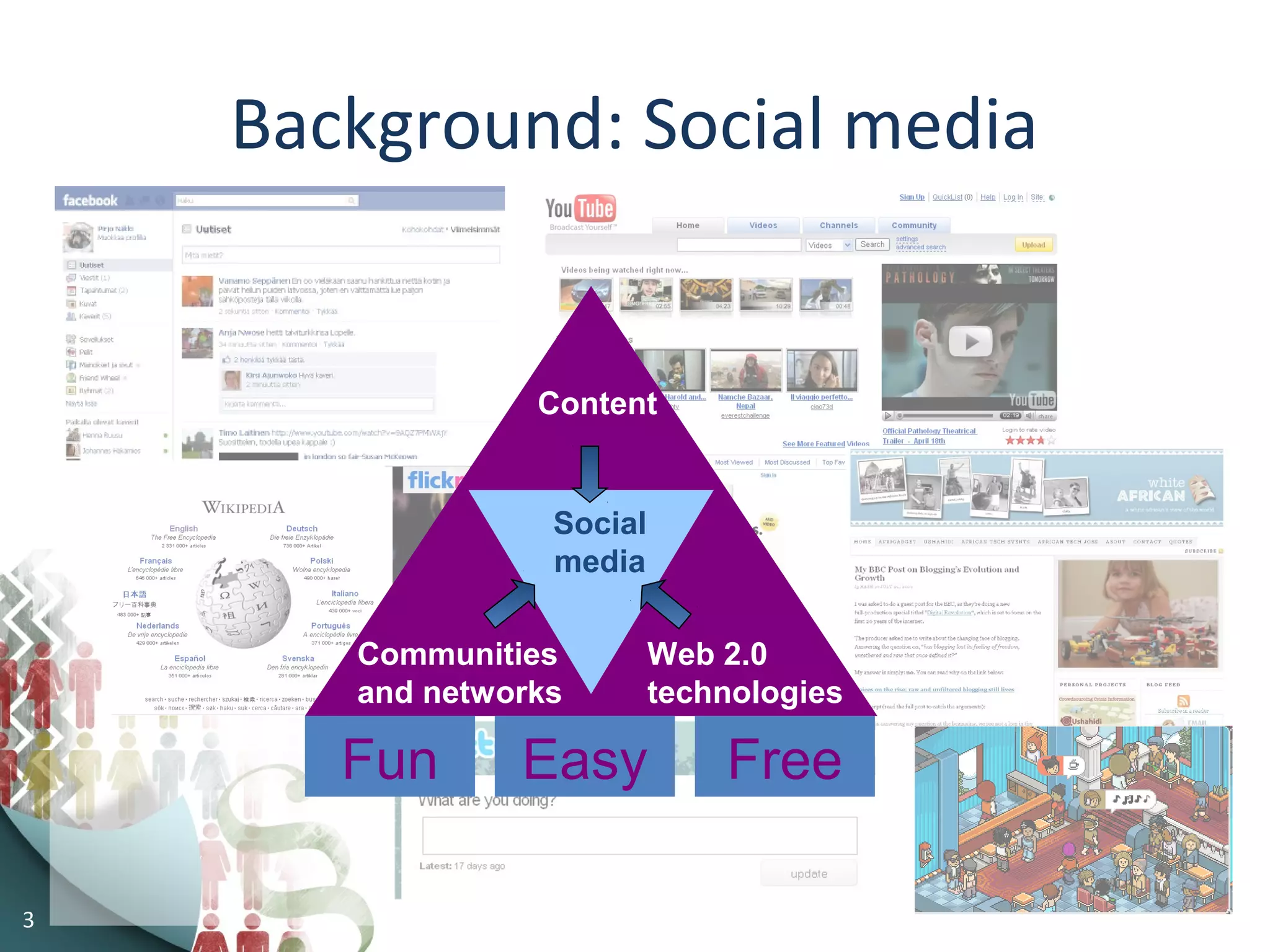
Background: Social media
Social
media
Content
Communities
and networks
Web 2.0
technologies
Fun FreeEasy
Three views to participation
• Goal: Civic participation
– deliberative process (public discussion), open and
accessible to the public
– involving citizens in processes that deal with their
everyday life and environment
• Process: Participatory design
– users participate actively as members of the design team
– integrates the knowledge of different stakeholders in a
common design space
• Result: Social media
– Process, not just tools, content, technology (Erkkola 2008)
– Produsage: open participation, fluid hierarchy, unfinished
artefacts, common property (Bruns 2008)
5
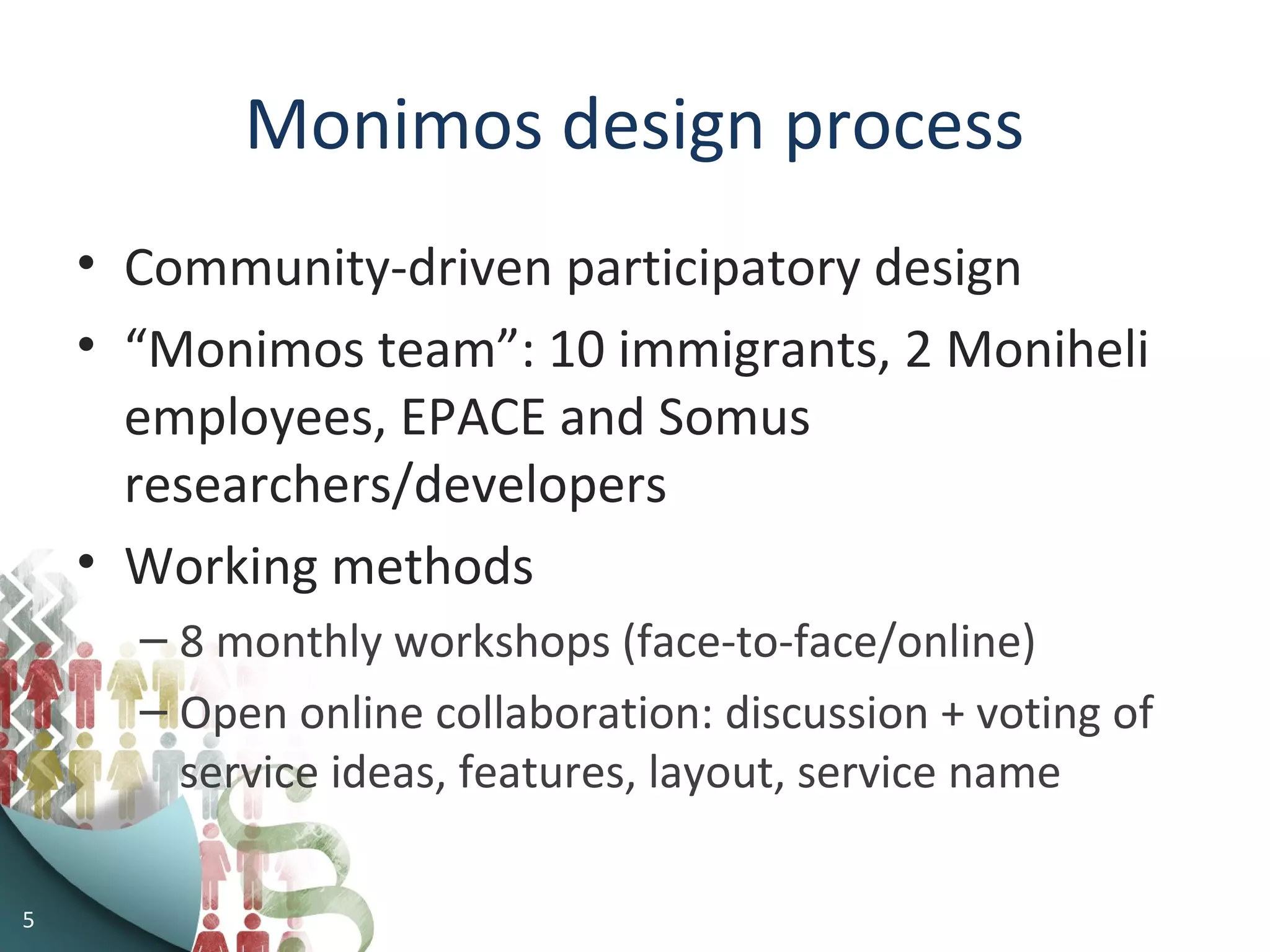
Monimos design process
• Community-driven participatory design
• “Monimos team”: 10 immigrants, 2 Moniheli
employees, EPACE and Somus
researchers/developers
• Working methods
– 8 monthly workshops (face-to-face/online)
– Open online collaboration: discussion + voting of
service ideas, features, layout, service name
6
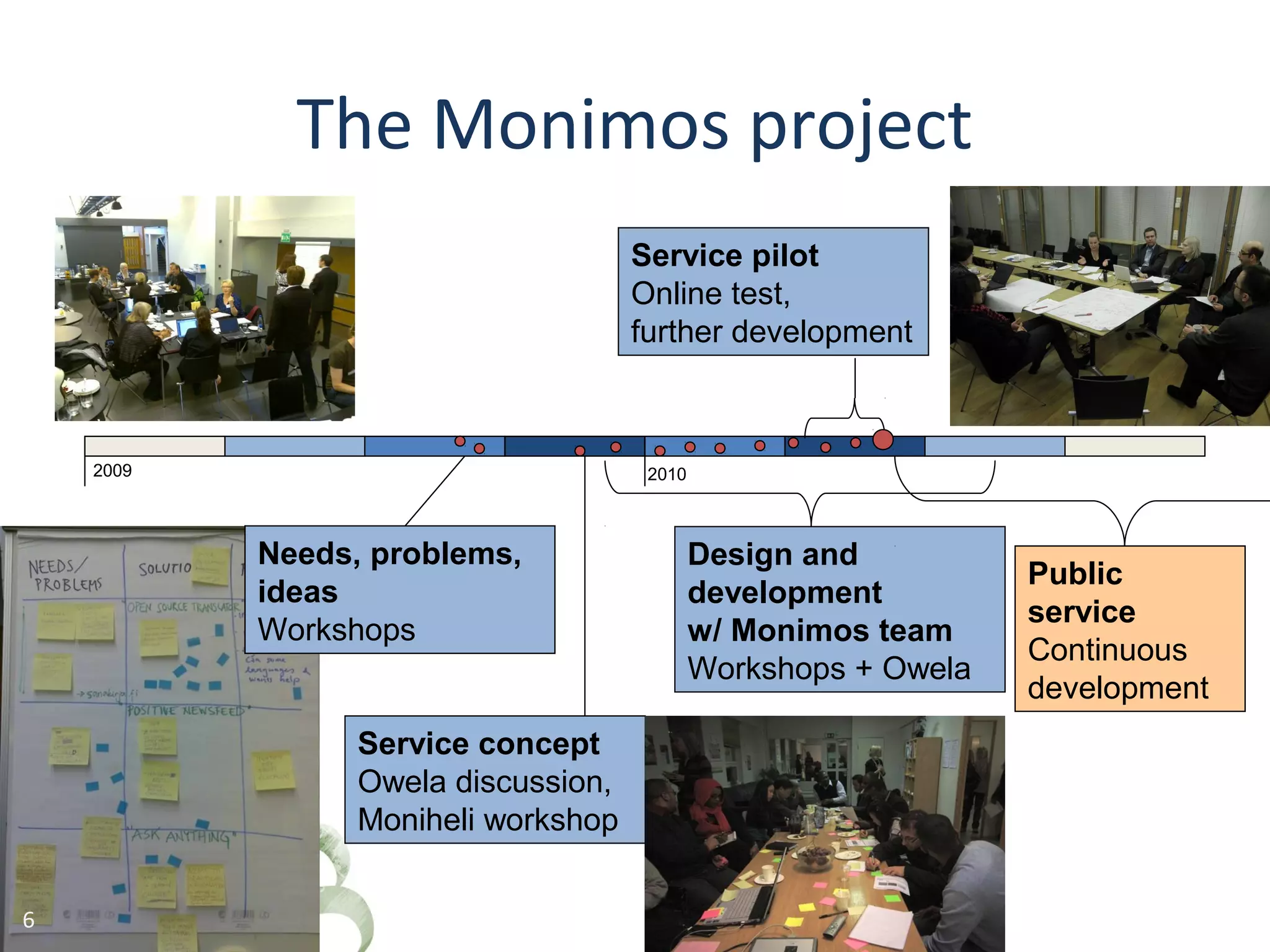
The Monimos project
Needs, problems,
ideas
Workshops
Service concept
Owela discussion,
Moniheli workshop
Service pilot
Online test,
further development
2009 2010
Design and
development
w/ Monimos team
Workshops + Owela
Public
service
Continuous
development
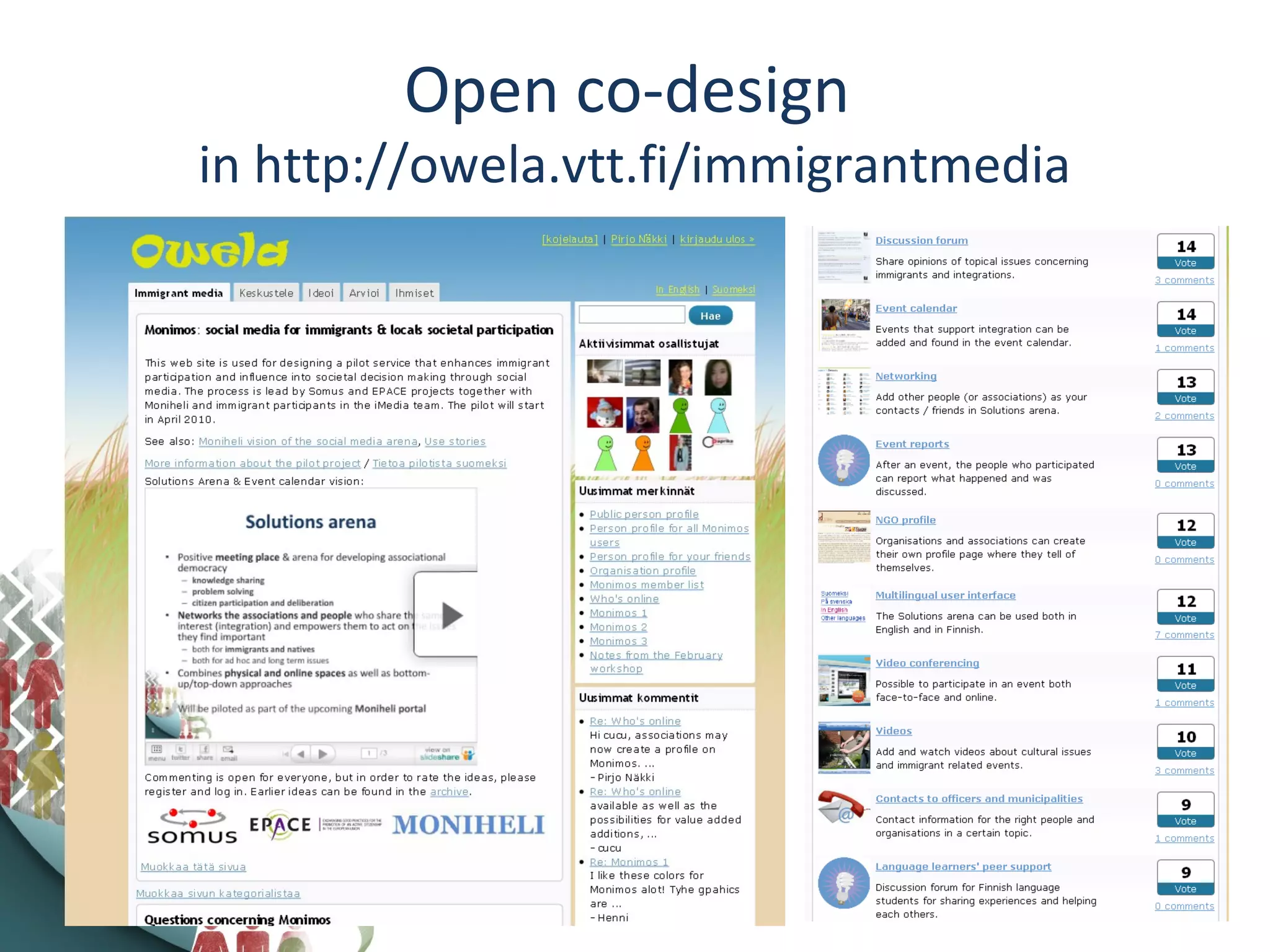
Open co-design
in http://owela.vtt.fi/immigrantmedia
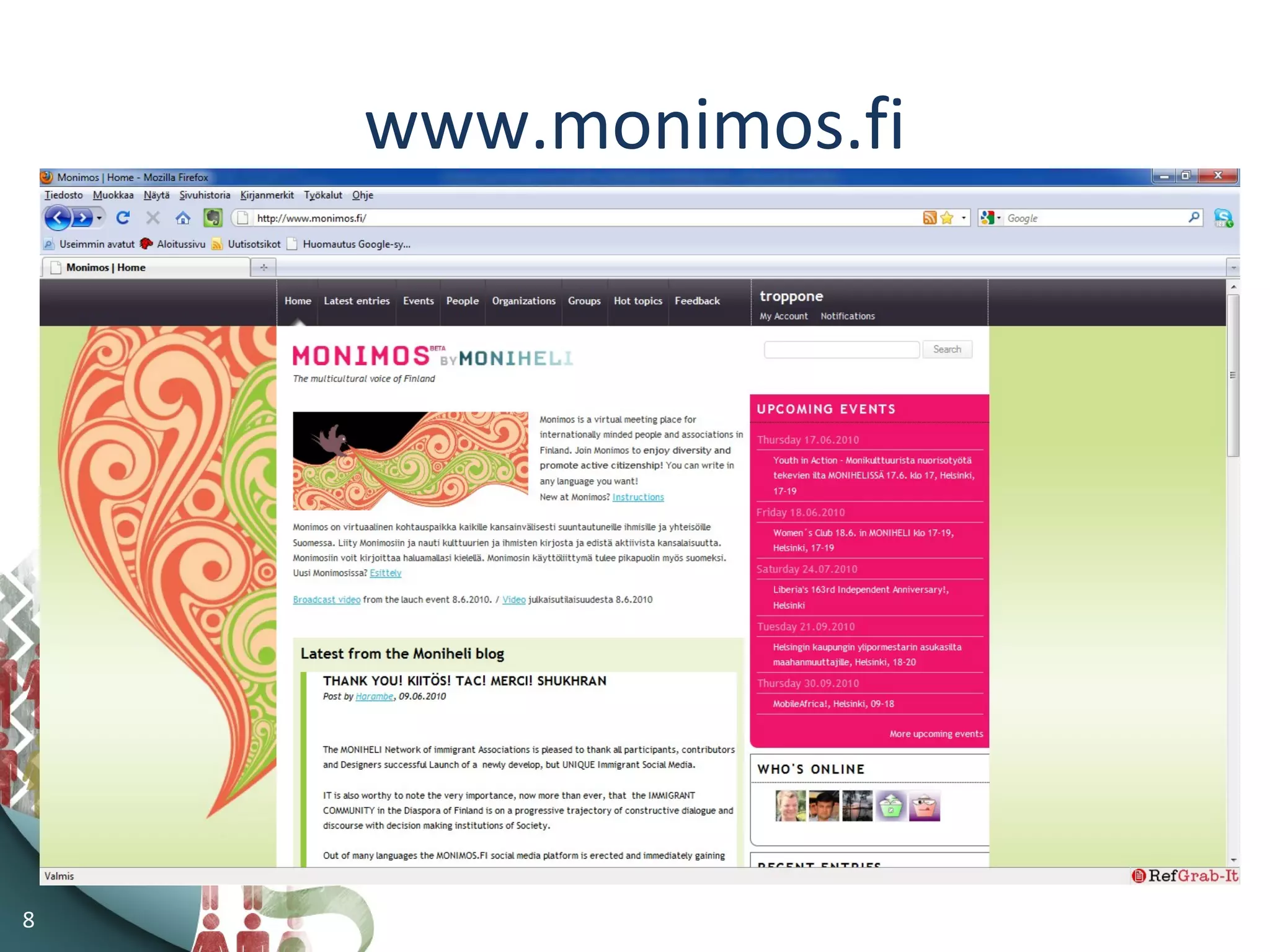
www.monimos.fi
8
Monimos value proposition
“Monimos is a virtual meeting place for
internationally minded people and
associations in Finland to enjoy diversity and
promote active citizenship”
9
Meaning that Monimos…
• Is a positive meeting place for developing associational
democracy through
– Knowledge sharing and problem solving
– Citizen participation and deliberation
– Combining fun and utility
• Networks the associations and people who share the same
interests and helps empower them to act on important issues
• Combines physical and online spaces as well as bottom-
up/top-down approaches
 Monimos is a vehicle for encouraging collective action
10
11
Issues/findings
• Which roles of individuals are present in
people’s decision-making?
• Who owns the project? Researchers,
participants, (funders)?
• Democracy, or co-owning, can hinder
visionary work
• Decisions & design drivers need to be
reminded often, to avoid repetitive
discussions
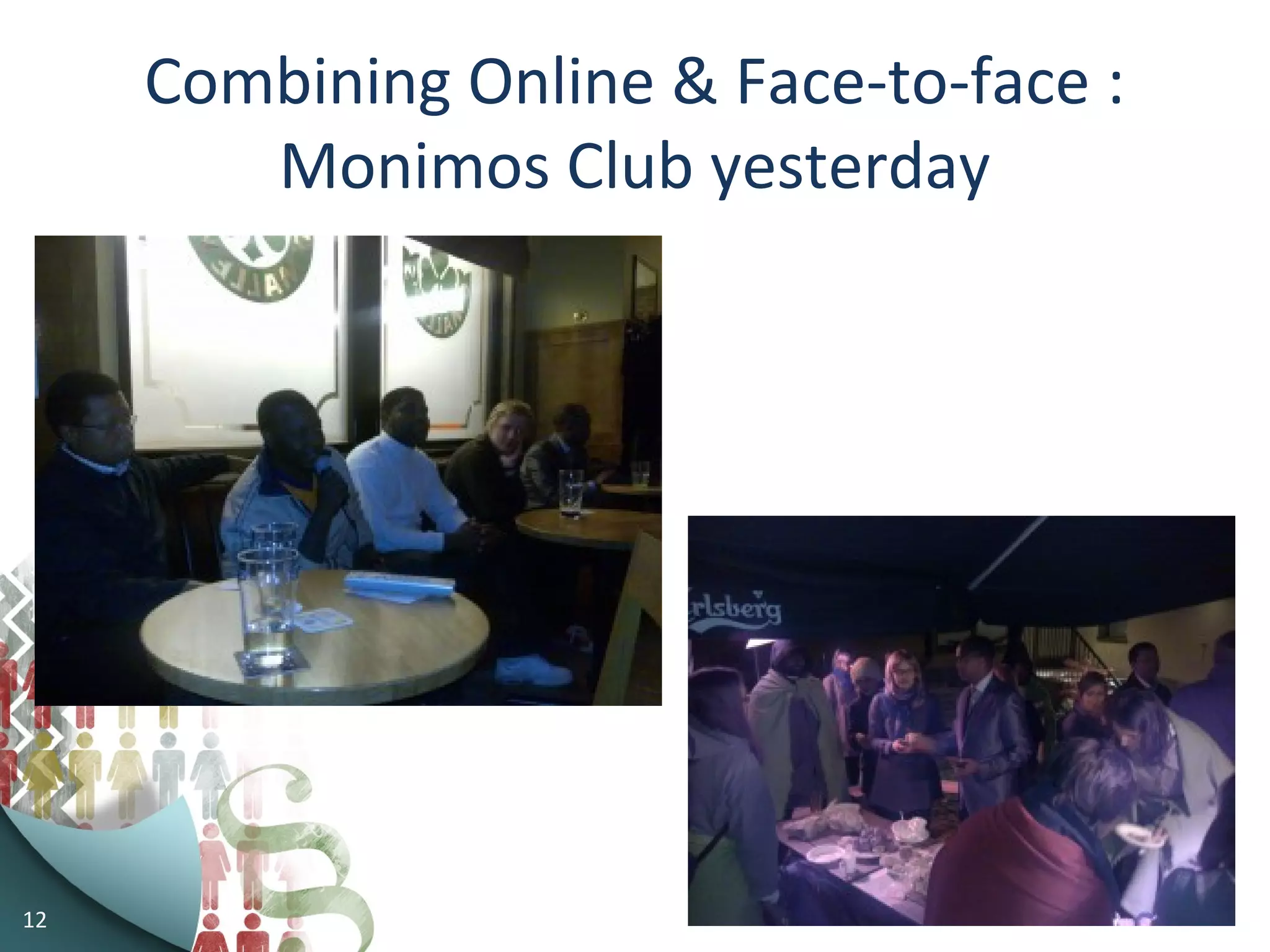
Combining Online & Face-to-face :
Monimos Club yesterday
12
Challenges & success factors
• ”yet another website”
• will it gain enough user base to fly
• Integration/immigration hot subject??
• From talk to action?!
• Communities tend to end up meeting F2F! 
• Top-down vs. bottom-up
• Can gov agencies follow and utilize the service
• Ownership of the service & vision
• Co-design has created a driving force – will it last?
13
14
Conclusions
• Open process needs A LOT of meta-level
communication and crystallization, as well as clear
decision-making guidelines
• Social media- & produsage-like process – already
starting from the design phase
– needs to be taken into account in tool, method and
process selection & design
• Community-driven design is difficult FOR ALL
PARTIES, agreement on open process necessary
15
Thanks!
• Questions?
• We dare you to participate!
– http://www.monimos.fi
– http://somus.vtt.fi
• Contact:
– Teemu.Ropponen@tkk.fi, Pirjo.Nakki@vtt.fi

Monimos Aalto Service Factory 22.10.2010

  • 1.
    1 Co-designing a socialmedia service for civic participation Case Monimos Oct 22, 2010 Teemu Ropponen // SOMUS-project Aalto University School of Science and Technology Department of Media Technology
  • 2.
    Case Monimos • Cansocial media help immigrants in participating in the society and in collaboration with public sector? • Shared case study of two research projects – Somus: Social media for citizens and public sector collaboration – EPACE: Exchanging good practices for the promotion of an active citizenship in the EU, (Ministry of Justice) • ...in collaboration with the network of multicultural associations in Helsinki capital area (Moniheli)
  • 3.
    3 Background: Social media Social media Content Communities andnetworks Web 2.0 technologies Fun FreeEasy
  • 4.
    Three views toparticipation • Goal: Civic participation – deliberative process (public discussion), open and accessible to the public – involving citizens in processes that deal with their everyday life and environment • Process: Participatory design – users participate actively as members of the design team – integrates the knowledge of different stakeholders in a common design space • Result: Social media – Process, not just tools, content, technology (Erkkola 2008) – Produsage: open participation, fluid hierarchy, unfinished artefacts, common property (Bruns 2008)
  • 5.
    5 Monimos design process •Community-driven participatory design • “Monimos team”: 10 immigrants, 2 Moniheli employees, EPACE and Somus researchers/developers • Working methods – 8 monthly workshops (face-to-face/online) – Open online collaboration: discussion + voting of service ideas, features, layout, service name
  • 6.
    6 The Monimos project Needs,problems, ideas Workshops Service concept Owela discussion, Moniheli workshop Service pilot Online test, further development 2009 2010 Design and development w/ Monimos team Workshops + Owela Public service Continuous development
  • 7.
  • 8.
  • 9.
    Monimos value proposition “Monimosis a virtual meeting place for internationally minded people and associations in Finland to enjoy diversity and promote active citizenship” 9
  • 10.
    Meaning that Monimos… •Is a positive meeting place for developing associational democracy through – Knowledge sharing and problem solving – Citizen participation and deliberation – Combining fun and utility • Networks the associations and people who share the same interests and helps empower them to act on important issues • Combines physical and online spaces as well as bottom- up/top-down approaches  Monimos is a vehicle for encouraging collective action 10
  • 11.
    11 Issues/findings • Which rolesof individuals are present in people’s decision-making? • Who owns the project? Researchers, participants, (funders)? • Democracy, or co-owning, can hinder visionary work • Decisions & design drivers need to be reminded often, to avoid repetitive discussions
  • 12.
    Combining Online &Face-to-face : Monimos Club yesterday 12
  • 13.
    Challenges & successfactors • ”yet another website” • will it gain enough user base to fly • Integration/immigration hot subject?? • From talk to action?! • Communities tend to end up meeting F2F!  • Top-down vs. bottom-up • Can gov agencies follow and utilize the service • Ownership of the service & vision • Co-design has created a driving force – will it last? 13
  • 14.
    14 Conclusions • Open processneeds A LOT of meta-level communication and crystallization, as well as clear decision-making guidelines • Social media- & produsage-like process – already starting from the design phase – needs to be taken into account in tool, method and process selection & design • Community-driven design is difficult FOR ALL PARTIES, agreement on open process necessary
  • 15.
    15 Thanks! • Questions? • Wedare you to participate! – http://www.monimos.fi – http://somus.vtt.fi • Contact: – Teemu.Ropponen@tkk.fi, Pirjo.Nakki@vtt.fi