Money…
Group member
name:
1)Rahul kumar singh
Definitions of Money
• Traditional Definition : This view is defined as currency
and demand deposits, and its most important function is to act as a
medium of exchange. However, there are other assets which are
equally acceptable as a medium of exchange. By ignoring these
assets, the traditional view does not analyse their influence in
increasing their velocity.
The money supply of a country consists
of currency (banknotes and coins) and, depending on the particular
definition used, one or more types of bank money (the balances held
in checking accounts, savings accounts, and other types of bank
accounts). Bank money, which consists only of records (mostly
computerized in modern banking), forms by far the largest part
of broad money in developed countries.
Functions of Money
Money has three functions in the economy
1. Medium of Exchange : Money acts as a medium of
exchange that it is an item that buyers give to sellers when
they purchase goods and services. This transfer of money
from buyer to seller allows the transaction to take place. Thus
money is commonly acting as a medium of exchange.
2. Unit of Account : When we want to measure and record
economic value,we use money as the unit of account.
3. Store of value : A store of value is an item that people can
use to transfer purchasing power from present to the future.
Different forms of money
There are 4 major types of Money :
• Commodity Money: where the valuable resources fulfil the functions of money.
Ex: stones, tea, sugar, metal
• Fiat Money:The value of fiat money is determined by government order which
makes it a legal instrument for all transaction purposes.
Ex: Paper money, Coins
• Fiduciary Money:Whenever any bank assures the customers to pay in different
types of money and when the customer can sell the promise or transfer it to
somebody else, it is called the fiduciary money.
Ex: cheques,bank notes
• Commercial Bank Money:Commercial Bank money or demand deposits are claims
against financial institutions that can be used for the purchase of goods and
services.
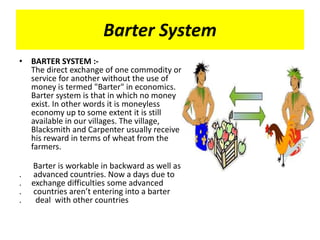
Barter System
• BARTER SYSTEM :-
The direct exchange of one commodity or
service for another without the use of
money is termed "Barter" in economics.
Barter system is that in which no money
exist. In other words it is moneyless
economy up to some extent it is still
available in our villages. The village,
Blacksmith and Carpenter usually receive
his reward in terms of wheat from the
farmers.
Barter is workable in backward as well as
. advanced countries. Now a days due to
. exchange difficulties some advanced
. countries aren’t entering into a barter
. deal with other countries
Problem with barter system
1. Lack Of Double Coincidence Of Wants
2. Lack Of Common Standard Of Value
3. Difficulty For Future Payments
4. Difficulties For Finance Minister
5. Lack Of Subdivision
6. Production of large and costly goods not feasible
Advantages with barter system
1. simple system devoid of the complex problems .
2. There is no question of over or under-production (or of unemployment or
over-hill employment) under the barter system since goods are produced
just to meet the needs of the society.
3. The problems of international trade, such as, foreign exchange crisis,
adverse balance of payments, do not exist under barter system.
4. There is no problem of concentration of economic
power into the hands of a few rich persons under the
barter system because there is no possibility of storing
the commodities.
5. Personal and natural resources are ideally utilised to
meet the needs of the society without involving any
wastage.
6. The barter system also reaps the benefits of division of
labour because it represents a great step forward from a
state of self- sufficiency hi which every man has to be a
jack of all trades and master of none.
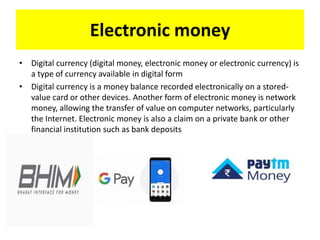
Electronic money
• Digital currency (digital money, electronic money or electronic currency) is
a type of currency available in digital form
• Digital currency is a money balance recorded electronically on a stored-
value card or other devices. Another form of electronic money is network
money, allowing the transfer of value on computer networks, particularly
the Internet. Electronic money is also a claim on a private bank or other
financial institution such as bank deposits
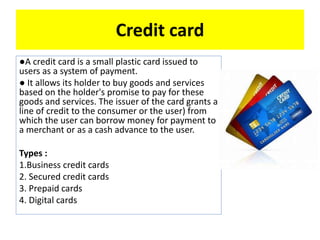
Credit card
●A credit card is a small plastic card issued to
users as a system of payment.
● It allows its holder to buy goods and services
based on the holder's promise to pay for these
goods and services. The issuer of the card grants a
line of credit to the consumer or the user) from
which the user can borrow money for payment to
a merchant or as a cash advance to the user.
Types :
1.Business credit cards
2. Secured credit cards
3. Prepaid cards
4. Digital cards
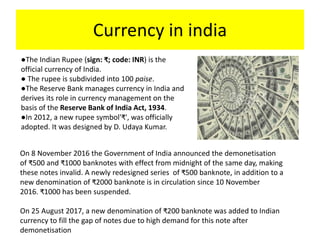
Currency in india
●The Indian Rupee (sign: ₹; code: INR) is the
official currency of India.
● The rupee is subdivided into 100 paise.
●The Reserve Bank manages currency in India and
derives its role in currency management on the
basis of the Reserve Bank of India Act, 1934.
●In 2012, a new rupee symbol'₹', was officially
adopted. It was designed by D. Udaya Kumar.
On 8 November 2016 the Government of India announced the demonetisation
of ₹500 and ₹1000 banknotes with effect from midnight of the same day, making
these notes invalid. A newly redesigned series of ₹500 banknote, in addition to a
new denomination of ₹2000 banknote is in circulation since 10 November
2016. ₹1000 has been suspended.
On 25 August 2017, a new denomination of ₹200 banknote was added to Indian
currency to fill the gap of notes due to high demand for this note after
demonetisation
loan
• In finance, a loan is the lending
of money by one or more individuals,
organizations, or other entities to
other individuals, organizations etc.
The recipient (i.e. the borrower)
incurs a debt, and is usually liable to
pay interest on that debt until it is
repaid, and also to repay the
principal amount borrowed.
• Acting as a provider of loans is one of
the main activities of financial
institutions such as banks and credit
card companies. For other
institutions, issuing of debt contracts
such as bonds is a typical source of
funding.
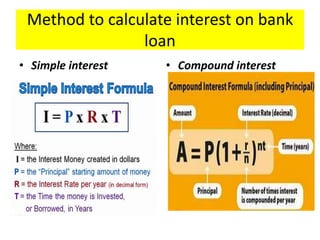
Method to calculate interest on bank
loan
• Simple interest • Compound interest
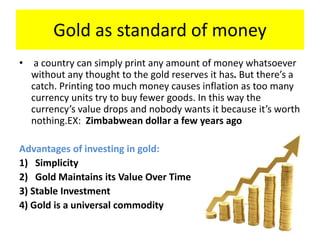
Gold as standard of money
• a country can simply print any amount of money whatsoever
without any thought to the gold reserves it has. But there’s a
catch. Printing too much money causes inflation as too many
currency units try to buy fewer goods. In this way the
currency’s value drops and nobody wants it because it’s worth
nothing.EX: Zimbabwean dollar a few years ago
Advantages of investing in gold:
1) Simplicity
2) Gold Maintains its Value Over Time
3) Stable Investment
4) Gold is a universal commodity
Cheques in india
Definition of a Cheque
"Cheque is an instrument in writing containing an unconditional order, addressed to
a banker, sign by the person who has deposited money with the banker, requiring him
to pay on demand acertain sum of money only to or to the order of certain person or
to the bearer of instrument."
Different Kinds / Types of Cheques
•
1)Blank Cheque
• Blank Cheque is a cheque which has no date, no name and no amount
written but is already signed
• 2)Crossed Cheque
• When a cheque bears across its face two parallel transverse lines, the
cheque is said to be crossed
•
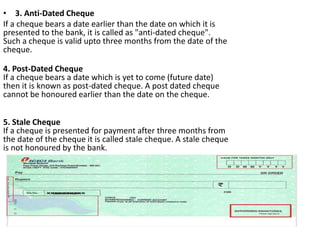
• 3. Anti-Dated Cheque
If a cheque bears a date earlier than the date on which it is
presented to the bank, it is called as "anti-dated cheque".
Such a cheque is valid upto three months from the date of the
cheque.
4. Post-Dated Cheque
If a cheque bears a date which is yet to come (future date)
then it is known as post-dated cheque. A post dated cheque
cannot be honoured earlier than the date on the cheque.
5. Stale Cheque
If a cheque is presented for payment after three months from
the date of the cheque it is called stale cheque. A stale cheque
is not honoured by the bank.
BITCOIN
• Bitcoin (₿) is a cryptocurrency, a form of electronic
cash. It is a decentralized digital currency without
a central bank or single administrator that can be
sent from user to user on the peer-to-peer bitcoin
network without the need for intermediaries.[8]
• Bitcoin was invented by an unknown person or
group of people using the name, Satoshi Nakamoto
Advantages:
●Freedom in Payment
●Control and Security
●Information is Transparent
●Very Low Fees
Disadvantages:
●Lack of Awareness & Understanding
●Risk and Volatility
●Still Developing
banks
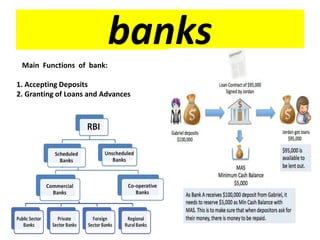
Main Functions of bank:
1. Accepting Deposits
2. Granting of Loans and Advances
RBI
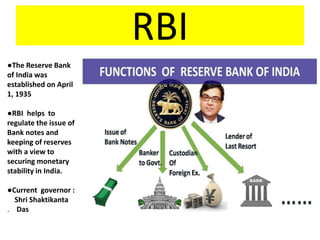
●The Reserve Bank
of India was
established on April
1, 1935
●RBI helps to
regulate the issue of
Bank notes and
keeping of reserves
with a view to
securing monetary
stability in India.
●Current governor :
Shri Shaktikanta
. Das
Demonetisation in india:
MERITS:
1. Demonetisation stroked at the unaccounted cash of corrupt people who stored
it by accepting a bribe or by saving taxes.
2. The higher currency note was visible in unlawful activities.
3. Demonetisation forced people to use their Pan Card of a small transaction of
20K so now people know that the income tax department already has their details
and hiding anything from IT Department can create a problem for them
4. After demonetisation, the trend of the cashless transaction has increased.
DEMERITS:
1. Indians got panicked when they come to know about the ban on
500 and 1000 rupees’ Indian currency.
2. increased pressure of expenses on the government for printing of
new currency and the destruction of the old currency government
expense.
3. Due to a cash crunch, their employer could not pay them for their daily
wages so either they have to stop working for a few days or they chose to
work and receive the payment when the things will become fine.
Money

Money

  • 1.
  • 2.
    Definitions of Money •Traditional Definition : This view is defined as currency and demand deposits, and its most important function is to act as a medium of exchange. However, there are other assets which are equally acceptable as a medium of exchange. By ignoring these assets, the traditional view does not analyse their influence in increasing their velocity. The money supply of a country consists of currency (banknotes and coins) and, depending on the particular definition used, one or more types of bank money (the balances held in checking accounts, savings accounts, and other types of bank accounts). Bank money, which consists only of records (mostly computerized in modern banking), forms by far the largest part of broad money in developed countries.
  • 3.
    Functions of Money Moneyhas three functions in the economy 1. Medium of Exchange : Money acts as a medium of exchange that it is an item that buyers give to sellers when they purchase goods and services. This transfer of money from buyer to seller allows the transaction to take place. Thus money is commonly acting as a medium of exchange. 2. Unit of Account : When we want to measure and record economic value,we use money as the unit of account. 3. Store of value : A store of value is an item that people can use to transfer purchasing power from present to the future.
  • 4.
    Different forms ofmoney There are 4 major types of Money : • Commodity Money: where the valuable resources fulfil the functions of money. Ex: stones, tea, sugar, metal • Fiat Money:The value of fiat money is determined by government order which makes it a legal instrument for all transaction purposes. Ex: Paper money, Coins • Fiduciary Money:Whenever any bank assures the customers to pay in different types of money and when the customer can sell the promise or transfer it to somebody else, it is called the fiduciary money. Ex: cheques,bank notes • Commercial Bank Money:Commercial Bank money or demand deposits are claims against financial institutions that can be used for the purchase of goods and services.
  • 5.
    Barter System • BARTERSYSTEM :- The direct exchange of one commodity or service for another without the use of money is termed "Barter" in economics. Barter system is that in which no money exist. In other words it is moneyless economy up to some extent it is still available in our villages. The village, Blacksmith and Carpenter usually receive his reward in terms of wheat from the farmers. Barter is workable in backward as well as . advanced countries. Now a days due to . exchange difficulties some advanced . countries aren’t entering into a barter . deal with other countries
  • 6.
    Problem with bartersystem 1. Lack Of Double Coincidence Of Wants 2. Lack Of Common Standard Of Value 3. Difficulty For Future Payments 4. Difficulties For Finance Minister 5. Lack Of Subdivision 6. Production of large and costly goods not feasible Advantages with barter system 1. simple system devoid of the complex problems . 2. There is no question of over or under-production (or of unemployment or over-hill employment) under the barter system since goods are produced just to meet the needs of the society. 3. The problems of international trade, such as, foreign exchange crisis, adverse balance of payments, do not exist under barter system.
  • 7.
    4. There isno problem of concentration of economic power into the hands of a few rich persons under the barter system because there is no possibility of storing the commodities. 5. Personal and natural resources are ideally utilised to meet the needs of the society without involving any wastage. 6. The barter system also reaps the benefits of division of labour because it represents a great step forward from a state of self- sufficiency hi which every man has to be a jack of all trades and master of none.
  • 8.
    Electronic money • Digitalcurrency (digital money, electronic money or electronic currency) is a type of currency available in digital form • Digital currency is a money balance recorded electronically on a stored- value card or other devices. Another form of electronic money is network money, allowing the transfer of value on computer networks, particularly the Internet. Electronic money is also a claim on a private bank or other financial institution such as bank deposits
  • 9.
    Credit card ●A creditcard is a small plastic card issued to users as a system of payment. ● It allows its holder to buy goods and services based on the holder's promise to pay for these goods and services. The issuer of the card grants a line of credit to the consumer or the user) from which the user can borrow money for payment to a merchant or as a cash advance to the user. Types : 1.Business credit cards 2. Secured credit cards 3. Prepaid cards 4. Digital cards
  • 10.
    Currency in india ●TheIndian Rupee (sign: ₹; code: INR) is the official currency of India. ● The rupee is subdivided into 100 paise. ●The Reserve Bank manages currency in India and derives its role in currency management on the basis of the Reserve Bank of India Act, 1934. ●In 2012, a new rupee symbol'₹', was officially adopted. It was designed by D. Udaya Kumar. On 8 November 2016 the Government of India announced the demonetisation of ₹500 and ₹1000 banknotes with effect from midnight of the same day, making these notes invalid. A newly redesigned series of ₹500 banknote, in addition to a new denomination of ₹2000 banknote is in circulation since 10 November 2016. ₹1000 has been suspended. On 25 August 2017, a new denomination of ₹200 banknote was added to Indian currency to fill the gap of notes due to high demand for this note after demonetisation
  • 11.
    loan • In finance,a loan is the lending of money by one or more individuals, organizations, or other entities to other individuals, organizations etc. The recipient (i.e. the borrower) incurs a debt, and is usually liable to pay interest on that debt until it is repaid, and also to repay the principal amount borrowed. • Acting as a provider of loans is one of the main activities of financial institutions such as banks and credit card companies. For other institutions, issuing of debt contracts such as bonds is a typical source of funding.
  • 12.
    Method to calculateinterest on bank loan • Simple interest • Compound interest
  • 13.
    Gold as standardof money • a country can simply print any amount of money whatsoever without any thought to the gold reserves it has. But there’s a catch. Printing too much money causes inflation as too many currency units try to buy fewer goods. In this way the currency’s value drops and nobody wants it because it’s worth nothing.EX: Zimbabwean dollar a few years ago Advantages of investing in gold: 1) Simplicity 2) Gold Maintains its Value Over Time 3) Stable Investment 4) Gold is a universal commodity
  • 14.
    Cheques in india Definitionof a Cheque "Cheque is an instrument in writing containing an unconditional order, addressed to a banker, sign by the person who has deposited money with the banker, requiring him to pay on demand acertain sum of money only to or to the order of certain person or to the bearer of instrument." Different Kinds / Types of Cheques • 1)Blank Cheque • Blank Cheque is a cheque which has no date, no name and no amount written but is already signed • 2)Crossed Cheque • When a cheque bears across its face two parallel transverse lines, the cheque is said to be crossed •
  • 15.
    • 3. Anti-DatedCheque If a cheque bears a date earlier than the date on which it is presented to the bank, it is called as "anti-dated cheque". Such a cheque is valid upto three months from the date of the cheque. 4. Post-Dated Cheque If a cheque bears a date which is yet to come (future date) then it is known as post-dated cheque. A post dated cheque cannot be honoured earlier than the date on the cheque. 5. Stale Cheque If a cheque is presented for payment after three months from the date of the cheque it is called stale cheque. A stale cheque is not honoured by the bank.
  • 16.
    BITCOIN • Bitcoin (₿)is a cryptocurrency, a form of electronic cash. It is a decentralized digital currency without a central bank or single administrator that can be sent from user to user on the peer-to-peer bitcoin network without the need for intermediaries.[8] • Bitcoin was invented by an unknown person or group of people using the name, Satoshi Nakamoto Advantages: ●Freedom in Payment ●Control and Security ●Information is Transparent ●Very Low Fees Disadvantages: ●Lack of Awareness & Understanding ●Risk and Volatility ●Still Developing
  • 17.
    banks Main Functions ofbank: 1. Accepting Deposits 2. Granting of Loans and Advances
  • 18.
    RBI ●The Reserve Bank ofIndia was established on April 1, 1935 ●RBI helps to regulate the issue of Bank notes and keeping of reserves with a view to securing monetary stability in India. ●Current governor : Shri Shaktikanta . Das
  • 19.
    Demonetisation in india: MERITS: 1.Demonetisation stroked at the unaccounted cash of corrupt people who stored it by accepting a bribe or by saving taxes. 2. The higher currency note was visible in unlawful activities. 3. Demonetisation forced people to use their Pan Card of a small transaction of 20K so now people know that the income tax department already has their details and hiding anything from IT Department can create a problem for them 4. After demonetisation, the trend of the cashless transaction has increased. DEMERITS: 1. Indians got panicked when they come to know about the ban on 500 and 1000 rupees’ Indian currency. 2. increased pressure of expenses on the government for printing of new currency and the destruction of the old currency government expense. 3. Due to a cash crunch, their employer could not pay them for their daily wages so either they have to stop working for a few days or they chose to work and receive the payment when the things will become fine.