
LinkEHR Studio: a tool for
archetype-based data transformations
David Moner
damoca@upv.es
Biomedical Informatics Group (IBIME)
ITACA Institute, Technical University of Valencia
Arctic Conference on Dual-Model based Clinical
Decision Support and Knowledge Management
Tromsø, May 27th and 28th, 2014
Model and data transformations
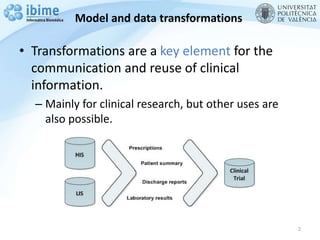
• Transformations are a key element for the
communication and reuse of clinical
information.
– Mainly for clinical research, but other uses are
also possible.
2
Model and data transformations
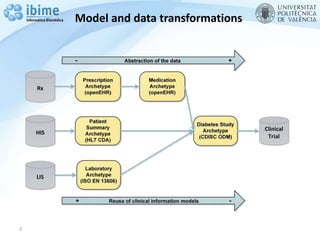
3
Model and data transformations
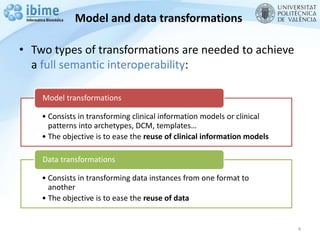
• Two types of transformations are needed to achieve
a full semantic interoperability:
4
• Consists in transforming clinical information models or clinical
patterns into archetypes, DCM, templates…
• The objective is to ease the reuse of clinical information models
Model transformations
• Consists in transforming data instances from one format to
another
• The objective is to ease the reuse of data
Data transformations
Model transformations
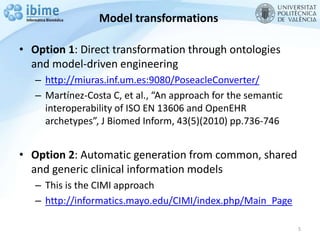
• Option 1: Direct transformation through ontologies
and model-driven engineering
– http://miuras.inf.um.es:9080/PoseacleConverter/
– Martínez-Costa C, et al., “An approach for the semantic
interoperability of ISO EN 13606 and OpenEHR
archetypes”, J Biomed Inform, 43(5)(2010) pp.736-746
• Option 2: Automatic generation from common, shared
and generic clinical information models
– This is the CIMI approach
– http://informatics.mayo.edu/CIMI/index.php/Main_Page
5
Data transformations
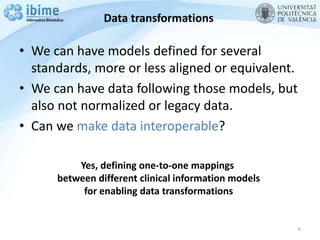
• We can have models defined for several
standards, more or less aligned or equivalent.
• We can have data following those models, but
also not normalized or legacy data.
• Can we make data interoperable?
6
Yes, defining one-to-one mappings
between different clinical information models
for enabling data transformations
7
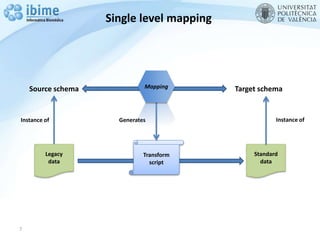
Source schema Target schema
Transform
script
Standard
data
Instance of Instance ofGenerates
Single level mapping
Mapping
Legacy
data
Single level mapping
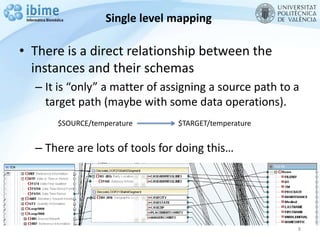
• There is a direct relationship between the
instances and their schemas
– It is “only” a matter of assigning a source path to a
target path (maybe with some data operations).
– There are lots of tools for doing this…
8
$SOURCE/temperature $TARGET/temperature
Two level mapping
• When we use a dual-model it becomes more
complicated
– The archetype defines a sub-schema that must be
used during the mapping process.
– We can generate an ad hoc schema, specific for
each archetype, but this solution can potentially
create maintenance and interoperability
problems.
9
Two level mapping
10
www.linkehr.com
• LinkEHR Studio is a Reference Model-
independent archetype tool.
– It can define archetypes based on EN ISO 13606,
openEHR, HL7 CDA, HL7 FHIR, CDISC ODM…
– It is also a mapping and transformation-generator
tool to convert existing data into archetype/RM
compliant data.
Two level mapping
• LinkEHR Studio mapping functionality allows
using directly archetypes as source or target
schema.
– It is a tool for EHR systems developers.
• It generates an XQuery transformation
program that can be used by any system that
needs a conversion to/from archetyped data.
– It works with XML data.
11
12
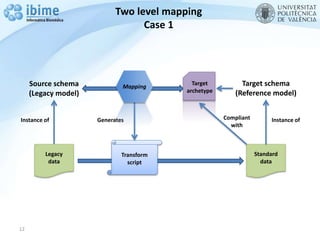
Source schema
(Legacy model)
Target schema
(Reference model)
Transform
script
Standard
data
Instance of Instance ofGenerates
Two level mapping
Case 1
Mapping
Target
archetype
Compliant
with
Legacy
data
Two level mapping
Case 1
• Transformation of legacy to RM instance
according to an archetype definition.
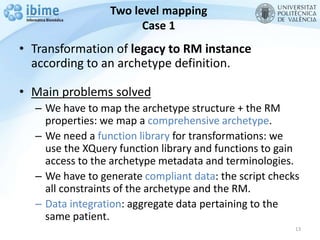
• Main problems solved
– We have to map the archetype structure + the RM
properties: we map a comprehensive archetype.
– We need a function library for transformations: we
use the XQuery function library and functions to gain
access to the archetype metadata and terminologies.
– We have to generate compliant data: the script checks
all constraints of the archetype and the RM.
– Data integration: aggregate data pertaining to the
same patient.
13
Two level mapping
Case 1
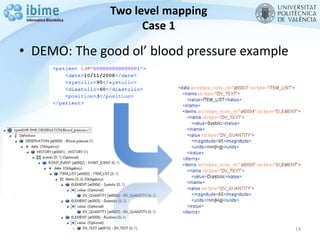
• DEMO: The good ol’ blood pressure example
14
Two level mapping
Case 1
15
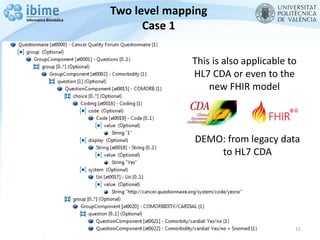
This is also applicable to
HL7 CDA or even to the
new FHIR model
DEMO: from legacy data
to HL7 CDA
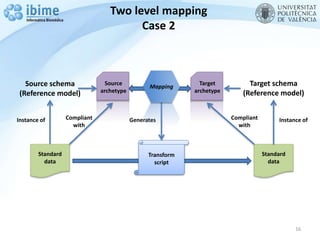
Two level mapping
Case 2
16
Source schema
(Reference model)
Target schema
(Reference model)
Transform
script
Standard
data
Instance of Instance ofGenerates
Mapping
Target
archetype
Compliant
with
Standard
data
Source
archetype
Compliant
with
Two level mapping
Case 2
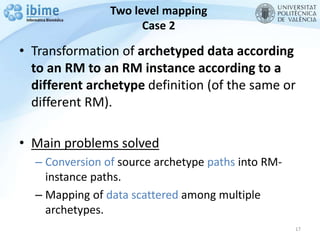
• Transformation of archetyped data according
to an RM to an RM instance according to a
different archetype definition (of the same or
different RM).
• Main problems solved
– Conversion of source archetype paths into RM-
instance paths.
– Mapping of data scattered among multiple
archetypes.
17
Two level mapping
Case 2
• DEMO: from openEHR blood pressure to
13606.
• DEMO: from openEHR problems to an HL7
CDA document.
• DEMO: from HL7 CDA consultation note to
openEHR.
18
Integrating the transformation
scripts in your systems
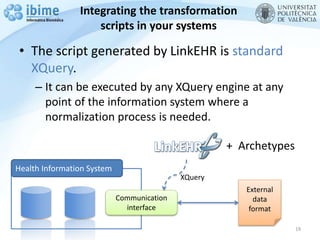
• The script generated by LinkEHR is standard
XQuery.
– It can be executed by any XQuery engine at any
point of the information system where a
normalization process is needed.
19
Communication
interface
Health Information System
External
data
format
XQuery
+ Archetypes
Use cases
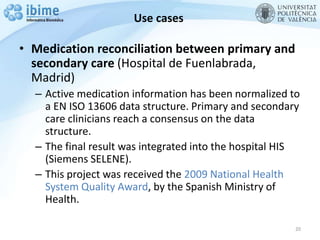
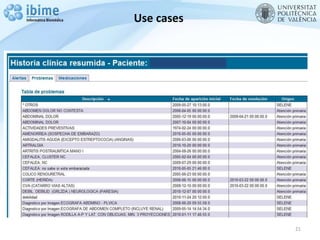
• Medication reconciliation between primary and
secondary care (Hospital de Fuenlabrada,
Madrid)
– Active medication information has been normalized to
a EN ISO 13606 data structure. Primary and secondary
care clinicians reach a consensus on the data
structure.
– The final result was integrated into the hospital HIS
(Siemens SELENE).
– This project was received the 2009 National Health
System Quality Award, by the Spanish Ministry of
Health.
20
Use cases
21
Use cases
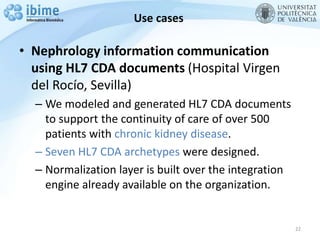
• Nephrology information communication
using HL7 CDA documents (Hospital Virgen
del Rocío, Sevilla)
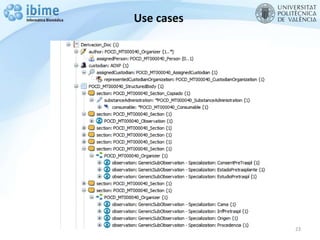
– We modeled and generated HL7 CDA documents
to support the continuity of care of over 500
patients with chronic kidney disease.
– Seven HL7 CDA archetypes were designed.
– Normalization layer is built over the integration
engine already available on the organization.
22
Use cases
23
Use cases
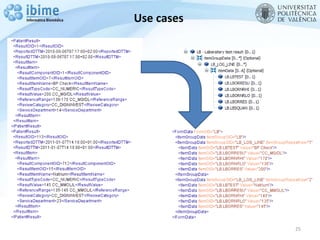
• Feeding of a contract research organization
(CRO) information system using CDISC ODM
– Data from a commercial EHR system was extracted
and transformed to CDISC ODM.
– Data was anonymized during this process.
– Normalized data was consolidated in the CRO
system for further processing.
24
Use cases
25
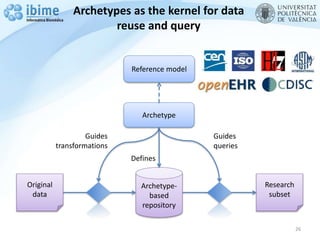
Archetypes as the kernel for data
reuse and query
26
Reference model
Archetype
Archetype-
based
repository
Original
data
Research
subset
Defines
Guides
transformations
Guides
queries
Thank you for your attention!
Questions?
This presentation has been supported by a grant from Iceland,
Liechtenstein and Norway through the EEA Financial Mechanism.
Operated by Universidad Complutense de Madrid

Archetype-based data transformation with LinkEHR

  • 1.
    LinkEHR Studio: atool for archetype-based data transformations David Moner damoca@upv.es Biomedical Informatics Group (IBIME) ITACA Institute, Technical University of Valencia Arctic Conference on Dual-Model based Clinical Decision Support and Knowledge Management Tromsø, May 27th and 28th, 2014
  • 2.
    Model and datatransformations • Transformations are a key element for the communication and reuse of clinical information. – Mainly for clinical research, but other uses are also possible. 2
  • 3.
    Model and datatransformations 3
  • 4.
    Model and datatransformations • Two types of transformations are needed to achieve a full semantic interoperability: 4 • Consists in transforming clinical information models or clinical patterns into archetypes, DCM, templates… • The objective is to ease the reuse of clinical information models Model transformations • Consists in transforming data instances from one format to another • The objective is to ease the reuse of data Data transformations
  • 5.
    Model transformations • Option1: Direct transformation through ontologies and model-driven engineering – http://miuras.inf.um.es:9080/PoseacleConverter/ – Martínez-Costa C, et al., “An approach for the semantic interoperability of ISO EN 13606 and OpenEHR archetypes”, J Biomed Inform, 43(5)(2010) pp.736-746 • Option 2: Automatic generation from common, shared and generic clinical information models – This is the CIMI approach – http://informatics.mayo.edu/CIMI/index.php/Main_Page 5
  • 6.
    Data transformations • Wecan have models defined for several standards, more or less aligned or equivalent. • We can have data following those models, but also not normalized or legacy data. • Can we make data interoperable? 6 Yes, defining one-to-one mappings between different clinical information models for enabling data transformations
  • 7.
    7 Source schema Targetschema Transform script Standard data Instance of Instance ofGenerates Single level mapping Mapping Legacy data
  • 8.
    Single level mapping •There is a direct relationship between the instances and their schemas – It is “only” a matter of assigning a source path to a target path (maybe with some data operations). – There are lots of tools for doing this… 8 $SOURCE/temperature $TARGET/temperature
  • 9.
    Two level mapping •When we use a dual-model it becomes more complicated – The archetype defines a sub-schema that must be used during the mapping process. – We can generate an ad hoc schema, specific for each archetype, but this solution can potentially create maintenance and interoperability problems. 9
  • 10.
    Two level mapping 10 www.linkehr.com •LinkEHR Studio is a Reference Model- independent archetype tool. – It can define archetypes based on EN ISO 13606, openEHR, HL7 CDA, HL7 FHIR, CDISC ODM… – It is also a mapping and transformation-generator tool to convert existing data into archetype/RM compliant data.
  • 11.
    Two level mapping •LinkEHR Studio mapping functionality allows using directly archetypes as source or target schema. – It is a tool for EHR systems developers. • It generates an XQuery transformation program that can be used by any system that needs a conversion to/from archetyped data. – It works with XML data. 11
  • 12.
    12 Source schema (Legacy model) Targetschema (Reference model) Transform script Standard data Instance of Instance ofGenerates Two level mapping Case 1 Mapping Target archetype Compliant with Legacy data
  • 13.
    Two level mapping Case1 • Transformation of legacy to RM instance according to an archetype definition. • Main problems solved – We have to map the archetype structure + the RM properties: we map a comprehensive archetype. – We need a function library for transformations: we use the XQuery function library and functions to gain access to the archetype metadata and terminologies. – We have to generate compliant data: the script checks all constraints of the archetype and the RM. – Data integration: aggregate data pertaining to the same patient. 13
  • 14.
    Two level mapping Case1 • DEMO: The good ol’ blood pressure example 14
  • 15.
    Two level mapping Case1 15 This is also applicable to HL7 CDA or even to the new FHIR model DEMO: from legacy data to HL7 CDA
  • 16.
    Two level mapping Case2 16 Source schema (Reference model) Target schema (Reference model) Transform script Standard data Instance of Instance ofGenerates Mapping Target archetype Compliant with Standard data Source archetype Compliant with
  • 17.
    Two level mapping Case2 • Transformation of archetyped data according to an RM to an RM instance according to a different archetype definition (of the same or different RM). • Main problems solved – Conversion of source archetype paths into RM- instance paths. – Mapping of data scattered among multiple archetypes. 17
  • 18.
    Two level mapping Case2 • DEMO: from openEHR blood pressure to 13606. • DEMO: from openEHR problems to an HL7 CDA document. • DEMO: from HL7 CDA consultation note to openEHR. 18
  • 19.
    Integrating the transformation scriptsin your systems • The script generated by LinkEHR is standard XQuery. – It can be executed by any XQuery engine at any point of the information system where a normalization process is needed. 19 Communication interface Health Information System External data format XQuery + Archetypes
  • 20.
    Use cases • Medicationreconciliation between primary and secondary care (Hospital de Fuenlabrada, Madrid) – Active medication information has been normalized to a EN ISO 13606 data structure. Primary and secondary care clinicians reach a consensus on the data structure. – The final result was integrated into the hospital HIS (Siemens SELENE). – This project was received the 2009 National Health System Quality Award, by the Spanish Ministry of Health. 20
  • 21.
  • 22.
    Use cases • Nephrologyinformation communication using HL7 CDA documents (Hospital Virgen del Rocío, Sevilla) – We modeled and generated HL7 CDA documents to support the continuity of care of over 500 patients with chronic kidney disease. – Seven HL7 CDA archetypes were designed. – Normalization layer is built over the integration engine already available on the organization. 22
  • 23.
  • 24.
    Use cases • Feedingof a contract research organization (CRO) information system using CDISC ODM – Data from a commercial EHR system was extracted and transformed to CDISC ODM. – Data was anonymized during this process. – Normalized data was consolidated in the CRO system for further processing. 24
  • 25.
  • 26.
    Archetypes as thekernel for data reuse and query 26 Reference model Archetype Archetype- based repository Original data Research subset Defines Guides transformations Guides queries
  • 27.
    Thank you foryour attention! Questions? This presentation has been supported by a grant from Iceland, Liechtenstein and Norway through the EEA Financial Mechanism. Operated by Universidad Complutense de Madrid