

Ian McNicoll
Introduction to openEHR
Reference Model (RM)
openEHR RM for ‘mortals’
The clinical modelling tools hide
most of the Reference Model
and detailed understanding is
not required for clinicians or 3rd
party developers
Some aspects of the RM are
worth knowing as it carries a
few key pieces of information
that do not need to be modelled
in archetypes i.e we get those
‘for free’
Technical modelling basics
A few basic ideas from the world
of technical modelling will help
BUT .. the whole point of openEHR
and archetypes is to hide most of
this complexity
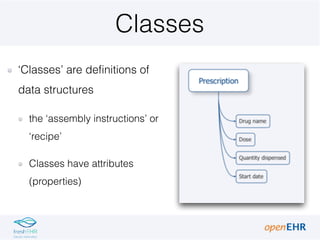
Classes
‘Classes’ are definitions of
data structures
the ‘assembly instructions’ or
‘recipe’
Classes have attributes
(properties)
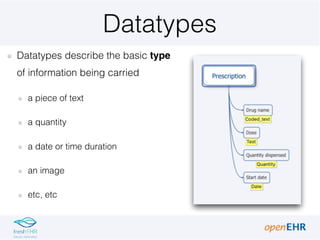
Datatypes
Datatypes describe the basic type
of information being carried
a piece of text
a quantity
a date or time duration
an image
etc, etc
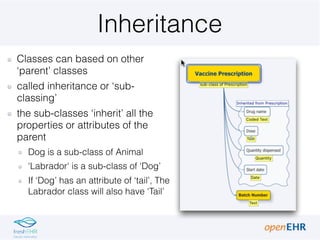
Inheritance
Classes can based on other
‘parent’ classes
called inheritance or ‘sub-
classing’
the sub-classes ‘inherit’ all the
properties or attributes of the
parent
Dog is a sub-class of Animal
‘Labrador' is a sub-class of ‘Dog’
If ‘Dog’ has an attribute of ‘tail’, The
Labrador class will also have ‘Tail’
Facebook class example
Mailing Address
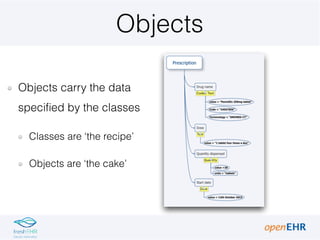
Objects
Objects carry the data
specified by the classes
Classes are ‘the recipe’
Objects are ‘the cake’
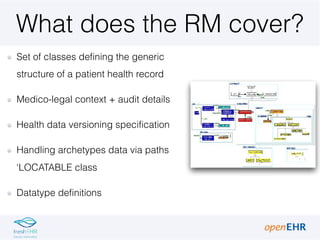
What does the RM cover?
Set of classes defining the generic
structure of a patient health record
Medico-legal context + audit details
Health data versioning specification
Handling archetypes data via paths
‘LOCATABLE class
Datatype definitions
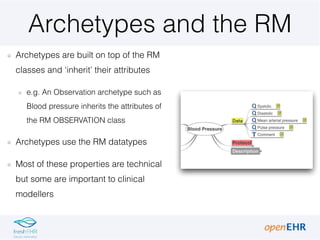
Archetypes and the RM
Archetypes are built on top of the RM
classes and ‘inherit’ their attributes
e.g. An Observation archetype such as
Blood pressure inherits the attributes of
the RM OBSERVATION class
Archetypes use the RM datatypes
Most of these properties are technical
but some are important to clinical
modellers
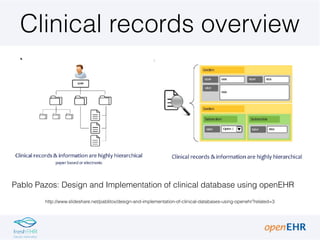
Clinical records overview
Pablo Pazos: Design and Implementation of clinical database using openEHR
http://www.slideshare.net/pablitox/design-and-implementation-of-clinical-databases-using-openehr?related=3
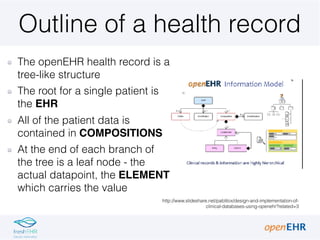
Outline of a health record
The openEHR health record is a
tree-like structure
The root for a single patient is
the EHR
All of the patient data is
contained in COMPOSITIONS
At the end of each branch of
the tree is a leaf node - the
actual datapoint, the ELEMENT
which carries the value
http://www.slideshare.net/pablitox/design-and-implementation-of-
clinical-databases-using-openehr?related=3
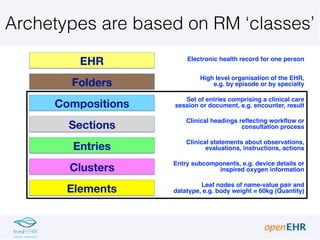
Archetypes are based on RM ‘classes’
EHR
Folders
Compositions
Sections
Entries
Clusters
Elements
Electronic health record for one person
High level organisation of the EHR,
e.g. by episode or by specialty
Set of entries comprising a clinical care
session or document, e.g. encounter, result
Clinical headings reflecting workflow or
consultation process
Clinical statements about observations,
evaluations, instructions, actions
Entry subcomponents, e.g. device details or
inspired oxygen information
Leaf nodes of name-value pair and
datatype, e.g. body weight = 60kg (Quantity)
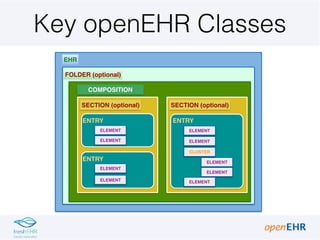
Key openEHR Classes
EHR
FOLDER (optional)
COMPOSITION
SECTION (optional)
ENTRY
ELEMENT
ELEMENT
ENTRY
ELEMENT
ELEMENT
ENTRY
ELEMENT
ELEMENT
ELEMENT
ELEMENT
CLUSTER
ELEMENT
SECTION (optional)
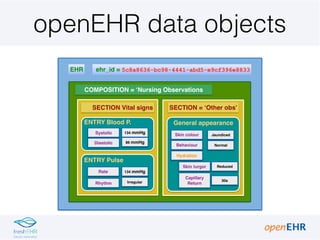
openEHR data objects
EHR
COMPOSITION = ‘Nursing Observations
SECTION Vital signs
ENTRY Blood P.
Systolic
Diastolic
ENTRY Pulse
Rate
Rhythm
General appearance
Skin colour
Behaviour
Skin turgor
Capillary
Return
Hydration
SECTION = ‘Other obs’
ehr_id = 5c8a8636-bc98-4441-abd5-e9cf396e8833
134 mmHg
86 mmHg
134 mmHg
Irregular
Jaundiced
Normal
Reduced
30s
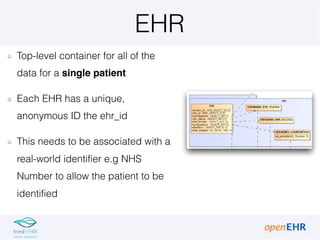
EHR
Top-level container for all of the
data for a single patient
Each EHR has a unique,
anonymous ID the ehr_id
This needs to be associated with a
real-world identifier e.g NHS
Number to allow the patient to be
identified
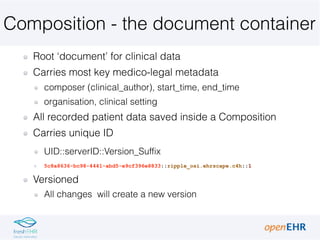
Composition - the document container
Root ‘document’ for clinical data
Carries most key medico-legal metadata
composer (clinical_author), start_time, end_time
organisation, clinical setting
All recorded patient data saved inside a Composition
Carries unique ID
UID::serverID::Version_Suffix
5c8a8636-bc98-4441-abd5-e9cf396e8833::ripple_osi.ehrscape.c4h::1
Versioned
All changes will create a new version
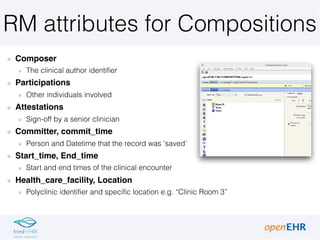
RM attributes for Compositions
Composer
The clinical author identifier
Participations
Other individuals involved
Attestations
Sign-off by a senior clinician
Committer, commit_time
Person and Datetime that the record was ‘saved’
Start_time, End_time
Start and end times of the clinical encounter
Health_care_facility, Location
Polyclinic identifier and specific location e.g. “Clinic Room 3”
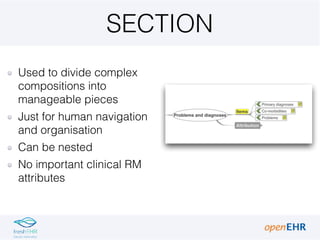
SECTION
Used to divide complex
compositions into
manageable pieces
Just for human navigation
and organisation
Can be nested
No important clinical RM
attributes
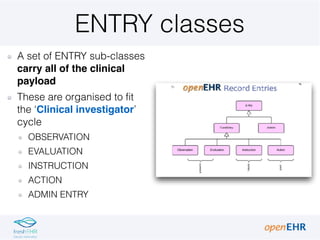
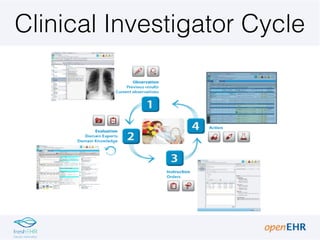
ENTRY classes
A set of ENTRY sub-classes
carry all of the clinical
payload
These are organised to fit
the ‘Clinical investigator’
cycle
OBSERVATION
EVALUATION
INSTRUCTION
ACTION
ADMIN ENTRY
Clinical Investigator Cycle
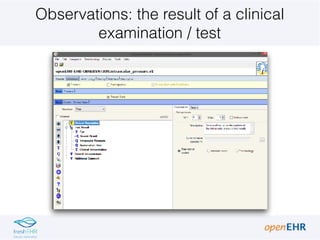
Observations: the result of a clinical
examination / test
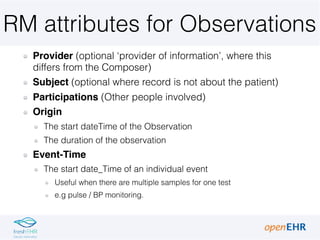
RM attributes for Observations
Provider (optional ‘provider of information’, where this
differs from the Composer)
Subject (optional where record is not about the patient)
Participations (Other people involved)
Origin
The start dateTime of the Observation
The duration of the observation
Event-Time
The start date_Time of an individual event
Useful when there are multiple samples for one test
e.g pulse / BP monitoring.
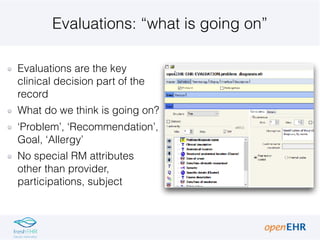
Evaluations: “what is going on”
Evaluations are the key
clinical decision part of the
record
What do we think is going on?
‘Problem’, ‘Recommendation’,
Goal, ‘Allergy’
No special RM attributes
other than provider,
participations, subject
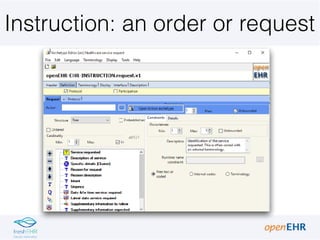
Instruction: an order or request
RM attributes for Instructions
Provider (optional ‘provider of information’, where this
differs from the Composer)
Subject (optional where record is not about the patient)
Participations (Other people involved)
Activities
allows multiple chained ‘sub-instructions’
Narrative (mandatory safety feature)
needed in data, to ensure a complex instruction can always be
dropped back to simple narrative
Timing
Complex timing schedule for the whole instruction (rarely used)
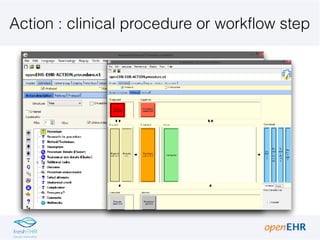
Action : clinical procedure or workflow step
RM attributes for Actions
Provider (optional ‘provider of information’, where
this differs from the Composer)
Participations (Other people involved)
e.g. Operating assistant
Time (the date and time that the action was
performed)
e.g. date of a procedure or a prescription
Current_status and careflow_step
the workflow status of the Action
e.g. planned, in-progress, completed, cancelled
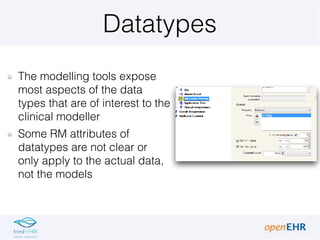
Datatypes
The modelling tools expose
most aspects of the data
types that are of interest to the
clinical modeller
Some RM attributes of
datatypes are not clear or
only apply to the actual data,
not the models
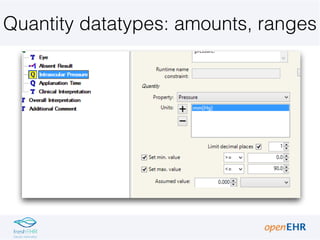
Quantity datatypes: amounts, ranges
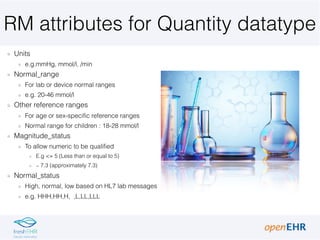
RM attributes for Quantity datatype
Units
e.g.mmHg, mmol/l, /min
Normal_range
For lab or device normal ranges
e.g. 20-46 mmol/l
Other reference ranges
For age or sex-specific reference ranges
Normal range for children : 18-28 mmol/l
Magnitude_status
To allow numeric to be qualified
E.g <= 5 (Less than or equal to 5)
∼ 7.3 (approximately 7.3)
Normal_status
High, normal, low based on HL7 lab messages
e.g. HHH,HH,H, ,L,LL,LLL
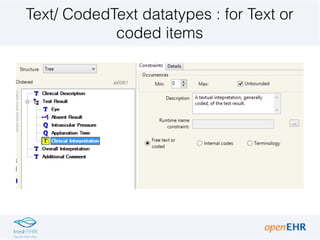
Text/ CodedText datatypes : for Text or
coded items
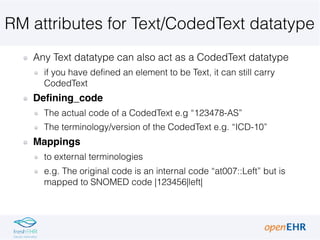
RM attributes for Text/CodedText datatype
Any Text datatype can also act as a CodedText datatype
if you have defined an element to be Text, it can still carry
CodedText
Defining_code
The actual code of a CodedText e.g “123478-AS”
The terminology/version of the CodedText e.g. “ICD-10”
Mappings
to external terminologies
e.g. The original code is an internal code “at007::Left” but is
mapped to SNOMED code |123456|left|

Other datatypes
Duration : 1 day , 3 minute, including ages
Boolean: True/ False
Proportion: 83%
Ordinal: 3: Moderate
Multimedia: Image, Sound
Identifier: NHSNumber
Parsable Text: XML, JSON
URI : Web-type links
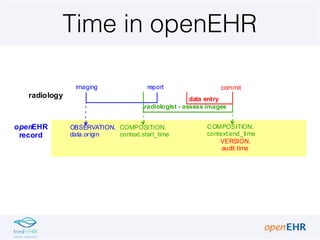
Time in openEHR
radiologist - assess images
data entry
commitimaging report
radiology
OBSERVATION.
data.origin
COMPOSITION.
context.start_time
COMPOSITION.
context.end_time
VERSION.
audit.time
openEHR
record
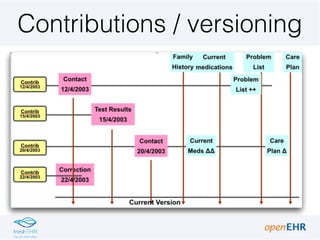
Contributions / versioning
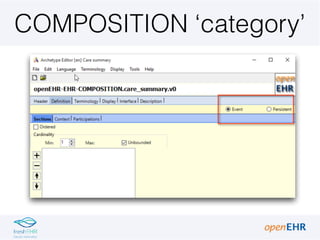
COMPOSITION ‘category’
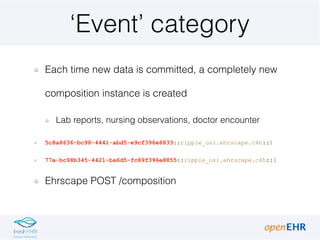
‘Event’ category
Each time new data is committed, a completely new
composition instance is created
Lab reports, nursing observations, doctor encounter
5c8a8636-bc98-4441-abd5-e9cf396e8833::ripple_osi.ehrscape.c4h::1
77a-bc98b345-4421-ba6d5-fc89f396e8855::ripple_osi.ehrscape.c4h::1
Ehrscape POST /composition
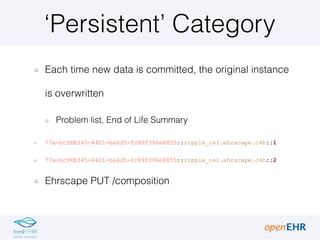
‘Persistent’ Category
Each time new data is committed, the original instance
is overwritten
Problem list, End of Life Summary
77a-bc98b345-4421-ba6d5-fc89f396e8855::ripple_osi.ehrscape.c4h::1
77a-bc98b345-4421-ba6d5-fc89f396e8855::ripple_osi.ehrscape.c4h::2
Ehrscape PUT /composition
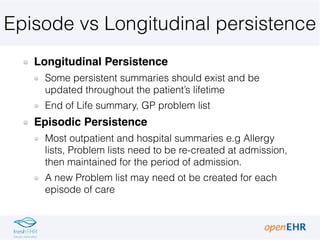
Episode vs Longitudinal persistence
Longitudinal Persistence
Some persistent summaries should exist and be
updated throughout the patient’s lifetime
End of Life summary, GP problem list
Episodic Persistence
Most outpatient and hospital summaries e.g Allergy
lists, Problem lists need to be re-created at admission,
then maintained for the period of admission.
A new Problem list may need ot be created for each
episode of care
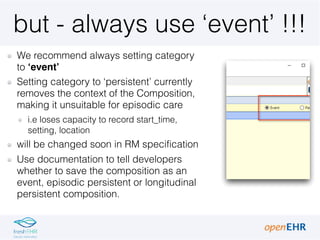
but - always use ‘event’ !!!
We recommend always setting category
to ‘event’
Setting category to ‘persistent’ currently
removes the context of the Composition,
making it unsuitable for episodic care
i.e loses capacity to record start_time,
setting, location
will be changed soon in RM specification
Use documentation to tell developers
whether to save the composition as an
event, episodic persistent or longitudinal
persistent composition.
Links
Most of the relationships between different Entries
and Elements is defined in archetypes and
templates, generally in the same Composition
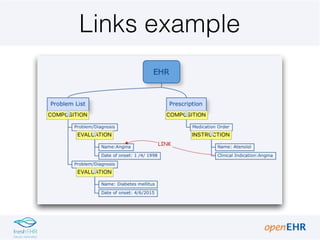
Links allow the system developer to connect
different Entries which do not have a ‘pre-cooked’
association, and where the Entries live in different
Compositions
Links example
Other stuff
Demographics
Extract model
Audit
Attestation
2 7 open_ehr rm reference model overview

2 7 open_ehr rm reference model overview

  • 1.
    Ian McNicoll Introduction toopenEHR Reference Model (RM)
  • 2.
    openEHR RM for‘mortals’ The clinical modelling tools hide most of the Reference Model and detailed understanding is not required for clinicians or 3rd party developers Some aspects of the RM are worth knowing as it carries a few key pieces of information that do not need to be modelled in archetypes i.e we get those ‘for free’
  • 3.
    Technical modelling basics Afew basic ideas from the world of technical modelling will help BUT .. the whole point of openEHR and archetypes is to hide most of this complexity
  • 4.
    Classes ‘Classes’ are definitionsof data structures the ‘assembly instructions’ or ‘recipe’ Classes have attributes (properties)
  • 5.
    Datatypes Datatypes describe thebasic type of information being carried a piece of text a quantity a date or time duration an image etc, etc
  • 6.
    Inheritance Classes can basedon other ‘parent’ classes called inheritance or ‘sub- classing’ the sub-classes ‘inherit’ all the properties or attributes of the parent Dog is a sub-class of Animal ‘Labrador' is a sub-class of ‘Dog’ If ‘Dog’ has an attribute of ‘tail’, The Labrador class will also have ‘Tail’
  • 7.
  • 8.
    Objects Objects carry thedata specified by the classes Classes are ‘the recipe’ Objects are ‘the cake’
  • 9.
    What does theRM cover? Set of classes defining the generic structure of a patient health record Medico-legal context + audit details Health data versioning specification Handling archetypes data via paths ‘LOCATABLE class Datatype definitions
  • 10.
    Archetypes and theRM Archetypes are built on top of the RM classes and ‘inherit’ their attributes e.g. An Observation archetype such as Blood pressure inherits the attributes of the RM OBSERVATION class Archetypes use the RM datatypes Most of these properties are technical but some are important to clinical modellers
  • 11.
    Clinical records overview PabloPazos: Design and Implementation of clinical database using openEHR http://www.slideshare.net/pablitox/design-and-implementation-of-clinical-databases-using-openehr?related=3
  • 12.
    Outline of ahealth record The openEHR health record is a tree-like structure The root for a single patient is the EHR All of the patient data is contained in COMPOSITIONS At the end of each branch of the tree is a leaf node - the actual datapoint, the ELEMENT which carries the value http://www.slideshare.net/pablitox/design-and-implementation-of- clinical-databases-using-openehr?related=3
  • 13.
    Archetypes are basedon RM ‘classes’ EHR Folders Compositions Sections Entries Clusters Elements Electronic health record for one person High level organisation of the EHR, e.g. by episode or by specialty Set of entries comprising a clinical care session or document, e.g. encounter, result Clinical headings reflecting workflow or consultation process Clinical statements about observations, evaluations, instructions, actions Entry subcomponents, e.g. device details or inspired oxygen information Leaf nodes of name-value pair and datatype, e.g. body weight = 60kg (Quantity)
  • 14.
    Key openEHR Classes EHR FOLDER(optional) COMPOSITION SECTION (optional) ENTRY ELEMENT ELEMENT ENTRY ELEMENT ELEMENT ENTRY ELEMENT ELEMENT ELEMENT ELEMENT CLUSTER ELEMENT SECTION (optional)
  • 15.
    openEHR data objects EHR COMPOSITION= ‘Nursing Observations SECTION Vital signs ENTRY Blood P. Systolic Diastolic ENTRY Pulse Rate Rhythm General appearance Skin colour Behaviour Skin turgor Capillary Return Hydration SECTION = ‘Other obs’ ehr_id = 5c8a8636-bc98-4441-abd5-e9cf396e8833 134 mmHg 86 mmHg 134 mmHg Irregular Jaundiced Normal Reduced 30s
  • 16.
    EHR Top-level container forall of the data for a single patient Each EHR has a unique, anonymous ID the ehr_id This needs to be associated with a real-world identifier e.g NHS Number to allow the patient to be identified
  • 17.
    Composition - thedocument container Root ‘document’ for clinical data Carries most key medico-legal metadata composer (clinical_author), start_time, end_time organisation, clinical setting All recorded patient data saved inside a Composition Carries unique ID UID::serverID::Version_Suffix 5c8a8636-bc98-4441-abd5-e9cf396e8833::ripple_osi.ehrscape.c4h::1 Versioned All changes will create a new version
  • 18.
    RM attributes forCompositions Composer The clinical author identifier Participations Other individuals involved Attestations Sign-off by a senior clinician Committer, commit_time Person and Datetime that the record was ‘saved’ Start_time, End_time Start and end times of the clinical encounter Health_care_facility, Location Polyclinic identifier and specific location e.g. “Clinic Room 3”
  • 19.
    SECTION Used to dividecomplex compositions into manageable pieces Just for human navigation and organisation Can be nested No important clinical RM attributes
  • 20.
    ENTRY classes A setof ENTRY sub-classes carry all of the clinical payload These are organised to fit the ‘Clinical investigator’ cycle OBSERVATION EVALUATION INSTRUCTION ACTION ADMIN ENTRY
  • 21.
  • 22.
    Observations: the resultof a clinical examination / test
  • 23.
    RM attributes forObservations Provider (optional ‘provider of information’, where this differs from the Composer) Subject (optional where record is not about the patient) Participations (Other people involved) Origin The start dateTime of the Observation The duration of the observation Event-Time The start date_Time of an individual event Useful when there are multiple samples for one test e.g pulse / BP monitoring.
  • 24.
    Evaluations: “what isgoing on” Evaluations are the key clinical decision part of the record What do we think is going on? ‘Problem’, ‘Recommendation’, Goal, ‘Allergy’ No special RM attributes other than provider, participations, subject
  • 25.
  • 26.
    RM attributes forInstructions Provider (optional ‘provider of information’, where this differs from the Composer) Subject (optional where record is not about the patient) Participations (Other people involved) Activities allows multiple chained ‘sub-instructions’ Narrative (mandatory safety feature) needed in data, to ensure a complex instruction can always be dropped back to simple narrative Timing Complex timing schedule for the whole instruction (rarely used)
  • 27.
    Action : clinicalprocedure or workflow step
  • 28.
    RM attributes forActions Provider (optional ‘provider of information’, where this differs from the Composer) Participations (Other people involved) e.g. Operating assistant Time (the date and time that the action was performed) e.g. date of a procedure or a prescription Current_status and careflow_step the workflow status of the Action e.g. planned, in-progress, completed, cancelled
  • 29.
    Datatypes The modelling toolsexpose most aspects of the data types that are of interest to the clinical modeller Some RM attributes of datatypes are not clear or only apply to the actual data, not the models
  • 30.
  • 31.
    RM attributes forQuantity datatype Units e.g.mmHg, mmol/l, /min Normal_range For lab or device normal ranges e.g. 20-46 mmol/l Other reference ranges For age or sex-specific reference ranges Normal range for children : 18-28 mmol/l Magnitude_status To allow numeric to be qualified E.g <= 5 (Less than or equal to 5) ∼ 7.3 (approximately 7.3) Normal_status High, normal, low based on HL7 lab messages e.g. HHH,HH,H, ,L,LL,LLL
  • 32.
    Text/ CodedText datatypes: for Text or coded items
  • 33.
    RM attributes forText/CodedText datatype Any Text datatype can also act as a CodedText datatype if you have defined an element to be Text, it can still carry CodedText Defining_code The actual code of a CodedText e.g “123478-AS” The terminology/version of the CodedText e.g. “ICD-10” Mappings to external terminologies e.g. The original code is an internal code “at007::Left” but is mapped to SNOMED code |123456|left|

  • 34.
    Other datatypes Duration :1 day , 3 minute, including ages Boolean: True/ False Proportion: 83% Ordinal: 3: Moderate Multimedia: Image, Sound Identifier: NHSNumber Parsable Text: XML, JSON URI : Web-type links
  • 35.
    Time in openEHR radiologist- assess images data entry commitimaging report radiology OBSERVATION. data.origin COMPOSITION. context.start_time COMPOSITION. context.end_time VERSION. audit.time openEHR record
  • 36.
  • 37.
  • 38.
    ‘Event’ category Each timenew data is committed, a completely new composition instance is created Lab reports, nursing observations, doctor encounter 5c8a8636-bc98-4441-abd5-e9cf396e8833::ripple_osi.ehrscape.c4h::1 77a-bc98b345-4421-ba6d5-fc89f396e8855::ripple_osi.ehrscape.c4h::1 Ehrscape POST /composition
  • 39.
    ‘Persistent’ Category Each timenew data is committed, the original instance is overwritten Problem list, End of Life Summary 77a-bc98b345-4421-ba6d5-fc89f396e8855::ripple_osi.ehrscape.c4h::1 77a-bc98b345-4421-ba6d5-fc89f396e8855::ripple_osi.ehrscape.c4h::2 Ehrscape PUT /composition
  • 40.
    Episode vs Longitudinalpersistence Longitudinal Persistence Some persistent summaries should exist and be updated throughout the patient’s lifetime End of Life summary, GP problem list Episodic Persistence Most outpatient and hospital summaries e.g Allergy lists, Problem lists need to be re-created at admission, then maintained for the period of admission. A new Problem list may need ot be created for each episode of care
  • 41.
    but - alwaysuse ‘event’ !!! We recommend always setting category to ‘event’ Setting category to ‘persistent’ currently removes the context of the Composition, making it unsuitable for episodic care i.e loses capacity to record start_time, setting, location will be changed soon in RM specification Use documentation to tell developers whether to save the composition as an event, episodic persistent or longitudinal persistent composition.
  • 42.
    Links Most of therelationships between different Entries and Elements is defined in archetypes and templates, generally in the same Composition Links allow the system developer to connect different Entries which do not have a ‘pre-cooked’ association, and where the Entries live in different Compositions
  • 43.
  • 44.