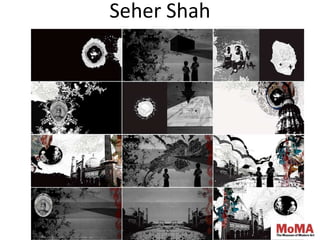
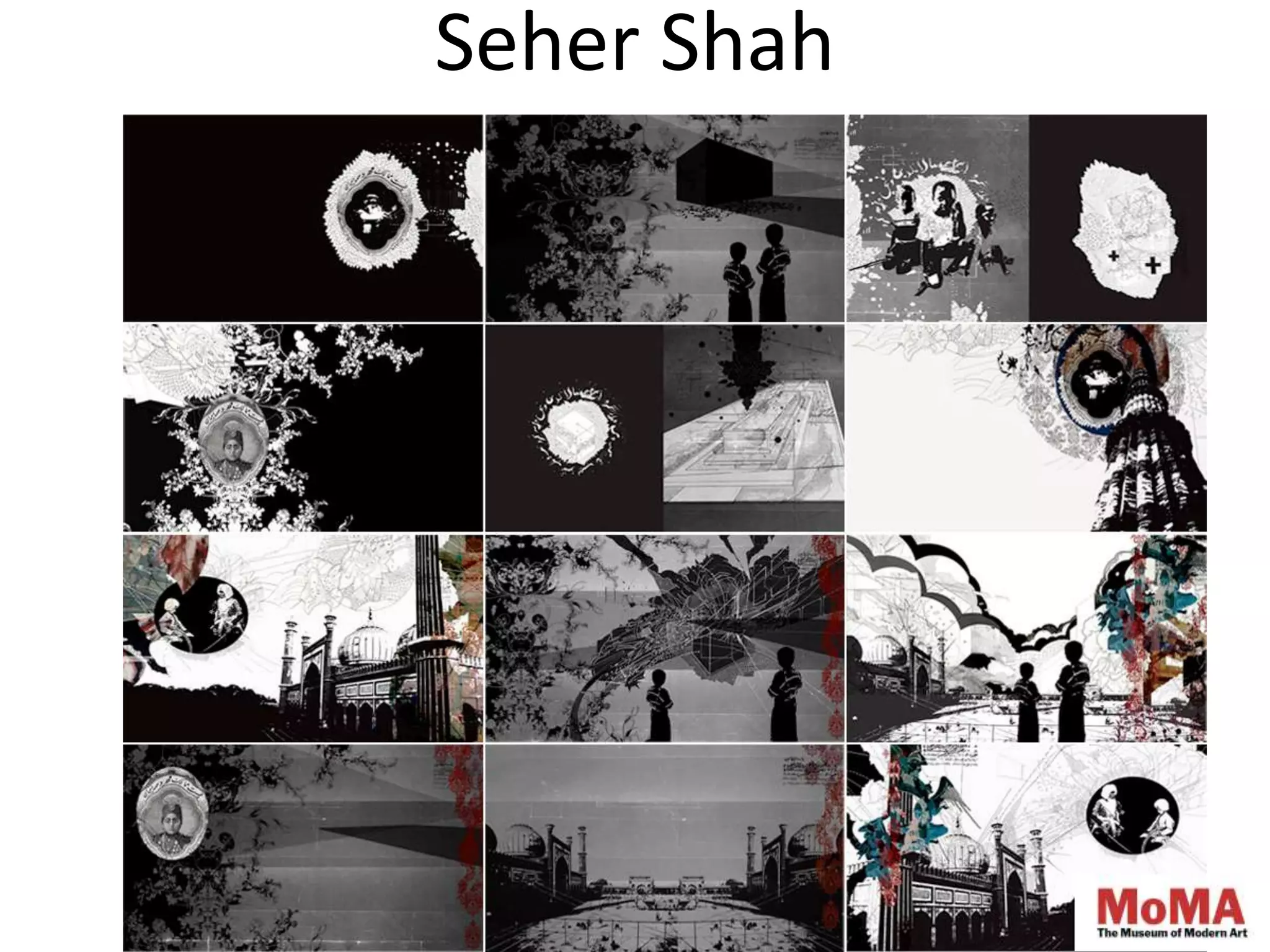
Seher Shah
How is Power related to Architectural
Spaces?
• Brianna: Over time, new buildings have gotten classier…they
look more modern, nice. That smooth and sharp design
conveys a sense that you have to have $$$ to live there.
• Taeron: The bigger the castle/temple, the more power you
have. Like the Hagia Sofia (in Istanbul).
• Joie: People tend to furnish their homes with plants and fancy
stuff, if you have those plants mounted on the outside, it
conveys a sense of wealth and power….because they can afford
someone to maintain it.
• Kenny: Size and MATERIAL of building conveys a sense of
power and dominance.
• Kai: So if you see a OLDER building…does that mean it can’t be
related to wealth/power or Opulence
How is Power related to Architectural
Spaces?
• Arvin: “Pretty” architecture shows off like it has power and
money (trump hotel). You can tell by the design.
– Zenzeee: When a building has bigger windows, bigger beds,
special buttons that do cool things (amenities)
– Nyle: this relates to arguments about gentrification…there’s a fear
of things changing/renovating…because if something “looks
fancy” there’s a concern that you can’t afford it.
– Ardi: This is kinda like our school compared to others in our
building. We got a ceiling design, filtered water, etc.
• Jakara: Looks can be deceiving…just because it looks fancy or
powerful doesn’t mean it actually is. Salt and sugar are
DIFFERENT!
• Justin: Ancient Greeks using ionic columns to convey power.
– Kozak: This is scene in Classical revival arch in America. Also
obelisks from ancient Egypt.
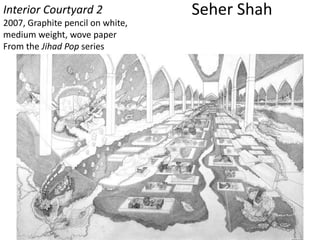
Seher ShahInterior Courtyard 2
2007, Graphite pencil on white,
medium weight, wove paper
From the Jihad Pop series
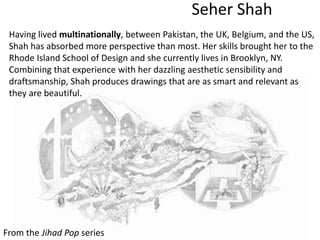
Seher Shah
From the Jihad Pop series
Having lived multinationally, between Pakistan, the UK, Belgium, and the US,
Shah has absorbed more perspective than most. Her skills brought her to the
Rhode Island School of Design and she currently lives in Brooklyn, NY.
Combining that experience with her dazzling aesthetic sensibility and
draftsmanship, Shah produces drawings that are as smart and relevant as
they are beautiful.
Seher Shah
Jean: Seems very meticulous, thinking about different pressures of
the graphite she uses.
Joie: She doesn’t know exactly where certain things will go in
drawings, but she ‘moves’ with the work.
Kevin: She knows DA’ limit of how much she can put into her
work before she needs to take a break.
-Tots: it’s almost like her designs could get a bit
repetitive…and she needs to refresh.
Rasha: at First, I thought her artwork would be strictly digital…but
it’s crazy to see that she’s DRAWING this type of meticulous work.
Ruhith: Everything she makes seems pre-meditated, it’s mapped out
in her head. Sitting on top of the paper, she’s able to really BE in the
work.
JOIE 2: JUST GOTTA ADD ON: I’m not sure if she thinks her work is
going to get repetitive, but she doesn’t want to get lost in the same
idea…but to have some variety in her work.
Seher Shah
Ardi: She seems chilled out about her work. The work is complex
and classy.
Richard: She sounds like a narrator
Raph: Her voice portrays her art in a way…her work doesn’t
have color…just black, gray, white.
Zenzee: I disagree…she seems quite relaxed…but she doesn’t
have a specific plan, she works on her art based on her body and
emotions as she’s sitting on the paper.
Arvin: Just using blacks and whites (and grays!) shows a lot of
contrast.her work shows some kind of story.
-kozak: It shows a TREMENDOUS amount of restraint and
discipline as an artist to use such colors.
Guzzy: She focuses on the simplicity…the lack of color shows
her as an artist, as an observer of the world.
Jakara:”she wants to have a new set of eyes when she looks at
things”
Seher Shah
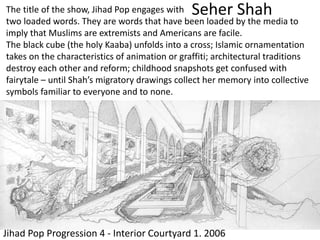
Jihad Pop Progression 4 - Interior Courtyard 1. 2006
The title of the show, Jihad Pop engages with
two loaded words. They are words that have been loaded by the media to
imply that Muslims are extremists and Americans are facile.
The black cube (the holy Kaaba) unfolds into a cross; Islamic ornamentation
takes on the characteristics of animation or graffiti; architectural traditions
destroy each other and reform; childhood snapshots get confused with
fairytale – until Shah’s migratory drawings collect her memory into collective
symbols familiar to everyone and to none.
Seher Shah
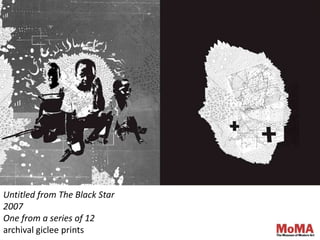
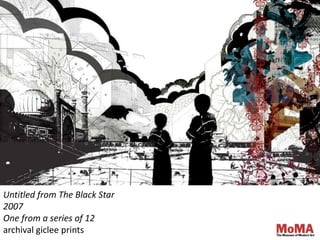
Untitled from The Black Star
2007
One from a series of 12
archival giclee prints
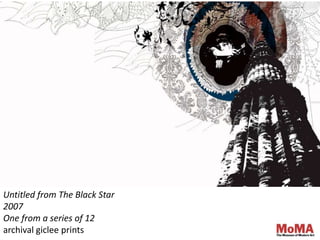
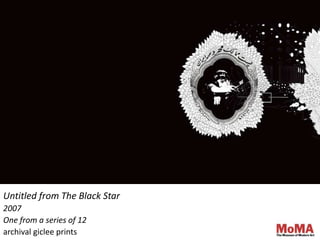
Untitled from The Black Star
2007
One from a series of 12
archival giclee prints
Seher Shah
Seher Shah
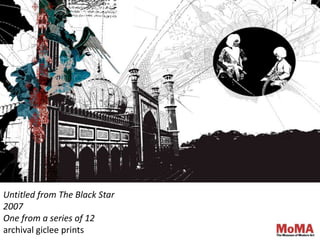
Untitled from The Black Star
2007
One from a series of 12
archival giclee prints
Seher Shah
Untitled from The Black Star
2007
One from a series of 12
archival giclee prints
Seher Shah
Untitled from The Black Star
2007
One from a series of 12
archival giclee prints
Seher Shah
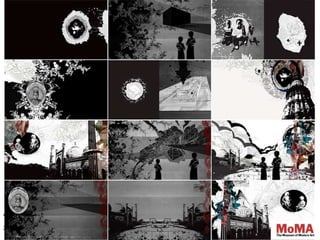
The Black Star
2007
series of 12
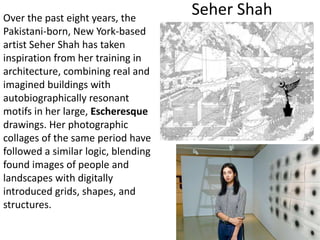
Seher ShahOver the past eight years, the
Pakistani-born, New York-based
artist Seher Shah has taken
inspiration from her training in
architecture, combining real and
imagined buildings with
autobiographically resonant
motifs in her large, Escheresque
drawings. Her photographic
collages of the same period have
followed a similar logic, blending
found images of people and
landscapes with digitally
introduced grids, shapes, and
structures.
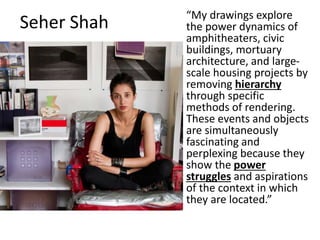
Seher Shah “My drawings explore
the power dynamics of
amphitheaters, civic
buildings, mortuary
architecture, and large-
scale housing projects by
removing hierarchy
through specific
methods of rendering.
These events and objects
are simultaneously
fascinating and
perplexing because they
show the power
struggles and aspirations
of the context in which
they are located.”
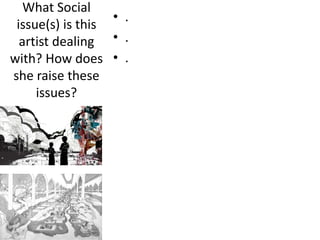
What Social
issue(s) is this
artist dealing
with? How does
she raise these
issues?
• .
• .
• .
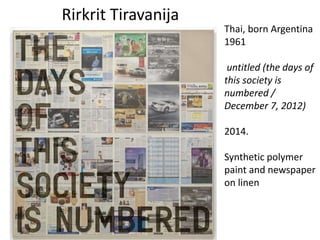
Rirkrit Tiravanija
Thai, born Argentina
1961
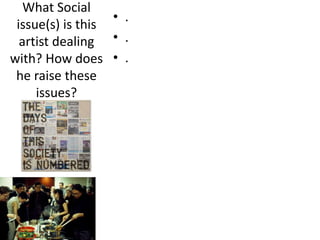
untitled (the days of
this society is
numbered /
December 7, 2012)
2014.
Synthetic polymer
paint and newspaper
on linen
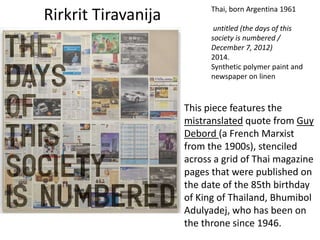
Rirkrit Tiravanija Thai, born Argentina 1961
untitled (the days of this
society is numbered /
December 7, 2012)
2014.
Synthetic polymer paint and
newspaper on linen
This piece features the
mistranslated quote from Guy
Debord (a French Marxist
from the 1900s), stenciled
across a grid of Thai magazine
pages that were published on
the date of the 85th birthday
of King of Thailand, Bhumibol
Adulyadej, who has been on
the throne since 1946.
Rirkrit Tiravanija
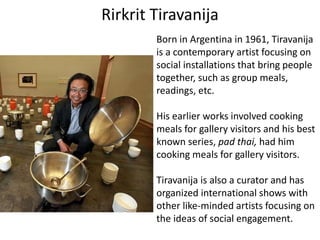
Born in Argentina in 1961, Tiravanija
is a contemporary artist focusing on
social installations that bring people
together, such as group meals,
readings, etc.
His earlier works involved cooking
meals for gallery visitors and his best
known series, pad thai, had him
cooking meals for gallery visitors.
Tiravanija is also a curator and has
organized international shows with
other like-minded artists focusing on
the ideas of social engagement.
Rirkrit
Tiravanija
Demonstration
Drawings
2009
Rirkrit Tiravanija
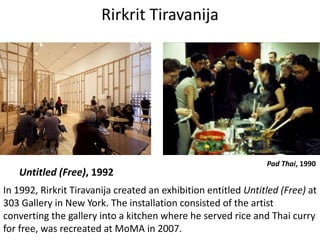
Untitled (Free), 1992
In 1992, Rirkrit Tiravanija created an exhibition entitled Untitled (Free) at
303 Gallery in New York. The installation consisted of the artist
converting the gallery into a kitchen where he served rice and Thai curry
for free, was recreated at MoMA in 2007.
Pad Thai, 1990
Rirkrit Tiravanija
”[with my art] It
is not what you
see that is
important but
what takes
place between
people.”
What Social
issue(s) is this
artist dealing
with? How does
he raise these
issues?
• .
• .
• .
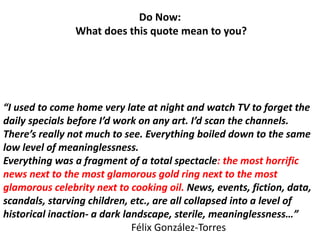
“I used to come home very late at night and watch TV to forget the
daily specials before I’d work on any art. I’d scan the channels.
There’s really not much to see. Everything boiled down to the same
low level of meaninglessness.
Everything was a fragment of a total spectacle: the most horrific
news next to the most glamorous gold ring next to the most
glamorous celebrity next to cooking oil. News, events, fiction, data,
scandals, starving children, etc., are all collapsed into a level of
historical inaction- a dark landscape, sterile, meaninglessness…”
Félix González-Torres
Do Now:
What does this quote mean to you?

MoMA THREE: Scenes for a New Heritage

  • 1.
  • 2.
    How is Powerrelated to Architectural Spaces? • Brianna: Over time, new buildings have gotten classier…they look more modern, nice. That smooth and sharp design conveys a sense that you have to have $$$ to live there. • Taeron: The bigger the castle/temple, the more power you have. Like the Hagia Sofia (in Istanbul). • Joie: People tend to furnish their homes with plants and fancy stuff, if you have those plants mounted on the outside, it conveys a sense of wealth and power….because they can afford someone to maintain it. • Kenny: Size and MATERIAL of building conveys a sense of power and dominance. • Kai: So if you see a OLDER building…does that mean it can’t be related to wealth/power or Opulence
  • 3.
    How is Powerrelated to Architectural Spaces? • Arvin: “Pretty” architecture shows off like it has power and money (trump hotel). You can tell by the design. – Zenzeee: When a building has bigger windows, bigger beds, special buttons that do cool things (amenities) – Nyle: this relates to arguments about gentrification…there’s a fear of things changing/renovating…because if something “looks fancy” there’s a concern that you can’t afford it. – Ardi: This is kinda like our school compared to others in our building. We got a ceiling design, filtered water, etc. • Jakara: Looks can be deceiving…just because it looks fancy or powerful doesn’t mean it actually is. Salt and sugar are DIFFERENT! • Justin: Ancient Greeks using ionic columns to convey power. – Kozak: This is scene in Classical revival arch in America. Also obelisks from ancient Egypt.
  • 4.
    Seher ShahInterior Courtyard2 2007, Graphite pencil on white, medium weight, wove paper From the Jihad Pop series
  • 5.
    Seher Shah From theJihad Pop series Having lived multinationally, between Pakistan, the UK, Belgium, and the US, Shah has absorbed more perspective than most. Her skills brought her to the Rhode Island School of Design and she currently lives in Brooklyn, NY. Combining that experience with her dazzling aesthetic sensibility and draftsmanship, Shah produces drawings that are as smart and relevant as they are beautiful.
  • 6.
    Seher Shah Jean: Seemsvery meticulous, thinking about different pressures of the graphite she uses. Joie: She doesn’t know exactly where certain things will go in drawings, but she ‘moves’ with the work. Kevin: She knows DA’ limit of how much she can put into her work before she needs to take a break. -Tots: it’s almost like her designs could get a bit repetitive…and she needs to refresh. Rasha: at First, I thought her artwork would be strictly digital…but it’s crazy to see that she’s DRAWING this type of meticulous work. Ruhith: Everything she makes seems pre-meditated, it’s mapped out in her head. Sitting on top of the paper, she’s able to really BE in the work. JOIE 2: JUST GOTTA ADD ON: I’m not sure if she thinks her work is going to get repetitive, but she doesn’t want to get lost in the same idea…but to have some variety in her work.
  • 7.
    Seher Shah Ardi: Sheseems chilled out about her work. The work is complex and classy. Richard: She sounds like a narrator Raph: Her voice portrays her art in a way…her work doesn’t have color…just black, gray, white. Zenzee: I disagree…she seems quite relaxed…but she doesn’t have a specific plan, she works on her art based on her body and emotions as she’s sitting on the paper. Arvin: Just using blacks and whites (and grays!) shows a lot of contrast.her work shows some kind of story. -kozak: It shows a TREMENDOUS amount of restraint and discipline as an artist to use such colors. Guzzy: She focuses on the simplicity…the lack of color shows her as an artist, as an observer of the world. Jakara:”she wants to have a new set of eyes when she looks at things”
  • 8.
    Seher Shah Jihad PopProgression 4 - Interior Courtyard 1. 2006 The title of the show, Jihad Pop engages with two loaded words. They are words that have been loaded by the media to imply that Muslims are extremists and Americans are facile. The black cube (the holy Kaaba) unfolds into a cross; Islamic ornamentation takes on the characteristics of animation or graffiti; architectural traditions destroy each other and reform; childhood snapshots get confused with fairytale – until Shah’s migratory drawings collect her memory into collective symbols familiar to everyone and to none.
  • 9.
    Seher Shah Untitled fromThe Black Star 2007 One from a series of 12 archival giclee prints
  • 10.
    Untitled from TheBlack Star 2007 One from a series of 12 archival giclee prints Seher Shah
  • 11.
    Seher Shah Untitled fromThe Black Star 2007 One from a series of 12 archival giclee prints
  • 12.
    Seher Shah Untitled fromThe Black Star 2007 One from a series of 12 archival giclee prints
  • 13.
    Seher Shah Untitled fromThe Black Star 2007 One from a series of 12 archival giclee prints
  • 14.
    Seher Shah The BlackStar 2007 series of 12
  • 15.
    Seher ShahOver thepast eight years, the Pakistani-born, New York-based artist Seher Shah has taken inspiration from her training in architecture, combining real and imagined buildings with autobiographically resonant motifs in her large, Escheresque drawings. Her photographic collages of the same period have followed a similar logic, blending found images of people and landscapes with digitally introduced grids, shapes, and structures.
  • 16.
    Seher Shah “Mydrawings explore the power dynamics of amphitheaters, civic buildings, mortuary architecture, and large- scale housing projects by removing hierarchy through specific methods of rendering. These events and objects are simultaneously fascinating and perplexing because they show the power struggles and aspirations of the context in which they are located.”
  • 17.
    What Social issue(s) isthis artist dealing with? How does she raise these issues? • . • . • .
  • 18.
    Rirkrit Tiravanija Thai, bornArgentina 1961 untitled (the days of this society is numbered / December 7, 2012) 2014. Synthetic polymer paint and newspaper on linen
  • 19.
    Rirkrit Tiravanija Thai,born Argentina 1961 untitled (the days of this society is numbered / December 7, 2012) 2014. Synthetic polymer paint and newspaper on linen This piece features the mistranslated quote from Guy Debord (a French Marxist from the 1900s), stenciled across a grid of Thai magazine pages that were published on the date of the 85th birthday of King of Thailand, Bhumibol Adulyadej, who has been on the throne since 1946.
  • 20.
    Rirkrit Tiravanija Born inArgentina in 1961, Tiravanija is a contemporary artist focusing on social installations that bring people together, such as group meals, readings, etc. His earlier works involved cooking meals for gallery visitors and his best known series, pad thai, had him cooking meals for gallery visitors. Tiravanija is also a curator and has organized international shows with other like-minded artists focusing on the ideas of social engagement.
  • 21.
  • 22.
    Rirkrit Tiravanija Untitled (Free),1992 In 1992, Rirkrit Tiravanija created an exhibition entitled Untitled (Free) at 303 Gallery in New York. The installation consisted of the artist converting the gallery into a kitchen where he served rice and Thai curry for free, was recreated at MoMA in 2007. Pad Thai, 1990
  • 23.
    Rirkrit Tiravanija ”[with myart] It is not what you see that is important but what takes place between people.”
  • 24.
    What Social issue(s) isthis artist dealing with? How does he raise these issues? • . • . • .
  • 26.
    “I used tocome home very late at night and watch TV to forget the daily specials before I’d work on any art. I’d scan the channels. There’s really not much to see. Everything boiled down to the same low level of meaninglessness. Everything was a fragment of a total spectacle: the most horrific news next to the most glamorous gold ring next to the most glamorous celebrity next to cooking oil. News, events, fiction, data, scandals, starving children, etc., are all collapsed into a level of historical inaction- a dark landscape, sterile, meaninglessness…” Félix González-Torres Do Now: What does this quote mean to you?

Editor's Notes

  • #5 https://dl.dropboxusercontent.com/u/17872451/Jhaveri%20Contemporary_%20artforum_shah_2014.pdf http://www.livemint.com/Leisure/hhNYcmgfof3e78MD47KExJ/Falling-in-line.html
  • #6 http://www.momentaart.org/momenta-art-seher-shah.html
  • #7 http://www.momentaart.org/momenta-art-seher-shah.html
  • #8 http://www.momentaart.org/momenta-art-seher-shah.html
  • #9 https://dl.dropboxusercontent.com/u/17872451/Jhaveri%20Contemporary_%20artforum_shah_2014.pdf http://www.livemint.com/Leisure/hhNYcmgfof3e78MD47KExJ/Falling-in-line.html
  • #16 https://dl.dropboxusercontent.com/u/17872451/Jhaveri%20Contemporary_%20artforum_shah_2014.pdf http://www.livemint.com/Leisure/hhNYcmgfof3e78MD47KExJ/Falling-in-line.html
  • #17 https://texasarchitects.org/v/article-detail/Seher-Shah-s-Constructed-Landscapes-/e6/